




Abstract
The aim of the present study is to disclose the forced convective heat transport phenomenon of nanofluids inside a horizontal circular tube subject to a constant and uniform heat flux at the wall. Consideration is given to the effect of the inclusion of nanoparticles on heat transfer enhancement, thermal conductivity, viscosity, and pressure loss in the turbulent flow region. It is found that (i) heat transfer enhancement is caused by suspending nanoparticles and becomes more pronounced with the increase of the particle volume fraction, (ii) its augmentation is affected by three different nanofluids employed here, and (iii) the presence of particles produces adverse effects on viscosity and pressure loss that also increases with the particle volume fraction.
1. Introduction
In general, the working fluid such as water, oil, and ethylene glycol is used for various industrial fields, namely, power generation and air conditioner. However, those fluids with low thermal conductivity suppress development of compact and higher-performance heat exchangers. Fluid including nanoparticles is referred to as nanofluid, which is a term proposed by Choi [1]. The term “nanofluid” refers to a two-phase mixture with its continuous phase being generally a liquid and the dispersed phase constituted of “nanoparticles,” that is, extremely fine metallic particles of size below 100 nm. In other words, the large surface-area-to-volume ratio also increases the stability of the suspensions. Thus, the nanofluid becomes a new promising heat transfer fluid in a variety of application cases. For example, the thermal properties of such a nanofluid appear to be well above those of the base-fluid and, particularly, the suspended nanoparticles remarkably increase the thermal conductivity of the mixture [2, 3] and improve its capability of energy exchange.
With the nanofluids as the coolant, Lee and Choi [4] proposed that the nanofluids dramatically enhance cooling rates of microchannel heat exchanger compared with the cases of conventional water and liquid-nitrogen coolant. Li and Xuan [5] studied experimentally convective heat transfer performances of nanofluids for laminar and turbulent flow inside a tube. They disclosed that a remarkable increase in heat transfer performances of nanofluids causes for the same Reynolds numbers. Heat transfer enhancement using copper nanoparticles is also proposed by Xuan and Roetzel [6]. Xuan and Li [7] measured convective heat transfer coefficient of Cu/water nanofluids from 0.3 in volume fraction to
Meanwhile, there are some inconsistent reports on nanofluid behavior in forced convection. For example, Pak and Cho [9] studied convective heat transfer performance in tube using nanofluids, that is,
Throughout the existing reports, Wang and Mujumdar [11] described that (i) the application of nanofluids for heat transfer enhancement should not be decided only by their effective thermal conductivity, and (ii) many other factors such as particle size, shape and distribution, microconvection, pH value, and the particle-fluid interactions should have important influence on the heat transfer performance of the nanofluids.
The purpose of this study is to disclose the thermal fluid flow transport phenomenon of nanofluid in a circular tube by measuring thermal conductivity, effective viscosity, the pressure drop, and the convective heat transfer performance for various concentrations of three different nanofluids. Here aqueous-based nanofluids containing diamond, alumina, and copper oxide, that is, diamond/water,
2. Experimental Apparatus and Measure Method
The nanoparticles used in this study are diamond, alumina (
Physical property of nanoparticles.

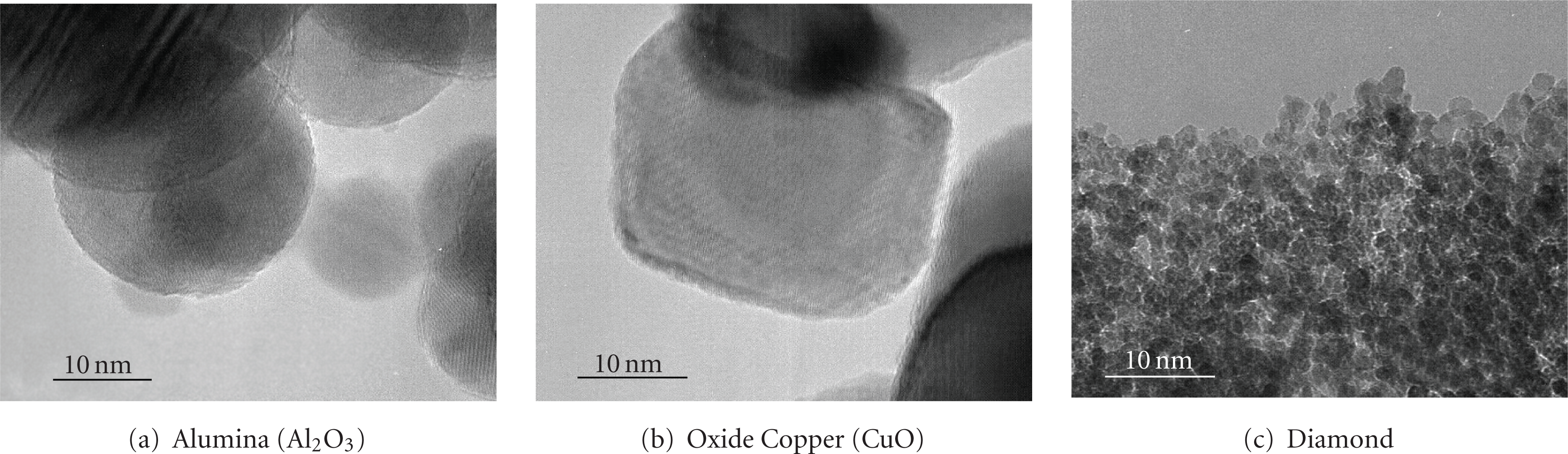
TEM images of three different nanoparticles.
Nanofluids at 1 vol.% of particle volume fraction after 60 days.

Zeta potential and average particle diameter in nanofluids for various volume fractions.

The effective thermal conductivity of nanofluids is measured with the aid of a KD2 thermal property meter (Labcell Ltd, UK), which is based on the transient hot wire method. Here the thermal conductivities of the nanofluids and base liquid (water) are measured at 293 K. The KD2 meter is calibrated using distilled water before any set of measurements.
The viscosity of nanofluids is measured with the use of a rotary viscometer (BROOKFIELD Co. DV-II+ProCP). The measurement is carried out at 293 K for the nanofluids of different concentrations and containing particles of three different materials. At least the viscosity for each nanofluid is measured three times and the mean value is applied as an effective viscosity of the nanofluid.
Figure 4 illustrates the experimental apparatus for measuring the convective heat transfer coefficient which consists of a closed flow loop, a heating unit, a cooling part, and a measuring and control unit. A straight stainless tube with 1000 mm in length, 3.96 mm in inner diameter, and 0.17 mm in thickness is employed as the test section and electrodes for the direct electric current heating are connected at both ends. The DC power supply (TOKYO SEIDEN CVS1-5 K) is employed and its voltage is adjustable with the aid of the voltmeter (YOKOGAWA 2011). The test tube is surrounded by a thick thermal insulation material to suppress heat loss from the test section. The six thermocouples (100 μm in diameter), which are welded on the outer surface of the test tube, are used to measure the local wall temperature along the heated surface of the tube, and the other thermocouples are inserted into the flow at the inlet (Tin) and outlet (Tout) of the test section to measure the bulk temperature of a working fluid. Here, axial positions are 150 mm, 290 mm, 430 mm, 570 mm, 710 mm, and 850 mm from the inlet of the test section, whose locations are named as T1, T2, T3, T4, T5, and T6, respectively. The working fluid in the test loop is circulated by a magnet pump (IWAKI MD-100 RM). Here the maximum flow rate that the pump can deliver is 8 L/minute and is measured by an electromagnetic flowmeter (KYENCE FD-81SO). The pressure loss between the inlet of the test section and the outlet is measured with the aid of the differential pressure instrument (NAGANO-KEIKI NR-250). Notice that the test loop is cleaned up between runs even with the same nanofluid.
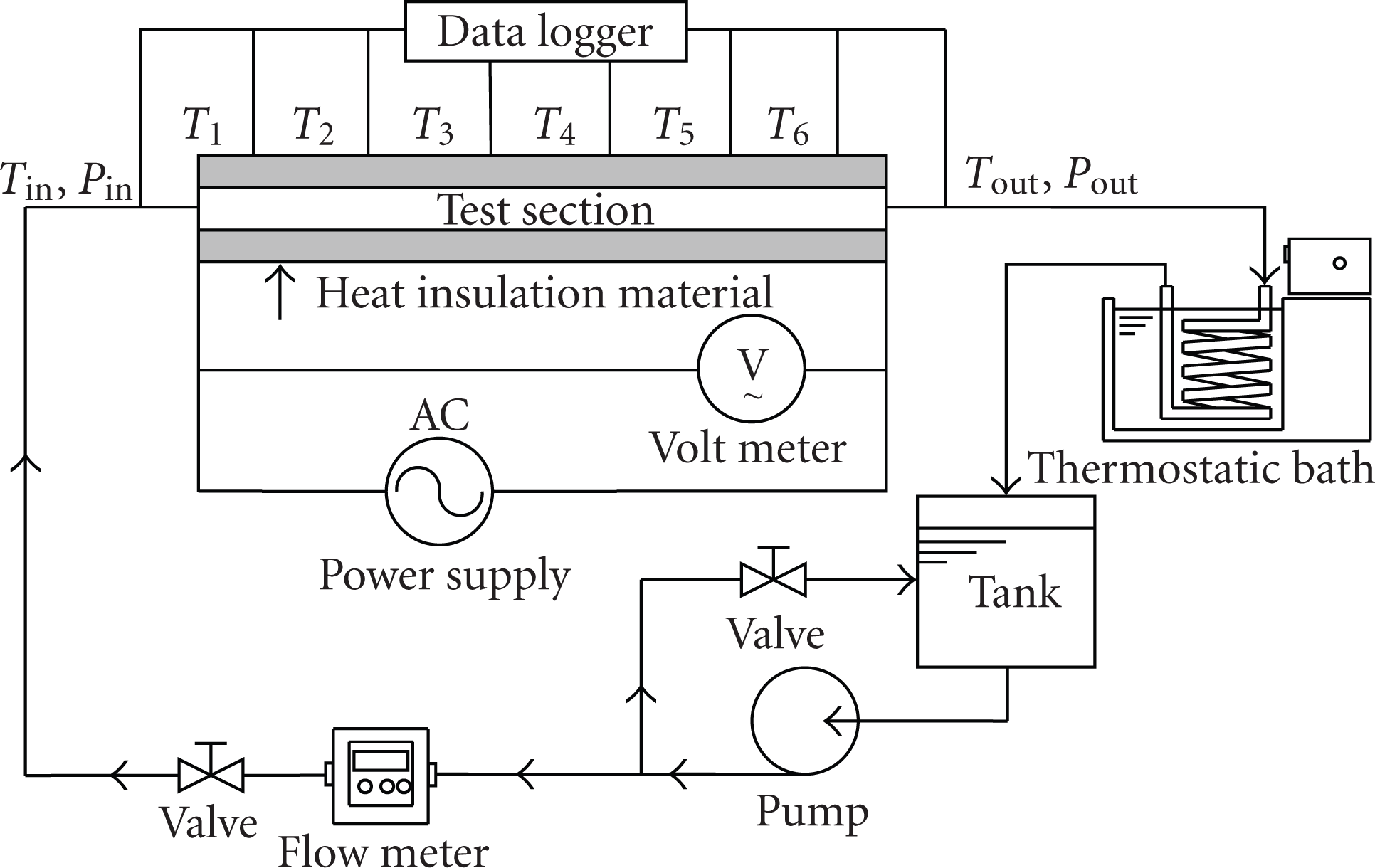
Experimental apparatus.
The measured local wall temperature and heat flux are used to calculate the local Nusselt number

where D is the diameter of test tube, h x is the local heat transfer coefficient, and k is the thermal conductivity of working fluid. Note that the thermal conductivity in (1) employs the value measured here. The local heat transfer coefficient is defined as

Here the subscriptx represents axial distance from the entrance of the test section, q is the heat flux, T w,x is the measured local wall temperature, and T m,x is the mixed mean temperature. The mixed mean temperature is determined by the following energy balance equation;

where Tin, ρ, and cp are, respectively, the inlet temperature, the density, and the specific heat of fluid, S and A are, respectively, the outer surface area of test tube and the cross sectional area, and U is the averaged flow velocity.
Three volumetric fractions of
3. Results and Discussions
The measured effective thermal conductivity k n,f , for three difference nanofluids, is illustrated in Figure 5 in the form of volume fraction versus dimensionless thermal conductivity where k n,f is divided by that of the base liquid (water), k f . As a comparison, the prediction is superimposed in the figure as straight lines. Here the Hamilton and Crosser equation [13] (H-C equation) is employed. This equation is a classical formula to predict thermal conductivity of solid-liquid mixture;

where ϕ shows volume fraction, and the subscript nf, S, and L indicate nanofluid, solid particles, and liquid, respectively, and n is sphere coefficient. Note that n = 3is used in (4). The density ρ
n,f
and specific heat


Note that the density and specific heat of the nanofluid in (3) are determined by (5) and (6), respectively. It is observed that the effective thermal conductivity increases with increasing the volume fraction and its trend is different for each nanofluid. In other words, the thermal conductivity of CuO-nalfluid is predicted by the correlation equation, while the corresponding values for diamond/water and CuO/water nanofluids become larger than that of the pure water in the low-volume fraction region and increases slightly in the higher volume fraction.
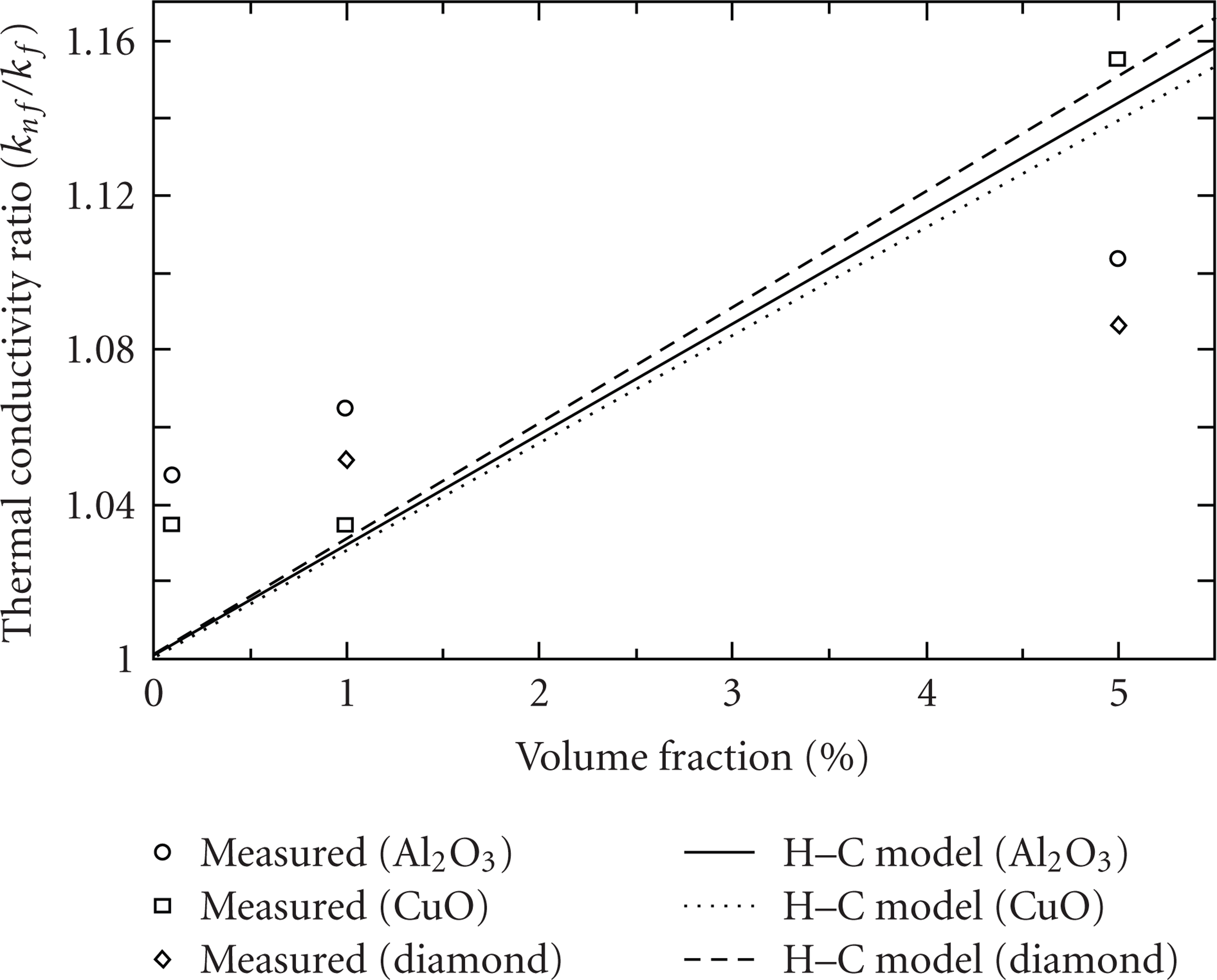
Measured thermal conductivity of nanofluids under different volume fractions.
The viscosities for three different nanofluids, which are normalized by that of the pure water, are illustrated in Figure 6. For comparison, the prediction by Batchelor equation [14] is superimposed in Figure 6 as a solid line;

Relative viscosity for different nanofluids.
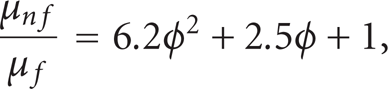
where μ n,f is viscosity of suspension and μ f is that of a pure fluid. One observes that the measured viscosities of nanofluids are much higher than that of prediction, the viscosity of nanofluids increases with an increase in the particle concentration, and this trend is different for three nanoparticles. The effective particle volume fraction including cluster in a nanofluid becomes higher than that in the ideal suspension fluid in which each particle is independently and homogeneously dispersed in a fluid. In other words, the cluster including a fluid is considered as a particle, resulting in attenuation in the fluid volume fraction. Thus, the viscosity of diamond nanofluid is the highest, because diamond particles are strongly aggregated, as is seen in Figure 3(c), and cluster restricts a large amount of pure water. On the contrary, the viscosity of CuO nanofluid is relatively low because the CuO nanoparticles had already aggregated in the state of the powder.
The pressure loss between the test sections, for three different nanofluids, is illustrated in Figure 7 in the form of pressure drop versus flow rate at 5 vol% of volume fraction. The following equation for pure water is superimposed in the figure as lines for comparison;

where l is the length of test tube and ρ is the density of nanofluid. The friction coefficient of the pipe λ is given by the Blasius equation,

Pressure drop for different nanofluids at 5 vol.%.
Next task is to consider the effect of suspension of nanoparticles on enhancement heat transfer. Figure 8 depicts the relationship between Nusselt number Nu and Reynolds number Re with different volume fractions, as a parameter. Figures 8(a), 8(b), and 8(c) correspond to the results for
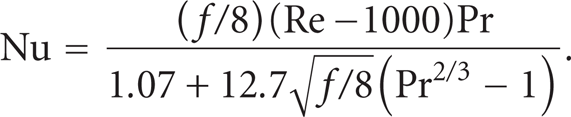
Here, the friction coefficient f is calculated by

One observes that the Nusselt numbers for each nanofluid are higher than those for pure water. In other words, the Nusselt numbers for 1 vol.% diamond, CuO, and
Nusselt numbers for each nanofluid.

In other words, lower enhancement of heat transfer for diamond and CuO nanofluids is attributed to substantial aggregation of nanoparticles, which plays an important role in heat transfer performance. This is because average diameter of the aggregated diamond nanoparticles is increased with an increase in volume fraction, as is seen in Figure 3(c) so that the Nusselt number of 1.0 vol.% is almost the same as that of 5 vol.%, as is seen in Figure 8(c).
Throughout the experimental results, as the volume fraction of nanoparticles is increased, the viscosity of nanofluids with cluster and the pressure drop are amplified, but the latter is slightly affected by the different nanofluids. Heat transfer enhancement is caused by the suspension of particles and its trend is intensified with an increase in the volume fraction of particles and is attributed to average diameter of the aggregated nanoparticles. In order to suppress aggregation of nanoparticles, the absolute value of zeta potential for the particle in suspension has to be intensified.
4. Conclusions
Experimental study has been performed to investigate heat transfer performance of aqueous suspensions of nanoparticles, that is,
The relative viscosity of nanofluids increases with an increase in concentration of nanoparticles, and the increase rate of the viscosity for nanofluid is different by the particle.
The pressure loss of the nanofluids tends to increase slightly compared with that of pure water.
Heat transfer performance in the circular tube flow is amplified by suspension of nanoparticles in comparison with that of pure water.
Heat transfer enhancement is affected by the occurrence of particle aggregation, that is, zeta potential of nanoparticles in suspension.
Footnotes
Nomenclature
Acknowledgments
This study was supported by the Grants-in-Aid for Scientific Research (C) (no. 16560153) from Japan Society for the Promotion of Science (JSPS). The author would like to express his thanks to Mr. Satoh of Graduate School of Science and Technology, Kumamoto University, for the heat transfer experiment.