




Abstract
A model to predict the effective thermal conductivity of heterogeneous materials is proposed based on unit cell approach. The model is combined with four fundamental effective thermal conductivity models (Parallel, Series, Maxwell-Eucken-I, and Maxwell-Eucken-II) to evolve a unifying equation for the estimation of effective thermal conductivity of porous and nonporous food materials. The effect of volume fraction (ν) on the structure composition factor (ψ) of the food materials is studied. The models are compared with the experimental data of various foods at the initial freezing temperature. The effective thermal conductivity estimated by the Maxwell-Eucken-I + Present model shows good agreement with the experimental data with a minimum average deviation of ±8.66% and maximum deviation of ±42.76% of Series + Present Model. The combined models have advantages over other empirical and semiempirical models.
1. Introduction
The model for estimation of effective thermal conductivity of heterogeneous mixtures is of interest in several engineering applications particularly food storage and food processing. The heterogeneous materials are bivariant compositions considered in the continuous and dispersed phases. The two-phase porous systems and food materials are heterogeneous media that share a few features as well as a several differences. The two-phase materials are generally made of solid-fluid composition with verity of shapes and sizes. The foods are heterogeneous capillary-porous colloidal materials consist of carbohydrates, protein, fat, minerals, vitamins, and ash along with water and air voids.
Numerous models were developed to find out the effective conductivity of the mixtures, but one of the major limitations of the models is its suitability for specific applications. The Eucken [1] and Maxwell [2] models were the most restrictive bounds for lower and higher volume fractions of the mixtures. But the models are only valid for vanishingly small and higher volume fractions of the dispersed phase of the mixtures (spherical shape). Meredith and Tobias [3] presented a review on conduction in heterogeneous systems and modified the earlier models of Rayleigh [4] for interactions of higher order between particles. A review of various methods for predicting the effective thermal conductivity of composite systems was proposed by Progelhof et al. [5]. They suggested that the semi-empirical approach may be more appropriate to characterize the effective thermal conductivity of structural materials such as low-density foams. Wang et al. [6] proposed a unifying equation for heterogeneous mixtures for different combinations of fundamental models, which form the basis of many of the more complex models available in the literature. The modeling of complex materials as composition of the five basic structural models using combinatory rules (equal structure volumes and equal structure effective thermal conductivities) based on the structure volume factor was proposed. Carson et al. [7] developed a model for predicting the thermal conductivity of frozen and unfrozen food materials. The effective thermal conductivity models that are functions only of the components thermal conductivities and volume fractions could not be accurate for both granular type (external porosity) and foam type porous foods (internal porosity). The structure composition factor is an extra parameter, required for predicting the thermal conductivity more accurately than the earlier proposed models. Levy [8] developed a model (modified Maxwell-Eucken) for predicting the thermal conductivity of two-component mixtures. It is one of the accurate models for predicting the thermal conductivity of heterogeneous materials, but the limitation of this model is that it was derived solely by algebraic manipulation. It was based on mathematical rather than physical arguments.
Series (De Vries [9]) and asymptotic (Fernandes et al. [10], Batchelor and O'Brien [11]) approaches have been introduced to evaluate thermal conductivity of regular arrays of spheres. The assumptions made for parallel and series structures of the composite mixtures are parallel and perpendicular to the heat flow. The stagnant thermal conductivity of a porous medium can be estimated based on a two-layer model analogous to resistances in an electrical circuit (Deissler and Boegli [12]). The maximum and minimum values of the thermal conductivities are obtained when the thermal resistances are in parallel and series, respectively, to the direction of the temperature gradient (normal to the heat flux). Kunii and Smith [13] proposed the unit cell model consisting of spherical particles contacting each other with point to point. They assume that the temperature gradient is applied along the direction of point contact of the spheres. A lumped parameter model for predicting the thermal conductivity of the porous medium was described by Hsu et al. [14]. Numerical simulations of finite difference or finite element methods were used to predict the effective conductivity of the unidirectional fibrous composite materials (Rocha and Cruz [15], Buonanno and Carotenuto [16]) and packed beds (Christon et al. [17]). Samantray et al. [18] proposed a comprehensive model to estimate the effective thermal conductivity of two-phase materials. The model was adapted for predicting the effective conductivity of various binary metallic mixtures with a high degree of confidence (Karthikeyan and Reddy [19]). Reddy and Karthikeyan [20] developed the collocated parameter model based on the unit cell approach for predicting the effective thermal conductivity of the two-phase materials.
Thermal conductivity measurement of food materials using guarded hot plate apparatus was carried out by Willix et al. [21]. The thermal conductivity of various food materials was measured for the temperature range of −40 to
The primary effects influencing the effective conductivity of the heterogeneous mixtures include conductivity ratio (α), structure volume fraction (ν), and structure composition factor (ψ). At present, there is no satisfactory solution for all ranges of α and ν, because the neighbour interactions on the field produced higher order effects, which is difficult to model. In addition to the primary effects, the secondary parameters such as contact resistance, radiation, convection, Knudsen effect, and particle geometrical characteristics influence the effective conductivity. In this paper, an extended approach to predict the effective thermal conductivity of two-dimensional spatially periodic two-phase systems based on the unit cell approach with isotherm has been attempted and unifying equations are solved for frozen and unfrozen foods (multicomponent material). The unifying equations from four fundamental structure models combined with present model have been validated with experimental data for various food materials to evolve a better multistructure model. The reliability of the combinatory models has been checked by comparing the present model predictions with the experimental data and Levy's model.
2. Thermal Conductivity Estimation of Two-Phase System
2.1. Isotherm-Based Unit Cell Model
The earliest model of the unit cube was prescribed by Krischer [25]. The upper and lower limits to the conductivity of two-phase mixtures were described by Wiener [26]. The electric resistance analogy leads to algebraic expressions for stagnant thermal conductivity of the two-phase materials. The resistance method is referred to as the collocated parameter model. The main feature of the method is to assume one-dimensional heat conduction in a unit cell. The unit cell is divided into three parallel layers, namely, solids, fluid, or composite layers normal to the temperature gradient. The effective thermal conductivity of two-phase system is determined by considering equivalent electrical resistances of parallel and series in the unit cell model. The thermal conductivity of the composite layer is obtained using the series model.
The effective thermal conductivity of the two-dimensional medium can be estimated by considering a square cylinder with cross-section “
Two-Dimensional spatial periodic two-phase system. (a) Touching square cylinder. (b) Unit cell of square cylinder.
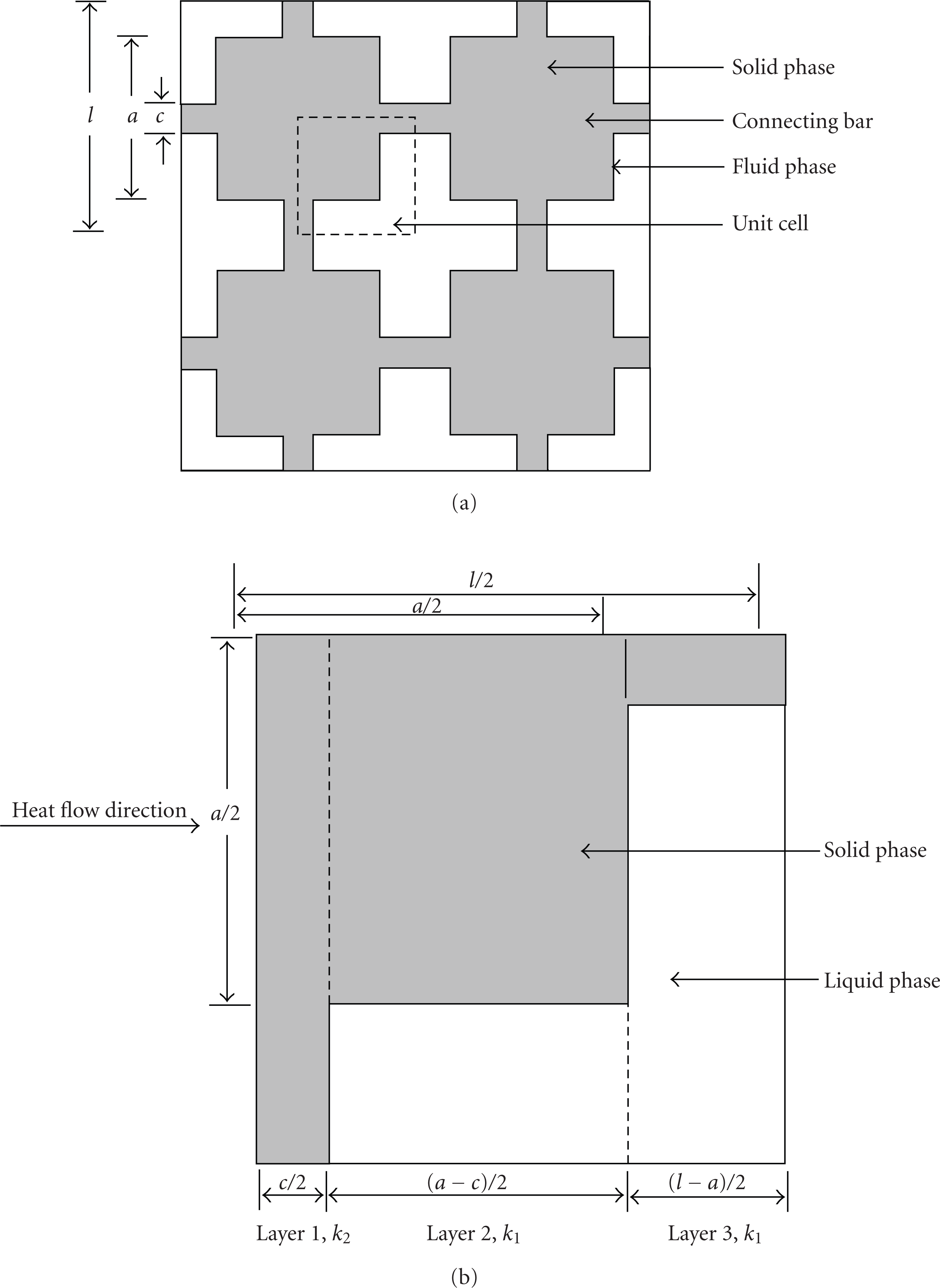
The total resistance offered by the unit cell is given as

where, resistance offered by layer 1 is,
Also,

The concentration is defined as the solid-phase fraction of the unit cell and is given by
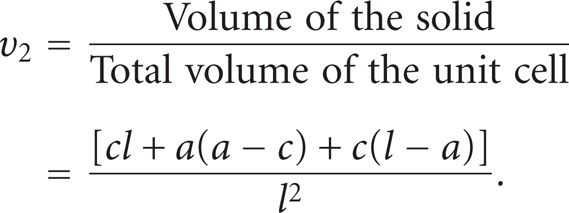
Equation (3) can be rewritten as

where
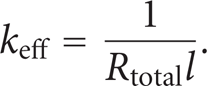
The effective thermal conductivity of two-phase mixtures is given as:

2.2. Other Basic Structure Models
The popularly reported basic structure models for estimation of effective thermal conductivity of two-phase materials include Parallel, Series, ME-I (Rocha and Cruz [15]; Buonanno and Carotenuto [16]), and ME-II (Rocha and Cruz [15]; Buonanno and Carotenuto [16]). In Series and Parallel models, it is assumed that the layer of the components of physical structures is oriented either perpendicular or parallel to the heat flow.
In the parallel model, the effective thermal conductivity is expressed as

In the series model, the effective thermal conductivity is given by
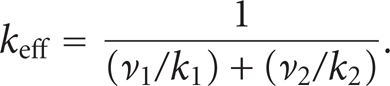
The effective thermal conductivity of low concentration two-phase systems is given by Maxwell-Eucken-I (Rocha and Cruz [15]; Buonanno and Carotenuto [16])

For high concentration two-phase system, the effective thermal conductivity is expressed by Maxwell-Eucken-II (Rocha and Cruz [15]; Buonanno and Carotenuto [16])

2.3. Combinatory Models for Heterogeneous Materials
Krischer [25] developed a model based on the complex structure, which could be approximated by the mixture of simple structures. The effective conductivity of the structure is the combined effect of parallel and series models and is given as.

The complex physical structures of the heterogeneous materials can be modeled by using simple combinatory rules. Wang et al. [6] developed a new approach of unifying equation for fundamental models by selecting suitable multicomponent parameters. The method proposed by them is adapted to combine the present model with four fundamental structure models to evolve unifying equations for heterogeneous two-phase materials. The thermal conductivity of two-component materials is expressed by Wang et al. [6]:

Equation (12) is used in the series and parallel models when d
i
= 1 and
The schematic of two-component materials as uniform mixtures of two-structural models is shown in Figures 2(a)–2(d). The heterogeneous model assumed that the half of the mixture is represented by one model and the remaining half by another model. Figure 2(a) shows that half of the volume has parallel structure with component 1 as continuous phase, whereas the other half of the volume has the two-dimensional spatially periodic square cylinder structure (present model) with component 2 as continuous phase. Similarly other structural models can be combined with present model for effective thermal conductivity prediction of food materials (Figures 2(b)–2(d)). The selected binary structure models for food materials are discussed in the following sections.
Two-component materials as uniform mixtures of two-structural models (a) Parallel + Present Model. (b) ME-I + Present Model. (c) ME-II + Present Model. (d) Series + Present Model.

For modeling of thermal conductivity, the food materials may be classified as four types:
unfrozen nonporous foods (
unfrozen porous foods
frozen nonporous foods
frozen porous foods
2.3.1. Parallel + Present Model
Substituting (6) and (7) in (12) and equating the Parallel and Present models yield effective thermal conductivity as

The solution of (13) is obtained as

where

The volume composition factor for multicomponent material may be written as


Based on the structure composition factor for multicomponent material can be expressed as


From (16)–(19), substituting the values

The solution of (20) is obtained as

2.3.2. Series + Present Model
Combining the Series model and Present model yields an effective thermal conductivity; from (12) we have

Equation (22) is simplified as

where

2.3.3. Maxwell-Eucken-I + Present Model
Combining the Maxwell-Eucken-I and present model yields an effective thermal conductivity:

Equation (25) is rearranged as

where

2.3.4. Maxwell-Eucken-II + Present Model
The Maxwell-Eucken-II and the present model are combined which yields an effective thermal conductivity:

Also

where

From (16)–(19), substituting the value of
3. Parametric Analysis of Combined Models
The nondimensional conductivity of a heterogeneous system mainly depends on volume fraction (ν), conductivity ratio (α), thermal contact between solid-solid interface and structure composition (ψ). The variation of nondimensional conductivity with volume fraction (ν2) for unfrozen nonporous food

The variation of nondimensional conductivity with volume fraction of the disperse phase for unfrozen nonporous foods (

The variation of nondimensional conductivity with volume fraction of the disperse phase for frozen nonporous foods (

The variation of nondimensional conductivity with volume fraction of the disperse phase for unfrozen porous foods (

The variation of nondimensional conductivity with volume fraction of the disperse phase for frozen porous foods (
The effect of volume structure factor on the volume composition factor for different heterogeneous models has been investigated for lower (
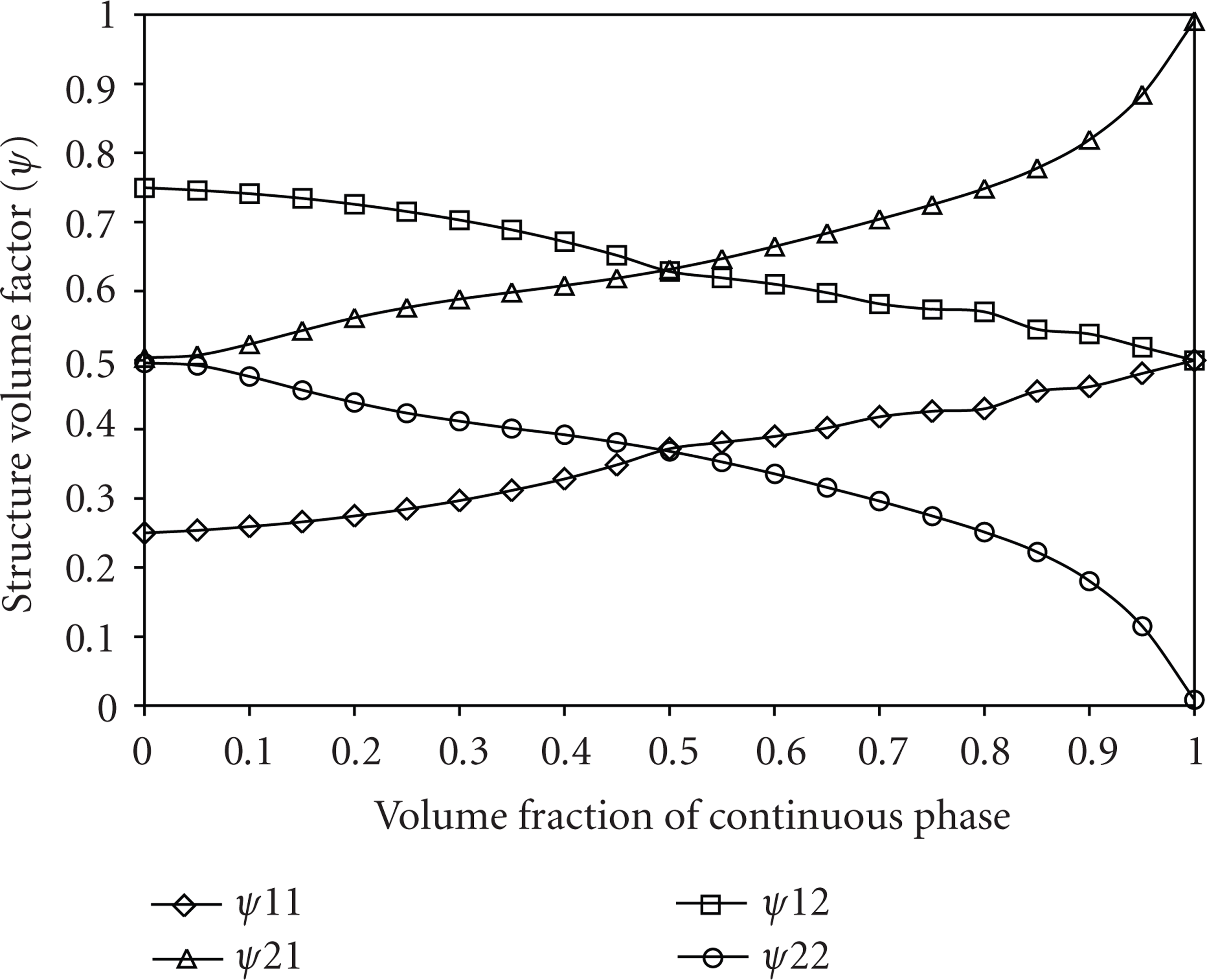
The variation of structure composition factor with volume fraction for unfrozen nonporous foods (
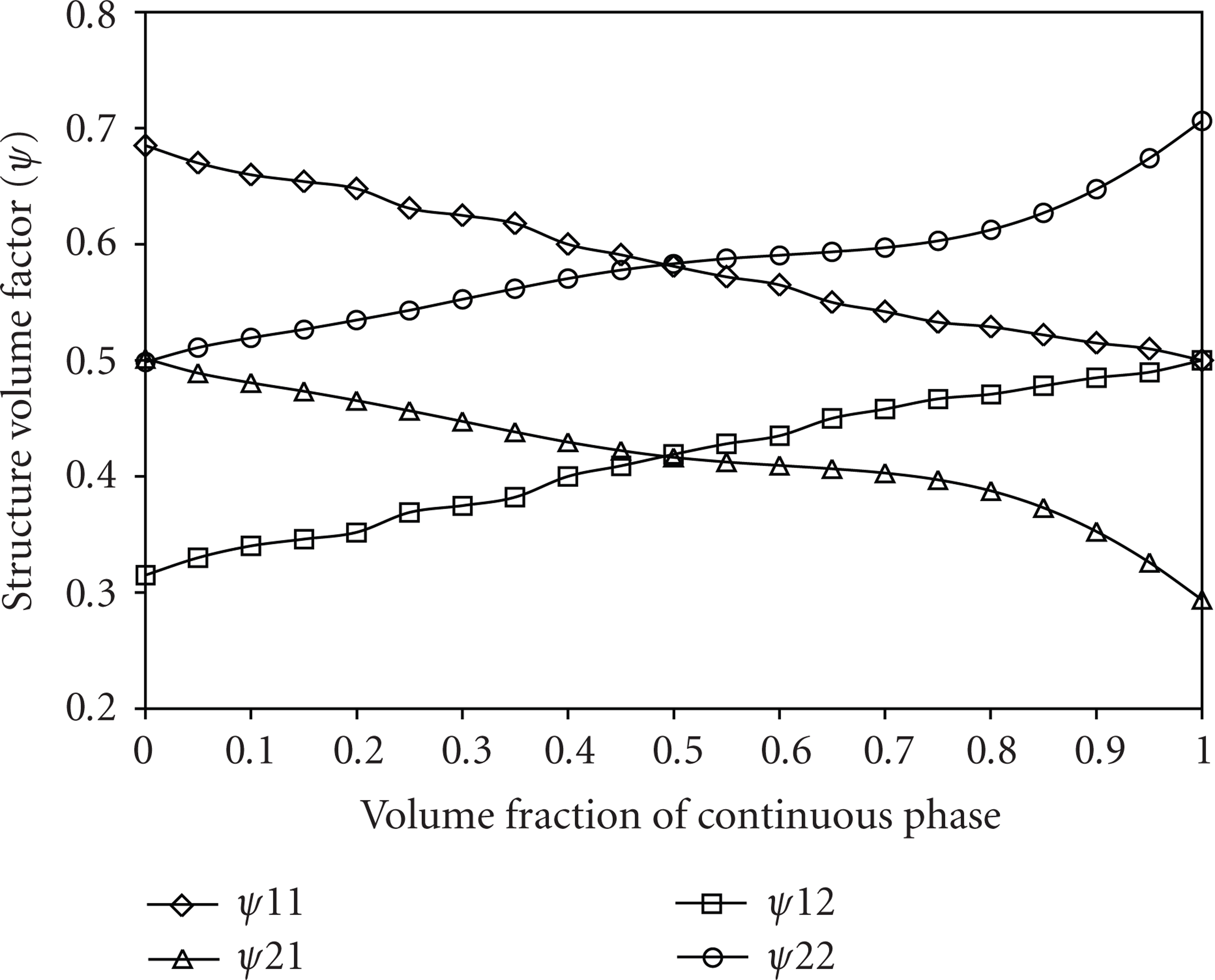
The variation of structure composition factor with volume fraction for unfrozen nonporous foods (

The variation of structure composition factor with volume fraction for unfrozen nonporous foods (

The variation of structure composition factor with volume fraction for unfrozen and nonporous foods (
4. Effective Thermal Conductivity of Foods
The effective thermal conductivity of various foods has been estimated using combinatory models. The food materials are essentially consisting of water, protein, fat, carbohydrate, salt, and ash. A lumped conductivity has been considered using parallel approach for a dispersed phase consisting of more than one component. The thermal conductivity and density of food components are given in Table 1. In the frozen foods, ice, water plus ice, water, and fat contents are considered as a continuous phase whereas food solid components, food solid components plus water, and food solid components plus ice, food solid components plus ice plus water are considered as the dispersed phase. The major constituents of the various food materials are illustrated in Table 2. The experimental conductivity data were considered at initial freezing temperature of the food materials for the comparison of four unifying equations. It is evident that the unifying equations are not a function of temperature.
Properties of food components [27].

Composition of food materials.

Levy [8] proposed a model based on the Maxwell-Eucken Model for multicomponent materials. The Levy's model predictions are better for fat and other types of food materials, when the entire range of compositions and temperatures is considered. The Maxwell-Eucken-I + Present model estimations are comparable to the Levy's model for frozen, nonfrozen porous, and nonporous food materials. Therefore, the physical model of Levy must be the same as the ME-I + Present model for a heterogeneous mixture (Macroscopic scale) for conductivities of both equal component structures. The comparison of Levy's model with Maxwell-Eucken-I + Preset model for different types of lower (
Comparison of present and Levy's models with experimental data for various food materials.


Comparison of Levy's model with Maxwell Eucken-I + Present model for frozen and unfrozen porous and nonporous materials.

Comparison of experimental results with Maxwell Eucken-I + Present model for food materials.

Comparison of Levy's model with experimental results.

Comparison of Parallel + Present model with experimental results.

Comparison of Series + Present model with experimental results.

Comparison of Maxwell-Eucken-II + Present model with experimental results.
5. Conclusion
The various combinatory models are developed to evolve unifying equation to predict the effective thermal conductivity of the food materials. The effects of volume fraction on nondimensional conductivity are responsible for the physical corrections of the model. The structure composition factor and structure volume fraction are important tools to predict the thermal conductivity of the multicomponent materials. The combinatory models are compared with the experimental data for various food materials. The results show that the ME-I + Present model is superior to the other models for wide variety of food materials. The minimum deviation is found to be ±8.66% for ME-I + Present model. This is because measurement errors in the composition of foods, temperature dependence of thermal conductivity of ice, and nature were the limitations of the predictive models. The unifying equations can effectively be used to predict the thermal conductivity of various multicomponent materials.