




Abstract
The purpose of this experimental study is to evaluate the effects of particle species, surface charge, concentration, preparation technique, and base fluid on thermal transport capability of nanoparticle suspensions (nanofluids). The surface charge was varied by changing the pH value of the fluids. The alumina (
1. Introduction
Due to the low thermal conductivities of most common liquids used in heat exchangers, such as water and ethylene glycol, it has become urgent to look into other advanced alternatives. A new type of fluids called nanofluids (suspensions of nanometer-sized particles in various fluids) has been extensively investigated to enhance the heat carrying capacity of fluids although the mechanism behind exceptionally enhanced thermal conductivity of nanofluids is still not well understood. Different mechanisms have been put forth to explain thermal transport enhancement such as interfacial resistance, nanoparticle motion, liquid layering at particle-liquid interface, and nanoparticle clustering [1]. Among them, nanoparticle motion (Brownian motion) [2–9] and nanoparticle clustering [10–15] have attracted most attention. The initial experiments show preferred thermal properties of nanofluids [16–20], such as an order of magnitude higher thermal conductivity than that predicted by conventional theory on heterogeneous two-component mixture. A very small concentration of copper nanoparticle (less than 0.3% volume fraction of 10 nm nanoparticles) can enhance the thermal conductivity of base fluid (ethylene glycol) by up to 40% [21]. On the other hand, the Hamilton and Crosser (HC) model predicts a less than 1.5% improvement in thermal conductivity [22]. In another study [16] where metallic multiwalled carbon nanotubes (MWCNTs) were dispersed in synthetic oil (α-olefin), an astonishing improvement of 160% in thermal conductivity was observed with only a 1.0% volume fraction of MWNT. The authors argue that the three-dimensional network formed by CNTs is responsible for significant thermal conductivity improvement. A recent study shows that the enhancement of thermal conductivity of nanofluids heavily depends on fluid temperature [9, 23] and particle sizes [24, 25]. Herein a two- to fourfold increase in thermal conductivity was observed when the fluid temperature increased from
This research is focused on a systematic investigation of key parameters that affect the thermal conductivity of nanofluids. These parameters include surface charge, nanoparticle composition and concentration, base fluids, and preparation techniques. The paper starts with nanofluid preparation and the measurement system, followed with comparisons of the obtained results with those published in open literature and predicted by theory, and then the effects of key parameters are discussed and summarized in detail in the end of the paper.
2. Nanofluids Preparation and Experimental Apparatus
2.1. Nanofluid Preparation
Preparation of nanofluids through which nanoparticles should be uniformly dispersed in base fluids is the first step for improvement in thermal conductivity, but its importance is often ignored. The nanofluid does not simply refer to a liquid-solid mixture. Some special requirements are necessary, such as uniform, stable, and durable suspension, low or no aggregation of particles, and no chemical reaction. There are three primary methods being used to prepare nanofluids [29]: (i) direct dispersion of powder form nanoparticles in the base fluids; (ii) nanoparticle synthesized by chemical precipitation and then dispersed in base fluids; (iii) direct nanoparticle synthesis in the base fluid by organic reduction. Stability of the dispersion is ensured by controlling the surface charge of the nanoparticles through the control of the pH value of fluids. This is very effective for oxide nanoparticles such as alumina and copper oxide used in this research.
The nanofluids under current investigation can be divided into two groups based on the base fluids including DI water and ethylene glycol (EG). Both alumina
TEM images of alumina (a) and copper oxide (b) nanoparticles.

The smaller sized alumina particles (nominal size: 10 nm) from a different source (NanoAmor Inc.) were also considered. But it was found that the dispersion of these alumina nanoparticles in DI water is very difficult even after adding various surfactants such as sodium dodecyl sulfate (SDS), cetyltrimethyl ammonium bromide (CTAB), Pluronic P105 and applying long time ultra sonication. No thermal conductivity measurement was conducted for these alumina nanoparticle solutions.
Temperature rise is minimized by utilizing multiple short sonications (instead of a long sonication) and the evaporation of base fluids is avoided by sealing the container with caps during sonication. The power and time settings of the ultra sonicators were chosen in such a way that a better dispersion is achieved with minimum increase in nanofluids temperature. For example, the DI water-based nanofluids reach
2.2. Thermal Conductivity Measurement Apparatus
Transient hot wire method (THW) was adapted by many researchers to determine the thermal conductivity of the nanofluid suspensions [21, 30–35]. The THW method is a simple but effective transient method for measuring thermal conductivity of materials. This method determines the thermal conductivity by observing the rate at which the temperature of a very thin wire increases with time after an abrupt electrical pulse. It can eliminate the error from natural convection since the measurement is completed in a very short time (less than one second). Figure 2 presents the temperature rise of the wire during the thermal conductivity measurement for DI water.
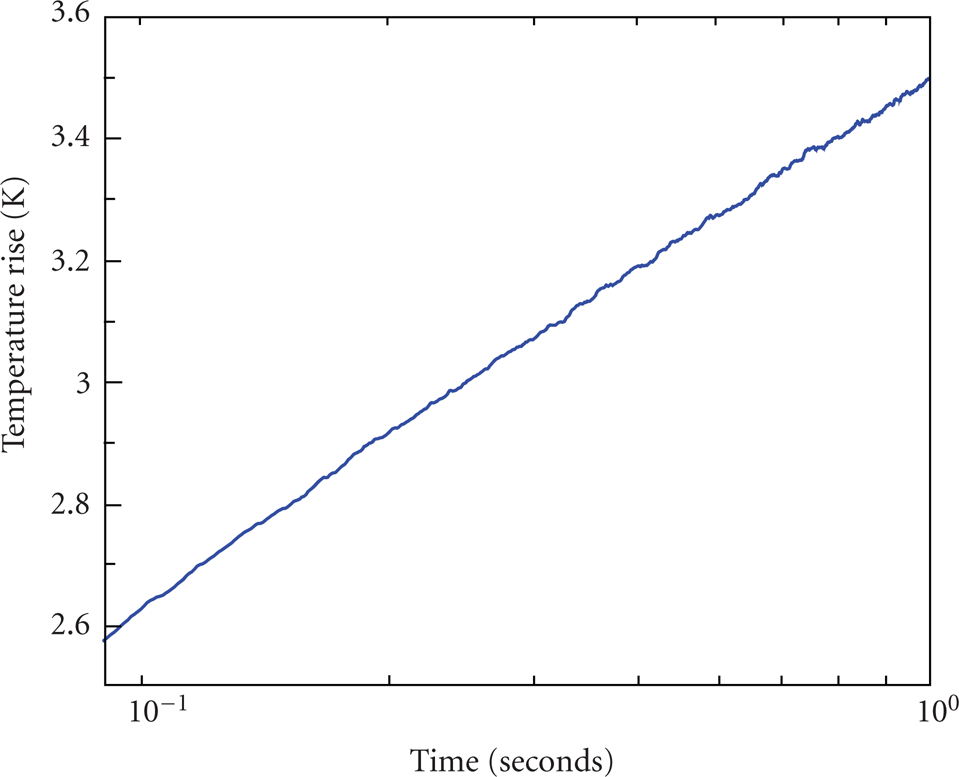
Temperature rise of the hotwire in DI water versus time (with time plotted on log scale).
In this research, an isonel coated platinum (source: A-M systems) with 25 μm in diameter and 15 cm in length was immersed horizontally in a plexiglass cell
(a) Schematic of transient hot wire (THW) system and (b) test cell containing platinum wire and nanofluids.


where k is the thermal conductivity of the fluid, q is the heat dissipation rate. L is the length of the wire and t the time (from start of heating), and
The calibration of the apparatus was performed by comparing the measured thermal conductivities of DI water and EG with those from literature values at room temperature [36]. Deviation for DI water and EG is 0.66% and 2.36%, respectively. The uncertainty analysis of measured thermal conductivity was attached in the appendix. Each thermal conductivity value was obtained from an average of 20 measurements with an estimated accuracy of ± 0.0015 and ± 0.0013, respectively [37]. These results demonstrate that the experimental setup used in the present work can produce a reliable thermal-conductivity data. Additional details of the apparatus and technique are available elsewhere [32].
3. Results and Discussion
3.1. Comparison with Published Literature
The thermal conductivities of alumina/DI water, alumina/EG, and copper oxide/EG are compared with available published results [38–42]. The nanofluids were dispersed using the bath sonicator and the results are presented in Figures 4, 5, and 6. The experimental results are consistent with other published results within the experimental uncertainty. The thermal conductivity increases with the increase of volumetric fraction of nanofluids. Apparent density values for alumina (4.0 g/cm3) and copper oxide (6.4 g/cm3) were used for volume fraction calculations.


3.2. Effect of pH Value on Thermal Conductivity
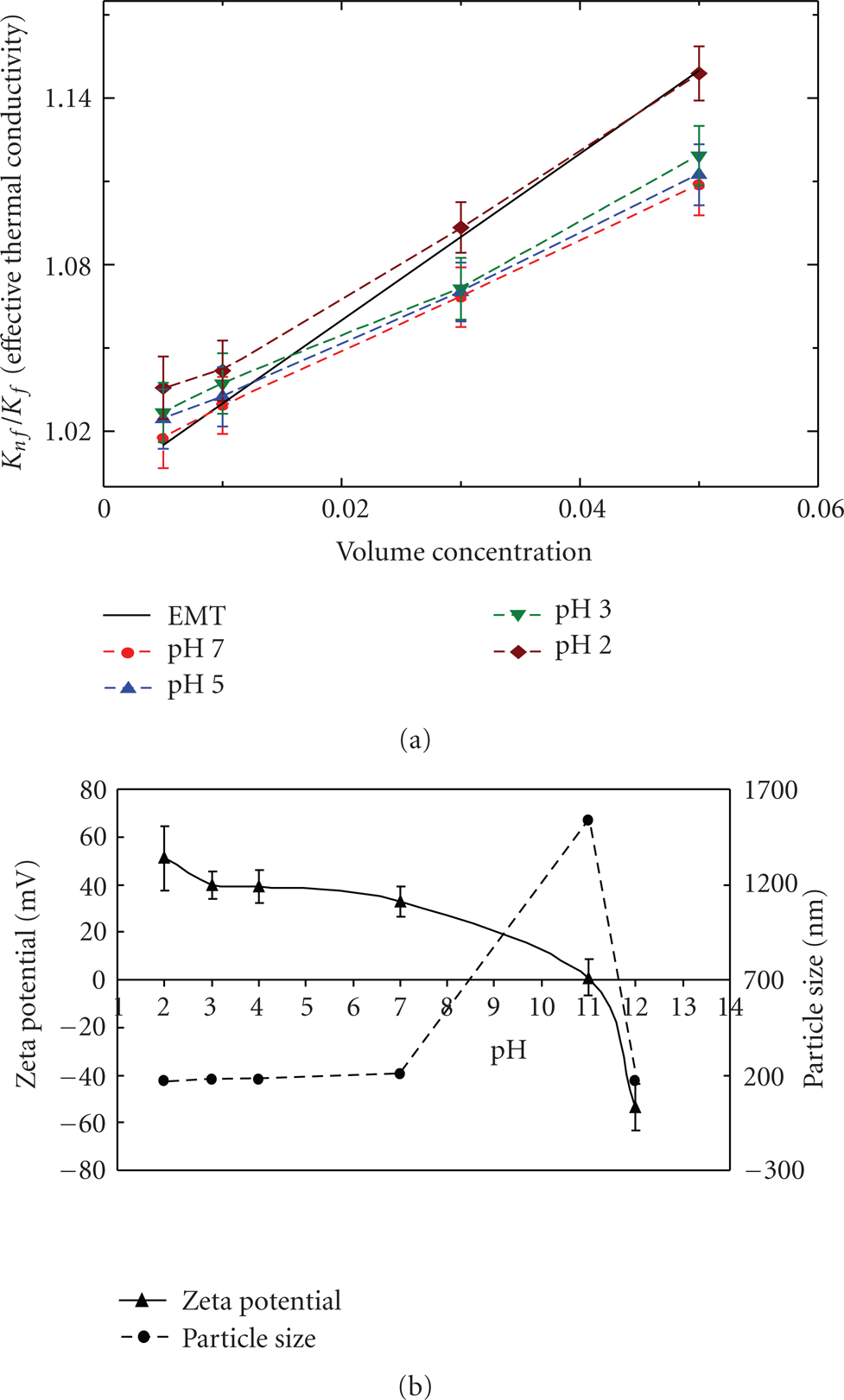
Surface charge is critical for the stabilization of colloidal solutions. The effect of pH value on thermal conductivity of DI water-based alumina nanofluids was examined in this work. The pH values of alumina/DI water were changed from 7.0 to 2.0 by adding HCl solution into the nanofluids. By adding NaOH solutions, the values of 7.0 to 11.0 were obtained. The nanoparticles were dispersed using bath sonicator with parameters mentioned above. The corresponding thermal conductivities were measured using THW apparatus and plotted in Figure 7(a). As a comparison, the prediction from effective medium theory (EMT) is also plotted (solid line) [42]. The EMT gives a relationship between particle volume fraction and thermal conductivity improvement solely based on particle volume concentration (ϕ) as described below

Effect of pH value on (a) thermal conductivity of DI water-based alumina nanofluids and (b) particle size.
The EMT theory is conventionally employed when (1) the particles are assumed to be static; (2) thermal conductivity of the particles is much higher than that of base fluid; (3) the volume fraction of particles is small; (4) the shape of particles is spherical. Compared with abnormal improvement in thermal conductivity reported by published results, overall the present thermal conductivity results of alumina nanofluids are lower than the values from the prediction from EMT theory. Our finding is consistent with published results by Timofeeva et al. [42]. The conclusion was made that the low thermal conductivity is mainly caused by aggregation of nanoparticles. One consequence of the aggregation is the reduction of particle numbers in solution and size increase (clustered structures) of particles. The impact of these mechanisms on thermal conductivity enhancement is complicated depending on the primary mechanism for heat transport. On one hand, the size increase of particles in nanofluids forms fractal/clustered structures in fluids which will shorten the heat conduction path in medium, so the thermal conductivity should be increased. On the other hand, the size increase of particles reduces the particle motions which have been proposed to entrain the motion of the fluid for promoting more heat transfer. As a result, the enhancement in thermal conductivity will be reduced. The competition between these two heat transfer mechanisms decides the thermal conductivity enhancement.
To prove this hypothesis, the particle sizes in nanofluids were measured by a Zetasizer machine (Malvern Instruments Ltd), which is based on dynamic light scattering (DLS) technique. In DLS, particles are illuminated with a laser. The intensity of the scattered light fluctuates at a rate that is dependent upon the size of the particles as smaller particles are moved further by the solvent molecules and move more rapidly. Analysis of these intensity fluctuations yields the velocity of the Brownian motion and the particles hydrodynamic size is calculated using the Stokes-Einstein relationship. The results indicate that the average size of particles in the fluids is reduced from 207 nm to around 160 nm when the pH value changes from 7 to 2 (Figure 7(b)). It is also worth noting that the average particle size increases up to 1500 nm when the zeta potential of particle is around zero (pH = 11). It is apparent that a large aggregation occurs when the interparticle repulsion force between particles is small or the surface charge of nanoparticles is small. As the nanofluids become more acidic (lower pH value), more charges are accumulated on the particle surface. Less aggregation occurs and the dispersion is improved. As the result, the effective thermal conductivity increases. For instance, at volumetric fraction of 5%, the thermal conductivity ratio (nanofluids to base fluid) increases from 1.06 to 1.14 (within the error limit). The value of 1.14 is consistent with effective medium theory (EMT) prediction. But the EMT theory fails in taking into consideration the effect of nanoparticle size increase (due to aggregates/clusters formation) on thermal conductivity.
3.3. Effect of Base Fluids on Thermal Conductivity
To study the effect of base fluid property on thermal conductivity in nanofluids, DI water and EG-based alumina nanofluids were measured after they were dispersed using probe type sonicator. Figure 8 shows the trend of thermal conductivity of alumina nanoparticles in different base fluids at different volume concentrations. Apparently, the effective thermal conductivity (ratio of thermal conductivity of nanofluids to that of base fluid) of EG-based alumina nanofluids is higher than that of the DI water-based alumina nanofluids at same concentrations. Unlike DI water-based nanofluids, the thermal conductivity of EG-based alumina nanofluids accurately follows the trend predicted by EMT. One possibility is that in a colloidal system (nanofluids) consisting of a large number of small particles, particles will collide with each other in the course of their Brownian motion. In such a collision, the particles may be so attracted to one another that they stick together to form aggregates. The aggregation rate depends on both the viscosity of base fluid and surface charge of the nanoparticles [43].A further study on the effect of base fluids on nanofluids thermal conductivity is underway.
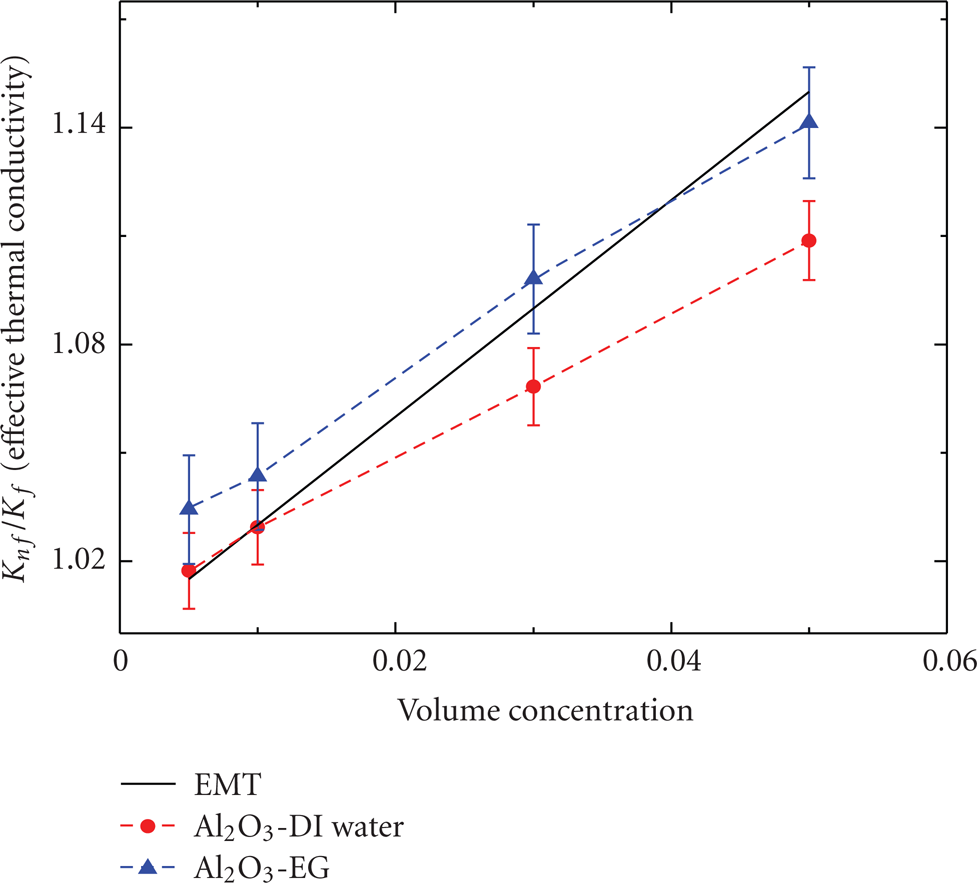
Effect of base fluids (DI water and EG) on thermal conductivity of alumina nanofluids.
3.4. Effect of Nanoparticle Species on Thermal Conductivity
To evaluate the effect of nanoparticle species on thermal conductivity, alumina, copper oxide, and a

Effect of particle species on thermal conductivities of EG-based alumina, copper oxide, and
3.5. Effect of Sonication Methods on Thermal Conductivity
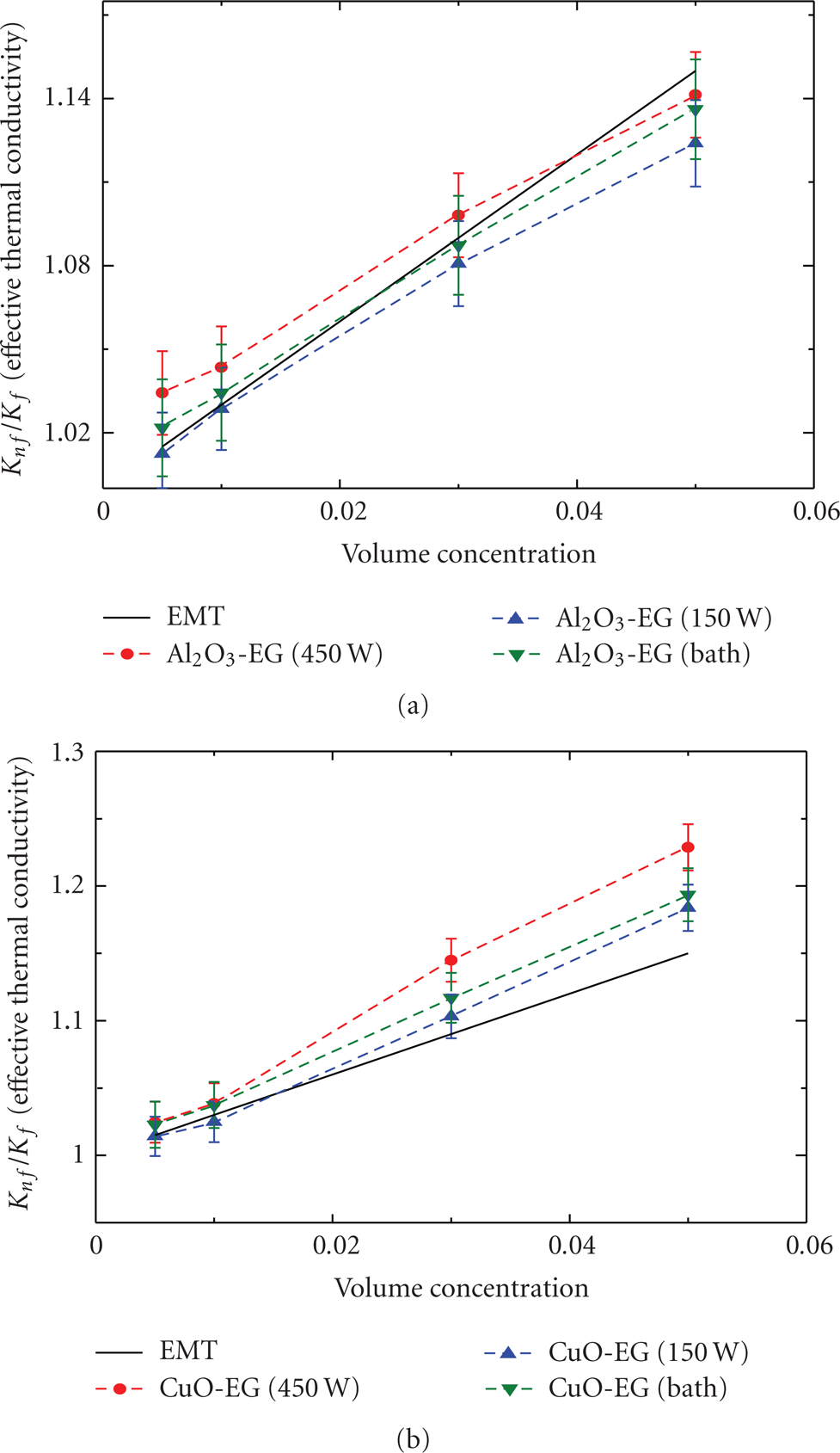
Another important parameter to determine thermal conductivity of nanofluids is preparation method. Three sonication methods are used to study the effect of sonication techniques on effective thermal conductivity of nanofluids. All nanoparticles (alumina and copper oxide) are dispersed in EG. The three sonication techniques include: (1) sonication of nanofluids with a probe sonicator (Branson Digital Sonifier 450) at 80% magnitude (maximum power: 450 W) for 2 minutes; (2) another probe sonicator (Omni-Ruptor 250) at 80% magnitude (maximum power: 150 W) for 2 minutes, and (3) a bath sonicator (Model: 75D VWR) for 4.5 hours at maximum power setting (maxium power: 90 W). The measured thermal conductivities are plotted in Figure 10. For both alumina and copper oxide nanofluids, the 450 W probe sonication gave the highest effective thermal conductivity enhancement, followed by bath sonication, and lastly, 150 W probe sonication. Even at lower concentrations
Effect of sonication power on thermal conductivities of EG-based (a) alumina and (b) copper oxide nanofluids.
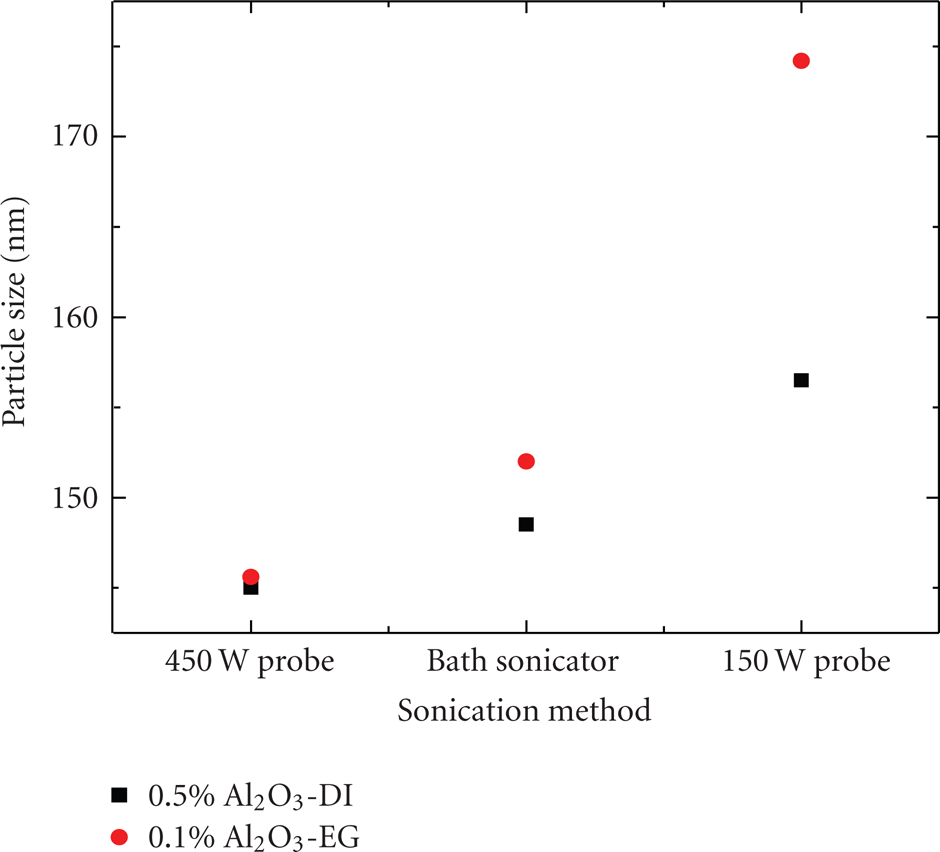
Effect of sonication power on (agglomerated) alumina particle size of DI water and EG-based nanofluids.
4. Conclusions
The effect of surface charge (pH value), base fluid, particle species, and dispersion method on thermal conductivity of alumina and copper oxide nanofluids are addressed in a systematic way. The high surface charge (low pH value) of nanofluids improves dispersion of nanoparticles in base fluids. The viscosity of base fluid reduces the Brownian velocity of nanoparticles so that the sedimentation/agglomeration of particles in nanofluids is decreased. All these lead to a higher thermal conductivity. Therefore, the thermal conductivity of nanofluids can be effectively improved by changing pH of fluids and by using more viscous fluids. Another important parameter is dispersion technique. The results demonstrate that high power sonication can significantly improve thermal conductivity of nanofluids and also stability of nanofluids.
Footnotes
Appendix
Uncertainty analysis is given as follows:
Best estimate for the uncertainty [37] is given as follows:
Nomenclature
Acknowledgment
The authors would like to acknowledge the support of Nanomanufacturing Center of Excellence (NCOE) Strategic Seed Grant from the State of Massachusetts.