




Abstract
Data transmission from sensor nodes to a base station or a sink node often incurs significant energy consumption, which critically affects network lifetime. We generalize and solve the problem of deploying multiple base stations to maximize network lifetime in terms of two different metrics under one-hop and multihop communication models. In the one-hop communication model, the sensors far away from base stations always deplete their energy much faster than others. We propose an optimal solution and a heuristic approach based on the minimal enclosing circle algorithm to deploy a base station at the geometric center of each cluster. In the multihop communication model, both base station location and data routing mechanism need to be considered in maximizing network lifetime. We propose an iterative algorithm based on rigorous mathematical derivations and use linear programming to compute the optimal routing paths for data transmission. Simulation results show the distinguished performance of the proposed deployment algorithms in maximizing network lifetime.
1. Introduction
Wireless sensor networks (WSNs) are becoming increasingly pervasive in many military, civil, agricultural, and industrial applications. In sensor networks deployed in harsh or unstructured environments, sensor nodes are typically powered by irreplaceable batteries with a limited amount of energy supply. Minimizing the total energy consumption and optimizing the network-wide load balance to prolong the lifetime of sensor networks have been an essential task in sensor network implementation.
Data transmission from a sensor node to a base station (BS) or a sink node often consumes a significant amount of energy and to a large degree determines the operation hours of the sensor, which in turn affects the lifetime of the entire network. Typically in large-scale sensor networks, it is not always sufficient to deploy one single BS for the entire network, and the advantages of deploying multiple base stations (BSs) are fourfold: (i) shorten the distance between sensors and BSs to cut down the amount of energy consumption on data transmission; (ii) expand network connectivity to improve communication coverage (iii) increase data rate and reduce message delay of the network; and (iv) provide backup routes and sinks for better fault tolerance. However, determining the locations of these BSs is an extremely complex task because their optimal locations depend on a wide variety of factors including the network topology, communication model, routing mechanism, and lifetime metric.
We generalize and solve the problems of deploying multiple BSs in WSNs to maximize network lifetime under both one-hop and multihop communication models for different lifetime metrics. In the one-hop communication model, data messages are directly sent to BSs without any intermediate routing, and therefore the sensors far away from BSs deplete their energy faster than those close to BSs. We formulate the BS deployment problem as the NP-complete p-center problem and present an optimal solution for small-scale networks and design an efficient heuristic approach for large-scale ones based on the minimal enclosing circle (MEC) algorithm [1]. In the multihop communication model, sensor nodes that are one-hop away from the BSs, referred to as critical nodes, need to relay data packets for all other nodes, resulting in much faster energy exhaustion than other nodes. A good deployment strategy would place the BSs in the dense areas of a network to mitigate this issue. We propose an iterative algorithm based on rigorous mathematical derivations and geometric optimization techniques to maximize the network lifetime. Moreover, we develop a linear programming model to compute optimal routing paths for data transmission, which provides a theoretical lower bound for evaluating the network lifetime of any given BS deployment scheme. All these algorithms are implemented and tested on a large set of randomly generated simulation networks. Extensive simulation results illustrate the superior performance of the proposed BS deployment algorithms in comparison with existing methods.
The rest of the paper is organized as follows. In Section 2, we conduct a survey of BS deployment problems and strategies that are closely related to our work. In Section 3, we construct the energy models and formulate the BS deployment problems under different routing models. In Sections 4 and 5, we propose either optimal algorithms or heuristic approaches to deploy BSs for maximizing the lifetime of networks with one-hop and multihop communication models. The simulation results are presented in Section 6 to evaluate the efficiency of the proposed algorithms. We conclude our work in Section 7.
2. Related Work
The deployment of BSs is a fundamental and crucial task in the implementation and operation of WSNs. The number of BSs is a critical factor of the sensor network architecture that significantly affects the network performance. There exist several efforts in deploying a single BS [2, 3] or multiple BSs [4–9]. Most of these studies assume that the number of available BSs is known a priori. Sensor nodes and BSs are usually deployed in a two-dimensional planar area. In an arbitrary network graph, finding the optimal locations for a given number of BSs to maximize network lifetime is very challenging as the search space is considered infinite. Researchers often formulate this problem as an integer linear programming (ILP) task [6, 9] and restrict the possible locations of BSs to a number of given feasible sites or simply the locations of sensor nodes. Meanwhile, the optimal multihop flow-based routing is calculated by solving a linear programming-(LP) modeled problem with given BS locations. However, this approach has several limitations. First, ILP is NP-complete so it does not scale well for networks with a large number of sensors. Second, since the locations of BSs are restricted, the ILP solution can only select the optimal locations among a limited set of possible locations. Several other efforts in BS deployment [4, 5, 7] employ iterative clustering algorithms such as k-means algorithm.
The problems we consider and the solutions we propose in this paper are different from those described above in several aspects. In our problems, the locations of BSs are not restricted to a set of given sites. We consider both one-hop and multihop communication models for evaluating different types of network lifetime. Furthermore, we integrate a number of geometric optimization techniques into our solutions to the BS deployment problems for network lifetime maximization.
3. Energy Model and Problem Formulation
3.1. Energy Model
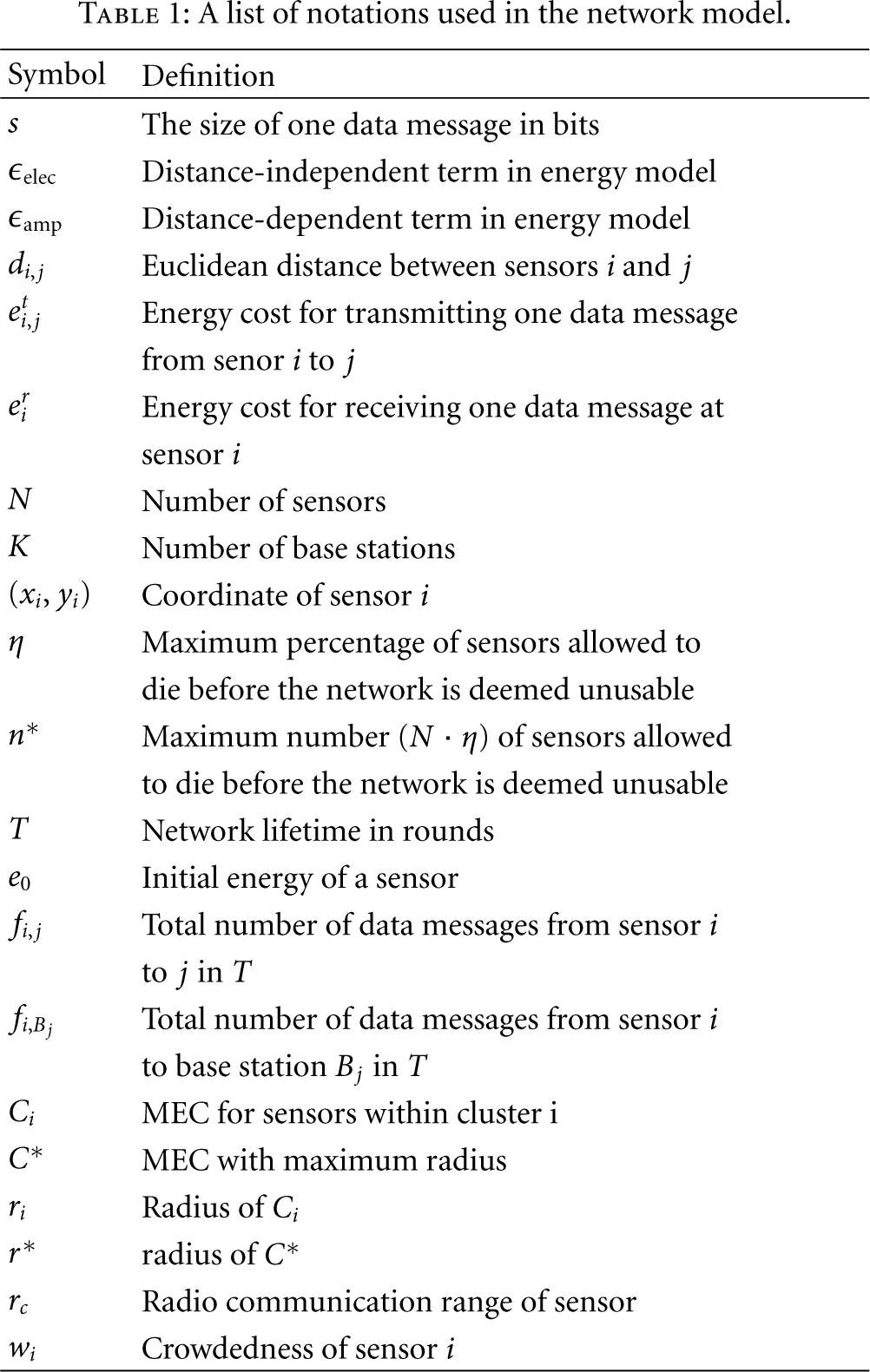
Table 1 lists all the notations used in this paper. For a sensor node, we assume that the data transmission consumes most of the energy. Each sensor generates a fixed-sized data message of s bits in every round (or period) and transmits it to one of the BSs via either a one-hop or multihop path. We further assume that sensors are able to adjust their transmission power levels on a continuous scale according to the wireless link distance. Our energy model is based on the first-order radio model described in [10]. The energy dissipation in transmitting one data message from sensor i to sensor j over a direct wireless link can be modeled as


A list of notations used in the network model.
3.2. Network Lifetime Definition
In general, the lifetime of WSNs is defined as the number of rounds until the network operation terminates due to the increasing number of dead sensor nodes. We use η to represent the maximum percentage of sensors that are allowed to die before the network is deemed unusable. When
3.3. Problem Formulation
The multiple BSs deployment problem is formulated as follows. Given a WSN represented as a graph BS deployment using one-hop communication (BSD-1). In this model, every sensor sends its data directly to the closest BS, which means that no routing is needed within the cluster. BS deployment using multihop communication (BSD-M). In this model, data generated by sensors is routed to BSs via multihop paths. To achieve the performance optimality, the routing path from each sensor to the BS is not fixed so that data may go through different paths at different times to reach the BS.
BSD-M needs to jointly consider the BS deployment and routing mechanism. Let T represent the network lifetime measured as the number of rounds, 


4. Algorithm Design for BSD-1
In the one-hop communication model, each sensor sends its data to the closest BS directly. Thus, the sensors far away from the BSs drain their energy faster than others. The problem of deploying a single BS in one-hop communication model has been well studied in the literature [2]. Here, we consider deploying multiple BSs to maximize the network lifetime, which is denoted by parameter η,
4.1. BSD-1 with
For
Theorem 1.
BSD-1 with
Proof.
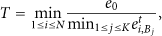
In the one-hop communication model, each sensor only consumes energy on transmitting data to its closest BS, so the network lifetime can be calculated by

By reducing BSD-1 with
Algorithm 1 (IMEC Algorithm).
Initially deploy K BSs at the locations of K sensors randomly chosen out of N sensors. Cluster the sensors by assigning each of them to its closest BS. Compute the MEC for the sensors within each cluster and move the BS to the center of the circle if the BS is not located there. If any BS moves at the previous step, go to Step 2; otherwise, return the BS locations.Step 1.
Step 2.
Step 3.
Step 4.
For small-scale WSNs, we can apply the optimal algorithm in [15] to solve the BSD-1 problem. Unfortunately, this algorithm does not scale well for WSNs with a large number of sensors. Based on the heuristic proposed in [16] for Euclidean p-center problem, we propose an iterative heuristic algorithm, which calls MEC algorithm for large-scale WSNs. We refer to this algorithm as Iterative Minimal Enclosing Circle algorithm (IMEC), as shown in Algorithm 1.
At each iteration of IMEC algorithm, N sensors are divided into K clusters, each of which contains one BS and at least one sensor. In fact, each BS defines a Voronoi polygon. For those sensors within the same cluster, we compute the MEC to cover them using the algorithms proposed in [1]. In order to minimize the maximum distance between a sensor and the BS, we have to deploy the BS at the center of the circle. Let
Lemma 1.
At each iteration of IMEC,
Proof.
Let
The time complexity of an iteration consists of two main components: one is to divide sensors into K clusters, which can be done in
4.2. BSD-1 with
For
A naive optimal algorithm for this problem would run in time
Algorithm 2 (SMEC Algorithm).
Initialize the BS locations using IMEC algorithm and cluster the sensors by assigning each of them to its closest BS; compute Compute Select and ignore one of the sensors located on the boundary of If Step 1.
Step 2.
Step 3.
Step 4.
SMEC uses IMEC to initialize the BS locations. At Step 2, we compute the MEC
Lemma 2.
At each iteration of SMEC,
Proof.
Let

An example that supports Lemma 2.
The iteration terminates when
5. Algorithm Design for BSD-M
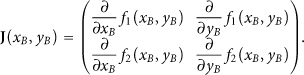
In the multihop communication model, the maximum network lifetime depends on both BS locations and data routing paths. We have formulated BSD-M as an NP-complete quadratic programming problem in Section 3.3. Nevertheless, for given BS locations, since transmission cost
We first consider a single BS deployment scenario and rigorously derive the BS location, which is then used in a heuristic designed for the deployment of multiple BSs.
5.1. Single BS Deployment
In the multihop communication model, besides transmitting its own data, a sensor also relays data from other sensors to BSs. Thus, the sensors that are one hop away from a BS need to relay all the data generated by other sensors. Different from the one-hop communication model, the sensors close to a BS may actually run out of energy first. Therefore, a good deployment strategy would consider placing the BS in an area with a high sensor density to prolong the network lifetime. We introduce a new concept, crowdedness, denoted as 



5.2. Multiple BSs Deployment
The multiple BSs deployment problem is more challenging than the single BS deployment problem, as we need to consider sensor clustering. We propose an iterative algorithm, Iterative Analytical Derivation (IAD), based on the analytical derivation results of the single BS deployment problem, as shown in Algorithm 3.
Algorithm 3 (IAD Algorithm).
Initialize the BS locations using IMEC algorithm. Initialize the number of iterations Compute the minimal energy consumption path from each senor to each BS; cluster the sensors by assigning each of them to the BS with the least energy consumption. Compute the BS location using analytical derivation for each cluster; If Step 1.
Step 2.
Step 3.
Step 4.
At each iteration of IAD algorithm, we assign each sensor to the BS with highest energy efficiency to minimize the total energy consumption of the network. Inside each cluster, the new BS location is obtained using the same method presented in the single BS deployment scenario. The total energy consumption within each cluster is also minimized by simultaneously considering the deployment of BS in a crowded area to prolong the network lifetime. We set the maximum number of iterations to be
6. Simulation Results
In this section, we present the simulation results from the BSs deployment experiments on a number of randomly generated networks with various sizes. We implement and evaluate the performance of the proposed deployment algorithms in comparison with several existing ones.
In the simulation setup, we consider a network of sensors that are randomly placed in a square-shaped planar area. Different networks are created by varying the network size and the number of given BSs. Each sensor has a communication radio range of
6.1. Performance of IMEC Algorithm
IMEC algorithm is designed for BSD-1 problem to maximize CL performance when

Performance comparison of IMEC and the optimal algorithm in 200 sample networks with N = 15 and K = 3.
6.2. Performance of SMEC Algorithm
SMEC algorithm is designed for BSD-1 problem to maximize WL performance when
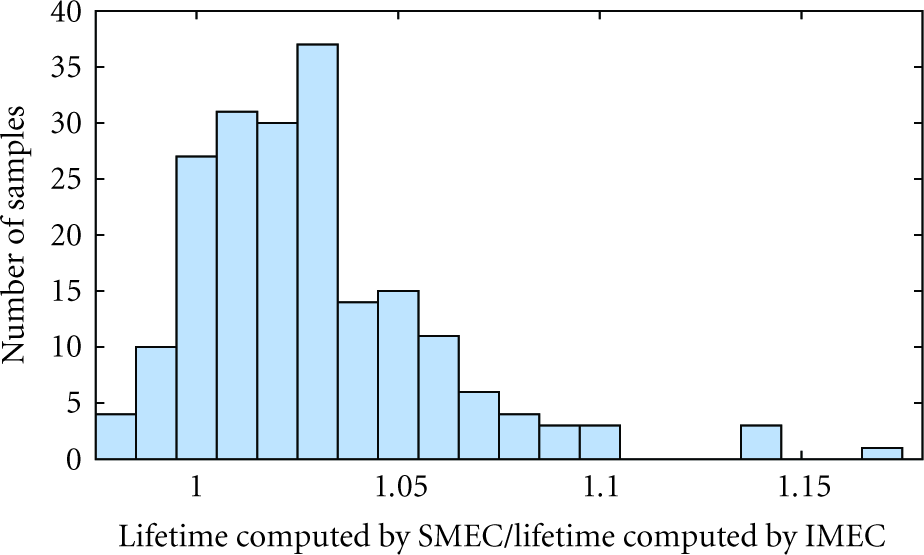
Performance comparison of SMEC and IMEC algorithm in 200 sample networks with N = 300, K = 6, and
6.3. Performance of IAD Algorithm
IAD algorithm is designed for BSD-M problem that uses multihop communication model to maximize network lifetime. We compare it with two existing algorithms: k-means algorithm [7] and Global algorithm [4]. Again, the sample networks are randomly generated with the placement of 500 sensors in

Performance comparison of IAD, k-means, and Global algorithms with 5 BSs in response to various sensor distributions.

Performance comparison of IAD, k-means, and Global algorithms with fixed sensor placement in response to various numbers of BSs.
7. Conclusion
In this paper, we investigated the problems of deploying multiple BSs in WSNs to maximize the network lifetime under one-hop and multihop communication models. We formulated the multiple BSs deployment problems as optimization problems and proposed various optimal or heuristic solutions based on geometric optimization techniques and rigorous mathematical derivations. The extensive simulation results illustrated the efficacy of these proposed deployment algorithms.
Footnotes
Acknowledgments
This research is sponsored by National Science Foundation under Grant no. CNS-0721980 and Oak Ridge National Laboratory, U.S. Department of Energy, under Contract no. PO 4000056349 with University of Memphis.