




Abstract
The concept of Cooperated Multipoint (CoMP) transmission is proposed for LTE-Advanced, which is in a form of distributed networks. In this background, a novel CoMP architecture is proposed in this paper, based on Group Cell concept in China FuTURE 4G TDD systems. Moreover, four actual scenarios are also concluded in CoMP, which, respectively, are single user in intracell, multiple users in intracell, single user in intercell and slide handover in intercell. In addition, a joint subcarrier optimization method is proposed to mitigate the intercell interference and improve performance under CoMP architecture; the method includes two aspects, which, respectively, are subcarrier allocation with maximum gain to interference plus noise ratio (GINR) and power allocation based on balanced signal to interference plus noise ratio (SINR). On this basis, three combined schemes are presented in simulation. Compared with traditional scheme, the proposed scheme improves throughputs and reduces blocking probability. Moreover, the average data rates in cell edge are also raised.
1. Introduction
As the increasing demands for global mobile communication markets, it is a continuous growth for the need of 3G evolution systems. For 3GPP organization, Universal Mobile Telecommunications System (UMTS) is proposed for 3G Long Term Evolution (LTE), called as the Evolved UMTS Terrestrial Radio Access (UTRA) and UMTS Terrestrial Radio Access Network (UTRAN) [1]. On the other hand, for 3GPP2 organization, Ultra Mobile Broadband (UMB) is proposed and enhanced, aims at almost the same requirements as those in 3GPP LTE. For IEEE organization, IEEE 802.16e standard, also called as Mobile Worldwide Interoperability for Microwave Access (WiMAX) is established, with similar requirements as those in 3GPP LTE too.
The objective of UTRA evolution study item is to develop a framework for the evolution of 3GPP radio access technology towards a high data rate, low latency, and packet optimized radio access technology [2]. There are some new requirements on higher spectrum efficiency and faster data rate in cell edge; moreover the multiple access method based on Orthogonal Frequency Division Multiple Access (OFDMA) technology has been widely accepted. Despite the fact that OFDMA effectively avoids intracell interference inside a single cell, but it may bring with extra intercell interference due to cofrequency subcarriers reused among different cells. Especially, intercell interference become a serious problem in the future multicell environment.
In April 2009, a novel technology concept named Coordinated Multipoint transmission (CoMP) is proposed in 3GPP working meetings, listed as a study item in LTE-Advanced [3]. For CoMP, it is a distributed network, where different antenna units are connected into one eNodeB. There is cooperation among antenna units and eNodeBs, providing diversity gain for users.
In this paper, a novel CoMP architecture is proposed, and this architecture is based on Group Cell concept, which has been tested in China FuTURE 4G TDD systems [4]. On the other hand, in order to mitigate intercell interference combined with CoMP scenarios, a joint subcarrier resource optimization method is also proposed, including two aspects: subcarrier allocation and power allocation. The proposed subcarrier allocation in CoMP is based on the gain to interference plus noise ratio (GINR). By means of cooperation among antenna units and eNodeBs, the dynamical power allocation is also taken, which tries to establish balanced signal to interference plus noise ratio (SINR) among cells. By this way, it enables to mitigate intercell interference and improve system performance.
The rest of this paper is organized as follows: CoMP based on Group Cell architecture is introduced in Section 2. The joint subcarrier optimization method is proposed in Section 3, respectively, including subcarrier allocation with maximum GINR and power allocation based on balanced SINR. The performance for different combined subcarrier optimization schemes are compared in Section 4. Finally, the conclusion is made in Section 5.
2. Cooperated Multipoint Transmission
The traditional cellular architecture is proposed by Bell lab, in which one cell is usually determined by base station and its controller, which then connect into core network. However, this network architecture may bring with time delay for user and degrade network efficiency [5]. In order to enlarge cover area and improve the capacity of system, the distributed antenna system (DAS) is proposed in 1987, which pulls away the remote antenna unit by optical fibre [6, 7]. However, DAS mainly aims to realize cellular seamless cover and not consider the cooperation among the antenna units, which is still hard to raise the Quality of Service (QoS) for cell-edge users.
As a critical technology, CoMP is proposed in 3GPP study item for LTE-Advanced. In the downlink, it supports for dynamic coordination in scheduling and transmission, including joint transmission from multiple geographically separate points [8]. Moreover, as shown in Figure 1, we propose a new architecture for CoMP, based on Group Cell concept.
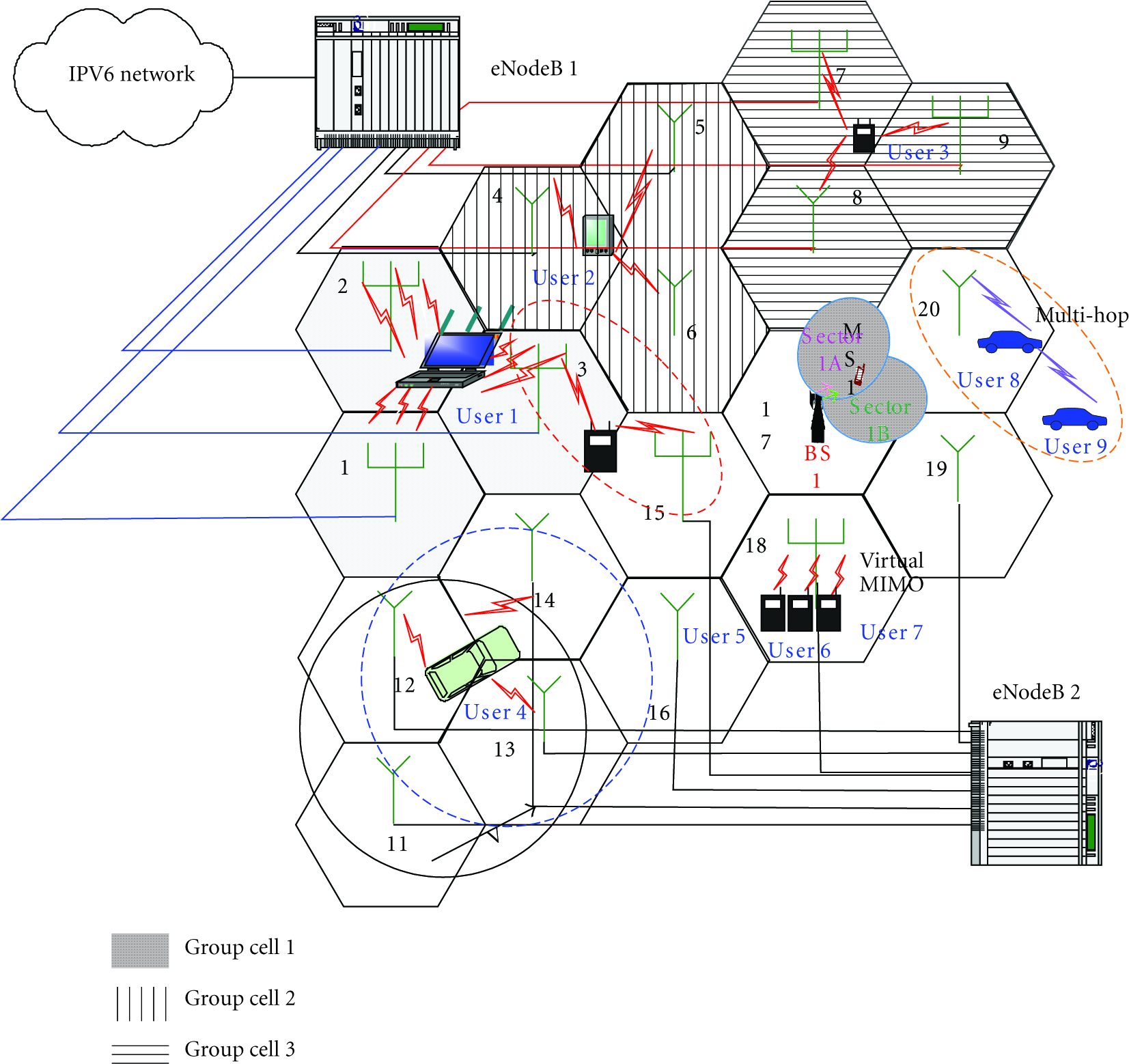
CoMP architecture based on Group Cell.
In this architecture, each eNodeB has several separated antenna units. The antenna units can be single antenna or antenna array. The function of signal processing is accomplished at the eNodeB. In Figure 1, eNodeB 1 has 9 antenna units. If the antenna units in this area are indexed by 1~9 and the size of the Group Cell is 3, it can be found that there are 3 Group Cells connected with eNodeB 1 in this area. Moreover, users in each Group Cell can be served by adjacent antenna units. This is a fixed Group Cell structure and the antenna units of each Group Cell are fixed. With the movement of the user, different fixed Group Cell can be selected.
Another cooperation transmission in Group Cell is called as slide Group Cell, viewed as the process of sliding windows. Considering the scenario in eNodeB 2, with the movement of User 4, the antenna units of the Group Cell that serves User 4 can also move corresponding with it. As shown in Figure 1, the antenna units 11, 12, and 13 are used for User 4 in timeslot 1. With the movement of User 4, in timeslot 2, the antenna units 12, 13, 14, and 16 can be selected to serve for User 4, whose antenna units are dynamically changed instead of fixed. This is the CoMP transmission in slide Group Cell, also called as slide handover [4]. By such ways, users are always staying in the center of Group Cell and the cell-edge effect can be eliminated. Considering the cooperation in downlink, four scenarios are concluded for CoMP, respectively, they are single user in intracell, multiple users in intracell, single user in intercell, and slide handover in intercell, which are shown in Figure 2.

CoMP scenarios in Group Cell.
In Figure 2, it can be seen that both single user and multiple users can be served by a series of antenna units. For these antenna units, each of them is cooperated. Moreover, this cooperated relationship is also among eNodeBs. For CoMP architecture, it is in a form of distributed network, where many antenna units are connected into one eNodeB and different eNodeBs can be cooperated with each other. Moreover, some adjacent antenna units are constructed into a group cell, which means the group cell can be made by partial antenna units. When user is in cell edge, the antenna units can be dynamically chosen as user moves, which let user feel as in the center of antenna units all the time, keeping the actual performance well [9]. In addition, by means of this architecture, it not only raises the capacity in cell edge, but also reduces the number of handover.
As a new technology in LTE-Advanced, CoMP bring challenges into radio resource management in the future, which needs to consider the intercell/intracell cooperation. For multicell OFDMA systems, the intercell interference problem is usually caused by cofrequency subcarriers reused among different cells. How to optimize the subcarrier resource under CoMP architecture is very critical. Specially, to achieve tight intercell orthogonal radio resource assignment, the work in [10] analyzes fast intercell radio resource management in CoMP, and presents two approaches, respectively, are centralized and autonomous. However, it focuses on theoretical analysis and not give the specific optimization algorithms. Under this background, we propose a joint subcarrier optimization method for CoMP, including subcarrier allocation and power allocation.
3. Subcarrier Resource Optimization
The interference in OFDMA-based systems arises as the cofrequency resources are reused in neighbor cells. For example, when two users are within different cells using cofrequency blocks simultaneously, the SINR associated with these blocks may drop into a low level, resulting in lower resource utilization.
In OFDMA system, its subcarriers are orthogonal among intracell users, which enables to avoid the intracell interference effectively. However, for the cofrequency subcarriers reused among different cells, it may bring with extra intercell interference, and intercell interference becomes one of critical problems, which may degrade users' performance in the OFDMA system. For CoMP scenarios, it needs cooperated transmission in the downlink, which means one user should be served by many different antenna units. By this analysis, how to optimize the subcarrier resource in downlink is important for CoMP.
On the basis of cooperation among antenna units and eNodeB, both subcarrier allocation and adaptive power allocation method are proposed to optimize the subcarrier resources. By the cooperative relationship in CoMP, these methods enable to select the optimal subcarrier, establish balanced SINR among the cofrequency subcarriers and further reduce intercell interference.
3.1. Subcarrier Allocation with Maximum GINR
Fixed subcarrier allocation is a traditional subcarrier allocation method in OFDMA system. In this method, it includes two ways, which, respectively, are group subcarrier allocation and interval extended subcarrier allocation, allocating a group of adjacent subcarriers or interval subcarriers to each user [11]. But this method neglects the state of subcarriers, always brings with extra interference among the cofrequency subcarriers and degrades the performance of users. Considering this situation, a novel subcarrier allocation method is presented for CoMP based on GINR.
In OFDMA system, the downlink GINR of a subcarrier can be defined as [12]

The proposed subcarrier allocation method is with maximum GINR from antenna units to users. Moreover, all the available subcarriers are allocated according to GINR, and the process is given as follows.
Set up a GINR matrix for subcarrier allocation, as shown in formula (2), the row vectors denote user flags, while the column vectors denote carrier flags. In formula (2),

Firstly, choose the maximum elements in GINR matrix. When the largest elements are in the
3.2. Power Allocation Based on Balanced SINR
For OFDMA systems, the water-filling algorithm is usually taken for subcarrier allocation, which is usually based on channel state information (CSI). If the CSI is well for one user, increase the power. Else, reduce the power. When this scheme is taken in single cell, for the subcarriers are orthogonal in intracell users, the intracell interference can be effectively avoided, improving the cellular capacity. But for multicell, for the subcarriers with cofrequency reused among different cells, it may bring serious intercell cofrequency interference for other users.
According to intercell interference coordination in 3GPP LTE [13], it proposes power allocation schemes that allocate partial power in cell-center users and full power in cell-edge users, written as fixed power allocation. For this power allocation method, it can reduce the interference caused by users in cell-center, but on the other hand, it degrades the performance for these users. In addition, for full power in cell-edge, it may bring extra interference to users in the other cells. So for the power allocation method, it should not only meet the service requirement for intracell users, but also needs to mitigate such intercell interference to users in other cells.
In order to optimize power allocation in intercell coordination schemes, a new power control algorithm is taken to adjust the power allocation in subcarriers, based on the cooperation among different antenna units and access points in CoMP.
By means of cooperation relationship in CoMP, the intercell interference information can be exchanged among antenna units and eNodeBs. So the power allocation can be dynamically adjusted among different antenna units and eNodes, the proposed power control algorithm aims to establish balanced SINR for cofrequency subcarriers among intercells, which not only can make the power be in a optimal scope, but also can mitigate intercell interference. This algorithm is introduced as follows.
In the initial state, users in intracell are divided into two parts: cell-center users and cell-edge users, according to the power ratio (PR). Specifically, the PR is defined as the ratio of useful power and intercell interference from cofrequency subcarriers in other cells. If the PR is higher than a standard value, such user is classified into cell-center user. Else if the PR is lower than the standard value, such user is classified into cell-edge user. In order to mitigate the interference from cell-center users, these subcarriers are allocated with lower power. But for those cell-edge users, those subcarriers are allocated with higher power, which enables to improve performance in poor channel conditions.
On the other hand, the target SINR must be set for different users, based on the service types and CSI. After all the parameters are initiated, it begins to adjust the power by power control algorithm, making users' SINR reach target value and keeping SINR balanced among antenna units and eNodeBs. The proposed power control algorithm is in a form of iterations, and the main iterative process is the following.
On the basis of initial parameters, the iterative power is computed by the power iterative equation, and SINR with such power can be got by the SINR equation. Then, the next iterative power is updated by power iterative equation, and update SINR by the iterative power. If the iterative SINR approximates target value, stop iteration and output the power. Else, go back to continue the iterative process, until current SINR approximates target value.
For maximum power is constrained in power allocation, if the iterative power is beyond the scope of maximum power, and current SINR still does not reach target value, remove such user, reset initial parameters and priorities for users [14]. Then begin new iterative process again. Take single cofrequency subcarrier as an example, the steps of this iterative algorithm in CoMP are given as follows.
Set initial parameters, such as initial subcarrier power According to the following power iterative equation, compute the modified power Compute If If


3.3. Joint Subcarrier Optimization Algorithm
On the above analysis, the subcarrier resource can be optimized from two aspects, which, respectively, are subcarrier allocation and power allocation. According to subcarrier allocation with maximum GINR and power allocation based on balanced SINR, the subcarrier resource can be optimized for CoMP, written as Scheme 1. Its process is given as follows.
Confirm the serving access point according to channel gain from antenna units to users. Classify all the intracell users into cell-edge users and cell-center users according to power ratio. Acquire the sum of channel gain on current subcarriers and cofrequency interference from other cell to current users. Then compute the GINR for different users and available orthogonal subcarriers. Allocate the subcarriers according to the priority in line vectors. The larger the GINR value is, the higher the priority is. By means of the proposed optimizing power allocation algorithm in CoMP, adjust the power in allocated subcarriers, and dynamically adjust SINR to be balanced among cofrequency subcarriers.
4. Performance Analysis
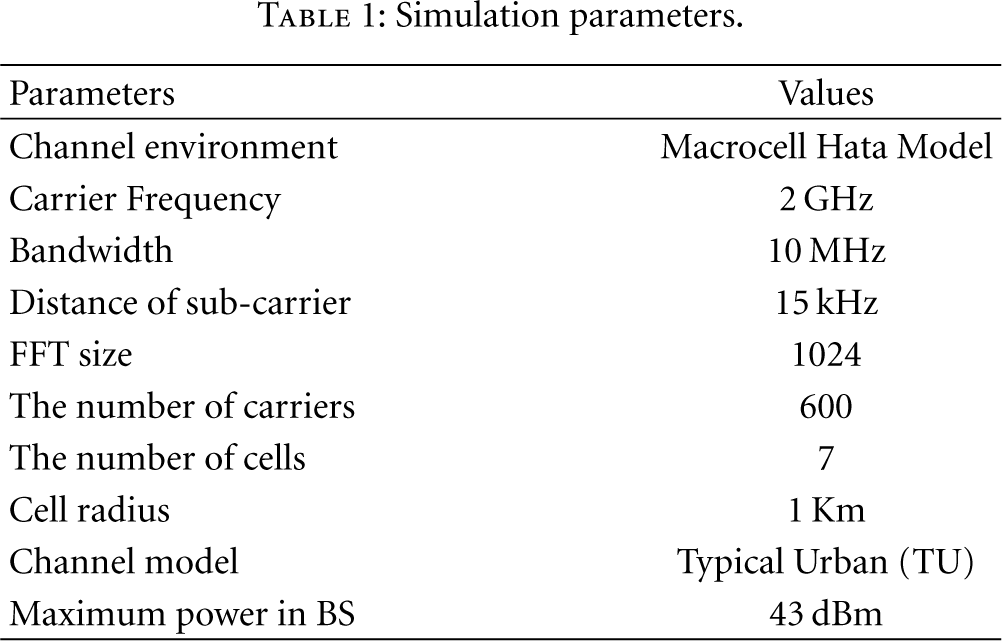
In order to compare the performance for the proposed subcarrier optimization method, simulation is taken in CoMP and we take the scenario of intracell multiple users as an example. The basic simulation parameters are referenced from LTE proposals, as shown in Table 1 [15, 16]. We mainly analyze the performance of throughput, blocking probability and average data rates in cell-edge. Moreover, the users per cell are generated by Monte Carlo method.
Simulation parameters.
Four schemes for subcarrier resource optimization are analyzed in simulation and, respectively, are as follows.
Scheme 1: CoMP: subcarrier allocation based on GINR, CoMP: power allocation based on balanced SINR. Scheme 2: Fixed subcarrier allocation, CoMP: power allocation based on balanced SINR. Scheme 3: CoMP: subcarrier allocation based on GINR, Fixed power allocation. Scheme 4: Fixed subcarrier allocation, Fixed power allocation.
In Scheme 1, the joint subcarrier optimization method takes the cooperation among different antenna units and eNodeBs, respectively, subcarrier allocation with maximum GINR, and power allocation based on balanced SINR. On the basis of CoMP, the state of cofrequency subcarriers are cooperated among cells, enables to control intercell interference, select subcarriers, and allocate power. Scheme 2 takes fixed subcarrier allocation (allocate a group of adjacent subcarriers or interval subcarriers to users), while it takes dynamically power allocation based on balanced SINR. Scheme 3 takes subcarrier allocation with maximum GINR, while it takes fixed power allocation (partial power in cell-center and full power in cell edge). Scheme 4 is a traditional scheme; both fixed subcarrier allocation and fixed power allocation are taken.
Figure 3 shows the throughput comparison by different subcarrier resource optimization schemes. It can be seen that as the growth of users, the throughput in cell gradually increases. Especially, when users per cell are the same with these four schemes, the throughputs in Scheme 1 are raised more than Schemes 2, 3, and 4, illustrate that the subcarrier resources are optimized by means of CoMP.

Throughput comparison.
Moreover, Scheme 2 is better than Scheme 3 since each scheme takes different optimization ways. One is in power allocation, whose process is dynamical and the power on each subcarrier is adjusted to keep the balanced SINR among cells. The other is in subcarrier allocation, which is a static process. It searches for the largest GINR as the objective subcarrier. From this comparison, it can be seen that the power optimization plays an important role in subcarrier optimization process. Scheme 4 takes traditional ways without consider intracell cooperation. Compared with Schemes 3 and 4, the throughput is raised by the proposed subcarrier allocation method, whose performance is better than traditional ways.
Figure 4 compares the blocking probability with the change of users per cell under different schemes. From this graph, it can be seen that the blocking probability grows as the increase of users per cell.

Blocking probability comparison.
For Schemes 2 and 4, the performance is mainly improved by proposed power allocation method. For Schemes 3 and 4, the performance is mainly improved by proposed subcarrier allocation method. By optimizing subcarriers, the blocking probabilities are decreased compared with the traditional ways. Moreover, the blocking probability decreases more by using the proposed power allocation method than the proposed subcarrier allocation method. Specially, it takes joint subcarrier optimization ways in Scheme 1, shows its blocking probability, and reduces into the minimum extent among four schemes.
Figure 5 shows the average data rates in cell edge. Similarly as throughput, it can be seen that the average data rates are raised the most by Scheme 1. In addition, the performance of Schemes 2 and 3 are also well. As a traditional way, the improvement of data rates brought by Scheme 4 is in a low level.

Average data rates comparison for cell-edge users.
From this comparison, it can be found that the data rates in cell edge are raised greatly by the proposed schemes, which illustrates that such schemes with CoMP enable to improve the performance in cell edge.
5. Conclusion
In this paper, a novel CoMP architecture is proposed for LTE-Advanced, which is based on Group Cell concept. Besides, four scenarios for CoMP are also introduced, respectively, single user in intracell, multiple users in intracell, single user in intercell, and slide handover in intercell.
In order to mitigate the intercell interference and improve performance with CoMP transmission, a joint subcarrier optimization method is proposed, which, respectively, are subcarrier allocation with maximum GINR and power allocation based on balanced SINR. On this basis, three combined optimization schemes are given in this paper by means of CoMP technology.
Compared with traditional ways, simulation results show that the proposed schemes improve throughput and reduce the blocking probability. Moreover, the data rates are also raised in cell edge.
Footnotes
Acknowledgments
This work is supported by project of National Natural Science Foundation of China (61001116), BMSTC Project (D08080100620802), National 863 project (2009AA011506), State Emphasis Special project (2009ZX03003-011-02), Sino-Swedish Project (2008DFA12110), and Fundamental Research Funds for the Central Universities.