




Abstract
Using high-intensity femtosecond laser pulses for surface structuring, technologically important metallic light absorbers (dark Au, W, and Ti alloy) with absorption of about 85–95% over a broad wavelength range from ultraviolet to infrared were produced. It was found that the enhanced absorption of the dark metals is caused by a rich variety of nano-/microscale surface structures. The dark metals produced in this study may find a variety of applications in the fields of renewable energy and energy efficiency, such as thermophotovoltaics, solar energy absorbers, thermal radiation sources, and radiative heat transfer devices.
1. Introduction
The femtosecond laser has been shown to be an advanced tool in material processing and micromachining [1–4]. Recently, Vorobyev and Guo have developed a technique that allows to transform highly reflective metals to either totally absorptive or reflecting only a certain color of light, creating the so-called black and colored metals [5, 6]. Among different metallic materials, gold, tungsten, and Ti alloys are materials widely used in many applications. In this paper, by tailoring femtosecond laser-induced surface structures, dark Au, W, and Ti alloy (Ti90/Al6/V4) were produced and their spectral optical properties in the wavelength range of 250–2500 nm were studied. In the entire wavelength range, the absorptance of the darkened metals increases to about 85–95%. These measurements show that the darkened metals have high absorptance in the ultraviolet (uv), visible, and infrared (IR) spectral regions. The study shows that the enhanced absorption of the dark metals is caused by a rich variety of nano-/microscale surface structures. The technique used allows to produce a darkened area as small as a tightly focused laser spot, that is, down to about 10 μm, or as large as needed when a scanning laser beam is employed. The dark metals produced in this study may find a variety of applications in the fields of renewable energy and energy efficiency, such as thermophotovoltaics, solar energy absorbers, thermal radiation sources, and radiative heat transfer devices.
2. Experimental Setup
Experimental setup for darkening metals is shown in Figure 1. An amplified Ti:sapphire femtosecond laser system that consists of a mode-locked oscillator and a two-stage amplifier including a regenerative amplifier and a two-pass power amplifier was used for surface structuring. To produce surface structures, the laser beam is horizontally polarized and normally focused onto the samples [5, 6]. We studied femtosecond laser darkening of a large area (with a diameter of 24 mm) on metal samples. To produce a large darken surface area, we use raster scanning of the sample. In our experiment, the sample was moved by an X-Y motorized translation stage. The total reflectance of the blackened sample is measured at a constant light incidence angle of 8° over a wavelength range of 250–2500 nm using a Perkin-Elmer Lambda 900 spectrophotometer with an integrating sphere. Before laser surface treatment, the samples were mechanically polished and further cleaned with methanol. Surface structuring is performed in air at a pressure of 1 atm. Following laser treatment, the topography of surface structural modifications is studied using a scanning electron microscope (SEM).

Experimental setup for processing of metal samples.
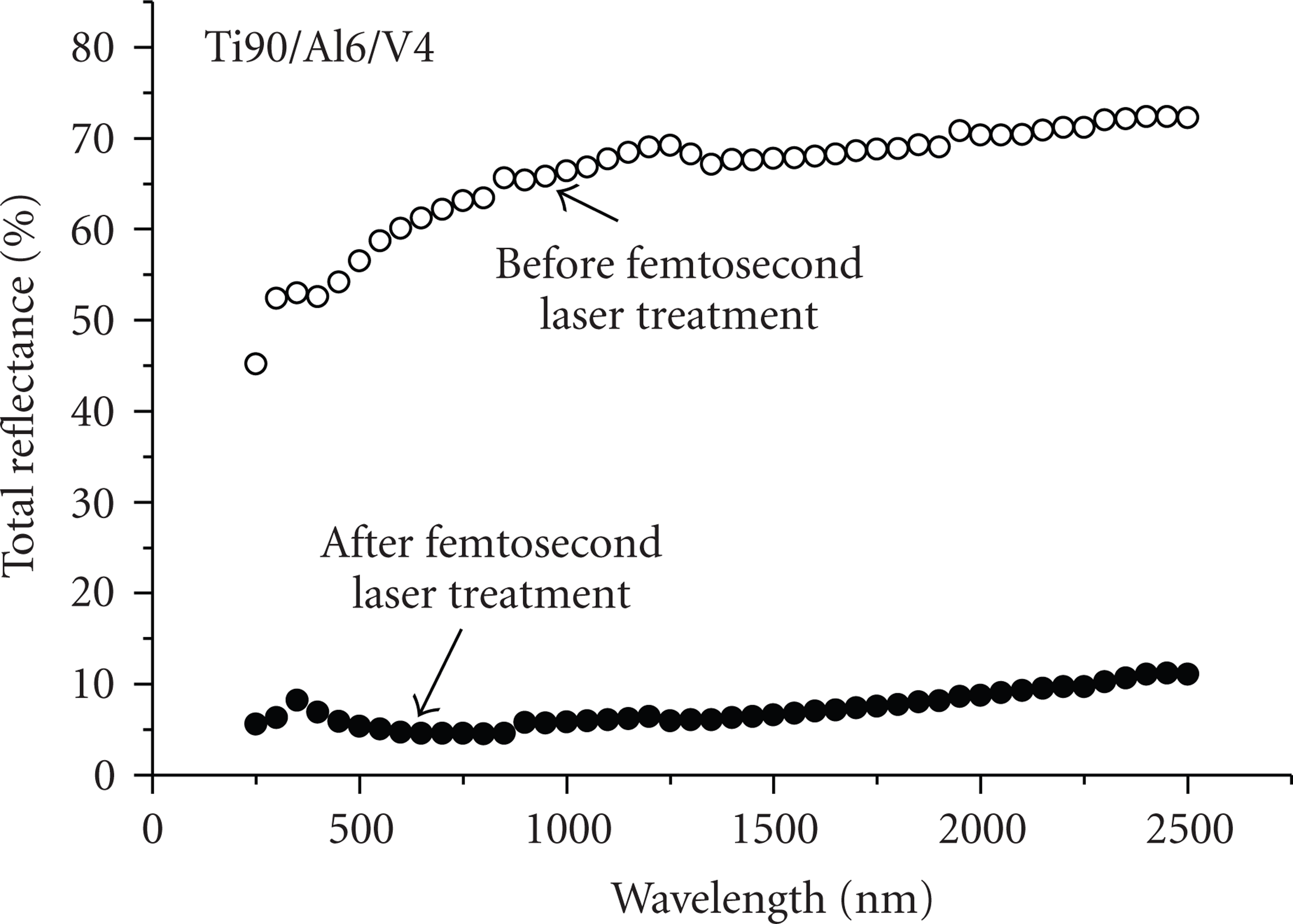
Spectral reflectance of the dark Ti90/Al6/V4 alloy as a function of wavelength. For a comparison, the reflectance of the polished sample before laser processing is also shown.

Spectral reflectance of the dark gold as a function of wavelength. For a comparison, the reflectance of the polished sample before laser processing is also shown.
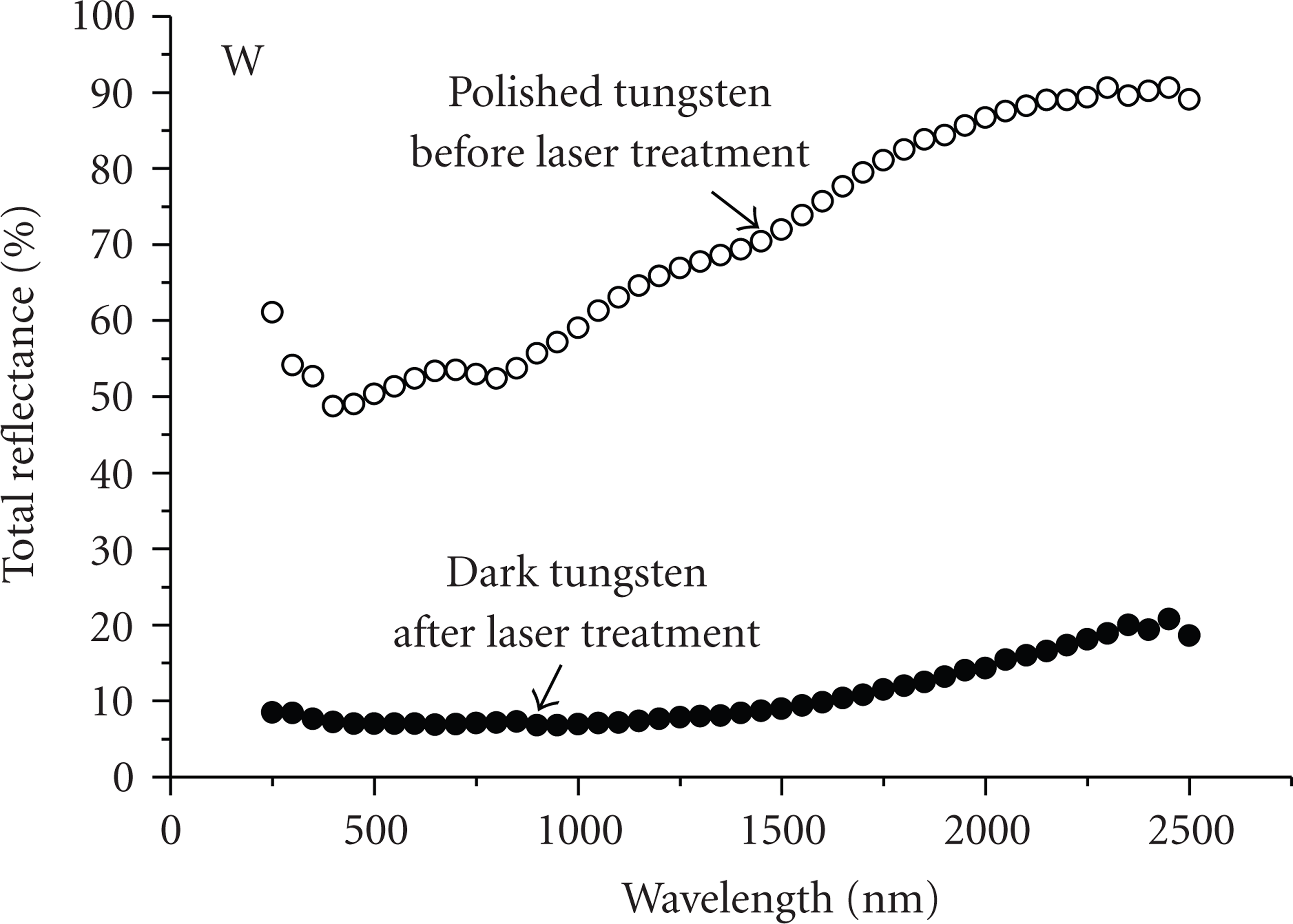
Spectral reflectance of the dark tungsten as a function of wavelength. For a comparison, the reflectance of the polished sample before laser processing is also shown.
3. Experimental Results and Discussion
The measured total reflectance of darkened samples as a function of wavelength both before and after laser processing is shown in Figures 2, 3, 4. It can be seen that the total reflectance of the darkened samples drops significantly in the entire wavelength range between 250 and 2500 nm, and its new value is below 10% in average. Due to a dramatically decreased reflectance in the visible wavelength range, the treated surface appears pitch black, and a photograph of the darkened tungsten sample is shown in Figure 5 as an example. Note that the surface structures produced in this study are not yet optimized for maximum darkness, and the remaining few percent of the reflectance can be suppressed with further optimization of the processing conditions.
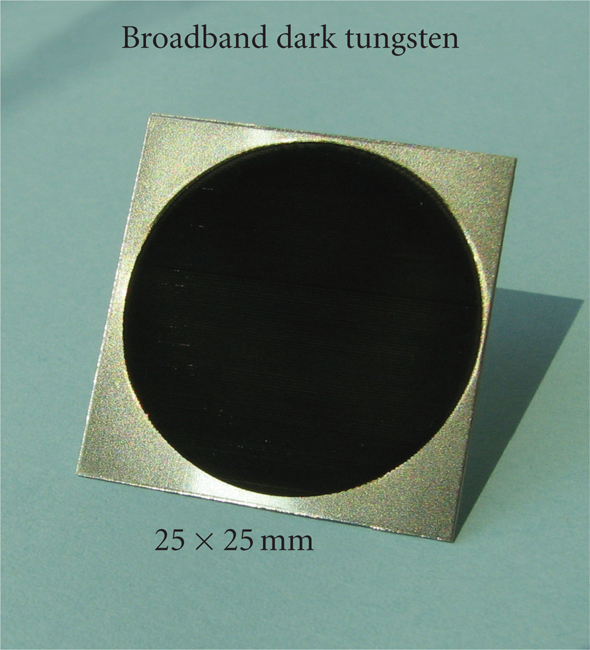
Photograph of the broadband dark tungsten sample.
To identify the surface structures that cause metals to appear dark, a detailed SEM study of the surface topography was performed. Representative SEM images of the surface structure for dark gold are shown in Figure 6. The images show that the surface of the dark gold has a rich variety of surface structures, including nano-/microscale voids, nanoprotrusions, microscale aggregates of nanoparticles that fuse onto each other and on the metal surface, and periodic grooves with a period equal to the vertical step between the adjacent horizontal scanning lines (about 100 μm as shown in Figure 6(a)). Surface topography of the dark W and Ti90/Al6/V4 alloy is similar to that of the dark Au.

SEM images showing surface structural features of the dark gold.
The observed strong broadband absorption due to femtosecond laser-induced surface structures can be explained as follows. The SEM study shows that the size of surface structural features ranges from nanoscale to microscale. Therefore, there are surface structures that are either larger or smaller than light wavelengths. The reduced reflectance observed in the experiments can result from several absorption mechanisms. The surface structures that are smaller than a certain light wavelength can contribute to light absorption due to antireflection effect of random subwavelength surface textures in terms of graded refractive index at the air/solid interface [7]. The surface structures that are smaller than light wavelength can also give rise to the enhanced absorptance due to plasmonic effect [8]. However, in contrast to isolated small metal particles, where surface-plasmon resonances occur at sharp individual frequencies [8], the aggregates of the coalesced nanoparticles of the dark metal cause a broadening of the resonances into a band of frequencies similar to the broadband optical response of random metallic fractals [9]. Another important contribution to the broadband absorptance of the black metal comes from a broadening of surface-plasmon absorption spectra induced by various sizes and shapes of surface nanostructures [10]. Lastly, there are also contributions to absorption from surface structures that are greater than the light wavelength due to trapping of the light in cavities and Fresnel angular dependence of reflection. The overall effect of all these absorption mechanisms results in a strong broadband absorption of electromagnetic waves.
Finally, we note that scanning a high-fluence laser beam across a sample surface can also be used for producing periodic groove structures on metals, as shown in Figure 6(a). The period of these periodic groove structures is determined by the vertical step between the adjacent horizontal scanning lines (about 100 μm for surface structure shown in Figure 6(a)). Using this approach, it is possible to produce periodic groove structures with a period, D, in the range of 10–1000 μm that provides an additional way to modify optical properties at infrared (5–30 μm) [11], THz (30–300 μm) [12], and even longer wavelengths. It is known that surface gratings with their period smaller than light wavelength can enhance absorption through both antireflection mechanism [13] and dissipation of excited surface plasmons polaritons into a metal surface [12]. Therefore, our femtosecond laser surface structuring technology can controllably enhance absorptance of metals from the uv to THz spectral range.
4. Conclusions
In summary, femtosecond laser surface structuring enables us to produce metallic light absorbers, the so-called dark metals, with high absorptance in a broad wavelength range covering uv, visible, and infrared. The enhanced broadband absorption of electromagnetic radiation is due to the creation of a unique combination of surface nano-/microstructures produced by femtosecond laser processing. In our study, the processing conditions for achieving maximum darkness were not optimized, and we believe that the remaining few percent of reflectance can be suppressed with further optimization of the processing conditions. By using this technique, the size of the darken surface area can be as small as a tightly focused laser spot, that is, down to about 10 μm, or as large as needed when a scanning laser beam is used. The broadband dark metals produced in this study may find a variety of applications in the fields of renewable energy and energy efficiency, such as thermophotovoltaics, solar energy absorbers, thermal radiation sources, and radiative heat transfer devices.
Footnotes
Acknowledgments
This work was supported by the US Air Force Office of Scientific Research and the National Science Foundation.