




Abstract
In multimedia sensor networks, there may exist simultaneously two streams: end-to-end stream and event-to-sink stream. It brings a new set of challenges for QoS guarantees in multimedia transmission. In this paper, we first present a self-adaptive QoS guarantee scheme based on two-layer feedback. In transport layer, we partition network into 10 typical states and design a transport protocol, which makes the state transition to the optimal one. Moreover, we design a revenue structure of media stream to describe the relation between QoS and multimedia capturing approaches in the application layer, thus evaluating the optimal scheme of capturing multimedia according to multimedia packet generation ratio calculated by transport layer. A series of simulation experiments using NS2 are performed to demonstrate the effectiveness of our proposed scheme.
1. Introduction
With the complexity of environment, conventional sensor networks [1], which are capable of collecting and processing simple scalar data such as temperature, humidity, or light, cannot provide users with complete and accurate knowledge to the monitored environment. It is desirable to introduce multimedia data (e.g., audio, video, and image) into environment monitoring activities in order to improve efficiency [2]. Motivated by this, multimedia sensor networks (MSNs) come into being. The characteristic of rich information, powerful capabilities, and flexible services doubtlessly make MSNs benefit from a plethora of data-hungry applications such as environment monitoring, traffic surveillance, security, and emergency response [3, 4].
Compared to conventional sensor networks, MSNs can provide more various service forms thanks to their capability of sensing and processing information-immense multimedia data. It is urgent to design effective QoS guarantee scheme to support flexible and reliable service for users. In general, MSNs have two kinds of basic service modes: event driven and query driven. (1) Event Driven Service Mode (E Service). In this mode, multiple sensor nodes preprocess (e.g., compress, identify, and match) the raw environmental data then filter out and transmit valuable semantic data (called as E data) to the sink node. (2) Query-Driven Service Mode (M Service). In this mode, service request can always be initiated by users. MSNs respond to these service requests and return media stream (called as M data) to users.
The above two service modes have different transport models. Opposed to the traditional end-to-end transport model, the event-driven service mode uses event-to-sink transport model [5]. However, in query-driven service mode, media stream follows end-to-end transmission scheme. Generally, these two service modes coexist in multimedia sensor networks. To the best of our knowledge, most of the existing transport protocols [6] merely focus on one specific reliability model, which is not suitable for the case of two transport models' coexistence in MSNs. Furthermore, they pay more attention to the transport QoS of simple scalar data not complex multimedia data.
In this paper, we present a transport protocol, which mainly aims at the coexistence of event-to-sink and end-to-end transport models in MSNs. Our goal is to maximize the QoS of E and M service while guaranteeing the operating efficiency (low congestion and low-energy consumption) of MSNs. First, we define the QoS concepts of two service modes for the above two service models. Second, according to E and M packets' arrival rates on sink node and network congestion level, we categorize 10 typical states of MSNs. The protocol adjusts E and M packets' transmission rates by states of MSNs, thus it optimizes the QoS metrics.
E packets' transmission rate can be adjusted by the varied report frequency of sensor nodes, and a new report frequency can be sent to a corresponding sensor node directly. However, for M service, because of its feature of multiparameter (e.g., for video stream, key parameters include color, resolution, and frame rate), a same M packets' transmission rate may correspond to different configurations of media parameters resulting in different M service's QoS. Therefore, the objective of adjusting M packets' transmission rate is to find an optimal configuration of media parameters to maximize QoS value while ensuring that the new transmission rate equals to the adjusted one. Here, we turn the pending problem into a conditional extremum one and feed the configuration of media parameters back to the corresponding sensor node in application layer. In this way, we relate transport protocol with the optimal configuration of media parameters by two-layer (transport layer/application layer) feedback, which could maximize the QoS values of both event-to-sink and end-to-end models.
The remainder of this paper is organized as follows. Section 2 overviews the related works. Section 3 defines the QoS concept of E and M services in MSNs. Section 4 describes a self-adaptive QoS guarantee scheme based on two-layer feedback. In Section 5, we carry out extensive experiments using NS2 simulator to evaluate the performance of our transport protocol. Finally, we conclude the paper in Section 6.
2. Related Work
We overview the related works from two aspects: QoS guarantees in application layer and QoS guarantees in transport layer.
2.1. QoS Guarantees in Application Layer
From the perspective of application, QoS parameters include sampling rate, delay, packet loss rate, and the number of active nodes. In other words, the application requires the gathering rate, node deployment, and the measurement accuracy of sensor nodes related to the application-level QoS. Kogekar et al. [7] presented a dynamic reconfiguration method in wireless sensor networks to guarantee application-level QoS under energy-constrained condition. However, QoS guarantees in application layer of MSNs have not been addressed. Alwan et al. [8] proposed an adaptive mobile architecture for multimedia networks, which focused on two layers of key importance in multimedia wireless network design, namely, compression algorithms in the voice/video application layer and routing algorithms in network layer. Self-adaptation and its corresponding algorithms can be implemented in application layer and MAC layer, respectively. However, the function of self-adaptation provided by application layer is not visible to users. Foresti and Snidaro [9] proposed an application-level negotiation algorithm for multimedia networks, with two distinct advantages: (1) globalization of local parameters, which makes resource reservation flexible to let users reserve QoS parameters directly; (2) localization of global parameters, which makes resource reservation simple and makes it easy to perform the optimal delay assignment.
2.2. QoS Guarantees in Transport Layer
Many pioneering papers have addressed the issue of transport protocol [10] for conventional sensor networks. Reliable Multisegment Transport (RMST) [11] is a selective NACK-based protocol designed to run on top of the directed diffusion network layer protocol with two modes of [5] introduced the concept of “end-to-end reliable transport” and presented an event-to-sink reliable transport (ESRT) protocol. Reliable event detection at the sink is based on collective information provided by source nodes instead of on any individual report; however, the conventional end-to-end transport protocol is not applicable for event-driven traffic. Pump Slowly, Fetch Quickly (PSFQ) [12] is a transport protocol suitable for reliable data transmission, which is a simple approach with minimal requirements on the routing infrastructure using the minimum signaling, thus it reduces communication cost for data reliability and allows successful operation even under highly error-prone conditions. The delay-aware reliable transport (DART) [13] protocol is presented for timely and reliably transporting event features from the sensor field to the sink with the minimum energy consumption; the objective of DART is not QoS optimization. The log-normal shadowing model (LNSM) [14] captures the effects caused by the imperfect antennas and environmental obstructions. However, it is incapable of modeling the path loss for the continuously varying airborne height, and modeling as a function of elevation angle is more convenient.
3. Basic Concepts
Quality of Service (QoS) defines the satisfaction degree of service provided by network service provider. In this paper, we use utility [15] as an important QoS metric in MSNs, which is different from some traditional QoS metrics (e.g., average data packet delay, loss rate, resource utilization, etc.). The utility of service consists of two parts: (1) transmission efficiency, defined as the ratio of transmission rate to receive rate, is inversely related to packet loss rate; (2) user's revenue, defined as the satisfaction degree of application requirements comes from data receivers, is closely related to the number of data packets received per unit time.
As shown in Figure 1, supposing that at a given moment, there are i nodes in an event region to cooperatively gather abnormal event information to obtain better detect reliability, and j is the number of nodes providing real-time media streams for different M services. Hence, we can get that there are one E service and

Topology of multimedia sensor network with E and M data streams.
3.1. Transmission Efficiency
For each sensor node, the transmission efficiencies of M and E services are defined as
3.2. Revenue of E Service
For E service based on event-to-sink model, its revenue indicates the accuracy of event detection. Akan and Akyildiz [5] discussed the relation between event detection accuracy ζ and E packet receive rate

Accuracy function of event detection.
3.3. Revenue of M Service
For M service, its revenue refers to the traditional multimedia QoS metrics (e.g., color, resolution, and frame rate for video streaming). In our prior work [16], we proposed a method to describe QoS requirements for media stream in MSNs. This method categorized some principle parameters which have an influence on multimedia service. The users can assign different weights to each parameter by application requirements, and different weights reflect the importance level of parameters in different applications.
In this paper, we use the prior method to describe the relationship among the revenue of media stream, the transmission rate of M packets, and the configuration of parameters. As shown in Figure 3(a), the structure is composed of three layers; the root node is the revenue ζ of multimedia application. The second-layer nodes are media parameters

The revenue structure of media stream.
There is typically a positive correlation between the value of each parameter and the revenue value. For example, the application revenue, when a node receives video stream with 30 frames/sec, is obviously greater than that with 20 frames/sec. If we assume the contribution to the revenue as 1 when the value of
Since the numbers of pixel along x-axis and y-axis determine the resolution of video stream, we express the resolution with two parameters (
Definition 1.
If the revenue of a stream media service is determined by n parameters, then the parameter configuration vector
For each V, the revenue can be calculated as

For M service, the revenue is effected by two factors: the parameter configuration of stream media V and the receive rate of M packets

The problem of QoS guarantees in multimedia sensor networks can be described as follows. Without network congestion, how to guarantee the revenue of E service while maximizing the revenue of M service by selecting the optimal configuration of parameters of M data?
4. Self-Adaptive QoS Guarantee Scheme
First, we propose a self-adaptive QoS guarantee structure based on two-layer feedback. The QoS guarantee structure consists of two layers: transport layer and application layer. In transport layer, transport protocol adjusts the transmission rates of M and E services, in order to guarantee QoS of these two services under the condition of no network congestion. When the transmission rate of E service changes, the transport layer feeds back a new transmission rate to the corresponding sensor node; when the transmission rate of M service changes, application layer generates the optimal configuration of media parameters by the new transmission rate then feeds back the configuration to the corresponding sensor node in application layer.
The kernel of our self-adaptive QoS guarantee scheme is to adjust transmission rate of M and E packets and generate the optimal parameter configuration of M data. We use a transport protocol and configuration method of streaming media parameters to solve the above problems. Considering sensor node's limitation on both energy and computation, the main computation is executed on the sink node.
4.1. Partitioning of Value Space of S
To adjust transmission vector S, we first analyze the relation among S,
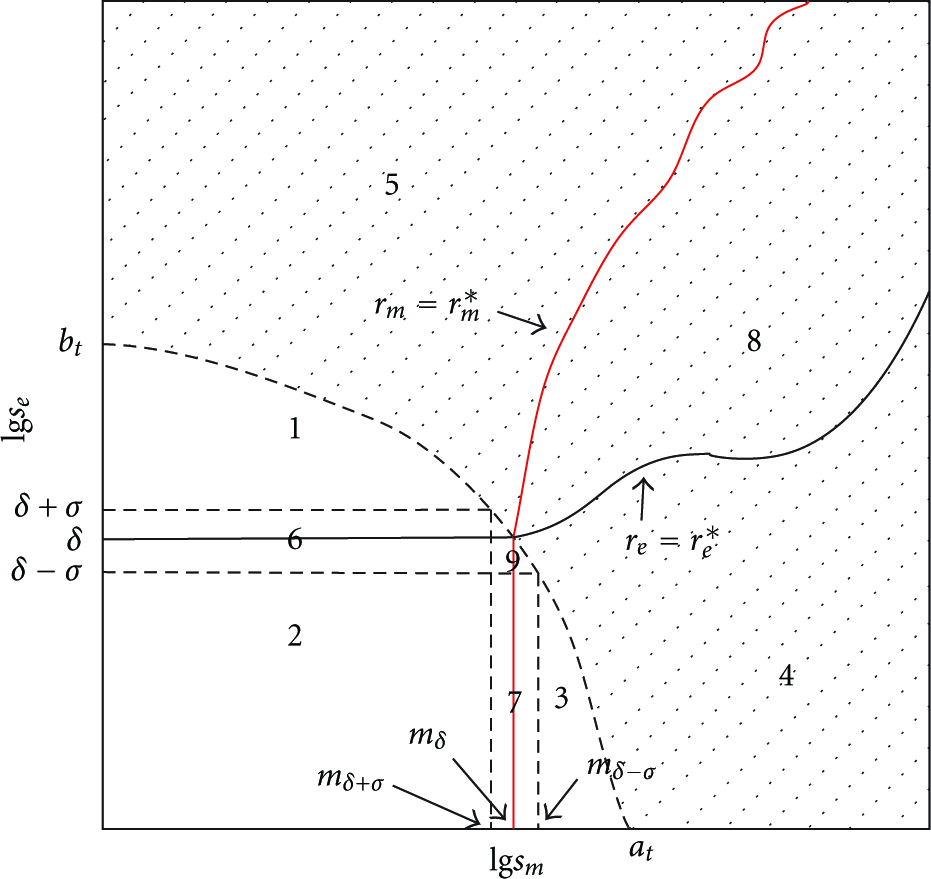
Partitioning of typical region of transmission space.
Assume that when
The line
4.2. Transport Protocol
From a series of simulation, we can find that when receive rates
Network states.
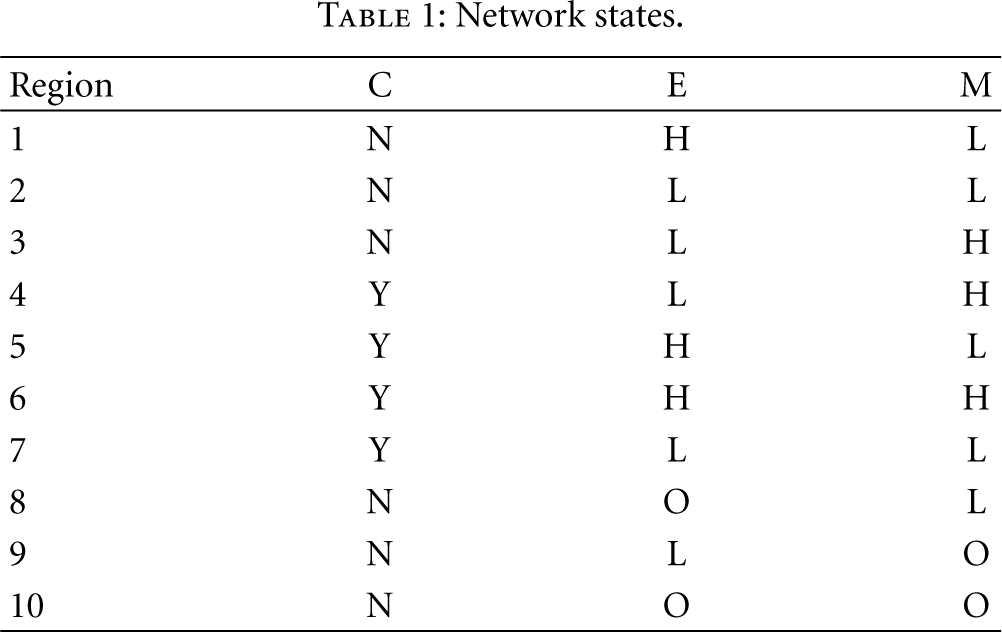
According to network states, we design a transport control protocol, which can bring the network into the optimal state (N, O, O) by adjusting
/* (1) If (CONGESTION); (2) If ( /* State(Y, H, -), approximation methods. */; (3) (4) ELSE /* State methods.*/; (5) (6) End; (7) Else if (NO CONGESTION); (8) If( /* State (N, O, L), (9) (10) Else if /* State (N, L, O), (11) (12) Else if ( /* State (N, O, O), the state remains unchanged. */; (13) Else /* State (N, L, L) or (N, H, L) or (N, L, H), are adjusted linearly. */; (14) (15) End; (16) End;
4.3. Optimal Solution for Media Gathering Configuration Vector
Assume the length of M packet is T, we can get 

For example, consider a video stream with resolution
According to (2), (3), and (4), we can formalize the Problem as follows: to find a parameter configuration vector
If the maximum value of 


Solving the group of equations

We can get
Since
5. Experimental Results and Performance Analysis
5.1. Simulation Environment
In order to perform empirical evaluation of our transport protocol, we conduct simulations using NS2. All of our simulations are based on the same scenario, where 50 nodes are randomly deployed in the target region of
Configuration parameters of nodes.

Data generation scheme.

5.2. Relationship between Receive Rate and Transmission Vector
In order to partition the value space of

Relationship between receive rate and transmission vector.
In order to explain the relationship among
5.3. Case of Transport Protocol Operation
In this section, we carried out 4 groups of experiments starting with 4 different initial states, as shown in Figure 6. All experiments are based on the same topology and adopt the data generation scheme above.

State transition process with initial state.
For E service, we set
Figures 6(a)–6(d) represent the state transition process with 4 kinds of initial states: (N, L, L), (N, H, L), (N, L, O), and (Y, H, -), respectively. The value of y-axis is
When
When
When
When
5.4. Generation Case of Parameters Configuration
Assume that the revenue structure for video streaming service is as shown in Figure 3(b), there are four parameters (color, x-axis and y-axis resolutions, frame rate) in the configuration. Generally, x-axis and y-axis resolutions have a fixed ratio, and their revenue contributions are equal, so we can merge the two parameters into the resolutions. There are three types of parameters: color
We calculate the extremum points of the three equations above, respectively. Set
Meanwhile, due to constraints of physical devices, the value range of q is not continuous but consists of discrete points within
6. Conclusions
In this paper, we propose a self-adaptive QoS guarantee scheme based on two-layer feedback for multimedia sensor networks, which combines transport control protocol and the optimal configuration of media parameter in application layer. By analyzing the relation between M and E packet's transmission rate and receive rate, the network state is partitioned into 10 typical states according to the utility of two services and network congestion status. Furthermore, the transport layer maintains a network state transition map, adjusts the transmission rates, and feeds them back to the corresponding sensor nodes by the current network state. The application layer maintains a hybrid structure, which describes the relation of multimedia gathering and receipt parameters. Application layer calculates the optimal configuration of media parameter and feeds back to the sensor node according to M packet's transmission rate.
Footnotes
Acknowledgments
This work is supported by the Natural Science Foundation of China under Grant No. 61070205 and No. 61070206, the program of New Century Excellent Talents in University of China under Grant No. NCET-08-0737, the Beijing National Natural Science Foundation under Grant No. 4092030, and the Cosponsored Project of Beijing Committee of Education.