




Abstract
An ACSR (Aluminum Conductors Steel Reinforced) power line, when it lies in a fire environment, can manifest a permanent elongation and change in bending, as when the conductors attain a temperature of over 500°C, a drastic fall of the mechanical strength of the steel core is caused. This work is a study about the conductor cross-section at the position of the abruption, in case it occurs. This cross section appears to be approximately 62.5% of the original value. Subsequently, two approximative methods of calculating the bending change of overhead lines are shown.
1. Introduction
Wildfires in an area with dry vegetation and trees during summer months are usually caused by human negligence and spontaneous combustion in small spaces with garbage, pine needles, and so forth. The propagation of a wildfire usually intersects with an energy line, due to the great spread of transmission and distribution networks.
The conductors, primarily used in high- and middle-voltage networks, are of the ACSR type (Aluminum Conductors Steel Reinforced). Their mechanical strength stems from the steel core while the conductivity is mainly due to the aluminum strands.
From experimental material strength studies, it is known that the resistance of a metal to deformation is given by its tensile strength and its yield stress. Experimental studies show that steel heated to a temperature of 500°C exhibits a decrease of its modulus of elasticity to 1/3 of its original value [1, 2].
This work concerns the permanent change in bending of an ACSR power line present in an agrarian area, when, due to a fire, the conductors temperature exceeds 500°C. Additionally, the lowest possible cross-section achievable by a conductor without suffering abruption is investigated. Finally, two approximative methods of calculating the bending change due to the permanent elongation are shown.
2. Permanent Conductor Elongation due to a Fire
For a flame temperature of θ = 870 to 1000°C due to the fire [4, 5], the result of the following equation [1, 6] is the minimum linear thermal expansion Δl of solids (in this case of the ACSR conductor steel core):

where a = 0.000124 1/°C is the steel coefficient of linear expansion, l is the initial length of the conductor, and
From the above, it can be concluded that the conductors do not revert to their original length (after the extinguishing of the fire), as due to the strain forces of the network, the simultaneous thermal stress, and the decrease of the modulus of elasticity they gain an additional elongation. If σ is the tensile stress of the conductor steel core, then according to Hooke's law [1, 3] it holds that:
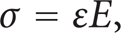
where E is the modulus of elasticity and ε is the tensile strain (the change in length Δl per unit of the original length l). This equation holds for the linear range of the characteristic
Consequently, as the tensile stress σ is approximately the same before and after the fire and the modulus of elasticity E is one third of its original value due to the thermal stressing, the tensile strain ε is three times greater after the fire [1, 3]. This means that the elongation is at least three times greater than the linear thermal expansion Δl. Once the fire is extinguished, the conductors cool down and contract as they are no longer thermally stressed. The contraction is considered to be equal to 1/3 of the elongation [1], leaving a permanent elongation of
3. Calculations of Line Bending before and after the Fire Using the Line Catenary Curve
For the calculation of the line curve before and after the fire, the equations of the catenary curve for suspension at equal altitudes are used [7, 8]
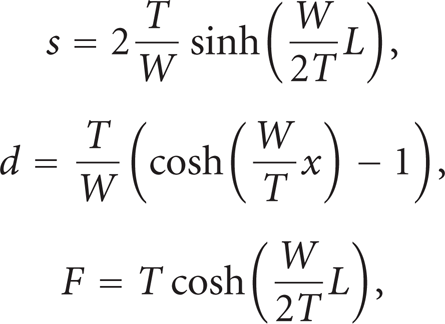
where s is the conductor length, T is the tensile stress, F is the force stressing the poles, L is the distance between the two poles, W is the weight per meter of the conductor, x is the horizontal distance from the pole, and d is the vertical distance of the conductor from the suspension height.
These equations can be modified for suspension at unequal levels
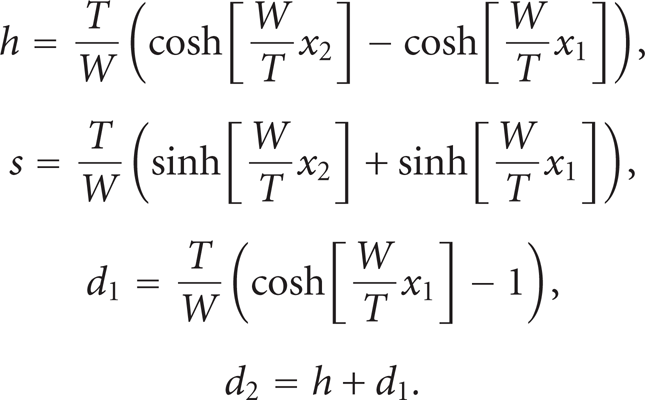
where h is the altitude difference between the conductors’ suspension heights on the two poles, d1 and d2 are the maximum vertical distances of the conductor from the two suspension heights, respectively, and
Firstly, the tensile stress T and the initial length of the conductors s before the fire are calculated. Additionally, the maximum vertical distances d1 and d2 of the conductors from the suspension heights of the two pylons, respectively are calculated. Consequently, the conductor length before the fire and the permanent elongation are added giving the conductor length after the fire. Next, the emerging equation system is solved for the tensile stress and the horizontal distance from the pole which maximizes the line bending after the fire.
The application of this method to different cases of ACSR lines showed a decrease of the conductor tensile stress to about 70% of its original value.
4. Approximative Calculation of Line Bending before and after the Fire
The calculation of line bending before the fire can also be accomplished approximating the conductor curve with a parabola, instead of a catenary curve [7, 8]. If the following are known:
the conductor weight per meter before the fire W,
the length of the conductor before the fire L,
the altitude difference between the conductors’ suspension heights on the two poles h, and
the tensile stress before the fire T,
the vertical distance of the conductor from the suspension height d can be calculated.
The following are needed for the calculation of line bending after the fire d o :
the permanent conductor elongation due to the fire (c.f. Section 2)
the new conductor weight per meter W o due to the aforementioned permanent elongation, and
the tensile stress after the fire T o .
An approximation of T o , can be made, considering the tension of a steel rod, which is supposed to be the ACSR conductor's steel core, to which the conductor mechanical strength is owed. From material strength studies, it is known that when a steel rod, whose cross-section is A, is tensile stressed and abrupted, the cross-section of the abruption position A T is [3] (Figure 1)


Cross-section of the abruption position A T of a tensile stressed rod [3].
This phenomenon is related to the temperature increase of the material in the abruption position. This temperature increase can be attributed to internal mechanical strains. Consequently, when a rod is tensile stressed, elongated but not abrupted, its cross-section A1, in the thinning position, fulfils the following inequalities:
When heat is transferred from a burning agrarian area to a tensile stressed conductor, the steel core mechanical strain is increased as the conductor is expanding according to (1). In the case of a fire, the needed heat for abruption is offered from the environment. Thus, if an abruption occurs, (5) still holds. Correspondingly, if the conductor is elongated but not abrupted, its new cross-section A1 fulfills the above inequalities. It holds for the tensile stress T o after the fire that

Indeed, from the application of the methodology described in Section 3 to a real transmission line, (6) is satisfied as
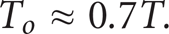
Inequality (6), and much more so (7), can be useful to the approximate calculation of line bending after the fire. Hereupon, two approximative methods are shown.
4.1. The 1st Approximative Method
Supposing that the curve of the conductor between two poles is a parabola, the following equations describe the forces on a point of the curve (Figure 2):


Approximation of the conductor curve between two poles as a parabola.
It was supposed that the conductor length L is equal to the curve projection to the x-axis. This supposition is valid due to the small distances between the poles. Hence, it arises from (8) that

The following equations hold for line suspension at unequal levels, as shown in Figure 3:


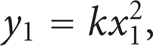
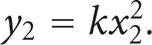

and from (11) and (14), it follows that

Next, from (10) and (15), it arises that

However the distance of the parabola curve from the straight line connecting the positions of suspension

where r1 and r2 are the horizontal distances of the point for which the line bending is calculated from the two poles, respectively.

Line suspension at unequal levels.
Finally, from (12), (16), and (17), it follows that
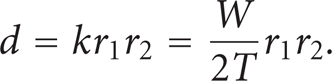
As an arithmetical example a medium voltage line ACSR 35 mm2 with the following characteristics is given:
Consequently,
Next,
before the fire

after the fire
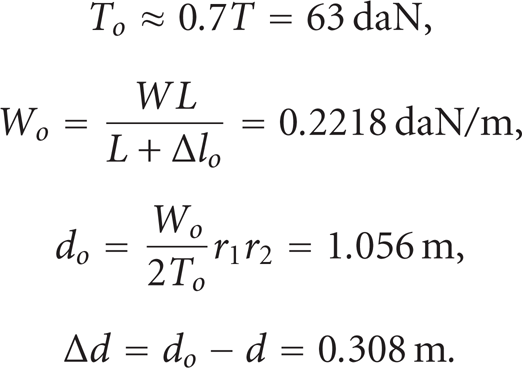
4.2. The 2nd Approximative Method
This method is based on the treatment of the conductor curve as a section of a parabola between two poles of equal altitude. The following equations hold [7] (Figure 4):
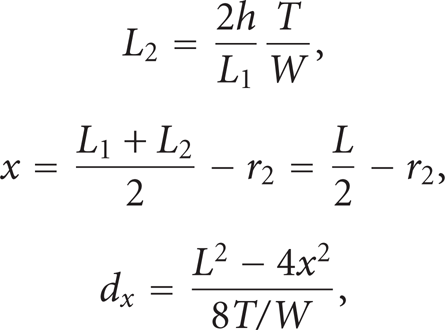
where the origin of the x-axis is considered as the point where the parabola exhibits a minimum, and x is the distance between the start of the axis and the point for which the line bending is calculated, L1 is the distance between the two poles, L2 is the distance between the first pole and the hypothetical pole, and d x is the distance of the parabola curve from the straight line connecting the positions of suspension at equal levels.
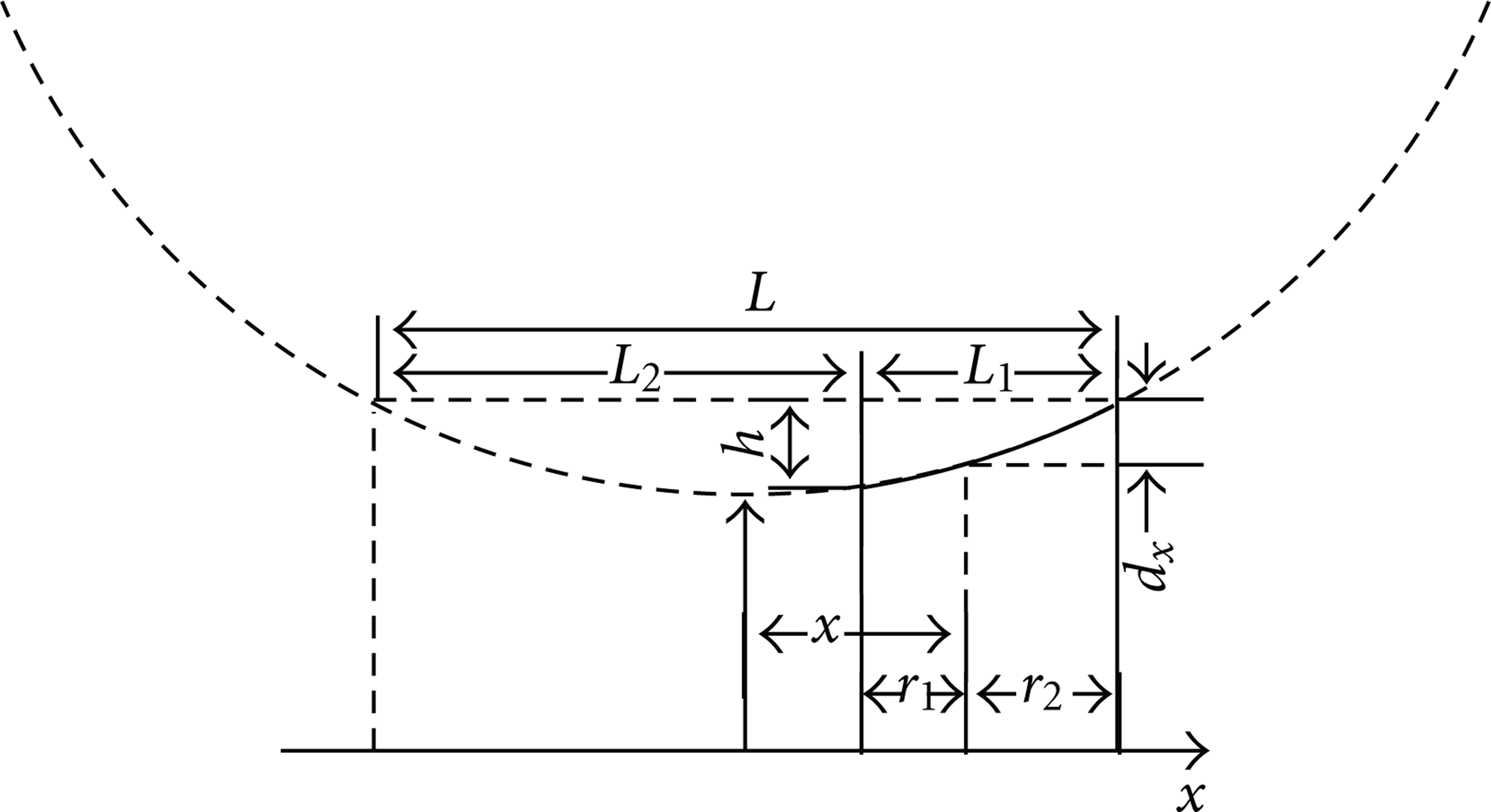
Calculation approximation supposing that the line is part of a line suspension at equal levels.
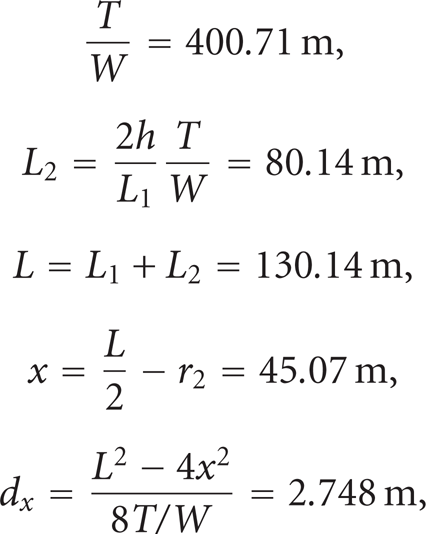
As an arithmetical example of this method, the data of the previous example are used.
Consequently
before the fire,
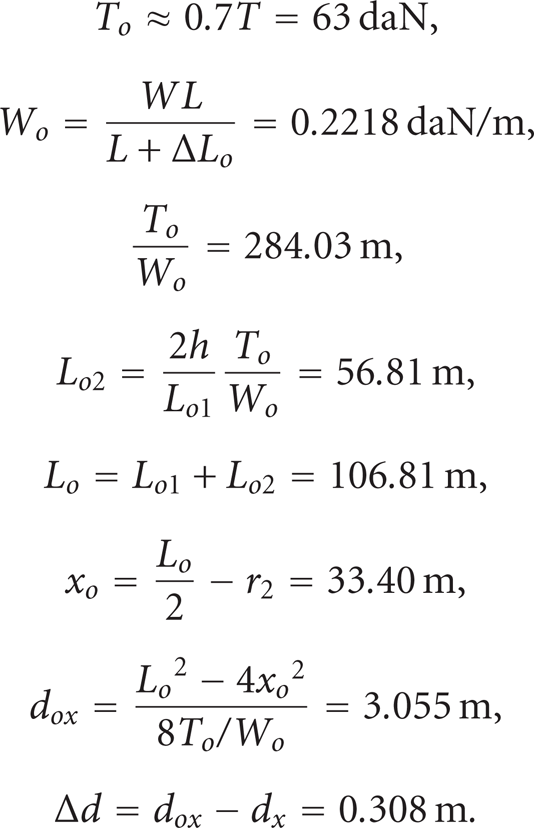
after the fire,
5. Conclusions
From the performed calculations, it appears that when ACSR conductors attain a temperature of over 500°C due to a fire, a drastic decrease of the mechanical strength of the steel core is caused. This results in greater line bending after the extinguishing of the fire.
Additionally, it is shown that if the conductor is not abrupted, its cross-section is at least 62.5% of the original. Consequently, the tensile stress is also at least 62.5% of the original. On the other hand, conductor abruption implies that the cross-section, in the abruption position, was decreased beyond this threshold.
Moreover, two approximative methods of calculating the bending, before and after a fire, were shown. For the application of these methods, it is proposed that the tensile stress should be considered equal to 70% of its original value after the fire.