




Abstract
The paper discusses the behavior of beams with external damping patches made of auxetic materials. The damping force is modeled by using the nonlocal theory. Unlike the local models, the nonlocal damping force is modeled as a weighted average of the velocity field over the spatial domain, determined by a kernel function based on distance measures. The performance with respect to the eigenvalues is discussed next, in order to avoid resonance. The optimization is performed by determining the location of patches from maximizing the eigenvalues, or the gap between them.
1. Auxetic Materials
Materialswith negative Poisson's ratio are termed by Evans et al. [1] as auxetics or auxeticmaterials. The term auxetic is coming from the Greek word auxetos, meaning that which may be increased. Instead of getting thinner like an elongated elastic band when stretched, an auxetic material gains volume, expanding laterally. Auxetic materials and their negative Poisson's ratios have not been well understood. Materials of this type are expected to have interesting mechanical properties, such as high energy absorption, fracture toughness, indentation resistance, and enhanced shear moduli, which may be useful in some applications; see, for example, Lakes [2–4], Overaker et al. [5], and Wang and Lakes [6]. The aforementioned authors studied the application of auxetic materials to damping devices, medical anchors, and cushions. Scientists have been aware of the existence of auxetic materials for over a hundred years, though without very special attention, and treating them as an accident ora curiosity. In the case of an isotropic material, the range of Poisson's ratio is from − 1.0 to +0.5, based on thermodynamic considerations of strain energy in the theory of elasticity. Love [7] presented an example of a cubic single crystal pyrite as having the Poisson's ratio of − 0.14, and he suggested that the effect may be caused by twinned crystals. Subsequently, an auxetic behavior has been observed in other naturally occurring single-crystal materials such as arsenic (Gunton and Saunders [8]) and cadmium (Li [9]). Baughman et al.[10] have extended earlier studies to reveal that 69% of the cubic elemental metals and some face-centered cubic (FCC) rare gas solids areauxetic when stretched along the specific [110] off-axis direction.
The auxetic behavior is found in materials from molecular and microscopic levels up to the macroscopic level. Negative Poisson's ratios are observed in real materials with a high degree of anisotropy, such as conventional honeycomb network, re-entrant honeycomb and hexagonal structures (Figure 1), reticulated metal foams, the skin covering a cow's teats, certain rocks and minerals, living bone tissue, and so forth. Fabrication of man-made auxetic materials and structures has succeeded, that is, composite laminates, microporous polymers, 2D honeycombs and 3D foams. All major classes of materials (polymers, composites, metals, and ceramics) can exist in auxetic form. A specific feature exhibited by auxetic materials in comparison with other foams is their significant damping capacity at various loading levels, with increase up to 16 times compared to conventional foams (Scarpa et al. [11], Donescuet al. [12], Donescu et al. [13], Chiroiu et al. [14], andMunteanu et al. [15]).
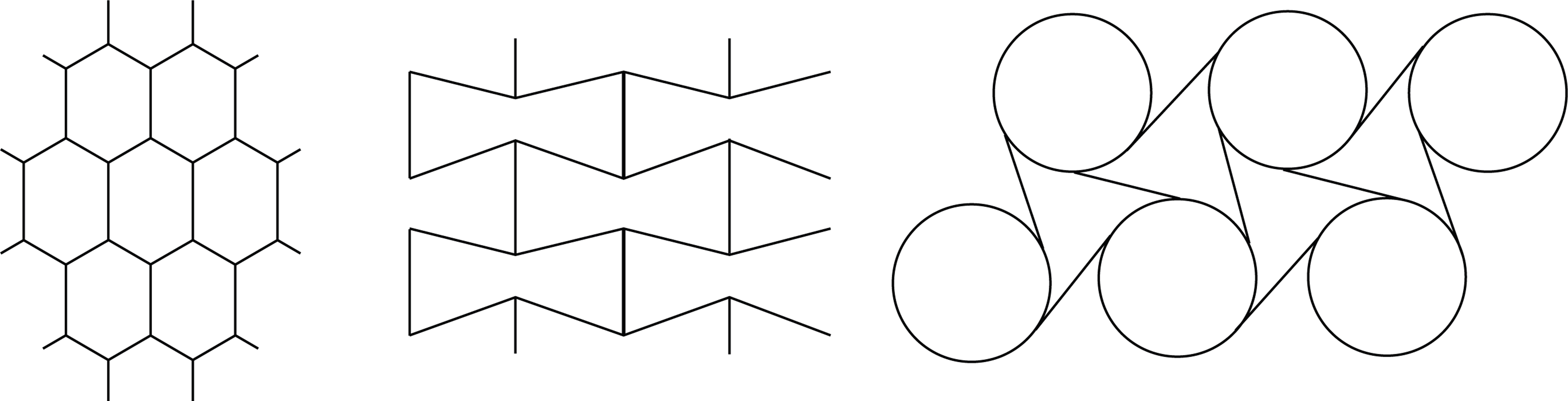
Conventional honeycomb network, re-entrant honeycomb and hexagonal structures, with negative Poisson's ratio.
In this paper, the damping capacity of an auxetic material is tested by adding to an aluminum beam several externaldamping muffled patches made of conventional grey open-cells polyurethane foam (Scarpaet al. [16]). To describe the damping capacity of this material, the nonlocal theory is considered since the nonlocal energy loss per unit volume versus the number of hysteretic cycles has shown to be a better approximation of the experimental results (Friswell et al. [17, 18]) than the local energy loss. The nonlocal damping force is modeled as a weighted average of the velocity field over the spatial domain, and it is determined by a kernel function based on distance measures (Flugge [19]). Lei et al. [20] analysed the nonlocal damping model including time and spatial hysteresis effects for Euler-Bernoulli beams and Kirchoff plates by using the Galerkin method. Such models are a generalization of the viscous damping, and examples include structures with viscoelastic damping layers, structures supported on viscoelastic foundations, long adhesive joints in composite structures and surface damping treatments for vibration suppression using fluids (Ghoneim [21], Adhikari [22], Adhikari etal. [23]). Wagner and Adhikari [24] gave more background and references for nonviscous damping models in which the damping forces are assumed to depend on velocity time histories, as well as instantaneous velocities.
2. Theory of Nonlocal Damping
The governing equation of motion for a linear damped Euler-Bernoulli beam may be expressed as [20]

where x is the spatial variable, t is time, L is the length of the beam, and ℒ is the nonlocal operator defined by

The last term in (2) is defined as

where C(x,ξ,t-τ) depends on the displacement only. Equation (1) is subjected to the initial conditions

and appropriate boundary conditions. If the damping kernel functions are assumed to be separable in space and time, we can write C(x,ξ,t-τ) in a general form as [20]

Expression (5) represents the general form of nonlocal viscoelastic damping model. The Heaviside function H(x) denotes the presence of nonlocal damping. We have H(x) = H0 (constant) if x is within the patch, and H(x) = 0 otherwise.
In this paper, we study the spatial hysteresis with the kernel function given by a delta function with respect to time. In this case, C(x,ξ,t-τ) depends not only on the instantaneous value of the velocity or strain rate

but depends on the spatial distribution of the velocities

In (7), velocities at different locations within a certain domain can affect the damping force at a given point. This spatial hysteresis that describes the damping mechanism for quasi-isotropic composite beams is similar to the damping model proposed by Banks and Inman [25], Banks et al. [26], andSorrentino et al.[27]. The spatial kernel function, c(x-ξ), is normalized to satisfy the condition

The Poisson ratio is an important factor in defining the spatial kernel. As the method involves a specifically choice of c(x-ξ), applicable to auxetic materials, a preliminary work is necessary. The purpose is to estimate the damping capacity for a sample beam made of conventional grey open-cells polyurethane foam, and to choose the best form for c(x-ξ) so that the variation of the energy loss per unit volume with respect to the number of compressive cyclic loadings is the closest to the experimental data (e.g., Bezazi and Scarpa [28] and Scarpa et al. [11]). The polyurethane sample is obtained from cylinders having the diameter of 30 mm and length of 170 mm. Then, it is compressed inside the mould obtaining a final nominal diameter of 20 mm and length of 100 mm. Figure 2 defines the compressive loading and displays the variation of the Poisson's ratio with respect to compressive strain for this sample [28]. The auxetic foam exhibits a negative Poisson's ratio of − 0.185 at compressive strain from 10 to 25%, showing a sharp increase for rising compressive strain, reaching then the zero value at 55% of compressive strain and a positive Poisson's ratio of 0.083 at 70%. For any given loading cycle, the dissipated energy is

Poisson's ratio versus compressive strain for auxetic foam (from [28]).

In Figure 3, we present the energy loss per unit volume (mJ/cm3) versus the number of compressive cyclic loadings for an auxetic sample, obtained by the local theory, nonlocal theory with spatial kernel function given by (9) with α=0.22, and experiments (Scarpa et al. [11]), respectively. While the nonlocal and experimental values of the energy have similar values after 20000 cycles, the local values are lower with a decrease by 35.7%.
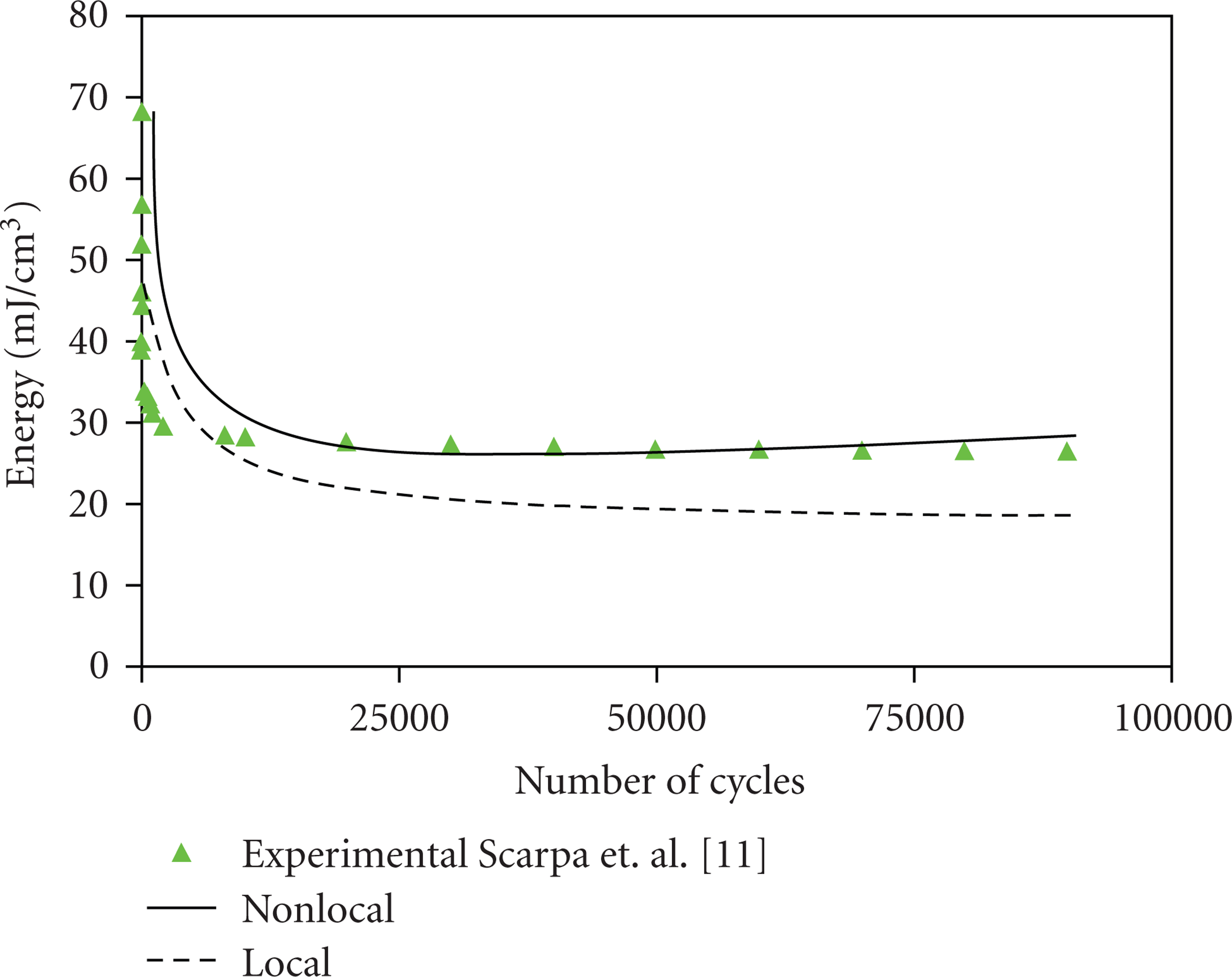
Damping capacity of an auxetic sample (local, nonlocal, and experimental).
3. The Equation of Motion
The external damping muffled patches are attached at (x1,x1+Δx1), (x2,x2+Δx2)⋯(x k ,x k +Δx k ), x2≥x1+Δx1, x i ≥xi-1+Δxi-1, i=2,…,k, as shown in Figure 4 (Chiroiu[29]). The design parameters are k p , x j and Δx j , j=1,2,…,k p , under the conditions x2≥x1+Δx1, x i ≥xi-1+Δxi-1, i=2,…,k p . The equation of motion for the beam is given by

The beam with external damping patches.

The third term represents the nonlocal external damping defined over the spatial subdomains (x i ,x i +Δx i ), i=1,2,…,k, as ([14, 20])

The damping kernel is defined by (7) and (9). The initial conditions (4) are written as

The associated boundary conditions are written for a cantilever beam

The eigenfrequencyproblem (10)–(12b) is characterised by the integro-differential equation (10), which can be analytically solved by using the cnoidal method (Munteanu and Donescu [30], V. Chiroiu and C. Chiroiu [31]).
The general solutions of (10) must be found as a sum of cnoidal functions

where N is the number of cnoidal functions (Jacobian elliptic functions) considered in the series depending on the accuracy required, A
j
are unknown constants, k is the wave number, ω is the frequency, and φ is the phase. By denoting

with

The eigenvalues are found by solving the eigenvalue problem (14) and (15), along with the associated conditions (12a) and (12b).
4. The Eigenfrequency Forward Problem
As we pointed out earlier, the cnoidal method is used to solve(10). After some algebraic manipulations and taking into account the following formulae

(14) and (15) are reduced to the eigenvalue equation
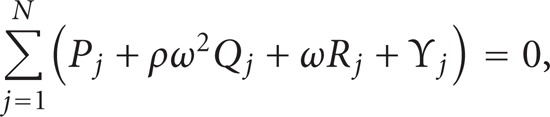
where P, Q, and R are polynomials in cn, sn, and dn, and

By equating the terms with the same power in cn, sn, and dn, K equations are obtained from(17)
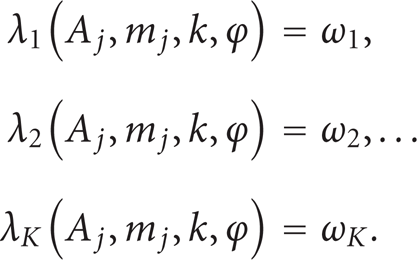
The number of unknowns of the problem

The problem is minimizing the combined residuals to calculate accurate values forp M . To solve the eigenfrequency problem, a nonlinear least-squares algorithm is proposed. The objective function is defined by

where δ i n (p j ), i=1,2, n=1,2,…,N1, are two control indicators for the verification of the initial conditions (12a) at points x n , n=1,2,…,N1

The boundary conditions (12b) have associated also six control indicators to verify the conditions for a clamped beam

for a simply supported beam

or a free end beam

The unknowns
5. The Inverse Approach
The ability of tailoring the best behavior of beams at vibration consists of a qualitative and quantitative understandings of the damping properties. One way to manipulate the eigenfrequencies is to vary the damping capacity of the beam. The objective of this section is to optimize the behavior of the beam with external auxetic patches for a vibration regime, in order to avoid resonance. In this way, the beam with external auxetic patches is designed in order to maximize the performance with respect to the eigenfrequencies.
In the case of the inverse problem, the location and lengths of the external patches are unknown. These unknowns are determined from maximizing the eigenfrequencies of the beam or gap between them.
In the formulation of the inverse problem, the bound optimization formulation of Bendsoe et al. [32] andPedersen [33–35]is used. The unknown parameters are the positions of the patchesx j and their lengths Δx j , j=1,2,…,k p , under the conditions x2≥x1+Δx1, x i ≥xi-1+Δxi-1, i=2,…,k p .
The inverse problem consists of determining x j , Δx j , j=1,2,…,k p , so that (17) and (18) are satisfied, and all eigenvaluescan stay above agiven complex constant C1+iC2. The formulation of the optimization problem is as followings:
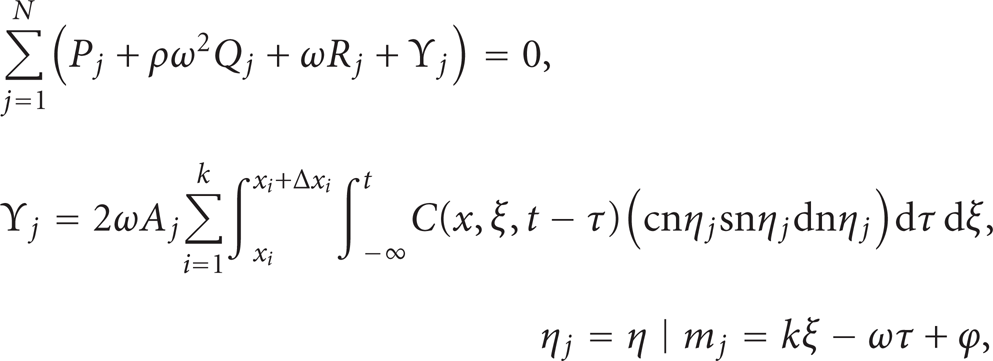
where P, Q, andR are polynomials in cn, sn, and dn.
If we want to maximize the difference between two consecutive eigenvalues, say ω i and ωi+1, the problem can be formulated as
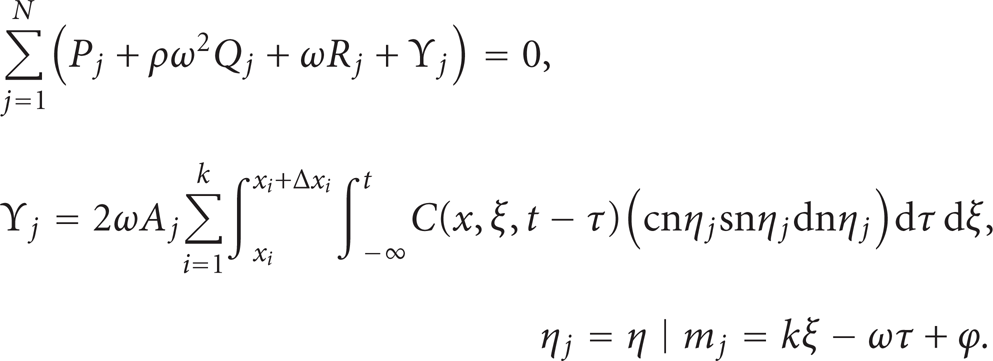
In other words, we can manipulate the eigenvalues of a structure by varying the positions of the patches within the physical limits and the specific demands of each problem.
6. Applications
Let us firstly apply the above theory to some examples as considered in [20], that is, cantilever beams with a nonlocal damping patch made of a conventional viscous material. The properties of the beam are identical to those reported in [20] with α=5. In the case of an auxetic patch, we consider the negative Poisson's ratio ν= − 0.35 and α=0.22. In [20], the approximate solutions for the complex eigenvalues and modes with nonlocal damping are obtained using the Galerkin method. The numerical results obtained using the proposed method are very similar to those obtained by employing the Galerkin method in [20]. We are interested next in the effect of the auxetic patch on the mode shapes. Figure 5 shows the real and imaginary parts of the first four mode shapes for a cantilever beam with the auxetic (the solid line) and viscous patches (dashed line), respectively. It can be seen that in the case of the auxetic patch, the mode shapes are different from those corresponding to the traditional viscous patch. We also note that the real parts of the mode shapes are sensitive with respect to the material used for the patch.
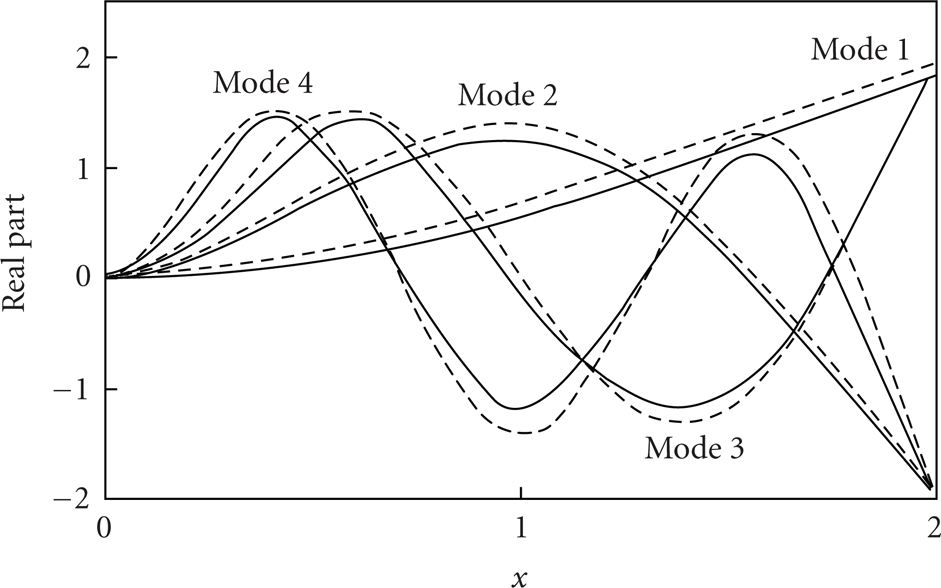
Real parts of the first four mode shapes of a cantilever beam with auxetic patch (solid line) and viscous patch (dashed line).
Now, we restrict our attention on a cantilever aluminum beam of L=2 m, of circular cross section diameter d=0.005 m, Young's modulus E=70 GPa, ρ=2700 kg/m3, Poisson's ratio ν=0.35, with k p = 0,1,2, and 3, and α=0.22. The auxetic material has a negative Poisson's ratio, ν= − 0.35. The number N of cnoidal functions is 4. For N>4, the increase in the accuracy of the results obtained using the genetic algorithm is not significant.
Firstly, we compare the frequency responses of the beam with 0, 1, 2, and 3 patches (symmetrically located with respect to the beam ends). Figure 6 displays the frequency response of the beam for 0 and 1 patches, respectively, and Figure 7 for 2 and 3 patches, respectively. It can be seen from these figures that the amplitude of the vibration is diminished as the number of patches increases.
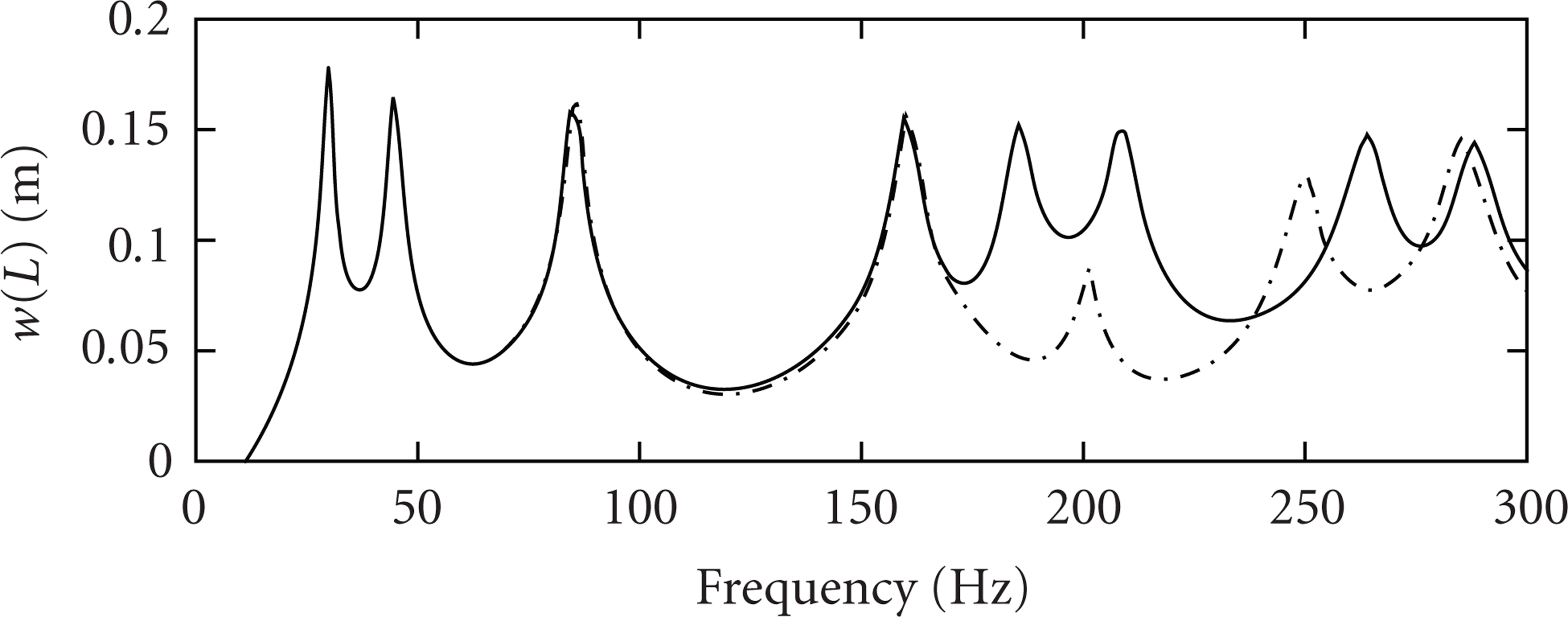
Frequency response for 0 (solid line) and 1 auxetic (dashed line) patches.
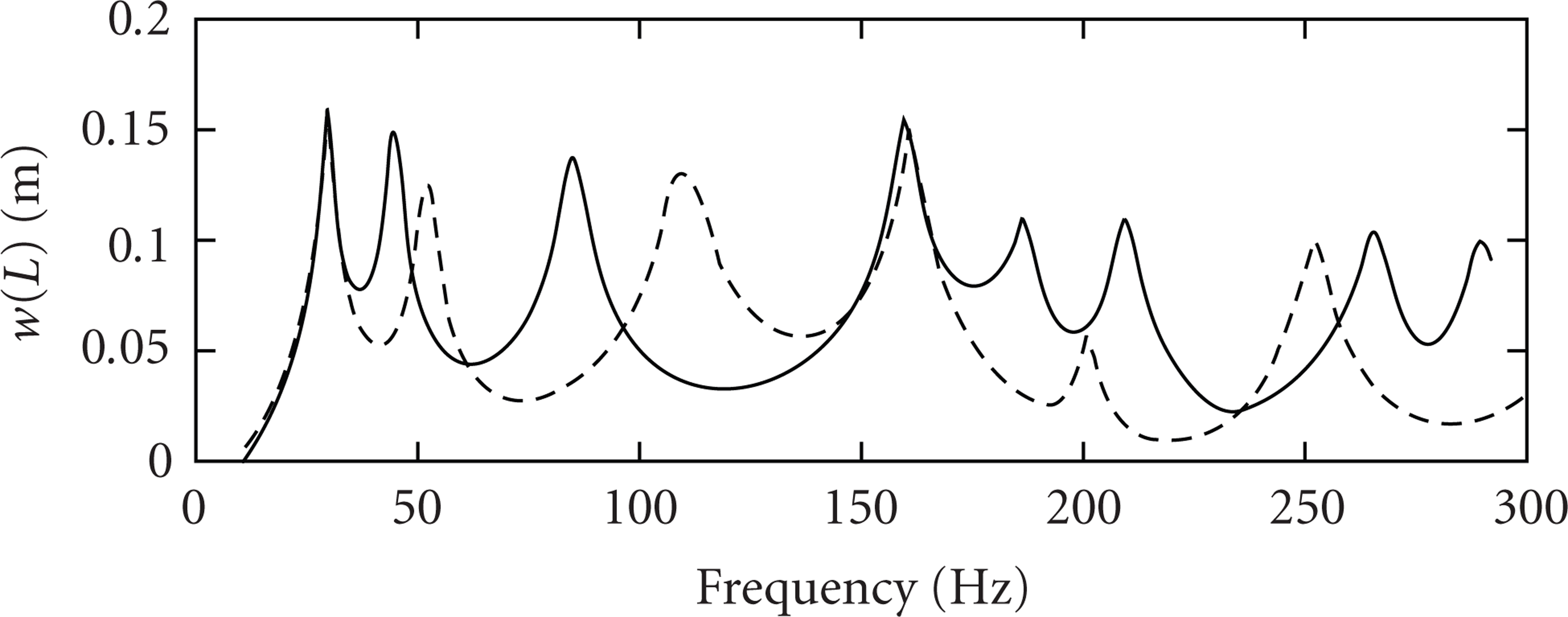
Frequency response for 2 (solid line), and 3 (dashed line) auxetic patches.
So far, we have considered the forward problem, where the number and location of the patches are known. Recall that the inverse problem determines the location of the patches by maximizing the eigenvalues or the gap between them in order to avoid resonance. Table 1 shows the five eigenfrequencies for nonoptimized cantilever beam with 0, 1, 2, and 3 auxetic patches, located symmetrically with respect to the ends of the beam.
The first five eigenvalues for a cantilever beam with auxetic patches.

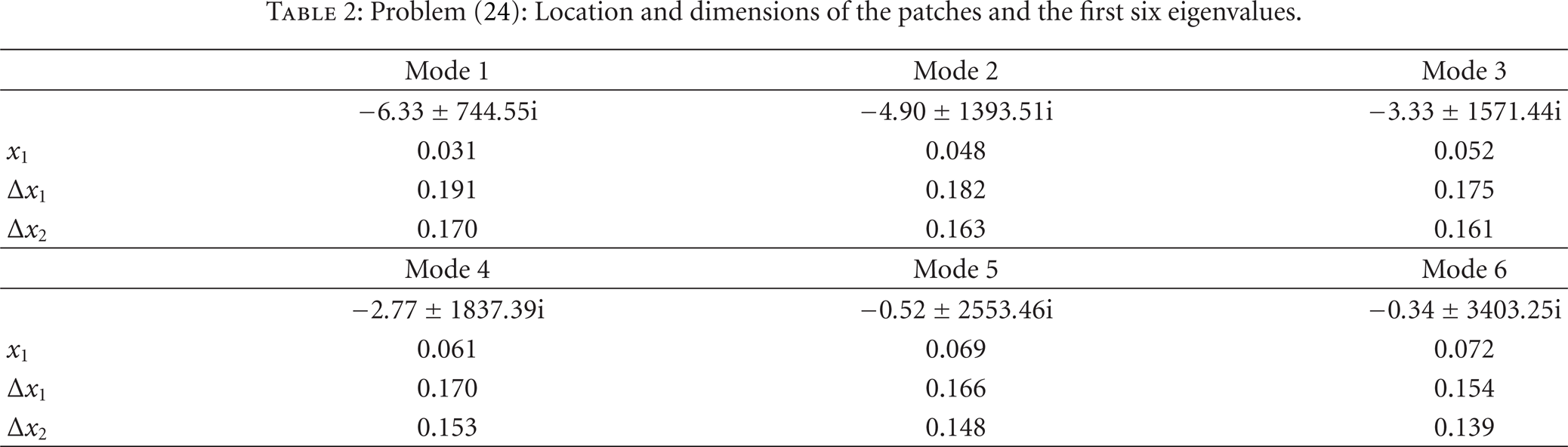
The inverse problem is solved for 3 auxetic patches (symmetrically located with respect to the beam ends). The unknowns arex1, x2, x3, Δx1, Δx2, Δx3, while the known quantity is h p = 0.003 m. The inverse problem (24) is solved for C1+iC2 = −0.005+681.4i, and the problem (25) for C3 = −0.0066+681.43i, and C4 = −0.0025+233.13i.
Tables 2 and 3 present the estimates of (24) and, respectively (25), that is, the location and dimensions of the patches and the first six eigenvalues of the beam. Due to the symmetry of the problem, the results are reported only for x1, Δx1, and Δx2 since all simulations give x2 = 1 and the patchx3 is symmetric with x1, with respect to the middle of the beam, and Δx1 = Δx3. It can be seen from these tables that all eigenvalues stay above the complex constant C1+iC2 for (24) and the difference between two consecutive eigenvalues is maximized for (25), respectively. It is observed thatx1 is moving towards the middle of the beam when the mode increases, and the length of the patches decreases for superior modes. The optimization problem (25) gives lower values for all estimates in comparison with problem (24).
Problem (24): Location and dimensions of the patches and the first six eigenvalues.
Problem (25): Location and dimensions of the patches and the first six eigenvalues.

7. Conclusions
The paper describes a nonlocal theory approach to model the damping contribution and dynamics of beams with auxetic foam patches. The damping force is modeled as a weighted average of the velocity field over the spatial domain, determined by a kernel function based on distance measures. The proper choice of the spatial kernel function is based on the experimentally variation of the energy loss per unit volume with respect to the number of compressive cyclic loadings.
The unification of auxetic and nonlocal behaviors makes possible the design optimization of the beam with external auxetic patches with respect to the eigenvalues in order to avoid resonance. The optimization is performed by determining the location of the auxetic patches through the maximization of the eigenfrequencies of the beam or the gap between them. The examples presented in this paper show that one can improve the damping capacity of the beam by choosing the external patches made of an auxetic material, at the same time being possible to avoid resonance by manipulating the eigenfrequencies.
The study of beams with auxetic patches is twofold: It promises to make more understandable the damping properties of the structures that use an auxetic material to add damping to them. On the other hand, it provides the fundaments for the fabrication of new composites with tailored properties, with improved control of damping properties, opening the door to new applications. Materials with negative Poisson's ratio easily undergo volume changes but resist shape changes and may thus be viewed as the opposite of rubber materialsor antirubbers.
Footnotes
Nomenclature
Acknowledgments
The financial support received by the PNII-Idei 106/2007 code 247/2007 is gratefully acknowledged. The authors also thank the referees for their useful comments.