




Abstract
Objective:
There are multiple treatment options for hiccups, including non-pharmacological therapies, but little evidence of superiority of one treatment over another. The aim of this study was to investigate the effects of acupuncture on persistent hiccups after arthroplasty.
Methods:
From April 2010 to December 2015, 15 patients with primary unilateral total hip/knee arthroplasty were diagnosed with persistent hiccups and given acupuncture at PC6, CV12 and ST36. Each acupuncture session lasted 30 min. The total number of treatment sessions was determined by the persistence of symptoms, but acupuncture was administered no more than three times over the course of a week. The hiccups assessment instrument (HAI) was used to assess the severity of hiccups pre-treatment and post-treatment. Adverse events were also recorded.
Results:
Absolute resolution was observed in all 15 patients after less than three acupuncture sessions. Of these, 10 patients required only one acupuncture session, 3 patients required two sessions and 2 patients required three sessions. The HAI score improved after each round of acupuncture treatment (P<0.05). The average HAI score improved significantly post-acupuncture compared to baseline values pre-treatment (P<0.05). Symptoms accompanying the hiccups included pain in the diaphragmatic area (five patients), mild dyspnoea (three patients), dysphagia (two patients) and nausea/vomiting (one patient). All these accompanying symptoms disappeared at the point of resolution of the hiccups. There were no adverse effects related to acupuncture during the study period.
Conclusion:
Based on our results, acupuncture may represent a potential treatment option for hiccups after arthroplasty. Caution must be exercised, however, given the lack of a control group. Accordingly, randomised controlled trials will be required to verify the efficacy and effectiveness of acupuncture for the treatment of hiccups.
Hiccupping is an involuntary contraction of inspiratory muscles (the diaphragm and external intercostal muscles), manifesting with a characteristic sound of a delayed and sudden closure of the glottis.1 Although hiccup is a transient and benign phenomenon, it often results in unpleasant emotion. Occasionally, some hiccups last over 48 hours or repeatedly recur after frequent intervals and are defined as intractable hiccup or persistent hiccups. The adverse events include insomnia, exhaustion, wound dehiscence after surgery, dehydration and weight loss resulting from inability to swallow fluids and food, and ventricular dysrhythmias as a result of disturbance in serum potassium.2
Although hiccups are not uncommon, the aetiology is still unclear, which results in a wild spectrum of therapeutic management (including pharmacological agents and non-pharmacological approaches).3–4 The pharmacological agents used in hiccups include amantadine, sodium valproate and chlorpromazine.5–7 However, none of these treatments is superior to the others in terms of efficacy or side effects.8 Due to the potential adverse events and often unsatisfactory results of pharmacological therapy, there is growing interest in non-pharmacological treatment options, especially acupuncture.
Acupuncture, a complementary medicine treatment modality, is an important part of traditional Chinese medicine. The technique involves the insertion of thin needles into the body and is mostly used for pain relief and rehabilitation.9–11 Recently, acupuncture has been recognised as a potential method of treatment for hiccups.12 To our knowledge, however, the effects of acupuncture on persistent hiccups have not been reported.
In the present study, we investigated the effects of acupuncture at PC6, CV12 and ST36 on persistent hiccups after arthroplasty. In addition, we evaluated the safety of acupuncture by monitoring for adverse events.
Methods
Informed consent was obtained and recorded. The study followed a protocol approved by the Ethics Committee of Changzhou Traditional Chinese Medical Hospital, affiliated with Nanjing University of Traditional Chinese Medicine.
Acupuncture
The acupuncture treatment was delivered by one experienced acupuncturist and all patients underwent the same therapeutic protocol. The duration of each acupuncture session was 30 min.13 The total number of treatment sessions was determined by the persistence of symptoms, but treatment was given no more than three times over a period of 1 week.
Traditional acupuncture points PC6, CV12 and ST36 were selected based on their historical use per traditional Chinese medicine (TCM) theory. Disposable sterile steel needles (32-gauge, diameter 0.25×length 40 mm, Jiajian Medical Instrument Company, Wuxi, China) were inserted, following strict sterilisation procedures. The needles were manipulated manually with moderate force (including lifting, thrusting, twirling and rotating) in order to generate de qi, which is characterised by pressure-like sensations, soreness, distension and numbness.14
Study clinical parameters
The hiccups assessment instrument (HAI) was used to assess the severity of hiccups. Patients were asked to mark the severity level of their hiccups on a 0–10 numerical scale. 0 was used to indicate the absence of hiccups, while 10 reflected maximum severity.15
A re-evaluation was conducted 1–2 days after each acupuncture treatment. A score of HAI greater than 0 implied that at least one more acupuncture treatment was needed. Once the patient reported a HAI score of zero, no further acupuncture treatment was indicated.
Statistical analysis
SPSS V.19.0 (SPSS Inc., Chicago, Illinois, USA) was employed for statistical analyses. The temporal changes in HAI scores were analysed using Wilcoxon’s rank sum test. P<0.05 was considered to represent statistical significance.
Results
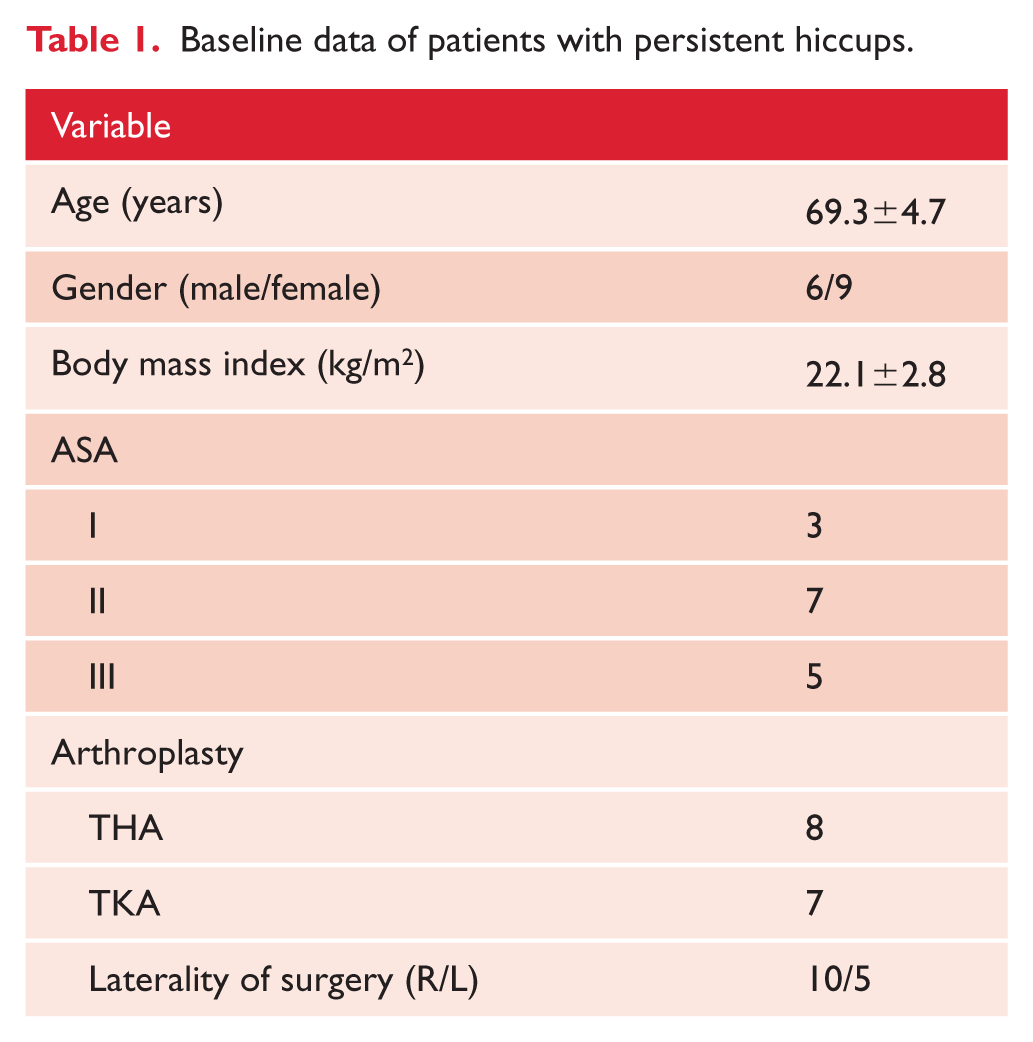
From April 2010 to December 2015, 15 patients undergoing primary unilateral total hip arthroplasty (THA) or total knee arthroplasty (TKA) of American Society of Anesthesiologists (ASA) grade I–III, and aged 62–75 (average 69.3±4.7) years, were diagnosed with persistent hiccups and enrolled in this study (Table 1). All the patients received general anaesthesia. Body mass index ranged from 18 to 27 (mean 22.1±2.8) kg/m2. There were nine female and six male participants, with a total duration of hiccups of 84.3±17.6 (range 48–115) hours prior to enrolment. Baseline HAI scores were 7.6±2.2 (range 3–10), reflecting a significant impact on daily living.
Baseline data of patients with persistent hiccups.
Absolute resolution was observed in all 15 patients after acupuncture treatment with a final HAI score of zero. A total of 10 patients received only one acupuncture session, 3 patients required two sessions and 2 patients required three sessions.
Other symptoms accompanying the hiccups included pain in the diaphragmatic area (five patients), mild dyspnoea (three patients), dysphagia (two patients) and nausea/vomiting (one patient). All these accompanying symptoms disappeared at the point of resolution of the hiccups. No adverse effects related to acupuncture were observed in this study.
The HAI score improved following each round of acupuncture treatment, with a statistically significant reduction in average HAI score pre-acupuncture versus post-acupuncture at each time point (P<0.05, Table 2).
HAI score before and after acupuncture treatment.
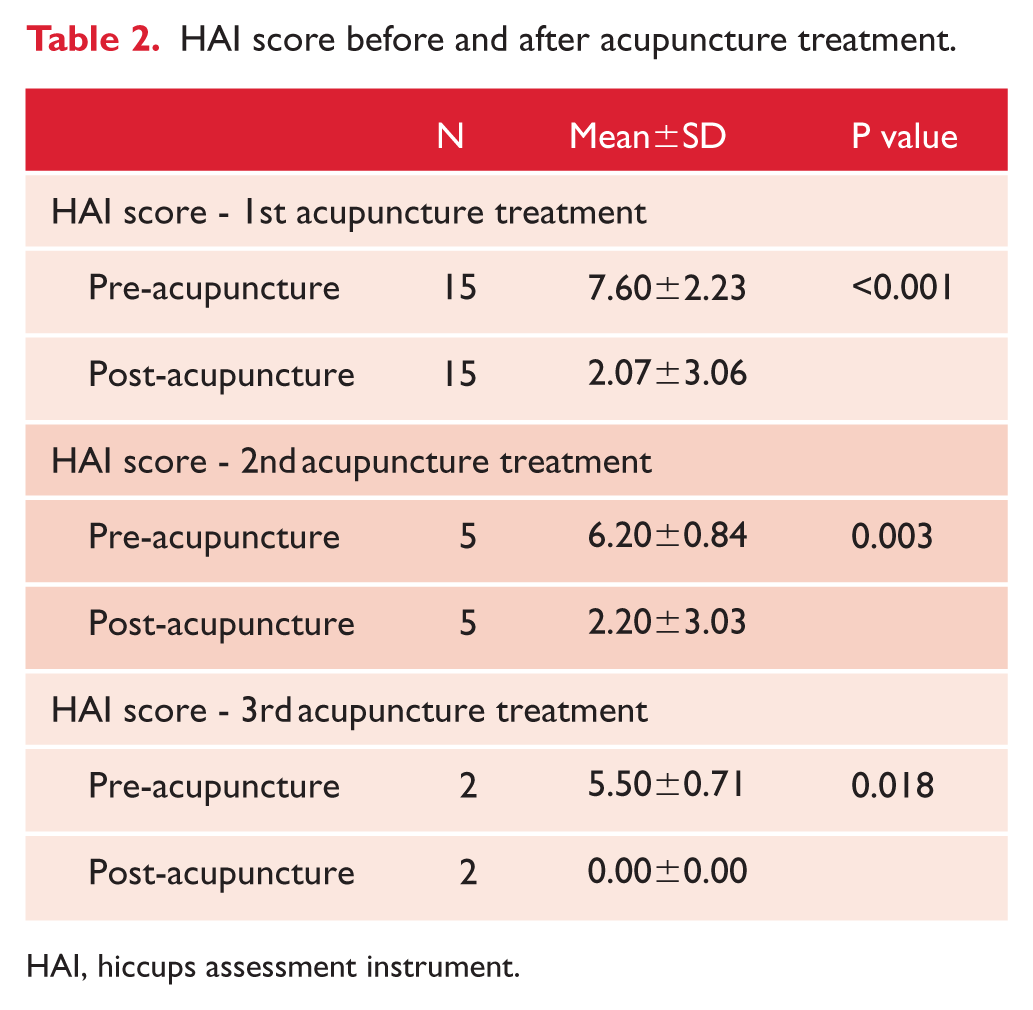
HAI, hiccups assessment instrument.
Discussion
Although hiccups are a frequent and nearly universally experienced phenomenon, they serve no known useful or protective function. The aetiology is still unclear, which results in a wide spectrum of therapeutic management options. However, no available treatment has been proven to be an optimum choice to date. Baclofen, a popular remedy for hiccups, often results in fatigue and vomiting.16 Considering the adverse side effects and potential failures of medication, there is growing interest in non-pharmacological treatment options. Becker recommended non-pharmacological approaches to treat hiccups after reviewing the mechanism and therapeutic options for nausea, vomiting and hiccups.17 Non-pharmacological approaches included acupuncture, breath holding, rapidly swallowing ice water and breathing into a paper bag.
Acupuncture, which has been practiced clinically in China for over 3000 years, is a time-honoured non-pharmaceutical therapeutic option for hiccups.18 In 2004 the American Academy of Medical Acupuncture pointed out that hiccups might be an indication for acupuncture.19 Baseline HAI scores were 6.2±2.7 (range 3–10) in our series, which suggests a significant impact on daily living. All 15 patients with persistent hiccups experienced resolution with less than three sessions of acupuncture. The average HAI score improvement pre-acupuncture versus post-acupuncture was statistically significant (P<0.05). No adverse effects related to acupuncture administered at PC6, CV12 and ST36 for persistent hiccups after arthroplasty were observed in the present study.
Nowadays, the exact mechanism of action underlying the putative effects of acupuncture on hiccups is still unclear, although the hiccup reflex arc may play an important role. According to Kolodzik & Eiler, the hiccup reflex comprises three parts: afferent pathways (vagal, phrenic and sympathetic branches); efferent pathways (phrenic nerve, nerves innervating the glottis and the external intercostal muscles) and a central connection (cervical spinal cord levels 3–5).20 Acupuncture could potentially modulate any part of the hiccup reflex arc through various means including enhanced perfusion, altered axonal excitability and/or autonomic nervous system neuromodulation.21 Schiff et al. reported that altered secretion of neurotransmitters and neurohormones might be an important mechanism underlying the effects of acupuncture.22 Considering the successful use of ephedrine for intraoperative hiccups, sympathetic stimulation might play an important role in the suppression of hiccups.23 It is possible that acupuncture at PC6, CV12 and ST36 could act by stimulating sympathetic nerve activity and disturbing the hiccup reflex arc.
TCM acknowledges that gastric emptying may be disturbed in hiccups. Impulses generated by acupuncture could stimulate vagal afferents and modulate the hiccup reflex arc to improve gastric function.24 Some studies have indicated that acupuncture could reduce gastric retention and improve gastroparesis symptoms.25 Moreover, acupuncture has been shown to improve the recovery of patients undergoing colorectal cancer resection.26 Acupuncture at ST36 can stimulate the gastric branches of the vagus nerve27 and it is possible that needling at all three acupuncture points could affect the afferent pathways (vagal, phrenic and sympathetic branches) arising from T6-12. Sun et al. reported that acupuncture at ST36 and PC6 could stimulate nucleus tractus solitarii neurons in rats with abnormal gastric motility. Another study proposed that acupuncture at PC6, CV12 and ST36 (as used in the present study) could stimulate discharge of subnucleus reticularis dorsalis neurons.28 29
The most common pathology attributed to the aetiology of hiccups is gastrointestinal disease including gastro-oesophageal reflux disease and gastric distension.30 The persistent stimulation of oesophageal chemo-receptors by gastric acid is responsible for a persistent form of hiccups.31 Overdistension of the stomach and rapid stretch above a determined volume threshold in the proximal oesophagus could reduce hiccups.32 Salem et al. reported that pharyngeal stimulation was an effective therapy for hiccups.33 Later, Kanaya et al. speculated that rapid expansion of the pharynx oralis irritates the vagus nerve, triggering the hiccup reflex.34 Based on the local innervation of the tissues at PC6 and CV12 and their neuroanatomical relationship with the upper GI tract, stimulation at both these locations could potentially improve abnormal gastro-oesophageal function via somato-visceral pathways.
No adverse effects related to acupuncture occurred in this study. The lack of adverse effects is reassuring but observational studies with substantially larger numbers of participants are needed to confirm this. However, a prospective survey of 32 000 consultations suggested that acupuncture is a safe intervention.35
The use of the HAI to assess the severity of persistent hiccups after arthroplasty is arguably novel. This measurement constituted a 0–10 numerical scale for patients to quantify their experience and provided a relatively more objective measurement to evaluate improvement post-acupuncture. Through this assessment, we were able to describe the improvement quantitatively; this was our first time using a continuous variable to assess the impact of an intervention on persistent hiccups.
There was a major limitation of the present study that should be acknowledged. As there was no control group, we cannot distinguish between true therapeutic effects of acupuncture and the natural history of hiccups, which generally resolve without treatment over time. Despite this limitation, our results are encouraging and highlight the need for further (controlled) research studies.
Footnotes
Contributors
QZ conceived the study and designed the protocol. JX, YQ and HZ drafted the manuscript. YG and LP sought ethical approval. All authors contributed to writing of the manuscript, and read and approved the final version accepted for publication.
Funding
The authors received no financial support for the research, authorship, and/or publication of this article.
Declaration of conflicting interests
The authors declared no potential conflicts of interest with respect to the research, authorship, and/or publication of this article.
Patient consent
Obtained.
Ethics approval
The study protocol was approved by the Ethics Review Committee of Changzhou Traditional Chinese Medical Hospital, affiliated with Nanjing University of Traditional Chinese Medicine.
Provenance and peer review
Not commissioned; externally peer reviewed.