






Abstract
We study inventory control with volume flexibility: A firm can replenish using period‐dependent base capacity at regular sourcing costs and access additional supply at a premium. The optimal replenishment policy is characterized by two period‐dependent base‐stock levels but determining their values is not trivial, especially for nonstationary and correlated demand. We propose the Lookahead Peak‐Shaving policy that anticipates and
INTRODUCTION
Today's logistics environment is characterized by an ongoing shortage of truck drivers (Bhattacharjee et al., 2021), disrupted supply chains in the wake of the pandemic (Berger, 2021), and rising oil prices (Krauss, 2022). Shipping rates for 2022 surged by 20%–100% compared to the year before (Tyagi et al., 2021), forcing manufacturers to make better use of their “base capacity”.
We worked with a manufacturer in the fast‐moving consumer goods industry whose daily replenishments from its factory to distribution centers are characterized by
The option to source above the current base capacity by paying a premium, referred to as “volume flexibility,” introduces the following trade‐offs. When inventories in the warehouses are low, the manufacturer must decide whether using the more expensive, premium supply is beneficial or whether replenishment can be postponed to later low‐demand periods and supplied at regular rates. Vice versa, when the manufacturer faces forecasts with demand peaks, volume flexibility allows anticipatory ordering at base cost. This lookahead peak shaving has the benefit of avoiding the premium that must be traded off against the resulting increased inventory‐related costs.
Our problem can be modeled as a single‐sourcing inventory system with backlogging. Order quantities are constrained by a weak capacity limit with the flexibility to source above the base capacity at a premium (see Figure 1a). Porteus (1990) shows that under the resulting piece‐wise linear cost structure, a generalized base‐stock policy, characterized by an additional base‐stock level per price segment, minimizes the expected sourcing and inventory costs per period. Under two price segments, the generalized base‐stock policy first places a base order to raise the inventory position to the high base‐stock level. If that quantity exceeds the base capacity, at most the base capacity is ordered (see Figure 1b, green area). After this base order, if the adjusted inventory position is still below the low base‐stock level, additional units are ordered at the premium cost to raise the inventory position to the low base‐stock level (see Figure 1b, blue area).

The left panel visualizes our modeling of volume flexibility using a piece‐wise linear sourcing cost in which the first


Unfortunately, there are currently no closed‐form expressions for the optimal base‐stock levels in a stochastic setting that aims to minimize expected costs. One must resort to numerical approaches such as dynamic programming (Lu & Song, 2014; Martínez‐de Albéniz & Simchi‐Levi, 2005). The latter requires discretization of the demand distribution and quickly becomes computationally expensive, especially when demand is nonstationary or correlated. Multivariate comparative statics are needed to understand the interaction among parameters, which is cumbersome for numerical approaches. The nonexistence of closed‐form solutions also hampers implementation in practice. As such, we have seen our manufacturer resorting to simplifying, suboptimal heuristics to set base‐stock levels. This may substantially increase costs, as we also observe in our numerical experiments. We believe this practice may also exist at other companies facing the same problem. They may benefit from simple formulae for the optimal policy. This paper proposes such formulae by utilizing robust optimization.
We show the robust optimality of the Lookahead Peak‐Shaving policy that anticipates or
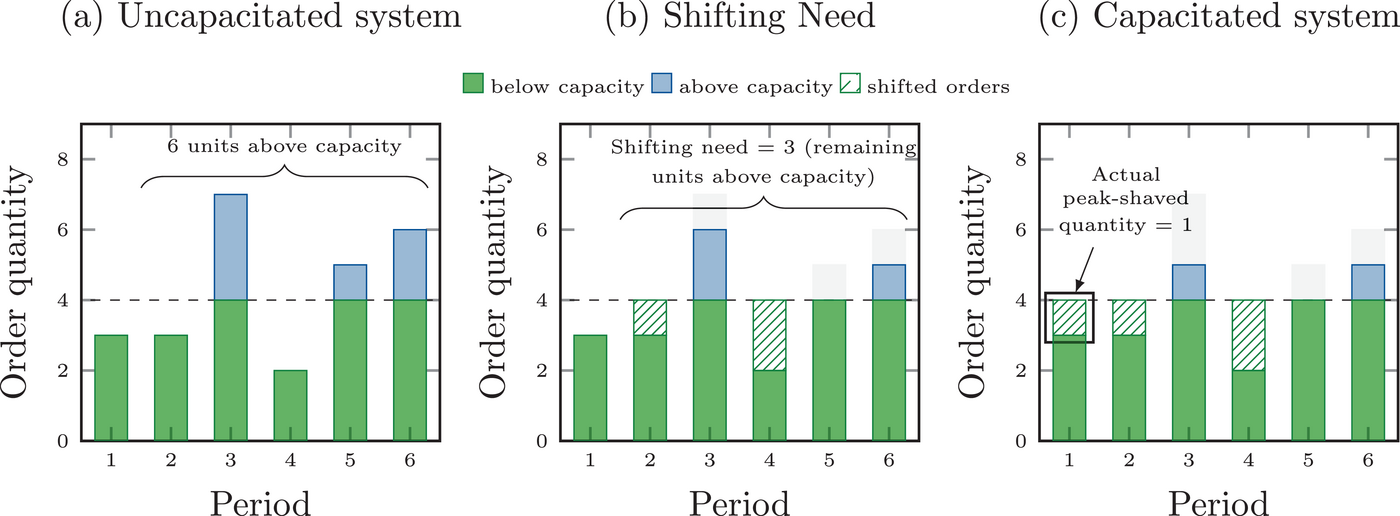
The Lookahead Peak‐Shaving policy: (a) computes order quantities assuming no capacities; (b) determines the shifting need, that is, the desired amount of units to shift to the current period; and (c) peak shaves orders from future capacitated periods to the current period, hereby reducing future premium costs at the expense of increasing the inventory mismatch costs.
The deterministic nature of robust optimization allows capturing the base‐stock levels in a closed form based on the worst‐case demand realizations. The explicit expression of the peak‐shaved quantity yields insight into how and when peak shaving results in filling up the base capacity, thereby reducing future premium costs at the expense of increased inventory mismatch costs. The applicability and effectiveness of our policy are supported by comprehensive numerical analyses and its application using data from our manufacturer. We compare our robustly optimal approach against two heuristic replenishment policies, of which the manufacturer currently adopts one. The numerical experiment shows that our policy performs well, especially when demand is nonstationary, negatively correlated, and when capacity fluctuates. This performance improvement is not only in terms of worst‐case but also in terms of the conventional “expected cost” criterion. We also demonstrate how the manufacturer may use his forecast and related forecast errors to compute the worst‐case realizations needed to determine the base‐stock levels. The application of our Lookahead Peak‐shaving policy on 869 products of the manufacturer results in 6.7% cost savings.
In sum, our contribution is threefold: (1) We prove the robust optimality of the Lookahead Peak‐Shaving policy with a novel proof technique based on the Simplex algorithm; (2) our robustly optimal policy also yields excellent performance in terms of expected cost, especially when demand is nonstationary and negatively correlated, and when capacities fluctuate around the mean demand; (3) our explicit expressions are intuitive, easy to apply in practice and allow multivariate “what‐if” analyses, yielding insights into how peak shaving pro‐actively matches capacity and demand. Our model easily extends to other settings where flexible supply is prevalent such as companies with a dedicated workforce but the option to pay for overtime or part‐time labor or contracts may be used to source from a preferred supplier up to a predefined level, but with the option to resort to back‐up suppliers at a higher cost.
RELATED LITERATURE
We contribute to the stochastic inventory control literature by building on methods and techniques from the field of robust optimization. When sourcing costs are linear in the ordered volume, inventory mismatch costs are convex and unmet demand may be backlogged, Karlin and Scarf (1958a) prove that a base‐stock policy minimizes expected costs. Karlin (1958) extends the linear sourcing cost assumption to any convex function and shows that the latter makes the optimal base‐stock level dependent on the inventory levels before order placement. Low inventory levels induce lower base‐stock levels: it is better to partially postpone orders and incur an additional inventory mismatch than ordering now at a higher unit sourcing cost. Porteus (1990, p. 662) refers to this policy as a generalized base‐stock policy. Porteus (1990) shows that there are a finite number of base‐stock levels if the sourcing cost is piece‐wise linear and convex. In particular, when the sourcing cost has two linear segments, the optimal policy is defined by two base‐stocks that determine when the capacity is deceeded, exactly used, or exceeded (as visualized in Figure 1b). We will show that the robustly optimal policy exhibits the same policy structure.
While the optimal policy structure is known in a conventional stochastic setting, the optimal base‐stock levels are not. Lu and Song (2014) use dynamic programming to obtain the optimal order quantities. This computational approach, however, does not scale extremely well although Martínez‐de Albéniz and Simchi‐Levi (2005) demonstrate how to reduce the computational effort by limiting the search space. Yet, both articles assume perfect knowledge about the demand distribution, an assumption we will relax. Henig et al. (1997) investigate a similar model in which a contracted capacity of
We employ robust optimization and refer to Ben‐Tal et al. (2009) for a good introduction. Robust optimization provides an alternative to stochastic optimization by minimizing the worst‐case cost, that is, the maximum possible cost, rather than minimizing the expected cost. Min–max approaches have been used since the early days of inventory control. Karlin and Scarf (1958b), for instance, minimizes the expected cost for
The demand data of the companies we have worked with all contain signification fluctuations on a daily basis. Yet, the monthly cumulative demand is prone to less variability. This conservative nature of interval uncertainty hampered widespread adoption of robust optimization in inventory control, both in theory and in practice. That is, until Bertsimas and Sim (2004) pioneered the use of “budgets of uncertainty” to reduce the level of conservatism. In addition to uncertainty intervals around the uncertain variables, they restrict the cumulative deviation from the nominal values of all uncertain variables to be within a budget. Their approach is intuitive: the uncertainty may be large in specific periods but the cumulative deviation typically reduces as the planning horizon increases. For instance, we may have poor daily forecasts on consumer demand but the monthly relative forecast error is typically smaller—as we also observe in our data set. This opened the door toward many follow‐up papers within inventory control. Bertsimas and Thiele (2006) demonstrate how to apply the method of Bertsimas and Sim (2004) on several classic inventory problems, such as single sourcing with, and without, a fixed set‐up cost, systems with hard capacity constraints on the orders and inventory levels, and networked multi‐echelon systems. Interestingly, they show that the optimal robust structure is often identical to its stochastic counterpart. These results are powerful as they demonstrate that robust formulations may perform well in stochastic settings when the uncertainty sets are chosen well. In other words, when the policy structure is alike, the robust policy parameters may be tuned in such a way that the resulting robust policy and its parameters match the optimal stochastic policy parameters. As such, without requiring the exact demand distribution, the robust policy is capable of achieving the same cost performance as the stochastically optimal policy when evaluated on the expected cost performance measure. This is an appealing feature when the knowledge on the stochastic distribution is sparse. We build further on the aforementioned works by tackling an inventory system in which the sourcing costs are piece‐wise linear and convex while leveraging a specific parameterization of the worst‐case uncertainty realizations set to derive closed‐form expressions of the policy parameters. Moreover, we demonstrate the resulting cost savings when we apply our model to a real data set.
Determining the budgets of uncertainty forms an important aspect of robust optimization. In other words: “How do we trade‐off expected cost performance in a stochastic setting versus conservatism?” A fundamental method was coined by Bandi and Bertsimas (2012), proposing the use of the central limit theorem (CLT) to constrain the periodic and cumulative uncertainty by the period means and standard deviations. Mamani et al. (2017) use the same CLT approach to define their uncertainty sets with respect to the period means and standard deviations. In doing so, they provide closed‐form expressions of the robustly optimal policy parameters in classic single sourcing inventory management settings with linear transportation costs that only rely on the first two moments of the demand distribution. We employ the same uncertainty sets as Mamani et al. (2017) but apply them to the system with piece‐wise linear sourcing costs. For a detailed overview of robust optimization including piecewise linear functions, we refer to Gorissen and Den Hertog (2013) and Ardestani‐Jaafari and Delage (2016). Our problem is part of their class of problems. While Ardestani‐Jaafari and Delage (2016) consider the generic robust optimization problem for piecewise linear functions, we are able to analytically solve for the optimal policy of the specific robust optimization problem of volume flexibility. Wagner (2018) extends the results of Mamani et al. (2017) to continuous review and provides useful insights on how to implement robust order quantities in a dynamic rolling horizon setting. Employing robust optimization does not only provide a tractable way to solve large‐scale problems, it also allows for a deeper analysis of policy structure and related policy parameters. Sun and Van Mieghem (2019), for instance, introduce, and prove robust optimality of capped dual index policies in dual sourcing settings with nonconsecutive lead times; settings where little is known about the optimal stochastic policy despite some asymptotic results (Xin & Goldberg, 2018). Moreover, they numerically show their policy performs exceptionally well on a diverse set of stochastic settings.
We contribute to the aforementioned streams by determining the robustly optimal policy structure when sourcing costs are piece‐wise linear and convex. Moreover, we manage to provide closed‐form expressions of the optimal parameters in settings that we believe to be widely applicable in practice. As such we propose a tractable model that provides insight in how orders should be placed to benefit from the contracted supply capacity.
MODEL OF CAPACITATED SOURCING WITH VOLUME FLEXIBILITY
We model the transportation sourcing problem with volume flexibility as a periodically reviewed inventory system with backlogging and piece‐wise linear, convex sourcing costs. The lead time is zero to avoid notational clutter but our results hold for longer lead times. We will next outline the stochastic formulation of the problem together with the stochastically optimal policy and subsequently introduce the robust formulation of the problem. For the remainder of the paper, we use the following notational conventions: vectors are denoted in bold; summations 


Stochastic model
The demand 






A feasible policy, π, consists of a sequence of mappings 


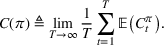

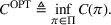
The structure of the optimal policy 





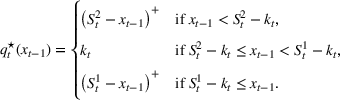
To the best of our knowledge, no closed‐form expressions of the period‐dependent policy parameters 

Robust model
We adopt a robust rolling horizon formulation similar to Sun and Van Mieghem (2019) that works as follows. In each period 






In each period 


The optimization problem we solve in every period is similar to Mamani et al. (2017) but adapted to include a piece‐wise linear sourcing cost: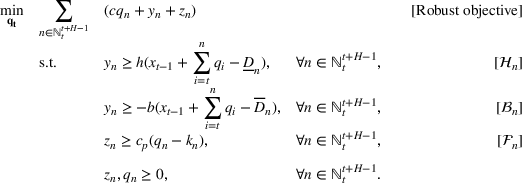







It remains to describe the uncertainty set 







Note that we adopt a rolling horizon approach and start indexing from period 

Both sets of bounds 



The above formulation results in a symmetric uncertainty set: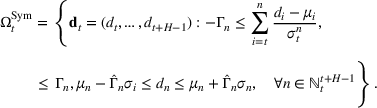


SOLUTION OF THE ROBUST MODEL
Solution for the uncapacitated system
We first review some established results in robust sourcing with a linear sourcing cost, from here on denoted as the 


We denote the optimal order quantities that solve the deterministic linear program in the uncapacitated system (Equation 4 without the constraint set 

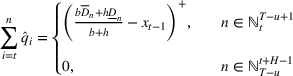



Equation (6) can thus be formulated using cumulative base‐stock levels: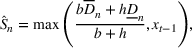




The rolling horizon optimal order in period 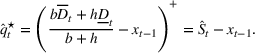
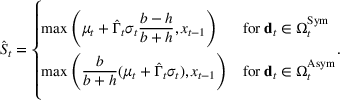
Solution for the capacitated system
We determine the optimal robust order policy and policy parameters for piece‐wise linear and convex sourcing costs starting from the solution of the uncapacitated system described in Subsection 4.1. Note that the robustly optimal order quantities When the inventory constraints 




Lemma 1 shows that in the system with piece‐wise linear sourcing costs, the robustly optimal order quantities The flexibility premium does not exceed the backlog penalty and the holding cost does not exceed the flexibility premium, that is, 


Under Assumption 1, it is only valuable to shift orders forward to avoid the sourcing premium cost. There is a potential need to shift orders from period Let 

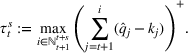
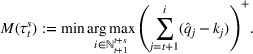
Here, the sum 


We summarize three observations with respect to the shifting need in Corollary 1: The shifting need has sensitivities:



First, the shifting need is indirectly dependent on the starting inventory due to the dependency on the order quantities of the uncapacitated system. If the starting inventory is large, the uncapacitated order quantities are lower, and vice versa. Thus, with more starting inventory, the shifting need decreases (or stays the same, if there was no shifting need). Second, any increase in the capacity of a future capacity leads to a decrease in the shifting need if that period had an impact on the shifting need. Else, the shifting need will stay constant, if there was no shifting need in that period. Third, the shifting need naturally increases (or remains constant) when shifting is considered over a longer horizon
Formulating the shifting need with respect to the worst‐case demand realizations, as defined in (3), results in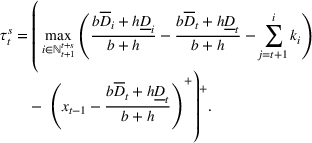
We find that less volume is shifted forward when holding costs increase, but more volume is shifted forward when backlogging and the overtime premium increase. This result is intuitive: when it is more expensive to hold inventory, fewer orders will be shifted forward to avoid future overtime premiums; likewise, if the backlog penalty increases, less orders will be postponed to avoid the overtime premium in the current period. Based on Equation (10), we obtain the sensitivities of the shifting need captured by the following corollary: The shifting need has sensitivities:


From Lemma 1, we observe that it is profitable to shift orders as long as we do not shift more than The length of the planning horizon satisfies: 


We can now formulate the robustly optimal policy for the capacitated system. The robustly optimal policy advances orders from periods with demand peaks to period The Lookahead Peak‐Shaving policy over a lookahead horizon of 

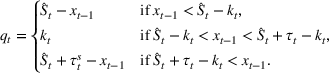
We can prove this policy to be robustly optimal by repeating Lemma 1 until no further improvement is possible, which converges to the optimal solution as our problem is convex (a formal derivation is provided in the proof of Theorem 1 in Appendix A in the Supporting Information). A Lookahead Peak‐Shaving policy with a lookahead horizon of 
Hence, under the optimal policy, we will always order up to the base‐stock level of the uncapacitated system 
A key contribution of our work is to obtain an explicit expression of the shifting need. Including the worst‐case demand realizations derived using the symmetric uncertainty set (see Equation 5) into our expression of the shifting need results in: Let Shifting need for




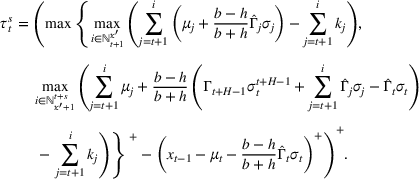
The expression of the shifting need simplifies in a stationary environment where both Let Shifting need for





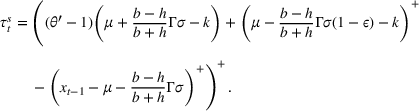
The aforementioned expressions are in closed form but rely on the defined uncertainty set. Prior to applying our findings in practice, we first must provide parameterizations of the uncertainty set, which we do in Subsection 6.1 but first we provide some more analytical results related to the amount of shifting in various scenarios.
ANALYSIS OF THE ROBUST SOLUTION FOR THE CAPACITATED SYSTEM
Sensitivity of peak‐shaved quantity with respect to capacity changes
The Lookahead Peak‐Shaving policy shifts orders from future peak‐demand periods to the current period in order to avoid the sourcing cost premium. We denote the peak‐shaved quantity, that is, the amount of units shifted to the current period 


The quantity of orders that can be peak shaved from future periods to the current period is determined by the current period's base capacity and the shifting need, denoted by For given capacities 



Figure 3a depicts the relationship between the current period's base capacity 

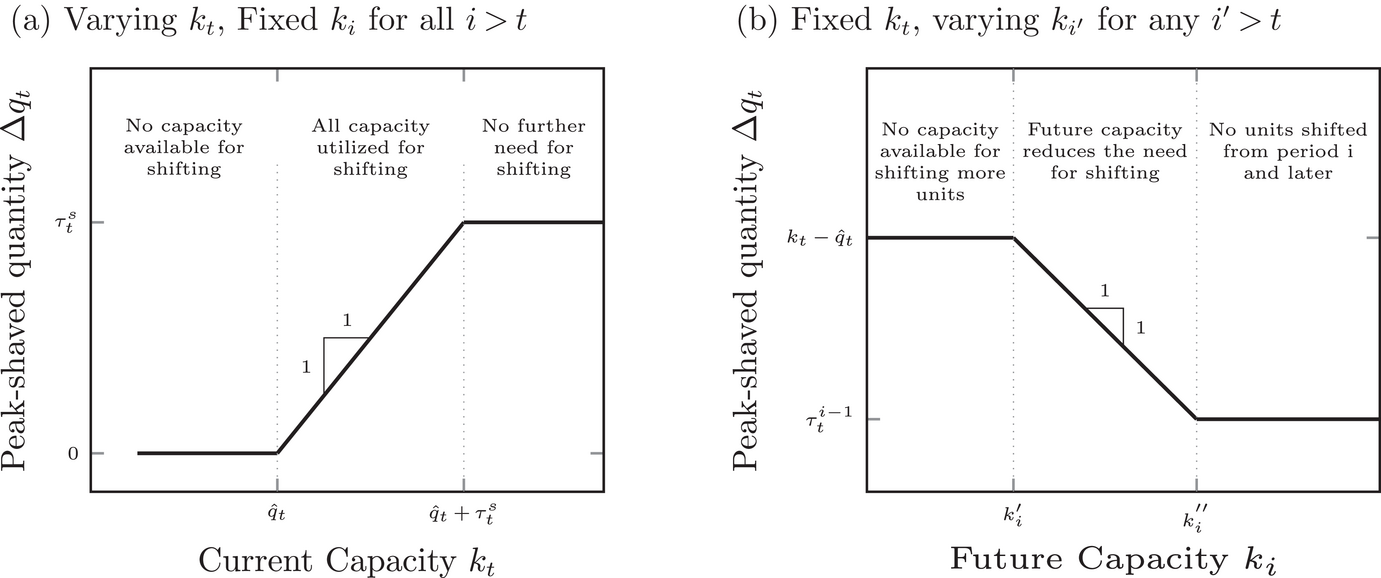
The peak‐shaved quantity for varying base capacities of the current period (panel a) or varying future capacities (panel b).
The peak‐shaved quantity is also dependent on the future capacity levels, as we show in Figure 3b. In general, higher future capacities decrease the amount that needs to be peak shaved as it reduces the shifting need. If there is peak shaving occurring for a given vector of base capacities, then reducing the capacity in a future period may (1) not change the amount peak‐shaved, if the current period's order already uses the base capacity, (2) reduce the amount peak‐shaved as future capacity becomes available and sourcing above base capacity in the current period is no longer needed (i.e., the shifting need becomes smaller than the slack available) or (3) not change the amount peak‐shaved, if the future capacity is already large enough to absorb all units shifted from that future period and later periods such that further increasing future capacity does not result in more peak shaving to the current period. Proposition 2 formalizes the relationship between the peak‐shaved quantity and base capacities. Let the capacities in all periods of the planning horizon be given by For any period 





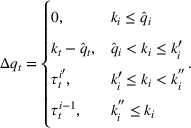
Figure 3b illustrates the scenario where future base capacities are increased while the current period's base capacity is held constant. We illustrate the case when we are currently peak shaving orders from period 


In addition to the role of the base capacities, the amount shifted is also dependent on the premium that is to be paid on flexible transportation supply. A larger premium of the transportation market encourages the manufacturer to peak shave more units to the current period, avoiding the future premium. The premium has an impact on the amount peak‐shaved by increasing the lookahead horizon. A higher premium leads to more periods being included in the lookahead horizon as it becomes beneficial to shift units forward by more periods. Proposition 3 formalizes this insight: Let the lookahead horizon be 


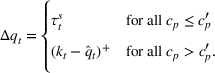
Figure 4 plots the peak‐shaved quantity 


Peak‐shaved quantity

At some point, however, any increase in the shifting need may not increase the units peak‐shaved, as the order quantity is capped by the base capacity of the current period 
Analysis of the shifting need in nonstationary environments
Before performing an extensive numerical study, we demonstrate how the shifting need behaves in various settings with nonstationary demand. Figure 5 plots three settings of nonstationary demand (top panels) and the corresponding base‐stock levels and shifting need (bottom panels). For ease of exposition, all scenarios have a fixed capacity of 100 units per period (orange line, top panels). Given that the shifting need 


We show for three settings with nonstationary demand (top panels) how the base‐stock levels and shifting need (bottom panels) anticipates changes in demand. The shifting need decreases when future demand is low, and vice versa. This anticipative behavior explains the strong numerical performance of our numerical experiment in Section 6.


The top panel of Figure 5a corresponds to a scenario with alternating sequences of high and low demand. The standard deviation is constant. The bottom panel of Figure 5a shows the corresponding low base‐stock level (circles), high base‐stock level (triangle) and the shifting need (length of the blue line). The shifting need thus corresponds to the volume that would be shifted forward, if sufficient base capacity is available in the current period and the inventory is below the low base‐stock level. The lower base‐stock levels (circles) are constant over the periods where the demand is constant (periods 1–10, 11–20, …). It equals the robustly optimal base‐stock level of the uncapacitated system. The upper base‐stock level (triangles) shows the key dynamics of the robust Lookahead Peak‐Shaving policy. In high demand periods, the upper base‐stock level is high as more units are peak shaved, if base capacity is available. If the expected demand drops within the shifting horizon, less orders are peak shaved. The shifting horizon in this example is four periods, thus the high base‐stock level decreases in periods 7–10 and 27–30, four periods before the expected demand drops. At the same time, when the expected demand raises within the shifting horizon, more orders are peak shaved. We note that the actual peak‐shaved quantity is dependent on the demand realizations. The shifting need only indicates the amount that shall be shifted to earlier periods, if base capacity is available. Thus, the shifting need anticipates drops (raises) in the expected demand, and decreases (increases) as a result to decrease (increase) the amount shifted forward in low (high) demand period.
The same pattern arises, when we keep the expected demand constant and vary the standard deviation over time (Figure 5b). In this case, the pattern for periods with high demand uncertainty resembles the pattern for periods with high expected demand in Figure 5a. Peak shaving increases for periods with high uncertainty and reduces for periods with low uncertainty (Figure 5b, bottom panel). In this way, additional inventory is kept when higher uncertainties are expected over the shifting horizon.
Figure 5c illustrates a cyclic mean but constant coefficient of variation. The lower base‐stock level follows the same pattern as the expected demand curve. We observe how the upper base‐stock level and the shifting need exhibit a similar pattern as the demand, but one shifted forward. The demand curve exhibits peaks (valleys) in periods 6, 26, and 46 (16 and 36) and the upper base‐stock level exhibits peaks (valleys) in periods 4, 24, and 44 (14 and 34). Thus, the upper base‐stock level exhibits the peaks (valleys) when the cumulative expected demand over the shifting horizon reaches its peak (valley). In those periods, the most (the least) is supposed to be peak shaved.
NUMERICAL EXPERIMENT
We first perform an extensive numerical study where we let demand be nonstationary and correlated, and capacities fluctuate. Subsequently, we show the performance using a real data set of a manufacturer. In all settings, the evaluation criterion is the conventional expected cost rather than the worst‐case cost realizations.
Tuning the uncertainty set for practical implementation
The remaining challenge in utilizing our robust Lookahead Peak‐Shaving policy is fine‐tuning the uncertainty parameter sets 


The Lookahead Peak‐Shaving policy is optimal when demand is stationary and not correlated, and when capacity does not fluctuate: Γ and 
Two benchmark heuristics
To demonstrate the numerical performance of the Lookahead Peak‐Shaving policy, we construct two benchmark heuristics. Both adopt the optimal policy structure but set the base‐stock levels differently. First, we propose the Set 


In practice, this corresponds to a policy that sets the base‐stock levels using the forecast and its error. The Set The days‐of‐sales policy


In contrast to the
Performance on synthetic data set
We set the unit holding cost 


Each period, the Lookahead Peak‐Shaving policy is optimized over a rolling horizon of 
Impact of fluctuating the mean demand and capacities
We first focus on the impact of fluctuating demand and capacities that we model as follows: The demand in each period 

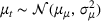




In Figure 6, we present the performance improvement of the Lookahead Peak‐Shaving policy over our two benchmark policies: the
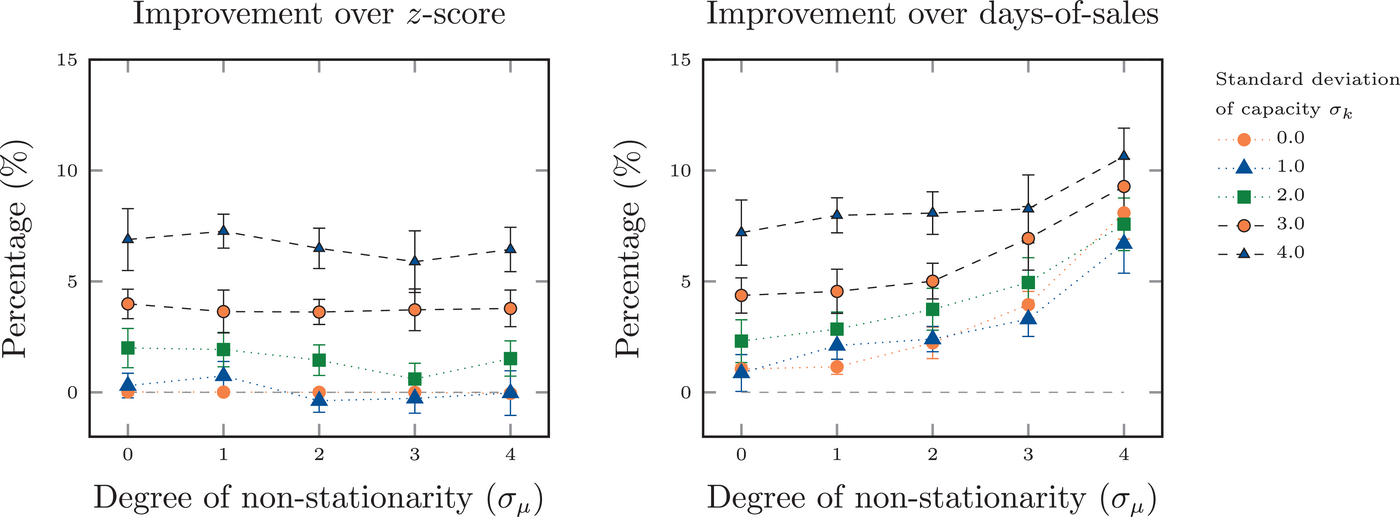
We observe that the Lookahead Peak‐Shaving policy outperforms the
We allot the excellent performance of the robust policy to its ability to better anticipate differences between future demand and contracted capacity. Consequently, it can more efficiently decide when to advance orders in order to avoid future overtime premiums. The opportunities for leveraging this forward‐looking feature increase when the degree of nonstationarity increases and when capacities fluctuate. We conclude that the robust Lookahead Peak‐Shaving policy seems to perform well in comparison to the benchmark policies, also when evaluated against the expected cost criterion.
Impact of demand correlation and variability
We also investigate the impact of demand correlation and variability. We model demand to be correlated according to an AR(1) process with correlation coefficient 

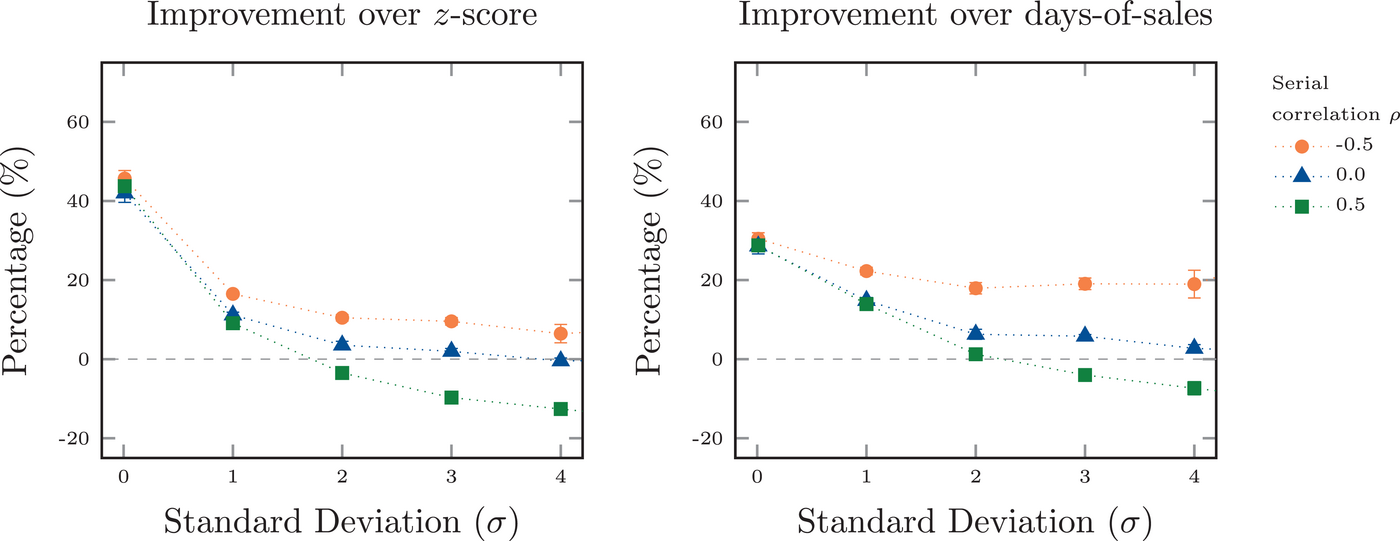
The Lookahead Peak‐Shaving policy performs best when demand is negatively correlated and when demand variance is small. In these cases, it can better anticipate future capacities and demand.
We first note that the Lookahead Peak‐Shaving policy is optimal when demand is deterministic as in this case the worst‐case bounds are equal and solving the linear program, as in Equation (4), yields the optimal order quantities. We observe strong cost improvement of +40% compared to the
Performance on a real data set
We also investigate the performance of our policy on real data of a manufacturer in the consumer‐goods industry. Its shipments between plant and warehouse are outsourced to dedicated transportation carriers. Daily available transportation capacities may be exceeded on a given day by resorting to the freight auction market that comes at a premium.
Our data set contains demand and forecast information of 869 stock keeping units (SKUs) for a time span of approximately 3 months, covering the fourth quarter of 2019 (hence no Covid‐19 impact). For each SKU we possess the demand realizations and for each day and SKU, we have the forward‐looking demand forecasts for each of the next 40 days. The forecast includes both the output of advanced statistical tools and judgmental adjustments made by demand planners that interact closely with marketing and sales. Although the forecast accuracy of monthly demand is rather good with forecast errors (mean average percentage errors) typically below 10%, the forecasts of daily demands show larger errors as large key account orders may arrive several days earlier or later compared to the original forecast. This fits well with the uncertainty set that can allow for large periodic deviations, but can force the sum over several periods to have a small deviation. We split our data set that contains 3 months of data into a training set to optimize all policy parameters (the first 1.5 months), and a test set to evaluate the policies (the subsequent 1.5 months).
We apply the Lookahead Peak‐Shaving policy and compare it to the same two benchmark policies as the previous section. We describe how we retrieved the empirical moments from the data in detail in Appendix C in the Supporting Information. Each product has its own pre‐dedicated, and fixed, capacity that we set equal to the mean of each product across all periods within the training set. This mimics how the manufacturer typically negotiates capacity around (or slightly above) the average daily shipment size while shipments exceeding this pre‐dedicated capacity are made on the freight auction market. We use the same product‐specific capacities for the evaluation set.
For each SKU, we use the training set to obtain the policy parameters, that is, Γ and 
We report the cost performance of the Lookahead Peak‐Shaving policy and both benchmark policies in Figure 8 using a Pareto plot, where we rank the products from largest volume to smallest. The numerical parameters we used are as follows. We keep 


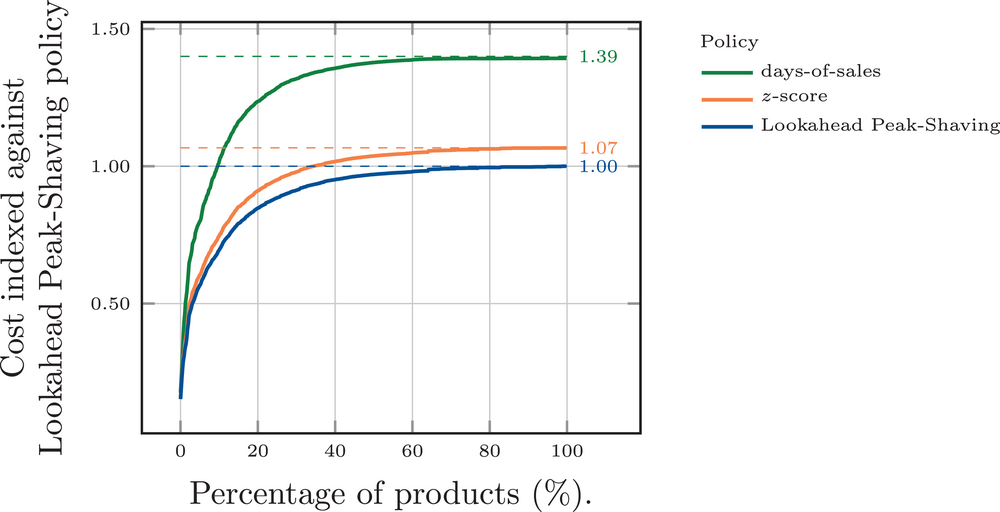
Pareto plot. Products ranked according to size. Here we can see for the percentage of largest products, how much they contribute to the total cost. All costs indexed around the Lookahead Peak‐Shaving policy.
We conclude that for the full portfolio the Lookahead Peak‐Shaving policy can clearly outperform the current policy adopted by the manufacturer.
CONCLUSION
We studied the robustly optimal replenishment policy in a single sourcing backlogging system with volume flexibility. Sourcing costs are piece‐wise linear and convex with an additional premium incurred once a pre‐dedicated threshold is exceeded. This setting corresponds to various contexts, for example, factories typically have a dedicated workforce but can temporarily exceed this capacity by exploiting overtime labor, companies can choose from several suppliers with individual capacity constraints and different unit costs or firms can book dedicated transportation capacity with an option to use the transportation spot market. We adopt a robust formulation and prove that the robustly optimal policy has the same structure as the stochastically optimal policy. The robust base‐stock levels are characterized by the robustly optimal base‐stock level of the uncapacitated system and an explicit expression of the shifting need that determines when orders should be advanced to earlier periods to avoid the overtime premium. We term the resulting policy the Lookahead Peak‐Shaving policy as it peak shaves orders from future peak‐demand periods to the current periods. We compare our policy against two benchmark heuristics and find that our policy performs well, also when evaluated against the expected costs; especially in settings characterized by high fluctuations of the periodic capacity, of the expected demand, or of both. We affirmed these findings by applying our model on data of a manufacturer. The robust policy saves 6.7% compared to the policy currently used by the manufacturer. In conclusion, our closed‐form expressions facilitate adoption in practice, they generate intuitive insights for managers into the dynamics of the problem and their application on real data results in substantial savings.

References
Supplementary Material
Please find the following supplemental material available below.
For Open Access articles published under a Creative Commons License, all supplemental material carries the same license as the article it is associated with.
For non-Open Access articles published, all supplemental material carries a non-exclusive license, and permission requests for re-use of supplemental material or any part of supplemental material shall be sent directly to the copyright owner as specified in the copyright notice associated with the article.
