






Abstract
This paper proposes price cannibalization as a growth strategy despite prior findings that suggests avoiding it. We focus on a multiclass, capacity‐constrained pricing problem in which each of the product classes has a price range. Specifically, we examine the effects of price range overlaps and introduce it as a revenue‐maximizing pricing strategy. Price cannibalization happens when sales in some product classes decrease due to the existence of overlaps between the price ranges. We employ a multimethod approach. First, we define a Markov decision problem to obtain the revenue‐maximizing strategy in a two‐class sales scenario. We show that price range overlaps are part of the optimal strategy. Second, we collect multichannel data from a European storage company to examine how price range overlaps impact a customer's purchase decisions. The results show that the existence of price range overlaps leads to cannibalization, but increases spending and improves conversion. Finally, we use simulations to compare several pricing strategies and demonstrate the long‐term effects of using price range overlaps in pricing algorithms in complex situations. Our findings suggest that using price range overlaps, though leads to cannibalization, actually helps companies avoid spoilage and early sellouts, leading to better capacity utilization and higher revenue.
INTRODUCTION
“If you don't cannibalize yourself, somebody else will.” – Steve Jobs
Price cannibalization happens when sales in some product classes decrease as a result of changes in the prices of other product classes (Raza & Govindaluri, 2019; Talluri & Van Ryzin, 2006). We study a pricing problem faced by a firm that sells multiple differentiated classes of perishable products and determines a range of prices for each of its product classes. If price ranges of two different product classes overlap, sales of the inferior class (in terms of attributes or quality) can be cannibalized by the superior class. As such, cannibalization can happen. For instance, in the airline industry, business class tickets are considered more valuable than premium class tickets because they offer better attributes, such as legroom and luggage size. If a premium class ticket has a higher starting price than some of the business class tickets on the same flight, that is, price range overlaps exist, the customers might be less likely to purchase premium class and more likely to purchase business class tickets. Figure 1 shows such a real‐world example (Schlappig, 2017).
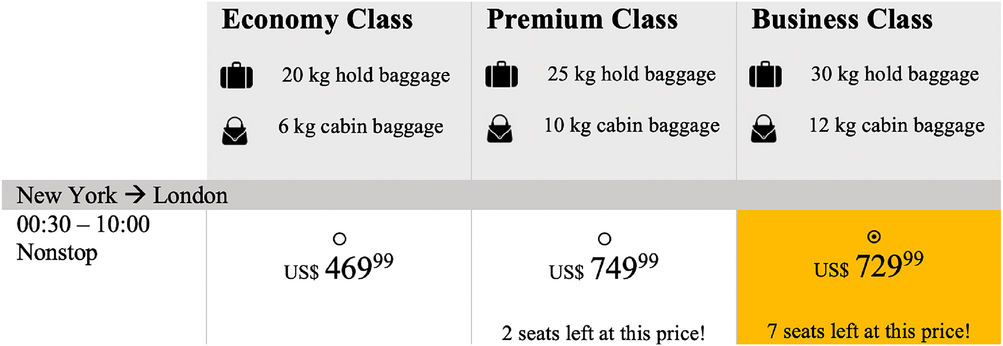
An example of price range overlaps in the airline industry.
Price range overlaps happen mainly for two reasons: changes in class capacity (number of products remaining in each class) and differences in intraclass product attributes (attributes that make products different within each class). First, in perishable product markets, price is a function of class capacities (Anjos et al., 2005; Rana & Oliveira, 2014). If the premium class faces a significantly higher demand than the business class, prices of the former might increase, whereas the prices of the latter could decrease to such an extent that the premium class becomes more expensive than the business class. Second, differences in intraclass attributes, such as the distance of a seat from an entrance, results in firms using a range of prices for each class. In this case, if there are some overlaps between the price ranges of two classes, cannibalization of the inferior class could be a possible outcome.
While some companies have recognized the need to cannibalize themselves before competitors do, and are embracing self‐cannibalization (Yu & Malnight, 2016), the extant revenue management research suggests that firms should avoid cannibalization because it generally causes a decline in sales in one of the existing products or revenue streams (Talluri & Van Ryzin, 2006; Yeoman, 2012). So, should firms allow or avoid price range overlaps? Will allowing price range overlaps lead to cannibalization? More generally, how will the customers react to overlapping price ranges in terms of the product they purchase, their spending, and their purchase likelihood?
Previous literature on capacity management of multiclass perishable products has focused on managing demand uncertainty in each product class. For example, dynamic capacity substitution or having callable products are approaches to reacting to capacity conditions postpurchase, by upgrading customers or products to superior classes, in order to enable better capacity utilization and increase the overall demand (Gallego et al., 2008; Shumsky & Zhang, 2009). However, a seller might as well use a lower price for a superior class to signal its higher purchase value and nudge its customers to upgrade themselves to the superior class prepurchase, especially if the price of the superior class is lower than all or some of the prices in the inferior class. As such, overlapping price ranges potentially can be useful in proactively assigning the customers to superior classes on their own initiative. Similar use cases of varying prices in responding to market fluctuations and uncertainty in demand are studied by the previous research (see for instance, Feng et al., 2020; Li & Srinivasan, 2019; Stamatopoulos et al., 2019). However, despite the applications of price ranges in many industries, there is limited research that investigates the implications of having overlapping price ranges in demand management. It is even less known if price range overlaps could be used to better manage a firm's capacity and demand in the long run. So, can price range overlaps be used as a pricing strategy in proactive capacity management and what are their effects on the company performance?
This paper investigates the impacts of using overlapping price ranges to achieve proactive demand management, particularly in capacity‐constrained industries, in which companies use price ranges for their differentiated product classes. In this paper, we aim to address the following research questions, for a company that sells multiple classes of perishable products: RQ1: Is using price range overlaps revenue maximizing? RQ2: What are the effects of price range overlaps on consumers and firm performance? RQ3: What are the long‐term effects of price range overlaps?
To answer the first research question, we consider a seller that uses price ranges for two (differentiated) classes of products. During this stage, we assume that price range overlaps would lead to cannibalization. Then, we define a Markov decision problem (MDP) and obtain optimal price ranges for revenue maximization. Our MDP solutions suggest that optimal prices should, in fact, overlap when an inferior class faces high demand but a superior class does not. In this case, price range overlaps lead to scattering of the demand over all the classes, helping the seller both to avoid spoilage in the superior class and to reduce early sellouts in the inferior class. Early sellouts are signs of a potential revenue opportunity because the firm could have potentially increased prices before the sellout. Moreover, in the case of an early sellout, prospective customers will turn to competitors who are still able to offer their required product. Hence, avoiding early sellouts can grant a competitive edge for a seller. On the other hand, spoilage costs equal to the opportunity cost of having unsold or unoccupied products. This paper proposes a strategy that can balance out these two capacity management concerns. It avoids early sellouts in the popular classes by nudging the customers into purchasing from the superior classes, which in turn decreases associated spoilage costs that are usually higher in the superior classes. Furthermore, MDP solutions also suggest that the optimal starting price level of a superior class is a convex function of the product availability in the inferior class. This means that, as the availability in the inferior class decreases, the starting prices of the superior class should first decrease and then increase.
To answer the remaining questions covered in this research, we partner up with a European storage rental company that rents out storage spaces of different sizes, each with a dynamically adjusting range of prices. This company's customers browse product information online and fill out a contact form if they are interested in renting a storage space. Interested customers get a call from a sales representative and are invited for a site visit before finalizing their purchase. This empirical context provides us with a unique opportunity to address our research questions for two reasons. First of all, this storage rental company operates in a capacity‐constrained industry with perishable products. Their products have multiple classes and different price ranges, some of which might overlap at times, due to capacity conditions, because this firm uses a dynamic pricing algorithm to dynamically adjust the prices of each class, with respect to its capacity. Second, this company operates in a complex, multichannel environment, in which their customers interact with the company via both online and offline channels. As such, the company struggles to balance the marketing department's pricing decisions and the operational consequences they bear.
We collect and combine data across different channels (e.g., online data, telesales data, and data from on‐site visits) in order to study how the existence of price range overlaps affects a customer's purchase decisions. In this study, we investigate the purchase behavior of 8609 customers (6611 of whom have visited the physical sites) and 24,749 price ranges. Using a combination of Heckman and seemingly unrelated regression (SUR) models, we find that having price range overlaps indeed leads to cannibalization because, in the presence of overlaps, customers tend to rent superior sizes compared to when there is no overlapping of price ranges. We also find that when price ranges overlap, cannibalization takes place for private customers but not for business customers. Interestingly, customers also tend to spend more when price overlaps exist, because they consider purchasing from the superior sizes. In addition, making a purchase decision when price ranges overlap is associated with an increase in the likelihood of a consumer purchase.
Finally, to address the third research question and to evaluate the long‐term effects of embracing price range overlaps, we develop a Monte Carlo simulation. We incorporate the empirical results into the simulation to capture the systematic effects of using price range overlaps in a pricing strategy. We compare the revenue performance of five pricing strategies, each of which has a different reaction to overlapping price ranges. The results suggest that the MDP's convex pricing algorithm has positive effects compared to the other algorithms, in terms of increasing revenue and overall occupancy, by avoiding early sellouts and decreasing spoilage costs.
This paper utilizes three studies to provide a comprehensive perspective on cannibalization that occurs due to overlapping price ranges. We present our research framework in Figure 2, which illustrates how our research questions relating to overlapping price ranges are addressed by the three studies. The figure also depicts how these methods work together to address issues raised throughout the paper. The first question we explore is whether having price range overlaps is an optimal strategy. To answer this, we employ an MDP and dynamic programming approach to investigate whether such overlaps are optimal or part of an optimal pricing strategy in a simple two‐class sales scenario. Then, we use empirical models to validate the assumptions made in the MDP and study consumer behavior in the presence of price range overlaps in the short term. Our empirical study demonstrates that cannibalization occurs due to having price range overlaps. Finally, we use simulations to examine the long‐term systematic effects of price range overlaps as a pricing strategy in a complex, real‐life, multiclass sales scenario. The simulation employs the optimal strategy structure introduced by the MDP in a complex case to provide general insights for practitioners. It also uses customer response estimations from the empirical study to provide more valid predictions. Without the MDP component, this paper cannot argue concerning optimality and loses its theoretical lens in drafting empirical models of customer response. Empirical evidence empowers us to validate our modeling assumptions and measure cannibalization effects. The simulation study sharpens the paper's managerial contributions and offers a generalized approach by integrating all our findings into practical pricing strategies and algorithms.
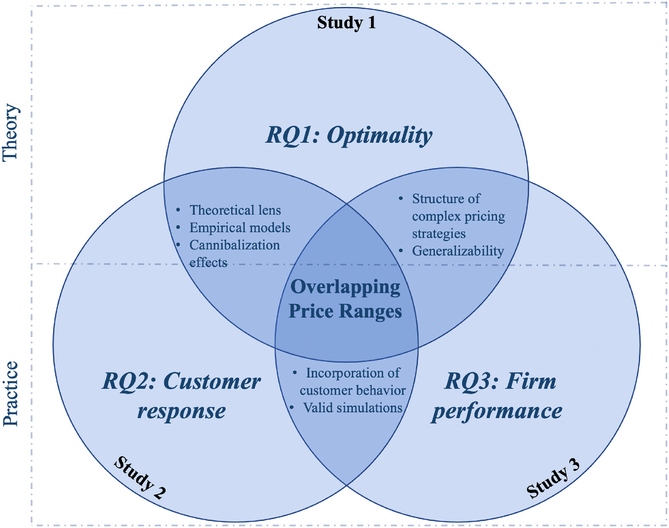
Research framework.
In conclusion, these studies show that when a company aims to scatter the demand over different product classes, both the company and the customers can benefit from embracing cannibalization resulting from price range overlaps. This is in line with recognizing self‐cannibalization as a forward‐looking growth strategy (Yu & Malnight, 2016). Companies can use lower starting prices of a superior class as an information cue and enhance the purchase value of the superior class (Li et al., 2019), which in turn can help increase sales, thereby avoiding spoilage in the superior class and sellouts in the inferior classes.
This paper offers three important contributions to the literature. First, previous literature has offered insights on how firms can cope with uncertainty in demand in the multiclass, perishable‐product market. However, these insights are reactive measures in capacity management. Product flexibility, product callability, and dynamic capacity substitution are but a few examples (Gallego & Phillips, 2004; Gallego et al., 2008; Shumsky & Zhang, 2009) of such solutions. Contrary to these reactive approaches that use capacity as the primary variable, we examine a proactive pricing strategy that uses ranges of prices as primary variables to effectively manage demand. This strategy results in avoiding early sellouts and reducing spoilage costs. Second, this paper is situated within the dynamic pricing research on vertically differentiated products, where customers' valuations of the product attributes are uniform. While previous research has introduced theoretical methods to identify the optimal pricing policy based on the degree of quality differentiation, customer behavior, and inventory levels (see, for instance, Akçay et al., 2010; Bitran et al., 2006; Parlaktürk, 2012; Chen & Chen, 2015), to the best of our knowledge, this paper is the only one that examines the incorporation of adjacent class availability into setting price ranges in a large‐scale dynamic pricing algorithm, while also addressing managerial concerns about the fear of cannibalization within this context. Third, our empirical setting provides us with a unique opportunity to identify, measure, and evaluate cannibalization caused by price range overlaps, and introduce it as a growth strategy, which provides a contrast to the emphasis on avoiding cannibalization in previous literature (Talluri & Van Ryzin, 2006).
This paper addresses a challenge within the interplay of marketing and capacity management. Operations managers often focus on capacity management without having any role in setting prices, whereas marketing managers concentrate on prices without taking capacity into consideration. Our study offers implications for managers of both disciplines in terms of setting price ranges in perishable goods industries, and the impacts it has not only on consumer demand but also on capacity utilization. While our paper begins by establishing its theory in a simplified, two‐class sales scenario, it offers clear guidelines for designing a dynamic pricing strategy in a complex multiclass setting with hundreds of products in an algorithmic fashion through a combination of empirical study and simulation experiments. Additionally, the paper sheds light on the proactive contribution of price range overlaps to capacity utilization, providing marketing managers with insights into designing dynamic‐discounting schemas in multiclass settings. In such cases, the discount on superior classes can be considered a concave function of the capacity of low classes.
OVERVIEW OF RELATED LITERATURE
Multiclass demand management
To begin with, our study adds to the stream of literature on demand and capacity management in the capacity‐constrained market of multiclass perishable products. While prior literature focuses on capacity‐based strategies to control demand, we focus on the applications of price ranges in demand management. We elaborate on three innovative approaches introduced by prior research. First, a flexible product is a menu of two or more typically substitutable products a constrained firm offers. At a time near the end of the sales period, the firm has the right to assign customers who purchase a flexible product, to one of the alternative classes. Flexible products have the advantage of increasing overall demand and enabling better capacity utilization (Gallego & Phillips, 2004). The second approach is callable products. If firms can convert a product from an inferior class to a superior class, it can apply this approach. In this approach, the self‐selected customers of the inferior class permit the firm to “call” the product at a predetermined price. This predetermined price is higher than the initial price of the inferior class, but lower than that of the superior class. Firms leverage the callable approach to avoid sellouts and serve the customers if the demand for the superior class is high (Gallego et al., 2008). The third approach is known as dynamic capacity substitution. The condition for this approach is that a product from a superior class must meet the demand for a product from an inferior class. In this approach, firms first use the available capacity to satisfy the same‐class demand, until a reservation capacity is met, then they upgrade customers until the capacity reaches a protection limit. Upgrading customers helps avoid spoilage in the superior classes by offering inferior‐class customers an upgrade (Ceryan et al., 2018; Shumsky & Zhang, 2009).
These approaches offer ways to react to capacity conditions and to decrease demand uncertainty. In other words, they take the capacity as the focal variable to manage the demand. Varying prices are often considered the most natural mechanism for responding to market fluctuations and uncertainty in demand (see for instance, Aviv & Pazgal, 2005; Aydin & Ziya, 2009; Chen & Gallego, 2019; De Vericourt & Lobo, 2009; den Boer, 2015; Feng et al., 2020; Gallego & Hu, 2014; Li & Srinivasan, 2019; Stamatopoulos et al., 2019; Sun et al., 2015; Talluri & Van Ryzin, 2006, p. 176). This paper focuses on overlapping price ranges, rather than capacity controls, to effectively manage the demand. In addition, in cases where companies are offering many classes of products, reactive approaches require heavy resources and monitoring capabilities. In this paper, by relying on the prices as information signals, we introduce a pricing strategy that enables firms to manage their capacity proactively. Firms can set price ranges in a manner that nudges customers into upgrading to a superior class, which can simultaneously help them avoid sellouts in the inferior class and spoilage in the superior class.
Cannibalization
Moreover, our study also contributes to earlier studies on cannibalization effects. Unlike prior studies that focus on avoiding or minimizing cannibalization, this paper leverages a real‐life setting to investigate a revenue‐maximizing pricing strategy that uses cannibalization. We first explain cannibalization and discuss previous findings on this topic in four research areas. We then present the positioning of our work in the literature.
Cannibalization refers to the reduction in sales or volume in one of the current revenue streams due to a marketing initiative (Yeoman, 2012). For instance, how can a firm set the price of its latest product without influencing the demand for the current products (Talluri & Van Ryzin, 2006)? Cannibalization effects have been studied in product line design, product or brand differentiation, price promotions, and multichannel environments.
In product line design, researchers propose frameworks that enable firms to consider the effects of cannibalization of current generation products in sales predictions for a next‐generation product. These frameworks are used to determine the pricing scheme and timing of the introduction of next‐generation products to reduce its cannibalizing effect on the current generations of products (Guo & Chen, 2018; Lin & Kremer, 2014).
In product differentiation, the cannibalization of the higher quality product by lower quality products is a concern that determines a firm's strategic decisions concerning the pricing, quality, and timing of differentiation (Moorthy & Png, 1992; Parlaktürk, 2012). To alleviate this concern, Desai (2001) proposes conditions for quality preferences and market competitiveness in various customer segments, while Kim et al. (2013) demonstrate that firms can adopt the commonality strategy in a market with a nondominating consumer preference structure. Similarly, in brand differentiation, Meredith and Maki (2001) designed an analytical model that enables firms to detect cannibalization of their premium brand by their cheap brand, which, in turn, allows them to react to the effects of cannibalization very early.
Cannibalization is widely studied in price promotions. For instance, in markdown pricing (a deliberate price reduction strategy used by retailers to dump extra capacity), strategic consumers may predict the markdown strategy and buy the product during the clearance period for future consumption. As such, markdown pricing may cannibalize future sales. Hu et al. (2015) determine a threshold for optimal markdown decisions and argue that the firm should introduce markdowns when the amount of leftover inventory is higher than the threshold, and dispose of all otherwise. Also, using coupons could potentially cause similar cannibalization problems, which include losing revenue from existing customers instead of attracting new ones. Reimers and Xie (2018) show that depending on a product and a firm, using coupons can lead to market expansion, and cannibalization effects can be compensated through an increase in new customer acquisition. Last but not least, cannibalization studies also appear in retail store expansion, in which the goal is to find locations for new stores, while taking into account the likelihood of cannibalization of the total demand for existing stores throughout the entire chain (see, for instance, Drezner, 2011; Ngwe, 2017; Pancras et al., 2012).
Last, in multichannel research, channel cannibalization is cited as the fear and pessimism that firms usually exhibit when deciding whether new channels should be added to the existing channel mix or if a promotion on one channel cannibalizes the cross‐channel sales (Gong et al., 2015; Verhoef et al., 2015). However, different authors have shown that these fears are overstated (Deleersnyder et al., 2002), and if channels are appropriately designed, it can lead to channel synergies (Herhausen et al., 2015). Danaher et al. (2010) argue that adding a digital channel does not cannibalize sales on other channels. Indeed, they show that removing an existing digital distribution channel does not influence the media content demand on other digital channels, but it significantly intensifies the problem of digital piracy on other illegitimate channels. Luo et al. (2020) investigate offline‐to‐online targeting strategies used by traditionally offline retail stores that are seeking to entice their existing customers to buy online with incentives. They show that consumers who live near the retailer's physical store tend to increase their offline spending and total sales once induced to buy online. However, inducing consumers who live far away from the brick‐and‐mortar store to buy online can backfire by reducing offline and total sales by approximately 5.7% for each additional distance in kilometers.
To summarize, cannibalization research is initially concerned with identifying the potential cannibalization sources and then minimizing their effects. Identifying cannibalization is historically considered a statistical challenge (Van Heerde et al., 2010). Since it is difficult to obtain individual consumer level data that can describe their intent, identifying cannibalization requires extensive analysis of the sales data from the focal marketing initiative and the sales data on other revenue streams. Moreover, while prior research primarily suggests minimizing cannibalization, we have seen companies repeatedly cannibalizing their products through new innovative solutions (Yu & Malnight, 2016). Hence, further research is required to shed more light on when companies should avoid or minimize cannibalization and when they should embrace it.
In this paper, we study a multiclass empirical setting in which a firm uses overlapping price ranges. We observe how individual customers make purchase decisions when there are overlapping price ranges in their intended product class. We also measure the way customers react to overlapping price ranges could affect a firm's revenue performance. We study an empirical setting in which multiple touchpoints provide us with detailed customer interaction data (Brynjolfsson et al., 2013) to understand customer purchase decisions, before they are exposed to prices. As such, we are able to identify and measure the effects of cannibalization resulting from a firm using overlapping price ranges.
A MARKOV DECISION PROBLEM
Model
In this section we find the revenue‐maximizing pricing strategy for a simplified instance of a firm providing two different product classes in which there are two available items for sale (RQ1). We assume that class maximum prices are fixed for each class, and the firm decides how much to charge as their starting price. Customers are myopic, and their willingness to pay (


MDP variables and their description.
Abbreviations: MDP, Markov decision problem; wtp, willingness to pay.
The structure of the problem is as follows: 


Our stochastic assumptions are as follows. We assume that arriving customers have a 


The MDP periods are assumed to be sale points and are denoted by n. We show the state variable by the vector 


Equation (1) aims to find p
21 where 



MDP solutions
In this section, for illustrative purposes, we first solve the MDP with some quantified assumptions, and subsequently report the results. The corresponding proofs for the general case are reported in Supporting Information 1. We show that the optimal price structure entails overlapping price ranges (Theorem 1). Second, to obtain the optimal price structure for each of the classes, we mainly look at how the starting price of the superior class changes with respect to the capacity of the inferior class (Theorem 2). Finally, we present some complimentary analyses.
We use a value‐iteration approach in order to solve this dynamic pricing problem. We assume 



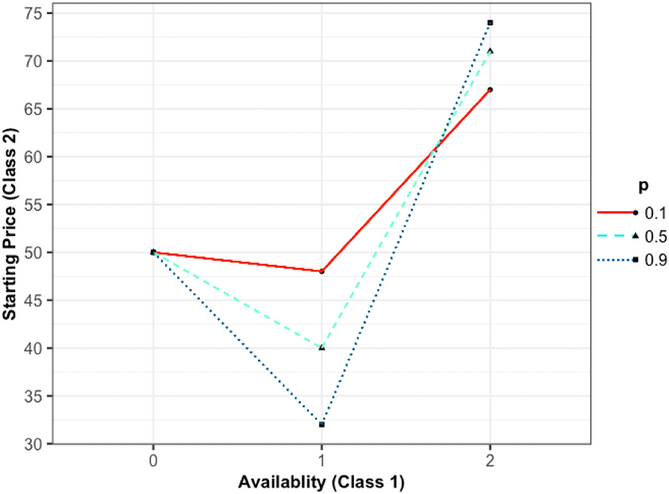
The optimal starting price of Class 2 (based on availability of Class 1).
First of all, when the inferior class is occupied while the superior class is not, the lower starting price of the superior class increases sales in the superior class. These sales would have been lost (spoilage) if the price range of the superior class had started higher than that of the inferior one. In Figure 3 (the dashed line), if there is only one product available in the inferior class, the starting price of the superior class is 40 units, while the only available product in the inferior class is worth 60 units. Second, embracing overlaps enables the firm to avoid sellouts in popular classes. If a particular class is popular with customers while others are not, not providing other alternatives for the customers, within that price range, will lead to sellouts in the popular class. While subsequent customers will not purchase, subsequent demand will be considered as lost sales. The findings of this example are incorporated in the below theorem. The set of optimal prices contains price range overlaps.
In order to prove Theorem 1, we show that in one of the states, namely (1,2), the expected obtained revenue is higher if we allow the starting price of Class 2 to be lower than the maximum price of Class 1. As such, in Equation (EC.8), we compare the expected revenue of the first and second maximization parts. The proof will follow using Axiom 1 in Supporting Information 1, which states that the cumulative probability function 
Moreover, the starting price of the superior class is a (convex) function of the capacity of its inferior class. The results suggest that the prices for the superior class are also functions of the capacity of the inferior class. This finding is important, as the correlation between the optimal starting price of a class and the capacity of its inferior classes can lead to overlaps in price ranges. This insight is the basis of a practical dynamic pricing algorithm in which price ranges are functions of not only the capacity of the class they represent but also the capacity of other classes. We use this insight in the subsequent sections in a complex environment with a higher number of products and classes. This finding is incorporated in Theorem 2 as follows: The starting price of the superior class is a convex function of the capacity of the inferior class.
To prove Theorem 2, our strategy is to show that 


We now turn to analyzing the sensitivity of optimal price ranges to the probability p. As defined in Table 1, p is the likelihood of purchasing a product from the inferior class, where a customer can buy products from either of the classes due to having a higher willingness to pay than the prices in both of the classes. We previously showed that if 


The results of the MDP determine the optimal pricing strategy and pinpoint the fact that this strategy necessitates embracing overlaps in the price ranges. This finding answers the RQ1. Throughout the MDP, by considering the parameter p, we assumed that cannibalization would happen stochastically. Next, we will focus on an empirical setting in which a firm uses overlapping price ranges in practice. We will validate the MDP's assumption, which states that cannibalization will happen in cases where price ranges overlap (RQ2). Finally, in this section, we examined a simplified case of a two‐class dynamic pricing problem utilizing price ranges. These findings are restricted and cannot be extended to a general, complicated dynamic pricing algorithm. To address this issue, in the third study, we employ simulations to illustrate how we can develop a large‐scale dynamic pricing strategy using the MDP outcomes. We will examine how embracing price range overlaps affects consumer purchase decisions and the firm's short‐ and long‐term performance (RQ3).
RESEARCH CONTEXT AND DATA
Research setting
In this research, we collaborate with a major self‐storage rental company in Europe. The popularity of storage rental services is increasing drastically: the number of facilities with 24 h access increased from 19% in 2017 to 35% in 2018 (FEDESSA, 2018). The European storage rental market has a high potential for future growth, due to the higher population density and “degree of urbanization,” compared with the mature market in the United States.3 In highly populated cities, lack of space and the rising costs of available space will inevitably result in more demand for storage rental services.4
Storage rental spaces are considered as perishable products. If rental space units are not rented out, the corresponding revenue during their period of availability cannot be realized later on. Thus, it is not surprising to see that many self‐storage companies are using revenue management and dynamic pricing (Bank of America, 2013).
Our partner company differentiates its storage spaces into different classes, in terms of storage sizes (in cubic meters), in order to serve more customers with different storage needs and valuations. There is a price range for each size, because the distance of a storage space to the entrance determines how expensive the unit will be compared to other units of the same size. The company uses dynamic pricing algorithms to generate price ranges for each size, which can result in overlaps between two or more different sizes. As such, it is possible that the starting price for a product size lies within or below the price range of another one. In this case, the larger unit is likely to cannibalize the demand for the smaller one, due to its higher volume and its lower minimum price.5 Like the assumptions in the MDP section, this company considers that maximum prices for each size are fixed numbers, but starting prices for each size can change as a decreasing function of the corresponding occupancy of units of that size.
Figure 4 contains our partner company's prices at a given day in a specific European city. It shows an example of the existence of overlaps in the price ranges used by this company. This location includes products of different sizes, ranging from 1 to 66 


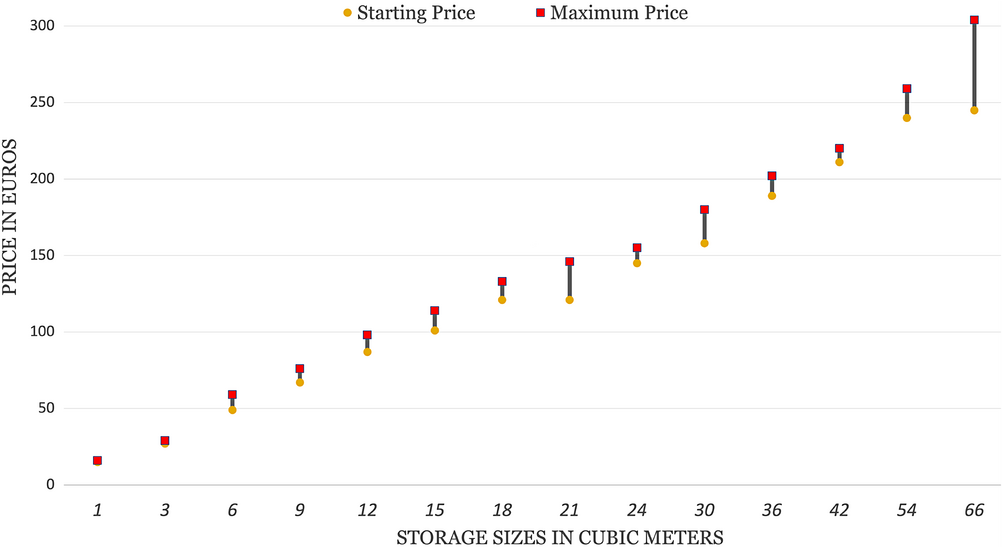
Example prices of a storage rental company.
Our partner company is concerned about how to deal with such overlapping price ranges. They are concerned about renting out bigger sizes at prices equal to or even lower than the prices of smaller units, as potentially, it would mean they were renting out extra spaces with zero or negative prices. Furthermore, because this firm was using a dynamic pricing algorithm that adjusted the prices with respect to capacity conditions, unit prices were functions of the occupancy rate in their corresponding sizes. As such, price ranges changed constantly over time, as a result of new bookings or customer churns. This contributed to an increase in the possibility of price range overlaps. For instance, on average, there were around three overlapping price ranges in each of this firm's business units (locations in which many storage spaces were rented out) during February and March 2020. In 40% of the business units, on average, more than three occurrences of overlapping price ranges were observed.
Most customers begin their journeys online, where they can select their required storage class and check out the prices.6 Because the actual price of a chosen size is determined by the dynamic pricing algorithm, and is only available at the point of purchase, the customers can find only the starting price during their online visit. The firm uses broader size indicators such as XS, S, M, L, and XL, which we refer to as classes. Within each class, there are usually storage spaces of more than one size. For instance, both 1 and 3 
Data and assumptions
The online interaction of customers was captured by a CRM software, by assigning an identifier to each of the customers. The offline customer interactions were registered by the staff in the call center and employees on‐site. A daily trigger registered historical daily prices, which are used to track what prices are communicated to whom. For each unique customer, we collected data on the channel from which the customer initiated the request (i.e., online vs. by phone), customer information on their submitted form, their requested class, the starting prices communicated to them during the phone call, their stated reasons for storage requirements, and their purchase decisions made during their on‐site visit. We also collected daily information on the prices of each of the storage units, their occupancy status, and the status of the price ranges.
We collected these data between February and September 2020. During this period, 8609 customers started their online journeys on the website or via a direct phone call, and requested a storage space to rent. Among them, 6611 customers made on‐site visits and 53% of them (3514) made a purchase. Since we knew the customers' requested classes and their visiting time, we were able to find out whether they were exposed to overlapping price ranges during their on‐site visit and prior to their purchase decision. Among the customers who visited the locations, 43% of them faced overlapping price ranges for at least two sizes within their requested class of storage space. Supporting Information Table EC.2 presents an overview of the number of customers who purchased a class of storage space for each requested class (final class) and those who did not convert.
Customer demographics, such as age, gender, type (private or business), are mostly available for those who end up renting. For each customer, we looked at the sizes within each class and counted the number of overlaps (#WithinClassOverlaps). We also created a dummy variable (DummyWithinClassOverlaps), with values equal to one, in cases where the number of overlaps was positive. #FreeUnitsInRequestedClass refers to the number of available units in a customers' requested class. Purchase outcomes include whether a customer ended up renting (Conversion), the monthly amount in Euros that a customer spent on the storage space that he/she rented (FinalPrice), the rented storage class (FinalClass), and the actual size of the rented storage space (FinalSize). Based on the sizes of each product class, we calculated the AverageRequestedSize. This variable is the main independent variable in our analysis. We model the customers' final choice (FinalSize) as a function of their AverageRequestedSize. Similarly, at the time of the site visit, we recorded average price in the requested class via AverageRequestedPrice. Last, to distinguish price range overlaps (in a binary sense) from price differences (in a continuous notion), we use the variable RelativePriceDifference. This variable captures the average of differences in starting price of bigger sizes and maximum price of smaller sizes within the requested class and divides it by the AverageRequestedSize. Table 2 presents our descriptive statistics. The correlation matrix between the introduced variables is also available in Supporting Information Table EC.3. Concerning other controls such as the phone calls, we recorded the time difference between the phone call and the appointment, and the number of phone calls that each of the customers made to the company. Moreover, we recorded the week number of the visit per each customer. Last, we used a dummy variable called Calculator for customers who used the built‐in calculator to calculate the class of the storage space they needed. The calculator item is the only part of the website design that some of the customers use and others do not, the rest of the website design is the same for all customers. So, we measured it to account for its influence on the customers' choices.
Descriptive statistics.
Within the time frame of this study, there were a total of 3514 customers who were renting a storage unit. Of them, 1207 were women and 231 were business customers. In total, we studied 24,749 price ranges within the classes requested by customers. A total of 2845 customers found at least one price range overlap within the price ranges of their requested class. The average number of price range overlaps in a customer's requested class was 0.81. All of the customers found at least one available unit in their requested class.
In the MDP section, we introduced the probability p corresponding to the situations in which a customer would still rent from the inferior class, despite being able to purchase from the superior class. In the time frame of this study, we can see that there is a significant proportion of customers (

EMPIRICAL ANALYSIS AND RESULTS
In this section, we use empirical models to examine customer purchase behavior in the presence of price range overlaps, versus in the absence thereof, in terms of their choice of conversion, final sizes, and the final price paid.
Model‐free evidence
We first examine the effect of price range overlaps on the probability of customer conversion. Figure 5 demonstrates the conversion trend, starting from Week 6 (early February) and extending until Week 33 (mid‐August) of 2020. The blue lines show the fitted conversion trends. The solid lines correspond to overlapping price ranges and the dashed lines correspond to nonoverlapping price ranges. Moreover, the gray areas around each of the curves correspond to a 90% confidence interval. This trend shows a substantial increase (overall 52%–55%) in the conversion probability for those customers who make their purchase decisions where overlapping price ranges exist.
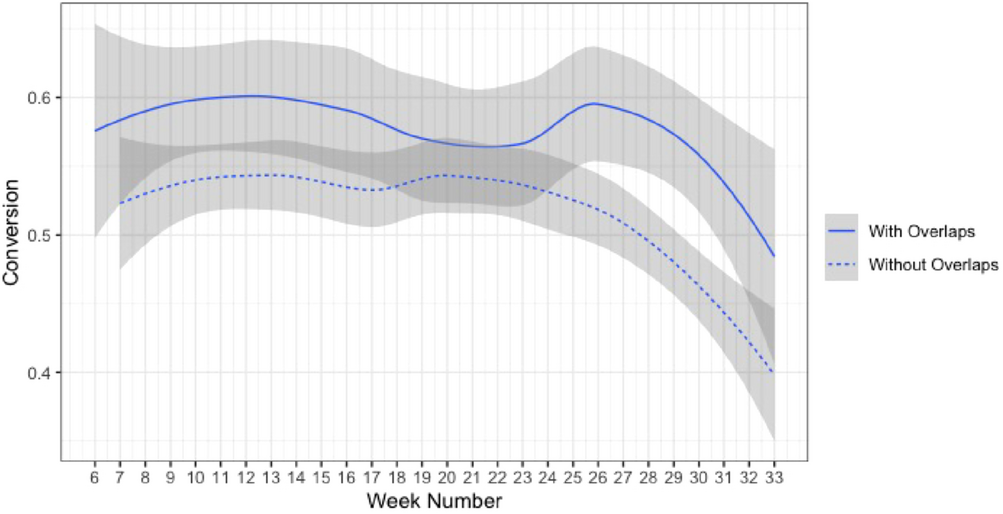
Time series graph of conversion probability.
We examine whether price range overlaps lead to cannibalization. We look at the customers who have decided to rent and examine how the existence of price range overlaps affected the final size of the storage space they rented. If price range overlaps do indeed lead to cannibalization, we will see that customers who notice that the price range of the bigger size overlaps with that of the size they requested will rent a comparatively bigger storage space (in terms of 


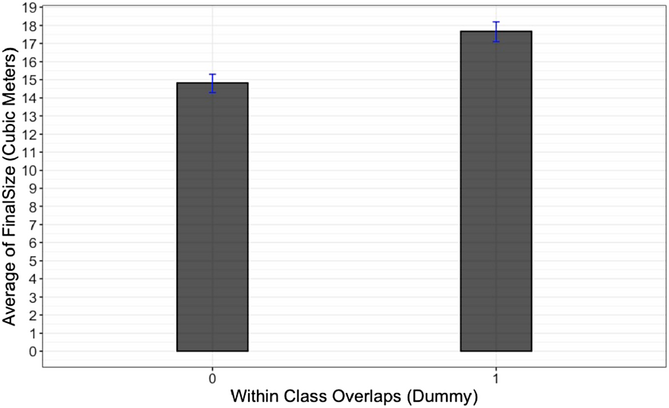
Final size plot.
Empirical models
We apply regression analyses to formally identify the effect of price range overlaps on a customer's decision to rent a space. Regressions allow us to account for heterogeneity that correlates with price range overlaps and outcome variables. If omitted, these heterogeneous effects would introduce endogenous issues, resulting in biased interpretations. The major endogenous variables in our analysis are website, location, and customer‐specific effects. Thus, we account for the customers' interaction behavior with the website, time‐based business unit data, and customer trends in order to capture the temporal variation that these introduce.
We use empirical models to measure the influence of price range overlaps on a customer's final choice in terms of the product they end up renting. Since this choice depends on an overall conversion decision, we first need to understand the influence of price range overlaps on renting probability. We model the conversion using regression analysis, where the dependent variable, conversion, is a function of the number of overlaps within the requested class and the average of prices within the requested class. Next, we identify the effects of price range overlaps on the final size and price that the renting customers choose and pay. We look at the final size chosen by a customer as a function of the size they intend to rent, that is, the average requested size, and examine whether price range overlaps moderate the relationship between the average requested size and final size. The models are explained below and are conceptualized in Supporting Information 2.



However, LPMs have limitations: (i) they assume a linear relationship between conversion and the number of price range overlaps, which may result in misspecification of the model and sensitivity to data; and (ii) they may yield probability predictions outside the range of 0 to 1 by treating conversion as continuous, which can result in gross underestimation or overestimation of the true effects. To address these concerns, we use a Probit model (Equation 2) in which β3 is the estimator of interest: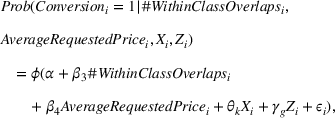





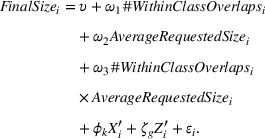
Similar to 







Baseline results
We first present a baseline of our estimation results. In the beginning, we look at all the observations and use a Probit regression to estimate the customer conversion probability. Next, we assume that 


Baseline results for effects of price range overlaps on customers' purchase decisions.
Notes: Demographics include gender and type corresponds to business or private. Storage & customer FE include relative price difference, free unit count, time‐control variables, website control variables, call count, and the time difference between customers' interaction with the firm.


Next, we check customers' demographics and type, and excluded customers who did not make a purchase. We examine the effect of the number of price range overlaps on customers purchase decisions, in relation to 

Selection bias
Next, we expand the baseline estimation results to obtain better and unbiased estimates of the effect sizes. Although Equation (2) focuses on all the visiting customers, Equations (3) and (EC.20) study 


To address this selection issue, we use a built‐in package in R called the SampleSelection (Toomet & Henningsen, 2008) to run a Heckman selection model. This model consists of a Probit regression as the first‐stage regression and a second‐stage OLS. The second‐stage incorporates the inverse Mills ratios obtained from the Probit. In this paper, Equation (2) acts as the selection equation and it is estimated using a Probit regression with the results identical to those reported in Column 1 of Table 3. Before reporting the estimation results, we test the selection bias hypothesis. Considering 


The Heckman estimation results of Equations (3) and (EC.20) (as the response functions) are reported in Columns 1 and 2 of Table 4. The result concerning the cannibalization effects (coefficient of the interaction term in the first column) is still consistent with earlier result of the baseline model. Additionally, we find a significant and positive effect (1.324, 
Heckman model and SUR results for effects of price range overlaps on customers' purchase decisions.
Note: Demographics include gender and type corresponds to business or private. Storage & customer fixed effects include relative price difference, free unit count, time‐control variables, website control variables, call count, and the time difference between customers' interaction with the firm.
Abbreviations: OLS, ordinary least square; SUR, seemingly unrelated regression.


Seemingly unrelated regressions
Our second addition to the baseline model is related to the relationship between Equations (3) and (EC.20). At the rental moment, 


We use the R package SystemFit (Henningsen & Hamann, 2008) to estimate Equations (3) and (EC.20) using SUR. Additionally, to account for the selection bias discussed earlier, we incorporate the inverse Mills ratios obtained from the Probit in estimating Equations (3) and (EC.20) in SUR. In other words, we simultaneously estimate Equation (3) (for 

The results in Columns 3 and 4 (Table 4) show a significant positive effect (1.426, 


Robustness checks
We conducted a number of robustness checks on our main findings. First, we checked to see if the results are robust under alternative measures of price range overlaps. We used a dummy variable DummyWithinClassOverlaps instead of a count variable for overlaps. We also used a dummy variable if there where price range overlaps between different classes. The results are shown in Supporting Information Table EC.5, and are qualitatively consistent with earlier findings.

MONTE CARLO SIMULATION
Although the results of the empirical study offer us valuable insights, making pricing decisions by relying on short‐term empirical average effect models without considering long‐term systematic effects can be problematic. For example, in the storage rental business, selling out in a popular size can contribute to the growth of competitors who are still serving the demand for a particular popular size. On the other hand, having unsold free storage spaces will result in spoilage costs; these costs will be higher for superior units. Closed‐form analytical models cannot capture such complex interconnections in such dynamic operational environments. However, a combination of empirical and simulation methods can help researchers capture the long‐term systematic effects and strengthen the empirical findings. In this section, in order to investigate the systematic effects of having price range overlaps on a pricing strategy in the long run, we turn to discrete‐event simulations.11
Figure 7 provides a concise overview of the steps, components, and procedures discussed in our Monte Carlo simulation. Initially, we develop a model of the customer purchase process, considering a diverse range of products with various storage sizes. We analyze and estimate statistical distributions for parameters such as customer types, arrival times, and contract duration. In a subsequent step, our aim is to validate the initial model by integrating insights from the empirical study into our customer purchase process model. Following this, we verify the simulation model to ensure its accuracy in predicting future trends beyond the data used for validation. Next, we include the theoretical results of the MDP in the simulation to test their generalizability in a more complex setting. As such, our study then advances to the creation of multiple pricing strategies, designed as scenarios within the simulation. These pricing strategies have different reactions to price range overlaps to understand if Theorem 1 holds. Moreover, we design a pricing algorithm based on the convexity condition (Theorem 2) to test for its optimality and compare its revenue performance with the other scenarios. Finally, we run the simulation using different pricing algorithms (as scenarios) multiple times to assess their long‐term effects on performance. In the remainder of this section, we further discuss these components.
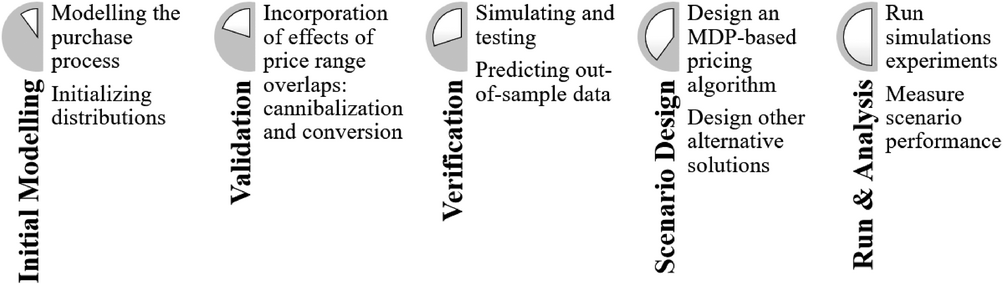
Simulation steps, components, and procedures.
In our initial simulation model, we use the actual products, prices, and demand data from our research partner. We use simulation to model how a customer makes purchase decisions on‐site when visiting a location and observing the price ranges. We simulate the actual company setting by including the exact storage space features, such as sizes and availability. We also implement the company's current dynamic pricing algorithm in the simulation. As such, the prices change due to new bookings or cancellations, matching the price changes in the real‐life setting. Next, we estimate customer type distribution, the arrival of new customers and the distribution of contract duration, using our partner company's historical data. In Supporting Information 3, we discuss our initial model of the purchase stage on‐site in Supporting Information Figure EC.2. This model is subsequently modified and validated, based on the empirical results discussed in the previous section, as follows.
First, our empirical study suggests that a customer's purchase decision and the size of the storage space they rent depends on whether the price range of their requested class overlaps with that of the units with superior sizes. Supporting Information Figure EC.7 shows how the effects of the price range overlaps are incorporated into the initial simulation, in order to reach the validated model. For instance, cannibalization happens when private customers observe that the price ranges of superior sizes overlap with the price range of their requested class. Hence, in the simulation, when (private) customers find price range overlaps, they also consider buying from the superior sizes. Second, in the presence of overlaps, the conversion event is more likely to happen, according to the Probit regression estimator in Table 3. By incorporating these findings into the initial simulation, we compare the performance of both models in predicting the actual out‐of‐sample occupancy trends in a particular city. Supporting Information Table EC.7 demonstrates that the validated simulation model fits the actual data substantially better. The simulation details and the required verification and validation steps are reported in Supporting Information 3.
Using the validated model, we evaluate the long‐term effect of price range overlaps using three main firm performance indicators: occupancy rate, total revenue, and spoilage costs. The occupancy rate is defined as the percentage of units sold, divided by the total units. Total revenue refers to the monetary sales made from purchases in all of the product classes. Spoilage costs refer to the monetary cost of not being able to sell a product, and are equal to the summation of the unit price of a product into the duration of the time during which the product remains unused.
To evaluate long‐term effects, we compare five pricing strategies that deal differently with price range overlaps, and accordingly with the resulting cannibalization, differently. These strategies share the same dynamic pricing logic, which dictates that the prices in each of the classes are decreasing functions of the same‐class capacity. However, they are different in terms of how they react to either the lower class capacity or its price range. In summary, these pricing strategies are designed in such a way that (1) they represent a spectrum of the firm's possible reactions to price range overlaps in our comparison set; (2) they have the price ranges at a similar average per cubic meter level; and (3) the price of each product is a decreasing function of its class capacity. These strategies are called Automatic Avoidance, Default, Limited Avoidance, Manual Avoidance, and Smart Overlaps. Table 5 briefly introduces these strategies. In this section, we discuss the default and smart overlaps strategies due to their higher importance and leave the description of the other three in Supporting Information 3. It is, however, worthwhile to mention that the other three strategies are designed in a way to mimic the company's possible attempts to avoid price range overlaps.
Summary of five pricing strategies (strategies are sorted alphabetically).
Abbreviation: MDP, Markov decision problem.
We chose one of the cities in which some storage spaces are available for rent. This location has 373 storage spaces in 15 sizes. The predictions are made based on historical demand data and by extrapolating it to a period of 500 days. The 500‐day period is used because occupancy reaches an equilibrium before this time and does not fluctuate. We ran simulation experiments under different pricing strategies in this location and analyzed company performance therein.
We now present the result of our simulation experiments. Figure 8A demonstrates the effects of different pricing strategies on the total occupancy in this city. The lower occupancy growth rate of those algorithms that avoid cannibalization in this graph corresponds to sellouts in popular sizes. Because of these sellouts, the growth in occupancy does not continue, due to the loss of prospective customers. However, as demonstrated by the blue and green curves that correspond to overlapping price ranges, when the demand for a popular size is high, a proportion of the customers will buy bigger sizes, thereby deterring the sellouts. The higher growth rate in Figure 8, and the higher overall occupancy is the first benefit that a firm can achieve by embracing the cannibalization option.
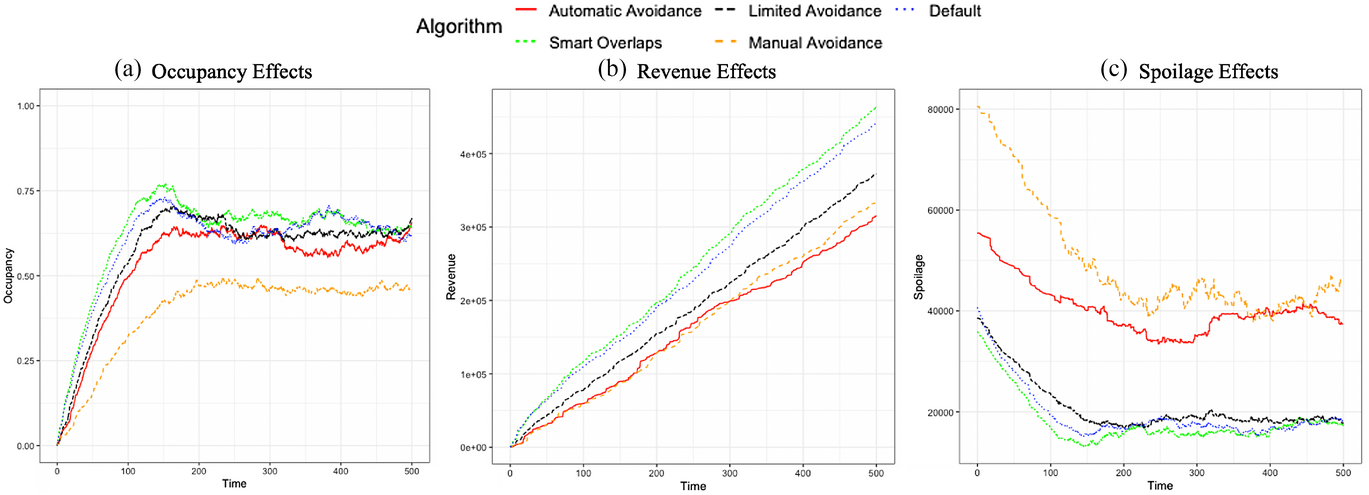
Monte Carlo simulation results of different pricing strategies on long‐term firm performance.
Figure 8B compares the revenue predictions over the following 500 days at the focal location. Embracing cannibalization improves revenue. Moreover, the smart algorithm can score higher in terms of the revenue than the default algorithm because after sellouts in the smaller sizes, it raises the prices of the bigger ones. By allowing price ranges to overlap with each other, the potential revenue is realized faster than when the firm avoids overlaps. Moreover, Figure 8C corresponds to the spoilage costs in the simulation period and demonstrates the superiority of overlapping price ranges. Embracing cannibalization helps the firm sell the superior sizes more quickly, which in turn decreases the spoilage costs due to the higher spoilage costs of the superior units. Moreover, by scattering the demand over different classes, overall occupancy increases continuously (as depicted in Figure 8A), which in turn decreases spoilage.
DISCUSSIONS AND CONCLUSIONS
Discussions of main findings
We explore price range overlaps as part of a pricing strategy for multiclass, perishable product markets, in which sellers use a range of prices per each of the classes. Past evidence suggests that firms avoid cannibalization (for instance, in Talluri & Van Ryzin, 2006). This paper shows that although price cannibalization happens by allowing overlaps between the price range of one class and that of its superior class, this cannibalization is part of an optimal pricing strategy. To show this, we first analyze the revenue‐maximizing pricing strategy for applications of price ranges in an industry that produces perishable multiclass products. Then, we empirically examine the effects of overlapping price ranges on the purchase behavior of customers (conversion, size, spending) and firm performance, using a combination of secondary data analysis and simulations.
Using an MDP framework, we examine whether the optimal pricing strategy includes price range overlaps. We assumed that price range overlaps would cause a decline in inferior‐class sales (cannibalization). We found that when the capacity constraints are tight in the inferior class and less stringent in the superior class, price range overlaps contribute to revenue maximization and help avoid sellouts and spoilage. Lastly, we observed that if the probability of purchase from the inferior class, in a case where a purchase can be made in the superior class is nonzero (
We use a secondary data set from our partner company that allows us to understand how price range overlaps affect customers' purchase decisions. We provide empirical evidence that making purchase decisions in the presence of price range overlaps is associated with an increase in purchase likelihood and final spending. Moreover, customers buy from higher classes when they observe price range overlaps. As such, price range overlaps lead to cannibalization but, interestingly, only for private customers and not for business customers. As business customers still purchase from inferior classes in the presence of price range overlaps, the probability of purchase from the inferior classes in the presence of overlaps (p in the MDP) is nonzero (
Finally, we developed a Monte Carlo simulation to compare the long‐term performance of five pricing strategies that react to price range overlaps differently, by incorporating these empirical findings. We showed that allowing organically generated price range overlaps to exist outperforms avoiding them manually or automatically. We also compared the MDP's convex pricing strategy with the rest of the pricing strategies. The convex algorithm outperforms all of the other algorithms in terms of revenue, total occupancy, and spoilage costs. Moreover, we also showed that pricing strategies that embrace price range overlaps (smart overlaps, default, limited avoidance) outperform those that avoid it in the long run, despite the evident cannibalization effects. The results pinpoint the effectiveness of using cannibalization as a proactive capacity management strategy. This strategy relies on price range overlaps to nudge the customers into upgrading themselves to higher classes that enable better capacity utilization. Firms can use cannibalization as an information‐based pricing strategy to nudge customers into higher classes.
Theoretical, methodological, and managerial implications
From a theoretical perspective, our research contributes to the literature in the following ways. First, we contribute to capacity management and dynamic pricing literature. Research on demand management of multiclass perishable products has offered us insights into addressing the challenges of demand uncertainty in each product class. Prior research has focused on studying reactive approaches to capacity conditions postpurchase in order to scatter the demand over all of the product classes (Gallego & Phillips, 2004; Gallego et al., 2008; Shumsky & Zhang, 2009). Varying prices are often considered the most natural mechanism for proactively responding to market fluctuations and uncertainty in demand (Talluri & Van Ryzin, 2006, p. 176). This paper examines a proactive pricing strategy that can offer the combined benefits of these reactive approaches. We demonstrate that overlapping price ranges are effective in motivating customers to upgrade themselves to superior classes, which also increases their conversion and spending.
Second, we study a pricing strategy that is relevant to both operational decision theory and marketing strategy. Marketing strategists rely on insights obtained from behavioral decision theory in order to increase the purchase likelihood by nudging the customer into making a purchase (see, e.g., Ivashuk, 2019; Schneider et al., 2018; Simons et al., 2017; Thaler & Benartzi, 2004; Thaler & Sunstein, 2003; Tversky & Kahneman, 1981; Weinmann et al., 2016). However, operational theorists are concerned with allocating the right product to the right customer at the right time (see, e.g., Shumsky & Zhang, 2009). Our study brings together these disciplines and demonstrates that a pricing strategy using price range overlaps can achieve both goals simultaneously: increasing sales performance and enhancing operational capacity allocation.
Last, in this paper, we identify an optimal pricing strategy with cannibalization. While prior studies in revenue management suggest minimizing cannibalization (Talluri & Van Ryzin, 2006; Van Heerde et al., 2010; Yeoman, 2012), our research shows that embracing cannibalization can pay off by allowing price ranges to overlap. Using a combination of dynamic programming, an empirical analysis, and a simulation study, we demonstrate the short‐ and long‐term effects of this optimal pricing strategy.
From a methodological standpoint, this study introduces a novel methodological approach to comprehensively analyze cannibalization resulting from price range overlaps. In this context, we illustrate how researchers can address concerns related to optimality, validity, and generalizability in empirical research. We initially investigate the optimality of price range overlaps by employing an MDP and dynamic programming framework in a two‐class sales scenario. The empirical validation of our MDP assumptions and consumer behavior is conducted through empirical models. The observed cannibalization due to price range overlaps is confirmed in our empirical analysis. To extend our insights, we employ simulations that integrate the MDP‐derived optimal strategy within a complex multiclass sales context. Leveraging empirical customer response estimations, these simulations offer valuable predictions. The incorporation of the MDP framework is crucial for establishing optimality and maintaining a theoretical foundation for our empirical models. Empirical validation enhances our modeling assumptions and cannibalization effect assessment. Ultimately, the simulation study refines managerial implications, synthesizing findings into actionable pricing strategies and algorithms, thus contributing to practical applications.
From a managerial viewpoint, the results provide insights for capacity‐constrained multiclass firms in order to guide them in the use of ranges of prices in their pricing strategy. To begin with, we suggest that the price of a superior class is not only a decreasing function of its capacity, it is also a nonmonotone and convex function of the capacity in its inferior class. Pricing strategists can use the convex algorithm introduced in the simulation study to incorporate this pricing insight into their dynamic pricing algorithms.
Moreover, the top management of companies often ask questions about overlaps in the price ranges of their product classes, due to cannibalization fears. In our experience, a firm's most intuitive reactions to such overlaps are to avoid them in the first place. However, our study demonstrates that overlapping price ranges can help them to improve revenue performance in terms of conversion probability and spending.
In addition, operations managers often focus on capacity management, and marketing managers are responsible for pricing strategies. This study demonstrates the importance of integrating these two aspects and offers insights into improving capacity utilization and increasing consumer demand by incorporating price cannibalization into the pricing strategy.
Moreover, although we conduct this study in the storage rental context, the results can be generalized to other capacity‐constrained businesses, where the products can be classified into different classes based on the main product attribute. Also, where within each product class, heterogeneities exist in some minor product attributes, leading to a range of prices per each of the classes. Examples of such industries include rental businesses, airlines, hospitality, telecommunication, and energy markets. These industries can consider using overlapping price ranges as a means of capacity management. This allows them to understand the optimal price behavior in superior classes with respect to inferior‐class capacity. They could also measure cannibalization probability that is specific to their own context and incorporate it, for example, as a convexity argument in the design of their dynamic pricing algorithms.
Finally, the concept of price range overlaps, and decreasing the prices of superior classes when the inferior classes face high demand, can help managers design effective discounting strategies. Discounts can stimulate a sense of winning in customers, making such strategies highly effective in influencing customer choices. Marketing managers can rely on our findings to design superior‐class “dynamic discounts” when the inferior classes are facing high demand, right before a sellout occurs. In this case, it is worth mentioning that the existence and amount of discounts on the superior class will be a concave function of the capacity of the inferior class.
Limitations and future work
We now discuss the limitations of this work, which provide fruitful opportunities for future research. First of all, we used an observational study to examine consumer behavior in the presence of overlapping price ranges. In doing so, we relied on the dynamically occurring overlaps in our partner company's price ranges. Future research could use a controlled field experiment where customers are randomly assigned to different experimental conditions, with or without price overlap groups. Doing so, enables us to study the causal effects of price range overlaps on customer behavior. Second, we found evidence that providing customers with alternatives from superior classes in the price range of inferior classes correlates with an increase in purchase probability. However, customer behavior might be different in situations in which the overlaps exist in the superior class price ranges and their requested class, compared to the cases in which these overlaps materialize in the price ranges of the inferior classes and their requested class. While we focus on the former case in this paper, the latter could affect the purchase decision differently. On the other hand, past research has shown that increasing the number of alternatives in terms of the customers' choice set might result in choice‐paralysis and, in turn, hurt the conversion process. An overlapping price range, in fact, nudges the customers into considering alternatives from other classes. Hence, it increases the customers' choice set. As such, due to choice paralysis, the existence of overlaps can backfire on the conversion process. Although we checked for effects of time‐based customer and storage space, further research could design controlled lab experiments for further identification of the behavioral mechanisms underlying the observed effect that overlapping price ranges have on conversion. Third, future research could implement our proposed convex pricing strategy in order to assess its long‐term effects on consumer behavior and the revenue performance of a company.
In conclusion, this work sheds light on how and when multiclass sellers can use overlapping price ranges. Moreover, our research has the potential of offering a template for future researchers in using multichannel (or omnichannel) retail settings to study complex phenomena. Price cannibalization is a complex phenomenon because it is impossible to identify customer intent by relying on limited touchpoints. However, the potential of multichannel retailing in enabling researchers to harness detailed information on the physical and online behavior of customers can facilitate studying their reactions to overlapping price ranges, which enables the identification and measurement of cannibalization.
Footnotes
ACKNOWLEDGMENTS
The authors thank the department editor Fred M. Feinberg, the SE, and three reviewers for their helpful comments throughout the review process. They would also like to thank the participants at the Academy of Management 2020 and Statistical Challenges in Electronic Commerce Research (SCECR) 2020 for their constructive feedback. The authors acknowledge financial support from Erasmus Research Institute of Management (ERIM) and Vereniging Trustfonds. The authors are entirely responsible for the contents of this article, and the usual disclaimers apply.
1
It is important to mention that this assumption need not always hold. The probability density of
2
One possible explanation for this behavior lies in how airlines could use overlapping price ranges, as demonstrated in  . They might find it reasonable to set the starting price of premium class (Class 1) lower than the price of the only remaining business ticket (Class 2) with the hope of exploiting a customer with an extremely high willingness to pay for the premium class. This case is not unlikely (
3
4
According to the European Self Storage Annual Survey in 2018, around 33% of self‐storage customers are commercial customers (B2B) who often use self‐storage as a flexible solution for their supply chain needs. At a B2C level, self‐storage services are mostly used at life‐changing moments, such as moving home, starting a family, a death in a family, entering a relationship, traveling, renovating, or divorce.
5
It is important to note that cannibalization can happen, even if there are no overlaps in price ranges, however, we are focused only on the instance of cannibalization caused by overlapping price ranges.
6
The company does not acquire information about customers' requested size, but rather it does register information about the requested class. This is mainly because customers do not have a strong preference over a certain size in cubic meters and it is easier for them to choose a broader category label such as small or medium.
7
S also refers to storage spaces with sizes of between 4 and 12
8
To check for possible multicollinearity, we compute the Variance Inflation Factor (VIF) for each of the regressions in Table 3. For all of the variables included in the regressions ). We also employed the Goldfeld–Quandt test to assess potential heteroskedasticity in our regression. Upon running the test on the linear regressions containing the final size, we obtained a GQ value of 1.057 and a p‐value of 0.1206. Consequently, we rejected the alternative hypothesis that the error variance differs across data segments.
9
10
Forty‐eight percent of business customers were exposed to overlapping price ranges. Forty‐three percent of private customers found the prices in an overlapping manner in their requested class.
11
This strategic approach helps us avoid epistemological silos (or empirical elephants), as described by Chandrasekaran et al. (2018). The use of simulation methods can help overcome inherent limitations of empirical research by providing a way to address complex problems in operations management that may not be adequately captured by traditional empirical research designs (see for instance, De Vries et al., 2018; Keys & Wolfe, ).
12
We optimize the smart overlaps algorithm to find the best combination of its hyper parameters using over 1100 simulation experiments, each with a period of 500 days, to showcase how the optimal parameter levels can be obtained. For details, refer to Supporting Information 3.
