






Abstract
In practice, many retailers employ price‐matching guarantees (PMGs), committing to meet the price of an identical product at a competitor's outlet. Despite the profound linkage between retailers and manufacturers, existing literature has predominantly explored retailers' PMGs without contemplating the influence of manufacturers' wholesale pricing strategies. Employing a supply chain model comprising one manufacturer and two retailers, we scrutinize the implications of wholesale pricing—uniform or discriminatory—on supply chain members and consumers when retailers have the option to extend PMGs. Our analysis uncovers that retailers refrain from offering PMGs when the manufacturer is granted the discretion to set discriminatory wholesale prices—even if such offers align with the manufacturer's preferences. Conversely, under uniform wholesale pricing, PMGs thrive at equilibrium—even if the manufacturer opposes the practice—as long as the degree of demand or cost asymmetry between retailers and average hassle costs remains relatively modest. Although firms' preferences regarding PMGs vary, a Pareto zone exists where all entities prefer that either the efficient retailer under demand asymmetry or the inefficient retailer under cost asymmetry extends the PMG. Despite the potential advantages of PMGs for the more efficient retailer, the enforcement of uniform wholesale pricing diminishes supply chain profit, consumer welfare, and overall social welfare. The detrimental impacts on welfare owing to the imposition of uniform wholesale pricing persist, even amid the presence of hassle costs associated with price matching. Our findings thus instigate a dialogue for policymakers concerning the validity of regulating wholesale pricing when PMGs are in effect.
Keywords
INTRODUCTION
A price‐matching guarantee (PMG) is a commitment made by a retailer to match a competitor's lower price for an identical product. This strategy is widely adopted across a multitude of industries, including appliances, electronics, flights, hotels, packaged goods, and tires. Prominent retailers in the packaged goods sector, such as Walmart, Target, Best Buy, and Fry's, are renowned for offering PMGs. According to Dealerscope's 2023 directory of the top 101 consumer electronics retailers in the United States and Canada, 20 of the top 25 and 35 of the top 50 retailers (excluding warehouse clubs) provide PMGs.
A 2019 survey conducted by Yes Marketing reveals that over half of consumers leverage mobile devices to enhance their in‐store shopping experience. 1 The newest generation of retail smartphone apps caters to customers by not only streamlining the process of searching for price information but also actively reducing the inconvenience associated with requesting a price match. Smartphone apps such as BuyVia, Camelcamelcamel, Flipp, Flyerify, Listonic, Reebee, Shopbrain, ShopSavvy, and Yroo enable users to search for product prices in their local area and across online stores, including Amazon. These apps capture and integrate price data with users' shopping lists to expedite the price‐matching process. Applications like Paribus, PriceRazzi, and Slice are specifically designed to automate price matching. PriceRazzi continually scans the Internet for lower prices on products, alerting users if a lower price is detected, even postpurchase. Paribus and Slice take it a step further, eliminating the need for manual scanning. These apps integrate with users' email accounts, automatically recording any electronic invoices received. If the price of a purchased product decreases, the apps automatically contact the store to request a price match. In the United Kingdom, several retailers proactively manage PMGs. Tesco collects daily prices from competitors and automatically refunds consumers the difference in the prices of branded products. Sainsbury's issues a voucher for the price difference between its goods and the lowest prices at ASDA and Tesco, redeemable during the next visit.
These apps not only simplify and expedite the price search process but also actively reduce the hassle associated with requesting a price match. When price matching is relatively straightforward for consumers, the economics literature agrees that PMGs lead to higher retail prices by facilitating tacit collusion (e.g., Arbatskaya, 2001; Edlin, 1997; Salop, 1986). Specifically, at equilibrium, both retailers offer a PMG, allowing them to maintain higher prices compared to the case of no PMGs. This outcome is not achieved through any explicit agreement but is implicitly driven by the benefits of offering PMGs—hence referred to as“tacit” collusion. At equilibrium, neither retailer has an incentive to cease offering PMGs or deviate from the high retail prices. To the best of our knowledge, the existing literature on PMGs assumes retailers' procurement costs to be exogenous parameters. In this paper, we recognize the active role of the manufacturer in the supply chain and explore the relationship between the manufacturer's wholesale pricing strategy and retailers' PMG strategies.
Retailers' PMGs directly impact the product's manufacturer: the higher retail prices decrease total demand. Theoretically, the manufacturer has incentives to influence retailers' pricing decisions through its wholesale price choices. Indeed, empirical studies have shown that, second only to pricing history, “wholesale prices are an important driver of retail prices across categories and account for 26.4% of the variance in retail price in the Dominick's data” with 6120 brand‐store combinations (Nijs et al., 2007, p. 480). The manufacturer could either increase the wholesale price (i.e., for a higher profit margin) to compensate for the loss in demand or decrease the wholesale price to mitigate double marginalization and stimulate demand.
Though it may seem that a manufacturer's best interest lies in freely determining wholesale prices, various wholesale pricing regimes are employed across numerous industries worldwide. On the one hand, empirical studies from the consumer packaged goods industry, where retailers' PMGs are prevalent, provide evidence that manufacturers discriminate among retailers with their wholesale prices. For example, Villas‐Boas (2009) demonstrates that coffee manufacturers in Germany sell packaged coffee to different supermarket chains at varying wholesale prices. Similarly, Yonezawa et al. (2020) reveal that wholesale prices for yogurt products in the United States differ among 33 unique product line and store combinations.
On the other hand, uniform wholesale pricing (i.e., enforcing equal wholesale prices) is often perceived as fairer to all buyers and is easier to implement. Some countries, such as the United States, have even prohibited wholesale price discrimination through legislation like the Robinson–Patman Act, while others, such as China, have more lax regulations. In fact, the appropriateness of enforcing a uniform wholesale price for all retailers has been the subject of debate for decades (see, e.g., Arya & Mittendorf, 2010; Inderst & Shaffer, 2009; Luchs et al., 2010). Empirical evidence indicates that the likelihood of a court finding a defendant guilty of violating the Robinson–Patman Act in the United States has significantly decreased, “from more than 1 in 3 before 1993 to less than 1 in 20 for the period 2006–2010” based on 345 cases from 1982 to 2010 (Luchs et al., 2010).
In practice, as shown in a field experiment on the Alibaba B2B trading platform between July 29, 2018, and August 30, 2018, and first‐hand data collected from 3840 suppliers, both uniform wholesale pricing and discriminatory wholesale pricing have been documented (Cui et al., 2020). Concurrently, PMGs are implemented by some retailers in countries like the United States and China.
Acknowledging the existence of both discriminatory and uniform wholesale pricing strategies in various industries and countries, we pose the following research questions: What are the optimal wholesale and retail price decisions in the presence of PMGs? What is the equilibrium price‐matching strategy of retailers when the wholesale price is endogenously determined by the manufacturer? From the perspective of policymakers, is discriminatory wholesale pricing beneficial or detrimental in terms of consumer and social welfare when PMGs are a possibility?
As we address these questions, we investigate whether retailers' PMGs facilitate tacit collusion when the wholesale price is endogenous. Moreover, we explore whether the manufacturer benefits when retailers offer PMGs. To this end, we employ a stylized supply chain model featuring one manufacturer and two retailers. We examine cases where retailers exhibit asymmetry from both a market perspective (i.e., demand asymmetry) and an operational perspective (i.e., cost asymmetry). To account for varying regulatory environments, we analyze decisions under both a discriminatory wholesale pricing regime, where the manufacturer optimizes wholesale prices without constraints, and a uniform wholesale pricing regime, where the manufacturer sets equal wholesale prices.
Our analysis reveals that although offering PMGs enables retailers to tacitly collude and collectively raise their retail prices, doing so is profitable for the retailers only when the manufacturer is prohibited from wholesale price discrimination. When retailers offer PMGs, the manufacturer has an incentive to employ price discrimination by charging a higher wholesale price to one retailer (say Retailer A) and a lower wholesale price to the other (say Retailer B). In this case, Retailer B sets a lower retail price, while Retailer A prefers a higher retail price. However, due to the PMG, Retailer A must match Retailer B's price. Through this mechanism, the manufacturer exploits the PMG rules at the retail level by manipulating wholesale prices. Specifically, the manufacturer manipulates retail prices through Retailer B's lower wholesale price, while simultaneously increasing the wholesale price for Retailer A, thus extracting profits from Retailer A. Consequently, Retailer A has no incentive to offer the guarantee, and, as a result, PMGs fail to prevail at equilibrium.
Based on the above supply chain interactions, we obtain additional results. First, when the manufacturer optimizes its wholesale price decisions without regulations, it will adopt a discriminatory wholesale pricing regime, and retailers will not offer PMGs at equilibrium. Interestingly, under a discriminatory wholesale pricing regime, while the manufacturer prefers retailers to offer PMGs, the retailers refrain from doing so to avoid falling victim to the manufacturer's wholesale price discrimination. These qualitative results hold under both demand asymmetry (i.e., market efficiency) and cost asymmetry (i.e., operational efficiency), with the nuance being that when both retailers offer PMGs the manufacturer discriminates against the efficient retailer under demand asymmetry and against the inefficient retailer under cost asymmetry.
Second, when the manufacturer is prohibited from wholesale price discrimination, the offering of PMGs at equilibrium depends on the degree of asymmetry between retailers. If retailers are relatively similar, they will both offer PMGs at equilibrium and maintain high retail prices. These high retail prices reduce demand, consequently diminishing the manufacturer's profit. In other words, when wholesale price discrimination is banned, the manufacturer would prefer that retailers do not offer PMGs, but they do nonetheless. As the degree of asymmetry increases, a Pareto zone emerges in which all firms prefer that only the efficient retailer under demand asymmetry or only the inefficient retailer under cost asymmetry offers PMGs. This observation may explain why, in reality, some retailers offer PMGs while others do not.
Third, when retailers can offer PMGs, banning wholesale price discrimination results in higher retail prices, thereby reducing the manufacturer's profit, total supply chain profit, consumer welfare, and social welfare. Moreover, we find that this negative impact intensifies with retailer asymmetry. The underlying rationale is that, without PMGs in our model, banning wholesale price discrimination creates a dampening effect that shifts sales from the inefficient retailer to the efficient retailer. However, if PMGs are offered, then the ban also gives rise to a profit‐margin neutralizing effect, exposing the pure demand difference between retailers under demand asymmetry, or a demand neutralizing effect, exposing the pure cost difference between retailers under cost asymmetry. Consequently, the inefficient retailer suffers more from disproportionate demand loss or profit margin loss, resulting in lower profits.
Lastly, our extensions demonstrate that the welfare‐reducing effects of banning wholesale price discrimination in the presence of PMGs remain consistent with our baseline model when we include consumer heterogeneity and hassle costs. Additionally, in our extensions, we showcase the robustness of our results by employing a utility‐based consumer choice model.
LITERATURE REVIEW
Two main research streams are related to our work—PMGs for end consumers and wholesale price discrimination in the intermediate goods market.
In the first related research stream, a substantial body of economics/marketing research analyzes how PMGs affect retail price competition. As we summarized in Section 1, the first well‐established result is that PMGs between retailers facilitate tacit collusion (Salop, 1986). Specifically, a PMG allows a retailer to respond to any lower price upon a consumer's request. At the same time, consumers can obtain the lowest price for purchases from their preferred firm instead of switching to the lower‐priced firm. Therefore, PMGs mean that the price‐matching firm cannot be undersold, so its rivals have no incentive to cut prices. Consequently, all firms offer PMGs and collectively increase their prices. This is referred to as tacit collusion or conscious parallelism, and it does not violate antitrust law. Collusion is illegal only when it is based on an agreement, but PMGs allow retailers to collectively increase their prices without any explicit arrangements or coordination agreements (Ivaldi et al., 2003). The knowledge that both retailers are offering PMGs is sufficient for the two retailers to sustain high prices—neither retailer has an incentive to deviate from the implicitly agreed‐upon equilibrium.
Another intriguing question arises from the potential for retailers to use PMGs to damage their rivals. For instance, Arbatskaya et al. (2004) provide a real‐life example in which one store owner deliberately reduces the price of a product (to a level far below the cost) to force its rival to lose money via price matching, while avoiding the profit loss itself by not keeping any inventory. Nowadays, a detailed look at the fine print of PMGs reveals conditions such as the rival needing to be an authorized dealer, the stock keeping unit (SKU) of the product must be the same, and the product must be available in stock. Consequently, there has been interest in the operations management literature to investigate the impact of these conditions (Nalca et al., 2010, 2013, 2020).
The argument for tacit collusion remains valid even in a variety of different settings. This holds true when the interaction between retailers follows a sequential structure (Belton, 1987), when firms have the ability to influence customers' level of information via advertising (Baye & Kovenock, 1994), when the location of firms has an impact on consumer purchasing decisions (Zhang, 1995), or when customers are involved in an expensive sequential search among various stores (Lin, 1988). Contemporary research, exemplified by the work of Zhuo (2017), also provides empirical evidence of the anti‐competitive effects of PMGs within online markets.
The second well‐established result is that retailers employ PMGs to price discriminate against customers who do not utilize PMGs, due to the high cost of obtaining comparative price information, their store loyalty, or simply their unawareness of the retailer's guarantee. Specifically, in a duopoly, one retailer sets a high price to increase profits from customers who do not take advantage of PMGs, while selectively matching the lower price of the competing retailer for customers who do use PMGs (Corts, 1997; Png & Hirshleifer, 1987).
The third well‐established result is that retailers use PMGs as signaling devices. Srivastava and Lurie (2004) empirically study the conditions necessary for PMGs to effectively signal low prices (e.g., buyers' opportunity cost of time, proximity, and density of stores). Moorthy and Winter (2006) and Mamadehussene (2018) underscore the ability of PMGs to signal a retailer's low‐cost or high‐quality positioning to consumers who are not informed about prices and for whom obtaining comparative price information is costly.
Distinct from the preceding studies, our objective in this paper is to elucidate the interaction between the PMGs offered by retailers and the manufacturer's wholesale pricing strategy. Given the technological advancements that diminish the cost of obtaining comparative price information and simplify the price‐matching process for customers, we unravel this interaction by specifically scrutinizing the robustness of the collusion outcome associated with PMGs, incorporating an active manufacturer, and endogenizing the wholesale price decisions. As far as we know, no other paper in the literature integrates the manufacturer's perspective into the study of retailers' PMGs. Our model underscores the significance of the vertical interaction, revealing that PMGs do not inherently facilitate collusion when the wholesale price decisions are endogenized. We further illustrate that tacit collusion is feasible only if a uniform wholesale pricing regime is imposed and ceases when the manufacturer is permitted to implement a discriminatory wholesale pricing policy. Interestingly, we also identify cases where all parties benefit from PMGs under a uniform wholesale pricing regime. Specifically, we demonstrate the existence of a Pareto zone under uniform wholesale pricing, where the manufacturer and both retailers are better off when only one retailer offers a PMG.
The second stream of literature pertinent to our work scrutinizes the theory of price discrimination by manufacturers, also referred to as price discrimination in the intermediate goods market. The primary insight from this body of literature is that it is optimal for a monopolist manufacturer to impose a higher wholesale price on more efficient firms or firms with more appealing products (considering the concept of an augmented product). However, the manufacturer's engagement in price discrimination generally shifts sales from the more efficient downstream firms to the less efficient ones, consequently diminishing social welfare (DeGraba, 1990; Katz, 1987; Yoshida, 2000). Therefore, enforcing uniform wholesale pricing draws sales (or production) towards more efficient firms, thereby enhancing both consumer and social welfare.
The effects of wholesale price discrimination can significantly vary under different transfer arrangements between firms. Specifically, Arya and Mittendorf (2010) and Inderst and Shaffer (2009) demonstrate that wholesale price discrimination can improve welfare under a two‐part tariff (i.e., a unit wholesale price plus a fixed fee). Taking an operational perspective, Brunner (2013) examines the impact of retail activities, such as service, and Vakharia and Wang (2014) investigate supply chain efficiency in the presence of wholesale price discrimination.
The paper by Shang and Cai (2022) bears a close relation to our study. The authors delve into a supply chain model consisting of one seller and two buyers, where the wholesale prices can be identical—an outcome akin to the uniform wholesale pricing scenario in our model. They investigate the wholesale price‐matching negotiation mechanism in a business‐to‐business setting, while we explore this mechanism in a business‐to‐consumer context. Owing to these differing model setups, Shang and Cai (2022) focus primarily on the impact of the wholesale price‐matching negotiation mechanism on firms' performance. In contrast, we zero in on the interplay between wholesale pricing strategies and retail price‐matching strategies.
Unlike the studies mentioned in the second research stream, our work augments the literature on wholesale price discrimination by integrating the concept of PMGs offered by retailers. We focus on straightforward wholesale price contracts and demonstrate a complete reversal in the net welfare effect of regulating wholesale pricing upon the introduction of retailers' PMGs. In the absence of PMGs, uniform wholesale pricing can prove advantageous for both consumer and social welfare. However, when retailers have the capacity to offer PMGs, it can become detrimental to the manufacturer, consumer welfare, and overall social welfare.
THE MODEL
We consider a supply chain where a single manufacturer distributes its product to the market via two retailers. These two retailers carry solely the manufacturer's product and participate in price competition. The game unfolds in three stages.
In the first stage, dubbed the strategic PMG game, retailers decide whether to offer the guarantee or not, denoted by strategies 


In the second stage, the manufacturer determines the wholesale prices, Discriminatory wholesale pricing: The manufacturer establishes optimal wholesale prices that can differ for each of the two retailers. Uniform wholesale pricing: The manufacturer sets an identical wholesale price (i.e., 

Throughout this paper, “regulating wholesale prices” refers to the enforcement of a uniform wholesale pricing policy by the manufacturer. In the third stage, retailers determine their own prices, represented as
In the first stage, retailers simultaneously make their PMG decisions, taking into account the wholesale pricing policy in effect. In the second stage, the manufacturer sets the wholesale prices, informed by the PMG decisions of the two retailers. In the third stage, the retailers decide on the retail prices simultaneously, keeping in mind the wholesale prices. In response to the information available on PMGs and prices, consumers rationally decide which retailer to patronize and whether to request a price match to maximize their utility. For the entire game, we derive the static subgame perfect equilibrium. To solve the game, we work backwards, first deriving the consumer demand in the absence of PMGs, followed by a scenario in which PMGs are present.
No PMGs
The following utility function represents a typical consumer, who symbolically shops on behalf of all consumers in the market:
The utility function described here is widely used in the literature (Cai et al., 2012; Inderst & Shaffer, 2009; Ingene & Parry, 2004; Shubik & Levitan, 1980; Singh & Vives, 1984). The term 


The 


This utility function incorporates the classic economic principles of diminishing marginal rate of substitution and diminishing marginal utility. It postulates that consumer utility decreases as retailers become more interchangeable. Throughout this paper, we assume that this representative consumer makes rational decisions based on available information regarding PMGs. While 



In the absence of PMGs, maximizing the representative consumer's utility function provides the following demand function for each retailer: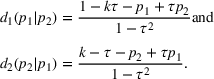
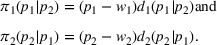

The impact of PMGs
Consumer behavior literature provides substantial evidence that consumers are more likely to request price‐matching refunds at the point of purchase than postpurchase (Kukar‐Kinney, 2005). Studies also reveal that PMGs result in heightened shopping intentions among consumers (Biswas et al., 2002) and the extent of the promised refund significantly influences prepurchase perceptions and consumer behavior (Kukar‐Kinney, 2003). Srivastava and Lurie (2001) showcase the results of three studies that inspect price‐matching policies from a consumer standpoint and highlight an increase in the number of stores shopped at in the presence of a PMG, as compared to its absence. Aligned with these research findings that suggest intensified consumer interest and efforts to seek refunds, we commence with a demand model wherein all consumers are aware of the PMG strategies and the prices set by the retailers. This is also in line with the common practice of retailers promoting their price‐matching strategies to attract more consumers; for instance, signs advertising PMGs are usually prominently displayed to all customers (e.g., at the store's entrance and/or various locations within the store).
Moreover, as we have noted in Section 1, the hassle of invoking a PMG has been greatly reduced for consumers due to recently developed specific apps. As such, we initially assume that there is no hassle cost involved for consumers to request a price match. This implies that under a retailer's PMG, if a retailer's price is higher than its rival's, then all consumers will seek a price match and be granted the lower price upon request. Later, we relax this assumption and demonstrate that our results remain robust unless the hassle cost is significantly high—which would eradicate the value of PMGs for retailers irrespective of the manufacturer's wholesale pricing strategy.
Let us suppose that Retailer 1 offers a PMG. If 


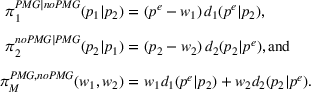
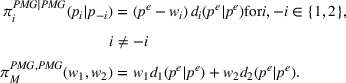
We deliberately focus on this model framework as it is best suited to facilitate tacit collusion, in line with the existing literature as discussed in Section 2. It distinctly illustrates the significant influence of an active manufacturer (as opposed to exogenous wholesale prices) on the ability of retailers to collude via PMGs. Nevertheless, we expand upon our setup in Section 5 by incorporating the hassle cost of requesting a price match and the existence of asymmetric operational costs for retailers.
ANALYSIS
We first outline the implications of enforcing a uniform wholesale pricing policy when PMGs are not in use through the following lemma. Suppose the retailers are barred from offering PMGs. When discriminatory wholesale pricing is permitted, the manufacturer imposes a higher wholesale price on the efficient retailer compared to the inefficient retailer. Upon enforcing a uniform wholesale pricing strategy, as compared to when discriminatory wholesale pricing is allowed, the following results hold: the manufacturer experiences a decrease in profit; the efficient retailer sees an increase in profit; the inefficient retailer's profit declines; while both total supply chain profit and consumer welfare see a boost, leading to a rise in overall social welfare.
If the manufacturer sets the wholesale prices such that 

Enforcing uniform wholesale pricing leads to a decrease in the wholesale price for the efficient retailer (
Moving forward, we will show that the welfare‐increasing effect of enforcing uniform wholesale pricing is reversed when PMGs come into play. We start by examining the equilibrium PMG and pricing decisions under uniform and discriminatory wholesale pricing.
Uniform wholesale pricing
Suppose for a moment that wholesale prices are exogenously set and identical for both retailers. In this scenario, a PMG offered solely by an inefficient retailer does not alter the final retail prices paid by consumers. This is because the inefficient retailer already charges a lower retail price than the efficient retailer when no PMG is offered; thus, the sole PMG from the inefficient retailer does not affect the equilibrium prices under the scenario where neither retailer offers a PMG.
However, the situation changes if the PMG is offered by the efficient retailer or by both retailers. Consumers who might have switched to the lower‐priced retailer now consider requesting a price match at the higher‐priced retailer. Consequently, the higher‐priced retailer is compelled to match the price of its competitor, thereby reducing its profit margin. This means the lower‐priced retailer can no longer attract as many consumers by reducing its price, leading to diminished incentives for price cuts. As a result, both retailers have motivations to increase their retail prices.
Lemma 2 reveals that this impact of PMGs with exogenous and equal wholesale prices extends to the case of uniform wholesale pricing. Suppose the manufacturer implements a uniform wholesale pricing strategy. If the inefficient retailer alone offers PMG, the equilibrium prices remain identical to those in the no‐PMG scenario. If only the efficient retailer offers PMG, the equilibrium sees a lower wholesale price, and the profit margin for the efficient retailer is higher, compared to the scenario without PMGs. If both retailers offer PMGs, the equilibrium features a lower wholesale price, and the profit margin for the efficient retailer increases compared to the scenario without PMGs.
While the manufacturer still possesses the ability to adjust the wholesale price level under a uniform wholesale pricing system, it is indeed possible for retailers to maintain elevated retail prices as long as the efficient retailer offers a PMG. In response to the higher retail prices resulting from the efficient retailer's PMG offer, the manufacturer opts to lower the wholesale price to mitigate the potential damage caused by loss of demand. Consequently, the efficient retailer's profit margin experiences a boost.
When both retailers offer PMGs, a price hike initiated by one retailer induces the other to follow suit, culminating in substantially higher prices. Given that these resulting retail prices markedly surpass those seen when only the efficient retailer offers a PMG, the manufacturer elevates the wholesale price to offset the total demand loss. However, in order to prevent a disproportionate increase in retail prices, the wholesale price is set at a level where the efficient retailer's profit margin remains higher than the margin without a PMG.
Proposition 1 formally validates the concept that under uniform wholesale pricing, retailers can derive benefit from offering a PMG if the level of demand asymmetry between the retailers remains below a certain threshold, as detailed below. If the manufacturer implements a uniform pricing policy, then at equilibrium there exist two threshold values, If If If 




To further illustrate Proposition 1, please refer to Figure 1.
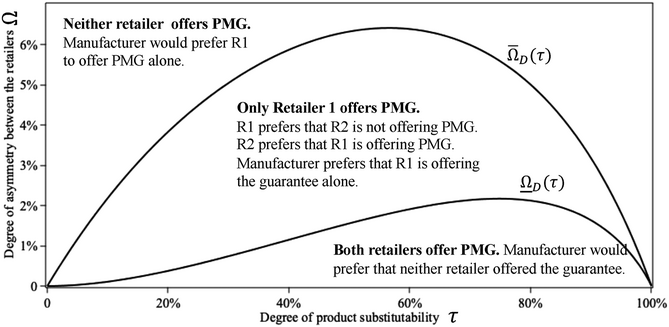
Equilibrium PMG decisions with uniform wholesale pricing. PMG, price‐matching guarantee.
First, when the level of demand asymmetry is sufficiently low (i.e., 
Second, as the degree of demand asymmetry becomes intermediate (i.e., 

Interestingly, in this intermediate scenario, the preferred strategy for all supply chain members is that only the efficient retailer offers PMG. While the inefficient retailer benefits from less intense competition by unilaterally opting out of PMG, the manufacturer appreciates the resulting higher wholesale price. In fact, this intermediate scenario represents the only case where the manufacturer benefits from the price‐matching strategy adopted by the retailers. This finding diverges from the previous case with slightly asymmetric retailers, where firms' preferences are constantly in conflict. Therefore, the range 
Third, if the demand asymmetry between the retailers becomes extremely high (i.e., 
Figure 1 also demonstrates that PMGs are more likely to occur when retailer substitutability (i.e., τ) is within an intermediate range. When retailer substitutability is low, retailers have a weaker incentive to offer PMGs since their retail prices are already high without PMGs and offering PMGs would reduce their profit margin due to an increased wholesale price from the manufacturer.
Discriminatory wholesale pricing
As delineated in Lemma 1, when the manufacturer has control over setting wholesale prices (i.e., they are endogenous), the absence of PMGs makes it optimal for the manufacturer to establish a higher wholesale price for the efficient retailer and a lower one for the inefficient retailer (i.e., Suppose the manufacturer implements a discriminatory wholesale pricing strategy. If neither retailer provides PMG, the manufacturer adjusts the wholesale prices to ensure the efficient retailer has a higher profit margin than the inefficient retailer. If only one retailer provides PMG, the manufacturer determines the wholesale prices so the offering retailer's profit margin is zero, while maintaining a positive profit margin for the other retailer. If both retailers offer PMGs, the manufacturer sets the wholesale prices to render the efficient retailer's profit margin zero, while ensuring the inefficient retailer's profit margin remains positive.


Lemma 3 reveals that the manufacturer's price discrimination strategy changes according to the retailers' PMG strategies. Without PMGs, the manufacturer sets a higher wholesale price for the efficient retailer to capitalize on the greater demand. However, when only one retailer offers PMG, the manufacturer invariably discriminates against the PMG‐providing retailer.
Under the influence of demand asymmetry, the efficient retailer tends to price higher than the inefficient retailer. Thus, if only the efficient retailer offers PMG, the manufacturer exerts more control over retail prices by reducing the wholesale price for the inefficient retailer, while concurrently increasing it for the efficient retailer. The wholesale price for the efficient retailer is set so high that the manufacturer extracts all its profit margin.
On the other hand, if only the inefficient retailer offers PMG, the manufacturer discriminates against the inefficient retailer. This allows the efficient retailer to set a lower retail price than the inefficient retailer. Given the inefficient retailer's PMG commitment, the manufacturer exploits this situation by extracting all profit margins from the inefficient retailer.
When both retailers offer PMGs, the manufacturer has the chance to discriminate against either retailer. In this scenario, the manufacturer discriminates against the efficient retailer to leverage its higher demand. In fact, the manufacturer intensifies the discrimination to squeeze all profit margins from the efficient retailer. If the manufacturer implements a discriminatory wholesale pricing strategy, then at equilibrium the retailers do not offer PMGs.
Proposition 2 asserts that PMGs do not prevail when the manufacturer has the capacity to apply discriminatory pricing towards the retailers. With discriminatory wholesale pricing, the potential advantages of offering PMGs do not necessarily result in greater profits for the retailers, as one retailer may lose its entire profit margin (as outlined in Lemma 3). Notably, the manufacturer's aim is not to penalize a retailer solely for offering PMG; rather, the manufacturer's objective is to minimize the adverse impact of PMG, such as elevated retail prices and, more crucially, decreased demand due to these higher prices.
The manufacturer is actually in a better position when the retailers offer PMGs compared to the no PMG scenario, as it can then profit from a higher wholesale price given to one retailer while simultaneously mitigating the negative impact of higher retail prices. Nonetheless, the gain of the manufacturer comes at the expense of the retailers. Consequently, offering PMG becomes a dominant strategy for both retailers, leading to the nonexistence of PMG at equilibrium.
Impact of enforcing uniform wholesale pricing
As previously outlined in Lemma 1, when PMG is not viable, the enforcement of uniform wholesale pricing results in pricing decisions that reduce the manufacturer's profit, increase the efficient retailer's profit, decrease the inefficient retailer's profit, and elevate the overall supply chain profit, consumer welfare, and social welfare. In this section, we assess the implications of such a ban on wholesale price discrimination within the context of PMG by comparing equilibrium solutions under uniform and discriminatory wholesale pricing. For this comparison, we concentrate on the parameter range where PMG is sustainable under the uniform wholesale pricing system (i.e., when The following holds true if the manufacturer is obligated to enforce uniform wholesale pricing while the retailers have the option to offer PMG—as compared to when discriminatory wholesale pricing is allowed. The total supply chain profit, consumer welfare, and social welfare decrease. The manufacturer's profit decreases while the profit of the efficient retailer increases. The inefficient retailer's profit increases for Ω within the range of 


The primary contribution of Proposition 3 is the finding that enforcing uniform wholesale pricing typically results in PMG prevailing at equilibrium, provided that the demand asymmetry between retailers is not excessively large (i.e., 


From a managerial perspective, our analysis unveils several unconventional insights. First, it is the efficient retailer, rather than the inefficient retailer, who always supports the enforcement of uniform wholesale pricing and seeks the opportunity to implement PMG. Second, the inefficient retailer, who is not consistently inclined to offer PMG, should meticulously analyze the repercussions of advocating for uniform wholesale pricing. With PMG, enforcing uniform wholesale pricing illuminates the pure demand difference between retailers by neutralizing their profit margins, an effect we refer to as the
Moreover, the combination of uniform wholesale pricing with PMG has other adverse effects. Generally, the dampening effect without PMG enhances consumer welfare. However, with PMG, the tacit collusion between retailers drives up retail prices, thereby reducing total demand and negatively impacting consumer welfare. While the profit‐margin neutralizing effect benefits the efficient retailer, the manufacturer, the inefficient retailer, and the entire supply chain suffer due to the elevated retail prices. In essence, enforcing uniform wholesale pricing in the presence of PMG is detrimental to total supply chain profit, consumer welfare, and, hence, social welfare. Therefore, the presence of PMG overturns the otherwise welfare‐improving effects of enforcing uniform wholesale pricing in the absence of PMG.
EXTENSIONS
Cost asymmetry
Let us assume that retailer 



Though cost asymmetry may remind one of demand asymmetry, it introduces a unique pricing mechanism. Whereas a demand‐efficient retailer would lean towards a higher price, a cost‐efficient retailer would opt to price lower, leading to different market outcomes. In the absence of PMGs and under discriminatory wholesale pricing at equilibrium, the manufacturer levies a steeper charge on the cost‐efficient retailer (Retailer 1) compared to the cost‐inefficient retailer (Retailer 2). Even with this elevated wholesale price, the efficient retailer manages to offer a retail price lower than the inefficient retailer, thus capturing a greater market demand. Additionally, thanks to its cost efficiency, the efficient retailer enjoys a thicker profit margin. On the flip side, the inefficient retailer grapples with challenges in both demand—owing to its need to price above the efficient retailer—and reduced profit margins. Should uniform wholesale pricing be mandated in a scenario devoid of PMGs, the situation further deteriorates for the cost‐inefficient retailer. This is because the manufacturer then resorts to a price that sits between the discriminatory wholesale prices, signifying a rise in wholesale price for the cost‐inefficient retailer.
The subsequent proposition provides a clearer picture of the PMG decisions given these two wholesale pricing paradigms. Suppose the only difference between the retailers is the cost asymmetry. If the manufacturer implements discriminatory wholesale pricing, then the retailers will abstain from offering PMGs. If the manufacturer implements uniform wholesale pricing, the equilibrium PMG strategy for the retailers is contingent upon the degree of cost asymmetry. Specifically, there are two critical threshold values, If If If




When both retailers offer PMGs, the manufacturer price discriminates against the inefficient retailer. This decision contrasts with the demand asymmetry case, where the manufacturer discriminates against the efficient retailer. The shift stems from the manufacturer's preference to discriminate against the retailer that sets a higher retail price. Given such discriminatory wholesale pricing, offering PMG becomes a suboptimal strategy for both retailers. Consequently, no retailer opts for PMG at equilibrium.
Tacit collusion arises under uniform wholesale pricing as long as the cost‐inefficient retailer offers PMG: both retailers effectively set the same price, leading to equal demand. Thus, price matching neutralizes the effects of cost inefficiency on demand, a phenomenon we term the “demand‐neutralizing effect.” In this context, it is not the demand that disadvantages the cost‐inefficient retailer but rather the profit margin. Drawing parallels to the case of demand asymmetry (as presented in Proposition 1), we observe that PMG remains prevalent at equilibrium under uniform wholesale pricing, provided the asymmetry between the retailers does not exceed a specified threshold.
We next delve into the repercussions of regulating wholesale prices within the ambit of cost asymmetry, focusing on parameter ranges where PMG is predominant under the uniform wholesale pricing framework (i.e., at least one retailer implements PMG at equilibrium). Suppose the only difference between the retailers is the cost asymmetry. If retailers are barred from offering PMGs and the manufacturer is bound to uniform wholesale pricing, then the outcomes as compared to when discriminatory wholesale pricing is allowed are as follows: the manufacturer's profit decreases, the efficient retailer's profit increases, the inefficient retailer's profit diminishes, and the total supply chain profit, consumer welfare, and social welfare all improve. If PMG is implementable and the manufacturer is limited to uniform wholesale pricing, then for

The following observation holds true for both demand asymmetry and cost asymmetry when uniform wholesale pricing is enforced (as seen by comparing Proposition 5 and Proposition 3): Coupling uniform wholesale pricing with PMG results in higher retail prices, leading to decreased overall demand. Consequently, this negatively impacts total supply chain profit, consumer welfare, and social welfare, which starkly contrasts with scenarios where PMG is not an option.
However, the underlying mechanisms differ. The primary distinction can be observed in the Pareto zones highlighted in Propositions 1 and 4. Specifically, in the range 

Customer heterogeneity
In our baseline model, all consumers capitalize on PMGs. We now modify this assumption by introducing a segment of customers who do not benefit from PMGs, primarily due to a lack of awareness. Let α represent the fraction of consumers uninformed about price matching, thus never requesting a match. Consequently, 
Adjusting the utility function in Equation (1) to account for this customer heterogeneity, we can derive the resulting profit functions for the retailers to be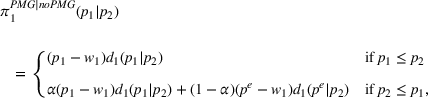

The scenario where only Retailer 2 offers PMG can be described by switching the subscripts. When both retailers offer PMG, the profit functions are as follows, given 

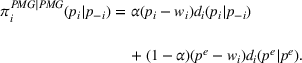
In this analysis, we assume that the retailers are symmetric. The subsequent proposition extends our primary result regarding the adverse effect of prohibiting wholesale price discrimination (when retailers have the option to offer PMGs) to the scenario involving uninformed customers. Given that retailers are symmetric, the following holds true in the presence of uninformed customers: In an industry where PMGs are not possible, a ban on wholesale price discrimination is inconsequential. In an industry where price matching can be practiced: With uniform wholesale pricing, retailers offer PMG at equilibrium. With discriminatory wholesale pricing, retailers do not offer PMG at equilibrium. Prohibiting wholesale price discrimination diminishes supply chain profitability, consumer welfare, and social welfare.
To delve deeper into how PMGs function with uninformed customers, we elucidate the equilibrium decisions of the participants.
No price matching
When retailers cannot offer PMGs, the scenario remains unaffected by customer segmentation. Both informed and uninformed customers face identical prices from the retailers. Owing to retail symmetry, the manufacturer refrains from price discrimination. Consequently, there is no discernible difference between discriminatory and uniform pricing regimes when price matching is omitted.
Uniform wholesale pricing
In equilibrium, both retailers choose to offer PMG, leading to escalated retail prices. However, since uninformed customers do not exploit price matching, the retailers restrain their price increases compared to what they would apply without these uninformed customers. The manufacturer, in this context, benefits from the presence of uninformed customers, as they curb excessive retail price increments triggered by PMGs.
Discriminatory wholesale pricing
Our exploration yields two decisions: (i) the manufacturer opts for price discrimination against the retailer providing the guarantee and (ii) the retailer that offers the guarantee practices price discrimination towards uninformed customers. For instance, if only Retailer 1 extends the guarantee, the manufacturer will levy a higher price on Retailer 1, compelling it to set a higher list price compared to Retailer 2. While Retailer 1 will match Retailer 2's price for informed customers, it will impose its elevated price on the uninformed group. Thus, the existence of uninformed customers allows Retailer 1 to secure heftier profits, despite confronting an augmented wholesale price. However, the diminishing retail margin resulting from the higher wholesale cost outweighs the benefits accrued from pricing uninformed customers higher. Hence, no retailer extends a PMG under the discriminatory wholesale pricing regime.
We further probe into the influence of uninformed customers amid retail asymmetry. The equilibrium structure under the uniform wholesale pricing regime, when considering retailer asymmetry, can be generalized to encompass information heterogeneity. This implies that the threshold values 


In both scenarios, whether it is demand or cost asymmetry, the likelihood of observing PMG as the equilibrium strategy of retailers diminishes as the size of the uninformed customer segment grows. Naturally, in the extreme case where the market is comprised solely of uninformed customers, neither retailer will offer PMG since there are no customers to avail of the offer.
Hassle cost
Suppose that a proportion, α, of consumers incur a hassle cost, δ (where 
To illustrate the consumer decision‐making process, assume that only Retailer 1 offers PMG. If 



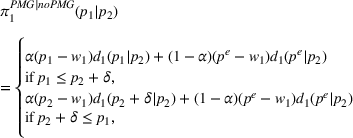

The situation where only Retailer 2 offers PMG can be deduced by simply switching the subscripts. For the profit functions of the retailers when both offer PMG, the functions are then presented as follows:
The case in which only Retailer 2 offers PMG can be written by swapping the subscriptions. Letting 

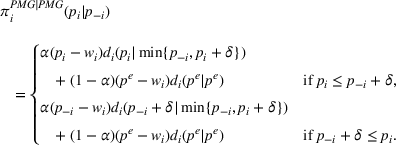
The primary insight is that a retailer's profit margin diminishes when offering PMG due to the manufacturer's wholesale price discrimination. Consequently, PMG is not a dominant strategy when the manufacturer can employ price discrimination against the retailers. This observation is encapsulated in the subsequent proposition. Consider the case with demand asymmetry and hassle cost. If the manufacturer implements discriminatory wholesale pricing, the retailers do not offer PMG at equilibrium. If the manufacturer implements uniform pricing, then two threshold values If If If




PMGs remain the equilibrium strategy for retailers under a uniform wholesale pricing regime, even though PMGs are less advantageous compared to the scenario without a hassle cost. We refer to Figure 2 for a deeper examination of the influence of hassle cost and consumer heterogeneity. For this discussion, we initially assume that the hassle cost is extremely high (

PMG strategy with uniform wholesale pricing and high hassle cost, that is,

Suppose both retailers offer PMGs and that the price at Retailer 1 is greater than or equal to that at Retailer 2 (i.e., 

What about the influence of the magnitude of the hassle cost (δ)? So long as δ is not prohibitive, a portion of the α percent of consumers will still request a PMG. Therefore, compared to a prohibitive δ, a reduced δ amplifies the likelihood for retailers to elevate their prices using PMGs, ostensibly reducing the fraction of consumers who never solicit a PMG (akin to a diminishing α). Consequently, as δ wanes, the propensity of retailers to extend PMGs grows. Yet, considering the unique case where In the presence of a hassle cost of requesting PMGs, restricting the manufacturer to uniform wholesale pricing allows retailers to maintain high retail prices by offering PMGs when 





Recall that when PMGs are not an option, if the manufacturer is limited to uniform wholesale pricing, then (i) the manufacturer's profit decreases, (ii) the efficient retailer's profit increases, (iii) the inefficient retailer's profit decreases, and (iv) there is an increase in the total supply chain profit, consumer welfare, and social welfare. These outcomes are consistent whether or not hassle costs are considered, as they only become relevant when PMGs are in effect. Furthermore, the adverse effect of PMGs, exacerbated by a uniform wholesale pricing policy on the overall supply chain performance and both consumer and social welfare, persists even with the inclusion of hassle costs.
Utility‐based consumer choice model
To demonstrate the robustness of our principal results, we construct a utility‐based choice model where consumers exhibit heterogeneity across three dimensions: preferences/tastes, awareness of all retailers, and the hassle cost linked to requesting a price match. Concerning awareness levels, we categorize consumers into three groups: 





For partially informed consumers, comparing retailers or benefiting from PMGs is not feasible. Therefore, a 



Fully informed consumers, contrastingly, will evaluate retailers and will engage in price matching if it proves advantageous (meaning, the rewards of requesting a price match outweigh its associated hassle cost). The utility of a fully informed consumer situated at 
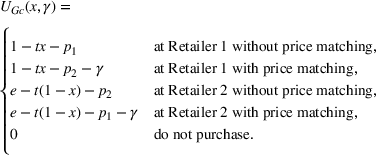

We first expound on the ramifications of price matching under a discriminatory wholesale pricing policy. Figure 3 depicts the alterations in profits for all supply chain participants when both retailers extend the guarantee, in contrast to the scenario where neither does.

Change in the profits if both retailers offer PMG compared to the case of no PMG under discriminatory wholesale pricing regime,

Aligning with the findings of Lemma 3, providing a PMG is not advantageous for the more efficient retailer, particularly since the manufacturer imposes price discrimination. Consequently, at equilibrium, retailers abstain from offering PMGs, consistent with Proposition 2.
Subsequently, our discussion shifts to the repercussions of price matching within a uniform wholesale pricing structure. Figure 4 illustrates the variations in profit for every supply chain entity when both retailers present the guarantee vis‐a‐vis when neither of them does.

Change in the profits if both retailers offer PMG compared to the case of no PMG under a uniform wholesale pricing regime,

Consistent with Proposition 1, offering PMG enables retailers to collude under the uniform wholesale pricing regime. The profits for both retailers rise, while the manufacturer's profit declines. Moreover, these elevated retail prices result in diminished consumer welfare.
CONCLUSIONS
This article delves into the influential role of manufacturers in determining wholesale prices within a supply chain environment that comprises competing retailers with the potential to offer PMGs. Our exploration juxtaposes discriminatory wholesale pricing with uniform wholesale pricing, yielding several notable insights.
Although PMGs enable retailers to tacitly collude by increasing prices, they are not prevalent at equilibrium when the manufacturer discriminates in wholesale pricing, especially against a retailer that offers PMGs. Interestingly, when both retailers embrace PMGs, discrimination targets the efficient retailer during demand asymmetry and the inefficient one during cost asymmetry.
Under the bounds of uniform wholesale pricing, PMGs thrive at equilibrium, given that both demand or cost asymmetry among retailers and the associated hassle costs remain moderate. While retailers might gain through tacit collusion with PMGs, the profit‐margin neutralizing effect under demand asymmetry and demand neutralizing effect under cost asymmetry pose significant threats, particularly to the inefficient retailer. Still, a Pareto‐optimal scenario emerges where all supply chain entities would rather only one specific retailer (i.e., the efficient retailer under demand asymmetry and the inefficient retailer under cost asymmetry) offer PMG.
Without PMGs, endorsing uniform wholesale pricing through regulations enhances welfare by bridging the gap between retailers and redirecting sales from the inefficient to the efficient entity. Yet, with PMGs in play, our study uncovers that such regulations can potentially erode supply chain profits, consumer welfare, and overall societal welfare. Additionally, heightened hassle costs linked to PMGs diminish the adverse effects of imposing uniform wholesale pricing, as they diminish the allure of PMGs for retailers.
In terms of contributions, this article pioneers the discourse linking wholesale price discrimination with PMGs—two pivotal pricing strategies at the wholesale and retail echelons, respectively. Despite rich literature surrounding both domains, a glaring gap exists in discussions about the interplay of these pricing schemes and their overarching effects on all stakeholders. Our findings shed light on the potential pitfalls of restrictive regulations on wholesale pricing, especially in the context of retailers offering PMGs. Such constraints can inadvertently harm manufacturers, consumers, and societal welfare. Additionally, we furnish actionable strategies for both retailers and manufacturers. For the former, the emphasis lies in discerning the circumstances under which PMGs should be offered and, for the latter, the focus is on pinpointing the ideal wholesale pricing approach.
Future studies could extend this paper by exploring alternative demand functions. Additionally, it would be interesting to delve into the interactions between PMGs and wholesale pricing within more intricate supply chain structures.
Footnotes
ACKNOWLEDGMENTS
The authors are very grateful to the departmental editor Albert Ha, the senior editor, two anonymous reviewers, and Charles Ingene for their helpful and constructive suggestions. The authors also acknowledge support from NSFC (Grant 72232001).
1
2
For a depiction of this nonlinear demand, consider the scenario wherein Retailer 1 offers price matching and the prices comply with the following:

References
Supplementary Material
Please find the following supplemental material available below.
For Open Access articles published under a Creative Commons License, all supplemental material carries the same license as the article it is associated with.
For non-Open Access articles published, all supplemental material carries a non-exclusive license, and permission requests for re-use of supplemental material or any part of supplemental material shall be sent directly to the copyright owner as specified in the copyright notice associated with the article.
