






Abstract
Motivated by the booming online grocery market and the extensive use of contingent free‐shipping (CFS) policies in the e‐grocery industry, we investigate the optimal CFS and pricing decisions for online grocers. Under a CFS policy, consumers enjoy free shipping for orders exceeding a certain threshold value; otherwise, they are charged a flat fee for orders below this threshold. We adopt a utility‐based model to capture consumers' behavior of purchasing additional items to qualify for free shipping under a CFS policy and analyze its impact on policy structure and consumer surplus. We characterize the e‐grocer's optimal pricing and CFS policy and find that consumer heterogeneity and demand distribution lead to different forms of the optimal shipping policy. When consumer heterogeneity is large enough, the optimal policy induces some consumers to top up and may allow some others to ship for free. In this case, the e‐grocer can charge a high‐profit margin. Otherwise, a top‐up option is unnecessary, and a flat‐rate shipping fee policy is optimal. Moreover, while the optimal policy never induces all consumers to top up when they are rational, it is possible to do so when consumers associate some psychological disutility with the shipping fee. Surprisingly, the total consumer surplus under the optimal policy may increase in the latter case. We further model a Stackelberg game between an e‐grocer and an offline channel and find that the difference between the e‐grocer's internal shipping cost and consumers' inconvenience cost of shopping offline is a main driver for market segmentation. Lastly, we show that a subscription‐based free‐shipping program, in addition to the jointly optimized CFS and pricing policy, cannot improve profits when consumers' order size and frequency are independent. Our findings help online grocers make operational and marketing decisions under the impact of consumers' top‐up behavior.
INTRODUCTION
E‐commerce, one of the fastest‐expanding industries in the global economy, is forecast to exceed $8 trillion in sales in 2026 (eMarketer, 2022). The U.S. e‐commerce sales reached $601.7 billion in 2019 and steadily increased from 5.5% in Q1 2013 to 11.4% in Q4 2019 of the country's total retail sales (U.S. Census Bureau, 2019). Since 2020, the worldwide lockdown caused by the COVID‐19 pandemic has catalyzed the growth of e‐commerce. Analysis of the U.S. Department of Commerce data reveals that in 2020, consumer online spending experienced a 32.4% year‐on‐year growth (Ali, 2021). After 2020, the growth rate of the e‐commerce market has adjusted back toward the pre‐pandemic scale, giving rise to $870.8 billion in sales in 2021 (U.S. Census Bureau, 2022). The U.S. retail e‐commerce revenue is forecast to exceed $1.7 trillion in 2027 (Statista, 2022).
One of the biggest winners in e‐commerce amid the pandemic was the e‐grocery industry. The onset of the COVID‐19 pandemic and lockdown measures have accelerated consumers' reliance on online grocery and permanently changed their shopping habits. Research indicates that this trend will continue even after the reopening of the economy (Aull et al., 2022). Indeed, the e‐grocery market share in the United States surged from 3.4% in 2019 to 9.5% of all grocery sales in 2021 and is projected to reach 20.5% by 2026 (Acosta, 2021).
The transition to online grocery shopping brings about fundamental changes in the ways that grocery stores serve their customers. In contrast to traditional grocery stores, online grocers are responsible for delivering orders to their customers. The shipping and handling incur significant costs to the firms. Melton (2019) reports that most online grocers charge consumers only 80% of the overall delivery cost, and the current models of grocery delivery are simply not sustainable. It is no surprise that online grocers would like to pass on their internal shipping and handling costs to consumers as much as possible. For example, Whole Foods introduced free 2‐hour delivery through Amazon Prime in 2017. However, starting on October 25, 2021, Whole Foods charges $9.95 for every delivery order to help cover operating costs associated with delivery.
The shipping policy implemented by an online grocer has a profound impact on consumer behavior. Market surveys show that shipping cost impacts the purchase decisions of up to 95% of U.S. online consumers, while 63% identify shipping cost as the primary reason for abandoning their shopping carts (Forter, 2019; Statista, 2018). There is little doubt, therefore, that shipping policy is one of the most important marketing and operations decisions for online grocers.
To attract and retain more consumers, and to alleviate the negative impact of shipping costs, online grocers adopt a variety of shipping policies. For example, Gopuff, a consumer goods and food delivery company operating in the United States and England, charges a flat fee of $1.95 for each delivery. Kroger Delivery and Walmart Grocery charge customers a flat‐rate shipping fee that depends on consumer location and delivery speed. The majority of online grocers, such as Walgreens, Hungryroot, Yamibuy, and Weee, adopt a contingent free‐shipping (CFS) policy. Under this policy, consumers incur no shipping charge as long as their order value exceeds a certain threshold; otherwise, they are charged a flat‐rate shipping fee. Lewis (2006) shows that the CFS policy is the most effective in generating revenue for online grocers. This result is verified by a survey finding that 52% of online consumers add items to their shopping carts to reach the free‐shipping threshold (Statista, 2018). In our paper, we refer to such an action as consumers' “top‐up” behavior. We use “CFS policy” to broadly refer to the widely used contingent free‐shipping policy, including the degenerate cases such as unconditional free shipping and flat‐rate shipping policies.
Finding the optimal CFS policy, however, is not a simple task. In practice, online grocers (hereinafter, interchangeably referred to as e‐grocers) adopt a broad range of CFS policy parameters (i.e., the free‐shipping threshold and the below‐threshold flat‐rate shipping fee). For example, Walgreens offers free shipping on orders of $35 or more and charges a flat‐rate fee of $5.99 otherwise. Hungryroot's free‐shipping threshold and below‐threshold flat‐rate fee are $70 and $6.99, respectively. Two online grocers for Asian food, Yamibuy and Weee, use different policy parameters as well: the former charges $5.99 for orders below $49, whereas the latter charges $5 for orders below $35. In this paper, we establish an analytical model to understand the variety of shipping policies in the marketplace and offer a meaningful approach to designing shipping policies for online grocers.
The optimal CFS policy must balance the trade‐offs between shipping revenue and additional sales generated by consumers' top‐up behavior. A higher shipping fee certainly results in more shipping revenue from consumers who purchase below the free‐shipping threshold. However, increasing the shipping fee will discourage some consumers from placing an order altogether, leading to a loss not only in the shipping revenue but also in the sale. On the other hand, a higher free‐shipping threshold will motivate some consumers to order more but deter others from considering the top‐up option, resulting in a smaller or zero basket size. Moreover, the effects of shipping fees and free‐shipping thresholds are entangled: a higher shipping fee may encourage more consumers to top up, whereas a higher free‐shipping threshold may encourage more consumers to pay the shipping fee. The interplay between shipping fees and consumers' top‐up behavior deserves a rigorous investigation, especially when pricing is a joint decision.
In this paper, we consider an online grocer who optimizes decisions on its profit margin and CFS policy, characterized by a below‐threshold flat‐rate shipping fee and a free‐shipping threshold, for a market with heterogeneous consumers. Given the grocer's CFS policy and profit margin, consumers make purchase decisions to maximize their net utility. Specifically, consumers can choose to make no purchase, purchase below the free‐shipping threshold and pay a flat‐rate shipping fee, or purchase no less than the threshold and enjoy free shipping. We aim to answer the following research questions: How does a CFS policy affect consumers' top‐up behavior? What are an online grocer's optimal joint decisions on shipping policy and pricing in integrated marketing and operational planning? What is the impact of a CFS policy on the e‐grocer's profit and consumer surplus? How does the competition from an offline channel affect the e‐grocer's shipping policy and pricing decisions?
To the best of our knowledge, the joint optimization of all three decisions (i.e., the profit margin, the free‐shipping threshold, and the below‐threshold flat‐rate shipping fee) has not been studied analytically in the existing literature. Our work helps understand the best balance among these three decisions. Moreover, our model is fairly general and can incorporate the impact of consumer irrationality around shipping fees and subscription‐based free‐shipping programs on the grocer's shipping policy and pricing decisions.
We summarize our main findings as follows: We characterize the structure of the optimal policy based on consumer heterogeneity and demand distribution. We find that even though it may be optimal to induce all consumers to pay a shipping fee, it is never optimal to induce all consumers to top up. Moreover, as consumer heterogeneity and the proportion of the high‐valuation consumers increases, the optimal policy that covers both consumer segments is more likely to induce the high‐valuation consumers to top up and the low‐valuation consumers to pay a shipping fee. The optimal CFS policy may lead to different consumer surplus consequences. In particular, the optimal policy that charges all consumers a flat‐rate shipping fee is the least effective in extracting consumer surplus as it does not discriminate between consumers; the optimal policy that allows some consumers to ship for free may hurt their surplus, as the policy enables the e‐grocer to charge the highest profit margin. We consider a Stackelberg game where an offline channel acts as the first mover to compete with the e‐grocer. We find that when the proportion of high‐valuation consumers is large, the offline channel can price the e‐grocer out of the market if the e‐grocer's internal shipping cost is high relative to the consumers' inconvenience cost of shopping offline but shares the market with the e‐grocer otherwise. In the latter case, the e‐grocer serves the high‐valuation consumers while the offline channel serves the low‐valuation consumers. We are the first to incorporate consumers' psychological disutility of shipping fees analytically into the design of shipping policies. Interestingly, we find that, unlike the case without shipping fee disutility, it can be optimal for the e‐grocer to induce all consumers to top up in the presence of the disutility. Such a psychological disutility, while always lowering the grocer's profit, can improve consumer surplus. We consider the profitability of subscription‐based free‐shipping programs and find that such a program is never profitable when consumers' order frequency and basket size are independent. When the order frequency and basket size are negatively correlated, introducing such a program in addition to the CFS policy can generate more profit for the grocer.
We organize the rest of the paper as follows. We review the relevant literature in Section 2. We describe the model in Section 3. We analyze the optimal policies for a market with two types of consumers and explore the implication of channel choice in Section 4. We explore extensions of our model in Section 5 and conclude the paper in Section 6. All technical proofs are presented in the Supporting Information.
LITERATURE REVIEW
In this section, we review papers that are closely related to our work and highlight our contributions to each stream of the literature. We summarize and compare the different aspects of the most related literature and our work in Table 1.
Summary of related literature.
The first stream of literature focuses on the effect of shipping fees on consumer purchase decisions. Brynjolfsson and Smith (2000) empirically demonstrate that online consumers are sensitive to shipping fees. Lewis (2006) and Lewis et al. (2006) are among the first to study the effect of shipping fees on order basket size. Through empirical analysis, they find that free shipping leads to greater order incidence but a smaller average basket size than does flat‐rate shipping, whereas CFS policies that offer lower shipping fees on larger basket sizes lead to greater sales. Yang et al. (2005) examine the impact of CFS policies on consumer purchasing behavior and find that an increase in product price raises the probability of meeting the free‐shipping threshold, thereby reducing the average shipping fee for repeat consumers. Xu (2016) uses transaction data in apparel retailing to study the effect of the free‐shipping threshold on demand and product returns. Chen and Ngwe (2018) employ structural modeling and find that CFS policies promote consumer spending more across multiple product categories to meet the free‐shipping threshold. Hemmati et al. (2021) empirically show that CFS policies induce “bubble purchases,” where consumers top up to meet the free‐shipping threshold and then return the unwanted products. While these papers focus on the impact of shipping policies on consumer behavior, our paper uses the insights from this literature to develop our consumer utility framework. We provide a complete characterization of the optimal pricing and CFS policy for online grocers through analytical modeling of consumer behavior.
Our research is also related to the partitioning mechanisms on pricing literature, which studies the impact of splitting the total purchase price into two or more parts on consumer behavior. Marketing research shows that consumers often do not make purchase decisions rationally—that is, based on the total price—when product prices and shipping and handling costs are charged separately. For example, Morwitz et al. (1998) find that consumers tend to overlook small shipping and handling costs, thereby discounting the total price. As a result, partitioned pricing can lead to higher consumer demand. In contrast, Thaler (1985) suggests that such a partitioning strategy creates a greater mental loss. Schindler et al. (2005) conduct a behavioral experiment to show that when consumers perceive the shipping charge as an alternative way to contribute to a retailer's profit, the partitioning strategy can result in reduced demand compared to a bundled pricing format. Gümüş et al. (2013) analyze the equilibrium of online retailers who adopt either a partitioned pricing or a bundled pricing format in an oligopolistic framework. Drawing insights from this literature stream, we capture consumers' top‐up behavior to avoid the partitioned shipping fee induced by a CFS policy. We demonstrate the benefit of policies that promote consumers to top up for free shipping over the traditional shipping policies. In addition, we consider the case where the shipping fee creates a psychological disutility in consumer valuation and find that this disutility further promotes the use of top‐up policies and may improve consumer welfare.
Moreover, our work is closely related to the literature on the design of shipping policies. Leng and Becerril‐Arreola (2010) are the first to analyze the joint decisions of profit margin from the marketing function and the CFS threshold from the operations function. They assume that consumer heterogeneity is continuous and characterize consumers' optimal purchase amount using an analytical model and numerically find the retailer's optimal decisions in response to shipping fees, retailer's shipping subsidy, and consumer heterogeneity. Becerril‐Arreola et al. (2013) further consider inventory decisions, in addition to the profit margin and the free‐shipping threshold, in a two‐stage process through a simulation study. However, the above two papers do not endogenize the important decision of shipping fee. Shao (2017) considers a supply chain with a supplier and competitive retailers and finds the retailers' equilibrium price and order quantity under the free‐shipping and paid shipping policies. The paper also treats shipping fees as exogenous. Cachon et al. (2018) employ a data‐driven analytical model to evaluate the profitability of a retailer's CFS policy and identify the best free‐shipping threshold policy for the retailer. Their model accounts for consumers' top‐up behavior and product returns. In contrast, our paper provides analytical solutions to the joint optimization of the CFS policy parameters (i.e., the flat‐rate shipping fee and the free‐shipping threshold) and the profit margin. We identify the regimes where the optimal policy discriminates consumers by inducing different ordering behavior and investigate how market conditions and the firm's internal logistical efficiency affect the e‐grocer's decisions.
There has been a rich literature that analytically studies the competition between online and offline channels (see, e.g., Balasubramanian, 1998; Chun & Kim, 2005; Liu et al., 2006; Viswanathan, 2005). These papers incorporate factors such as offline transportation cost, online disutility cost, and different prices of online and offline retailers into their model and analyze how these factors affect consumers' channel choice. Forman et al. (2009) empirically examine the trade‐offs between buying online and from a local brick‐and‐mortar store and provide evidence for the existence of physical transportation costs and online disutility costs. We consider the competition between an offline channel and an online grocer adopting a CFS policy. Similar to the above‐mentioned papers, we assume that consumers incur an inconvenience cost when purchasing offline and a disutility cost when shopping online. We find that the competition from the offline channel further motivates the e‐grocer to adopt a top‐up policy and, surprisingly, may induce the e‐grocer to raise the free‐shipping threshold to compensate for a reduced profit margin and shipping fee.
Last but not least, subscription models have been generating growing attention in the operations management literature. Under such a model, consumers prepay a fixed membership fee and receive free shipping services for their subsequent orders. Belavina et al. (2017) compare the subscription model with the flat‐rate shipping model in online grocery shopping in the presence of an offline channel. They find that the subscription model leads to more frequent orders with a smaller basket size, higher profitability, and lower food waste but higher delivery‐related greenhouse gas emissions. Wang et al. (2019) study the impact of service subscriptions on product pricing and consumer surplus in both monopolistic and competitive settings. Fang et al. (2021) study the impact of subscription programs on e‐tailers when consumers are independently heterogeneous in terms of shopping frequency and disutility in topping up for free shipping. They find that when the e‐tailer can optimize the product prices and membership fee, the addition of a membership program is always beneficial. In stark contrast, we show that a subscription program cannot generate a greater profit when the e‐grocer has already jointly optimized the profit margin and the shipping policy if consumers' order frequency and order quantity are independent. When order frequency and quantity are negatively correlated, a subscription program can be profitable.
MODEL
The online grocer's shipping policy
We describe each CFS policy using two parameters: a free‐shipping threshold 


Next, we define the basket size of an order. In our basic setting, we assume that each order consists of only a single type of product. Therefore, its basket size can simply be defined as the number of items in the order. In Supporting Information Section EC.1.1, we relax this assumption and consider the case where the e‐grocer offers multiple horizontally differentiated products, such as apples and pears, and we show that our results are robust under this generalization.
We further assume that the product has a unit procurement cost. Therefore, an order with basket size y is equivalent to an order that has a procurement cost of y dollars. Let x denote the total purchase price of an order. Since y is equivalent to the procurement cost of the order and m denotes the profit margin, we have 

Lastly, let 

The consumers' purchase decisions
We consider a market consisting of
The function 



Let 


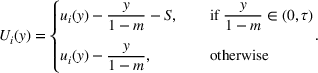
Let 








For future analysis, we define 



Furthermore, we define 
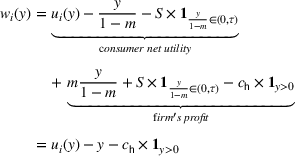


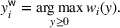


The three basket sizes (


Specifically, when 







The online grocer's problem
We consider the problem when the e‐grocer jointly optimizes over 



Given a policy 


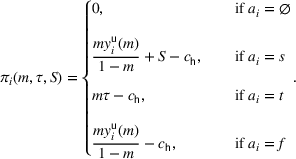
We state the following assumption on


Assumption 2 guarantees that the social surplus associated with any type i consumer cannot be negative. Once 


Clearly, the grocer's profit increases with m, τ, or S, ceteris paribus. However, the interdependence between the online grocer's policy decisions and the consumer's choice of basket size makes joint optimization challenging and worth investigation. We analyze the optimal shipping policies in the following section.
ANALYSIS AND RESULTS
We first analyze the optimal policy for a general valuation function 



Optimal policy under general valuation functions
In this section, we consider any general valuation function 
Homogeneous consumers
We start the analysis by looking into the scenario when there is only one type of consumers, that is, There are two types of optimal shipping policies for homogeneous consumers: a zero‐margin flat‐rate policy that induces action s with a top‐up policy that induces action t with 


Moreover, under any optimal policy, the consumers order a basket of size




Proposition 1 indicates that the online grocer has two ways to induce homogeneous consumers to purchase the socially optimal basket size 


Lastly, it is worth noting that the optimal policies are not unique. For example, under the zero‐margin flat‐rate policy, the threshold 





Heterogeneous consumers
We now consider the scenario when the market consists of both high‐ and low‐type consumers. We assume that the high‐type consumers have a higher consumption valuation than the low‐type consumers. To be more precise, we state the following assumption regarding
For all 


Under the optimal policy, the e‐grocer must extract all consumer surplus from at least one type of consumer. Otherwise, the e‐grocer can always increase the profit margin m and/or the CFS policy parameters 
Hereinafter, we refer to a policy that induces only the high‐type consumers to purchase as a high‐coverage policy (HCP). In contrast, we refer to a policy that induces both types of consumers to purchase as a full‐coverage policy (FCP). We further refer to the “best” HCP (FCP) as the one that maximizes the grocer's total profit among the set of HCPs (FCPs). The optimal policy must be either the best HCP or the best FCP.
Let 


The best HCP should be similar to the optimal policy for homogeneous consumers in Proposition 1. We state this result in the next corollary. The best HCP is a zero‐margin flat‐rate policy with a top‐up policy with
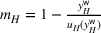
Under the best HCP policy, the high‐type consumers order the socially optimal basket size





It turns out to be challenging to provide a complete characterization of the best FCP under the joint optimization over We define a partial ordering among the four actions: 


Lemma 2 has several implications. First, as discussed earlier, the high‐type consumers will always purchase a positive basket size if the low‐type choose to do so. In addition, if the low‐type qualify for free shipping with their intrinsic basket size, so do the high‐type consumers. More interestingly, Lemma 2 suggests that no policy can induce the high‐type to pay shipping fees but the low‐type to top up. That is, the action pair 


Next, we argue that some action pairs, though feasible, cannot occur under the optimal policy. For example, it is never optimal to allow both types of consumers to ship for free. It is also not optimal to induce the ‐low‐type to pay shipping fees, but the high‐type to ship for free because the e‐grocer can always raise the free‐shipping threshold to force the high‐type to pay shipping fees and earn a greater profit. Thus, we can further narrow down the search for optimal policies by removing the suboptimal action pairs. The following lemma shows that we only need to focus on four candidate action pairs under the best FCP policy. Under the best FCP policy, 
We remark that, for a market with homogeneous consumers, it is never optimal to allow consumers to ship for free. However, this result no longer holds when there are multiple types of consumers. When consumers have heterogeneous valuations, allowing the high‐type to enjoy free shipping can be optimal when the low‐type is induced to top up. Although the e‐grocer can set a larger τ to induce the high‐type consumers to top up as well, doing so would cause the low‐type to suffer from a negative net utility. Hence, the low‐type consumers will end up with no purchase. Once the marginal loss in profit from the low‐type consumers outweighs the marginal gain in profit from the high‐type consumers, the e‐grocer would rather let the high‐type ship for free while inducing the low‐type to top up. We will illustrate this scenario using a parametric example in Section 4.2.
Define 




Lemma 3 implies that the best FCP should be one of the four candidate policies: If 





The intuition of Proposition 3 is as follows: 


Proposition 3 implies that the best FCP is either 





Optimal policy under square root valuations
In this section, we employ a square root valuation function. The square root utility is one of the commonly used utility functions in the literature; see, for example, Basu et al. (1985), Chung (1994), and Leng and Becerril‐Arreola (2010). Specifically, let 


Optimal policy structure
Given the square root valuation function, we can compute the intrinsic basket size 







Recall that 







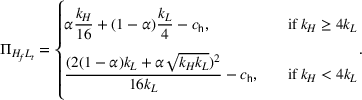
We defer the derivation of equations in (4) to Supporting Information Section EC.2.1.
We are interested in understanding when the best HCP (


Intuitively, we expect the best HCP to be optimal only when α is sufficiently large. The following theorem shows the existence and uniqueness of thresholds The optimal policy must be one of policies if if if if 





Figure 1 illustrates the optimal policy. Theorem 4 indicates that 


Optimal policy with respect to α and

We remark that some of the thresholds may coincide with each other. For example, in the proof of Theorem 4, we show that 


To sum up, our results suggest that only when there exist a relatively large number of low‐type consumers, that is, α is relatively small, it is worthwhile for the e‐grocer to serve both low‐type and high‐type consumers. Moreover, we find that a top‐up policy such as 


Discussion
In this section, we perform sensitivity analysis with regard to consumer heterogeneity (

Impact of consumer heterogeneity and demand distribution
We analyze how consumer heterogeneity (


By Theorem 4, the thresholds 


Proportion 5 further implies that as consumer heterogeneity increases, the flat‐rate shipping policy 


Next, we are interested in the impact of α and When the optimal policy is an FCP, the optimal profit margin 


Proposition 6 suggests that the more heterogeneous the consumers are, the higher profit margin the e‐grocer can charge. In addition, because shipping revenue and sales revenue are complementary, we can show that the flat‐rate shipping policy 


Finally, we examine the impact of α and (a) The optimal shipping fee 
Shipping fee and free‐shipping threshold under FCP


As discussed earlier, shipping revenue is complementary to sales revenue. Proposition 6 implies that 


Impact of internal shipping cost
Next, we explore the role of the e‐grocer's internal shipping cost in the e‐grocer's policy design. The next proposition shows the impact of The thresholds 




Previously, we assumed 




We are also interested in whether the firm can recover the internal shipping and handling cost from the shipping revenue. We state the results in the following proposition. When a flat‐rate policy (


We illustrate the result in Figure 2. The shaded region in Figure 2 indicates the case where the e‐grocer's shipping revenue is less than its internal shipping cost. Proposition 9 states that when the firm employs a flat‐rate shipping policy, its shipping revenue is always sufficient to cover the internal shipping cost. Otherwise, the e‐grocer cannot be profitable. However, when the optimal policy is 


Optimal policy with respect to α and


Value of top‐up policies/option
We have seen that the CFS policies with top‐up options, including 


Figure 3 presents the ratios 





Percentage improvement in profit between the optimal CFS policy and


Consumer surplus
Lastly, we explore the capability of the optimal policy in extracting consumer surplus. Clearly, such capability depends on the form of the policy, which, in turn, depends on α, as depicted in Proposition 9. Figure 4 presents the surplus (i.e., the net utility) of each high‐type consumer (solid line) and the total consumer surplus (dotted line) with respect to α.

A representative high‐type consumer's net utility (solid line) and the total consumer surplus (dotted line) with respect to α for


Surprisingly, allowing free shipping may hurt the consumer surplus but benefit the e‐grocer. In particular, when α is close to 0, the low‐type consumers dominate the market, and it is easier for the e‐grocer to extract consumer surplus using 


Channel choice
In this section, we assume that there exists an offline channel (i.e., a brick and mortar grocery store) that competes with the e‐grocer. We study the competition between this offline channel and the e‐grocer. We continue to use the square root valuation function in this section.
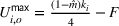
First, we derive the consumer net utility of purchasing via the offline channel. We assume that the offline channel has a profit margin of 
Let 



In reality, e‐grocers may adjust prices more often than offline grocers due to operational efficiency. For example, Hillen and Fedoseeva (2021) find that Amazon Fresh frequently adjusts the prices of food products, while Whole Foods continues to apply the traditional “sticky” retail pricing scheme despite the acquisition by Amazon. Therefore, we model the competition between an e‐grocer and an offline channel by a Stackelberg game. Specifically, as the leader, the offline channel first sets the profit margin 
We solve the problem backwards. We denote the equilibrium profit margin of the offline channel by 


Given the offline channel's profit margin 


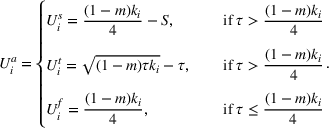
In the presence of the offline channel, the consumer chooses to shop online if and only if 

By anticipating the e‐grocer's best response, the offline channel determines the profit margin 




The following proposition characterizes the condition under which the e‐grocer is either forced out of the market or its equilibrium policy is The e‐grocer either serves no consumers or only the high‐type consumers in equilibrium when 

Proposition 10 suggests that the e‐grocer cannot serve both types of consumers in equilibrium as long as 

Figure 5 depicts the e‐grocer's equilibrium shipping policy. In Figure 5a, 


Comparison between the e‐grocer's optimal policies for

As F increases, the offline channel (e‐grocer) becomes less (more) competitive. Once F becomes sufficiently big, as shown in Figure 5b, the e‐grocer can serve both types of consumers using an 


Moreover, we compare Figure 5b with Figure 1 (the case without an offline channel). We observe that once F becomes sufficiently big such that the e‐grocer can serve both types of consumers, the presence of the offline channel does not affect the structure of the e‐grocer's shipping policy. That is, the e‐grocer's equilibrium shipping policy is exactly the same as its optimal policy without the offline competition. We further find in Figure 6 that when the e‐grocer's equilibrium policy is 



The e‐grocer's equilibrium profit and policy parameters with the offline channel (solid line) and without the offline channel (dotted line) for

In sum, when the offline inconvenience cost F is small, the offline channel is highly competitive so that it can either price the e‐grocer out of the market or share the market with the e‐grocer by giving up the high‐type consumers. Correspondingly, the e‐grocer either makes zero profit or adopts 

EXTENSIONS
We consider the following extensions in this section: the impact of consumers' psychological disutility about shipping fees in Section 5.1, and the profitability of subscription shipping programs in Section 5.2.
Disutility with the shipping fee
Consumer surveys show that 74% of U.S. shoppers deem free shipping as the most critical factor when shopping online (UPS, 2017). Moreover, 35.7% of U.S. online shoppers' cart abandonments occur when consumers see shipping costs (Meola, 2016; Statista, 2018). These findings are consistent with the theory of Thaler (1985), who suggests that the price partitioning strategy creates a greater mental loss. It is reasonable to argue that most consumers associate a psychological disutility with their shopping experience if they have to pay a positive shipping fee.
In this section, we analyze the optimal CFS policy in the presence of the shipping fee disutility, denoted by 


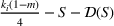

Before stating the main results in this section, we first illustrate how the optimal policy varies with 


Comparison between the optimal policies with and without the disutility


Several phenomena deserve our attention. First, we observe from Figure 7a–c that
When


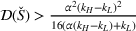


Proposition 11(1) shows that 


Lastly, we investigate the impact of the shipping fee disutility on consumer surplus. Interestingly, we find that the total consumer surplus may improve in the presence of the disutility. Note that the low‐type consumers always get zero surpluses under the optimal policy. Thus, to illustrate our finding, we simply compare the high‐type's consumer surplus under the optimal policy with and without disutility in Figure 8. The dark (light) gray area indicates the region where the high‐type consumers get more (less) surplus in the presence of the shipping fee disutility. The nonshaded regions indicate that the high‐type's surplus stays the same. The dotted lines represent the boundaries between different optimal policy structures in the benchmark case (i.e., 

High‐type's consumer surplus under the optimal policy with and without the shipping fee disutility under the setting of


Figure 8 shows that the high‐type consumers may enjoy a higher surplus in the presence of the shipping fee disutility. This could happen especially when the optimal policy switches from 


Our findings accentuate the advantage of CFS policies over flat‐rate policies in the presence of the shipping‐fee disutility. The CFS policies empower the e‐grocer with more levers to extract greater consumer surplus by inducing consumers to top up their order size. Meanwhile, consumers may benefit from an e‐grocer's CFS policy, as their surplus may increase in the presence of disutility.
Subscription shipping programs
Many online grocers offer subscription service programs that provide members with unlimited free shipping for their online orders. For example, Instacart, an online grocery delivery company fast‐growing during the pandemic, offers a subscription program called Instacart Express. Members pay $99 per year for free shipping on eligible purchases. In September 2020, Walmart launched the Walmart Plus membership program which charges an annual fee of $98 for grocery delivery.
In this section, we consider the impact of such subscription shipping programs on the e‐grocer's shipping policy design. In particular, we consider the situation where an online grocer has four levers: the profit margin m, the flat‐rate shipping fee S, the free‐shipping threshold τ, and the subscription membership fee P. We assume that the same margin m applies to both members and nonmembers. This assumption is generally consistent with the reality, where the platform offers each product at the same price to all consumers at the same time.
One characteristic of online grocery shopping is that purchase frequency is usually independent of the purchase quantity. While purchase quantity typically depends on household size, purchase frequency can be relatively stable as a matter of routine or buying habits. For example, market surveys show that the majority of the U.S. households shop for groceries once or twice a week (Statista, 2020). To capture this feature, we consider purchase frequency as another dimension to model consumer heterogeneity in the subscription programs. We attempt to answer the following research question: When can a subscription program improve the e‐grocer's profit?
To better illustrate our results and insights, we employ the same square root valuation function 






Type 



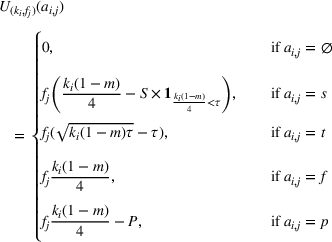
We find that the distribution of consumer types plays an important role in the profitability of a subscription program. We consider two scenarios to illustrate our results. First, we consider the case where the consumer distribution with respect to basket size is independent of that with respect to order frequency. Specifically, recall that α denotes the proportion of Suppose that the consumer distribution follows 







In the above setting, since the consumer distributions with respect to basket size and order frequency are unrelated, we can consider consumers with order frequencies 


Proposition 12 is in sharp contrast to Fang et al. (2021) who show that the introduction of a subscription service always improves an e‐tailer's profit. The key reason is that in our model all the policy parameters 
Next, we consider the case where the consumer distributions with respect to basket size and order frequency are correlated. We show that introducing the subscription program in this case may improve the e‐grocer's profit. To this end, we explore a special case where Suppose that the consumer distribution follows 


When subscription is profitable



The idea behind Proposition 13 is as follows. Suppose that the optimal subscription‐free policy 


As we can see from the above two scenarios, the correlation of the consumer distributions with respect to shopping frequency and basket size plays an important role in the profitability of the subscription programs. Therefore, the online grocer should carefully examine the nature of its consumers' ordering behavior before introducing such a program.
CONCLUSION AND FUTURE WORK
Shipping fee is one of the key factors that influence online shoppers' purchasing decisions. In this paper, we study online grocers' integrated contingent free‐shipping policy and pricing decisions. We study two competing driving forces—the free‐shipping threshold and the flat‐rate shipping fee—that induce different consumer purchasing behaviors. In particular, a lower free‐shipping threshold is more likely to induce consumers to top up their orders, while a lower flat‐rate shipping fee hinders consumers from doing so. We characterize the optimal CFS policy and pricing decisions and the corresponding consumer surplus. Our work provides a relevant approach to understanding the phenomenon that different online grocers may adopt different forms of shipping policies and reveals important insights about online grocers' integrated operational and marketing decisions.
In particular, we find that CFS policies, via manipulating shipping fee and free‐shipping threshold, serve as a more practical alternative to price discrimination for improving the firm's profit. When consumers are sufficiently heterogeneous, the e‐grocer should adopt a CFS policy with a top‐up option to induce differentiated buying behaviors, thereby improving its profitability. Otherwise, when consumers are more or less homogeneous, a simple flat‐rate shipping policy is sufficient. We show that the form of the optimal CFS policy depends on both demand distribution and consumer heterogeneity. Moreover, we find that among different forms of CFS policies, the one that induces all consumers to pay shipping fees is the least effective in extracting consumer surplus. Surprisingly, more complicated shipping structures, such as a two‐tier CFS shipping policy, do not always generate higher profits than simple CFS policies. This further justifies the popularity of simple CFS policies in practice.
In reality, many consumers associate a psychological disutility with paying shipping fees. We find that in the presence of this disutility, a policy that induces all consumers to top up may result in a win‐win situation for the e‐grocer and the consumers.
Lastly, we look into whether an e‐grocer should introduce a subscription program that waives shipping fees for members on top of a CFS policy. We show that the profitability of a subscription program depends on the correlation between consumers' shopping frequency and basket size. Thus, online grocers should closely examine the nature of their products and consumer shopping behavior before introducing a subscription program.
Our paper focuses on a monopolistic online grocer who sells products with a homogeneous profit margin. One future research direction is to consider the competition between multiple e‐grocers and investigate whether CFS policies would intensify or soften the competition. We believe that our study on the impact of consumers' top‐up behavior serves as a first step for further analysis under the competitive settings, but a more complex model will be needed to avoid Bertrand competition. In addition, we would like to study the joint decisions on shipping policy and pricing for e‐grocers such as Weee.com which sells products across a variety of categories with varying profit margins. Our current model needs to be carefully redesigned to ensure tractability. It will also be interesting to consider the design of delivery time and delivery window, which are two important features that influence consumer behavior in e‐grocery. Last but not least, our model does not consider consumers' stockpiling and return decisions, which are less common in e‐grocery. However, they serve as an interesting future research direction for e‐tailing. Broadly speaking, we believe there are significant opportunities for employing analytical models to better understand firms' integrated pricing and shipping decisions.
Footnotes
ACKNOWLEDGMENTS
We would like to express our gratitude to the Department Editor, Prof. Terry Taylor, the anonymous senior editor, and the reviewers for their constructive feedback and valuable suggestions. Their guidance has been instrumental in helping us improve the quality of this manuscript.
All authors contributed equally in this research.
LIST OF KEY NOTATIONS

References
Supplementary Material
Please find the following supplemental material available below.
For Open Access articles published under a Creative Commons License, all supplemental material carries the same license as the article it is associated with.
For non-Open Access articles published, all supplemental material carries a non-exclusive license, and permission requests for re-use of supplemental material or any part of supplemental material shall be sent directly to the copyright owner as specified in the copyright notice associated with the article.
