






Abstract
We study the optimal design of a professional service in a mixed market of customers with heterogeneous skills and capabilities of using such service.
INTRODUCTION
In recent years, the service sector in the United States has accounted for a majority of total employment. 1 Rapid growth in technology sectors has created an enormous market for professional services. For example, Amazon's cloud service, Amazon Web Service (AWS), has been a more profitable channel for Amazon compared to traditional retail. According to Amazon 2021 Annual Report, even though AWS revenues were much smaller than domestic retail revenues (11% vs. 61% of overall revenues, respectively), AWS profits were higher than retail profits. 2
A growing feature of such services is their extended complexity. Indeed, users have become increasingly differentiated in their capabilities to deploy the service offerings. Some users can deploy the service and tailor it to their own use. Other users find the service offerings technically complex and would prefer “plug and play” and may often choose to work with a third‐party intermediary. In the context of cloud computing, many machine learning projects are first deployed on distributed large‐scale data frameworks (e.g., Apache Spark or Hadoop) before the data training process can be initiated. Tech‐savvy users, familiar with computing hardware and infrastructure (e.g., CPU and GPU servers), can install and configure the parameters by themselves. Other users, lacking expertise in computer science, may contract with a third‐party intermediary (e.g., Databricks 3 ) to help them build the necessary framework to access the cloud service.
The boom in professional services, such as the industry of Infrastructure as a Service (IaaS) coupled with the ecosystem of intermediaries servicing customers of different expertise, calls for a better understanding of the optimal design of these services. We hope that our paper takes an important step toward service design, by understanding the trade‐offs in how to price and prioritize these services to customers.
In this paper, we refer to
Another prominent feature of professional services is that customers often have to compete for a limited shared resource, giving rise to congestion externalities. In the context of cloud computing, when there is a surge of requests on clusters, incoming jobs may experience delays in accessing busy servers based on their priority levels. Thus, customers on the cloud (either on their own or through an intermediary) impose an externality on other customers in a way that depends on their types. Given this subtle interaction, cloud operators should understand how to serve high‐margin expert customers that directly procure a service as against an increasing number of amateur customers brought by the intermediary. Note that the presence of the intermediary cuts into the provider's margins in serving amateur customers, but opens access to a new customer segment that otherwise would not deploy on the cloud.
In this paper, we develop a model that captures the key features in designing professional services: heterogeneity in customers' accessibility to a service, business through intermediaries, and congestion due to limited capacity. We analyze various pricing and prioritization schemes, and identify the fraction of amateur customers in the market as a critical driver of equilibrium outcomes, prices, and revenues. We show that under single pricing and the First‐Come‐First‐Served (FCFS) policy, the provider facing a high demand of expert users will serve these customers exclusively. When the demand of expert customers is not too high, the provider will naturally also serve amateur customers. The presence of amateur customers, however, allows expert customers to “free‐ride” and receive a positive surplus. So, the presence of large demand from amateur customers is a boon to expert customers, under the single pricing scheme.
Price discrimination allays free‐riding effects. As the service provider must share the reward of serving amateur customers with the intermediary, the provider prefers to serve expert customers for their high‐profit margins. As a result, the provider will not plan expansive coverage to all customers unless the demand of expert customers is sufficiently low. In this case, price discrimination may drive prices for both classes downward compared to the optimal single price. This finding offers an explanation as to why cloud services such as AWS and Microsoft Azure have expanded in scale and market reach over time across customer classes and have seen reduced profit margins after expansion.
We also optimize pricing and priorities jointly. A service provider may find it tempting to prioritize expert customers under price discrimination (as they bring better revenues). However, we caution against such policies. In fact, we show that prioritizing amateur customers can bring additional revenue benefits relative to the FCFS policy and a policy that prioritizes expert customers. Such benefits are driven by the wait‐time reduction of amateur customers when they are prioritized, which effectively alleviates double marginalization and boosts the joining rate of the amateur segment. Of course, prioritizing amateur customers will impose a higher waiting cost on expert customers. However, the joint revenues are better, as the revenue accrued from the additional amateur customers served outweighs any reduced margins of expert customers. In a similar vein, we find that prioritizing amateur customers can also bring welfare benefits. We identify
Finally, we consider two extensions. In the first extension, we allow the intermediary to have a marginal cost in acquiring amateur customers and show that all our conclusions extend. In the second extension, we assume the intermediary's fee is exogenous. Under this assumption, we show that prioritization cannot improve revenue or welfare benefits relative to FCFS. This is because customers share the same delay sensitivity irrespective of their type. This makes priority discrimination futile under the intermediary's exogenous fee. However, when the intermediary can set its fee, the provider can use prioritization to manage double marginalization.
LITERATURE REVIEW
Our work is related to the broad literature on service operations and queueing games. Naor (1969) proposes the first queueing model with strategic customers and Edelson and Hilderbrand (1975) extend Naor's framework to unobservable queues. A large body of the literature follows in this vein, such as Gilbert and Weng (1998), Mendelson and Whang (1990), and Chen and Frank (2004). See Hassin and Haviv (2003) for a comprehensive review of this literature. Recently, Chen et al. (2022) and Feldman et al. (2023) extend Naor's framework to consider a decentralized service setting similar to ours (e.g., a restaurant and a food delivery platform). They study the incentive issues between decentralized players in serving a market of heterogeneous customers. Cui et al. (2020) study the interactions between a service provider and a line‐sitting intermediary that makes money from providing queueing service for its customers. It is significant that none of these papers consider using prioritization to manage double marginalization, which is critical in our study. Our work differs from these papers as we explicitly demonstrate the economic and welfare benefits of joint price and priority discrimination.
As our work concerns priority pricing, it is closely related to the literature on priority queues. This literature begins with Adiri and Yechiali (1974), Balachandran and Schaefer (1979), and Alperstein (1988), and is extended by Afeche and Sarhangian (2015), Debo and Veeraraghavan (2014), Gavirneni and Kulkarni (2016), Hassin and Haviv (2006), and Armony et al. (2021). Notably, the priority decisions in these papers are primarily driven by customers' heterogeneity in delay sensitivities, whereas these decisions in our model are mainly due to the fact that customers are heterogeneous in their abilities of deploying the service. Specifically, a key feature of our model, the decentralization between the service provider and intermediary, is generally missing in this literature. Our work contributes to this literature by revealing the operational benefits of prioritization in combating double marginalization.
MODEL
We consider a service provider facing a heterogeneous market of customers with varied capabilities of deploying a service. A fraction α of the market consists of 
Further, customers often have to compete for a limited shared resource, giving rise to congestion externalities that adversely affect customers' service experience and their willingness to pay in the first place.
5
To capture this effect, we model the service system as an 
Each customer has a valuation
We assume 


Glossary of main notation.
Glossary of main notation.
Market of expert customers
In a market of expert customers only (
Formally, given a service price In a market of expert customers, the provider's optimal price and the resulting effective arrival rate are: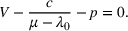




The proofs of the results in Sections 3–5 can be found in Appendix B, and the proofs of the results in Section 6 are in Appendix C in the E‐companion. Theorem 1 gives the threshold of market size 


We remark that in a market of expert customers, the price charged by a revenue‐maximizing service provider, as given in Theorem 1, is also socially optimal. This is because each customer receives a zero surplus whether she joins or not. This implies that the revenue collected by the service provider is the same as the social welfare, so that his revenue‐maximizing price is also socially optimal (see Hassin & Haviv, 2003, chapter 3 for similar observations).
Market of amateur customers
In a market full of amateur customers (
We model the interaction between the service provider, intermediary, and amateur customers as a three‐stage game. First, the provider sets a price
We use backward induction to solve the game. In optimality (of the intermediary's fee 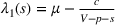

The one‐to‐one correspondence between 
Then, anticipating (4), the provider solves In a market of amateur customers, there exists a threshold 



Recall that in a market of expert customers, the provider can fully extract the surplus of joining customers. However, in a market of amateur customers, the provider has to share the reward of serving amateur customers with the intermediary. Thus, the presence of the intermediary cuts into the provider's profit margins. Nevertheless, the provider's optimal market coverage has a similar threshold structure, but this time, the threshold to induce full coverage is lower than the corresponding threshold in a market of expert customers, as congestion is more critical in the former amateur market with decreased profit margins. Thus, full market coverage is optimal in this market only when the market size is even smaller.
We next discuss the welfare implications of the two markets. As no consumer surplus is retained in either market, the social welfare We have





As evinced, the necessity of relying on an intermediary to reach amateur customers puts the provider at risk, creating double marginalization that adversely affects the provider's revenues. Moreover, the same double marginalization reduces market coverage too, leading to a lower utilization and decreased social welfare.
Heterogeneous market of expert and amateur customers
In this section, we consider a heterogeneous market mixed with expert and amateur customers. For example, AWS and Microsoft Azure serve both tech‐savvy customers who build their own computing infrastructure and amateur customers who hire Databricks to connect them to the cloud. In such markets, the joining decisions of expert and amateur customers create congestion externalities that mutually affect each other. In this section, we focus on the FCFS policy. (We study non‐FCFS queueing policies in Section 5.) We next formulate the interaction between two customer segments under FCFS. To this end, we utilize the one‐to‐one correspondence between the intermediary's fee Let (Intermediary's best response) (Expert customers' best response) if if if 















To understand Definition 1, note that the payoffs of expert and amateur customers from joining the service are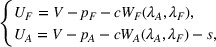


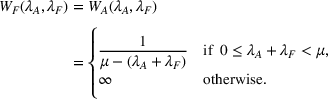
We next explain the best‐response formulations of different players in Definition 1. First, given the provider's prices 


Our next analysis focuses on a simple 
Now, for any price 

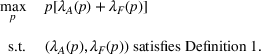
To solve the provider's revenue‐optimization problem (5), we first make an observation on the structure of SPE under single pricing. Consider single pricing and FCFS policy. For any price 

The intuition of Lemma 1 can be explained as follows. If 






Lemma 1 suggests that under single pricing, the provider must serve expert customers entirely before serving any amateur customers. It also suggests that the presence of amateur customers allows expert customers to
Lemma 1 provides a structural property of SPE under single pricing. Using this property, we divide all equilibria into two types based on whether amateur customers are served. Let The equilibrium The equilibrium 





By Definition 2, the provider serves expert customers exclusively in a Type I equilibrium and serves both customer types in a Type II equilibrium. Intuitively, a Type I equilibrium cannot be sustained when there are insufficient expert customers. The following result formalizes this intuition. Consider single pricing and FCFS. A Type II equilibrium occurs if and only if A Type I equilibrium occurs when Condition (6) does not hold. In this case, the provider's optimal price and the corresponding effective arrival rate of expert customers are given by
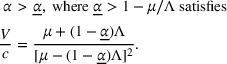

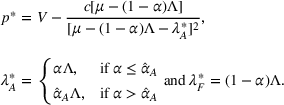

Theorem 3 fully characterizes the provider's optimal single price under FCFS. The presence of the intermediary cuts into the provider's margin of serving amateur customers, but it also opens access to a segment that otherwise cannot be reached. Charging a lower price to cover both segments has the potential to expand market coverage, but it will also introduce the adverse free‐riding effect. The trade‐off between double marginalization, market coverage, and congestion externality forms the crux of Theorem 3.
Theorem 3 identifies the fraction of amateur customers, α, as a critical driver of equilibrium outcomes. Specifically, there exists a threshold 


We present a graphical illustration of single pricing in Figure 1, where we normalize both the delay sensitivity 


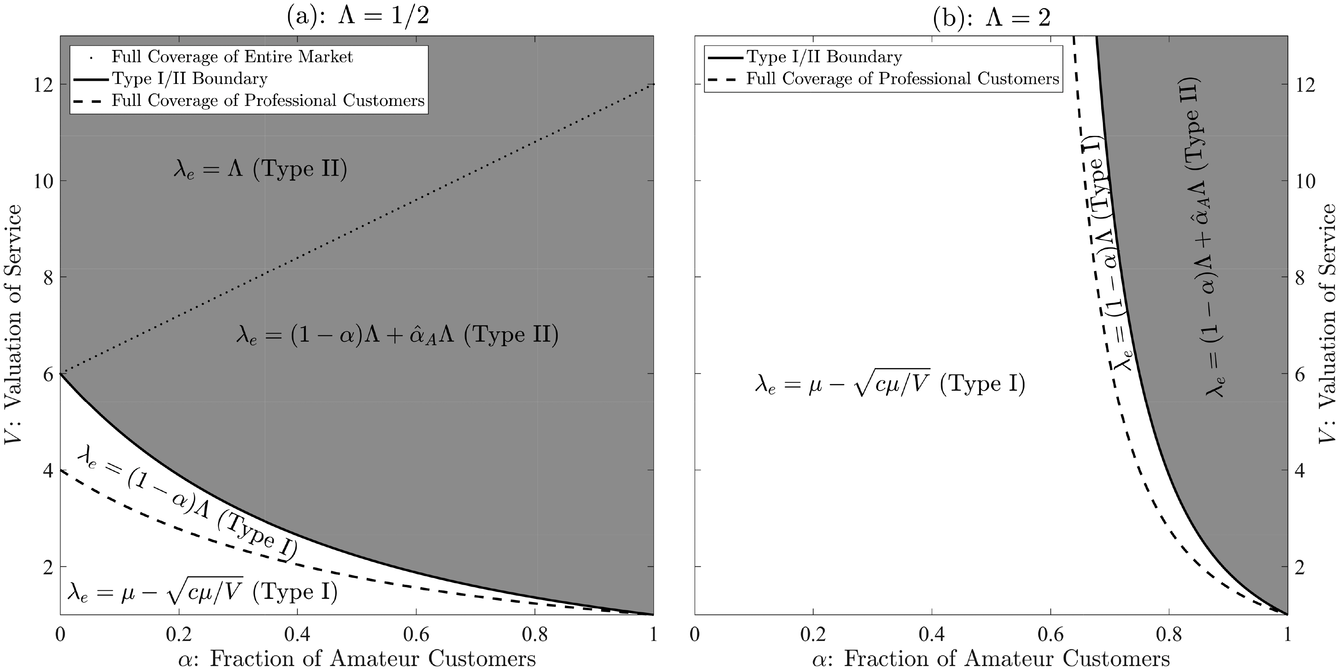
Equilibrium under single pricing.
Under fixed 
PRICE DISCRIMINATION
In the previous section, we focused on single pricing and identified the free‐riding of expert customers when amateur customers are served. In this section, we consider type‐based price discrimination and show that this advanced pricing scheme can fully allay free‐riding. To implement type‐based price discrimination, it requires identifying the type of each incoming customer. In the context of cloud computing, AWS and other major cloud operators have provided special entries for intermediaries such as Databricks. These entries are generally different from those of direct users who access the cloud without using these intermediaries. 8 Thus, whether one uses the special portal of Databricks to access the cloud will reveal the type of that customer, and this information can be used for price discrimination. 9
Under price discrimination, let 

To explain this latter point, note that the revenue‐maximizing intermediary will set 

The provider then selects prices 
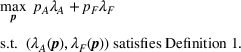
To solve the provider's optimization problem, we provide a structural property of the optimal price discrimination. Consider price discrimination and FCFS. If If


Similar to Lemma 1, Lemma 2 suggests that if any amateur customers are served under price discrimination (

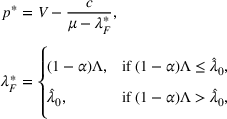
Lemma 2 allows us to narrow down the search region of feasible prices in (7). Specifically, we only need to consider prices such that either amateur customers are screened out ( Consider price discrimination and FCFS. A Type II equilibrium occurs if and only if A Type I equilibrium occurs when Condition (8) does not hold. The provider's optimal price and the corresponding effective arrival rate of expert customers are given by



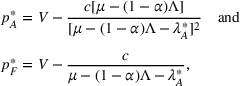
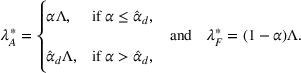
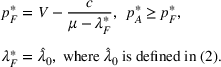
Some observations are in order. First, we can rewrite (8) as 


Thus, a Type II equilibrium can only emerge when the fraction of amateur customers is above 


In Figure 2, we give a graphical illustration of the equilibrium outcomes under price discrimination. Using the same parameters as those under single pricing, we compute the new equilibria under price discrimination. The solid and dashed curves represent the switching boundaries between Type I and Type II regimes under single pricing and price discrimination, respectively. We find that the Type II regime 
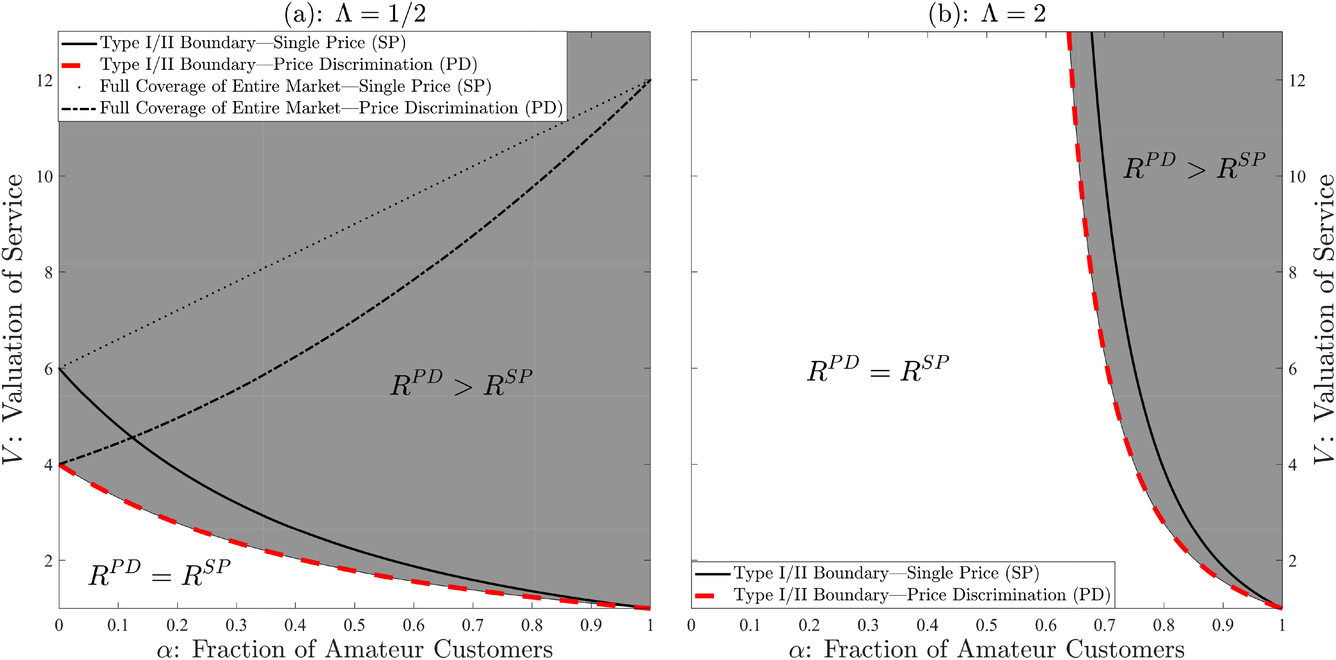
Equilibrium comparison between single pricing and price discrimination.
Not surprisingly, price discrimination can improve the provider's revenue by pulling more pricing levers. However, prices may also drop under price discrimination. Specifically, we find cases in which a provider who initially charges a single price chooses to lower prices for
The provider's revenue under price discrimination is strictly higher than that under single pricing when Under price discrimination, the provider charges a higher price to expert customers than amateur customers,







To explain Proposition 2, note that when the demand of expert customers exceeds 


However, it is intriguing that in some circumstances, price discrimination drives prices downward for both expert and amateur customers compared to the optimal single price. In this case, customers, irrespective of their types, can find a better price under price discrimination. To understand this result, recall that 


Indeed, we find that over time, highly profitable cloud services such as AWS and Microsoft Azure have all expanded in scale and market reach, but only to see their profit margins drop after expansion. Our results provide a tentative explanation for this trend.
PRICING AND PRIORITIZATION
In previous sections, we focused on analyzing the provider's optimal pricing strategy under FCFS. In this section, we propose another operational instrument to manage service systems: resource reallocation using
Note that priorities are
When preemptive prioritization is allowed, the expected wait times of the high‐priority class only depend on the joining rate of that class, whereas the expected wait times of the low‐priority class depend on the joining rates of both classes. In a two‐class queueing system that prioritizes class 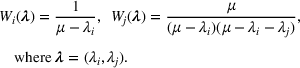
Prioritizing expert customers
We established in previous sections that the provider prefers to serve expert customers for their high margins under price discrimination. This intuition extends to the current setting with priorities. We first consider prioritizing expert customers and formulate the provider's revenue‐maximization problem as follows: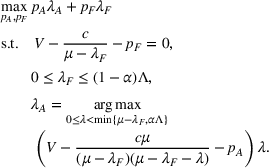
We make an observation on the structure of the optimal prices. Consider price discrimination and prioritizing expert customers. If 


In the context of Lemmas 1 and 2 with FCFS being the queueing discipline, the provider will serve expert customers entirely before switching to serving any amateur customers. The same structure is preserved when expert customers are prioritized, extending the intuition from Lemma 2. Specifically, price discrimination allows the provider to fully extract the surplus of expert customers, whereas the rewards of serving amateur customers must be shared with the intermediary. Consider price discrimination and prioritizing expert customers. A Type II equilibrium occurs if and only if A Type I equilibrium occurs when Condition (10) does not hold. In this case, the provider's optimal prices and the corresponding effective arrival rate of expert customers are given by



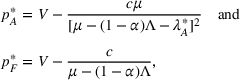
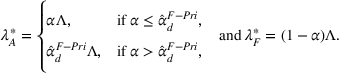
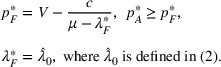
The equilibrium outcomes in Theorem 5 when expert customers are prioritized exhibit a similar threshold structure as those under FCFS. The threshold also matches that in Theorem 4. The optimal prices, however, depend on the queueing policy. The subtlety in prices under different queueing policies stems from the fact that FCFS places an endogenous waiting cost on each segment determined by decisions of both classes, whereas in priority queues, the joining decisions of the high‐priority class are determined solely within that class independently from the decisions of the low‐priority class.
Prioritizing amateur customers
We next consider prioritizing amateur customers and formulate the provider's revenue‐optimization problem as follows: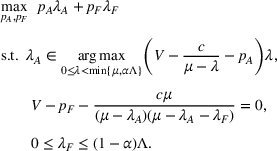
We characterize the optimal prices in the following result. Consider price discrimination and prioritizing amateur customers. A Type II equilibrium occurs if and only if A Type I equilibrium occurs when Condition (12) does not hold. In this case, the provider's optimal prices and the corresponding effective arrival rate of expert customers are given by



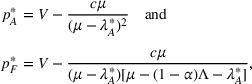
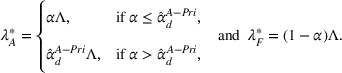
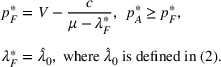
Theorem 6 shows that the equilibrium outcomes when amateur customers are prioritized exhibit a similar threshold structure as those under other queueing policies. Specifically, the switching boundaries between Type I and Type II regimes are identical in priority queues irrespective of which segment is prioritized. This result is because different priority policies are considered jointly with price optimization. Thus, the thresholds to induce a Type I equilibrium are identical in Theorems 4, 5, and 6. The provider's revenues are the same in a Type I equilibrium irrespective of the queueing policy because amateur customers are screened out and expert customers are served exclusively. However, when both segments are served in a Type II equilibrium, the provider's revenues will heavily depend on the queueing policy, as reallocating wait times across segments will readjust the profit margins of each segment. We address this issue in the next section.
Comparison between priority and FCFS
We next examine the provider's priority preference by comparing the provider's optimal revenues under three queueing policies (FCFS, prioritizing expert customers, and prioritizing amateur customers). As serving expert customers entails a higher profit margin, one may expect that prioritizing these customers can improve the revenue by reducing their wait times and creating even higher profit margins. However, contrary to this expectation, we show in the next result that prioritizing expert customers generates the lowest revenue among all three queueing policies.
Formally, let Given







Recall that the provider in principle prefers to serve expert customers under price discrimination. Thus, when there is a sufficient base of expert customers, the provider will serve them exclusively up to 
This implies that reallocating wait times through prioritization is only relevant in a Type II equilibrium, which emerges when the demand of expert customers is not too high, 
To explain such discrepancy, recall that prioritization is optimized jointly with price discrimination. Prioritizing expert customers, while creating higher profit margins of expert customers, increases the waiting cost of amateur customers. The effect of the increased waiting cost is further amplified by a revenue‐maximizing intermediary that adjusts fees in response to the de‐prioritization of its customers. This exacerbates double marginalization and prompts amateur customers to join the service at a rate significantly lower than that under FCFS. The latter effect can dominate the increased margins of expert customers, leading to inferior performance of this queueing policy.
In a similar spirit, there can be surprising revenue benefits by prioritizing amateur customers. Such benefits are driven by the wait‐time reduction of amateur customers which effectively alleviates double marginalization and boosts the joining rate of amateur customers. The provider then can charge a higher price to the amateur segment (
The above findings hint at a unique perspective of double marginalization rooted in the decentralization in serving amateur customers. They also demonstrate how the provider can use prioritization to manage double marginalization for better revenues. It is significant that in the current setting, the intermediary's fees are
We give a numerical comparison of three queueing policies in Figure 3 for various values of
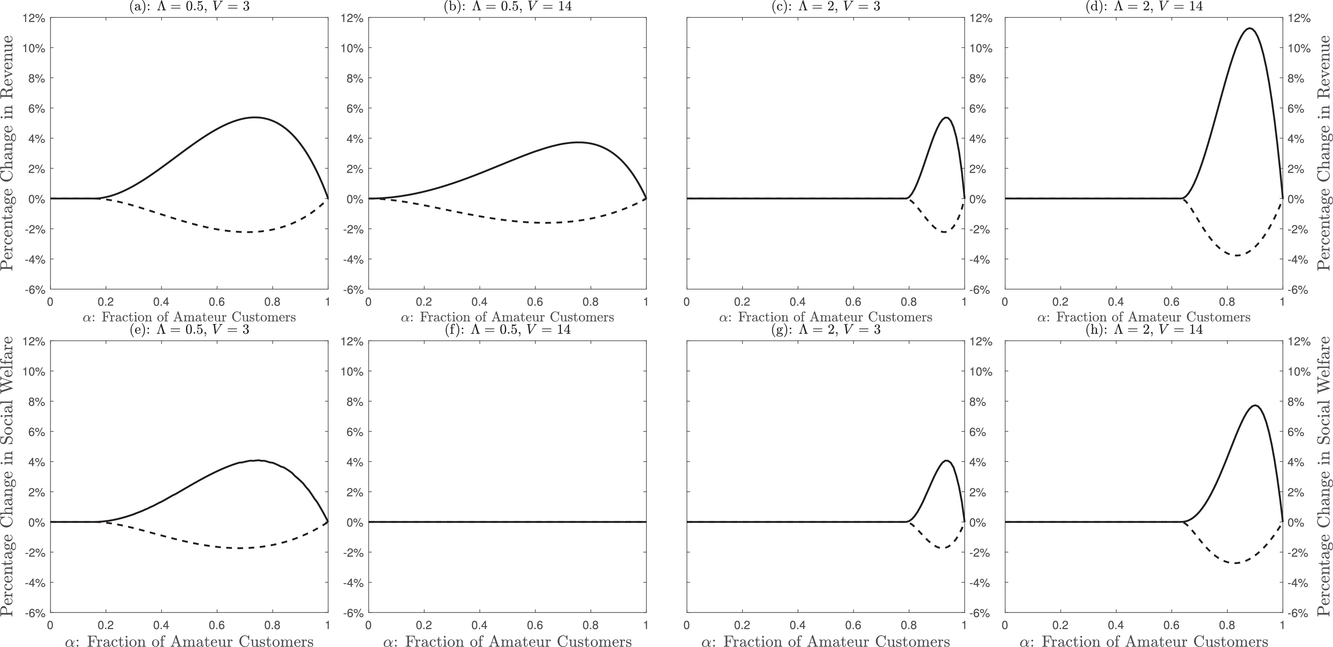
Percentage change in revenue and social welfare of prioritizing amateur customers (solid line) and prioritizing expert customers (dashed line) relative to First‐Come‐First‐Served.
Revenue comparison
First, when full market coverage is optimal (
Second, when full market coverage is not feasible under a large market size (
Social welfare comparison
The social welfare is computed by summing up the provider's and intermediary's respective revenues, as no consumer surplus is retained under price discrimination. We find that prioritization has a similar effect on social welfare as it does on the provider's revenues. Specifically, prioritizing amateur customers increases social welfare, whereas prioritizing expert customers decreases social welfare. The driving mechanism of social welfare, however, is very different from the revenue metric.
Welfare gains from prioritizing amateur customers emerge from the fact that prioritizing amateur customers allows this segment to join the service at a significantly higher rate. This brings the total joining rates closer to the socially optimal level. So, welfare improvement from prioritization is a result of
Panel f presents a scenario with a high valuation 
EXTENSION
In this section, we consider two extensions to our main model. Specifically, we consider a positive marginal cost and an exogenous fee for the intermediary in Subsections 6.1 and 6.2, respectively. In each extension, we relax one assumption in the main model while keeping all other assumptions fixed.
Marginal cost of intermediary
In the main model, we assumed that the intermediary incurs a zero marginal cost in serving amateur customers. This may be a reasonable assumption for cloud intermediaries with fixed facility costs (e.g., developing a platform and configuring connection parameters). Nevertheless, we acknowledge that in reality, acquiring new customers can be costly (e.g., marketing and advertising). We now analyze a model in which the intermediary incurs a marginal cost
To incorporate this cost Consider price discrimination and FCFS. If If A Type II equilibrium occurs if and only if A Type I equilibrium occurs when Condition (14) does not hold. The provider's optimal prices and effective arrival rates of amateur and expert customers are given by (13).

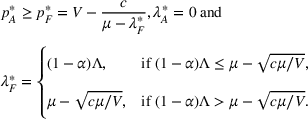


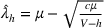

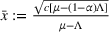

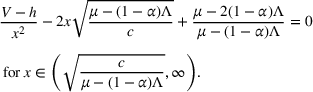
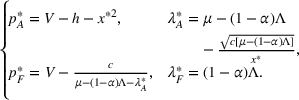
Intuitively, when the intermediary's marginal cost is prohibitively high, the intermediary will stop serving amateur customers, closing the provider's access to the amateur segment and making the market effectively composed of expert customers only. So, the amateur segment is only relevant when the intermediary's marginal cost is not too high. In this case, the positive marginal cost increases the threshold of α in (14) (relative to the case of zero marginal cost in (8)). In other words, under a positive marginal cost, it requires a higher fraction of amateur customers in the market for a Type II equilibrium to sustain. The marginal cost raises the intermediary's fee, which intensifies double marginalization and reduces the provider's willingness to serve amateur customers. Thus, a Type II equilibrium will not emerge unless the demand of expert customers is even smaller than that required in the case of zero marginal cost.
We compare the provider's optimal prices under single pricing and price discrimination and find that 

We next consider the provider's joint optimization of pricing and prioritization. When expert customers are prioritized, we revise the intermediary's best response in (9) to Consider price discrimination and prioritizing expert customers. If If A Type II equilibrium occurs if and only if A Type I equilibrium occurs when Condition (16) does not hold. The provider's optimal prices and effective arrival rates of amateur and expert customers are given by (15).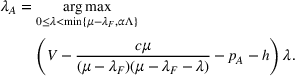

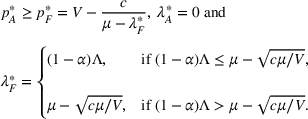


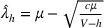



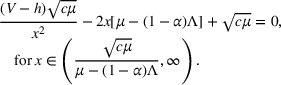
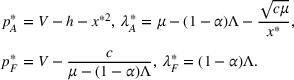
We are unable to characterize the provider's optimal prices when amateur customers are prioritized. We numerically compute the optimal prices under this prioritization scheme and compare the resulting revenue and social welfare with those under other queueing policies. Figure 4 presents the comparison results for various values of 



Percentage change in revenue and social welfare of prioritizing amateur customers (solid line) and prioritizing expert customers (dashed line) relative to First‐Come‐First‐Served:
Exogenous fee of intermediary
In our main model, we considered a monopoly intermediary that optimally selects its fee. Under this assumption, we demonstrated the provider's opposing preferences of customer segments in implementing price and priority discrimination. To better illustrate double marginalization as the critical driver, in this extension we consider a price‐taking intermediary that charges an
At a high level, the exogenous fee of the intermediary cuts into the provider's profit margin in serving amateur customers. This is equivalent to reducing the valuations of amateur customers by
We first characterize customers' joining decisions under FCFS. The intermediary cannot control the joining rate of amateur customers under an exogenous fee Let (Amateur customers' best response) if if if (Expert customers' best response) if if if 


























Using Definition 3, we characterize the provider's optimal prices under single pricing and price discrimination, respectively. We relegate these results to Appendix A in the E‐Companion and only present their comparison in the following result. Consider FCFS and an exogenous fee The firm's revenue under price discrimination is strictly higher than that under single pricing when When it is optimal to serve both types under pricing discrimination, it holds that

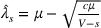



Similar to our main model, even when the intermediary's fee is exogenous, the provider prefers to serve expert customers for their high margins. So, a Type II equilibrium in which both types are served will only emerge when the demand of expert customers is sufficiently low. However, the threshold 


When comparing the provider's optimal prices under price discrimination and single pricing, we find that the prices charged to both types under price discrimination always exceed the optimal single price. This is in contrast to Proposition 2 established under the intermediary's endogenous fee that suggests a mixed price comparison between the two pricing schemes. Interestingly, the optimal price discrimination under an exogenous fee can have a very simple form: the price charged to amateur customers is set equal to the optimal single price, and the price charged to expert customers is higher by an amount of 

We next consider the provider's joint optimization of pricing and prioritization. Unlike our main model, the following result shows that the benefits of prioritization will not carry through under the intermediary's exogenous fee. In other words, it is sufficient to serve all customers under FCFS. To state the result, recall that we use Under price discrimination and an exogenous fee of the intermediary, it always holds that 



Proposition 5 can be further strengthened: the provider's optimal revenues under price discrimination are always the same under any non‐idling work‐conserving queueing policy. To understand the result, let 






The key to the above argument is that customers share the 
Our main model, however, allows the intermediary to adjust its fee in response to the provider's queueing policy. This adaptivity changes the effective valuations of the amateur segment and brings prioritization benefits that do not materialize when the intermediary is unable to optimize its fee.
CONCLUSION
With the growth in technology, many professional service offerings have become increasingly complex. This creates a chasm among users in their capabilities to deploy the service. Such user heterogeneity has important implications for the optimal design of professional services. In particular, users' onboarding experience can influence a service provider's pricing and prioritization strategy. Our work explores these concomitant issues, through a model that integrates user heterogeneity in skill sets with a classic framework of service operations.
We found that the presence of amateur customers allows expert customers to
We believe that the optimal design of professional services is a rich and complex problem that involves many strands of exploration. For instance, our paper does not consider competition between service providers and between intermediaries. Extending our framework to study competitive settings would generate potentially new policy recommendations. There are also contracting issues between the service provider and intermediary that we did not explore in this paper (e.g., Chen et al., 2022; Feldman et al., 2023). Integrating incentive issues with the service provider's pricing and priority decisions will advance our understanding of professional services. Another possible direction to pursue is the provider's information strategy at the customer level that has been proved effective for revenues and social welfare (e.g., Hu et al., 2017). A joint study of the provider's optimal pricing, prioritization, and information strategies constitutes an interesting direction for future study.
Finally, although our work is motivated by professional services and we introduce our model using cloud computing as the main backdrop, we believe that our results can also provide guidance for other relevant make‐to‐order systems with channel conflicts due to user heterogeneity in their accessibility to a product or service. A prominent example is restaurants that take both offline orders from dine‐in customers and online orders from food delivery platforms. Another relevant example could be make‐to‐order manufacturers that serve different regions, operating direct channels in their home region and indirect channels (e.g., through a retailer) in other regions.
Footnotes
ACKNOWLEDGMENTS
The authors thank the department editor Michael Pinedo, a senior editor, and two anonymous reviewers for constructive feedbacks in the review process. The authors also thank Fazil Pac and Will Wang for conversations and input on service industry contracts. Chenguang (Allen) Wu acknowledges support from the Hong Kong General Research Fund (Grant Number: 16506122). Chen Jin acknowledges the Singapore Ministry of Education Academic Research Fund Tier 1 (251RES2101), The Wharton School Dean's Postdoctoral Research Fund, and Mack Institute Research Fund.
1
See
2
See
3
Databricks is a data analytics agency integrated with Amazon Web Services and Microsoft Azure via Apache Spark. Databricks itself does not own a large‐scale computing cluster. See
4
We employ the dictionary definition of “amateur” in the strictest sense of “one lacking in experience and expertise in an art or science,” as it relates to the specific infrastructural details of the service.
5
In the context of cloud computing, existing computing resources can be limited relative to the huge demand during peak hours and this can cause an “insufficient capacity” issue. When it happens, users attempting the busy servers will get an “insufficient instance capacity” error (see
6
In general, we use
7
It is common that the service provider (e.g., AWS) and intermediary (e.g., Databricks) charge users hourly rates. However, because customers' processing times are often random, it is reasonable to assume that customers make their purchase decisions by computing the
8
Evidence can be found from various sources. AWS: see
9
Our communication with industry practitioners has also confirmed this fact. We are informed that Google cloud has implemented fairly different prices for direct clients and for intermediaries (Google cloud terms these intermediaries as “Value Added Resellers/Partners”).
10
Our communication with industry practitioners confirms that customers get different priority and preemption rates based on their classes and on how they access the service.
11
The within‐class service discipline is still FCFS and high‐priority arrivals preempt low‐priority jobs both in service and in queues.

References
Supplementary Material
Please find the following supplemental material available below.
For Open Access articles published under a Creative Commons License, all supplemental material carries the same license as the article it is associated with.
For non-Open Access articles published, all supplemental material carries a non-exclusive license, and permission requests for re-use of supplemental material or any part of supplemental material shall be sent directly to the copyright owner as specified in the copyright notice associated with the article.
