






Abstract
Online arbitrage, a recent trend on e‐commerce platforms, occurs when a firm (the “arbitrage firm”) copies the product description of another firm (the “designer firm,” who is the original seller of the product) and sells the product at a marked‐up price on a different platform from the designer firm. Once receiving a consumer's order, the arbitrage firm creates an order at the designer firm with a fake account and the consumer's shipping information. In this process, the designer firms fulfill all the purchase orders, and the arbitrage firm earns a profit without even touching the product. While the designer firm can enjoy a market expansion benefit, it also suffers from a high volume of product returns as some consumers eventually learn the true product price (from the receipt) and return the product they ordered from the arbitrage firm. We analyze the online arbitrage practice with a game‐theoretic model and show how the entry of an arbitrage firm can hurt the designer firm's profit. In the current practice, many designer firms cope with this issue by simply adjusting the price, but we show that such a strategy does not necessarily alleviate the problem. We propose a different strategy: the designer firm adjusts its refund policy to curb the greedy behavior of the arbitrage firm. We show that the proposed strategy leads the arbitrage firm to decrease its retail price, resulting in a smaller number of returns and higher profit for the designer firm.
INTRODUCTION
On the main page of the website tacticalarbitrage.com, a leading facilitator of online arbitrage, the introduction video says, “…tacticalarbitrage is an easy‐to‐use product analysis software that can search hundreds of online stores, amazon categories… for valuable profitable deals… quickly checking product after product for their purchase potential.” The website is not exaggerating—it browses 898 websites worldwide to find online arbitrage opportunities. 1 Similarly, on the homepage of arbitrageprofitspy.com, the header text describes the main advantage of online arbitrage: “Revolutionary new web based software instantly discovers ‘hard to find’ amazon products to sell for insane profit! Absolutely no traffic or inventory needed.” 2
Online arbitrage occurs when a firm (the “arbitrage firm”) copies the product description of another firm (the “designer firm,” who is the original seller of the product) and sells the product at a marked‐up price on a different platform (“platform‐B”) from the designer firm (which sells on “platform‐A”). Once receiving a consumer's order, the arbitrage firm creates an order at the designer firm with a fake account and the consumer's shipping information. The arbitrage firm profits from the difference between the price that consumers are willing to pay on platform‐B and the price that the designer firm sets on platform‐A. In theory, rational consumers would conduct extensive price comparisons before purchasing and would choose the firm with the lowest product price, leaving no room for online arbitrage. In reality, consumers often make impulsive purchases (Park et al., 2012) without thoroughly searching for alternative purchase channels, leaving plenty of opportunities for online arbitrage.
At the time of writing, no specific surveys or statistics describe the scale of online arbitrage practices, likely because it is hard to differentiate between the designer and arbitrage firms. It is easier to infer the trending popularity of online arbitrage practices from the growing number of websites that facilitate online arbitrage, including salefreaks.com, arbitrageprofitspy.com, and profitscraper.com, some of which have more than 140,000 users (i.e., arbitrage firms; Feifer, 2016). Because of their high popularity, Enterpreneur.com and Udemy.com even offer online courses on online arbitrage. 3 The online arbitrage practice and related courses are also popular in emerging markets such as China. Online arbitrage is also called “selling without a supplier” in China, and the name shows the key benefit for arbitrage firms: operating online shops even without a proper supplier or any inventory. 4 The practice was so prevalent that Taobao and JD had to publish rules to prohibit online arbitrage on their own platforms. 5 However, such restrictions adopted by the designer firm and its hosting platform (i.e., platform‐A) to avoid being arbitraged are usually ineffective because the restrictions do not apply to the arbitragers at a different platform. To the best of our knowledge, this study is the first attempt to understand the impact of online arbitrage and explore designer firms’ strategies on price and/or product return policies to alleviate the problems caused by online arbitrage.
Designer firms ostensibly benefit from online arbitrage because the potential market is expanded to another platform by the arbitrage firm. However, online arbitrage comes with a costly downside: an increase in product returns. For ease of exposition, we will use gendered pronouns for the firms: “he” for the designer firm and “she” for the arbitrage firm. Suppose a designer firm designs and directly sells his products on platform‐A at price pA . Consumers on platform‐A directly initialize the purchase request and the designer firm would fulfill these orders per consumers’ purchase requests (i.e., the “direct sales” process in Figure 1). An arbitrage firm copies everything from the product's description to platform‐B, where she sells the product at price pB (and pB > pA ) to profit from the price difference. Consumers on platform‐B impulsively purchase the product and make purchase requests from the arbitrage firm. After getting the consumers’ requests, the arbitrage firm places orders at the designer firm with the shipping information of these consumers. In the end, the designer firm fulfills the order to the customers on platform‐B (i.e., the “arbitrage sales” process in Figure 1). The consumers on platform‐B who pay attention to the shipping label and receipt can realize that the order is from platform‐A, not platform‐B, and the product was available for a lower price than what they have paid (e.g., products from Kohl's and Disney come with price stickers attached). 6 Upon realizing that they were victims of price exploitation, consumers of platform‐B may return the product for a refund. After getting the return requests from the customers, the arbitrage firm would initialize the same requests to the arbitrage firm. In the end, it is the designer firm, not the arbitrage firm, that fulfills all the return and pays for shipping (i.e., the “arbitrage‐caused returns” process in Figure 1). Customers on platform‐B have initialized returns and purchase requests to a seller on platform‐B, but in fact, it is the designer firm that accomplished the fulfillment.
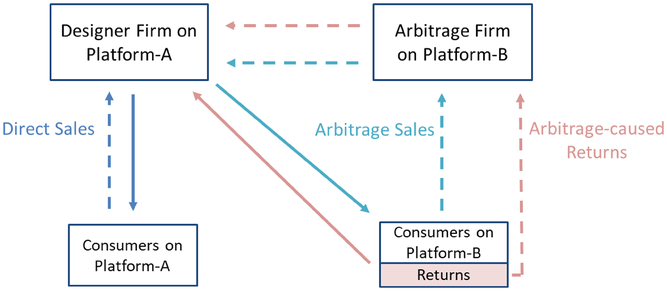
Flowchart of online arbitrage. Note: Dashed lines refer to purchase or return requests, and solid lines refer to purchase or return fulfillments.
The arbitrage firm makes a profit without even touching the product. Before receiving the products, consumers perceive that they are buying products from the arbitrage firm, it is the designer firm that has to ship the products, accept returns, and pay the shipping cost (Feifer, 2016). After receiving the products, some consumers would realize that they are exploited and initialize return at the arbitrage firm at platform‐B, who would simply submit the same return request to the designer firm at platform‐A.
Table 1 lists examples of online arbitrage featuring pairs of sellers that offer the same product for different prices on Amazon and eBay (though online arbitrage is not restricted to these platforms). From the prices and names of the sellers in our examples, we can infer that the Amazon sellers are the designer firms, while eBay sellers are the arbitrage firms. We can infer that by noting the randomly generated seller names on eBay and the organized seller names on Amazon. The price difference is as high as 75% in our examples. Detailed screenshots of the product listings on Amazon and eBay are in Online Appendix A, Section A.1.
Examples of online arbitrage (Amazon and eBay)
The scope and existence of online arbitrage are associated with the prevalence of impulse purchase behavior of consumers on online platforms. Impulse purchase behavior is influenced by a variety of factors ranging from prices to the shopping environment, among other things (Moser et al., 2019). While impulsive purchase is less likely to happen when the price of a product is high, the price thresholds that prompt impulse purchase behavior across different categories of products also differ. 7 For instance, the price range for impulse buying across categories such as groceries and houseware products could range under $50, whereas for clothing and electronics, it could even range up to $900. 8 The prevalence of online arbitrage is also related to the platforms’ policies. For the platforms that prioritize product sales without properly monitoring the supplier and product information of sellers, it is easier for arbitrage sellers to conduct online arbitrage. For example, from the anecdotal evidence described in the aforementioned online articles, online arbitragers are more prevalent on eBay and Pinduoduo, which have relatively lenient requirements about the supplier's information of products, than on JD and Amazon, which usually strictly require the information of the source of the products. In other words, online arbitrage is likely to exist as long as impulsive online consumers exist and the platform has a lenient policy on product listings.
Prior research on arbitrage looks at price exploitation that is either spatial (across regions) or temporal (across points in time; Subramanian & Overby, 2016). While e‐commerce should reduce arbitrage opportunities by facilitating price comparisons and reducing geographical heterogeneity, consumers often make impulsive purchases without conducting a rational, thorough search, so arbitrage opportunities still exist. Also, some consumers use only one platform exclusively, such that they are not in the habit of searching and comparing prices across platforms, and the product and price offered by the arbitrage seller may be attractive enough at the moment. We acknowledge that consumers who have purchased the product before are unlikely to buy from the arbitrage firm. Specifically, consumers who previously purchased from the designer firm are already familiar with the product, platform‐A, and the price, while consumers who purchased from the arbitrage firm had a chance to notice the discrepancy in the price and firm that fulfilled the order. Thus, arbitrage firms mainly target to exploit first‐time impulsive consumers, not repeat consumers or those who conduct thorough searches.
Although designer firms can benefit from online arbitrage because of the expanded potential consumers (i.e., consumers on platform‐B), they will incur costs from the high rate of returns on orders placed through the arbitrage firm as consumers realize that they were victims of price exploitation. For instance, Ripple Rugs, a product that was arbitraged from Amazon to eBay, was returned 219 times from arbitraged orders versus only once when it was sold on Amazon (Feifer, 2016). Returns are especially costly because most platforms have lenient return policies in which the seller covers the full cost of the return. “Full refund” policies are popular because can they lessen consumer uncertainty so much that the boost in sales outweighs the cost of returns (Nageswaran et al., 2020). Unfortunately, in the case of online arbitrage, the designer firm fully pays the return cost, while the arbitrage firm pays nothing. 9
Based on these observations, our first research question is: (1) Under which market conditions does online arbitrage hurt the designer firm's profit, and can price adjustments alleviate the problem? In practice, a designer firm can notice the existence of the arbitrage firm and adjust his price, perhaps just enough to account for the probable increase in returns from the arbitrage sellers or enough to match the arbitrage seller's price (Feifer, 2016). Some practitioners may argue that price adjustments alone can make arbitrage beneficial for the designer firm. However, we show that if the designer firm operates with a full refund policy, he may still lose profit from the arbitrage firm's market entry even after making price adjustments. The persistent problem of frequent returns leads to our second research question: (2) Can an adjustment to the refund policy as well as the price alleviate the return problem of online arbitrage? We propose that the optimal refund policy can be implemented as the “targeted refunds” discussed in Altug et al. (2021): The designer firm can infer the arbitrage firm based on the number of returns and offer different refunds for a single return (which applies to most consumers) and for multiple returns from the same account (viz., the arbitrage firm). We show that the combined price and refund policy adjustment alleviates the problem for the designer firm. Finally, we investigate other consequences: (3) How does the optimal refund case affect the arbitrage firm's profit and consumer surplus?
The remainder of the paper is organized as follows. We start with a literature review in the areas of arbitrage and refund policies. Then, we model the online arbitrage problem analytically and prove that a price adjustment alone does not solve the problem under the full refund case. We suggest an optimal refund policy that is more effective than the simple price adjustment, and we compare the profits of both firms and the consumer surplus in the full refund and optimal refund cases. We also explore hypothetical extensions to show the robustness of our results. We conclude by providing managerial insights and future research directions.
LITERATURE REVIEW
Arbitrage
Most existing studies on arbitrage focus on the opportunities brought by variations in geographic locations and purchase times (Chard & Mellor, 1989; Cross et al., 1990; Duhan & Sheffet, 1988; Gilbert et al., 1986). For example, Cheng et al. (2016) examine spot pricing in the context of cloud computing. They use price differences between East and West cloud computing markets in the United States to show how geography can provide arbitrage opportunities. Ahmadi and Yang (2000) analyze the arbitrage that occurs when a monopolist manufacturer supplies a product at different prices in two countries. An unauthorized distribution channel allows the flow of products from low‐price countries to high‐price countries. Current findings indicate that arbitrage may help the manufacturer reach more consumers.
Online arbitrage differs from the arbitrage opportunities brought by differences in geography and time. In the e‐commerce context, arbitrage firms take advantage of consumers’ impulsive purchase behaviors, which are prevalent online. Several studies investigate factors that can motivate irrational and impulsive purchase behavior (e.g., Chan et al., 2017; Parboteeah et al., 2009); known factors include the visual appeal and navigability of the website (Parboteeah et al. 2009; Park et al., 2012) and the type of device (consumers are more impulsive on mobile devices; Narang & Shankar, 2019). The issues related to online arbitrage are also different from those related to traditional channel conflict (e.g., Mukhopadhyay et al., 2008; Tsay & Agrawal, 2004). We compare the online arbitrage issue and channel coordination problem and include the discussions in Online Appendix A, Section A.2. In this study, we find that while online arbitrage can help the designer firm reach more customers, the costs incurred from the high rate of product returns outweigh the benefit of an expanded market.
Return policies
In our research context, most returns occur because consumers of the arbitrage firm can realize that they were victims of price exploitation after receiving the product, shipping label, and receipt. By contrast, most of the literature on return policies focuses on returns that are caused by misfit or quality uncertainty, which are most likely when the customer cannot evaluate the product before making the purchase decision (Gao & Su, 2016; Nageswaran et al., 2020; Ofek et al., 2011; Pu et al., 2022). Extreme (zero or full) refund policies were first studied by Davis et al. (1995) and Che (1996), while more recent works include Altug et al. (2021), Nageswaran et al. (2020), Hsiao and Chen (2014), and Su (2009).
Another stream of literature focuses on aspects of consumer behavior that inform the optimal refund policy (Altug & Aydinliyim, 2016; Chu et al., 1998; Hess et al., 1996; Shulman et al., 2009, 2011), but it remains unclear how the refund policy can help when most returns are prompted by the realization of price exploitation in the post‐purchase stage, not consumer's uncertainty. Our proposed differential refund policy is similar to the “targeted refunds” discussed in Altug et al. (2021), in which the designer firm can infer the arbitrage firm based on the number of returns and offer different refunds for a single return and for multiple returns from the same account.
MODEL
In our analytical model of the online arbitrage setting, we assume that there is a designer firm from platform‐A (or “A” in the equations) and an arbitrage firm from platform‐B (“B”).
Demand on platform‐A: The designer firm is located at the origin, and consumers are located on the Hotelling line. The consumer's utility is 


We assume that any comparison shoppers gravitate toward platform‐A (which has a cheaper price) before the purchase decision. In the Hotelling setup, all consumers with positive utility purchase the product. We derive the indifference point by solving 
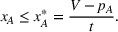
Then, we derive the demand function on platform‐A:
Demand on platform‐B: The arbitrage firm is located at the origin, and consumers are located on the Hotelling line. Using the Hotelling model, the consumer's utility is 


Again, all consumers with positive utility purchase the product. We derive the indifference point by solving 

Then, we derive the demand function on platform‐B:
Returns due to price exploitation: After receiving the purchased product from platform‐B, consumers who pay attention to the shipping label and/or receipt realize that price exploitation occurred, which leads to a disutility of 




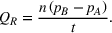
We analyze three cases. In the benchmark case, there is no arbitrage firm. We include a unit production cost c incurred by the designer firm to produce the product. In the other two cases, there is an arbitrage firm, and the designer firm's strategy varies. In the full refund case, the designer firm adjusts only the price, and the arbitrage firm can make price adjustments in response; the designer firm must pay fully for all returns and incurs cost s for return shipping, restocking, and handling. In the optimal refund case, the designer firm adjusts the refund policy as well as the price.
We make two key assumptions that suit our purpose of studying the costly phenomenon of frequent product returns caused by the price exploitation of the arbitrage firm. First, we assume that consumers who purchase on platform‐B do not search on platform‐A because they are making impulse purchases (Parboteeah et al., 2009), in which consumers develop a sudden and immediate purchase intention (Piron, 1991). Second, we assume that all returns are caused by the realization of price exploitation, not by quality uncertainty.
In the next sections, we analyze the outcomes for the designer firm, arbitrage firm, and consumers under the benchmark case, full refund case, and optimal refund case. In the equations, note that the subscript denotes the platform or the firm (A = designer firm, B = arbitrage firm), while the superscript denotes the case (B = benchmark case, F = full refund case, O = optimal refund case). Table 2 summarizes the frequently used notations in this paper.
Summary of notations
Benchmark case
In the benchmark case, there is no arbitrage firm in the market, so the designer firm simply decides on his optimal retail price, that is, the price that will maximize the following profit function:
Substituting the demand function (1) and solving for the optimal retail price with first‐order condition (FOC), we obtain: In the benchmark case, the equilibrium price and profit for the designer firm are: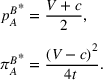
Proof. All proofs are in Online Appendix B.
Model with the arbitrage firm
We add an arbitrage firm to the market. Before the designer firm realizes that an arbitrage firm entered the market, his pricing remains the same as in the benchmark case. Once he realizes the entry, however, he can make two adjustments: the retail price and the refund policy. We model the decisions as a Stackelberg game, with the designer firm as the leader and the arbitrage firm as the follower. The model is general enough to capture the full range of options for the refund policy (full, partial, or zero) offered by the designer firm. We assume that the arbitrage firm must offer a full refund or else her reputation (reviews) would be affected (we relax this assumption in an extension; see Section 5.5). The profit functions of the designer firm and arbitrage firm for any retail price (


Note that 
The timing of the game is as follows: First, the designer firm announces his retail price and refund policy on platform‐A with the knowledge of the arbitrage firm's existence on platform‐B. Next, given the designer firm's retail price and refund policy on platform‐A, the arbitrage firm decides her retail price on platform‐B. The ability of the arbitrage firm to react to the adjustments of the designer firm is consistent with reality: although designer firms try to counter arbitrage opportunities by frequently changing their prices (Feifer, 2016), arbitrage firms can use software to automatically monitor the prices on platform‐A and alter the prices on platform‐B. 10
Full refund case
In the full refund model, the designer firm adjusts only the price while offering a full refund. In other words, the refund amount f is exogenously set to 


The functions indicate that for the quantity returned ( Under the full refund case, the equilibrium prices and profits for the designer firm and arbitrage firm are:


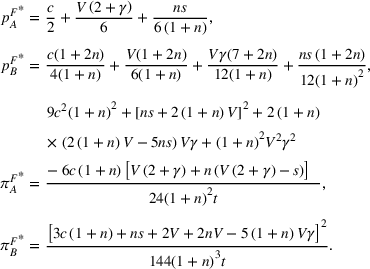
We assume the following conditions for both the designer firm and arbitrage firm would participate in the game: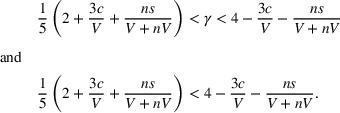
It seems intuitive that the designer firm should charge more when there is an arbitrage firm in the market, but the decision to charge a higher or lower price (relative to the benchmark case) depends on the market conditions. Finally, we find that price adjustments alone do not necessarily prevent the designer firm from losing profit to online arbitrage: In the full refund case, at equilibrium, a designer firm benefits from the entry of an arbitrage firm (i.e., 


The above proposition highlights the existence of scenarios where the entry of an arbitrage firm results in losses to the designer firm. In specific, we outline the thresholds on the consumer quality perception of the product across the platforms, under which the designer firm can gain or lose because of the arbitraging. While the upper bound of the thresholds of γ is greater than 1, the lower bound of it could be either greater or lesser than 1. In other words, under a full refund policy, the designer firm could either lose from the entry of the arbitrage firm when (i) the cost of return shipping, restocking, and handling (i.e., s) is relatively higher and/or (ii) the consumers’ quality perception for the product on platform‐B is relatively different from that on platform‐A.
Optimal refund case
We propose that the designer firm's better strategy is to adjust both the retail price and refund policy, denoted f. Other settings are similar to those in our previous section (i.e., Equations 5 and 6). First, the optimal response function of the arbitrage firm for a given designer firm's price and the refund amount is:
A more lenient refund policy may motivate the arbitrage firm to sell more, leading to more market expansion, which ostensibly is beneficial for the designer firm. However, a more lenient refund policy can also give the arbitrage firm the motivation to increase her price, which decreases the demand for the product and changes the return quantity on platform‐B. Thus, a deeper analysis of the impact of refund amount on dealing with the arbitrage firm is necessary.
Considering the FOC of the designer firm's profit function with respect to the refund amount, the designer firm can decide on:
As annotated in Equation (10), an increase in the refund amount has two effects on the designer firm's profit. First, in the market shrinkage effect, the arbitrage firm's optimal response to an increase in the refund amount is to increase her price, which leads to a decrease in demand on platform‐B. Second, the designer firm will incur a per‐unit net loss from refunding returns and collecting and restocking the returned products. The net effect can be positive, zero, or negative depending on the designer's retail price decision and refund amount. We solve the game using backward induction to obtain the following proposition: In the optimal refund case, the following equations give the equilibrium refund policy of the designer firm and the equilibrium prices and profits of the designer firm and arbitrage firm:


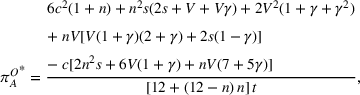

We assume the following conditions for the designer firm and arbitrage firm to participate in the game: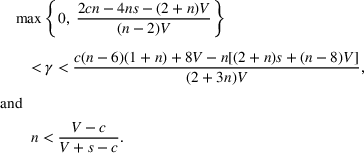
At equilibrium, the arbitrage firm charges a lower retail price under the optimal refund policy than under the full refund case: Whenever an optimal refund solution is feasible, (a) the designer firm's profit is higher under the optimal refund case than under the full refund case (i.e., 


The interpretation of Proposition 5 is straightforward: The designer firm always performs better if he can adjust both the price and refund policy than if he can adjust only the price while offering a full refund. Moreover, under an optimal refund policy with the existence of an arbitrage firm, the designer firm can earn even more profits than it does in the benchmark case. The arbitrage firm's profit is lower under the optimal refund case than under the full refund case (i.e.,
The arbitrage firm will always perform worse if the designer firm can adjust both the price and refund policy (i.e., Case O) than the case where he can adjust only the price while offering a full refund (i.e., Case F). In the optimal refund case, the arbitrage firm has the additional risk of not receiving a full refund, which forces her to lower her price, which reduces her profit.
Importantly, the optimal refund policy can be incorporated into the designer firm's refund policy without affecting the existing refund policy for consumers on platform‐A. Specifically, the designer firm can implement a differential refund policy: the reduced refund (called the “optimal refund” in the preceding section) applies only to accounts with multiple returns (viz., the arbitrage firm), while single returns (i.e., most consumers) receive the full refund. Our recommendation is similar to the “targeted refunds” discussed in Altug et al. (2021): The designer firm can infer the arbitrage firm based on the number of returns and offer a full refund for a single return (which applies to most consumers) and for multiple returns from the same account (viz., the arbitrage firm).
EFFECTS ON CONSUMER SURPLUS
We investigate three cases in Section 3 to explore the impact of online arbitrage on the designer firm and how the designer firm can better take into account this trending e‐commerce practice. In this section, we hope to better understand those cases from the perspective of consumers by comparing the consumer surplus across different cases (Cho et al., 2016, 2020; Kumar & Qiu, 2022; Mei et al., 2022). We first explore the consumer surplus for the consumers who have purchased and consumed the product from platform‐A and platform‐B, respectively, and then have a more comprehensive understanding by jointly considering the consumer surplus for consumers who have consumed the product.
Consumers on platform‐A make purchase decisions based on their utility Consumer surplus on platform‐A in the full refund case is greater than that in the benchmark case if and only if 
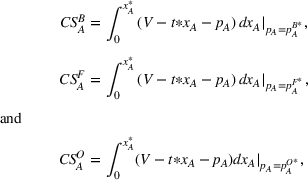



When the designer firm adjusts his price to account for the arbitrage firm's entry into the market, the consumer surplus on platform‐A can either increase or decrease depending on the relative product quality perception γ. Note that the upper bound of the thresholds of γ is less than 1. Thus, consumer surplus in the full refund case is higher than that in the benchmark case only when (i) the cost of producing the product (i.e., c) is relatively lower, and (ii) consumer perception of the product quality on platform‐B to be inferior to that on platform‐A. Consumer surplus on platform‐A in the optimal refund case is smaller than that in the full refund case.
Intuitively, with the optimal refund policy, the designer firm increases his price on platform‐A to accommodate the cost imposed by the arbitrage firm on platform‐B, and the price increase leads to a decrease in consumer surplus on platform‐A.
When considering the consumer surplus on platform‐B, we do not take into account consumers returning the product (because of the price exploitation) as they do not consume the product. In this light, the customers returning the product are not in the scope of consumer surplus. Note that consumers on platform‐B have the adjusted utility of Consumer surplus on platform‐B under the optimal refund case is greater than that under the full refund case.
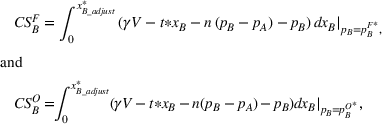



The explanation of Corollary 3 is analogous to Corollary 2: Earlier, we established that the arbitrage firm reduces her retail price at equilibrium under the optimal refund policy. The price reduction translates into an increase in consumer surplus on platform‐B. The total consumer surplus on platforms A and B under the optimal refund case is greater than that under the full refund case.
Corollary 4 suggests that although the optimal refund policy (relative to the full refund policy) negatively affects the consumer surplus on platform‐A, it leads to a greater consumer surplus overall. That is, the optimal refund policy not only benefits the designer firm with a higher profit than the full refund policy (i.e., Proposition 5(a)) but also generally benefits consumers who purchase (regardless of the purchasing platform) and consume the product.
EXTENSIONS
Designer firm sells on both platforms
The designer firm can sell the same product on both platforms at different prices, instead of allowing the arbitrage firm to exploit the price difference. In this scenario, some consumers from platform‐B may still return the product because of the price difference across platforms. The demand function from platform‐A is the same as that in our main analyses, but the demand from platform‐B now pertains to the designer firm instead of the arbitrage firm. The return decision of consumers purchasing the product on platform‐B depends on the post‐purchase utility of keeping the product, 



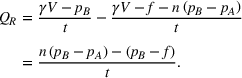
The case is denoted by the subscript AB in the equations below.
The designer firm seeks to maximize the following profit function:
Similar to the previous settings, the profit function accounts for the demands and profit margins on both platforms A and B and the cost of refunds, handling, and salvaging returns. We assume that all returns are due to price exploitation.
We solve the designer firm's profit function 
The optimal prices and the optimal refund amount are:


We compare the designer firm's profit under the two‐platform setting with the one in the benchmark case and find that the designer firm's profit when selling on both platforms A and B is always higher than that in the benchmark case and the full refund case. The results further confirm our conclusion. That is, enabling the designer firm to make both price and refund amount decisions can help him take into account the returns stemming from the price difference. However, our main focus is on the scenario where the designer firm sells only on one platform because selling at multiple platforms usually has a non‐zero cost for firms.
Designer firm offers wholesale contract to arbitrage firm
The designer firm might collude with the arbitrage firm by selling her the product at a wholesale price, 


The game between the designer firm and the arbitrage firm is still a Stackelberg leader–follower: The arbitrage firm decides her price based on the wholesale price she receives from the designer firm. The subscripts WA and WB denote platform‐A and platform‐B under the wholesale contract, respectively.
The profit functions of the designer firm and arbitrage firm are: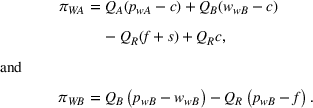
The analysis shows that under a wholesale contract, the designer firm decision tuple of (retail price on platform‐A, wholesale price for the arbitrager, optimal refund amount) makes it impossible for the arbitrage firm in the game because of the incentive compatibility of positive profit. Hence, a game that incorporates the wholesale contract is not feasible between the designer and arbitrage firms.
When the designer firm has the ability to offer a wholesale price for the arbitrage firm, the designer firm first decides on the pricing for the consumers on platform‐A, wholesale pricing for the arbitrage firm, and the optimal refund amount (simultaneously), and then the arbitrage firm decides on her selling price. In doing so, the designer firm will have every incentive to extract as many margins from the arbitrage firm as possible, resulting in the profits of the arbitrage firm being zero. In other words, the designer firm has the incentive in taking full advantage of its decision power and getting as much profit as possible, leaving the arbitrage firm no incentive to participate.
Different market sizes on the two platforms
In the main setting, we assumed that platforms A and B had the same market size; now, we relax the assumption to test the robustness of the results. If the market size on platform‐B is T, then the modified demand and return quantity functions on platform‐B are: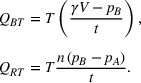
We find that our key results (Propositions 3, 5(a), and 6) hold with the modified functions. That is, even when the two platforms have different market sizes—as likely is true in most cases of online arbitrage—we prove that the entry of an arbitrage firm can result in loss of profit for the designer firm due to the increase in returns associated with price exploitation, and an optimal refund policy can enable the designer firm to alleviate the loss and curb the arbitrage firm's profits.
Inconvenience cost of returning and repurchasing on platform‐A
In the main model, consumers can return the product from platform‐B due to price exploitation, but we did not account for the possibility that consumers might repurchase the product from platform‐A. In this subsection, we allow consumers to repurchase the product from the designer firm with an inconvenience cost, ic. We use subscript ic to denote this case.
For consumers on platform‐B who decide to return the product, because their adjusted utility of 


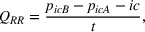

We can show that our key results (Propositions 3,5(a), and 6) hold when considering the inconvenience cost and consumers’ repurchase behavior.
Arbitrage firm's decision on the refund policy
In our main analyses, we assume that the arbitrage firm always offers a full refund and only decides on the price on platform‐B. In this section, we consider a scenario in which the arbitrage firm decides on the refund policy in addition to the price. The return decision of consumers purchasing the product on platform‐B depends on the post‐purchase utility of keeping the product, 




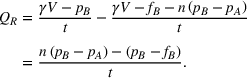
The subscripts AR and BR refer to the designer firm and arbitrage firm in the case where the arbitrage firm also decides its refund policy, respectively. The modified profit function of the arbitrage firm is
Under the full refund by the designer firm case (i.e., Case F, where 
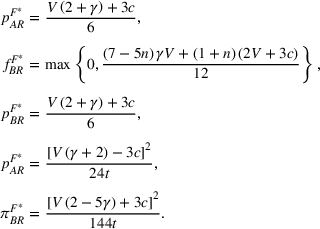
Under the optimal refund by the designer firm case (i.e., Case O, where 
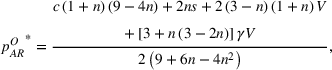

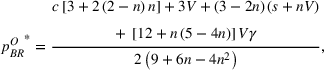
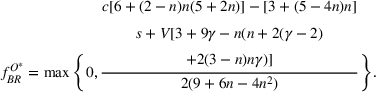
We find that our key results, Propositions 3 and 5(a) hold when both the designer and arbitrage firms decide their own optimal pricing and refund amount, confirming that the optimal refund policy proposed in our paper also works from the designer firm's perspective: the arbitrage firm's entry into the marketplace can result in losses to the designer firm and that the optimal refund policy helps the designer firm in counteracting those losses. We also find that Proposition 6 in our main analyses does not hold under this scenario. That is, when the arbitrage firm also optimizes its refund policy, the arbitrage firm is not always worse off when the designer firm switches from a full refund policy to the optimal refund policy. This is because when the designer firm offers a full refund policy, the arbitrage firm needs to eliminate the returns (i.e., 


Both firms do not allow returns
In our main analyses, we are interested in the overall impact of the existence of the arbitrage firm on the designer firm, especially the negative impact of the price‐exploitation‐induced returns. Apart from this negative impact, the existence of the arbitrage firm affects the designer firm through a market expansion effect. To explore the market expansion impact of the arbitrage firm, we analyze a case in which both the designer and arbitrage firms do not allow any returns. In such a case, the designer firm would not have to incur any costs for shipping and handling of the returns. The subscripts AN and BN refer to the designer firm and arbitrage firm in the case where no return is allowed, respectively. The updated profit functions are: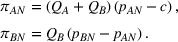
Optimal prices and profits of the designer and arbitrage firms are given as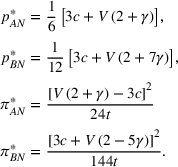
When both the designer and arbitrage firms do not allow returns, the profit of the designer firm in presence of the arbitrage firm is lower than its profit in the benchmark case when 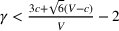
CONCLUSION
Managerial implications
E‐commerce has enabled a unique opportunity for the arbitrage of physical goods across platforms. While designer firms can benefit from the expanded consumer base, they suffer from the high return frequency that occurs when consumers of the arbitrage firm discover that they are victims of price exploitation. Firms on many e‐commerce platforms have lenient return policies that are intended to capture customers’ trust, which tends to translate into more sales and hence an increase in profit—unless an arbitrage firm enters the market.
We develop an analytical model to capture the phenomenon of online arbitrage. First, we show how the returns associated with price exploitation can hurt the designer firm's profit (relative to the benchmark case with no arbitrage firm). Then, we prove analytically that a simple price adjustment does not necessarily alleviate the problem. Specifically, we characterize how the effectiveness of a price adjustment depends on relative product quality perception across the platforms, production cost, and cost of shipping and restocking returns.
Next, we propose that the designer firm can more effectively cope with the arbitrage firm's entry by adjusting the refund policy as well as the retail price. We show that the optimal refund policy improves the designer firm's profit (relative to the full refund and benchmark cases) and causes the arbitrage firm to decrease her price, which leads to less profit for the arbitrage firm and more consumer surplus for consumers of the arbitrage firm. We propose that the optimal refund policy can be targeted to the arbitrage firm by enacting a differential refund policy: a full refund for single returns (most consumers) and the optimal policy for multiple returns (viz., the arbitrage firm). Our effective approach should be of particular interest to industry practitioners because many designer firms have control over both the price and refund policy.
Finally, we analyze how the consumer surplus on the two platforms is affected by the full refund and optimal refund cases. The full refund case results in an increase in the consumer surplus on platform‐A (vs. benchmark case) only when relative product quality perception on platform‐B is inferior to that on platform‐A. The optimal refund policy leads to an increase in the price on platform‐A, which decreases the consumer surplus; by contrast, the price decrease on platform‐B leads to an increase in the consumer surplus. The optimal refund policy, relative to the full refund case, improves both the designer firm's profit and the overall consumer surplus (for consumers who buy and consume the products regardless of the purchasing platform).
Limitations and future research directions
First, while we assumed no overlap in the consumer bases of the two platforms, it would be interesting to see how the arbitrage dynamics change in the presence of strategic consumers (those who search both platforms and take advantage of the lowest prices). We reason that the presence of an arbitrage firm on platform‐B could boost the sales of the designer firm on platform‐A as strategic consumers who discover the product on platform‐B would also search platform‐A and find the lower price there. However, the problem of increased returns would still be relevant for non‐strategic consumers.
Second, we assumed that all product returns were due to price exploitation, so there were no returns on platform‐A, and adjustments to the refund policy would not affect the product demand or returns on platform‐A. We believe this simplification was appropriate for our goal of studying online arbitrage and the associated problem of product returns. Moreover, the proposed optimal refund policy differentiates between a single return and multiple returns from the same account, similar to the “targeted refunds” discussed in Altug et al. (2021).
To the best of our knowledge, our paper is the first to investigate online arbitraging and highlight the important problem presented by frequent product returns. We not only demonstrate that the current practical practice lacks an effective solution but also analytically present a solution to potentially alleviate the problem.
Footnotes
ACKNOWLEDGMENTS
The authors would like to express sincere gratitude to Dr. David Sappington for his comments on the early version of this project, which was initially presented as a course project in his Information Economics course at the University of Florida. The authors are deeply grateful for the constructive feedback and thoughtful suggestions provided by Dr. Vijay Mookerjee, the senior editor, and anonymous reviewers. Avinash Geda and Jingchuan Pu are the co‐first authors.
1
2
3
4
5
6
7
8
9
10
“Salefreaks automatically … by adjusting your prices in real time so you always make as much profit as possible”
References
Supplementary Material
Please find the following supplemental material available below.
For Open Access articles published under a Creative Commons License, all supplemental material carries the same license as the article it is associated with.
For non-Open Access articles published, all supplemental material carries a non-exclusive license, and permission requests for re-use of supplemental material or any part of supplemental material shall be sent directly to the copyright owner as specified in the copyright notice associated with the article.
