






Abstract
Internet‐based technology enables firms to disseminate real‐time delay information to delay‐sensitive customers. We study how such delay announcements impact service providers in a competitive environment with two service providers who compete for market share. We model the service providers' strategies based on an endogenous timing game, investigating strategies that emerge in equilibrium. We determine the service providers' market shares under the various game outcomes by analyzing continuous‐time Markov chains, which capture customers' joining decisions, and by developing a novel computational technique to analyze the intractable asymmetric Join‐the‐Shortest Queue system, providing bounds on the market shares. We find that only the lower capacity service provider announces its real‐time delay under intermediate system loads and highly imbalanced capacities. However, for most parameter settings, the mere presence of a competitor induces both providers to announce delays in equilibrium, leaving customers better off on average. We relate our findings to the single‐provider delay announcement literature by discussing the impact of competition on service providers, delay announcement technology firms, and customers.
INTRODUCTION
Many service providers use delay information to manage congestion by influencing their customers' patronage decisions. Internet‐based technology advancements have enabled customers to be informed about their delay at multiple service providers simultaneously—even before physically interacting with any of them—to decide which provider to patronize. For example, the HCA East Florida hospital system publishes real‐time estimated delays at its emergency rooms (ERs) on its website (HCA East Florida, 2019). Similarly, the paid
When a service provider functions in
Given such information heterogeneity in practice, it is important to study the motivation behind them—specifically, when service providers should or should not announce real‐time delay in the presence of competition. Accordingly, we answer the following research questions: What operational factors drive a service provider's decision on whether to announce real‐time delay or not in the presence of competition? How? In the presence of competition, how does delay announcement technology impact customers, service providers, and the technology providers? How do these insights (in a heterogeneous competitive setting) compare with those for a single provider?
We consider a network setting where delay‐sensitive customers make patronage decisions based on (potentially) heterogeneously rich delay information from two service providers with comparable services, cost, and quality, but possibly different service capacities. These service providers, namely,
Our analysis reveals that both
We complement our main results with three extensions to our base model. First, we extend to applications where customers patronize based on expected
LITERATURE REVIEW
We first briefly review the literature about delay estimators, as one of our modeling choices pertains to delay estimations. Then, we review and highlight our contributions to two literature streams related to delay information provision in
Delay estimators
We consider that service providers announce (if they decide to do so) queue length (QL) delay (
Delay information provision in single‐service provider settings
The impact of delay information provision has been studied extensively in
In these single‐service provider settings, it is not always optimal for a firm to disclose delay information. For example, Hassin (1986) shows that a revenue‐maximizing service provider prefers to suppress her QL delay when her service rate is high and the system load is low. Dobson and Pinker (2006) show that a self‐interested firm may hide lead time information when customers have a sufficiently low level of heterogeneity in their patience levels. Guo and Zipkin (2007) show that broadcasting more precise information could degrade system performance and customer experience under some waiting cost distributions; therefore, a self‐interested firm may intentionally provide incomplete information (Allon et al., 2011; Guo et al., 2022). Dimitrakopoulos et al. (2021) study a firm that reveals and hides its QL in alternating periods. They show that the firm's profit generally improves if the durations of the revealing and hiding periods are appropriate.
In the papers mentioned above, customers' alternative to joining is to balk if their expected wait time is longer than their patience level. In contrast, we primarily focus on modeling competition as a service alternative by considering a
Delay information provision in multi‐service provider (network) settings
We now discuss network settings (settings with multiple service providers). Ambulance diversion in ERs is closely related to the practice of delay announcement; ERs can request diversion of ambulances to other hospitals during overcrowding periods. Considering decentralized threshold diversion policies, Enders (2010) establishes the optimality condition for the “never divert” policy, and Deo and Gurvich (2011) establish the Pareto optimality of the equilibrium in which ERs are always on diversion. Do and Shunko (2015) propose a centralized threshold policy that is Pareto improving over the decentralized policy. He and Down (2009) and Ramirez‐Nafarrate et al. (2014) show that delay announcements improve network synchronization and customer wait times even when only a small proportion of customers use the information. Pender et al. (2018) and Dong et al. (2019) study the impact of announcing moving average delays in a network setting and find that such announcements can cause the realized delays at the service providers to oscillate.
Unlike the above papers that do not consider the explicit question of whether a service provider should announce delay or not and whose primary focus is on
In Hassin (1996), Altman et al. (2004), and Hassin and Milo (2019), service providers do not have the choice of revealing or hiding their delay information; the congestion level of one service provider is always observable to customers, while the congestion level of the other service provider is always unobservable. In contrast, we allow the service providers to
MODEL SETUP
Consider a system with two single‐server service providers, 



In systems such as dine‐in restaurants and ERs, customers are often concerned with and informed about the expected delay before their service starts (Dong et al., 2019; Richard, 2016). Accordingly, we consider that delay‐sensitive customers patronize the service provider they expect to experience a shorter queue delay. (Indeed, a
Under the status quo neither provider announces delay information. Therefore, 





The delay announcement game
Service providers Stage 1: The service providers decide whether to announce. If both announce, they continue to do so indefinitely. Stage 2: The nonannouncing service provider(s) can revisit their decision after observing their competitor's decision in Stage 1. If one announces in Stage 1, the other decides whether to respond by announcing in Stage 2. If neither announces in Stage 1, they can revisit their decisions in Stage 2 (Table 1).
Stage 1 game
We elaborate more about the game setup in Appendix B in the Supporting Information. To analyze the game, we demarcate four information regimes based on the service providers' eventual announcement choices (after Stage 2): (i) Regime 


If 


Let The endogenous timing game either has no equilibrium or has exactly one equilibrium. Specifically, no regime emerges in equilibrium if and only if condition (4) or (5) holds. Otherwise, exactly one regime emerges in equilibrium; the conditions for each regime are specified in the proof in Appendix A.1 in the Supporting Information; see Equations (SI.1)–(SI.4).


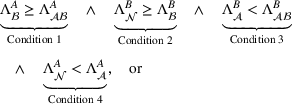
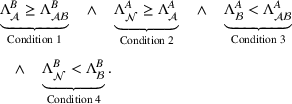
When (4) holds, there is no equilibrium because: Regime Regime Regime Regime


Analogous explanations hold for (5). We note that we obtain (4)–(5) without imposing any structure on the values of 

Patronage decisions and Markov chain models
This section details the customers' patronage decisions and the resulting CTMCs used to analyze the long‐run demand rates.
Regime

Under Regime 

Regimes

and

For brevity, we explain the model under Regime 




To model 


Under Regime 





Regime


Model A service completion at An arrival to 



In Period 





Regime

The CTMC under Regime A service completion at An arrival to 


Regime


ANALYZING LONG‐RUN DEMAND RATES UNDER EACH INFORMATION REGIME
We analyze the long‐run demand rates under 


Analyzing Regime

To understand the long‐run demand rates 


Period 1 analysis
Solving the balance equations of Model Under Regime 



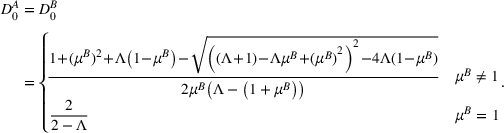
We observe numerically (as explained in Section 6) that the system becomes unstable in Period 1 rarely; this may occur when
Proposition 3 characterizes when announcing increases
When When When


Proposition 3 asserts that when 




Long‐term analysis
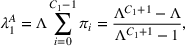
Regime When the arrival threshold converges in Period 2, The arrival threshold converges to one in Period 2 (i.e., The arrival threshold converges to two in Period 2 (i.e., 




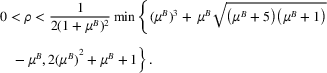

To obtain these conditions, we derive closed‐form expressions for 


Solid shaded regions specify sufficient conditions for convergence in Period 2. Recall that
For more general parameter settings, that is, when Proposition 4 does not hold, we need to understand the long‐term behavior of the arrival threshold








Examples of stable long‐term patterns of the arrival threshold



Under Regime 

If 


To fully characterize the evolution of the arrival threshold 


Analyzing Regime

Model 
We contribute to this literature by proposing a computational algorithm that provides provable tight lower and upper bounds on the long‐run demand rates under Regime 


The resulting truncated CTMC is shown in Figure 6. The nonrepeating portion consists of states


Truncated Markov chain for regime

We use ideas similar to recursive‐renewal‐reward theory (Gandhi et al., 2014) to write recursive relationships between the above expected values, extending these ideas to yield provable bounds instead of exact values. We present our procedure in Algorithm 1, which uses systems of linear equations to compute upper bounds on 


Procedure to compute an upper bound on 
When ρ is small to moderate (see the proof for a more precise characterization), 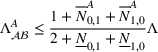


Following the same procedure, it is trivial to compute a lower bound on 
ANALYTICAL DETERMINATION OF THE GAME OUTCOME
This section uses the long‐run demand rates characterized in Section 4 to determine the equilibrium regime when
When the system load is sufficiently small When the system load is sufficiently large


When the system load is very low, Regime 

For nonextreme system loads, we use results derived in previous sections, including Equation (2) for Regime 


To cover a wide and reasonable parameter space, our numerical experiments consist of 43 values (as presented in Table 2) for the relative service capacities 


Subsets of different values of 
Figure 7 presents the resulting equilibrium regimes when we can determine the game outcome 


Analytically determined equilibrium regime; (green, yellow, blue, red, white) = (


The analytical limitations of Proposition 4 (which only yields closed‐form solutions when we can analytically establish Period 1 convergence) and Algorithm 1 (which only converges for sufficiently small ρ and may yield loose bounds) do not allow us to determine the game outcome analytically for the remainder of the parameter space. Therefore, we determine the game outcome numerically in Section 6 and find that the above analytical indications continue to hold.
NUMERICAL DETERMINATION OF THE GAME OUTCOME
For ease of exposition of determining the game outcome numerically for the remaining 67% of the parameter space, we denote the set of relative service capacities as 


We employ matrix‐analytic methods to compute the long‐run demand rates under Regimes 





Given our analytically determined outcome in Figure 7, we expect Regime 

When Regime

emerges in equilibrium
Regime A service provider almost always finds it favorable to respond to the competitor's announcement initiation unless it has a much higher service capacity and the system load is in an intermediate range. Therefore, Regime 


We first explain the results when 


Changes in

Ranges of intermediate system loads (for different values of
The exceptions mentioned in Remark 1 arise because 


When Regime

does not emerge in equilibrium
When Regime A service provider prefers being the sole announcer to the situation with no announcers whenever their competitor does not find it favorable. In this case, the unique regime that emerges in equilibrium is the one where the initiator is the only announcer (i.e., Regime 


Based on whether 

Regime Regime Regime 






For all 63 experiments for which 


Regime Regime Regime 







For all 101 experiments for which 


Game outcome
Putting together our observations from Remarks 1 and 2, we can assert the following outcome of the game: when the service providers have comparable or equal capacities, Regime 

These findings are summarized in Figure 10. As expected, the equilibrium outcomes are near‐symmetric about 

The equilibrium regime; (green, yellow, blue, red) = (


Managerial insights
Using the equilibrium delay information regime characterization in Figure 10, we now state insights about how the availability of delay announcement technology affects various stakeholders in a setting with two competing firms. The stakeholders of interest are the service provider(s), the delay announcement technology firm, and the customers.
Effect on the service providers
The literature on announcing delay in monopolistic settings (see Dobson & Pinker, 2006; Hassin, 1986; Ibrahim, 2018) has established that a profit‐maximizing service provider will announce delay (i.e., make its queue visible) when (1) its capacity is low or (2) its capacity is high and the system load is sufficiently low. In contrast, we find that two service providers under competition
Effect on the delay announcement technology firm
As both competing service providers almost always choose to announce delay in equilibrium, technology firms are likely to find keener adopters in a competitive setting. In equilibrium, the lower capacity service provider generally enjoys a larger market share than the status quo. Accordingly, the technology firm can benefit by marketing to the lower capacity service provider in a competitive setting by showing the projections of market share improvement. Therefore, we conclude that the competitor (the higher capacity service provider) will generally also be induced to adopt the technology. Our results imply that the technology firm should target market segments and geographies that feature competition rather than those that are monopolistic. To wit, the technology firm would be well‐advised to target hospitals (or restaurants) in the vicinity of other similar hospitals (and restaurants).
Effect on customers
In a monopolistic setting, Hassin (1986) finds that, at intermediate system load values, external intervention is required to induce the service provider to announce delay to improve social welfare. Measuring customer welfare by the average delay they experience, we find numerically that the presence of delay announcement technology improves customer welfare for all our parameter settings (i.e., whether the equilibrium outcome is Regime 


MODEL EXTENSIONS
We investigate three extensions. In Subsection 7.1, we evaluate the outcome when customers use expected
Patronage based on sojourn time
Our base model considers the more prevalent case where customers care more about their delay before their service starts (e.g., dine‐in restaurants and ERs). There are also settings where customers likely care about sojourn time (delay before the service plus service time), such as take‐out restaurants where customers value a short service time.
In the sojourn time setting, the equilibrium regime continues to be governed by Proposition 1. However, the long‐run demand rates differ from those in Section 4. For instance, Regime 





Based on Figure 11, Regime When the system load is intermediate and service capacities are starkly different (the sojourn time model leads to instability). When the system load is low and service capacities are comparable (the sojourn time model may have no equilibria or may induce only the higher capacity service provider to announce delay). When the system load is relatively low and service capacities are slightly different (the sojourn time model induces an equilibrium of Regime 
In the above cases, the patronage model based on delay induces an equilibrium regime of Regime 


Numerically determined equilibrium regime when customers patronize based on sojourn times; (green, yellow, blue, red, black) = (


Costly delay announcements
In our base model, delay announcements do not incur a recurring cost, for example, because the service providers have an in‐house capability to announce delays. This section considers a recurring subscription cost incurred to employ the announcement technology. In this case, the announcement decision involves comparing the technology cost to the additional profit obtained through an increased demand rate. Considering a fixed profit 



All our analytical results derived in Section 4, which characterize the long‐run demand rates under each regime, remain valid under costly delay announcements as these results are independent of the subscription cost. Similar to Proposition 1 for the case of costless delay announcements, Proposition 8 characterizes the regime(s) that emerge in equilibrium under costly delay announcements.
No regime emerges in equilibrium if and only if the cost is such that: Regimes Otherwise, one regime emerges in equilibrium, according to the conditions in Appendix A.8 in the Supporting Information.
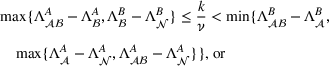
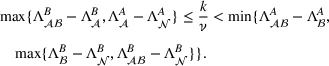


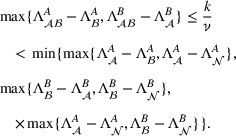
Proposition 8 implies that when delay announcements incur a cost, the game may result in no equilibria, one equilibrium, or multiple equilibria. Furthermore, we expect the equilibrium outcome to exhibit a much more complex relationship with ρ and 




We evaluate the game outcome for different costs. To make a fair comparison across different relative service capacities (as profit is now proportional to load), we normalize the system capacity 


For our experiments, we estimate a reasonable range for 




In Subsections 6.1–6.2, we observed and explained why when delay announcements are costless (


On a high level, as expected, a higher cost dissuades the providers from announcing delay. In particular, as the cost increases, parameter settings that result in an equilibrium outcome of Regime 


Percentage of experiments that result in each regime emerging in equilibrium


At a more granular level, for a given cost and relative service capacity, the effect of increasing the system load has a complicated impact on the regime outcome. In general, increasing the load triggers multiple switches from one regime outcome to another. This complicated structure arises because of the nonmonotonic and discontinuous dependence of 


Incorporating customers' balking behavior
This section considers that customers have a finite, homogeneous patience level of 


Regime

Under this regime, customers arrive at 





Regimes

and

Under Regime 



Regime

Under this regime, customers join the service provider with the shorter real‐time expected delay if it is shorter than 


We report our results on the same set of parameters as in Section 6, normalizing system capacity 



Equilibrium regime when customers can balk; (green, yellow, blue, red) = (


CONCLUDING REMARKS AND FUTURE DIRECTIONS
Technology advancements enable firms to disseminate delay information. In an endogenous timing game, we study whether a firm should initiate delay announcements when she competes for market share, uncovering the impact of relative service capacity and system load on the decisions in equilibrium. We find that only the lower capacity service provider announces its real‐time delay under intermediate system loads and highly imbalanced capacities. However, for most parameter settings, the mere presence of a competitor induces both providers to announce delays in equilibrium.
Contribution to literature
Our results can be viewed as extending the results in Hassin (1986), Dobson and Pinker (2006), and Guo and Zipkin (2007) to a network setting. These papers establish when it may be suboptimal for a firm to reveal QL delay when the alternative to joining is to balk. In contrast, we explicitly model competition, that is, if a customer does not patronize 

Among the papers with two service providers, Hassin (1996) is the only one that studies the impact of delay announcements on market shares (When service rate are identical). Hassin finds that it is advantageous for one of the providers to reveal their queue, given that the other one does not. This corresponds to two of the regimes in our paper (Regime 


Future directions
There are numerous interesting avenues for future exploration. For instance, extending the analysis to include multi‐server service providers, while analytically challenging, could lead to interesting results. Another potentially interesting extension is to model a heterogeneous customer population consisting of dedicated and flexible individuals: Dedicated customers would be loyal to one service provider regardless of her delay, while flexible customers would be delay‐sensitive and patronize based on delay information. Such heterogeneity in the customer population is explored in He and Down (2009) and Dong et al. (2019) when the two service providers announce delay information of identical granularity. We expect that this extension would simply attenuate the effects of announcing. Furthermore, it may be interesting to investigate settings with three or more service providers. Finally, extending our bounding procedure for Regime 
Footnotes
1

2
Given that customers choose the lower delay option, their patronage decision does not depend on their delay cost. Accordingly, the outcomes of our analysis are identical whether or not customers' delay costs are homogeneous.
3
We shall see that in equilibrium
4
We choose this tie‐breaking rule because customers in our model are sensitive to delay; accordingly, equal delay announcements (with equal presumed accuracy) should result in equal demand rates at both providers.
5
References
Supplementary Material
Please find the following supplemental material available below.
For Open Access articles published under a Creative Commons License, all supplemental material carries the same license as the article it is associated with.
For non-Open Access articles published, all supplemental material carries a non-exclusive license, and permission requests for re-use of supplemental material or any part of supplemental material shall be sent directly to the copyright owner as specified in the copyright notice associated with the article.
