






Abstract
A retailer places orders periodically for items that are shipped by a wholesaler. Items that are not sold perish randomly and independently of one another, with the perish probability depending on the age class. We consider a first‐in‐first‐out policy for depleting items. We model this problem as a Markov decision process with stochastic demand, unit holding, outdating and ordering costs, plus unit penalty costs for lost sales. We prove convexity for the penultimate period and show convexity may not hold any earlier. A dynamic program can be solved optimally for small instances. We introduce both a one‐stage‐lookahead heuristic and a heuristic which is a combination of two existing standard approaches, the newsvendor and periodic review models. For simulated data, we compare these heuristics to the optimal solution for small problem instances and to further lookahead policies for larger problem instances. We show that the two new heuristics achieve results close to optimal. Our numerical study, which includes real data from a large European retail chain, highlights that products perishing independently from each other strongly affect model behavior compared to existing approaches from the literature.
INTRODUCTION
Managing inventories for perishable products poses an important challenge to retailers for several reasons. Items perishing is costly due to the loss of revenue and potential disposal costs. Since the lifetime of fresh products is often random, the retailer does not know exactly how long a product will remain salable before it spoils which makes it difficult to determine future inventory. Furthermore, customers expect high availability of fresh products such as fruit and vegetables, with consequences if these expectations are not met. Namely, fresh products attract customers, who then buy other products that are on their shopping list at the same store. Therefore, if fresh products stock out, profitability of the whole store suffers, since customers may decide to buy all their products elsewhere and may not return in the future due to the inconvenience caused. Consequently, managing perishable products efficiently is crucial to the profitability of groceries in the retail industry. By taking the characteristics of customer demand and the perishability process into account, retailers can make better inventory decisions which balance satisfying customer needs and minimizing spoilage.
In this paper, we focus on food products. However, our model also applies to other settings such as the healthcare industry, within, for example, blood supply management. Red blood cells can be transfused up to 42 days after donation (Sarhangian et al., 2018), and blood platelets have a lifetime of only 5 days (Chao et al., 2018; Chen et al., 2019). Perishability is of special importance to blood platelets, since they are expensive to purchase, store and dispose, and lives may be put at risk if their management is not planned carefully (Duan & Liao, 2013; Haijema et al., 2007).
We consider store managers' ordering decisions for perishable products in the setting of a large European retail chain where customers pick older items first, that is, according to a first‐in‐first‐out (FIFO) policy. The FIFO policy is preferred by retailers because it helps to reduce spoilage. Hence, newer items are placed in boxes under the older items or kept in the backroom storage and cold room (Reiner et al., 2013). FIFO is also commonly used in the literature (e.g., Chao et al., 2015; Karaesmen et al., 2011; Ketzenberg et al., 2015; Nahmias, 2011).
When placing an order, it is important for the retailer to forecast both future demand and the amount of products that will perish. Customer demand is stochastic and varies from day to day. The perishing process is characterized by two measures. One is the maximum shelf life, which is the maximum number of days a product can be sold. The other is the perish probability, which determines the probability with which a product has to be discarded at the end of a day. A product perishing affects the retailer both by incurring an outdating cost and by depleting the inventory available for the next day. The closer an item is to its maximum shelf life, the more likely it is to perish.
We model the retailer's problem as a periodic review inventory control model with lost sales. Customer demand has an arbitrary distribution that we do not require to be stationary. In each period, any item perishes independently of the others with a known, age‐dependent perish probability. Therefore, items may perish out of sequence, that is, in a different order than they arrived. Any perished item incurs an outdating cost, but there is also a per‐item penalty cost for unfulfilled demand. We formulate our model as a Markov decision process (MDP).
Our setting is similar to the one analyzed by Ketzenberg et al. (2015), but with two important extensions. The first is nonstationary demand, which is frequently observed in retailing, where demand tends to be higher at weekends. The second is all items perishing independently; Ketzenberg et al. (2015) assume dependent perishing where items of the same age class all perish at the same time. Our independence assumption increases the number of possible state transitions but is more realistic for the retail setting we consider; for example, one bad pack of strawberries does usually not spoil the whole batch. As we will show in our numerical study, independent perishing strongly affects model behavior so dependent perishing is not a good substitute.
To demonstrate the practical use of our model, we collected hourly data from a large European retail chain over a time horizon of 2 years for 66 stores. We analyze sales data and selling prices for five perishable products (fruit and vegetables) with a range of maximum shelf lives and age‐dependent perish probabilities. The store managers currently use their own judgment to make order decisions, and the retail chain is considering using commercial software solutions in the future that would contain standard methods such as the periodic review or newsvendor model. In this paper, we compare such standard methods to the optimal solution and the heuristics we develop.
The paper proceeds as follows. In Section 2, we review the literature on periodic review models with perishable products. The following sections make several contributions to this literature. In Section 3, we propose a new model for a real‐life problem—the periodic review model with independent age‐dependent lifetimes and lost sales. We also develop a simplifying cost transformation, a lower bound on the optimal cost and show that convexity holds in the penultimate period but may fail earlier.
For instances with a small state space, we obtain optimal solutions via dynamic programming. Each state can have a large number of follow‐up states when inventories are large and maximum shelf lives long, so many realistic problem instances are computationally infeasible to solve optimally. Therefore, in Section 4, we introduce two heuristics tractable for larger problem instances. In Section 5, we analyze the performance of these two heuristics for both simulated and the aforementioned real data from the retail chain. We compare their performance both to each other and to simple order policies which either assume that items always perish (newsvendor model) or never perish (periodic review model). We show that there is a clear benefit from using these heuristics instead of simple policies, which are often applied in practice. In addition, our numerical results indicate that, in any considered problem case, at least one of our two heuristics is always close to optimality.
LITERATURE REVIEW
We review the literature of periodic review models for perishable products and stochastic demand. We distinguish between models that assume a fixed lifetime, and those that consider random lifetimes, which is also related to the literature on random yield.
Fixed lifetime
Research on fixed lifetime inventory systems originated with Van Zyl (1964), where the periodic review setting with backorders, stochastic demand, a FIFO inventory depletion policy, and a fixed lifetime of two periods is analyzed. Upper and lower bounds on the cost function are derived, and a nonstationary optimal ordering policy is shown to exist. Nahmias and Pierskalla (1973) add a per‐item perish cost to this model, and Nahmias (1975) further extends to a lifetime of
The model of Nahmias (1975) has also been studied with lost sales instead of backorders. Nandakumar and Morton (1993) utilize expected outdate bounds similarly to Nahmias (1976) to derive a heuristic. Chao et al. (2015) investigate nonstationary demand which can be correlated to account for seasonality. They introduce two policies that balance cost components and derive worst‐case performance bounds. They show that their results hold both for the backlogging and lost‐sales settings. Williams and Patuwo (1999) assume a lifetime of two periods but allow positive lead times. They derive optimal order quantities for lead times of up to four periods. Minner and Transchel (2010) analyze a model with positive lead times under service‐level constraints. Using their analysis of the inventory distribution, they compare a dynamic order size policy with constant order and base‐stock policies. Haijema and Minner (2016) provide further insight into fixed lifetime models by comparing the performances of constant order policies, base stock policies, and hybrid policies that also take age‐dependent inventories into account. Recently, Haijema and Minner (2019) consider a model with batch sizes and a mixture of demand via FIFO and last‐in‐first‐out (LIFO) depletion policies. They propose new solution policies based on a division of stock into new and old products which reduces the complexity.
Random lifetime
The majority of the random lifetime literature concerns continuous review models. Indeed, Ketzenberg et al. (2015) point out that by the time of publication of their paper, only they and Nahmias (1977) consider a periodic review model for perishable products with random lifetime and stochastic demand. Nahmias (1977) extends the model by Nahmias (1975) to a stochastic lifetime while assuming that successive goods outdate in the same order that they arrive and that all goods of the same age perish or survive jointly. Using a similar approach as Nahmias (1976), an adjusted myopic policy is derived.
Ketzenberg et al. (2015) address the random lifetime setting of Nahmias (1977) for lost sales. While they drop the assumption that products perish in the order in that they arrive, they do assume that all items in the same age group perish together. They evaluate the value of time and temperature history to determine the quality of goods. Assuming a lead time of one period, an infinite time horizon, and a stationary demand distribution, they develop heuristics that trade off simplicity and performance.
Kouki and Jouini (2015) study the effect of random lifetimes on the performance of inventory systems. They develop an analytical solution for exponential and deterministic lifetime distributions and conduct a simulation study for the more general case of Erlang distributions. For a comprehensive review of the literature on all types of inventory systems, see Bakker et al. (2012), Goyal and Giri (2001), Janssen et al. (2016), Karaesmen et al. (2011), and Nahmias (1982).
The periodic‐review inventory problem that we consider with stochastic demand, lost sales, and age‐dependent perishability where each item perishes independently has not been analyzed in the literature, despite this being a very common problem in retailing. Standard models from the literature solve extreme cases of our problem where either all or no items perish each day. We assess both these standard models and the age‐group‐dependent perishing model of Ketzenberg et al. (2015) in our independent‐perishing setting.
Random yield
Related to modeling random lifetimes is the literature on random yield, as only a portion of the products makes it to the next period due to the probability of an item perishing. For example, Voelkel et al. (2020) suggest an MDP that considers random yield during transport where either all or none of the items can spoil in each lead time period. Sonntag and Kiesmüller (2017) also regard stochastic demand and random yield in a multistage system. They introduce quality control systems to monitor the effect of random yield and achieve significant safety stock reductions. Kiesmüller and Inderfurth (2018) propose a periodic‐review model with order inflation to solve the multiperiod inventory control problem with stochastic demand, fixed setup costs, and random production yield. They show that simple heuristics can perform very well for this complex problem if the parameters are adjusted to demand and yield risks appropriately. For a more extensive overview of the literature on random yield models, see Yano and Lee (1995) and, more recently, Kiesmüller and Inderfurth (2018).
Even though our setting is similar to random yield problems, common policies such as order inflation cannot be applied: the inflation factor would ignore the fact that inventory in the first period is not subject to random yield as no perishing has occurred yet. Furthermore, the inflation factor does not take the age structure into account, which is important in our setting with age‐dependent perish probabilities.
MODEL
In this section, we formulate the mathematical basis for analyzing the stochastic periodic review model of a single stock‐keeping unit with a random and age‐dependent lifetime. We choose a finite horizon over a planning horizon of 
Sequence of events
First, the retailer observes the state of the inventory: 


Inventory transition
We write 







Newly ordered items have no yield loss, so 
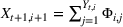


For 


Example state transition


Total cost
The cost components of our model are variable ordering, holding, penalty, and outdating costs. Ordering costs 





The one‐period cost function, given order 



Note that (2) assumes that excess inventory can be salvaged at unit salvage value
Our objective is to find the optimal cost 






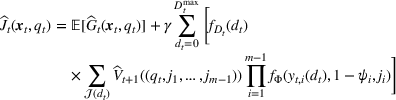




Equation (3) allows us to find the optimal solution using dynamic programming. The curse of dimensionality renders this method computationally intractable for large problem instances. For example, with 


For 


Next, similarly to Chao et al. (2015), we modify 


We formulate this simplification in Proposition 1. The proof of the proposition follows a similar structure to Chao et al. (2015). The proof can be found in Supporting Information Section EC.2. We define 




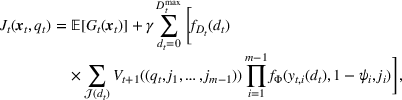


Convexity holds at the penultimate period. The proof of the below can be found in Supporting Information Section EC.3. For any inventory 


Before the penultimate period, convexity of 


Let The retailer never optimally orders more than three items, since any excess on three items will not sell at age one and hence incur an unnecessary holding cost. Therefore, we may restrict the retailer to orders of at most three, which, assuming the starting age Under this restriction of the state space, at any time period, all the age two items will sell (so none perish). Therefore, any unsold items must be age one (which perish with probability ψ), so the state can be delineated by the total inventory 





In Supporting Information Section EC.4, we show that, when 



HEURISTIC POLICIES
In this section, we develop and analyze heuristic policies. First, we discuss two policies which are often used in practice but are designed for the simple cases where either all or no product perishes. In Section 4.1, we introduce a Newsvendor policy optimal for the case where all product perishes, and in Section 4.2 a periodic review policy which assumes no product perishes. Next, in Section 4.3, we develop our own heuristic, which is a novel combination of the previous two. In Section 4.4, we analyze the ordering behavior of all three heuristics immediately evident from their formulae. Finally, in Section 4.5, we develop policies looking several periods ahead, with a particular focus on the one‐stage lookahead policy due to the convexity of our model at time 
Newsvendor heuristic
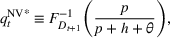
First, suppose all items perish after one period; this is a newsvendor model. Since the inventory is emptied at the end of each period, the optimal order at period 



Periodic review heuristic
Now suppose items do not perish at all; this is a standard periodic review model. Once an item is ordered, it remains in the inventory until it is sold, so its age is immaterial. Therefore, the state is simply the total inventory, denoted 
If items never perish, the overage cost per unit time is 








A combination of NV and PRV
While the heuristics NV in (10) and PRV in (12) are simple to calculate, they both ignore the age‐dependent perishability of items, a key feature of our model. NV and PRV stand at opposite ends of the perishability spectrum; in this subsection, we propose a heuristic which is a novel combination of the two.
Note that NV and PRV have the same structure, constructing an order at time 


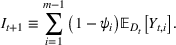
1. Expected on‐hand stock at

In NV, no items carry over from period 

As previously, write 




2. Order if on‐hand stock at

was known.
In both NV and PRV, the optimal order if the on‐hand stock 



For an age 


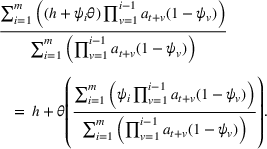
Note that (15) is consistent with NV and PRV. In NV, 


Of course, 


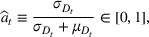

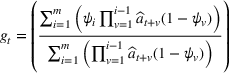
The ADPRV heuristic
Putting steps 1 and 2 together, our proposed heuristic, which we call the 




Comparison of the order quantities of NV, PRV, and ADPRV
In this subsection, we compare the three heuristics just introduced to each other and examine whether they underorder or overorder compared to optimal.
No on‐hand stock at t
First, we examine the simple case of the order at time 


Optimal and heuristic orders in period 1 by total period 1 stock for two problems with


Some on‐hand stock at t
Now we consider the general case where 


When 


Unlike PRV, (17) shows that ADPRV's order at time 


Recall from (19) that ADPRV always orders less than PRV when 


Further, Figure 1 shows ADPRV's order is close to optimal for all inventory levels, with a tendency to underorder more than overorder. Reasons behind this behavior will be discussed in Section 5 when the performance of ADPRV is analyzed.
Multi‐stage lookahead policies
In this subsection, we design heuristics which consider costs for a given number of future periods, but no further.
Recall 



Clearly, the larger we choose
The computation involved to calculate E
Another way to reduce the computational effort to calculate E1 specifically is to use Proposition 2, which shows that the remaining cost at period 


NUMERICAL STUDY
We conduct an extensive numerical study. In Section 5.1, we describe the parameters used to generate data on which we assess our heuristics in Sections 5.2 and 5.3. We also analyze effects of the parameters on our leading heuristics' performance and show that dependent perishing is not always a good substitute for independent perishing. In Section 5.4, we examine the performance of the lower bound on the optimal cost. In Section 5.5, we apply our heuristics to real data from a large European retail company.
Experimental design
In this section, we choose parameters to reflect a wide variety of scenarios. A summary of the parameters is given in Table 2.
Overview of parameters
We examine maximum lifetimes 
Inventory holding costs 


We choose a high discount factor, 


As illustrated in Table 3, we consider five distinct perish probability sets for each maximum lifetime. In each, the perish probabilities increase with age to reflect older products becoming more and more likely to perish. In total, we consider 135 settings.
Perish probabilities for maximum lifetimes 

Maximum lifetime

For a maximum lifetime of 


Percentage increase from optimal to heuristic expected cost for 
Abbreviations: ADPRV, age‐dependent PRV; E1, E2, E3, exact lookahead heuristics; E1 Dep, exact lookahead heuristic with dependent perishing; NB, negative binomial distributions; NV, newsvendor heuristic; Pois, Poisson distributions; PRV, periodic review heuristic; U, uniform distributions.

Box plots showing the variability of heuristic performance for
NV and PRV, the most basic of our heuristics which are frequently applied in practice, can perform poorly, Figure 2 showing both can be as much as 60% above optimal. Further, Table 4 shows that, even for parameters where one of the two performs better, ADPRV or E1 is at least two times closer to optimal, often much more. This demonstrates that neglecting the effect of stochastic perishing can lead to substantial losses.
In a PRV model no product perishes, so PRV performs better the lower ψ1. In addition, no perishing means the main cost to avoid is the penalty cost
In the remainder of this section, we first focus on the differences between independent and dependent perishing and then compare across different parameters our two main heuristics, E1 and ADPRV.
Dependent versus independent perishing
On average, Table 4 shows that E1 Dep performs almost twice as badly as E1, suggesting a benefit in assuming products of the same age perish independently rather than all together as in Ketzenberg et al. (2015). Yet, in fact, the difference in order quantities between E1 and E1 Dep varies wildly from problem to problem. This effect is demonstrated in Figure 3, which shows, for four of our 135 problem settings, the orders of ADPRV, E1, and E1 Dep minus the optimal order quantity for different total on‐hand stock levels.

Difference between optimal and E1, E1 Dep, and ADPRV orders at period 1 by total period 1 on‐hand stock for


In some problems, Figure 3d as an example, E1 and E1 Dep are virtually identical. Yet in others, for example, Figures 3a and 3b, E1 Dep begins to overorder compared to optimal once the total on‐hand stock surpasses the mean of the demand distribution (which is 20), with the size of the overorder growing with the inventory level up to a remarkable 20. In fact, no matter how large the total on‐hand stock levels become, E1 Dep still makes a nonzero order when the optimal, ADPRV and E1 orders are 0. We also see E1 Dep underorder compared to optimal by four items for medium on‐hand stock levels in Figure 3c. Below, we explain both behaviors.
First, we explain the 


If perishing was dependent instead, 


The underordering of E1 Dep in Figure 3c occurs because E1 Dep starts to order 0 just after the total stock exceeds 40, while the optimal policy waits until around 65. The reason for this difference is linked both to a small 
To summarize, while in some settings the retailer will perform just as well assuming a simpler dependent perishing model, in others, particularly when there is a large difference between penalty and outdating costs, this assumption will achieve very poor results, with the retailer at risk of either over‐ or underordering compared to optimal.
E1 versus ADPRV
While the lookahead heuristics E2 and particularly E3 perform excellently, their computational complexity prevents their practical use. In this section, we compare our two leading practical heuristics, E1 and ADPRV.
On average, ADPRV performs better than E1, as can be seen from Table 4 and Figure 2a. ADPRV also has a smaller standard deviation than E1, showing a more steady performance over a wide range of parameters. Yet, there are problem settings where E1 beats ADPRV and hence should be preferred. In this subsection, we shall explain the patterns in performance concerning demand and perish probability that lead to these preferences and examine the ordering bias of both heuristics.
Demand and perish probability
Both E1 and ADPRV perform better the larger ψ1, since the problem is easier to solve: the more items that perish, the higher the proportion of the inventory level at the next period that is made up of the retailer's order, a quantity over which the retailer has complete control. When 
As for demand, E1, which looks ahead just one period, performs well for Poisson, since there is low variance in demand from period to period, so the next period is more representative of general behavior. As the variance of demand increases from the Poisson to the negative binomial to the uniform, the next period becomes less representative and, as shown in Figure 2b, E1's performance worsens.
Figure 2b also shows that ADPRV, on the other hand, thrives when demand variance is high. The cause, explained in the following, is due to an effect also linked to the perish probability. ADPRV calculates its order by simply taking the expectation over both demand and perishing for the next period. The optimal policy is more bespoke, taking into account the whole distribution of demand and perishing, in both the next and future periods. When the variance of demand or perishing (or both) increases, the expectations used by ADPRV will be less accurate, so the cost under ADPRV will rise. However, the cost under the optimal policy will rise by a greater amount, since its more advanced toolkit, which is of great use when demand and perishing are more certain, becomes less and less advantageous over simply using the expectation as ADPRV does. In other words, the optimality gap of ADPRV decreases when the level of uncertainty in either demand or perishing (or both) rises. As Table 5 shows, the optimal policy shows a strong improvement on ADPRV's crude approach only when there is low uncertainty both in demand (Poisson) and perishing (low ψ1).
ADPRV and E1 performance over subsets of problem instances


Abbreviations: ADPRV, age‐dependent PRV; E1, exact 1‐lookahead heuristic; PRV, periodic review heuristic.
E1, like the optimal policy, also uses the whole distribution of demand and perishing but only for the next period, which is sufficient for good performance when uncertainty is low. As a result, Table 5 shows that E1's advantage over ADPRV is only for both small ψ1 and Poisson demand.
Bias in the order quantities
Figure 3 demonstrates that both E1 and ADPRV have some ordering bias, the former (respectively, latter) tending to consistently order more (respectively, less) than the optimal policy.
E1 chronically overorders since it assumes all product which survives to age 2 is salvaged at its order cost. In reality, if such product does not sell at age 2, it perishes for cost θ. The resulting overordering will be punished more severely the larger the outdating cost θ, explaining why E1 degrades with the outdating cost θ in Table 4.
Figure 3 also shows that the overordering of E1 is more pronounced for the negative binomial and uniform distributions, as the more unpredictable demand is, the more likely a product is to remain unsold for its entire lifetime and hence perish after two periods, a cost which E1 does not consider. Further, it can be seen from Figure 3 that the overordering effect is worse for smaller ψ1, since the smaller ψ1 is the greater the proportion of total product perishing that occurs at age 2.
Figure 3 shows that ADPRV usually underorders. For example, in Figure 3d, where 
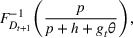


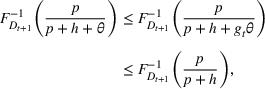
In Figures 3a, 3b and 3d, ADPRV's underordering generally grows with the on‐hand stock until it becomes large enough for both ADPRV and the optimal policy to order 0. We see this behavior for the following reason. No matter the current inventory, ADPRV orders at time 


We do not see the above effect in Figure 3c for two reasons. First, ψ1 is larger, so items are less likely to survive to age 2, meaning the old to new stock ratio at time 
Maximum lifetime

Due to the large number of states, problems with maximum lifetimes greater than 2 cannot be optimally solved by dynamic programming, so neither optimal nor heuristic expected costs can be calculated. Therefore, for 


Results are shown in Table 6 for 


Percentage increase from the benchmark (E2) to heuristic cost over 10,000 runs for 
Abbreviations: ADPRV, age‐dependent PRV; E1, E2, exact lookahead heuristics; E1 Dep, exact lookahead heuristic with dependent perishing; NB, negative binomial distributions; NV, newsvendor heuristic; Pois, Poisson distributions; PRV, periodic review heuristic; U, uniform distributions.
NV and PRV can again both perform poorly compared to the other heuristics, but, as expected, NV (which assumes 

The difference in performance between E1 and E1 Dep increases with 
Similarly to 

Lower bound on optimal cost
Recall that for 


To quickly approximate the optimal cost for problems with larger 
In this section, we test the lower bound by calculating the percentage decrease from the benchmark cost to the lower bound for 


Percentage decrease from benchmark to lower bound for 


Abbreviations: NB, negative binomial distributions; Pois, Poisson distributions; U, uniform distributions.
We see a clear improvement from 


To explain these patterns, note that the perish probabilities in Table 3 used in our numerical study increase with age. Therefore, the perish probability used for all ages by the lower bound satisfies 
Perish probabilities also explain the improvement in the lower bound with 


Real data
We compare our leading heuristics E1 and ADPRV both to each other and to the basic heuristics NV and PRV using real data from a large European retail company to better understand their performance in practice. We consider different types of perishable products (fruit and vegetables) that have different maximum lifetimes and perishability patterns. Table 8 contains the perish probabilities of the products, which start from 0.3 or 0.4 for the first day, and increase or stay the same for the days thereafter, reaching 1 by a maximum of 8 days. At the end of the day, the store manager checks which items are still salable for the next day and can be carried over. All perished items are discarded. The managers use their own judgment to place an order for the next day.
Perish probabilities
We evaluate these products with sales data of 66 stores. We collected daily selling prices and current batch sizes for each date, since the retailer can only order products in given batch sizes. Shortage penalty costs consist of the difference between selling price and ordering costs adjusted with discount factor 
Since we are only able to collect sales data and lost sales are unobserved, we estimate demand using hourly sales data and product‐ and store‐specific demand patterns based on the nonparametric approach developed by Lau and Lau (1996). We assume that demand is Poisson‐distributed and forecast demand with rolling‐horizon Poisson regression. As external variables, we consider lagged demand, selling price, and weekdays. Note that we can only consider a time lag of greater than 1 day since the last day's sales are not yet known when the order decision is made.
Results are shown in Table 9. Overall 321 product–store combinations, as expected since demand is Poisson, E1 performs the best and is hence used to benchmark the other three heuristics. NV performs very badly on average, with PRV a substantial improvement. However, the standard deviation of PRV is higher than NV, showing that there are scenarios where PRV can perform just as badly as NV. Indeed, in their worst‐case scenarios, NV and PRV have costs 23.8% and 22.8% higher than E1, respectively.
Average and standard deviation of NV, PRV, and ADPV expressed as percentages over E1 for 321 product–store combinations
Abbreviations: ADPRV, age‐dependent PRV; E1, exact lookahead heuristic order; NV, newsvendor heuristic; PRV, periodic review heuristic.
On average, the performance of ADPRV is close to E1 without much variation. In its best‐case scenario, ADPRV has costs 2.1% lower than E1, and in its worst case costs 4.6% higher. Therefore, choosing E1 over ADPRV or vice versa does not make much of a difference to the retailer's costs, and, with its reduced computational complexity, ADPRV may well be preferable.
CONCLUSION
We develop a periodic review inventory control model with stochastic demand and perishing, lost sales, and a FIFO depletion policy where the perish probability depends on the age class of the product. The novelty of our model is that we allow products to perish independently of one another. This is an important feature not only because of its practical relevance (one bad product rarely spoils the whole bunch) but also because we find significant differences in ordering patterns compared to the dependent perishing assumption of Ketzenberg et al. (2015). Consequently, assuming dependent perishing can lead to poor performance if products perish independently in reality.
We construct an MDP and show that convexity holds in the penultimate period, but, via a simple counterexample, that convexity can fail any earlier. In addition to an optimal solution algorithm, we also develop two new heuristic policies which find excellent solutions to large problem instances that cannot be solved optimally due to the curse of dimensionality. The first is a combination of the optimal solutions to the well‐known newsvendor and periodic review models, and the second is a one‐stage lookahead policy.
Using simulated data and data from a large European retail chain, we show that our heuristics outperform existing models, which do not fully consider the characteristics of the perishing process. This research also provides important practical insights. The retail chain initially considered using commercial software solutions that contain standard methods such as NV and PRV. However, our research clearly indicates that they would be better off using the new E1 and ADPRV heuristics presented in this paper. In a thorough comparison of E1 and ADPRV, we explain their performance patterns arising in our numerical study. In particular, we highlight that, for problem parameters where one heuristic shows weaker performance, the other shows a stronger performance. Therefore, our results can advise retailers which heuristic to use depending on the nature of the demand they receive and the perish probabilities of the products they sell.
In our model, we assume a FIFO approach that corresponds to common stocking policies of retailers. It would also be interesting to analyze a LIFO approach or a mixture of approaches to account both for different stocking policies and customers that pick the freshest products from behind. Another important aspect in retailing is the multiechelon structure, where the supply chain consists of suppliers, distribution centers, and/or warehouses from which products are delivered to multiple stores. A multiechelon inventory policy would require making order decisions at the different echelons and considering their interdependencies. For example, if the warehouse does not have enough stock to supply all orders, the policy would require shortage allocation rules or transshipments between stores could be used to better balance inventories. We leave these investigations to future research.
Footnotes
ACKNOWLEDGMENTS
We thank the department editor Jayashankar Swaminathan, the senior editor, and the anonymous referees for their constructive comments to improve the paper. The authors are grateful for the support of the EPSRC‐funded EP/L015692/1 STOR‐i Centre for Doctoral Training.

References
Supplementary Material
Please find the following supplemental material available below.
For Open Access articles published under a Creative Commons License, all supplemental material carries the same license as the article it is associated with.
For non-Open Access articles published, all supplemental material carries a non-exclusive license, and permission requests for re-use of supplemental material or any part of supplemental material shall be sent directly to the copyright owner as specified in the copyright notice associated with the article.
