






Abstract
Despite the prevalence of multiproduct firms in many industries, the supply chain contracting literature has predominantly focused on problems where an upstream player offers only one product. This paper studies multiproduct contract design for competing manufacturers each with several products to sell via a common retailer. We consider two contracting schemes under multinomial logit demand (MNL):
INTRODUCTION
Multiproduct firms are prevalent in many industries. Even what seems to be the single product of a firm can differ in colors, styles and sizes. In this paper, we consider a supply chain in which multiple manufacturers each sell several products via a common retailer. Examples of this abound. A supermarket typically carries soft drinks from both Coca‐Cola and PepsiCo, each supplying multiple products in a category (e.g., canned drinks). Global brands such as Cadbury, Ferrero Rocher, and Nestlé all sell different chocolate products in a grocery store or supermarket. An electronic appliance retailer often carries a range of different refrigerators from each of the major manufacturers such as LG, Samsung, and Whirlpool.
The prevalence of multiproduct firms notwithstanding, existing studies in supply chain contracting have predominantly focused on single‐product problems in which a manufacturer offers just one product to a retailer. That is, there is limited research on
With multiple products available from each manufacturer, a key question faced by the contracting parties is whether a separate price should be quoted for each product or an aggregate price for a combination of products. While contracting schemes may vary substantially in practice, it is useful to consider two dichotomous schemes depending on the specified contract terms. First, the manufacturers may charge the retailer an individual wholesale price for each product. Since the pricing of one product is independent of that of another, we refer to this scheme as
In this paper, we consider a supply chain in which an arbitrary number of manufacturers (e.g., Coca‐Cola and PepsiCo) compete to supply their products to a single retailer (e.g., a grocery store or supermarket). Each manufacturer produces multiple products and must set prices accordingly. While both individual and aggregate contracting schemes have seen their applications in practice, we are not aware of any existing research that systematically studies these schemes. This paper sets out to develop a better understanding of both schemes and inform supply chain members of when best to use each of the schemes. The specific research questions we aim to address are as follows: What are the optimal contracting decisions for the manufacturers and the optimal pricing decision for the retailer under each scheme? How does each player's equilibrium profit depend on the market structure and product characteristics under each scheme? Does one contracting scheme always dominate the other from any player's perspective?
To answer these questions, we develop a Stackelberg model to study the manufacturers' contract design decisions and the retailer's pricing decision. In our model, the manufacturers each offer a multiproduct supply contract to the retailer, then the retailer determines the retail prices (or order quantities) of the offered products and finally sells the products to consumers. This sequence of events fits a situation where manufacturers with established brands and often substantial bargaining power move first by quoting a price for their products. For each contracting scheme, we characterize the equilibrium for the game and conduct sensitivity analysis on each player's profit with respect to key model parameters. Then we compare these schemes to study how each one performs from the supply chain perspective. We also examine each player's preferences between the contracting schemes and determine how the preferences are influenced by changing market conditions.
We use the multinomial logit demand model (MNL) to describe the purchase behaviors of consumers when they are presented with multiple product alternatives. MNL is widely used to model the demand and market share of products within a category. Starting from the seminal paper by Guadagni and Little (1983), there have been numerous empirical studies that use MNL to estimate the choices of consumers. MNL is also a workhorse model in revenue management used to examine firms' pricing, assortment, and inventory decisions (see e.g., Gallego & Topaloglu, 2019; van Ryzin, 2012). It is appealing to both academics and practitioners. To quote the commentary by Guadagni and Little (2008),
Given the model setup, we find under individual contracting that the equal‐margin policy where each manufacturer sets an identical wholesale price margin for
Under aggregate contracting, a cost‐plus contract in which the manufacturers set their wholesale prices to cost and charge a fixed markup is optimal. The cost‐plus contract is simple and intuitive as only one contract parameter needs to be set by each manufacturer, making it easier to implement in practice. It is an extension of the two‐part tariff to a multiproduct setting where there is a fixed payment as well as a variable payment that is contingent on the aggregate order quantity of products available from a manufacturer. With this contract, the retailer's average purchase price decreases as her order quantity increases. Thus, it can also be seen as a variant of the total quantity discount contract where the discount is based on a purchase volume aggregated over several products (Crama et al., 2004). In equilibrium, the total supply chain profit is maximized, each manufacturer makes a profit equal to his marginal supply chain profit contribution, and the retailer receives the remaining profit, a result seen as a fair allocation of profits among supply chain members. We further show that this equilibrium is unique if the manufacturers are limited to offering a cost‐plus contract, which is indeed an optimal contract form.
We also compare these two schemes from the supply chain and each player's perspective. Qualitatively, aggregate contracting always delivers a higher supply chain profit, and we find that the efficiency loss for individual contracting decreases as the number of products or manufacturers increases in a symmetric setting with identical manufacturers. Using numerical studies, we also compare each player's profit between the two contracting schemes. A high‐level message is that no contracting scheme is dominant from any player's perspective. We further show that aggregate contracting is more beneficial to the retailer when there are more products available from each manufacturer or when consumer preferences are more homogeneous, while the opposite is true for the manufacturers. In addition, aggregate contracting is more beneficial to both the retailer and the manufacturers when there are fewer manufacturers.
Finally, we study a hybrid setting in which one manufacturer uses aggregate contracting and the other uses individual contracting. We fully characterize the equilibrium for the game and examine the impact of aggregate contracting on each player's equilibrium profit. By comparing the manufacturers' equilibrium profits in this hybrid setting with those in our baseline models, we find that each manufacturer prefers aggregate contracting regardless of the contracting strategy adopted by the other manufacturer. Therefore, in an extended game where the manufacturers are allowed to choose between aggregate contracting and individual contracting, both manufacturers will choose aggregate contracting in equilibrium. This, however, may result in a prisoner's dilemma under some parameter settings where both manufacturers can be better off switching to individual contracting.
This paper makes three main contributions. First, despite the prevalence of multiproduct firms in various industries, no prior research has studied competitive multiproduct contracting in a supply chain. The present paper fills this gap and advances our understanding of optimal contract design in a multiproduct context. Under both contracting schemes we fully characterize the equilibrium for the manufacturers and conduct a range of sensitivity analyses. Second, existing supply chain contracting models have predominantly used linear demand for tractability purposes. However, there is much empirical literature documenting the advantage of using discrete choice models to study consumer behavior in retail settings. Although discrete choice models (e.g., MNL) have been widely used in the marketing and revenue management literature, our paper is among the first to apply the MNL model to multiproduct contracting problems. Third, we find some results that to the best of our knowledge have not been reported in the literature, and based on these results, we develop some insights into the firms' contracting decisions. For example, under individual contracting the equal‐margin policy applies not only to the downstream retailer but also to the upstream manufacturers: An equal
The rest of the paper is organized as follows. Section 2 reviews the relevant literature, and Section 3 sets up the model and presents some preliminary results. We analyze the two contracting schemes and compare them in Section 4. Section 5 extends our model to a hybrid setting in which one manufacturer uses aggregate contracting and the other uses individual contracting. Finally, we conclude and discuss future research in Section 6. The online appendices include some additional technical results, a practical example in the soft drinks industry, and all the proofs.
LITERATURE REVIEW
This paper studies competitive multiproduct contract design in a supply chain. There are mainly two streams of literature related to this paper: (a) manufacturer competition within a supply chain, and (b) price and assortment competition.
Upstream competition within a supply chain or distribution channel has received wide attention in the operations and marketing literature. An early paper by Choi (1991) considers a channel structure with two competing manufacturers and a common retailer who sells both manufacturers' products. McGuire and Staelin (2008) consider two suppliers each selling a single product to their exclusive retailers. Parallel to this model, Choi (1996) examines a setting where each supplier can supply to both retailers. More relevant to contract design, Cachon and Kök (2010) consider a retail supply chain where two manufacturers compete to supply their products to a common retailer, with a focus on the effect of different contract forms on equilibrium outcomes. A notable feature of the above models is that they all consider linear demand. While linear demand facilitates the equilibrium analysis and often allows a close‐form solution, discrete choice models provide a more empirically sound means of studying consumer behaviors in retail contexts (Guadagni & Little, 1983, 2008). Using the MNL demand model, Heese and Martínez‐de Albéniz (2018) study a setting in which multiple manufacturers each sell a single product to a common retailer and offer a wholesale price contract to the retailer (i.e., the manufacturers use the individual contracting scheme). Nevertheless, their focus is on understanding the effect of the retailer's assortment breadth on manufacturer competition.
Notably, in the above literature, each manufacturer supplies only one product. We extend this literature by considering the case where each manufacturer supplies multiple products. This extension is not trivial since the existing (single‐product) literature is silent on the pricing of multiple products for a manufacturer. To address this question, we consider two contracting environments: individual contracting and aggregate contracting. We further compare the two schemes to develop insights into each player's contracting scheme preferences.
In addition, there is a vast literature on horizontal competition in terms of price, quantity, lead time, and service levels (Vives, 1999). This literature focuses on competition between firms in the same echelon engaging in horizontal competition. A number of papers in this literature have considered discrete choice models such as MNL and its variants (see, e.g., Besbes & Sauré, 2016; Gallego & Wang, 2014; Kök & Xu, 2011; Li & Huh, 2011). While this literature does consider multiproduct competition, the models essentially apply to a direct sales environment with no downstream player involvement. Thus, contract design is not a concern in this literature.
MODEL SETUP AND PREPARATORY RESULTS
We consider an arbitrary number of manufacturers (“he”) and a single retailer (“she”). Each manufacturer produces one or more products and may choose to supply some or all of his products to the retailer. All the products belong to the same category or family. For example, a supermarket carries different varieties of canned drinks from both Coca‐Cola and PepsiCo.
We denote the manufacturers by 





We model consumer choices under a random utility framework. The consumer utility derived from purchasing product 






For convenience, we define


Consumers maximize their expected utility by choosing one of the products on offer or the dummy product whichever gives the highest expected utility. This utility maximization leads to the purchase probability for each product, which can be written in closed form thanks to the Gumbel distribution for 


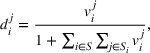

Different products may incur different production costs. Let 


This paper is concerned about the manufacturers' competitive contract design decisions and the retailer's pricing decision. As in competitive contracting models (see e.g., Cachon & Kök, 2010) and for the purpose of tractability, we do not consider any one‐off product carrying costs for the retailer. This is an appropriate assumption for retailers who typically carry a large range of products, all sharing a one‐off administrative cost. Thus, the marginal administrative cost of carrying any additional product is negligible compared to its purchase cost.
Product demand depends on retail prices, which in turn are influenced by the supply contracts offered by the manufacturers. While contracting schemes may vary substantially in practice, we consider two dichotomous schemes in our model: (a)
A supply chain perspective
Prior to analyzing the decentralized supply chain, this subsection examines the centralized problem where the manufacturers and the retailer are integrated into a single entity. The results in this subsection provide a basis for subsequent equilibrium analyses. In what follows, we take a two‐step approach, first examining the optimal pricing problem for a fixed set of products and then solving for the optimal set of products by anticipating the optimal prices for any given product set.
Suppose the products in the set Given the set of products 






Lemma 1 shows that it is optimal to set the same retail price margin for all the products on offer because the margins 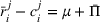

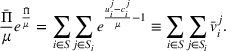
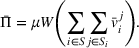
The above optimal supply chain profit can be seen as a set function of either the products or the manufacturers. Since the Lambert's W function is concave and increasing, we can show that The optimal supply chain profit 


Submodularity exhibits the property of diminishing returns to the extent that the marginal contribution or value of a product decreases when the existing set of products expands. Similarly, as the existing set of manufacturers increases, the additional supply chain profit contributed by the introduction of a new manufacturer diminishes.
We now examine the optimal product selection decision. This decision turns out to be quite straightforward. Since the optimal profit 
ANALYSIS
In this section, we analyze the two contracting schemes for the decentralized supply chain. Following backward induction, we first examine the retailer's pricing optimization given the manufacturers' contracts and then analyze each manufacturer's best response for determining the optimal contract. After characterizing the equilibrium for the manufacturers, we conduct sensitivity analysis with respect to key parameters. We also compare the equilibrium outcomes between the two schemes.
Individual contracting
Under individual contracting, each manufacturer offers a wholesale price for each individual product. We denote by 


It is helpful to consider a general form of the retailer's optimization problem for any given subset of products 





Given the wholesale prices 




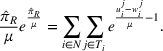


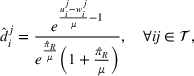
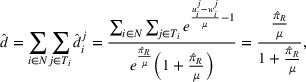
Having examined the retailer's problem, we now consider each manufacturer 

Suppose manufacturer 

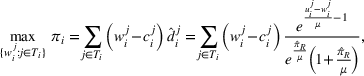
where we have substituted Equation (12) to obtain the second equality and Suppose manufacturer 


Proposition 2 shows that an identical wholesale price margin should be applied to all the products offered by the manufacturer. This mirrors the result for the retailer's pricing optimization problem in which the same retail price margin is applied to all the products carried by the retailer, as originally shown by Anderson et al. (1992) and also given in Equation (10). Proposition 2 extends this result to our supply chain setting, suggesting that the equal‐margin property holds not only at the retailer level but also at the manufacturer level.
From a technical standpoint, this proposition allows us to transform the original multidimensional optimization problem in Equation (14) into a single‐dimensional problem in which every manufacturer sets only one single margin for all the products he offers. While this transformation simplifies the analysis, we still need to examine whether each manufacturer should offer the full set or just a subset of his products. Such a problem becomes trivial in the single‐product setting studied by Heese and Martínez‐de Albéniz (2018) because offering the product is a (weakly) dominant strategy for each manufacturer. That said, we obtain a similar result in our multiproduct setting, as shown in the following proposition. It is optimal for each manufacturer to offer the full range of his products to the retailer.
The above proposition shows that every manufacturer should offer all his products to the retailers. The intuition of this result is that, since the wholesale margin is the same for all the offered products and offering more products increases the market share, each manufacturer is better off offering the full range of his products to maximize his profit. Based on Propositions 2 and 3, we can transform the original multiproduct problem into an essentially single‐product problem. Manufacturer There is a Nash equilibrium in which each manufacturer 

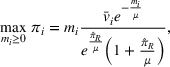


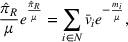


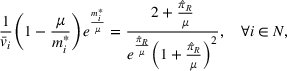


Proposition 4 shows that, for competitive multiproduct contract design under MNL, the manufacturers compete at the 


We can also comment on the equilibrium retail prices. Since the total margin is the same for all the products from a same manufacturer, a higher production cost implies a higher retail price. If production costs are identical for all the products from a manufacturer, then their retail prices should be identical as well. This may explain an often observed phenomenon that the retailer tends to set the same price for mildly differentiated products of the same brand (e.g., color, or flavor) that cost the same to produce. A case in point is Coca‐Cola that has multiple soda products, each with a different flavor sold at the same retail price. 3 It is more problematic however to compare retail prices for products from different manufacturers because neither their wholesale margins nor product costs may be the same. 4 As a final note, product pricing is a complex decision faced by a retailer. Our model only factors consumer preferences/utilities and wholesale prices into the retailer's pricing decision. There remain however many other factors that may affect the pricing decision (e.g., operational costs, promotion schedules, and competition from other retailers).
We now examine each manufacturer's equilibrium profit under individual contracting. Substituting Equation (17) into manufacturer Suppose 


The corollary shows that, consistent with our intuition, a manufacturer whose products have a greater
Next we perform a comparative statics analysis of the players' equilibrium profits and wholesale margins. For tractability, we focus on a semi‐symmetric setting in which the products of all the manufacturers have the same aggregate attractiveness, that is, Suppose 


Part (a) of the proposition shows that, as the aggregate gross attractiveness of each manufacturer increases, both the wholesale margin and every player's profit increase. To understand this, we know that an increase in gross attractiveness implies a greater market share for the retailer. As a result, the marginal profit with respect to the retail price is higher. This motivates the retailer to set a higher retail margin and thus she is better off with a larger value of 

Part (b) of the proposition shows that, when there are more manufacturers in the supply chain, the wholesale margin is lower and the retailer's profit is higher. As the number of manufacturers increases, competition intensifies. As a consequence, the wholesale margin is reduced and the total market share increases, a benefit to the retailer. Since we cannot analytically show the effect of
Aggregate contracting
Under aggregate contracting, each manufacturer offers a supply contract that sets the price as a function of the order quantity for every product. We denote the contract of manufacturer 


Following backward induction, we start by considering the retailer's problem. Given the contracts offered by the manufacturers 



Next, we consider each manufacturer's best response problem in determining the optimal contract, both in response to the competitors' contracts and in anticipation of the retailer's optimal retail prices for any given contracts. Suppose the contracts offered by the competitors are 




We remark that the analysis of the above best response problem poses several challenges. First, the manufacturer's contract must be searched from a function space. As a result, the conventional approach to analyzing contract design problems, which typically deals with a finite number of contract variables (e.g., a single variable for a wholesale price contract, or two variables for a buyback contract), does not apply in our problem. Second, for the best response problem, each manufacturer must take into account the retailer's optimal pricing decision while responding to the other manufacturers' contracts. Further, as discussed earlier, we cannot pin down the retailer's optimal prices since there is no specific form imposed on the manufacturers' contracts. To address these challenges, we adopt a different approach in which we first establish an upper bound for the manufacturer's profit and then demonstrate that this upper bound can be achieved with a certain type of contract. The following proposition presents the best response for each manufacturer. (a). Given 

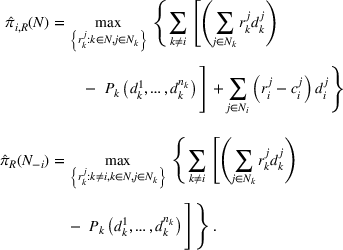
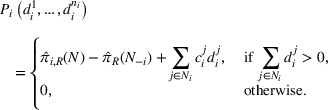
It is useful to first explain the notation in the proposition: 


Part (b) of Proposition 6 further shows that the upper bound profit can be achieved by using a cost‐plus contract, as prescribed in the proposition. In other words, it is optimal for each manufacturer to set his unit variable margin to zero and charge a fixed markup equal to the additional contribution made by manufacturer
One may wonder at this point what the retailer's optimal decision would be, given that manufacturer 
We now proceed to the analysis of equilibrium for the manufacturers. We begin with an observation that, considering that the strategy of the manufacturer is a function, the above cost‐plus contract is not the unique solution to the best response problem. Indeed one may construct alternative solutions by twisting the cost‐plus contract in a way that allows the manufacturer to reap the same profit while ensuring the retailer's optimal retail prices match those under the cost‐plus contract. Nevertheless, we can obtain a sharper result on uniqueness if the manufacturers are restricted to offering a cost‐plus contract, as will be shown in the next proposition.
Another observation is that for the best response problem, the manufacturer's profit is a discontinuous function of his markup. That is, the profit function involves a jump, the placement of which depends on the other manufacturers' markups. While it can be shown that the profit function is quasiconcave, the standard equilibrium existence result based on the fixed point theorem (Debreu, 1952; Vives, 1999) requires the profit functions to be continuous. Therefore, we apply a more native approach for equilibrium analysis in the sense that we first conjecture a set of strategies and then demonstrate that no manufacturer has any incentive to deviate from the proposed strategies.
Before presenting the equilibrium, we note an important consideration in the equilibrium analysis of aggregate contracting; that is, the retailer's optimal choice may involve a tie.
8
This is a general concern in the bilevel programming literature that the optimal solution to the lower level problem is not uniquely determined (Dempe, 2002). To address this issue, we follow the literature by adopting the optimistic approach with the interpretation that the leader may be able to persuade the follower to select the solution which is best for the leader (Dempe, 2002, p. 123). Similar assumptions have been used in other studies in operations management (see e.g., Anderson et al., 2017; Cachon & Kök, 2010). One may consider an alternative rule in which the retailer randomly selects an optimal solution to break a tie. The issue with this rule, however, is that a pure‐strategy equilibrium may not exist. The proposition below characterizes an equilibrium for the manufacturers under aggregate contracting.
There is a Nash equilibrium in which each manufacturer offers a cost‐plus contract and the equilibrium markup of manufacturer This is the unique equilibrium if the manufacturers are restricted to offering cost‐plus contracts.


For the equilibrium given in part (a), each manufacturer's markup is equal to his marginal contribution to the supply chain (i.e., 

Part (b) of Proposition 7 goes a step further by showing that the equilibrium we establish is unique, provided that the manufacturers are restricted to the cost‐plus form. Notice that the cost‐plus contract is indeed an optimal contract form, as can be seen in Proposition 6. In addition, this contract is simple to administer as it only requires the manufacturers to determine a fixed markup. Thus, it offers the manufacturers a natural nonlinear contract to consider. This uniqueness result suggests that the equilibrium may provide a reasonable prediction of manufacturer competition dynamics.
It is interesting to consider the connection between the equilibrium profit allocation in Proposition 7 and the core, a common solution concept of cooperative game theory. A cooperative game is characterized by a set of players 


In our setting, the grand coalition consists of all manufacturers in The equilibrium profit allocation in Proposition 7 is in the core of the corresponding cooperative game.


The above proposition shows that the equilibrium outcome under aggregate contracting satisfies all the conditions for the core. If a profit allocation is in the core, the grand coalition is stable under that allocation. Therefore, this result suggests that aggregate contracting encourages every player to stay in the supply chain and, in particular, the retailer does not want to use only a subset of the manufacturers.
We can be more explicit in terms of the profit split in equilibrium. Manufacturer
As If manufacturer If there is an additional manufacturer, then the retailer makes a higher profit, while all the existing manufacturers make a lower profit.





The results in Proposition 9 are self‐evident. From the definition of 


As for individual contracting, we next focus on a special case in which aggregate attractiveness is the same across all manufacturers. For this case, we obtain the following results. Suppose 


The first part of the proposition shows that the retailer's profit increases when the aggregate gross attractiveness of a manufacturer improves. The effect of 
Numerical studies
In this section, we perform a numerical analysis to complement our analytical results. The purpose of this analysis is twofold: (a) to examine how each player's equilibrium profit changes with key parameters under each contracting scheme; and (b) to compare the two schemes and study how the profit differences for each player and the supply chain change with key parameters.
We focus on cases in which the manufacturers have the same aggregate gross attractiveness. We set 








Efficiency loss from individual contracting
We denote by We obtain 


Corollary 2 shows that the total supply chain profit under individual contracting is lower than that under aggregate contracting. As shown in Proposition 7, there is no supply chain profit loss in equilibrium under aggregate contracting. In contrast, under individual contracting, we find from Equation (10) that the wholesale margin for manufacturer 
We are more interested in the magnitude of efficiency loss (which is also the supply chain profit gap from individual contracting over aggregate contracting) and how it changes with varying market conditions. We use the following measure to quantify the efficiency loss from the individual contracting scheme (in percentage terms):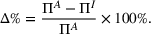

Average efficiency losses under individual contracting for different combinations of


Note that the data entries in Table 1 are 

Regarding the impact of
Each player's profit
This subsection examines the equilibrium profits of each manufacturer and the retailer. We start by calculating the difference in profits between the two contracting schemes for each player, and then derive various statistical measures across the numerical instances, as summarized in Table 2.
Profit difference for each player between aggregate and individual contracting


While aggregate contracting always outperforms individual contracting for the supply chain, it remains unclear whether each player also benefits from aggregate contracting. Table 2 shows that the difference in the retailer profit (i.e., 

In what follows, we examine the effects of key parameters on each player's preferences over the contracting schemes. It is worth noting that when evaluating the effect of each parameter, the profits are averaged across all the numerical instances with respect to the other parameters. Figure 1 depicts how each player's average profit changes with the number of products, 


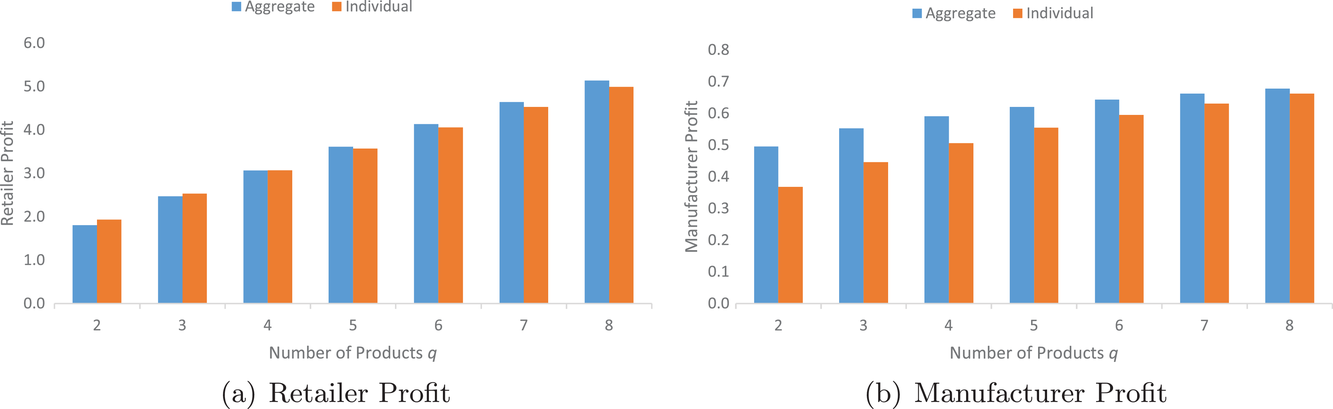
Effect of
Figure 2 illustrates how each player's average profit changes with the number of manufacturers,
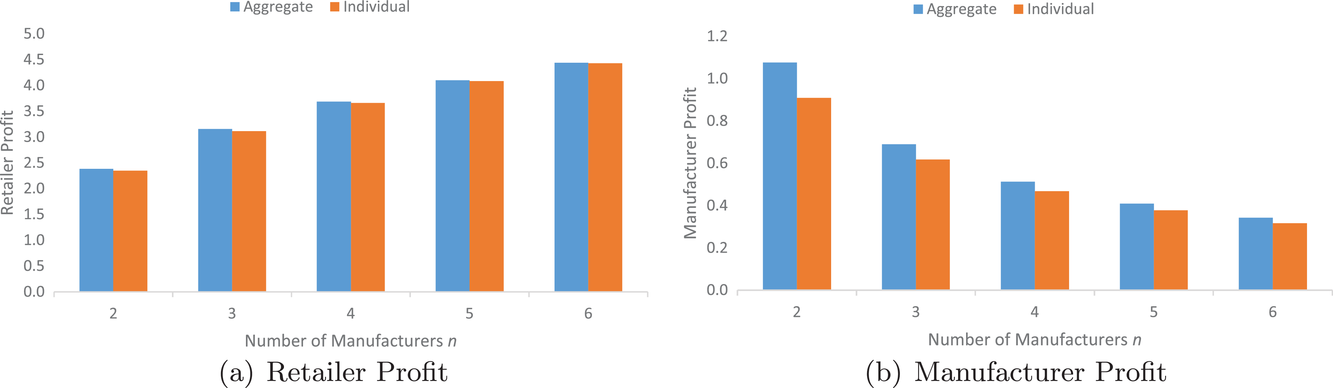
Effect of
We now examine how μ affects equilibrium profit allocations, as illustrated in Figure 3.
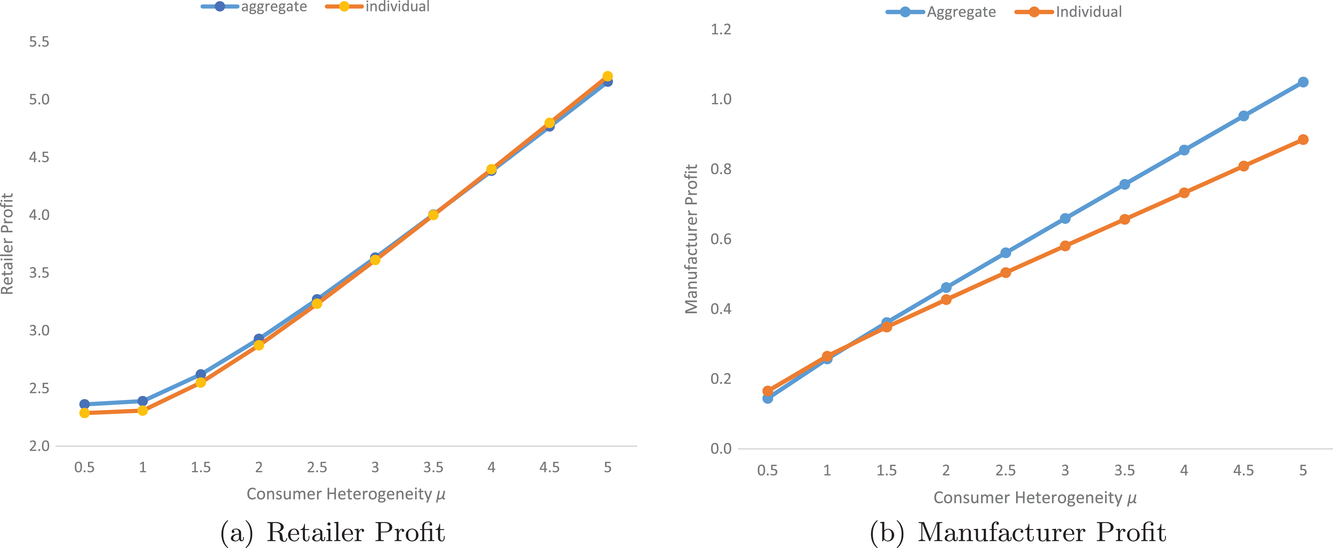
Effect of μ on each player's profit
Two observations can be made from this figure. First, each player's profit increases in consumer heterogeneity parameter μ, suggesting that both the manufacturers and the retailer benefit from having more heterogeneous consumer preferences. A high‐level intuition is that as consumer preferences become more heterogeneous, more manufacturers are able to capture a share of the market, thus dampening competition. As a result, each manufacturer benefits. We find that the overall demand also increases, thereby benefiting the retailer as well. Second, the retailer's profit is higher under aggregate contracting when μ is low, and each manufacturer's profit is higher under aggregate contracting when μ is high. The intuition of this result is not immediate, but it relates to the effect of consumer heterogeneity on the extent of competition induced by both contracting schemes.
AN EXTENSION WITH HYBRID CONTRACTING STRATEGIES
Our main analysis has focused on a symmetric setting where all manufacturers adopt the same contracting strategy. This may be appropriate when there is an industry norm for supply contracting or when the retailer specifies a particular contract arrangement for the manufacturers. If such a norm or requirement does not exist, however, it is useful to consider a hybrid setting in which manufacturers may adopt different contracting strategies. In this section, we examine a supply chain with two manufacturers (i.e., 


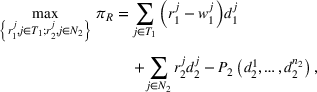

To proceed, we follow the same approach as in Section 4.2 by first examining the best response for manufacturer 2 who adopts aggregate contracting. Since individual contracting is a special case of aggregate contracting, the payment function for manufacturer 1 can be written as 



We now revisit the retailer's pricing problem with manufacturer 1 offering a wholesale price contract and manufacturer 2 offering a cost‐plus contract. The retailer's pricing problem in Equation (26) is reformulated as follows: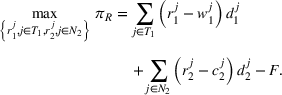




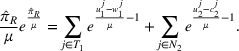



We now consider manufacturer 1's best response in determining the wholesale prices of his products. Similar to the analysis of individual contracting in Section 4.1, we take a two‐step approach: we first examine the optimal wholesale prices for any given set of products offered by manufacturer 1, and then study the optimal set of products for the manufacturer.
Suppose manufacturer 1 offers products in 
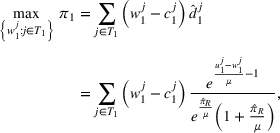


Using the above result, we can transform the multidimensional optimization problem in Equation (31) into a single‐dimensional problem where manufacturer 1 determines a single margin for all the products he offers. Following the same approach as in Section 4.1, Proposition 3 also applies, and it is optimal for manufacturer 1 to offer his full range of products to the retailer. Therefore, manufacturer 1's best response problem can then be reformulated as follows (after setting 

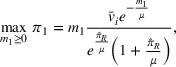


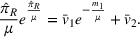
We are now ready to present the equilibrium for this extension with hybrid contracting strategies. There is a Nash equilibrium in which manufacturer 1 sets the same wholesale margin 
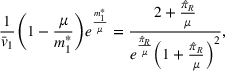





Several points are worth mentioning about Proposition 11. First, the conditions that characterize the equilibrium wholesale margin of manufacturer 1 share a similar structure with those of Proposition 4, with the difference that Equation (33) depends only on wholesale margin We obtain that 



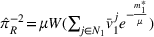



Corollary 3 shows that manufacturer 2 makes a greater profit when manufacturer 1 uses individual contracting rather than aggregate contracting, suggesting that manufacturer 2 prefers the other manufacturer to use individual contracting. Another question is whether one can find a relationship between 


The above results have some implications for an extended three‐stage game where each manufacturer first determines his contracting strategy, then accordingly determines the specific contract to offer the retailer, and finally, the retailer determines the retail prices (or the order quantities). This three‐stage game is appropriate when no regulatory or managerial requirements are imposed on the contracting strategy, so that the manufacturers can freely choose between aggregate contracting and individual contracting. As shown in our numerical studies, the dominant strategy is to use aggregate contracting, so in equilibrium both manufacturers will choose aggregate contracting. However, Section 4.3 demonstrates that the manufacturers make a higher profit under individual contracting when each offers a sufficiently large number of products (a high 




CONCLUSIONS AND FUTURE RESEARCH
Existing models in supply chain contracting focus primarily on single‐product problems. In this paper, we bridge a gap in the literature by studying competitive multiproduct contracting in a supply chain consisting of multiple manufacturers and a single retailer. With multiple products on offer from each manufacturer, a critical decision around optimal contract design is whether to quote a separate price for each individual product or an aggregate price for a combination of products. This paper considers two dichotomous contracting schemes: individual contracting where the manufacturers charge a wholesale price for every product separately, and aggregate contracting where each manufacturer designs a general nonlinear contract for a combination of his products. We fully characterize the equilibrium for the players under each scheme and obtain the following results. Under individual contracting, each manufacturer offers his full range of products to the retailer and charges an equal margin for each of his products. This result may be noteworthy in its own right as it extends the well‐known equal‐margin result obtained at the retailer to upstream manufacturer level. For aggregate contracting, the conventional approach to equilibrium analysis does not work in our model. Instead, we adopt a more native approach in which we first conjecture a set of strategies and then demonstrate that the conjectured strategies form an equilibrium. We show that a simple and intuitive cost‐plus contract is optimal for the manufacturers. The merit of this contract is its simplicity, with the manufacturers only needing to determine what fixed markup to add to their cost functions. Further, if restricted to cost‐plus contracts, we are led to a unique Nash equilibrium where the retailer sets retail prices in a way that maximizes the total supply chain profit. In terms of the equilibrium profit split, each manufacturer earns a profit equal to his marginal contribution to the supply chain, and the retailer earns the remaining profit.
We also examine the effect of changes in key parameters on equilibrium outcomes under each contracting scheme as well as the conditions for each player under which one scheme dominates the other. We derive analytical results whenever possible, and in cases where analytical analysis is not amenable, we resort to a numerical study. Overall, individual contracting results in efficiency losses while aggregate contracting does not. The efficiency loss from individual contracting decreases as the number of products available from each manufacturer, or the number of manufacturers, increases. Furthermore, no contracting scheme is always dominant from any player's perspective. We further examine how each player's contracting scheme preferences change along with varying market conditions. Specifically, we find that aggregate contracting benefits the retailer when each manufacturer offers more products, when there are fewer manufacturers in the supply chain, or when consumer preferences are less heterogeneous. For the manufacturers, aggregate contracting is more beneficial when there are fewer manufacturers or products on offer, or when consumer preferences are more heterogeneous. These sensitivity analysis results have important implications for optimal contract design. Indeed, managers should take into account the number of products, the concentration of the supply market, and consumer preferences when choosing an appropriate contracting scheme. Finally, as an extension, we study a hybrid setting where two manufacturers use different contracting strategies and demonstrate how a prisoner's dilemma may occur in a three‐stage game where manufacturers can choose between the two contracting strategies in the first stage.
This paper opens up several research opportunities in multiproduct contracting. First, we have chosen the standard MNL model, as suitable for the considered setting where all the products fit into the same category. Other discrete choice models may, however, be more appropriate for products from different categories. A natural extension of our model is to consider variants of MNL such as nested logit and hierarchical choice models (Gallego & Topaloglu, 2019; Li & Huh, 2011). Second, the supply chain considered in this paper involves multiple manufacturers and a common retailer. One may also study multiproduct contract design in settings with competing retailers. Third, in purely focusing on the firms' pricing and contracting decisions, we have refrained from considering asymmetric information. Incorporating information asymmetries in multiproduct contracting represents another avenue for future research. Finally, multiproduct contracting is an important problem in other retail contexts as well (e.g., agency selling and online retail platforms). Extending the current work along these lines also presents interesting opportunities for research.
Footnotes
ACKNOWLEDGMENTS
The author would like to thank Professor Hans Heese as well as the review team for their constructive comments, which help to improve the paper significantly.
Open Access Funding provided by The University of Melbourne within the CRUI‐CARE Agreement.
1
Several assembly models in the operations literature show that all manufacturers charge an equal margin and make the same profit in a decentralized assembly setting (see, e.g., Granot & Yin, 2008; Jiang & Wang, 2010; Nagarajan & Sošić,  ). This result, however, is different from our equal‐margin policy. Indeed, different manufacturers in our model may charge different wholesale margins, thus making different profits.
2
While assortment optimization is not a primary concern of the retailer, each manufacturer must determine which products to offer the retailer in our multiproduct setting. Since the retailer's pricing problem depends on the range of products supplied by the manufacturers, we consider this general from to account for cases where some manufacturers may wish to limit the range of their products offered to the retailer.
3
According to our search of Ralphs' website in February 2022, there are five flavors of Coca‐Cola Soda—12 cans/12 fl oz (classic, cherry, vanilla, cherry vanilla, and cherry vanilla zero sugar), all sold at the same price $6.49.
4
Ralphs also sells RC Cola Soda (12 cans/12 fl oz) at the same price $6.49 as Coca‐Cola Soda. In contrast, Amazon Fresh sells Pepsi Diet (12 cans/12 fl oz) at $6.19 but Coca‐Cola Soda (12 cans/12 fl oz) at $6.79.
5
For this assumption, we allow that the manufacturers supply different numbers of products, or that the production costs/expected utilities are different but the aggregate attractiveness is the same across the manufacturers.
6
For convenience, we examine the effects of
7
One may think of individual contracting as a restricted form of this general contract where
8
This problem does not occur for individual contracting since there is a unique solution to the retailer's optimal problem under that scheme.
References
Supplementary Material
Please find the following supplemental material available below.
For Open Access articles published under a Creative Commons License, all supplemental material carries the same license as the article it is associated with.
For non-Open Access articles published, all supplemental material carries a non-exclusive license, and permission requests for re-use of supplemental material or any part of supplemental material shall be sent directly to the copyright owner as specified in the copyright notice associated with the article.
