






Abstract
In recent years, our field has seen an increase in research that explicitly emphasizes an objective of social impact in the most unprivileged parts of the world—the so‐called global base of the pyramid (BOP; referring to the 2.7 billion people living on less than $2.50 per day, the largest but most resource‐poor economic group globally). This trend seems to cut across the traditional application areas of operations management (OM) and operations research (OR), and it coincides with an increased emphasis on environmental, social, and corporate governance (ESG) values in industry, a greater prominence of the United Nations' Sustainable Development Goals (UN SDGs), and increases in social impact research in other academic fields. In this paper, we pull together representative examples from our field of what we consider as social impact research aimed at improving living conditions at the BOP. We first examine the scale and scope of work published in
INTRODUCTION
A common refrain among researchers in our community is that what attracted them to our field in the first place is the broad applicability of its methods. The theoretical foundations of models originally developed for manufacturing and service applications are relevant well beyond these domains, and the more recent influx of techniques rooted in related disciplines—for example, game theory, empirical methods, and analytics—have equally broad applicability. As a result, our field has been able to shift its focus over time to tackle new and important challenges. This paper focuses on the recent contributions of our field to one such set of challenges.
In recent years, we have seen a substantial increase in the interest and effort of operations management (OM) and operations research (OR) scholars toward addressing pressing global problems. While the operations community has a long history of tackling important public‐sector challenges, much of this new stream of work is characterized by the explicit aim of improving the lives of those eking out a living at the so‐called global “base of the pyramid” (BOP).
1
Such efforts—and the resulting academic papers and conference presentations—are often informally classified within an
In this review, we aim to present a unified view of this theme, by selectively highlighting recent work in our field that meets the following criteria. First, our focus is on research that explicitly emphasizes social impact. In other words, social impact that benefits underserved or unprivileged communities must be a central objective, not a by‐product of improving system efficiency on the usual for‐profit metrics. Second, we focus on papers that pursue this objective in very challenging international settings. This is not to detract from the excellent research promoting social impact in the United States or other developed countries. Rather, we make this choice to highlight that OM/OR research addressing challenging global issues has many aspects in common, regardless of whether the application focus is sustainability, healthcare, business model innovation, or something else altogether. Third, we especially highlight papers with a significant stakeholder involvement or otherwise high levels of relevance to practice.
Our aims are fourfold. First, we wish to celebrate the excellent research that has had meaningful impact in improving the living conditions of the world's poorest citizens. Second, we wish to gather under one umbrella—that of social impact operations (SIO) at the global BOP—work that previously has belonged to different silos within our professional community despite having many aspects in common. These commonalities include not only objectives but also challenges related to data availability, stakeholder engagement, and implementation. By bringing researchers with similar agendas together, we can all learn from one another and develop a more unified approach to using OM/OR for BOP social impact. Third, by collating an overview of this type of work and highlighting some unifying themes, this review constitutes a call to action for our community to create a forum—for example, an annual workshop series—in which researchers in our field who have an interest in social impact at the global BOP can get together and exchange ideas. Finally, beyond reflecting on a recent trend in the OM/OR community, we hope to unearth future research opportunities for social impact that might arise from connecting the dots across this till‐now disjointed landscape. Doing more research in this area would not only be socially responsible (Lee & Tang, 2018; Netessine, 2021) but also contribute to achieving BOP sustainability—in the broad sense of the word adopted by the UN Sustainable Development Goals (SDGs)—described by Corbett (2018) as “making decisions while simultaneously taking into account economic, environmental, and social considerations.”
Interestingly, at the same time as our field has started emphasizing social impact more explicitly, the same has happened in industry and other academic fields. Business and finance are increasingly moving toward incorporating environmental, social, and corporate governance (ESG) metrics and values in their objectives and decision making. Similarly, other academic areas have started organizing around social impact values. 2 We envision coalescing together a community of researchers in our field dedicated to SIO at the global BOP.
One might well ask, what can we as OM/OR researchers bring to the table, when other fields—for example, economics and public health—have already started focusing on social impact issues? Similarly, why should we focus on the BOP explicitly, can we not just extend our existing insights and recommendations to resource‐limited settings? To answer the first question, it is useful to examine our strengths and our predilections. Being housed in business schools or engineering departments, OM/OR researchers typically have far closer ties with industry than researchers in other fields. Economists, and education and public health researchers, for example, have traditionally had closer ties with policy‐setting organizations. We should leverage our culture of engaging stakeholders in the field to uncover new solutions to pernicious problems, particularly given recent calls for private business stepping in and addressing important societal problems (Banerjee & Duflo, 2021). At the same time, we should strengthen our ties to policy‐setting institutions, to ensure that the impact of operational implementation on the performance of public programs is appreciated (Kaplan, 2021). Furthermore, policy‐oriented fields tend to be preoccupied with evaluating the effects of various interventions, to understand
To answer the second question, it is important to appreciate that the resource limitations at the BOP often result in operational systems having a fundamentally different structure. The available infrastructure, the motivation, and the challenges faced by individuals and organizations are often very different from those we often take as given in our modeling of operational systems in settings with more abundant resources. This observation does not detract from the body of knowledge our field has generated; rather, it presents an opportunity to further refine it—as well as, we hope, generate new universal insights that might generalize beyond the BOP.
While research in our community on SIO at the global BOP has many common threads and is worth consolidating (which is a main objective of this paper), the challenge we faced is that this work has thus far not always been presented using terms like “global” or “social impact.” As a result, this first review is guaranteed to not to be fully comprehensive. Also, because the work we wish to highlight often has broad appeal beyond the OM community and there has been a recent uptick in this stream of research, we include both some papers published outside the conventional OM outlets and some recent working papers.
In the next section, we provide an overview of research published in
POM RESEARCH ON SIO AT THE GLOBAL BOP
In this section, we present an overview of research published in POM over the past 25 years and discuss trends and topics in the area of SIO at the global BOP.
To get an understanding of the global reach of our community's research efforts, we first searched for all country names in the abstracts, titles, and keywords of all papers published in POM between 1997 and 2018. 3 Even though a simple country name search paints an incomplete picture at best (e.g., it fails to detect research that is not location specific), it serves as a useful proxy for the geographic focus of past research—especially research on developing countries (Torres & Alburez‐Gutierrez, 2022). The world map in Figure 1 reveals that the largest body of research published in POM focuses on the United States followed by China and India. With over 150 countries not appearing even once in our search, it also suggests that there are many as‐yet unexplored places where our community can unravel new phenomena or solve novel problems that may not even exist in the developed world.
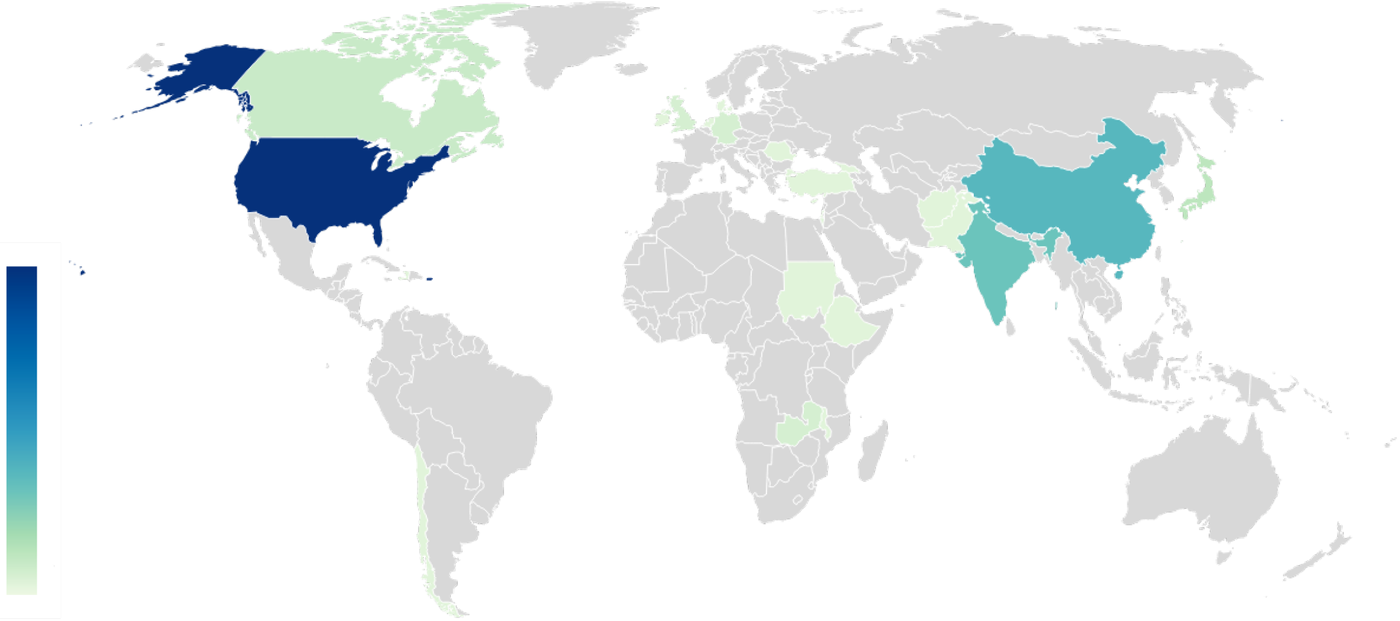
Countrywise research coverage in POM, 1997–2018. Darker colors reflect more research papers. Gray reflects zero research papers.
As a more systematic attempt to identify social impact research at the global BOP, we performed a semistructured search on all 1521 articles that appeared in POM between 1997 and 2018. The details of our study selection protocol are described in Figure A1 in the Appendix. First, we searched for keywords indicative of SIO at the global BOP, in each paper's abstract, title, and keywords. Then, we manually screened the abstract of each of the shortlisted 662 papers (or, if needed, the full paper) to determine whether it fitted into the global BOP SIO theme. As a part of this manual screening process, we also sought to identify subthemes within the broader theme of global SIO. Our final list of papers consists of 69 articles that plausibly fit into one of five broad SIO research categories: environmental sustainability, global health, humanitarian operations, infrastructure and institutions, and innovative business models and business processes. Our full list of papers can be found in Table A1 in the Appendix.
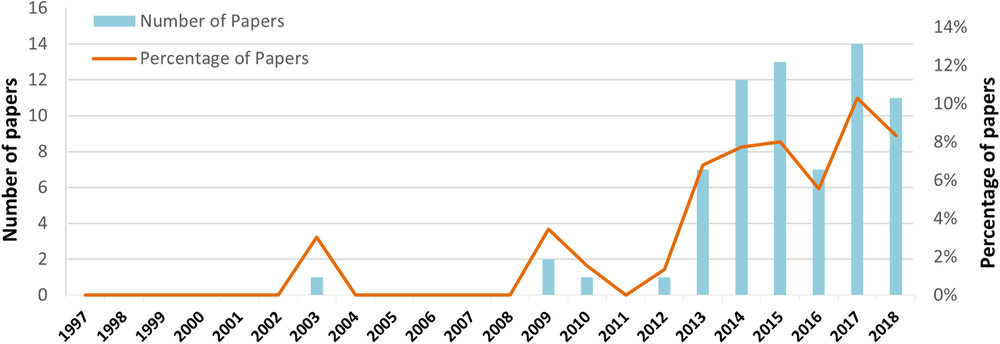
Time series of the 69 articles focusing on social impact operations (SIO) at the global base of the pyramid published in POM between 1997 and 2018
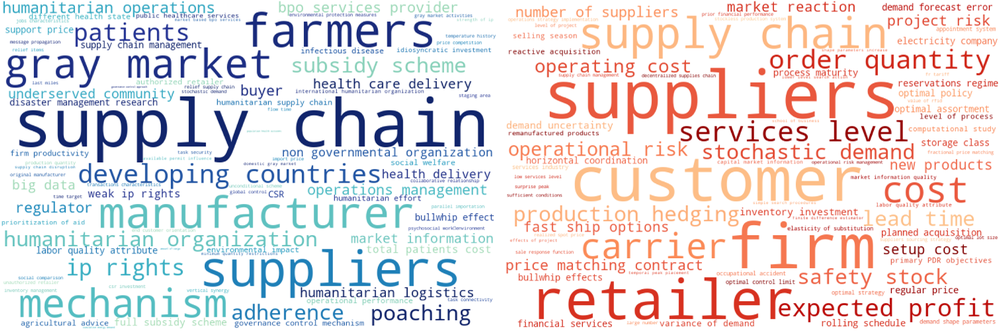
Keyword clouds for social impact operations papers and other papers published in POM. This figure presents the word clouds of 61 global social impact operations papers' abstracts (blue) and all other paper abstracts (red) published in POM during 1997–2018.
Figure 2 displays a time series of papers published in POM that fall broadly within the area of SIO in the bottom‐of‐the‐pyramid context. This figure reveals an expansion in this area of research activity in the past decade. Between 1997 and 2011, only four research articles were published in this area, followed by an uptick from 2012 to 2015. This increase overlaps with the publication of four POM special issues: Socially Responsible Operations (Sodhi & Tang, 2012), Research in Emerging Markets (Iyer et al., 2013), Humanitarian Operations and Crisis Management (Starr & Van Wassenhove, 2014), and Not‐for‐Profit Operations (Berenguer et al., 2015), which fall within the umbrella of SIO at the BOP. After 2015, the number of papers falling under SIO research with this focus has remained steadily high. In 2016–2018, a total of 32 papers—that is, 8.1% of papers published in POM—fell under this category.
The word clouds in Figure 3 contrast the words found in the abstracts of SIO papers in BOP contexts with those found in the abstracts of the remaining papers (which are not about SIO in BOP contexts) published in POM. 4 Keywords related to supply chain management appear as the most common cross‐cutting theme. Although “suppliers” is a common keyword in both word clouds, “retailer” does not appear as prominently in the SIO word cloud as in the word cloud for the remaining POM papers. This could partly be due to researchers being more interested in the upstream portions of supply chains, where the social planner is more likely to be positioned. We also observe that inventory management (e.g., order quantity, safety stock) and revenue‐related keywords (e.g., expected profit, cost) are less prominent in the SIO word cloud. In contrast, humanitarian operations, agriculture, and healthcare‐related keywords are more prominent in the SIO word cloud.
RESEARCH STREAMS FOR SIO AT THE GLOBAL BOP
Research examining challenges faced at the BOP through an operational lens falls in many areas. We highlight five such areas below, some of which are well established, and others very nascent.
Environmental sustainability
The livelihoods of the poor often depend directly on the natural resources in their vicinity, making them especially vulnerable to unsustainable depletion of environmental resources. In addition, developing country governments often struggle with effective policy implementation. Therefore, private‐sector involvement is considered essential to achieving environmental sustainability in underserved communities (department of international development (DFID), 2002).
Research on environmentally sustainable operations has a long history in our field (Atasu et al., 2020; Corbett & Klassen, 2006; Kleindorfer et al., 2005). However, work on environmental issues that affect the BOP is relatively sparse.
One stream of this literature has focused on agriculture operations and the use of natural resources in developing countries. Alizamir et al. (2022) examine an innovative global social impact program, where customers can tip the individual farmers who grow their sustainably sourced products, through a mobile app. Their findings indicate that in equilibrium, albeit well intended, such programs could have unintended consequences and make some farmers worse off. de Zegher et al. (2018) show that eliminating payment delays to palm oil growers conditional on forest protection increases smallholder farmers' welfare and halts illegal deforestation. Dawande et al. (2013) develop a model for socially optimal allocation of surface water to farmers in developing countries.
Another stream of the nascent literature on environmental sustainability in the BOP context has examined responsible sourcing practices, focusing on environmental concerns. Chen and Lee (2017) examine a setting in which a buyer sources from a supplier—often located in an emerging market—and faces reputation costs due to supplier noncompliance to ethical or environmental standards. These authors show that various mitigating strategies (e.g., process audits or supplier certification) complement one another and reduce the cost of sourcing. In a similar setup, Plambeck and Taylor (2016) show that when audited more intensively, suppliers exert more effort to hide information and less effort to prevent harm—defined as the “backfiring condition.” Ramchandani et al. (2020) provide empirical evidence that coffee companies that certify even a single product via third‐party certification agencies exhibit significantly lower ESG violations. From a corporate social responsibility viewpoint, Buell and Kalkanci (2021) show via a field experiment that bringing transparency into social or environmental responsibility practices improves sales. Distelhorst et al. (2017) find that adoption of lean manufacturing in global supply chains significantly reduces noncompliance with labor standards and mildly improves environmental compliance in emerging markets.
Global health
Over the past few decades, the operations community has built a substantial body of knowledge on how to manage healthcare delivery services (Dai & Tayur, 2020; Kc et al., 2020; Keskinocak & Savva, 2020). Following on the heels of this interest in improving healthcare delivery in mostly resource‐rich settings (often U.S. hospitals), the scope of work on healthcare operations has expanded to include research on healthcare delivery in resource‐limited settings—a stream of work often referred to as Global Health Operations (Kraiselburd & Yadav, 2013).
In our view, this work fits well under the umbrella of SIO, for various reasons. First, the practical setting for the great majority of this research is nonprofit organizations (international or local, public or private). The research objectives are therefore usually some measure of social impact, often directly related to the well‐being (healthcare access or health outcomes) of communities that are underserved or otherwise unprivileged. Second, similar to much of the broader OM healthcare research, this stream of work has often taken a very practice‐driven approach, relying on close collaboration with one or more stakeholders in the field.
From the perspective of potential impact, this stream of work is promising. Challenges to delivering healthcare in resource‐limited settings are often operational rather than clinical. Furthermore, while the actual delivery of care is often decentralized in resource‐limited settings, by partnering with nongovernmental organizations (NGOs), national programs, or health officials, research on global health operations has the potential to have a system‐level impact, even at a national level. Thus, there is potential for significant impact on populations that have the greatest need for improved healthcare delivery.
Some of the work on global health operations has extended traditional OM/OR topics into the context of global health, for example, inventory and procurement of health products (Gallien et al., 2017; Leung et al., 2016; Natarajan & Swaminathan, 2014, 2017); the optimization of supply chains, distribution, and logistics for diagnostic samples, medicine, and vaccines (De Boeck et al., 2022; Gibson et al., 2022; Jónasson et al., 2017; Noham et al., 2022; Parvin et al., 2018); and improving ambulance operations in developing countries (Boutilier & Chan, 2018; Gernert et al., 2022). Another stream of work has used predictive analytics to improve risk stratification (and consequently resource allocation) for healthcare delivery in resource‐limited settings (Boutilier et al., 2020, 2021). Yet another has involved collaboration with NGOs to understand how to structure the incentives of global health stakeholders to improve efficiency and outcomes (Carland et al., 2018; Suen et al., 2022) or to provide underserved communities access to care (Kohnke et al., 2017). Furthermore, OM/OR modeling has contributed to TB control in India (Suen et al., 2014, 2015, 2018), to mitigating mosquito‐borne viral diseases in Columbia (Claypool et al., 2019, 2021, 2022) and plague in Madagascar (Malloy et al., 2021), to improving HIV care in Jamaica (Barrow et al., 2020; Barrow & Brandeau, 2019), as well as to improve targeted interventions to vulnerable populations in sub‐Saharan Africa (Choi et al., 2017; Zhong et al., 2021). Much of this work has jointly incorporated operational and disease‐specific epidemiological modeling to improve cost‐effectiveness estimates that are relevant for policy makers.
Taken together, the OM/OR research on global health has not only leveraged an array of methodologies to address various operational challenges, but also has contributed to many different disease areas, including tropical, communicable, and noncommunicable diseases. This demonstrates the broad applicability of our methods and also underscores the point that many important problems in global health are operational. Even in health areas that are well understood clinically, improved program implementation can improve health outcomes.
Operations researchers have had access to high‐quality data on hospital operations (e.g., from U.S. and European hospitals) for some years, at this point, which has enabled our community to develop some evidence base for how to manage such systems. This has not always been the case in global health OR. Some authors have even taken the step of designing data collection methods to obtain the requisite data for operational analysis (Boutilier & Chan, 2018; Killian et al., 2021; Leung et al., 2016). However, much of the recent work on global health operations has been made possible by the increase in programmatic collection of field data in resource‐limited settings. We anticipate a continuation of this trend, which will hopefully not only increase the volume of high‐quality research on how to manage global health systems, but also allow for increased field implementation and evaluation of its recommendations.
Challenges in global health are a good source of academically interesting problems. Due to limited resources, the healthcare delivery systems in question are often fundamentally different from healthcare delivery systems in less constrained settings. This brings new methodological challenges to solve but can also help identify opportunities to improve healthcare delivery in less constrained situations. Furthermore, even for situations in which insights or recommendations are not readily applicable to resource‐rich hospitals, they are likely to generalize across other resource‐limited systems, since many programs (e.g., for HIV/AIDS, TB, and vaccinations) tend to be similar across countries with similar infrastructure. Also, international agencies such as the World Health Organization (WHO) actively develop and update protocols for the treatment of many diseases, including AIDS and TB. These WHO protocols are central to healthcare policy in many developing nations. Therefore, the generalizability of results can be very broad, even if it does not always extend to the healthcare systems in the United States or Europe.
Humanitarian operations
One of the clearest examples of the OM community contributing to global social impact is the expansive and active literature on humanitarian operations. By definition, this literature aims to improve living conditions for populations that have suffered serious adverse events (including tsunamis, earthquakes, pandemics, as well as man‐made disasters). Furthermore, while this literature largely focuses on improving efficiency, the objective is often not to minimize cost but to enhance the impact that humanitarian efforts can have on the ground. Arguably, this literature is the most established stream of the SIO effort aimed at the BOP.
One useful distinction, in navigating this stream of work, is between papers focusing on relief efforts in the wake of disasters (i.e., humanitarian response or short‐term recovery) and more permanent international aid (sometimes referred to as development or long‐term recovery). The literature focusing on disaster relief is generally considered to encompass four phases centered around disaster onset; mitigation, preparedness, response, and recovery (Altay & Green III, 2006; Ergun et al., 2011; Tomasini et al., 2009). This literature has studied both man‐made and natural disasters (Van Wassenhove, 2006), with key stakeholders coming from both the public and private sectors, and increasingly relies on field data to generate recommendations (Besiou & Van Wassenhove, 2020). While this literature is too expansive to concisely summarize here, we provide some examples of work that focuses on disaster relief for those living at the global BOP. Focusing on mitigation, Yücel et al. (2018) consider which links in a transportation network should be structurally improved, to ensure the resiliency of the transportation system to disaster‐related disruptions. From the perspective of preparation, Battarra et al. (2018) collaborate with the Red Crescent to solve the problem of prepositioning emergency supplies for earthquake preparedness. Sokat et al. (2018) consider how to deal with limited or missing data in planning disaster response, using the 2010 earthquake in Haiti as a case study. Various papers have examined different aspects of how to preposition supplies as a way to prepare for unpredictable disasters (Duran et al., 2011; Eftekhar et al., 2022; Uichanco, 2021). In addition to prepositioning supplies, humanitarian organizations must build and maintain response capacity. Pedraza‐Martinez and Van Wassenhove (2013) and Eftekhar et al. (2014) study vehicle procurement and replacement policies for the Red Cross, leveraging field data from resource‐limited countries. Similarly, McCoy and Lee (2014) investigate trade‐offs between fairness and efficiency in access to care, collaborating with an NGO in Zambia, and Stauffer et al. (2016) collaborate with the Red Cross to develop insights for how to configure supply chains as part of their disaster preparedness. Focusing on response and recovery, Kotsi et al. (2022) use data, collected directly from refugees, to understand the trade‐offs between in‐kind and cash assistance in a refugee crisis. Sodhi and Tang (2014a) examine the potential role of local microretailers for flood recovery and Ergun et al. (2014) consider the role of technology for coordinating various public and private organizations that play an important role in disaster response.
In the context of long‐term humanitarian aid, a stream of papers has examined how to increase the efficiency of food donation supply chains. Peters et al. (2021) collaborated with the World Food Programme to optimize not only their supply chain (i.e., sourcing and delivery) but also the contents of the food basket being shipped. They describe impressive implementation projects in the Middle East, northern South America, and southern Africa. Komrska et al. (2013) describes a collaboration between OM scholars and UNICEF to improve the latter's supply chain for therapeutic foods, which are distributed to children who suffer from malnutrition. Focusing more on the allocation side, Yang et al. (2013) present an optimization approach for prioritizing which children need food supplements the most, demonstrating that without increasing the budget for food supplements, the impact on disability‐adjusted life years could be increased by as much as 9% using a simple allocation model. Beyond nutrition, the OM community has also examined how to manage incentives in the supply chain for malaria drugs using subsidies (Levi et al., 2017; Taylor & Xiao, 2014), how to structure and manage supply chains of raw ingredients to increase access to malaria drugs (Kazaz et al., 2016), as well as how to best match donated medical devices to recipients (Zhang et al., 2020), to name a few important applications.
Importantly, it has been pointed out that while supply chain management is a well‐studied topic in OM/OR and the success of humanitarian operations often depends on effective supply chain management, the context of humanitarian organizations is substantially different from commercial settings (Van Wassenhove & Pedraza Martinez, 2012). This makes the direct transfer of knowledge or managerial insights from commercial resource‐rich settings to humanitarian or resource‐limited settings difficult, an observation that has motivated a dedicated literature developing knowledge for the humanitarian setting. This literature is now established and thriving. Similarly, social systems in resource‐limited settings (the context for the type of work we highlight in this paper) are often fundamentally different from better studied and less resource‐constrained settings. Given this similarity, the development of humanitarian logistics into a mature research area might serve as a model to follow, for those who wish to establish SIO in a global context as a distinct area of research.
Infrastructure and institutions
The billions living at the BOP face severe infrastructural constraints. For example, they lack access to clean water, electricity, and information. More often than not, they also find it hard to access state‐run institutions that serve as the pillars of civic society, such as those that provide legal, policing, financial, health, and educational services. Infrastructure and institutions provide the foundation for development. While many researchers in our field have examined health services at the BOP, other aspects of access to infrastructure and institutions in this segment have received far less interest.
Getting electricity to BOP users, who often live in off‐grid communities, has only recently attracted research attention in our field. Market‐related factors such as pricing and marketing play an important role in increasing the adoption of alternative energy sources—for example, solar panels—in of‐grid communities in the developing world (Hart & Christensen, 2002). In contrast, Kundu and Ramdas (2022) find that an operational metric—delays in repair of solar panels—hurts their adoption. Uppari et al. (2019) find that lack of purchase quantity flexibility hinders the adoption of solar light bulbs, which need to be recharged at a store when the battery runs out. Kerosene, which is noxious, can be bought in large quantities (eliminating the time wasted in going to the store to recharge) or in very small quantities (reducing blackout periods for liquidity‐constrained customers). Guajardo (2019) examine empirically how consumer usage and payment behaviors interact in an application of a rent‐to‐own business model for the distribution of solar lamps in developing countries.
A long history of research in economics, public health, and medicine, and a relatively new stream of work in our field, has highlighted the importance of mobile phones (and more recently smartphones) in enabling the poor to access information services targeted at education, health, agriculture, financial inclusion, and savings (Lee & Tang, 2018). Information dissemination via telecommunications infrastructure is core to the business model of many social ventures (Liao & Chen, 2017; Liao et al., 2019; Parker et al., 2016). From an institutional perspective, universal smartphone usage is a UN SDG supported by many governments—the assumption being that underprivileged consumers will use their phones to access life‐improving information. In this backdrop, Ramdas and Sungu (2022) find experimentally that placing daily caps on mobile data paradoxically increases access to life‐improving information for BOP smartphone users, by curbing entertainment binge usage, which drives subsequent data shortages and reduces information access.
A growing body of literature investigates the impact of technology‐enabled interventions in food and agriculture supply chains. Ganesh et al. (2019) find that installing point‐of‐sale (POS) devices in food subsidy stores reduces leakage, via improved monitoring; these authors show via simulation that POS technology can also create value by enabling better inventory replenishment planning. Levi et al. (2020a) empirically investigate the impact of an online agri‐platform that expands smallholder farmers' access to wholesale markets in India. They find that such platforms can increase the market prices of certain commodities, potentially improving farmers' welfare. They also highlight that the success of such an approach depends on certain process features (e.g., bidding efficiency and logistical challenges). Relatedly, Levi et al. (2020b) develop a two‐stage auction model for a state‐run online agri‐platform in India. Empirical results from a real‐life implementation reveal that the two‐stage auction increases farmers' revenue.
Governments and social organizations invest billions of dollars into aid for the world's most vulnerable populations. Operations‐based strategies can create tremendous value in these efforts through more efficient and effective resource allocation. Recent examples from OR include improving refugee–host location matching (Bansak & Paulson, 2020), providing optimal subsidies (Yu et al., 2018, 2020), and effective food safety inspections (Jin et al., 2019).
Innovative business models and business processes
While business models are often discussed in the context of for‐profit businesses, we consider a business model more broadly as an organization's recipe for creating value. An organization's business model describes how its resources and business processes transform inputs into more valuable outputs, and how the value created is captured. Naturally, nonprofit organizations might have some different characteristics than their for‐profit counterparts (Berenguer & Shen, 2020). While there is a huge mass of research in our field on business processes, and a growing body of work on business models, only a small portion of this work focuses on the global BOP (Lee & Tang, 2018).
The unique aspects of OM in BOP settings throw open new challenges—that require innovation to surmount. London et al. (2010) identify value creation constraints (inferior raw materials and inadequate access to financing and production resources) and value capture constraints (limited market access, market power, and market security) faced by BOP producers in the arts‐and‐crafts, agriculture and livestock sectors. Beyond these sectors, microenterprises with less than 10 employees account for around 90% of businesses and over 40% of employment in developing countries (Alibhai et al., 2017). These small firms face a very different environment than do large multinationals. Kundu et al. (2022) find that aside from disruptions to supplies or workers, managerial disruptions—that is, the sickness or death of relatives and owner sickness—hurt the sales and sales growth of Ugandan microretailers, and that building relational redundancy—for example, trustworthy owner cover—mitigates this problem. Fatunde et al. (2021) show empirically that when the supplier's sales agent changes, informal retailers face a significant and sustained drop in their business performance, relative to formal retailers. Caro et al. (2018) find that collaboration of buyers for the audit process—via jointly conducting audits or sharing individual audit reports and penalizing jointly—increases supplier compliance.
Some research in our field has examined the interplay between profit and social impact goals. London and Anupindi (2012) document how business models that involve collaborative interdependence between the private and public sectors can enhance the connection between profits and poverty alleviation. Calmon et al. (2022) show that social enterprises can reduce the misalignment between profit maximization and increasing consumer surplus by offering free product returns and committing to a maximum retail price.
Another stream of research has focused on innovative business models, which break trade‐offs, enabling better use of scarce resources in resource‐poor settings. In healthcare, for example, in a shared medical appointment (SMA), a physician sees multiple patients with the same condition at once, giving each patient in turn one‐on‐one attention. Through a field experiment, Buell et al. (2021) find that SMAs improve compliance to medications, patient satisfaction, and knowledge at the Aravind Eye Hospital in India. In this knowledge–service setting, productivity measured as the amount of information exchanged per unit of time is also greater in SMAs. Telemedicine‐based business models allow access to remote, underserved communities (Delana et al., 2019). There is an opportunity to offer virtual SMAs via telemedicine to greatly expand healthcare capacity at the BOP (Ramdas & Swaminathan, 2021). Devalkar et al. (2017) investigate an innovative ex post funding strategy for nonprofit organizations, where donors invest their funds based on the results delivered. The authors find that a threshold policy that balances the ex ante and ex post funds maximizes the total expected benefits. Arora et al. (2022) identify strategies to determine the service level for resource‐constrained nonprofit organizations to effectively serve disadvantaged populations. In a similar setting, Zhang et al. (2021) show that partial provision of nonprofit services can create value for beneficiaries, even when resources are abundant.
OPPORTUNITIES FOR FUTURE RESEARCH
Studying SIO with a view to helping solve pressing global challenges is a promising research direction for our community. These problems have long attracted the attention of researchers and practitioners from a diverse set of disciplines and experience bases. This broad and growing appeal gives us an opportunity for impact much beyond our field.
One can think about research opportunities in this area through a lens of
Similarly, our community has paid little attention to challenges faced within the
Finally, interesting opportunities exist within the already established areas of work, for example, research within the healthcare sector targeted at the BOP could be extended to focus more on the unique challenges related to the growing burden of noncommunicable diseases in low‐ and middle‐income countries. Similarly, interesting opportunities remain to further study the operations of
As a second perspective, it is fruitful to think in terms of themes that cut across various sectors. One theme, which is gaining momentum across application areas, is
The
While much of OM/OR research has traditionally treated people as resources—for example, the “servers” in a queuing system can be people or machines—the scope of our research has been extended to include
One of the broadest themes permeating most research with a social‐impact focus is
As a third perspective, one can look for opportunities for novel research based on the available methodological tools. While we believe there is great scope for all types of OM/OR work at the BOP—from descriptive to predictive to prescriptive—we see certain opportunities worth highlighting. For most of the sectors discussed above, data are increasingly becoming available (Chandy et al., 2017), opening the door for more empirical work on problems, which previously could only be tackled theoretically. Furthermore, more data will allow for a more convincing evidence base for recommendations and a stronger connection with stakeholders, which in turn will enable our community to do more field implementation, experimentation, and evaluation of operational interventions aimed at social impact at the BOP.
CONCLUSION
The key hypothesis underlying this review is that an increasing number of researchers in our field are interested in working on research projects, which have a high potential for positive social impact at the global BOP. However, the results of these research projects get evaluated and disseminated based on which traditional application areas in our field they are closest to (e.g., sustainability, supply chains, healthcare), despite often having more in common with each other than with their respective application areas.
By highlighting representative examples of OM/OR research with an explicit goal of social impact targeted at the world's poorest citizens, and giving this type of work the “label” of SIO at the BOP, we hope to spark a dialogue among researchers who share fundamentally similar perspectives and deal with similar challenges. A common terminology—consistent with other fields—might furthermore allow for dedicated forums to further this agenda. Similarly, we hope that building a community around these shared priorities and interests will make it easier for more researchers to join the effort.
One could argue that any research that has global implications could affect the lives of those at the BOP. We have attempted to include works that have such an impact as an explicit focus. However, since the labels of social impact or responsible operations have not been widely adopted within our field (although such terminology is increasingly used in other fields, as noted in Section 1), we may have inadvertently left out some relevant papers. This review offers a first attempt at compiling and highlighting this important dimension of the efforts of our field.
Beyond the internal workings of our community, consolidating its contributions to social impact at the BOP will increase the broader visibility and appeal of our field to socially conscious researchers. A new generation of students, coming of age during a period of active discourse about social issues, is deciding how to devote their talents. We believe that this generation of researchers is excited about having a positive impact on the world, and that by highlighting the potential of OM/OR to make such an impact, we might be better placed to attract them to our programs.
Given the broad applicability and relevance of our field, there is a long history of debating what types of problems we should collectively be addressing and what constitutes good research. Recent calls for more practice‐based research (Gallien et al., 2016); more responsible research (Lee & Tang, 2018; Netessine, 2021); more interesting, important, and impactful research (Cachon et al., 2020); as well as more work focused on diversity, equity, and inclusion (Corbett et al., 2022) are some examples of this ongoing discourse. We believe that well‐executed research focusing on SIO at the BOP would not only align with any reasonable answer to the question of what constitutes quality research in OM/OR but also serve to increase the relevance and visibility of our field as a whole.
Footnotes
ACKNOWLEDGMENT
We are grateful to Christopher Tang and Subodha Kumar for the invitation to contribute to the special issue, as well as thoughtful feedback on the paper.
1
An umbrella term used to refer to the global subpopulation, which is simultaneously the largest and the most resource‐poor (Prahalad, 2012). By some estimates, 2.7 billion people are living on less than $2.5 per day (United Nations Development Programme,  ). For brevity, we henceforth drop the adjective “global” in referring to the global BOP.
2
See, for example, the Mechanism Design for Social Good effort and the Golub Capital Social Impact Lab at Stanford University.
3
We used the International Organization for Standardization's (ISO's) list of country names. Details available at
4
We used TF‐IDF scores to determine the relative sizes of the words in each word cloud, and used “collocations API” to identify common phrases. Details available at