






Abstract
We study service triads by examining the member‐to‐member exchanges underpinning service formation, functioning, and feedback. A service triad comprises two serviced customers from the supplier's standpoint and two service providers from the end user's standpoint, which can cause operational complexity and challenges. We view the service triad as an operating entity and study four information‐rich cases to improve our understanding of this operational complexity. Leveraging scholarly knowledge related to service operations management and ecosystems theory, we uncover several interesting patterns related to the formation, functioning, and feedback exchanges. First, the formation exchanges depend on the value creation goal of the service triad. Second, the service buyer engages in operational coordination, despite delegating the delivery of services to the supplier. Third, feedback exchanges allow the service triad to monitor service performance for further improvement and innovation. Our qualitative inquiry focusing on the visualization and codification of members’ participation in exchanges advances our collective understanding of service triads beyond the dominant focus on structure and governance.
INTRODUCTION
Service entails expending effort to fulfill customer demand and is a critical driver of value realization for many businesses (Roth & Menor, 2003; Sampson & Froehle, 2006). Many organizations recognize the need to manage the efficacy of their service supply arrangements (Ellram et al., 2007; Spohrer & Maglio, 2008), given the importance of service in terms of both the intended and realized service products as well as the processual efforts associated with the design and provision of services. One increasingly prevalent form of a service supply arrangement found in practice is the service triad (Wynstra et al., 2015): A buyer contracts a supplier to directly deliver service to the buyer's customers or end users.
Consider the operations of universities where several contracted service suppliers directly deliver an array of core and supplementary services every day. These could include housing, dining, custodial, security services, and even classroom instruction—demanded by students, faculty, and staff (Marcus, 2021). End users of these university services may believe they are dealing directly with the institution's own personnel. In reality, they are transacting with suppliers contracted to deliver these services. Despite the prevalent use of service triads, much of the extant research on service triads is dominated by and derived from the study of dyadic service supply chains and focuses on the service buyer's governance of the service triad (e.g., Kalra et al., 2021; van Iwaarden & van der Valk, 2013). Our multiple case study of service triads advances the scholarly understanding of service firm supply arrangements by incorporating insights from service operations management (SOM) and ecosystems theory.
A triad is the smallest form of a network in which a node can affect the relationship between the other two nodes (Choi & Wu, 2009; Dubois, 2009). The service triad is not just an “emerging business model” (Wynstra et al., 2015, p. 1) but represents a distinct network of connected and associated interorganizational relationships (Vedel et al., 2016) that function collectively to provide services to end users. In a triad, service delivery depends critically on the interaction between the customer and the buyer's supplier, that is, the service encounter between the service end user and the service supplier (Habib et al., 2019; Kalra et al., 2021). This interaction is dependent on and influenced by the service buyer's interaction with the other two triad members (Abboud et al., 2021; Kalra et al., 2021). A multilateral alignment between customer demands and supplier considerations for service design is challenging and complex and requires brokering by a third party (Abboud et al., 2021).
Two prevalent scholarly perspectives need to be re‐envisioned to advance service triad operational insights. First, studies should look beyond the structure of triads. Prior research has focused on the different structures of triads, compared to dyads or outsourcing arrangements, but has not examined what happens within these structures (cf. Wynstra et al., 2015). Service triads are typically depicted with bidirectional arrows between the three members, diagrammatically showing the stylized interorganizational relationships (Andersson‐Cederholm & Gyimóthy, 2010; Carson et al., 1997; Madhavan et al., 2004; Z. Wu & Choi, 2005). These relationships represent contractually and relationally governed connections among organizations, but the nature of the operational exchanges among triad members is typically not analyzed further.
Second, a scholarly inquiry would benefit from a study that examines the triad as a whole. Prior research on service triads has mainly focused on the service buyer or one member‐to‐member dyad within the triad (Atilla et al., 2017; Karatzas et al., 2016; Kreye, 2017; Tate & Ellram, 2012). Instead, we take a multicentric view to examine the multitude of actors and their interactions. We draw on the business ecosystems theory, which advocates the investigation of multilateral rather than bilateral relationships (Jarvi & Kortelainen, 2017). A service triad is more than just a uniquely configured service supply arrangement. It is a functioning interorganizational unit, similar structurally to a business ecosystem, which can be studied in its entirety. If conceptualized as a multiactor service delivery system, it can reveal the operational challenges of aligning activities, thereby creating and capturing mutually beneficial value (Jacobides et al., 2018).
Our qualitative inquiry aims to answer the following research question:
We conducted a multiple case study of four service triads, each situated in a higher education setting and selected purposely to represent a wide array of service triads in this setting. Our qualitative inquiry specifically examines the service triad in terms of operational exchanges and provides several analytical and substantive contributions to scholarship and practice. First, our study provides an overview of the service triad's unique structural and relational evolvement over time. We describe the service triad process as a sequence of phases, formation, functioning, and feedback, consisting of distinct operational exchanges that form and inform the service triad. We developed an analytical framework and lexicon of member‐to‐member exchanges to describe ‘what happens’ in the cases. Using cross‐case comparisons, we found that improving the service triad's functional (as opposed to economic) value requires multilateral alignment involving all three service triad members in formation exchanges. In addition, we describe the influence of these member‐to‐member exchanges on other factors, including how feedback exchanges improve the triad's functioning and innovation. Finally, we synthesize our contributions in a process model that advances our insights into how service triads function as an operating entity.
LITERATURE REVIEW
Previous research on service arrangements
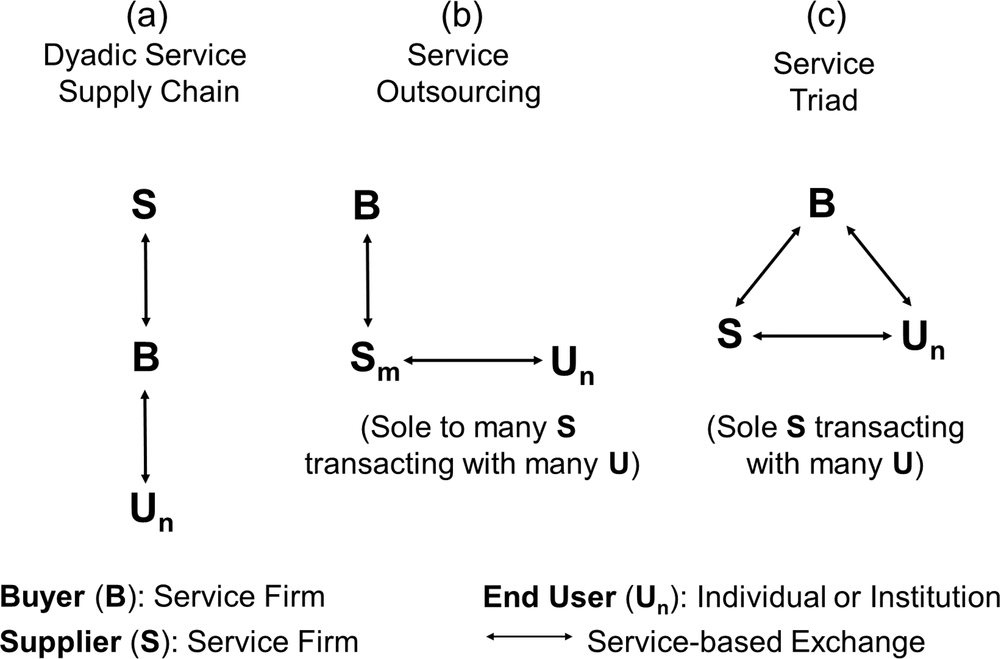
Figure 1 summarizes the relevant scholarly literature on service supply arrangements according to three overarching research streams.
Service supply arrangements
First, the purchasing and supply management literature has focused on dyadic service supply chains (see Figure 1a), where a manufacturer or a service firm contracts with a supplier to procure services to fulfill its end users’ service demands (Ellram & Tate, 2015; Giannakis, 2011). This stream is primarily concerned with traditional supply topics such as make‐or‐buy, global sourcing and risk, and contracting (Akkermans et al., 2019; Sumo et al., 2016; Tate & Ellram, 2012; van der Valk & Rozemeijer, 2009). For example, a commercial engine manufacturer (B) can use an external travel agency (S) to explore and finalize business travel arrangements for company personnel (B) to travel to its client's (U) facility and resolve an engine maintenance problem. In product service supply chain and service‐only supply chain settings (Wang et al., 2015), no direct exchanges take place between the service supplier (e.g., travel agency) and the service buyer's end users (e.g., client facility). In such “linear” service supply chains, the fulfillment of end users’ service demands, even when viewed from the customer's perspective (Maull et al., 2012), takes place across separate dyadic service‐based exchanges (Baltacioglu et al., 2007; Sampson, 2000; Wang et al., 2015).
Second, the literature on service outsourcing (see Figure 1b) has produced informative insights for service supply arrangements when the responsibility for managing the ongoing service arrangement with the buyer's customers is delegated to a professional service provider (Wuyts et al., 2015). A traditional example is call center operations for e‐commerce companies, where customers (U n ) communicate with an outsourced (and typically offshored) service provider (S m ) rather than with employees of the e‐commerce platform itself (B). In other words, the service exchange takes place between an external service supplier and the buyer's customers directly. For example, a hotel property owner (B) frequently outsources the operation and servicing of guests’ demands (U n ) to an external hotel management company or franchisee (S m ; Lin et al., 2020). When operations are franchised, the service buyer (property owner) does not directly engage with service end users but focuses on the operational, marketplace, and financial outcomes generated by the efforts of the outsourced service supplier (Eggert et al., 2017; Stavrulaki & Davis, 2014). Like the literature on dyadic service supply chains, the service outsourcing literature mostly focuses on the use of appropriate (contractual) control and the boundary of the firm (Lin et al., 2020; Niranjan & Metri, 2008; Wuyts et al., 2015).
Third, and most salient to our study, is the literature on service triads (see Figure 1c), in which a single service buyer (B) contracts a single service supplier (S) to deliver service to the service buyer's customers or end users (U n ; Wynstra et al., 2015). We focus on situations where the service buyer also offers services to its customers, complemented by a particular service delivered by an external service supplier. An example is the use of a third party for the reception desk and security staff on university premises, where the service supplier's employees (S) directly interact with students (U n ), which also receive core educational services delivered directly by the university (B). Hence, the suppliers’ service offering becomes a part of the larger service offering from the buyer to the end users, that is, a component service (Wynstra et al., 2006). In this context, there are two customers from the perspective of the service supplier (i.e., the buyer and the end user) and two service providers from the perspective of the service end users (i.e., the buyer and the service supplier). This gives rise to complex principal–agent problems (van der Valk & van Iwaarden, 2011). Suppliers may act opportunistically due to the presence of two principals: the contracting organization (service buyer) and the customers (service end users; Broekhuis & Scholten, 2018; Zhang et al., 2015). A stream of research has focused on issues of governance and control of the triad by the service buyer (Uenk & Telgen, 2019; van Iwaarden & van der Valk, 2013; van der Valk & van Iwaarden, 2011).
Service triad studies have not systematically investigated the operational exchanges between various actors, which is inconsistent with their emphasis on supplier–customer interaction as a defining feature. This paper aims to uncover the inner workings of the service triad from the level of the interaction between service suppliers and service end users. We argue that the service triad can be viewed as an operating entity: a multiactor service delivery system (Oliveira & Roth, 2012). A triad is effective if all three service triad members engage in mutually productive service‐based exchanges that result in the design and provision of apt quality service. It involves the acceptable matching of the provider's servicing endeavors and delivered services with a customer's demand requirements in a given operating context (see Golder et al., 2012; Roth & Menor, 2003). A service triad resembles a meso‐level supply ecosystem (Frow & Payne, 2018) in which actors operate interdependently and cooperatively (Letaifa, 2014) to cocreate service‐based value for all parties.
Theory development
We employ insights from SOM and business ecosystems theory to advance theorization on service triad operations. Our literature review informs three important considerations that provide direction for our qualitative inquiry, summarized in three suppositions that state our initial perspectives for the case study. Each supposition has at its core a single sensitizing concept for further research.
SOM researchers have traditionally focused on service design and provision responsibilities (Roth & Menor, 2003). They differentiate between the formation of the operational system given customers’ service needs and provider's service requirements and the functioning of that system to achieve quality outcomes that fulfill customers’ service demands. Any study of the formation and functioning of service systems must consider that both services and servicing (i.e., the intended offerings/outcomes and processual efforts) could be affected (Chase, 1996; Menor, 2015; Roth & Menor, 2003). Interest in the formation and functioning of an internal operational system has been extended to the study of service delivery networks and service supply chains (Field et al., 2018; Tax et al., 2013). SOM scholars have examined the provider's and customer's roles in service formation and functioning based on different service characteristics (Bellos & Kavadias, 2019; Chase, 1981; Ponsignon et al., 2011). This literature emphasizes that the service delivery system depends on the service concept, typically differentiating between different types of services. Yet, they have not considered service triads, in which service includes three parties with distinct customer and provider roles (Abboud et al., 2021; Ekman et al., 2016), which arguably constitute a unique service concept and context. These SOM insights allow us to formulate the following supposition that underlies our qualitative inquiry:
To advance theorization on service triads, particularly from an SOM perspective, we advocate looking beyond the stylized structure and governance of the triad. The service triad structure is no more than the temporary instantiation of ongoing exchange processes (paraphrasing Langley et al., 2013, p. 5). The relationships between members of the service triad are formed through a series of specific interactions. Hence, rather than treating the triad merely as a special supply arrangement with relationships among the actors, we focus on “what happens between parties in the relationships” (Gummesson, 2006, p. 342), namely, interaction. Within a relationship, a series of exchanges take place that leads to the establishment of the relationship itself, its continuation, to expend service efforts, share resources, or resolve conflict. More generally, an exchange is any act of deciding or doing between any two or more service triad members (Ekman et al., 2016; see also Sampson, 2000; Vargo & Lusch, 2004). These exchanges are like events that happen at a specific time and place and can provide a more grounded understanding of the day‐to‐day realities of operating service triads. In our qualitative inquiry, we thus focus on the sequence of exchanges that underlie the structure of service triads.
Studies on business ecosystems describe how groups of interacting firms, from a structural relationship standpoint, depend on each other's resources and activities to create network value (Adner, 2017; Jacobides et al., 2018). Business ecosystems theorization has been employed to study service arrangements such as platforms (D. Li et al., 2019; Thomas et al., 2014) and supply networks (Ketchen et al., 2014) but has not been used to investigate service triads. A service triad can be viewed as a “collaborative arrangement through which firms combine their individual [service] offerings into a coherent, customer‐facing solution” (Adner, 2006, p. 98). The objective of a “service‐triad‐as‐ecosystem” (cf. Akaka & Vargo, 2015) is to reach multilateral agreement among the service triad members on positions in the triad and flows between them (Adner, 2017) to achieve its collective value creation potential. This collective, collaborative, and adaptive multilateral agreement can generate value for all interdependent parties. As Jacobides et al. (2018, p. 2276, italics in the original) highlighted, Ecosystems are defined by nongeneric complementarities at the group level, which means that while there is competition to attract profits within the ecosystem, there is alignment in how all members benefit from the success of the collective enterprise (i.e., the ecosystem) (Adner, 2017), and thus, gain advantage over another collective enterprise (i.e., another ecosystem) or a set of unrelated firms.
Hence, our qualitative inquiry, consistent with business ecosystems theorization, studies how interactions in a service triad generate alignment in the activities of each member. Alignment here refers to the extent of agreement with a commonly understood configuration of activities between the members (i.e., positions and flows, cf. Adner, 2017 p. 42). This multilateral alignment extends beyond the language available to describe bilateral relationships. The ecosystem of the service triad members highlights the critical interactions across relationships. We cannot understand the delivery of service by the supplier to the end user without capturing the role of the service buyer in the process.
We aim to uncover how service triad members, akin to networked social actors, engage in formation and functioning exchanges to fulfill customers’ requirements and demands and configure an aligned structure of operational exchanges to realize the mutual value (Jacobides et al., 2018; Suddaby, 2006). To understand the formation and functioning of service triads, we analyze the inputs provided by all parties, map member‐to‐member exchanges, and study their alignment on the configuration of activities.
METHODS
We conducted a qualitative inquiry based on case studies of four service triads. Our inquiry is operationally relevant due to its information richness and the rigor of inductive analysis (Barratt et al., 2011; Charmaz, 2014). Given the importance of exploring how service triads are managed as an operating entity, of which little empirical insight currently exists, we can derive a theorizing narrative arc based on our analysis of illustrative case studies (Ketokivi & Choi, 2014; Shepherd & Suddaby, 2017). Our study offers a novel phenomenological perspective on service triads and an initial abstracting of formation and functioning insights to a theoretical level (Shepherd & Suddaby, 2017).
Case selection
We pursued a combined purposeful sampling strategy to select credible cases (Patton, 1990; Ridder, 2017; Yin, 2018). Consistent with the logic of theoretical sampling, which “simply means that cases are selected because they are particularly suitable for illuminating and extending relationships and logic among constructs” (Eisenhardt & Graebner, 2007, p. 27), our approach included two steps. First, we employed intensity sampling to identify a broad set of service triads from a specific context, that is, information‐rich cases that manifest the outsourced triadic supply arrangement (Patton, 1990, p. 171). Universities are representative contexts for other service‐based operations, as they procure and produce services to fulfill varying stakeholder demands. Universities in the Netherlands outsource various core and supplementary services, including catering, cleaning, and maintenance. They are an information‐rich context for qualitative inquiry into outsourced service arrangements for supplementary offerings (Marcus, 2021).
We first identified credible cases based on the operating characteristics provided above in close cooperation with purchasing directors and managers of Dutch public universities (13 in total) during and immediately following a Dutch University purchasers’ event they attended. This led to an initial list of 10 qualifying cases (Yin, 2018), with service triads that were being innovated or had recently been reconfigured to study processes related to formation and functioning. These cases varied in terms of the type of service offering (e.g., food and beverage, print, maintenance), between newly outsourced service or recontracted service with current or new service suppliers, and with varying extents of new services and servicing requirements. In this specific sense, our cross‐case findings allowed us to observe and compare the processes to be theorized and test and deepen emergent theoretical ideas (Langley et al., 2013).
Second, we selected four case studies to maximize variety in the underlying, descriptive characteristics to identify and explain the underlying operational workings of service triads (Patton, 1990, p. 177 ff.). The four cases are similar, as they represent service triad arrangements for university component services (Wynstra et al., 2006); however, they vary in terms of the type of service provided (print, food, event catering, insurance). They are based at four universities to allow for sufficient operating variance and representativeness of the broader type of member‐to‐member exchanges of phenomenological interest. The other six cases initially considered were dropped from our analysis because they were homogeneous in nature to the service triads included in our study sample.
Data collection
To study contemporary processes of service triad formation and functioning in depth, we relied on interviews and secondary archival data (Langley et al., 2013). We interviewed key informants for each service buyer during an on‐site visit, often starting with the purchasing manager and contract manager or another responsible staff member (typically from another university department). Subsequently, we conducted interviews on the service supplier side with key informants such as sales/account managers or operational managers. As the interviews were conducted sequentially, we were able to follow up on initial case findings and triangulate the data by including multiple perspectives on each case (Barratt et al., 2011; Voss et al., 2002). Some follow‐up interviews resulted from the identification of new interviewees during earlier interviews or focused on emerging topics. In a later round of interviews, we focused on the evaluation of service performance and customer satisfaction, which also led to secondary data for two out of four cases. Appendix A in Supporting Information provides an overview of informants and interviews per case.
The interviews were semistructured, open‐ended, and conducted with one or two key informants at a time. The interviewees were informed beforehand about the general purpose of the study and the topics to be discussed. The interview protocol for each case study was based on a template derived from sensitizing concepts derived from the literature review (see Appendix B in Supporting Information) and customized based on an initial understanding of each case. The main questions that drove our qualitative inquiry were: What is the service? How did it come about? We asked informants to recall events (e.g., exchanges) and processes (e.g., supplier selection), provide examples, and, if needed, consult case documents or notes before responding. We conducted 17 interviews across the four cases, the formal transcribed part of which lasted, on average, 41 min. The interviews were audio‐recorded and subsequently transcribed verbatim. The interview transcripts (208 pages) and interviewer notes are the main data source for this qualitative inquiry. Additional data were gathered from firm documents, project descriptions, publicly available news, and other media for triangulation (see Appendix A in Supporting Information).
Analytical approach
We followed a grounded theoretical approach (Charmaz, 2014) to analyze the collected data, involving data reduction, data display, and conclusion drawing and verification (Miles & Huberman, 1994). Examination of materials for each case led to the crafting of initial vignettes (Miles & Huberman, 1994). Next, we iterated between the data and our continuous sense‐making of the case data to answer the broader question: “What is this a case of?” (Tsoukas, 2009, p. 298). We developed abstracted visualizations and exchange coding that were not part of the meanings and concepts our informants held.
Similar to other qualitative studies, we used a three‐step approach to data coding (Gioia et al., 2013; Sjödin et al., 2020). Given our interest in understanding how service triads are operationally managed, we first conducted an in‐depth analysis of the rich case data to code first‐order concepts. For example, key informant statements such as “to serve customer demands in the long term, large investments would be required in the machinery” (P1) were coded under the categorical descriptor Lower Operational Cost. Our first‐order coding effort, entailing several in‐depth iterations through the data, resulted in 14 first‐order codes. The second step was identifying links between several first‐order codes to derive second‐order themes related to existing scholarly insights and theory. For example, the first‐order code Lower Operational Cost was categorized as an economic value driver of the innovated service triad, following Smith and Colgate's (2007) classification of customer value into economic (cost/sacrifice), functional (or instrumental), symbolic, and experiential value components. The third step involved aggregating second‐order themes into relevant phenomenological dimensions critical to theorizing about the nature of operational member‐to‐member exchanges observed in the studied service triads. Figure 2 presents the data structure of first‐order codes, second‐order themes, and aggregate dimensions.
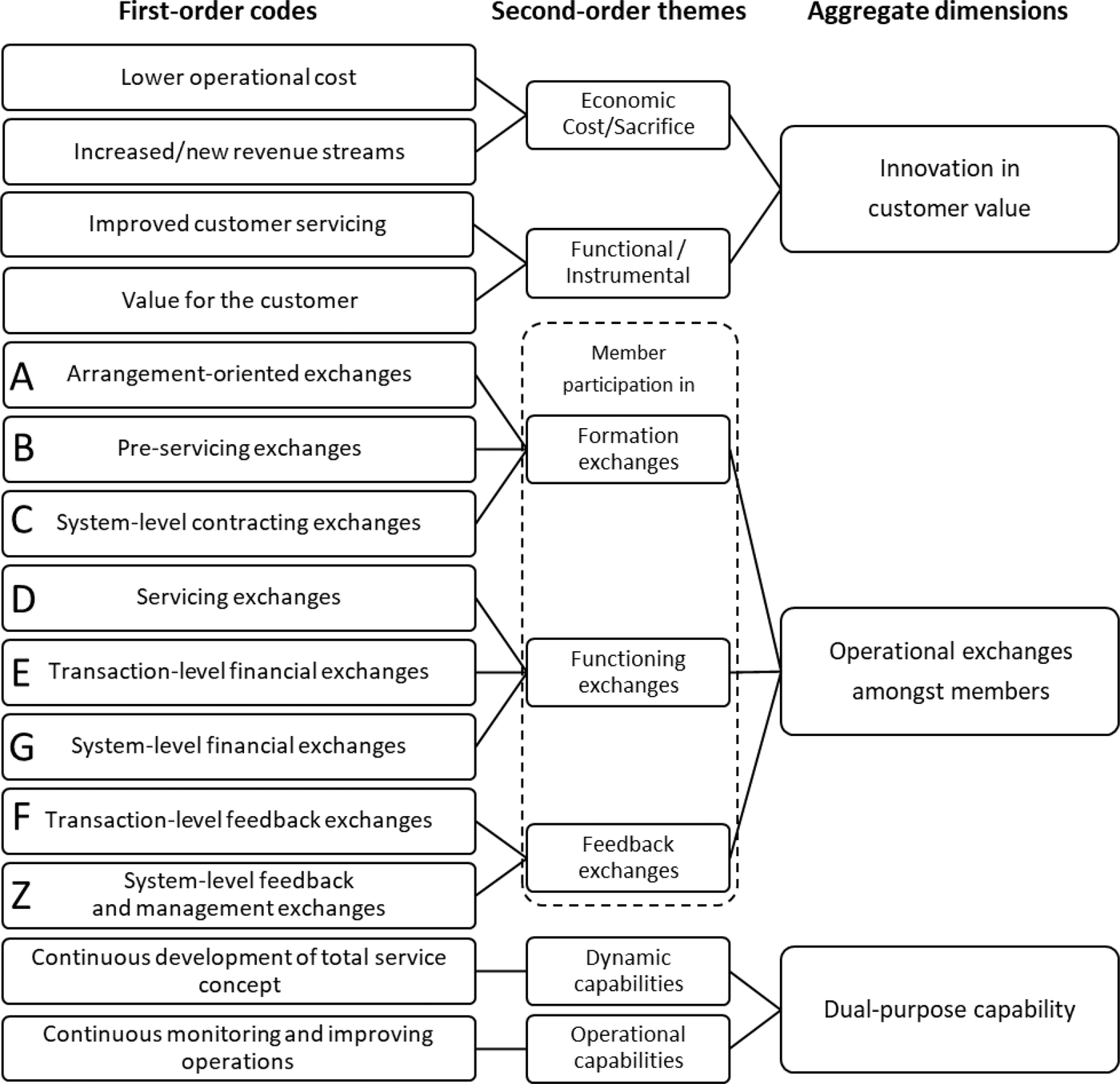
Data structure. Note: A–Z refer to codes describing member‐to‐member exchanges in the service triad.
The purpose of the lexicon of exchanges in the middle part of Figure 2 is to standardize first‐order codes across the cases to refer to the same type of members’ exchanges across each of the cases: For example, label “A” exchanges refer to arrangement‐oriented exchanges in all cases. Based on our primary and secondary data, we were able to distill the member‐to‐member interactions underlying the formation, functioning, and feedback exchanges occurring in our studied service triads (see, e.g., Figure 3). While our investigation started with the notion of formation and functioning (see Supposition 1), our qualitative inquiry slowly revealed the importance of structuring the process into a phase for preservicing (formation), servicing (functioning), and postservicing (feedback) activities. Hence, the notion of feedback exchanges was derived inductively from our case data.
We only identified exchanges that were corroborated by at least two data sources from interviews or secondary material. Secondary material was particularly useful for an accurate understanding of the operating details of the service triad. For example, secondary material such as flyers, the print supplier's website, and the site visit provided the most detailed information about the functioning of Alpha's on‐campus print shop. Appendix C in Supporting Information includes details of the exchanges in each of the four cases and a chronological overview and supporting data sources for each exchange. Iterating through the underlying case documentation, we produced a lexicon for coding these exchanges and created visual representations to capture them to facilitate further analysis (Miles & Huberman, 1994).
The aggregate dimensions emerging from our qualitative analyses point toward three main areas for operational theorizing about service triads: the nature of customer value innovation (Smith & Colgate, 2007), the categories of operational exchanges in which service triad members participate (Ekman et al., 2016; Field et al., 2018; Jacobides et al., 2018), and the capability that can transform members’ feedback into innovation and improvement (Helfat & Winter, 2011). Appendix D in Supporting Information provides representative quotes from key informants’ interview transcripts that support our qualitative data structure.
Double‐headed arrows represent bidirectional exchanges (e.g., D1 in Figure 3b). Single‐headed arrows represent unidirectional exchanges (e.g., Z t in Figure 3c). Arrows with a thick closed head represent financial exchanges (e.g., E1 in Figure 3b). Arrows are curved if they bring inputs from two members together to inform a third (e.g., A2 in Figure 4). In the text and figures, Z t ‐1 and Z t , respectively, refer to system‐level feedback and management exchanges that occurred prior to (re)formation (i.e., t − 1 refers to the time before the current) or immediately and continuously following the innovated service triad's operations (i.e., t refers to the current time), Formation—A: arrangement‐oriented; B: functioning‐supporting pre‐servicing; C: contracting. Functioning—D: service delivery and encounter; E: financial–transaction level; G: financial–system level. Feedback—F: feedback–transaction level; Zt: feedback and management–system level.
CASE STUDIES
Table 1 provides a descriptive summary of our four service triad cases. Service performance was not collected in two cases and was collected using different methods and measures in the other two cases, rendering any direct comparison of service performance across the cases meaningless. In this section, we describe our four innovated service triad cases. We provide a detailed account for case Alpha to illustrate our analytical procedure, especially for coding exchanges. Our inductive analyses proceeded similarly for the remaining three cases.
Summary of cases
Alpha—Print services
This university's print‐related services have traditionally been provided through an in‐house on‐campus print shop. However, they are now outsourced to an external service provider (i.e., service supplier) to reduce operational printing costs and improve resource productivity as part of a larger program to build better supplementary support services at that university. Using the lexicon of exchanges, we can now describe the operational exchanges that occurred in this innovated service triad as depicted in Figure 3a‐c.
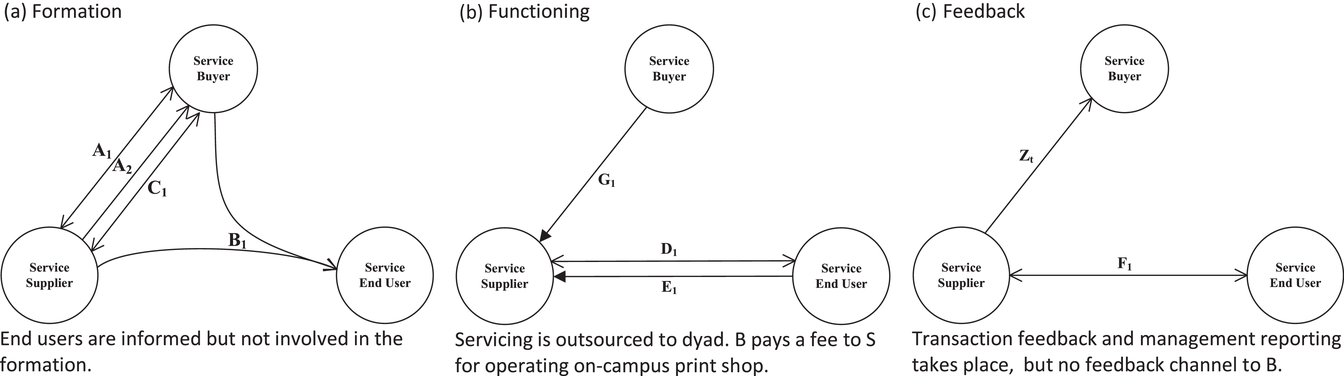
Alpha case.
The university engaged with its existing printing equipment supplier to discuss outsourcing the print shop services (exchange A1). A separate business unit of this printing equipment supplier responded with a novel servicing proposal for a combination of on‐ and off‐campus printing to improve efficiency (A2). Hence, the supplier changed from a resource/technology provider to a service supplier. End users were informed about the new service arrangement and its underlying service delivery system by the service buyer and service supplier (B1) using leaflets, workshops, and training. After substantial efforts to specify the required print services and servicing in detailed workflows and several months of negotiations between legal departments, the contract was signed after servicing had already started (C1).
Under the innovated outsourced service arrangement, most print jobs are ordered through an online portal, printed at a service supplier's off‐site production facility, and delivered directly to the end user (D1). Service end users (e.g., students) pay the service supplier directly for each transaction from their university card accounts or through online banking (E1). The service buyer compensates the service supplier for staff costs (operator hours) that are not directly related to specific transactions (G1). These include staffing the on‐campus print shop and servicing university departmental demands such as graphic design for the university's marketing and communication material. Some printing‐related services, such as graphic design, are still offered through the on‐campus shop, allowing direct service end user and service supplier interactions for difficult print jobs (D1) or customer feedback (F1). The service supplier produces management reports for the service buyer, including print usage and production data (Z t ). Customer satisfaction data have not been measured since the start of the servicing arrangement.
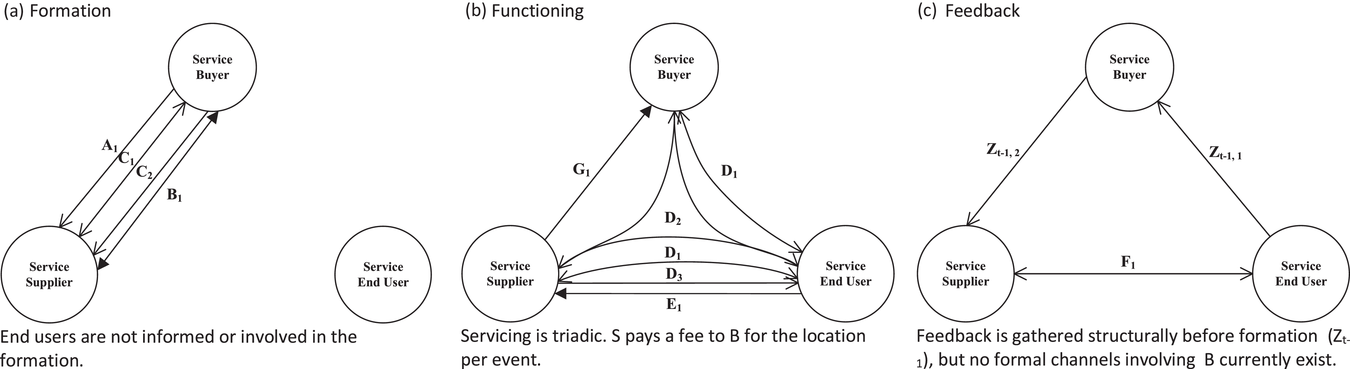
For the remaining cases, inductive analyses proceeded similarly to the Alpha case. Hence, for these other cases, we started by distilling the member‐to‐member exchanges in models similar to those reported in Figure 3 (see Figures 4–6). Appendix C in Supporting Information contains a table with a detailed overview of the respective member‐to‐member exchanges for all the cases.
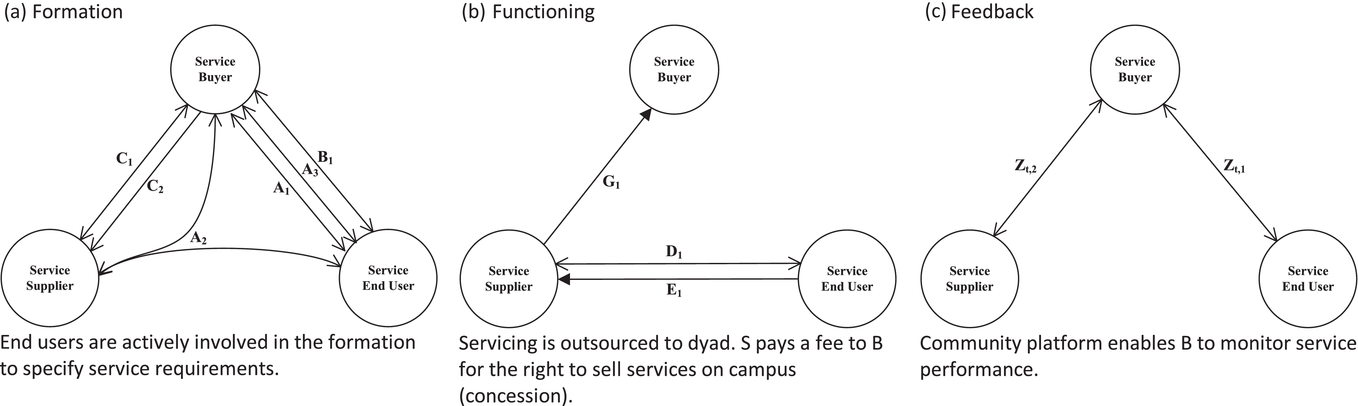
Beta case
Gamma case
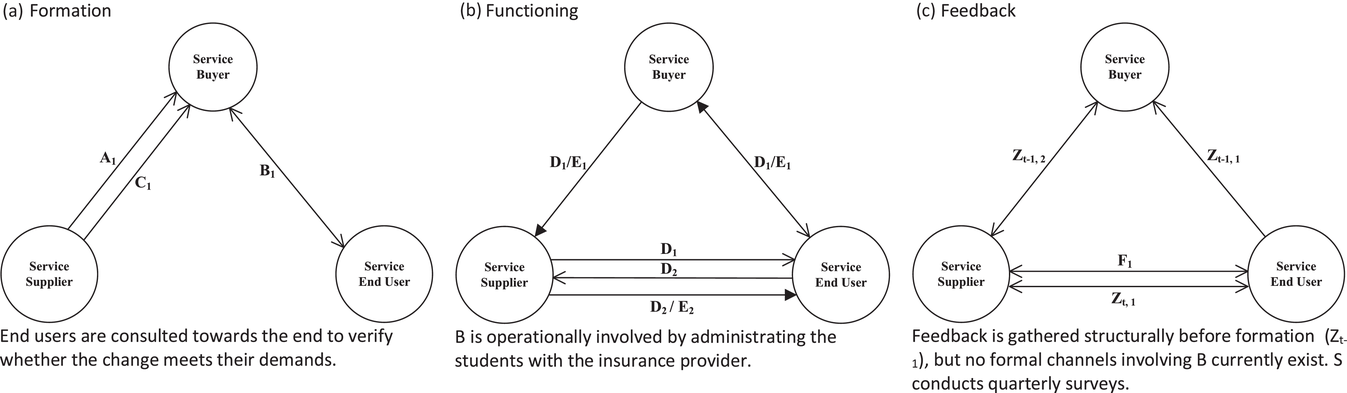
Delta case. The functioning exchanges D1/E1 and D2/E2 are a single functioing exchange including both registration and payment, or claim handling and payment, respectively.
Beta—Food and beverage
This university's food and beverage services include canteens, coffee stalls, and coffee machines across several inner‐city and campus locations. The trigger for forming a new service supply arrangement was the upcoming end‐of‐contract date with the previous food and beverages service supplier. A lengthy formation process was started to achieve higher service quality functionality and outcomes and improve customer satisfaction. Specific service quality improvements desired included internationalizing food offerings, ensuring service sustainability, and including local suppliers in the delivery system.
The service buying university formally engaged student end users to define quality and design a system to deliver this quality using surveys and focus groups. The university and students visited several other service suppliers supplying elsewhere, who were, in turn, invited to submit a vision (Request for Proposal) and later a formal tender offer (Request for Quotation). Although the university contracted with a primary outsourced service provider, this supplier was required to subcontract with local establishments to offer end users additional supplementary services. An example was a popular local coffee shop operating a coffee cart in the garden of one of the campus buildings.
As a result of this innovative service triad, end users can use a selection of services within a single location and pay the primary or subcontracted service supplier directly for each transaction. The primary service supplier pays rent and a revenue‐based kick‐back fee to the service buyer. The primary service supplier has complete insight into its subcontractors’ transaction data and subsequently shares this information with the service buyer. Furthermore, the service buyer has built a community platform to actively seek service experience feedback from its end users, which is processed by two community managers and shared with the service supplier. Detailed customer satisfaction data are gathered through annual surveys executed on the service buyer's behalf.
Gamma event catering
The Gamma case revolves around a botanical garden's event catering and cafeteria services owned by and operated as a separate university division. For this case analysis, we focus only on the event catering service side of the business. Events include weddings, company meetings and retreats, and parties. The service supplier's business controller demanded the innovation of this service triad after an 8‐year contract with the previous outsourced service supplier. This was seen as an opportunity to enhance the quality of the service to create higher‐level events that would attract more and more prestigious clients. Several service suppliers were invited to present a proposal—similar to but less formal than in the Beta case. The service buyer and the new service supplier collaborated to cocreate the physical servicescape and coinvest in operational resources such as kitchen equipment.
The event planning was cocreated by the three service triad members to coordinate the setup, scheduling, the design of the venue and the catering, as well as any other services required. Under this arrangement, a service end user looking to organize an event can reach out to either the botanical garden (i.e., service buyer) or the service supplier, but both need to respond to schedule the event. Event catering is executed solely by the service supplier. The service end user pays the service supplier after the event, who in turn reimburses the service buyer for the use of the venue. Real‐time feedback can flow directly between the service end user and the service supplier during or immediately following an event. No formal mechanism for measuring customer satisfaction was employed by either the service supplier or service buyer.
Delta—Insurance
The Delta case revolves around an insurance package covering healthcare, travel, fire, and theft that the university offers its international students. The redesign of the insurance package was triggered by an unscheduled meeting at a conference between a university psychologist and the current service supplier's account manager. They discussed how the current insurance package did not offer sufficient coverage for existing medical conditions and psychological care. The service supplier took the initiative to develop a better insurance policy for this and four other universities involved in this cocreation effort. After two rounds of concepts and proposals, the university, as a supplementary service buyer, decided to consult its student community body (i.e., service end users) to check that the new insurance policy met their demands and provided a better trade‐off between coverage benefits and cost.
Under this arrangement, all registering international students are invoiced for tuition and insurance premiums by the university (i.e., service buyer), who then registers the end user with the service supplier and pays the premiums. The service supplier sends the registration package directly to the service end user. A second phase starts when the service end user wants to submit a claim. The service supplier handles the claim and pays the service end user back if the claim is eligible. Subsequently, various feedback and complaint exchanges may occur between the service supplier and its end users. The service supplier established a formal customer satisfaction survey with quarterly reporting.
QUALITATIVE FINDINGS
Several overarching descriptive observations emanate from analyses of the case data depicted in Figure 3. We specify these observations before elaborating our exchange‐based theorization on the service triad as an operating entity.
First, the service buyer intermediates all members’ exchanges in the service formation phase (see Figure 3) but not in the service functioning phase, where servicing can be dyadic or triadic. In the formation phase of the service triad's operation, the service buyer acts as the bridge between the other parties in establishing operating relationships and orchestrating different roles and responsibilities, consistent with business ecosystem theorization on the role of the focal actor or hub in innovation cycles (Adner, 2017; Jacobides et al., 2018). Specific to our qualitative inquiry, the service buyers we examined contract their respective service suppliers to render service on their behalf, and thereby, our cases represent buyer‐initiated triads (Wynstra et al., 2015). In the university service triad setting, the service buyer controls the supplier's access to the service end users and selects and contracts suitable service suppliers to provide supplementary service to its own customers (e.g., faculty, staff, students), similar to shop‐in‐shop department stores or shopping malls (Broekhuis & Scholten, 2018; Zhang et al., 2015).
Second, all of our cases include multiple and diverse financial transactions that reflect the capturing of value‐in‐exchange (Grönroos, 2011; Sjödin et al., 2020). Financial exchanges vary even within our set of cases, and contexts play an important role in the coordination and multilateral alignment of operational positions and flows in the examined service triad ecosystems (Adner, 2017; Cook & Emerson, 1984). In the Alpha case, the service buyer only pays the service supplier for the service concession arrangement, and the service end users pay the supplier for its servicing and services. However, in the Beta and Gamma cases, the service supplier pays the service buyer for the right to render servicing (and sell services) to the service end users. In the Delta case, the service buyer only plays an administrative role in the financial arrangements of the service triad by forwarding the invoiced insurance premium to the service supplier.
In the next section, we further analyze our qualitative inquiry results to elaborate on the management of service triads when viewed as an operating entity. We refer to specific exchanges (see Figure 2 A–Z) and interviews or other case material (see Appendix A: P1–17; D1–15, in Supporting Information) to illustrate and provide support for our emergent service triad operations theorization.
Service triad formation for value creation
Our cases allow us to study why service triad innovations are instigated—especially those involving new services and servicing arrangements. In general, we observe that the previous service supply arrangement resulted in an unsatisfactory level of value for both service triad customers—that is, service end users and the service buyer. The formation of the service triad focused on improving the generated value of the services and servicing (Dyer et al., 2018). In our cases, customer value generation can be defined based on economic or functional aspects (see Smith & Colgate, 2007).
Economic value generation typically considers minimizing the costs and other sacrifices that need to be made (Smith & Colgate, 2007). Increasing value creation triggered the formation in the Alpha and Gamma cases. For example, in the Alpha case, the service buyer wanted to achieve greater economic value: In the long term, we would need large investments in the machinery […] to serve customer demands. So we asked [the provider] … do you want to run the department under our supervision? And will you help us to identify what can be simplified so that we don't need to make investments? [Alpha, P1]
In contrast, the Beta and Delta cases focused on improving the functional value of the service supply arrangement. Functional value generation concerns the extent to which a service has desired characteristics and provides utility (Smith & Colgate, 2007). For example, in the Beta case, the considerations of the service buyer revolved around fulfilling end user demands, hence the functional value focus of service: Our contract is about to end. We want something different. We have to consider customer demands. However, what are we going to do? […]. We now have a contract that doesn't work. I have received signals from the organization that it was not fulfilling demands. [Beta, P5]
Related to the Z
t‐
1 feedback exchange in Delta (see Figure 6c): We noticed that the insurance coverage did not fulfill all our demands. It became increasingly clear that, for example, preexisting conditions were excluded in the contract. [Delta, P17]
The value improvement goal as expressed by the service buyer is linked to the frequency of exchanges with the other two service triad members, particularly during the formation phase. We observe that when the main goal of the (re)formation of the service triad is to create economic value (as in the Alpha and Gamma cases), the service buyer instigates more formation exchanges with the service supplier, and the service end users are not or are only minimally involved during formation exchanges (see Figures 3a and 5a). When viewed from the perspective of a coevolving business ecosystem (Adner, 2017), the service triad is not configured for the mutually beneficial creation of value for all members in these two cases. Economic value is defined exclusively in the buyer–supplier relationship. Service end users are excluded from the formation process. The service buyer and service supplier align their positions and flows within the service supply arrangement for their own bilateral economic benefits and hierarchically capture rather than create service triad ecosystem value multilaterally (Jacobides et al., 2018). For instance, in the Alpha case, all interviewees talked extensively about the process and interactions between the service buyer (contract manager, purchaser) and service supplier (account manager). However, none referred to formation exchanges with end users (e.g., students) until after the service was online, and the users had to be informed about the changes. The exchanges between the service buyer and service supplier focused on reaching a better cost/benefit balance without more upfront investments by the university but did not concern or consider the position of end users.
In contrast, if the main goal of the innovation is to generate functional value, as in the Beta and Delta cases, more exchanges take place between the service buyer and service end users (see Figures 4a and 6a). In the Beta and Delta cases, service end users were dissatisfied with the levels of functional (and experiential) value. Customer dissatisfaction (in the Beta case: contractually insufficient customer satisfaction, exchange A1 in Figure 4a) and unfulfilled customer needs (in the Delta case: uninsured existing and psychological conditions, exchange Z t ‐1 in Figure 6c) led to reconsideration of the services and servicing choices underlying the service triad arrangement. For example, the head of the international office for Delta explains: “We want them to be adequately insured for healthcare while studying in the Netherlands for 2 years” [Delta, P14].
The service triad ecosystem underlying these two cases operates for the multilateral creation of functional value, with the service buyer playing a lead role in the service triad by engaging with the service supplier but also with service end users in the coordinated and coevolving (re)formation of the service triad (cf. Ketchen et al., 2014). These exchanges inform the service triad members about unmet customer demands and achieve greater value creation through the collective coherency of members’ exchanges with the ecosystem's operational structure (Tsujimoto et al., 2018).
We present the following proposition:
Our description of how interactions emanate from the value creation of service triads provides a way of studying the exact processes involved in value creation in a supply network context (Grönroos, 2011). In a service triad, value can be cocreated in multiple customer spheres. Value cannot simply be decomposed into value coproduction and value‐in‐use (Ranjan & Read, 2016) as these spheres overlap and interact. Following previous research (e.g., Ekman et al., 2016), our theoretical proposition links precise definitions of value creation to the emergence and evolvement of service networks.
Service triad functioning and service buyer engagement
In the second operating or functioning phase of our studied service triads, service delivery depends on the productive processing of triadic member inputs. Critically, for the functioning of service triads, these inputs do not originate from just two actors, as in the dyadic service supply chain or service outsourcing arrangements, but from all three triad members (Wynstra et al., 2015). Although theorization on the value cocreating roles of the service supplier and the service end users in the outsourced service context exists (De Pourcq et al., 2020; X. Li et al., 2016), our investigation additionally highlights the important intermediating and coordinating role of the service buyer (Kalra et al., 2021). As such, we theorize on the service buyer's co‐ordinational role in triad functioning.
The service buyer's outsourcing does not necessarily imply the transfer of all delivery responsibilities to a more capable service supplier (cf. Van Iwaarden & Van der Valk, 2013). We observed that service buyers can also be involved in service delivery at an operational level. In some cases, the configured service triad requires that the service buyer continuously engage in service provision. In other cases, a service buyer's intermittent and indirect enabling approach suffices for the appropriate functioning of the triad. Figures 5b and 6b show that servicing is inherently triadic in the Gamma and Delta cases. For example, in the Delta case, the service buyer signed up service end users for insurance packages and invoiced them to ensure requisite payment: “We work with one insurance provider, […], and we take out insurance and invoice our students” [Delta, P17].
The service buyer's continued involvement and direct interaction in the service triad's functioning took place in two cases (Gamma, Delta). In both cases, the triad rendered services that directly complemented a core university offering. In the Gamma case, being the venue of choice was an important aspect of the botanical garden's success. In the Delta case, ensuring safe and healthy residence for a large population of international students was crucial. In both cases, the involvement of the service buyer did not occur by purchasing or contract managers but by continual and direct engagement of the responsible entities at the universities. In the Gamma and Delta cases, these entities included the Head of Public Affairs and the Head of the International Office. For example, in the Gamma case, the service buyer and service end user cocreated the organized events, and the service supplier provided the catering services for dinner parties, business meetings, and so forth. “The Hortus rents out the location, not us. Therefore, they get the fee for the location. We are involved later to talk about the event catering” [Gamma, P13].
In the two other cases, the service buyer was not directly involved in transaction‐level functioning exchanges, although there was some continued interaction (particularly related to management reporting and finance) to ensure the stable functioning of the service triad. Figures 3 and 4 show that the servicing is inherently dyadic in the Alpha and Beta cases. In terms of value realization, the service buyer enables services between the other two members through intermittent financial exchanges (G1 in Figures 3b and 4b) but not by coproducing the service itself. This is further illustrated in the Alpha and Beta cases, where staff from purchasing and contract management (e.g., facilities and Information Technology (IT)) were responsible for the operational management of the service triad. In the Alpha case, the service supplier provided management level reporting on the operational status of the machines and servicing and received financial support for ongoing service operations from the buyer in return, signifying a more passive and indirect engagement of the buyer in the provision of service.
We observe and describe a replicated pattern where the service buyer maintains an intermediating and coordinating role during service provision. The functioning of the service triad depends on the continued and ongoing involvement of the service buyer, which can be active or passive, direct or indirect, intermittent or episodic. Nonetheless, it entails a focused engagement in coordinating service triad operations by the lead firm. Across our cases, inputs from the service buyer continue to play a role during service delivery.
As a result, we offer the following proposition:
Prior service triad literature highlights a diminishing role of the service buyer when a service interaction is outsourced to a capable supplier, risking the supplier circumventing the buyer and establishing its own relationship with the end users (cf. “bridge transfer”: Li & Choi, 2009; Perdikaki et al., 2015). In dyadic and service outsourcing arrangements, the role of the service buyer can be limited to contract design and contract management. However, in a service triad context, aligning members’ goals and responsibilities is difficult due to the presence of not just two but three members of the supply arrangement. The role of the service buyer is not managerially limited to planning the service triad and controlling the service supplier's performance, that is, during preservice arrangement and postservice monitoring (Van Iwaarden & Van der Valk, 2013; Zhang et al., 2015). The observed role of the service buyer as the focal lead in the service triad ecosystem highlights how interdependencies with other parties require coordination (Ketchen et al., 2014). The service buyer “can assume provider and beneficiary roles simultaneously” and “may be active and/or passive with respect to their participation” (Ekman et al., 2016, p. 52). Previous research has predominantly highlighted the lead firm's role in the emergence of the ecosystem (Jacobides et al., 2018; i.e., the formation of the service triad). Our investigation reveals an important ongoing operational responsibility that further strengthens the stability of the triad ecosystem (i.e., the functioning of the service triad).
Service triad feedback exchanges fostering dual‐purpose capability
Our cross‐case analysis identified a third type of operational exchange revolving around the gathering and processing of service triad feedback. Specifically, we observed two distinct forms of service triad feedback exchanges. First, three of our cases display some form of direct, transaction‐level service feedback exchanges (labeled F in Figures 3c and 6c). These feedback exchanges identify whether the service supplier's intended quality service was realized (cf. Golder et al., 2012). In the Alpha, Gamma, and Delta cases, these direct transaction‐specific feedback exchanges (F) primarily relate to the efficacy of rendered servicing and services. However, they also present an opportunity to improve the existing service delivery system. For example, consider the following quote in the Gamma case: “Those points were picked up immediately. It's a continuous process. … If we get feedback that something wasn't ok, we react immediately” [Gamma, P13]. In other words, direct transaction‐level feedback exchanges can inform “feedback‐to‐functioning” improvements of the operational elements and workings of the current service triad.
Second, system‐level feedback exchanges are a way to acquire and aggregate diagnostic information, typically in the form of management reports (labeled Z in Figures 3c and 6c). Hence, these diagnostic data are no longer based on service transaction‐specific feedback, such as complaints, but relate to comprehensive information on the efficacy of service fulfillment and resulting satisfaction. For example, in the Delta case, the service supplier administered a user satisfaction survey that monitored several key performance indicators, such as customer (complaint) response time. In the Alpha and Gamma cases, the service supplier periodically gave the service buyer an overview of the functionality and operational performance of the service triad system based on categorical analysis of complaints and feedback and other performance indicators. This type of system‐level feedback exchange often occurs bilaterally between the service supplier and the service buyer. System‐level exchanges ostensibly inform “feedback‐to‐(re)formation” innovations of the operational elements and workings of the adapted and evolving service triad ecosystem (Letaifa, 2014).
We now discuss the unique operational configuration of feedback in the Beta case, where the service buyer takes principal responsibility for managing feedback. This case demonstrates the utility of possessing and leveraging a dual‐purpose capability for managing operational functionality and innovation. Beta's service buyer gathered and systematically analyzed transaction‐ and system‐level feedback by establishing a community platform on which service end users provide feedback, vote on new ideas, and offer suggestions: Therefore, we invited part of the organization, including students and employees, to take part and provide input. We had an online tool that continuously collected feedback. … And, additionally, we went on a couple of tours with students and employees. […] This time we didn't go to [university X], but to other locations that had already established this kind of service arrangement. [Beta, P5]
The service buyer also hired a “street manager” and community managers to actively engage with service end users via this platform and other communication means: “We developed a role, which we called community management. It was managed by facility services. It's a form of continuous research or dialog with the customer market—and it steered the total concept” [Beta, P5]. This enabled the service buyer to conduct research, establish priorities, and identify new food and drinks offerings. The following two quotes illustrate how the service buyer solicited end user demand insights that informed formation exchanges and collected service end user feedback, thus facilitating service triad functioning exchanges.
Hence, the responsibility for informing feedback‐to‐functioning operational improvements and feedback‐to‐(re)formation dynamic innovations in the Beta case rests with the service buyer, not the service supplier. The feedback‐based capacity of Beta's service buyer to understand and act upon current and future expectations of service end users simultaneously benefited the service triad in two ways. First, Beta's service buyer's feedback capacity, as depicted by exchange Z t ,1 in Figure 4c, reflected operational capability (Hitt et al., 2016; S. J. Wu et al., 2010) that supported the functioning of the existing service triadic arrangement. Second, that same feedback capacity, as depicted by exchange Z t, 2 in Figure 4c, also served as a dynamic capability (Teece, 2007) that enabled the innovation of the previous outsourced service supply arrangement. Such a dual‐purpose capability reflects an organization's leveraging of the same capability toward different value generation purposes (Helfat & Winter, 2011). These two goals can be identified as the continuous operational improvement and dynamic innovation of the operational elements and workings of the triad.
We contend that the dual‐purpose capability to leverage feedback exchanges represents a critical consideration related to managing the formation and functioning of the service triad. For example, in the Alpha case, the contract manager thought that the service buyer's organization's prior inability to formulate clear performance indicators and measure them directly from service end users (e.g., customer satisfaction) limited its ability to monitor and evaluate the service supplier's functioning outcomes. Further, we observe that in cases where service end users played an active role during the formation phase (Beta, Figure 4a; Delta, Figure 6a), the service triads were configured to directly capture customer satisfaction levels fostering subsequent transaction‐level improvement and/or system‐level innovation. The direct exchanges with end users observed during the formation phase, in particular when functional value is generated, are linked to subsequent feedback exchanges for further productive improvement and innovation.
Hence, we offer the following service triad feedback exchanges proposition:
This dual‐purpose capability identification fills a gap in the extant service triad literature on the importance of diagnosing service quality. In their seminal exposition of the new service development process, Johnson et al. (2000) included a dotted recursive relationship between full launch (the functioning phase) and design (the formation phase). They signaled that this feedback‐based recursive does not receive the same weight or attention as the direct links between service design (or formation) and service launch (or functioning). In prior work, Menor (2015) includes “diagnosis” as a critical consideration for service quality management but positions it outside the realm of SOM. To further formalize the role of diagnosis, our qualitative inquiry reveals that the ability to leverage transactional and systematic feedback can serve an important connecting role in service triad innovation.
DISCUSSION
Our qualitative inquiry of the formation, functioning, and feedback exchanges observed in four purposefully sampled service triads yields meaningful insights to advance scholarly theorization and managerial understanding about service triads (Roth & Menor, 2003; Wynstra et al., 2015). We created a lexicon for service triad exchanges (see Figure 2 and Appendix D in Supporting Information) and visual depictions of these exchanges (see Figures 3). We then examined the role of these member‐to‐member exchanges in service triads, focusing on value creation, buyer's coordination, and improvement and innovation. Summarizing our qualitative findings, we derived a model of the service triad that managerially highlights the interplay between our aggregate dimensions (see Figure 2) and their associated exchanges‐based propositions (see Figure 7). This descriptive operational model depicts the three phases of service triad operations with their associated exchanges, forming a clockwise closed‐loop service triad innovation and development process (cf. Johnson et al., 2000 and Sjödin et al., 2020). The four black boxes in Figure 7 display the theorizing propositions emanating from our exploratory analysis.
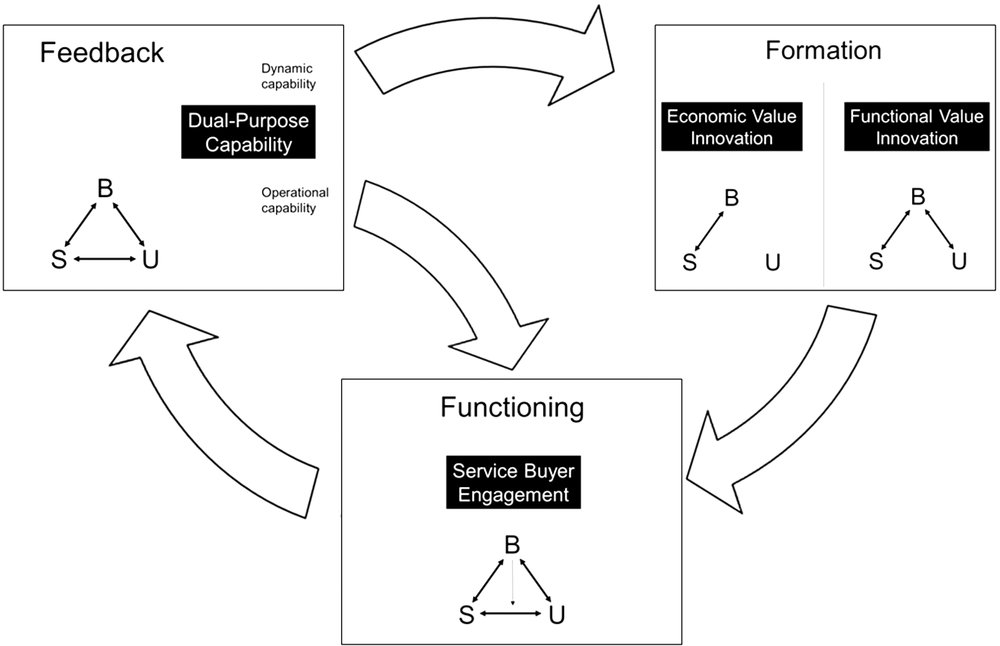
Descriptive operational model of the service triad
Starting from the formation phase, our comparative case analysis shows that the type of value generation influences the instigated exchanges among service triad members. Generation of economic value only involves interaction between the buyer and supplier, whereas creation of functional value also includes end users. Regarding the functioning phase, we observe that the service buyer engages in operational exchanges to benefit the triad as a whole. The service buyer is not absent from service delivery, as the conventional wisdom in the literature suggests. Although it can take multiple forms, service buyers remain engaged with the service triad's functioning even when contracting a service supplier to provide services directly on their behalf. The final consideration revolves around the central role of feedback to improve and innovate the service triad. We find that transaction‐level and system‐level feedback exchanges involving the service buyer enable the triad to improve service performance operationally and dynamically.
Theoretical and managerial implications
While configurational depictions and structural considerations of service triads are well‐documented in the extant literature, scholarly investigation of the operational workings of service triads is urgently needed. Our SOM and business ecosystems informed inquiry leads us to the following implications for theory and practice.
First, we draw attention to the exchanges‐based working of service supply chains by considering the service triad's formation, functioning, and feedback phases. Our analysis highlights that while our cases are structurally triadic, the system of operational exchange relations evolves between the formation, functioning, and feedback phases, leading to strikingly distinct visualizations in Figures 3. These figures show that no two service triads operate alike despite the commonalities between our cases (e.g., higher education setting, homogeneity in buyer and end user service requirements). As a result, the triadic structure of relationships (Figure 1) can be better captured at the level of member‐to‐member exchanges across the three phases of the operational cycle. The service design and provision literature may benefit from our inductively derived lexicon of operational exchanges, which is analytically generalizable to other contexts. In addition to other attempts at visualizing service operations (Sampson, 2012; Tax et al., 2013), our analytical approach focuses on the level of exchanges and provides a systematic way of analyzing “what is going on here.” This is exemplified in Proposition 1, which shows that generating functional value involves relatively more formation exchanges with service suppliers and service end users. Hence, focusing on member‐to‐member exchanges has allowed us to capture the variety of service triad operations using a uniform methodology.
Second, our research suggests viewing the role of the buyer in a service triad akin to a hub in an ecosystem: to draw together various resources from other members of the triad to create a productive service system. This includes a predictable commissioning role during the formation of the triad but extends into intermediating and coordinating roles during service functioning. Previous research on service triads primarily focuses on governance and contractual agreements between buyers and suppliers (van der Valk & van Iwaarden, 2011; Wuyts et al., 2015; Zhang et al., 2015). These streams of literature have been instrumental in developing opportunism‐informed theorization of the potential conflicts of interest between the three members of triadic supply arrangements. They typically focus on the governance role of the buyer (e.g., Kalra et al., 2021) but devote little attention to the continued coordination by the service buyer as the hub in the ecosystem. Service buyers may benefit from interpreting their role as a hub rather than as a service commissioner to bring together various players and resources, including (those of) the customers in the triad. We observed (Proposition 1) how focusing on economic value risks concentrating on the contractual relationship with the service supplier alone while leaving the service end users out of the equation. Furthermore, our qualitative inquiry points to the coordination and engagement of the service buyer (Proposition 2), even during the functioning phase in which servicing end users is outsourced to the service supplier (van Iwaarden & van der Valk, 2013). Hence, beyond governance and control, the service triad literature benefits from focusing on the critical interaction between service suppliers and service end users in relation to the service buyer's orchestrating role during formation, functioning, and feedback.
Third, our case studies provide rich empirical insights into the “inner workings” of service delivery networks comprising several distinct actors. Our findings show that multilateral alignment does not only take place through governance and control mechanisms but also operationally through multiple collaborative exchanges during the formation, functioning, and feedback of the triad. Although studying the level of interactions is hardly new in operations management (Chase, 1981; Ekman et al., 2016; Sampson & Froehle, 2006), our study shows how exchanges help to establish a collective understanding of the appropriate configuration of activities and members’ roles and responsibilities. This multilateral alignment benefits the triad as a whole and leads to the collaborative creation (and capture) of value (Adner, 2017; Field et al., 2018; Roth & Menor, 2003). Our examination of feedback exchanges (Proposition 3) reveals their role in fostering capabilities that can be leveraged to improve and innovate service triads. These feedback exchanges form the link between two otherwise sequential phases of formation and functioning.
Based on our findings, managers responsible for the formation and functioning of service triads can adopt the descriptive operational model of the service triad depicted in Figure 7 to achieve improved alignment of the multilateral relations in their service ecosystems or delivery networks (Adner, 2017; Tax et al., 2013). For example, when examining service triads that include a public sector service buyer, our qualitative findings can inform the critical operating role of those service buyers for feedback creation and later for customer value creation. An important call‐to‐action stems from our findings that buyers continue to coordinate and engage in ongoing functioning exchanges. These areas for management and improvement require a cyclical understanding of service triad innovation as depicted in our descriptive operational model. Specifically, operational insights gained through feedback need to be employed during the (re)formation phase of the service triad. This requires feedback information to be relegated to or through service buyers.
An aspect of our qualitative data is that only two out of four cases systematically collected service quality or performance data. The importance of contractual governance and monitoring of the service triad has been highlighted before (Kalra et al., 2021; Kreye, 2017; van Iwaarden & van der Valk, 2013). However, while contractually agreed upon, service performance data are not always collected in the cases. In the Alpha and Gamma cases, quality and satisfaction data were not collected in any year since these triads became operational (i.e., since 2016/2017), despite contractual and verbal agreements. Where functional value was generated, structural efforts were also made to collect satisfaction and service quality data from end users directly. In the Beta case, end users were involved most during the formation phase. Subsequent feedback exchanges were instrumental for sensing and shaping opportunities for improvement and innovation. The service supplier in the Delta case collected such data, but these were part of the reported management‐level information between the buyer and supplier. Our study draws the service buyer's attention to the importance of the operational management and alignment of service performance.
Limitations and future research
Our findings should be examined considering a few limitations inherent to our qualitative inquiry design. First, while operationally relevant primary and secondary data were gathered from multiple informants for each case study (see Appendix A, Table 1), we did not have access to specific service triad agreements or contracts. While the key informants’ operational realities were informatively represented through the data collected, examining the role of and consequences for contractual aspects of buyer‐initiated service triads (Nullmeier et al., 2021) on the nature of member‐to‐member operational exchanges is left for further research.
Second, our case study sample of university‐based innovated service triads may represent for some a constraint on the generalizability of our exploratory findings. Our higher education study context would have been more inferentially problematic had we initially proposed that our four cases constitute archetypes for the operation of service triads. Yet, the descriptive findings and theorization resulting from our qualitative inquiry are of general service triad research and managerial interest. As with many other types of service businesses (e.g., financial, healthcare, hospitality, professional), the service demands that universities encounter vary (e.g., mix, volumes, timings). It might not be productive to independently and directly attempt to fulfill them. This likely explains why universities are engaging in and increasingly relying on such service triad‐like arrangements (Marcus, 2021). Indeed, as with other types of service businesses, universities also need to fulfill a complex portfolio of customer or service end user demands that require multiple‐member exchanges if fulfilled through an outsourced service supply arrangement. In this specific way, the lexicon of exchanges and theorizing propositions may generalize to other service triad contexts.
Future research should aim to further empirically validate or enhance the analytical generalizability of our descriptive operational model of the service triad, for example, through additional literal or theoretical case study replication (Yin, 2018). Additional service triad studies could examine the specific nature of value creation (Grönroos, 2011), the participatory roles of members (Field et al., 2018), and the operational and dynamic capabilities (Helfat & Winter, 2011) that were observed from our qualitative inquiry. The discovery of the role of feedback exchanges and the fostering of operational and dynamic capabilities in a triadic or other multilateral context deserves further research attention. Dynamic capabilities combined with ecosystems theorization could illuminate the role of the service buyer or hub in any service supply arrangement.
Other service contexts where outsourced service arrangements are essential, such as in the sharing economy (Kumar et al., 2018; Li et al., 2019), may provide a fruitful avenue for advancing service triad operational insights. For example, the critically important role of the service buyer in service triad formation may be less prominent in other service contexts, such as with manufacturing service triads. In the sharing economy, the underlying shared service platform structurally resembles the service triad as depicted in Figure 1c but allows for many service suppliers to simultaneously fulfill the demands of many service end users (Apte & Davis, 2019; Kumar et al., 2018; Li et al., 2019). Both the manufacturing service triad and sharing economy service triads are structurally and contextually appealing for future investigations.
Footnotes
ACKNOWLEDGMENTS
The authors thank Michael Pinedo, the manuscript’s senior editor, and the set of reviewers for their professionalism exhibited throughout the review process. Their thoughtful and constructively critical feedback meaningfully improved the rigor and contribution of this research.
