






Abstract
This paper considers a single‐stage make‐to‐stock production–inventory system under random demand and random yield, where defective units are reworked. We examine how to set cost‐minimizing production/order quantities in such imperfect systems, which is challenging because a random yield implies an uncertain arrival time of outstanding units and the possibility of them crossing each other in the pipeline. To determine the order/production quantity in each period, we extend the unit‐tracking/decomposition approach, taking into account the possibility of order‐crossing, which is new to the literature and relevant to other planning problems. The extended unit‐tracking/decomposition approach allows us to determine the optimal base‐stock level and to formulate the exact and an approximate expression of the per‐period cost of a base‐stock policy. The same approach is also used to develop a state‐dependent ordering policy. The numerical study reveals that our state‐dependent policy can reduce inventory‐related costs compared to the base‐stock policy by up to 6% and compared to an existing approach from the literature by up to 4.5%. From a managerial perspective, the most interesting finding is that a high mean production yield does not necessarily lead to lower expected inventory‐related costs. This counterintuitive finding, which can be observed for the most commonly used yield model, is driven by an increased probability that all the units in a batch are either of good or unacceptable quality.
INTRODUCTION
We consider a single‐stage make‐to‐stock production–inventory system under random demand and random yield, where defective units are reworked. Random yield refers to the number of items meeting the desired quality requirements, set either by a company itself or externally, for example, by the US Food and Drug Administration (FDA) for pharmaceutical products or the Federal Communications Commission (FCC) for electronic products. Our goal is to determine the ordering policy that minimizes the total average inventory‐related cost per period, comprised of holding costs for all units on stock and backorder costs for all units that cannot be satisfied immediately from stock on hand.
In particular, the high‐tech industry has to deal with surprisingly low yield rates given the level of automation and sophisticated production equipment commonly used. This leads to many products that cannot be sold directly to customers but still incorporate substantial value. Gurnani et al. (2000) and Chen and Yang (2014) report that in the liquid crystal display (LCD) manufacturing industry, production yield rates of less than 50% are common. In the semiconductor industry, yield rates are usually between 50% and 70% (Gavirneni, 2004) but can vary from 0% to 100% between production runs (Leachman & Hodges, 1996). The reasons for producing defective items are manifold and range from imperfect or inconsistent raw material quality and the limited skill level of workers to limited machine capabilities. Although the high‐tech industry is commonly used in the scientific literature as an example of an industry with random yields, other industries also have to deal with yield rates that are significantly below 100%. For example, yield rates for olive oil production can be as low as 30% or 40% (Kazaz, 2004), and for vaccines they are about 75% (White III & Cheong, 2012).
Products that do not meet quality requirements are commonly either scrapped (e.g., in the food industry, Öztürk, 2017), sold as lower quality products for a lower price (e.g., in the apparel industry, Moussawi‐Haidar et al., 2016), or reworked (e.g., in the automobile industry, Sarker et al., 2008). Especially in industries where defective units incorporate substantial value, an incentive exists to rework these units. Rework activities are common in, for example, the semiconductor, glass, metal processing, chemical, pharmaceutical, and automobile industries (Buscher & Lindner, 2007; Chiu et al., 2007; Sarker et al., 2008; Widyadana & Wee, 2012). The following two examples from industry emphasize the considerable role of rework in the manufacturing process: Tesla, Inc. had to rework 84% of its Model 3 vehicles due to a low first‐pass yield of only 16%. First‐pass yields correspond to the percentage of units that leave the manufacturing process without requiring any rework, which in the automobile industry are commonly around 80% (Lopez, 2018). The Boeing Company announced as a result of its Boeing 787 Dreamliner quality issues that “the low production rates and rework are expected to result in approximately $1 billion of abnormal costs” (Gates, 2021), which emphasizes the necessity to incorporate random yields and rework.
This paper shows how to manage production–inventory systems under random demand, random yield, and rework, focusing on minimizing inventory‐related costs. Because of the complexity of this planning problem, optimal policies are either unknown or very complex and practically irrelevant, wherefore heuristic solutions are commonly used. In particular, when considering rework, all existing approaches rely on approximations. We follow this line of literature and focus on identifying heuristic solution approaches to this rarely studied problem.
We develop a new extension of the unit‐tracking/decomposition approach—originally developed by Axsäter (1990)—to derive an exact expression for the expected holding and backorder costs per period under a base‐stock policy and an improved state‐dependent ordering policy. The idea behind the unit‐tracking/decomposition approach is to decompose the problem into a series of single‐unit problems and minimize the expected cost per unit by comparing the cost of ordering the unit now with the cost of ordering it in a later period. We adjust the unit‐tracking/decomposition approach by taking order‐crossing into account, which occurs when units ordered in later periods that pass quality control enter the warehouse before units ordered earlier that require rework.
In summary, the contributions of this paper are as follows: (1) Problem‐wise, the contribution of this paper is that it analyzes a rarely discussed but practically highly relevant make‐to‐stock production–inventory system under random demand, random yield, and rework. We especially consider that items might have to undergo rework multiple times until they satisfy the quality requirements, which has not been studied in make‐to‐stock production–inventory systems under random demand and yield before. (2) Methodology‐wise, the contribution is threefold. First, we extend the unit‐tracking/decomposition approach to formulate the exact expression of the per‐period cost under a base‐stock policy and a simple approximation of this cost. Second, we use the same approach to develop a state‐dependent ordering policy. state‐dependent policy, take order‐crossing into account, which is prohibited by assumption in existing literature on the unit‐tracking/decomposition approach (see, e.g., Berling & Martínez‐de‐Albéniz, 2016a; Muharremoglu & Tsitsiklis, 2008). This emphasizes the paper's contribution also for other planning problems. Third, our solution approaches are, unlike existing approaches in the literature, not limited to a specific demand or yield model and, therefore, applicable to a variety of different systems. (3) Numerical results reveal that especially for low yields of 50%, as observed in the high‐tech industry, our state‐dependent approach leads to cost reductions of up to 6% compared to the base‐stock policy and 4.5% compared to an existing approach from the literature. (4) Managerial‐wise, we provide simple decision rules that help decision makers to decide when to use a base‐stock policy or a state‐dependent ordering policy. Finally, we show that for the most commonly used yield model, namely, stochastic proportional yield, high production yields do not necessarily reduce the inventory‐related cost of the system. This finding is counterintuitive but can be explained by an increased probability of the extreme outcomes, that is, all units in a batch being good or needing rework, which has a negative effect on the overall cost.
The remainder of this paper is organized as follows. We review the relevant literature in Section 2 and describe our problem in detail in Section 3. In Section 4, we derive the base‐stock policy using the unit‐tracking/decomposition approach. Based on this, we develop a heuristic for a state‐dependent ordering policy in Section 5. In Section 6, we analyze the performance of the state‐dependent ordering policy compared to the optimal base‐stock policy and an existing policy from the literature. In Section 7, we discuss the assumptions made in Section 3 regarding their effect on the solution procedure and the applicability of the model to solve practically relevant problems. We conclude the paper with a summary and an outlook on future research opportunities in Section 8.
LITERATURE REVIEW
In Section 2.1, we discuss papers that consider make‐to‐stock production systems under random demand and yield with a focus on papers discussing similar planning problems and methodological aspects as we do in this paper. We review the literature on the unit‐tracking approach in Section 2.2.
Make‐to‐stock production–inventory systems under random yield
Research into make‐to‐stock production systems under random demand and yield began in the late 1980s with a study by Ehrhardt and Taube (1987). They analyzed a single‐period inventory model, in which ordered units were subject to random yield and defective items were disposed of. The work by Ehrhardt and Taube (1987) has been extended by Henig and Gerchak (1990) and Wang and Gerchak (1996) to handle multiple periods and capacity restrictions on the production quantity. Bollapragada and Morton (1999) and Huh and Nagarajan (2010) analyze stationary multiperiod inventory systems under random yield and present different heuristic solution approaches, mainly within the class of linear inflation policies, because the optimal policy is very complex (Henig & Gerchak, 1990). Under a linear inflation policy, the order quantity calculated based on a classical base‐stock policy is inflated depending on the yield rate. Linear inflation policies show excellent performance and are therefore commonly used for such systems; this is also one of the reasons why our analysis relies on (adjusted) base‐stock policies.
Based on the early works on random yield systems with disposal of defective items, various extensions have been analyzed, focusing either on the effect of different yield models, for example, binomial, stochastic proportional, or all‐or‐nothing yield (see Yano & Lee, 1995), on the system costs (see Erdem & Özekici, 2002; Inderfurth & Vogelgesang, 2013; Kutzner & Kiesmüller, 2013; Sonntag & Kiesmüller, 2016), on the extension of the system to nonzero production times (see Inderfurth & Kiesmüller, 2015; Kiesmüller & Inderfurth, 2018), or multistage production processes (see Choi et al., 2008; Dettenbach & Thonemann, 2015; Sonntag & Kiesmüller, 2017). Voelkel et al. (2020) complement this work by analyzing the impact different costly tracking possibilities—always, never, or dynamic—have on ordering decisions.
None of these papers model rework activities. Rework processes in make‐to‐stock production systems with stochastic demand and yield have, to the best of our knowledge, only been considered by Gotzel and Inderfurth (2005) and Sonntag and Kiesmüller (2018). Gotzel and Inderfurth (2005) analyze a different system to this paper, considering an additional stock point before the rework process, which is perfect. They use a two‐parameter policy with both a produce‐up‐to level and a rework‐up‐to level to determine the production and rework quantities in each period.
Sonntag and Kiesmüller (2018) analyze the same production–inventory system as considered in this paper but only consider a perfect rework process. They modify an approach by Inderfurth and Kiesmüller (2015) under disposal to incorporate the possibility of reworking defective items. Sonntag and Kiesmüller (2018) approximately determine the expected per‐period cost and the optimal base‐stock level under a traditional base‐stock policy and then present an alternative base‐stock policy, which we describe in Section 6. Unlike Sonntag and Kiesmüller (2018), we derive the true expected cost and the optimal base‐stock level using an exact approach. Furthermore, we compare the performance of the heuristics proposed in this paper with the performance of the alternative base‐stock policy proposed in Sonntag and Kiesmüller (2018) and show that our methods outperform the existing approach.
Although Sonntag and Kiesmüller (2018) discuss the same system under perfect rework as considered in this paper, nonperfect rework processes have not been considered so far. Furthermore, their model is limited to normally distributed demand and stochastic proportional yield. In contrast, our proposed methods are able to handle various demand and yield distributions.
Unit‐tracking approach
The unit‐tracking or unit decomposition approach by Axsäter (1990) determines the total cost for the system by tracking the cost for each item ordered. This cost is made up of the holding cost while the item is in storage or the backorder cost for the time a customer has to wait for the unit to be available. The method differs from traditional approaches in inventory management that determine the cost by tracking the inventory level at the different stocking points. Axsäter (1990) introduces the unit‐tracking approach for a divergent two‐echelon inventory system under Poisson demand and a one‐for‐one replenishment policy under continuous review. Axsäter (1993a) extends the approach to batch ordering, and Axsäter (1993b) considers periodic instead of continuous review.
Whereas Axsäter (1990) introduces the unit‐tracking methodology for the class of one‐for‐one replenishment policies, Muharremoglu and Tsitsiklis (2008) and Janakiraman and Muckstadt (2009) use the approach to derive structural insights regarding the optimal solution. Muharremoglu and Tsitsiklis (2008) consider a serial multiechelon inventory system under stochastic lead times but without order‐crossing. They show that a state‐dependent echelon base‐stock policy is optimal and present an efficient algorithm to calculate the optimal base‐stock levels. Janakiraman and Muckstadt (2009) consider a similar system but add capacity limits to the production stages. Berling and Martínez‐de‐Albéniz (2016a) extend the analysis by Muharremoglu and Tsitsiklis (2008) and allow for expediting but again do not allow order‐crossing. Berling and Martínez‐de‐Albéniz (2016b) apply the results of Berling and Martínez‐de‐Albéniz (2016a) in the context of transportation within a supply chain.
Unlike previous works focusing on either divergent or serial multiechelon inventory systems, Yu and Benjaafar (2008) consider a single‐stage periodic review system with correlated, nonstationary demands. In line with the findings of Muharremoglu and Tsitsiklis (2008), they show that the optimal policy is a state‐dependent base‐stock policy. Berling and Martínez‐de‐Albéniz (2011) extend the analysis of single‐echelon continuous‐review systems by considering variable purchase prices for the considered product, for example, on the commodity market. They show how to determine the optimal price‐dependent policy with regard to stochastic demand and stochastic prices.
In summary, the unit‐tracking approach has shown broad applicability to various inventory‐related problems. However, the problem in the present paper requires a significant adjustment of the method in order to take order‐crossing into account. This has not been done so far due to its complexity. The present paper thus contributes significantly to other inventory‐related problems where order‐crossing is present (e.g., under stochastic lead times as discussed in Muharremoglu & Tsitsiklis, 2008, under the assumption of no order‐crossing).
MODEL FORMULATION
We consider a periodic review production–inventory system with random demand and random yield where defective items are reworked. In the following, we will first present the sequence of events and then explain the yield processes in more detail. The practical implications of the assumptions made in the model are discussed in detail in Section 7. The sequence of events in each period The period demand As visualized in Figure 1, the warehouse is restocked with all items leaving the production/rework process with sufficient quality, that is, An order of a batch of


Periodic review production–inventory system with random yield and nonperfect rework in period
The number of units leaving the production process with sufficient quality in period



Regarding the rework process, we consider two variants: perfect and nonperfect rework, where perfect rework is a special case of the more general nonperfect rework process. Under perfect rework, the items entering the rework process in period


Under nonperfect rework, reworked items might fail the quality inspection and require an additional rework cycle. Let










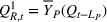
The optimal decision in each period is to order the amount of goods,


To the best of our knowledge, the structure of the optimal policy for the described problem is unknown and a complete enumeration of all possible outcomes to find the optimal policy is computationally intractable. Rather than search for the truly optimal decision in each period, we focus on finding the optimal base‐stock policy in Section 4 and then introduce a state‐dependent ordering policy in Section 5.
BASE‐STOCK POLICY
We use a base‐stock policy as starting point for our analysis on how to determine the production quantities in each period. Using an (adjusted) base‐stock policy is reasonable for several reasons. First, base‐stock policies are simple and commonly used in inventory management as a proxy for the optimal ordering policy. Second, the base‐stock policy is known to be the optimal policy under perfect yield (Federgruen & Zipkin, 1986). Third, an adjusted base‐stock policy—known as the “linear inflation policy” (Huh & Nagarajan, 2010)—has shown excellent performance in random yield systems with disposal of defective items, and is commonly used in the literature (see, e.g., Bollapragada & Morton, 1999; Huh & Nagarajan, 2010; Inderfurth & Kiesmüller, 2015). Finally, (adjusted) approximate base‐stock policies are also commonly preferred within the existing literature on random yield systems with rework of defective items (Gotzel & Inderfurth, 2005; Sonntag & Kiesmüller, 2018).
The new solution procedure used to find the optimal base‐stock policy, which has not been determined for the considered problem so far, is inspired by the unit‐tracking/decomposition approach introduced by Axsäter (1990). This method aims to decompose the problem into a series of independent “order the next unit now or later” problems that are solved sequentially. Therefore, each unit is matched with a specific demand that it will satisfy, and the expected cost for this pair is then determined. The expected cost is composed of a backorder cost multiplied by the expected time the customer has to wait for the unit and a holding cost multiplied by the expected time the unit has to wait for the demand. Both expectations are calculated based on the lead‐time until an item enters the warehouse and the distribution of the arrival time of customer demand.
Incorporating random yields and (nonperfect) rework increases the complexity substantially because units can cross each other in the pipeline. Order‐crossing implies that it is uncertain which demand will be matched with which unit because this will depend on past and future ordering decisions. For example, let us consider a situation under perfect rework with three units in stock and an outstanding order of one unit placed in the last period. With perfect yield, these units will be used to satisfy four consecutive demands, and the “next unit” to be produced will be used to fulfill a fifth demanded item. Now consider a system under random yield where the unit ordered in the last period needs to be reworked for two (or more) periods. That unit will then be available at the end of period


Timeline showing when orders are placed and when units arrive at the warehouse for

In Section 4.1, by extending the unit‐tracking approach, we derive an exact expression of the expected cost per period under a base‐stock policy and perfect rework. The structure of this cost is discussed in Section 4.2, along with its implications for the search procedure for the optimal base‐stock level. In Section 4.3, an accurate approximation of the marginal cost of increasing the base‐stock level is derived. This approximate expression facilitates the search for the optimal base‐stock level and provided the correct value in all instances calculated in Section 6. In Section 4.4, we show how this analysis can be extended to systems with a nonperfect rework process.
Base‐stock policy: Exact cost expression under a perfect rework process
The derivation of the expected cost per period is inspired by the unit‐tracking/decomposition approach and is carried out in three steps. The notation used is summarized in Table 1. Based on the number of units,


Notation
Step 1: Match each produced unit with a demand
A base‐stock policy implies that the order placed at the end of period 















Step 2: Determine per unit holding and backorder cost
The expected cost for a good unit used to satisfy the 



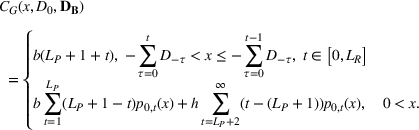
The first case in Equation (1), that is, when 







The expected cost for a reworked unit ordered in period 



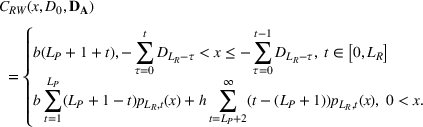








Step 3: Determine the cost per period
In a stationary state, that is, when the inventory position at the end of the last 


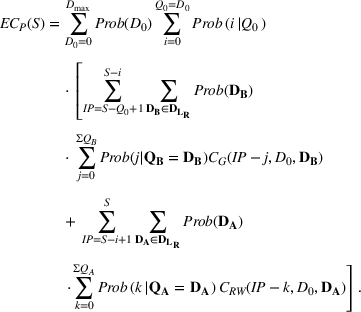
The first two sums in Equation (3), that is, those with 


Equation (3) can be simplified further by using the i.i.d. property of the demand so that it reads: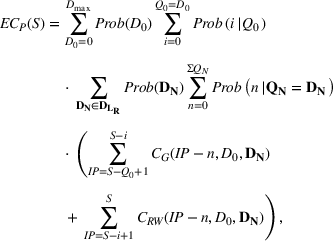








Cost structure and optimal base‐stock level under a perfect rework process
The optimal base‐stock level 


Periodic review production–inventory system with random yield and nonperfect rework in period
In contrast, the expected holding cost will be nondecreasing (typically increasing) in 


From Figure 3 and the explanation above, it is apparent that the expected cost for a unit, either good or reworked, in Equation (4) is nonconvex in 


Approximation of the marginal cost under a perfect rework process
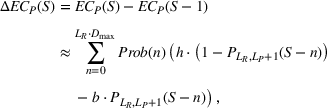
The unit‐tracking/decomposition approach is traditionally based on the marginal cost of the last unit ordered rather than the expected cost per period. As previously mentioned, such an approach is problematic due to the possibility of units crossing each other in the pipeline. However, a good approximation of the marginal cost can be attained if one instead focuses on the last unit that becomes available at the end of period 










Extension to a nonperfect rework process
The same general principle as in Sections 4.1 to 4.3 can be used to determine the expected cost per period and the optimal base‐stock level even if the rework process is nonperfect and items might have to undergo rework several times. That is, we can still (i) match each unit ordered in period 





Additional notation for nonperfect rework
In Step 2, the expected cost for a good unit under nonperfect rework is much in line with the cost for such a unit under perfect rework, that is, Equation (1). The difference is that there is no upper bound to the delay for 






When computing the expected cost, 
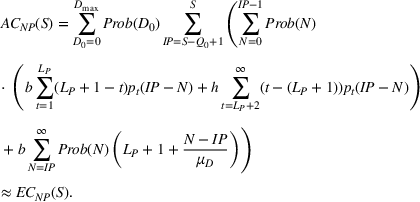


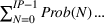

The probability that 




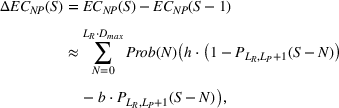
Similarly as in the case of perfect rework process in Equation (5), we can estimate the marginal cost of increasing 
STATE‐DEPENDENT POLICY
Remember that the base‐stock policy discussed in the previous section is not the optimal policy under stochastic yield with perfect or nonperfect rework. Indeed, the optimal policy is unknown. Here, we present computationally efficient heuristics for state‐dependent ordering policies that consider the current pipeline inventory instead of basing the decision on the long‐run distribution of the same, as the base‐stock policy does. Similar to Section 4, we will focus on a problem with a perfect rework process and then briefly explain how to extend the heuristic to a problem with a nonperfect rework process.
Inspired by the unit‐tracking/decomposition approach, the state‐dependent ordering policies are based on comparing the expected cost of unit 


To reduce the computational complexity, it is assumed that if unit 







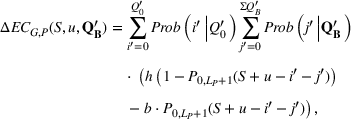
To determine 










To determine 










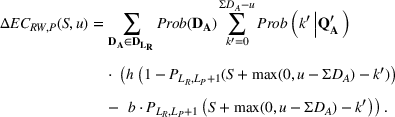





If the probability of unit 


The second estimate is based on the average of the state‐dependent probability that unit 


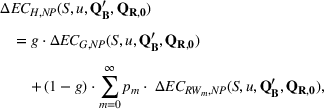
Under a nonperfect rework process, the marginal cost of postponing the ordering of unit 


NUMERICAL STUDY
In this section, we first present in Section 6.1 the test series used for the numerical studies. Afterwards, we investigate in Section 6.2 the performance of the state‐dependent ordering policies, 

Instance characteristics
As a starting point for the numerical study, we use an extended version of the test series in Sonntag and Kiesmüller (2017), which assumes a perfect rework process. The production time 


























Performance of the state‐dependent policies
In this section, the performance of the state‐dependent policies 


In their paper, Sonntag and Kiesmüller (
2018
) propose an “alternative base‐stock policy” based on an adjusted inventory position that is defined as the physical stock‐on‐hand minus backorders plus the expected number of units among the outstanding orders that will become available during the risk period 

Note that the “alternative base‐stock policy” 


The results are summarized in Table 4. Note that we omit four instances under stochastic proportional yield from the table because they lead to unusually high cost increases compared to the optimal base‐stock policy and therefore create a false impression of the average performance of the heuristics. For completeness, the results for the four excluded instances are summarized in Table 3 and we refer back to these instances later in the section.
Relative cost savings 






Relative performance of the myopic policies compared to the base‐stock policy (in %)


In Table 4, positive values indicate cost savings compared to the base‐stock policy whereas negative values reflect cost increases. For each method and each parameter of our full factorial design, the average and the maximum relative cost savings, 


The performance increases with the demand variability and the rework time
The improvement in performance of the different methods is linked to the amount of information about the current pipeline inventory used when determining the order quantity. The base‐stock policy uses the long‐run distribution of the number of units ordered over 


The expected costs increase and the relative performance decreases with the yield uncertainty
The increase in cost for the base‐stock policy observed in Table 4 is expected as an increased uncertainty implies more safety stock and/or backorders. This also partly explains the observed decrease in the relative savings, as 

A closer look at the behavior of the heuristics under stochastic proportional yield and very high yield variability reveals that they become too near‐sighted. This results in an overestimation of the cost impact of ordering unit 




The best performance is observed for mean yields of 50%
Because the base‐stock policy is the optimal policy under perfect yield, the potential for cost improvements by myopically adjusting the base‐stock policy is, as can be expected, decreasing with the expected production yield, 


Periodic review production–inventory system with random yield and nonperfect rework in period
Summarizing, the newly developed heuristics provide large potential for cost savings. Under stochastic proportional yield, the state‐dependent policies high yield uncertainty, that is, close to an all or nothing scenario (0% or 100% yield); high mean yield, that is, close to perfect yield (100%); and low demand uncertainty.



A policy using these rules along with the best heuristic 


The mean yield paradox
Unexpectedly, the numerical study shows that the expected inventory‐related costs are not always strictly decreasing in the expected yield, 


To analyze the “Mean Yield Paradox,” we present the results from an extended test series for 








The “Mean Yield Paradox” is illustrated by Figure 5a, which shows that the paradox exists under perfect and nonperfect rework. A similar paradox linked to the yield uncertainty cannot be observed as shown in Figure 5b. This figure verifies the conclusion from the previous section that the expected costs are increasing in the yield uncertainty. Figure 6a shows that the standard deviation of the number of units in a batch needing rework decreases with the expected yield, particularly when the demand uncertainty is high. This along with the decrease linked to lower yield uncertainties explains the initial decrease in expected cost observed in Figure 5a. However, a higher expected yield also implies that the yield distribution is—particularly under high yield variability—more anchored at the two extremes, that is, toward all units being of good quality or all units needing rework. This is illustrated by the skewness of the number of units in a batch that need rework in Figure 6b. The tendency of anchoring toward the extremes has a negative effect, which explains the increase of the expected cost for high values of 
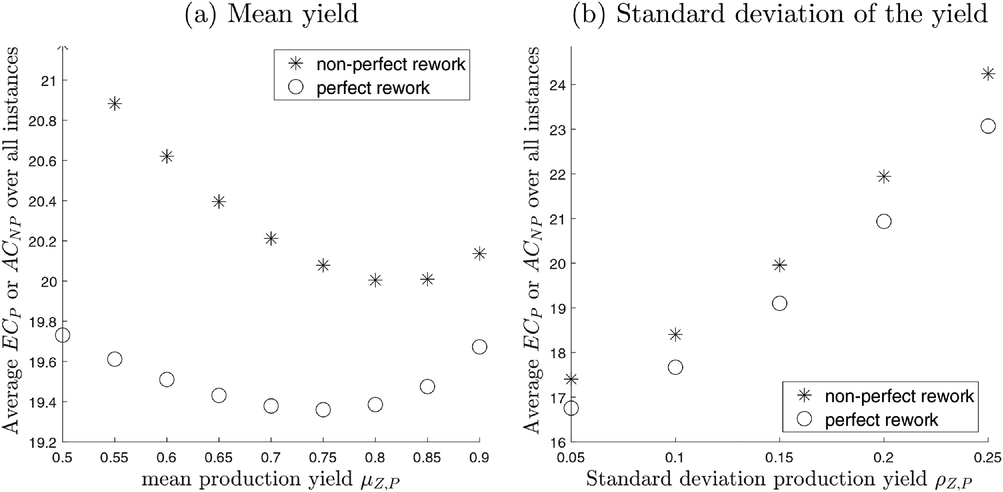
Comparison of the cost performance of perfect and nonperfect rework systems depending on (a) the mean yield and (b) the standard deviation of the yield of the production process

Standard deviation (a) and skewness (b) of the number of units ordered over
The reason that the “Mean Yield Paradox” is observed under stochastic proportional yield but not under binomial yield lies in the yield models themselves. While, the stochastic proportional yield model is a batch‐based yield model, the binomial yield model is an item‐based yield model. That means, that under stochastic proportional yield, the probability of an item being of good quality depends on the batch size and the number of other units in the batch that pass the quality inspection. Under binomial yield, the probability of an item being of good quality is always equal to 
DISCUSSION OF THE ASSUMPTIONS
In this section, we discuss the practical implication of the assumptions made in Section 3.
LP
and
LR,m
are constant
The processing time 

No quality differentiation
Note that the quality of a reworked item passing the quality inspection is the same as that of an item produced correctly without rework, which is commonly the case in, for example, the automobile or pharmaceutical industries. Therefore, all items entering the warehouse can be sold to customers without quality differentiation. However, depending on the industry, quality differentiation can be reasonable and is very common. One common example is the semiconductor industry and the microchips production, where the speed of the chips can vary and based on their quality be used to satisfy different customer segments (see, e.g., Bitran & Gilbert, 1994; Gallego et al., 2006; Hsu & Bassok, 1999; Nahmias & Moinzadeh, 1997).
Discrete instead of continuous time
The proposed model in this paper considers a periodic review policy which implies a discrete instead of a continuous time model. Based on our experience with industry, this assumption is reasonable as periodic production planning is used. Note that the length of a period can be chosen arbitrarily small in the model and one can, hence, asymptotically approach a continuous time model.
Items are never disposed of
We assume that items can always be reworked even though it might take several rework cycles. The reason is that the unit‐tracking approach is based on matching each ordered unit with a demand and vice versa, which is not possible if some units stochastically leave the system. Extending the solution process so that it can be applied to these scenarios is an interesting venue for future research as mentioned in Section 8.
Defective items are reworked immediately
Reworking defective items immediately can be reasonable for several reasons: First, reworking costs are arguably lower than production costs as the rework process is carried out on a product that already has been processed. This makes it economically preferable to rework defective units rather than initiating production of a new unit. Second, the value of keeping the units as finished products is higher than keeping them as defective products because finished products can be used to serve customer demand. Reworking defective units immediately has the additional benefit of reducing the uncertainty about the warehouse's future inventory level. Third, rework is usually required at the end of the production process, which means that the holdings costs for work in process inventory and finished goods inventory do not differ too much. However, there are situations where an immediate rework is not optimal, for example, if one has plenty of finished goods in stock because of high yield and/or low demand over a prolonged period. Of course, in such a situation one typically does not have many units to rework. Such a setting is particularly true for high demand products with relatively stable demand and demand in each period as considered in this paper. However, for products with low and erratic demand, this assumption might be an issue.
Focus on inventory‐related costs
In this paper, we focus on the inventory‐related cost of different ordering policies because these are the costs that can be reduced by altering the ordering policy. The expected production, rework and holding cost for work in process are constant if all defective units are reworked as the average batch size is the same as the average demand per period. However, to be able to determine if defective items should be reworked or scraped, as analyzed in Sonntag and Kiesmüller (2018), or to determine the value of improving the yield, one must consider additional costs such as production and rework costs.
CONCLUSIONS AND FUTURE RESEARCH
This paper discussed how to determine order quantities in a periodic make‐to‐stock production–inventory system with random yield and rework by deriving an exact expression for the expected cost per period under a base‐stock policy and then myopically improve upon the same.
Given that the optimal ordering policy is unknown, the numerical study revealed that it is reasonable to rely on a base‐stock policy if the mean yield and coefficients of variation of the yield are high. In such a case, the system is close to a perfect inventory system without random yield, for which the base‐stock policy is the optimal policy. A state‐dependent ordering policy adds little value under such parameter settings. However, under low mean yields of 50%, which are commonly observed in the high‐tech industry, the myopic improvements of the base‐stock policy outperform not only the base‐stock policy, by up to 6% in terms of costs, but also an existing approach by up to 4.5% in terms of costs. Such cost reductions may lead to sizable savings, especially when considering that products may incorporate substantial value, and that holding and backorder costs are relatively high in the high‐tech industry.
In contrast to earlier presented research, the approaches presented in this paper have the advantage that they are applicable independent of the input parameters and can even handle various other yield models and other demand distributions, such as Poisson distributions, which emphasizes the contribution of this paper. Our paper does not only contribute to random yield problems under rework but is also highly relevant to other inventory systems where order‐crossing occurs. As explained in Section 2.2, order‐crossing is always prohibited in existing papers using the unit‐tracking approach. Thus, the insights generated in this paper can be used, for example, to determine order quantities in an inventory system with continuous review and stochastic lead times where orders can cross each other. A highly interesting topic for future research is the consideration of nonstationary demand and yield distributions, because demand and yield distributions usually change over the life cycle of a product. Another worthwhile extension to the considered problem is to allow for products to be scrapped after a number of rework cycles if one has not managed to reach the required quality by then. A combination of the current heuristic and an inflation policy could be an interesting alternative to investigate in such a setting.
Footnotes
ACKNOWLEDGMENTS
The authors thank the editor, senior editor, and anonymous reviewers for their detailed feedback and constructive comments. They also thank Victor Martínz de Albéniz and Moritz Fleischmann for their valuable feedback on earlier versions of the paper.