






Abstract
When releasing a new version of a durable product, a firm aims to attract new customers as well as persuade its existing customer base to upgrade. This is commonly achieved through a rollover strategy, which comprises the price of the new product as well as the decision to discontinue the sale of the existing product (solo rollover) or to sell the existing product at a discounted price (dual rollover). In this study, we argue that the timing of the new product release is an important—but commonly overlooked—third lever in the design of a successful rollover strategy. The release timing influences the consumers' perception of obsolescence, by which an existing product is considered obsolete merely by reference to a new product. This reinforces the upgrading behavior of existing customers, but it also necessitates deep discounts of the existing product to keep its sale viable in a dual rollover. We analyze the impact of the release timing on solo and dual rollovers in markets for digital goods (i.e., where production costs are negligible) that are composed of naive and sophisticated consumers. Under the assumption that both the old and the new product would offer a similar utility if there was no perceived obsolescence, we show that in both markets a firm selecting the release times from a continuous timeline can induce sufficiently large parts of its existing customer base to upgrade so that a solo rollover is optimal. We also characterize the resulting market segmentation, and we offer managerial as well as policy advice.
Introduction
We study the optimal release strategy of a firm that sells different versions of a durable digital good. Ideally, the new releases “drive people to upgrade” (Apple's CEO Tim Cook, as cited by Gibbs 2016) and at the same time attract new customers from the remainder of the market. To this end, firms often focus on high‐value consumers in early product versions and subsequently persuade them to purchase the new releases at comparatively low prices (Dhebar 1994, Kornish 2001). The nominal release prices of video games, for example, have remained constant over the past 15 years despite the presence of inflation (Huang and Gilbert 2018, Kain 2018). This strategy requires the new product versions to be perceived as sufficiently novel, for otherwise the existing consumer base may not upgrade to the new releases. 1
Aside from the pricing of the new versions, an essential aspect of the release strategy concerns the decision whether to discontinue the existing product versions (solo rollover) or to keep them in the market at discounted prices (dual rollover), see Billington et al. (1998) and Erhun et al. (2007). Dual rollovers, which are often employed in the sale of mobile phones (e.g., the iPhone and Samsung's Galaxy lines), television sets and other high tech consumer goods, allow to complement the sales of the new product versions with an additional revenue stream from low‐value consumers that are attracted by the discounted prices of the older versions. On the other hand, the continued discounted sale of the existing versions may cannibalize the sale of the new versions. For this reason, a firm may prefer a solo rollover, as frequently observed in the markets for specialized tablets (e.g., Wacom's Intuos tablets) and scientific software (e.g., Wolfram Research's Mathematica). Other factors that influence the choice of a solo vs. a dual rollover include the presence of existing product inventories as well as product line complexity considerations.
We argue in this study that, in addition to the product pricing and the rollover type, the timing of new product releases provides the firm with an important third lever to design its release strategy. A careful timing of the new releases allows the company to control the perceived obsolescence of its product range and thus “drive people to upgrade” without incurring the risks associated with a dual rollover. For example, the market typically perceives existing versions of EA Inc's FIFA sports games as obsolete once a new version has been released, even though the previous versions are not outdated in objective terms (Cooper 2004, Koenigsberg et al. 2011, Nahm 2004). Likewise, in the well‐documented “slow iPhone phenomenon,” users experienced a perceived slowdown of old iPhone versions precisely when a new version was released (Richter 2016).
The phenomenon of perceived obsolescence is well recognized in the consumer research literature. Cooper (2004) and Slade (2009) suggest that perceived obsolescence (i.e., obsolescence in reference to a new product version) is the primary factor determining the novelty of a product, whereas absolute obsolescence (i.e., physical deterioration) is only the secondary aspect. An old version of a product can be perceived as obsolete because (i) it no longer employs the most recent technology (Nair and Hopp 1992, Slade 2009); (ii) it no longer complies with the most recent style trends (Hellmann and Luedicke 2018, Slade 2009, Waldman 1996); or (iii) it is less suited for new standards, for example, due to higher capacity, memory or bandwidth requirements (Cooper 2004). The consumer research literature also recognizes the impact of release cycles on the perception of obsolescence. Indeed, each of the aforementioned three contributing factors to perceived obsolescence tends to be positively correlated with the length of the release cycles: Longer release cycles usually imply a larger divergence of the old product from the latest technology and style trends as well as standards. Additionally, Bulow (1982), Dhebar (1994) and Schifferstein and Zwartkruis‐Pelgrim (2008) argue that the perceived obsolescence increases with longer release cycles because the consumers' attachment to the earlier versions along with the perception of irreplaceability or indispensability decreases over time. Consumers may also “psychologically justify” their perception of obsolescence by acting more recklessly with the old product version to justify an upgrade without appearing wasteful (Bellezza et al. 2017). Boonea et al. (2001) provide empirical support that consumers perceive the performance gains of a new product version to be larger when product upgrades occur less frequently. Likewise, Kuppelwieser et al. (2019) explain that consumers perceive longer release cycles not only as value‐adding to the upgrading process, but they also increase their willingness to buy. The link between the release timing and the perceived novelty gap of different versions may thus provide the firm with a lever to control the consumers' perception of obsolescence.
In this study, we analyze the impact of the consumers' perceived obsolescence on the optimal rollover strategy of a firm, as well as the resulting market segmentation and welfare distribution. Since the main drivers of perceived obsolescence depend on the length of the release cycles, we do not model the firm's rollover problem as a two‐stage problem, with the time interval between the two stages fixed exogenously, as commonly done in the existing literature. Instead, we propose a problem formulation that allows for an adjustment of the release cycle along a continuous timeline. To study the effect of perceived obsolescence in isolation, we assume that the firm is a monopoly that sells two versions of a single, purely digital good (i.e., with negligible reproduction and inventory costs); see, for example, Shapiro et al. (1998) and Varian (2001). We assume that the existing version of the good is to be replaced or complemented with a new version that can be released along a continuous timeline. We assume that the market is composed of two types of consumers: naive consumers only consider the product offering at the present time, whereas sophisticated consumers anticipate the future actions of the firm when taking their decision.
A critical finding from our model is the importance of the release timing. Once we incorporate the perception of obsolescence in the rollover design and the rollover design is fully endogenous (i.e., the firm can exactly control when to release a second version), the firm should discontinue the sale of the old product version precisely when the new version is released. In fact, even when the market is reluctant to regard the new version as objectively novel, the firm can delay its release to create a sufficiently large perceived novelty gap. In that case, inducing the existing customer base to upgrade provides higher revenues than attracting new low‐value customers with discounted prices for the old version. Our findings are in contrast to the existing rollover literature, which typically imposes a two‐stage structure in which the release times are fixed exogenously. We show that for sufficiently short fixed release cycles, a dual rollover—as advocated in some of the existing literature—may indeed be optimal. The existence of exogenous constraints on the release times, together with other aspects outside the scope of our model (such as an existing stock of the old product), may also explain the instances of dual rollovers observed in practice. To the extent that a firm can fully execute a prudent release timing under its control, our findings are in line with the solo rollover practices commonly observed for purely digital goods, as well as some semi‐digital products whose reproduction costs only increase gradually over time (Torres 2017). When instead there are constraints to the ability of the firm to choose all the parameters of its release strategy, then dual rollovers can emerge as the optimal course of action.
Our analysis shows that the optimal release interval depends on both the consumers' perception of obsolescence as well as their ability to foresee the firm's future actions. If the market consists solely of naive consumers, the optimal release interval decreases with the market's perception of the obsolescence. If the perceived obsolescence is high, this strategy incentivizes the consumers to purchase both versions, whereas it allows the company to price discriminate between consumers in the case of a low perceived obsolescence by offering a deep discount on the second version. If the market solely consists of sophisticated consumers, the firm establishes longer release intervals and decreases the price for the first product. That way, the firm creates a customer base that is willing to buy both product versions since the high‐value consumers find that the early version has a reasonable price and sufficiently long life cycle prior to its obsolescence, while the perceived novelty gap between the versions is large enough to justify an upgrade. In the most realistic case where the market is composed of both naive and sophisticated consumers, finally, the firm's release strategy is driven by the dominant consumer group. The threshold that determines the dominant consumer group again depends on the market's perception of obsolescence: The higher the perceived obsolescence, the less weight the firm places on sophisticated consumers.
From a welfare perspective, we show that both the firm and the sophisticated consumers benefit from (some level of) obsolescence. In contrast, the surplus of naive consumers decreases with the obsolescence as they regret their earlier purchase when the new version is released. Thus, a policy maker interested in increasing consumer surplus should ensure that naive consumers become sophisticated by being educated about the firm's future actions, for example by inducing the firm to communicate its release strategy to the consumers in a credible way. These findings may help to inform the ongoing debate over the effects of managed obsolescence on consumer welfare, such as the forced battery slowdown of old Apple iPhone versions that accompanied the release of new versions (Kayali 2020, McGee 2020, Mickle and McKinnon 2017).
The main contributions of this study may be summarized as follows. We introduce the concept of perceived obsolescence, which is well established in consumer research, to the product rollover literature. To this end, we propose a novel specification of the consumer's utility that captures the notion of perceived obsolescence in a behavioral fashion. We employ our specification of the consumer's utility to study product rollovers for purely digital goods. In contrast to traditional product rollover models, which typically involve two discrete time stages, our model employs a continuous timeline to fully endogenize product pricing, the choice of the rollover type (solo/dual) as well as the release timing. We derive the firm's optimal release strategy in markets composed of naive and sophisticated consumers, and we characterize the resulting market segmentation and welfare implications. We show that the firm maximizes its profits by pre‐committing to its rollover strategy. To verify the robustness of our findings, we extend our analysis to goods where the reproduction costs are non‐negligible (cf. Biyalogorsky and Koenigsberg 2014).
The optimal release of different versions of a product has been studied in the literature streams on product line design, product rollovers and version management. As we shall point out in the following, most of the literature differs from our work in assuming that the release intervals are fixed exogenously and do not impact the consumers' perception of quality.
The product line design literature characterizes the conditions under which a firm prefers a sequential release of different product versions over a simultaneous release. Typical examples include the release of a movie (in cinema, as Blu‐Ray and DVD) or a book (as hardcover, softcover and electronic). It is assumed that the firm can decide upon the order of the releases (in the case of a sequential release) as well as the quality of each version. Importantly, however, the lengths of the release cycles are considered fixed and thus do not influence the perception of quality. If the consumers buy at most one version of the product, then the firm prefers a sequential release (i) if the consumers are sophisticated and the cannibalization effect is low (Moorthy and Png 1992) or (ii) if the consumers are naive and there exists demand uncertainty (Biyalogorsky and Koenigsberg 2014). If the consumers are sophisticated and can buy multiple versions, on the other hand, then a sequential release is optimal irrespective of the cannibalization effect (Kornish 2001). Liang et al. (2018) show that the firm invests in higher product quality when the consumers are sophisticated.
In the product rollover literature, the firm needs to decide whether a second version of a product is released by means of a solo or a dual rollover. Similar to the product line design literature, the majority of the papers assume that the length of the release cycle is fixed and therefore does not influence the perception of quality. Additionally, the product rollover literature assumes a fixed quality gap between the products. The literature identifies the degree of consumer foresight and the quality gap between the products as the key factors that determine the optimal rollover type: For a naive consumer base, a solo (dual) rollover is optimal if the quality gap between the products is sufficiently high (low), see Ferguson and Koenigsberg (2007) and Koca et al. (2010). When serving a sophisticated consumer base, Levinthal and Purohit (1989) find that a solo rollover is always optimal, regardless of the quality gap. In contrast, Liang et al. (2014) show that a dual (solo) rollover is optimal if the market is dominated by naive (sophisticated) consumers and the novelty gap between the products is high (low). Lim and Tang (2006) and Arslan et al. (2009) are among the few papers in the product rollover literature that endogenize the release times. In both papers, however, the release time informs the volume of aggregate demand for the second product, and it does not impact the perceived quality of either product. Both papers find that a dual rollover is preferable when the consumers are naive and the marginal costs of the two product versions are similar. These rich findings can be explained by the differences in the employed consumer choice models (aggregate demand vs. explicit utility functions). For a review of the product rollover literature, we refer to Liu et al. (2018) and Wei and Zhang (2018).
The version management literature, finally, endogenizes the length of the release cycles, but it assumes that this length only affects the consumers' choice behavior through their discounting of future utilities and does not impact the perception of quality. The majority of the version management literature assumes a priori that the firms implement a solo rollover. Calzada and Valletti (2012) verify that a firm facing sophisticated consumers can improve its profits by increasing the release intervals, especially if the consumers are impatient. August et al. (2015) extend the discussion by showing that the optimal release interval increases (decreases) with the quality of the first version (which is assumed to be fixed). The version management literature is reviewed by Wei and Zhang (2018).
To our best knowledge, the paper of Lobel et al. (2015) is closest to our work. The authors assume that the quality differences between successive product versions depend on the lengths of the release cycles. In their work, the quality differences do not stem from perceived obsolescence, however, but they are due to technological innovations that accumulate over time. The quality differences are modeled by a Brownian motion, which would not be suitable for the modeling of perceived obsolescence (cf. section 2). In further contrast to our work, Lobel et al. (2015) do not compare solo and dual rollovers; instead, it is assumed that the firm has already settled for a solo rollover. The authors find that the firm selects larger release intervals (and thus higher quality gaps) between the product versions when the consumers are less patient, and they show that price pre‐announcements can significantly increase profits.
In summary, our key contribution to the literature is to study the impact of perceived obsolescence on the design of product rollovers (including the choice of rollover type) in markets with both naive and sophisticated consumers. This requires us to release products along a continuous timeline, where the obsolescence of old products is determined by the length of the release cycles.
The remainder of this study is organized as follows. After an introduction of our rollover model in section 2, section 3 presents the optimal rollover strategy in hybrid markets that comprise both naive and sophisticated consumers. We analyze the special cases of markets of purely naive and purely sophisticated consumers in sections 4 and 5, respectively, and we offer concluding remarks in section 6. Appendices A and B elaborate on the segmentation of markets of naive and sophisticated consumers, respectively, while various extensions to our model, the issue of pre‐commitment as well as the welfare analysis are relegated to Appendices C–F. All proofs can be found in Appendix G.
Model
We consider a monopolist that launches a digital product with price


At its respective launch, each version of the product provides a utility rate of


Markets that perceive products as less durable (such as soccer video games that are no longer aligned with the current football league compositions, which is especially likely with wider time gaps) correspond to lower values of α, whereas markets with a smaller perception of obsolescence (such as car racing games) correspond to higher values of α. As we have discussed in the introduction, the modeling feature that the drop in utility rate increases with the length of the release interval is in line with findings from the consumer research literature. This differentiates our work from earlier papers that have considered a fixed, exogenous obsolescence rate (Agrawal et al. 2015, Desai and Purohit 1998, Ferguson and Koenigsberg 2007).
Following Mussa and Rosen (1978), we assume that the consumers agree in their preference ordering, but they are heterogeneous in their appreciation of quality. This heterogeneity is reflected by the consumer type θ, which is assumed to be uniformly distributed over the interval [0, 1]. We assume that consumers use at most one product at a time, and they derive no salvage value from the old version when they upgrade to the new version. Thus, the versions are sufficiently close substitutes, and reselling an old version is not feasible. The absence of a second‐hand market might be due to contractual restrictions (e.g., personal software licenses), the impracticality of ownership transfer (e.g., mobile phone apps), data and privacy concerns or the desire to keep the old version as a backup (e.g., semi‐digital goods such as smartphones, GSMA 2012). Despite our reliance on the Mussa and Rosen preference model, we cannot utilize established techniques (such as those of Anderson and Dana 2009) to solve the firm's problem due to the presence of the behavioural features discussed above as well as the multi‐period choices faced by the consumers.
We distinguish between naive and sophisticated consumer foresight. A naive consumer does not anticipate future releases or future price discounts, either since she is unaware of or not interested in obtaining this information. A naive consumer therefore only considers the options immediately available to her. In contrast, a sophisticated consumer can predict the company's future actions, for instance through online channels (e.g., rumor websites such as


In summary, our model endogenizes the following variables on the firm's side: the price





Optimal Rollovers in Mixed Markets
This section characterizes the optimal rollover strategy as well as the resulting market segmentation in markets where the firm faces both naive and sophisticated consumers. We first compare the responses of these consumers to a solo (section 3.1) and dual rollover (section 3.2). We then discuss the optimal rollover design in markets with both consumer groups (section 3.3).
Solo Rollover
When the firm conducts a solo rollover, a naive consumer of type θ ∈ [0, 1] takes decisions at two time points: At time t = 0 she buys the first product if and only if (iff)





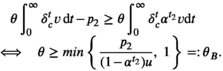
We assume that


In contrast, a sophisticated customer of type θ ∈ [0, 1] decides on her entire purchasing strategy under full information of the firm's future decisions at time t = 0. In particular, in the case of a solo rollover she compares (i) the utility 0 of purchasing neither product with (ii) the utility








For naive consumers, a late product buyer always has a lower type than an early product buyer. In fact, any naive consumer that does (not) purchase the first product at time t = 0 must have a type θ satisfying


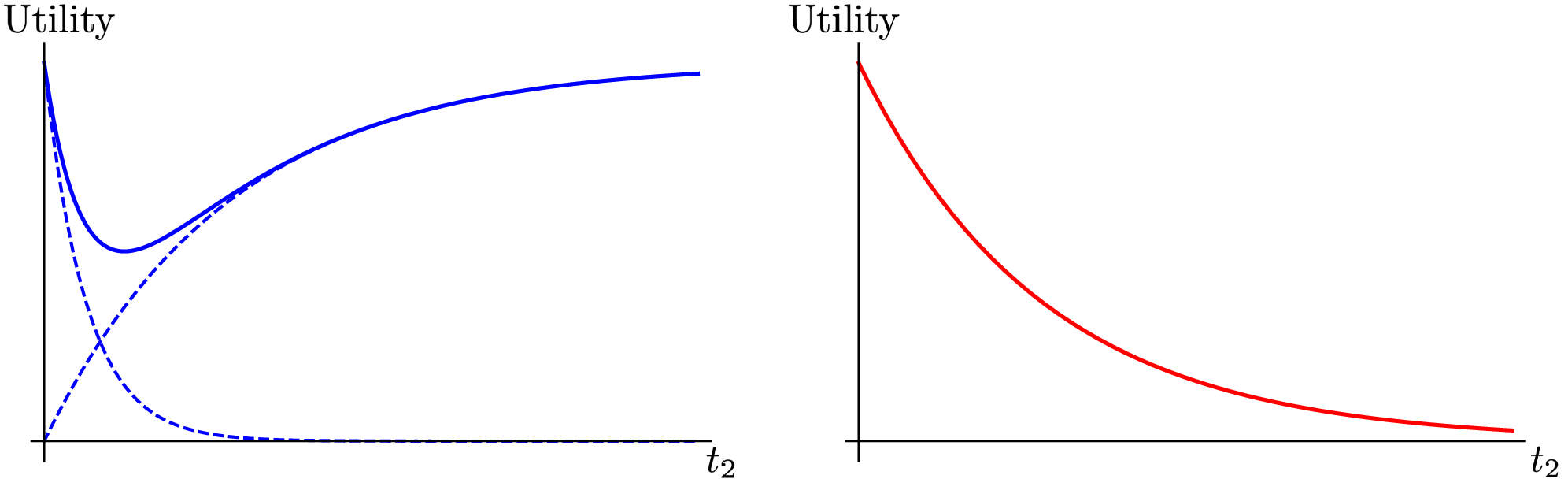
Utility Derived from Purchasing the First (left) and Second (right) Product [Color figure can be viewed at
We now show that the company can in fact influence the preference ordering of its sophisticated customers by adjusting the introduction time

For If If Moreover, we have


Proposition 1 shows that, if faced with the choice of buying a single product, a sophisticated high‐value customer prefers to wait if the introduction time






Dual Rollover
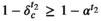
When the firm conducts a dual rollover, a naive consumer of type θ ∈ [0, 1] again takes decisions at two time points. As in the case of a solo rollover, she buys the first product at time t = 0 iff If she has not bought the first product, she prefers buying the first product at the price she prefers buying the second product over buying nothing iff she prefers buying the second product over buying the first product at the discounted price If she has already bought the first product, she buys the second product iff







As before, we assume that


A sophisticated consumer of type θ ∈ [0, 1] has the additional option to wait and purchase the first product at the reduced price



The behavior of sophisticated consumers allows the firm to choose between two types of preference orderings: it can impose a reversed preference ordering by adopting a sufficiently short release cycle, or it can induce a naive preference ordering through a longer release cycle. The latter will lead to results that are qualitatively similar to those under the solo rollover strategy.
Optimal Rollover Strategy
We now characterize the optimal rollover strategy and the resulting market segmentation.
For any γ ∈ (0, 1), a solo rollover is optimal in a mixed market. Moreover, the optimal market segmentation is as follows.
for for for for
for for for for







Theorem 1 builds upon our results for the limiting cases of markets comprising only naive and only sophisticated consumers in sections 4 and 5, respectively. With this in mind, let us denote by


Figure 2 illustrates the optimal rollover design in a market with a fixed degree of perceived obsolescence and impatient consumers (first part of Theorem 1). The foresight of sophisticated customers induces the firm to adjust the price and the release time of the second product according to the share of sophisticated customers such that a sufficient portion of these customers is willing to buy both versions. In particular, Figure 2 shows that for any fixed α,


Optimal Rollover Strategy as a Function of the Fraction γ of Sophisticated Consumers in the Market. From Left to Right and Separated by Dashed Lines, the Regions in the Three Graphs Correspond to LB/LB (N), ELB/LB (C) and ELB/LB (S) in Figure 3. We Use the Parameter Setting α = 0.5, u = 1,

The relative prices









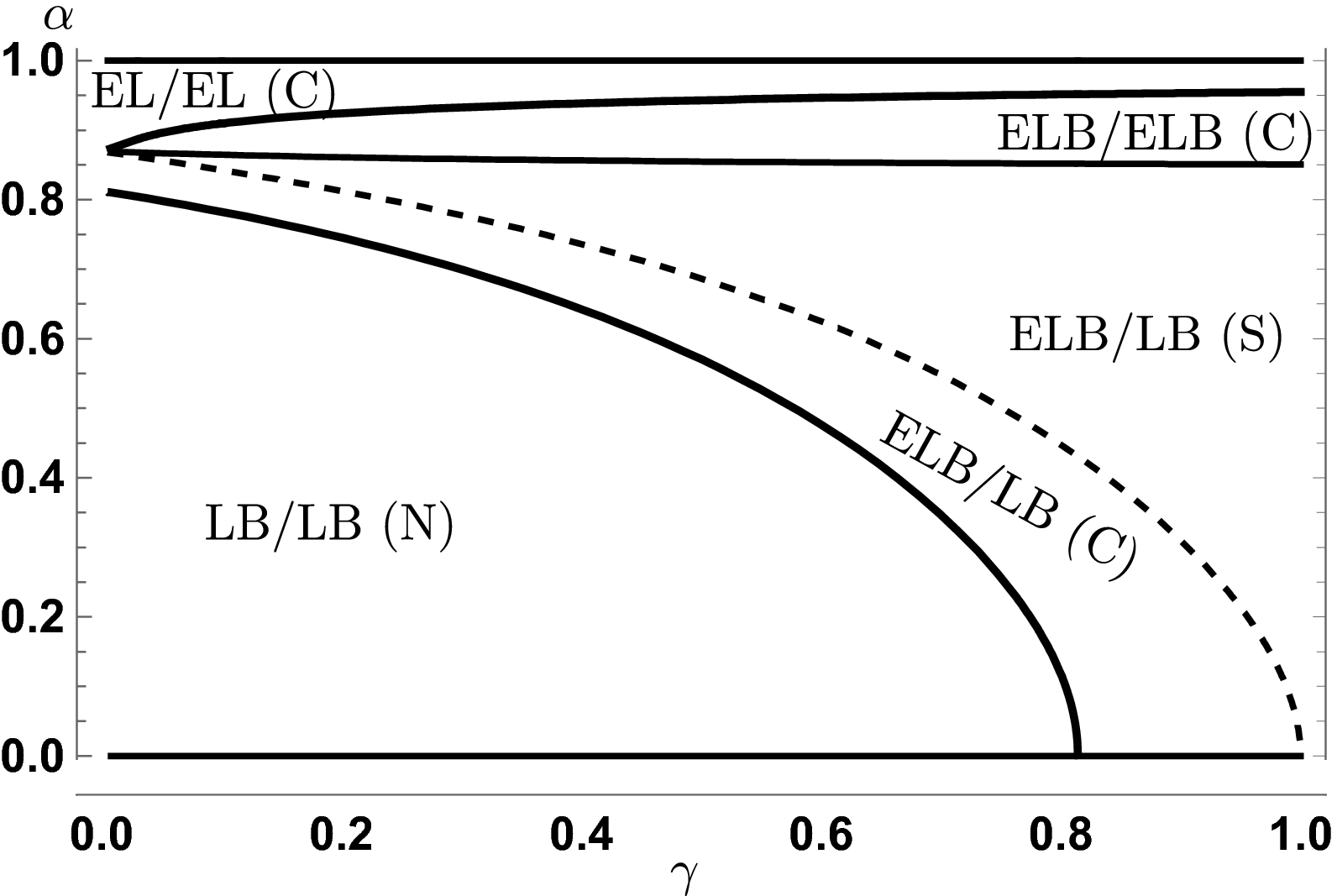
Market Segmentation Resulting from the Optimal Rollover Strategy. The Names of the Regions Correspond to those of Theorem 1. We Use the Same Parameter Setting as in Figure 2
Finally, in intermediate market regimes denoted by “(C),” the firm adopts a (nonlinear) combination of the relative pricing strategies from the purely naive and purely sophisticated settings. Note that, as expected, the firm adopts a naive (resp., sophisticated) focus regime for fractions γ close to zero (resp., one). Lower degrees of perceived obsolescence induce the firm to execute a sophisticated focus regime (cf. region ELB/LB (S)) for a wider range of γ. Indeed, even under a naive consumer focus regime, a lower degree of perceived obsolescence forces the firm to reduce the price and delay the release of the second product: while the firm is no longer able to convince every first‐period naive consumer to upgrade, regardless of the focus regime, it can induce every sophisticated first‐period buyer to upgrade under a sophisticated focus regime. Therefore, by setting the relative prices according to the sophisticated consumer behavior, the firm can counter the decreasing profits caused by the lower perceived obsolescence. A similar reasoning explains why for a very low degree of perceived obsolescence, the firm executes an intermediate market regime (cf. regions ELB/ELB (C) and EL/EL (C)): in that case, it is no longer optimal to convince every first‐buyer from either of the consumer groups to upgrade, and hence the focus regimes are no longer preferable.
The optimal rollover design for patient consumers (second part of Theorem 1), finally, closely mirrors that for impatient consumers. The key difference arises when the market is dominated by sophisticated consumers and the obsolescence is perceived to be insubstantial. In this case, the dominant group (the patient sophisticated consumers) strategically delays their purchase to the second period. Since the naive consumers are reluctant to upgrade in this case, the firm cannot counter the waiting behavior of the dominant group by focusing solely on the naive consumers, and it becomes optimal to indefinitely delay the release of the second product.
Our results show that even for markets that are “almost homogeneous,” that is, where γ → 0 or γ → 1, the firm's optimal rollover strategy will be informed by the presence of both the naive and the sophisticated consumers. This is in contrast to earlier research, which found that when one consumer group is sufficiently “dominant,” firms should focus exclusively on that group and exclude the others (Valletti and Szymanski 2006). The key difference to that work is that in our model, quality appreciation is identical for naive and sophisticated consumers. Therefore, for any market composition γ, (fractions of) both consumer groups will make a purchase. Of course, the degree of consumer foresight plays a role in the intertemporal choice, and this is addressed by tilting the prices and release intervals towards the dominant group (cf. Theorem 1).
Special Case: Naive Consumer Markets
In this section, we study the special case where all consumers are naive, that is, where γ = 0. We discuss the optimal pricing and timing decisions of the firm, as well as the resulting market segmentation, when the firm employs a solo (section 4.1) or a dual (section 4.2) rollover. We subsequently compare both strategies in section 4.2.
Solo Rollover
As a result of the naive consumer behavior described in section 3.1, the firm generates a profit
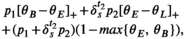


We now study the optimal solo rollover design.
There are threshold decay factors The optimal introduction time The optimal price The optimal price The optimal expected profit approaches u/2 as α → 0, it is continuously decreasing in α over



The optimal solo rollover design gives rise the following market segmentation.
For the threshold decay factors For For If Optimal market segmentation



Figure 4 visualizes the results of Theorem 2 and Corollary 1 for a particular problem instance. If the consumers perceive the old version as completely obsolete when the new version is released, then the firm sells the same product to the same consumers at the same (monopoly) price in immediate succession twice. As the perceived obsolescence decreases, the firm counters the decreasing profits by delaying the release of the second product as well as lowering the second product's price, thus convincing all previous consumers to upgrade while also attracting late buyers. For


Optimal Solo Rollover Strategy as a Function of α. In this Example, we set v = 1,


The threshold decay factors


It is noteworthy that the discount factor of the consumers does not impact the threshold decay factors


Appendix A.1 characterizes the optimal pricing for exogenously fixed release times

Dual Rollover
We now discuss the optimal pricing and timing decision of the firm under a dual rollover strategy. We subsequently conclude that a solo rollover is the optimal strategy for a market comprising naive consumers only.
As a result of the naive consumer behavior described in section 3.2, the firm's profit amounts to
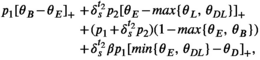


If the market solely consists of naive consumers, then a solo rollover is always optimal.
Figure 5 conveys the intuition why a dual rollover is always inferior to a solo rollover, independent of the decay factor α and the discount rates


Optimal Dual Rollover Strategy as a Function of β. In this Example, We Set α = 0.7, v = 1,


Appendix A.2 characterizes how the presence of discount buyers depends on the discount β offered by the firm, it presents the optimal pricing for exogenously fixed release times

Special Case: Sophisticated Consumer Markets
We now discuss the special case where all consumers are sophisticated, that is, where γ = 1. We first examine the firm's release strategy when the firm employs a solo (section 5.1) or a dual (section 5.2) rollover. We then again compare both strategies in section 5.2. While many of the results in this section are qualitatively similar to those of section 4, the sophisticated consumer behavior complicates the analysis, and some of the results are less amenable to an intuitive interpretation. For ease of exposition, we therefore relegate some of the material to the appendix.
Solo Rollover
We first study the optimal solo rollover design in a market with only sophisticated consumers.
If Otherwise, there are threshold decay factors The optimal introduction time The optimal price for the first product The optimal price for the second product The optimal expected profit approaches





In contrast to the naive setting, Theorem 4 shows that the release of the second product depends on the relative patience of the consumers and the firm. In particular, if the consumers are more patient than the firm, then their inclination to wait for the second product exceeds the firm's willingness to wait for the revenues from the sale of that product, and thus its release is delayed indefinitely. Theorem 4 also shows that the firm never releases the second product instantaneously. In fact, the firm always enforces a naive preference ordering by choosing a release time


The optimal solo rollover design leads to the following market segmentation.
If For For For Optimal market segmentation


Corollary 3 shows that as long as


Optimal Segmentation Strategies. In this Example, We Set
Appendix B.1 characterizes the optimal pricing for exogenously fixed release times

Dual Rollover
A solo rollover is the optimal strategy for a market comprising sophisticated consumers only.
The optimal rollover strategy is a solo rollover.
Theorem 5 implies that when facing sophisticated customers, the firm should adopt a longer release cycle so as to maximize the obsolescence effect and thereby reduce the lost revenues due to product cannibalization. In contrast, a dual rollover would require deep discounts β at time

Appendix B.2 characterizes how the presence of discount buyers depends on the discount β offered by the firm as well as how the optimal rollover strategy (solo vs. dual) depends on the preference ordering (naive vs. reversed) imposed on the consumers, it presents the optimal pricing for exogenously fixed release times

Conclusions
New product development is a key competitive weapon, especially in digital markets. As new products appear on the market, old ones may become obsolete and need to be phased out. In this study, we develop a theory of perceived obsolescence, whereby consumers notice obsolescence of an old product only in reference to a new version. This phenomenon has been widely studied in the consumer research literature but has to date been largely neglected by the product rollover and version management communities.
In this setting, we analyze a model for product rollovers that, in addition to the standard levers of the rollover type (solo vs. dual) and product pricing, accounts for the firm's ability to select the release time of the successor product and thus influence the perceived novelty gap between the product versions. Our model allows to answer important strategic questions related to product rollovers. Should a firm sell out the old product before it introduces the new one? When should the introduction of the new product happen? Should it sell the old product and the new product simultaneously? If so, should it sell them at different prices? We show that a successful product rollover requires careful planning and coordination. It is essential to plan the introduction of new products and the displacement of old products jointly. The answers to these critical strategic questions depend on the combination of demand side parameters (whether the market is mostly made by naive or sophisticated consumers) and supply side considerations (the strategic levers available to the firm, where we considered pricing, rollover type, and release time).
One important result, in our setting, is that the lever of release time plays a key role. When the firm can choose when to introduce a new version, it should always conduct a solo rollover and convince its customer base to upgrade through a careful management of the release times. In particular, the release intervals should be stretched out when the consumers are sophisticated and/or the market is confident about the durability of the old version. The appendix also explores the extension to semi‐digital goods and how the welfare is distributed among the market participants when we account for perceived obsolescence.
Multiple reasons can of course explain the presence of dual rollovers in practice, such as the existence of old product stock, capacity constraints or the absence of an active obsolescence management. These aspects impose additional constraints on the profit maximization problem of the firm that can reduce the profitability of the otherwise optimal solo rollover strategy. Even under those constraints, however, a firm should actively manage obsolescence through a prudent product release timing. Hence, we identify the incorporation of supply‐related issues into our model as a promising area of future research. In other words, relaxing the exogenous constraints often imposed in some literature (such as fixed prices, or capacity constraints, or fixed release time) can make the firm both substantially change its rollover strategy and increase its profits.
One can envisage several other fruitful extensions of our model. For example, the firm may be able to influence the perception of obsolescence through marketing campaigns that emphasize the advantages of the successor product (resulting in an endogenization of the parameter α). Alternatively, the firm may be able to credibly pre‐announce their rollover policy and thus influence the composition of the mixed market in section 3 (resulting in an endogenization of the parameter γ). More broadly, we believe that the manifold implications of perceived obsolescence warrant further investigation by the product rollover and version management communities.
Footnotes
Acknowledgments
We are grateful for the detailed and constructive comments of the departmental editor, the senior editor as well as the two referees, which have led to substantial improvements of the manuscript.
