






Abstract
We study a supply chain setup in which a buyer has private end customer demand information that she can share with the supplier. The demand information is relevant to the supplier's capacity decision. We address the question of whether the supplier benefits from installing nonlinear capacity reservation contracts rather than wholesale price contracts. We contribute to the literature by providing the first internally valid comparison of both contracts with human decision makers. We setup an experimental study with four treatments (both contracts as well as different supplier margins). From a supplier's perspective, we observe that the capacity reservation contract significantly outperforms the wholesale price contract; however, the supplier's benefit from using capacity reservation is much higher under low margins than under high margins. Regarding supply chain performance, the positive effect for the supplier exceeds the negative effect for the buyer in the low margin setting, while the two effects neutralize each other in the high margin setting. We identify behavioral factors explaining deviations from the theoretical predictions. In particular, we observe naïve anchoring and trust as strong behavioral drivers common to both contract types. Even though the complexity of the nonlinear contract results in weaker performance than that predicted by theory, our study reveals that suppliers can still benefit from installing them; thus, providing important managerial implications for the choice of the contract type.
Keywords
Introduction
Information is a crucial asset in supply chain management, and many technical challenges hindering efficient information flows have been overcome in our digital era. In this vein, operations management research stresses the importance of truthful information sharing between supply chain partners while acknowledging the risk of deception if incentives are misaligned. Misaligned incentives are, among others, a result of the contract format that governs the business interaction. We contribute to the literature by analyzing the interplay of contract format and information sharing, thereby shedding light on the important question of whether management should offer complex nonlinear contracts or stick to the common mode of wholesale pricing when information is shared.
We consider a capacity reservation game between a supplier (he) and a buyer (she) with an exogenous wholesale price as analyzed by Özer and Wei (2006) as our basic framework. We refer to Cachon and Lariviere (2001), Cohen et al. (2003), Özer and Wei (2006), and Oh and Özer (2013) who, among others, established the practical relevance of incentive conflicts resulting if private demand forecasts are shared. In the stylized game, the buyer who is closer to the end customer possesses private demand information that is relevant for the supplier's capacity decision; that is, the buyer knows whether the demand forecast is high or low. The supplier may offer a nonlinear capacity reservation contract, on top of the exogenous wholesale price, that stipulates reservation fees (fixed payments) to be paid for guaranteeing specific capacity levels. The reservation fees provide monetary incentives to buyers to reveal private information before capacity is set. Such fixed payments are relevant in industries where increasing capacity involves long lead times and high costs, like in the bio‐pharmaceutical industry (Plambeck and Taylor 2007). The normative benchmark for both contract formats (wholesale price and capacity reservation) is that forecast sharing is ineffective (“cheap talk”) and capacity reservation results in higher profits for the supplier and the supply chain than the wholesale price contract.
Yet, behavioral research challenges the normative prediction that nonlinear contracts outperform wholesale price contracts in terms of efficiency. On the one hand, supply chains perform considerably better under wholesale price contracts than theoretically predicted, because shared information is trustworthy and trusted (see Özer et al. 2011). On the other hand, nonlinear contracts perform consistently worse than theoretically predicted (Inderfurth et al. 2013). Three fundamental reasons for the poor performance of nonlinear contracts are that human contract designers set contract parameters sub‐optimally compared to the normative benchmark (see, Kalkanci et al. 2011, Kalkanci et al. 2014), buyers deviate from profit‐maximizing contract choices (see Inderfurth et al. 2013, Johnsen et al. 2019, Kalkanci et al. 2014), and forecast sharing does not fully resolve information asymmetries (Inderfurth et al. 2013, Johnsen et al. 2020). Overall, a sound recommendation for a contract format cannot be made, since none of these studies directly compares wholesale pricing and nonlinear contracting under forecast sharing.
Our first research contribution is providing the first internally valid comparison of forecast sharing under the two contracting modes. We run laboratory experiments with a student subject pool in a 2×2 design varying the contract format (wholesale price vs. capacity reservation contract) and the profit margin (low/high). We show that lower‐than‐predicted capacity reservation contract performance exceeds higher‐than‐predicted wholesale price performance when profit margins are low. When profit margins are high, both wholesale price contracts and capacity reservation contracts perform worse‐than‐predicted, while from a supplier's point of view capacity reservation still outperforms wholesale pricing. In contrast, Kalkanci et al. (2014) find no significant performance differences between the two contract formats when comparing endogenous wholesale price contracts and nonlinear contracts without information sharing.
Our second contribution is demonstrating why information sharing is effective when human decision makers design capacity reservation contracts. We show that suppliers have similar behavioral biases when setting capacities under the two contract formats, namely, anchoring and insufficient adjustment, as well as trust in shared forecasts (contrary to normative prediction, where all shared forecasts are ignored). By conducting capacity reservation treatments in which buyers were forced to share forecasts truthfully, we provide evidence that subjects' anchors can be explained by diversification driven behavior. This “naïve anchoring” covers mean anchoring as a special case, but also provides separate anchors for menus of contracts, like for capacity reservation contracts. We find that despite or because of these behavioral biases, the capacity reservation contract effectively provides incentives to dishonest buyers to choose supply chain aligned capacity reservation levels. In turn, when meeting honest buyers, capacity reservation contracts do not outperform wholesale price contracts.
Our third contribution is showing that suppliers choose capacity reservation contracts over wholesale price contracts when they have the choice between the contract formats. We observe that suppliers tend to offer more capacity reservation levels than theoretically predicted; however, the superior performance results are robust against this bias. Overall, we find evidence that generically promoting capacity reservation contracts in the organization might already be sufficient to capture positive benefits of this contract format, despite behavioral biases human decision makers exhibit.
The remainder of the paper is organized as follows. Section 2 reviews the related literature on nonlinear contracts, wholesale price contracts, and information sharing. The capacity reservation game and the game‐theoretic predictions are discussed in section 3. The experimental design and results are presented in section 4. A discussion of the findings and limitations is provided in section 5. Finally, section 6 offers a conclusion.
Literature Review
Misaligned incentives are well‐known to lead to manipulated forecast sharing (Cohen et al. 2003, Corbett et al. 1999, Terwiesch et al. 2005). Depending on the setup, for example, the timing of forecast sharing (Chu et al. 2017), forecasts may be inflated (when contracts are already negotiated, as with exogenous wholesale prices) or deflated (when information is shared before the contract offer, as with the capacity reservation contract in our case). In the following, we discuss the main mechanisms to resolve the efficiency losses resulting from information asymmetry and misaligned incentives: incentive alignment via nonlinear contracts such that coordination is in the best interest of profit maximizing and rational parties, and behavioral aspects of forecast sharing such as trust and trustworthiness that allow coordination even if incentives are misaligned.
Nonlinear Contracts
Nonlinear contracts have been comprehensively discussed with reference to a large variety of economic contexts under both full information and asymmetric information. Prominent examples in the supply chain domain concern pricing decisions (Wang et al. 2009), lot‐sizing decisions (Corbett and De Groote 2000), newsvendor decisions (Lau et al. 2007) and capacity planning (Özer and Wei 2006).
Under full information, nonlinear contracts are theoretically effective because they resolve the double marginalization problem (see, e.g., Ho and Zhang 2008, who show the similarity of a two‐part tariff and a quantity discount). However, the experimental literature on full information presents a mixed picture of the effectiveness of nonlinear contracts to solve the double marginalization problem. The studies in Lim and Ho (2007) and Ho and Zhang (2008) indicate that nonlinear contracts effectively reduce efficiency losses resulting from double marginalization, while Wu and Chen (2014) present nuanced results where efficiency may improve or worsen, compared to a simple contract. Furthermore, Cui et al. (2020) find, contrary to our results, in laboratory experiments with automated buyers following a probabilistic decision rule that suppliers prefer simple contracts over more complex nonlinear contracts.
Under asymmetric information, nonlinear contracts (also known as screening contracts or a menu of contracts) are theoretically effective because they resolve the double marginalization problem and they allow to tailor contract parameters to private information. While simple contracts, like wholesale price contracts, cannot resolve information asymmetry, nonlinear contracts provide powerful contract mechanisms to do so. As a special form of nonlinear contracts, capacity reservation contracts can align incentives by charging a reservation fee for a certain amount of capacity buildup by the supplier (Özer and Wei 2006).
Information Asymmetry—Nonlinear Contracts and Information Sharing
Table 1 summarizes previous behavioral research on nonlinear contracting under asymmetric information and positions our contribution. In particular, we discuss the supplier's contract offer, the buyer's contract choice, and the information sharing between buyer and supplier before we outline our contribution to the previous literature.
Research on Nonlinear Contracting under Asymmetric Information
Studies marked with (+) refer to setups where humans set the contract parameters. In all studies marked with (−) normatively optimal contracts are generated based on the supplier's a‐posteriori belief. The automatically generated contract parameters cannot be adjusted and ensure that they separate rational and profit‐maximizing buyers.
Contract Offer
One important aspect of nonlinear contracts concerns their design complexities. Kalkanci et al. (2011) and Kalkanci et al. (2014) analyze in laboratory experiments how humans set parameters in quantity discount contracts and find subjects are unable to set quantity breaks effectively. In particular, the actual contract offers do not effectively separate buyer types. To this end, Inderfurth et al. (2013), Sadrieh and Voigt (2017), Johnsen et al. (2019), and Johnsen et al. (2020) focus on the information sharing aspect by introducing a subtle contract design tool that generates optimal contracts based on the subject's beliefs about the private information. The generated contracts ensure the separation of buyer types as long as buyers act rationally and maximize profits. The advantage of this approach is that the results control for contract design complexities faced by human decision makers while focusing on the information sharing aspects. However, since recommendations concerning the contract format might be sensitive toward contract design complexities faced by humans (see Kalkanci et al. 2011, Kalkanci et al. 2014), we complement this research by analyzing how information sharing impacts contract performance when the optimal contract design structure for nonlinear contracts is not enforced.
Contract Choice
Normative theory assumes that buyers make rational and profit‐maximizing contract choices. Separation of buyer types then follows from buyers self‐selecting the profit‐maximizing contract option that was tailored to their type. However, the laboratory studies in Kalkanci et al. (2014), Inderfurth et al. (2013), Sadrieh and Voigt (2017), Johnsen et al. (2019), and Johnsen et al. (2020) show that buyers are concerned with social preferences and suffer from boundedly rational contract choices. Accordingly, even if contract offers follow the normative structure (see section 2.2.1), suppliers and the supply chain performance suffers from non‐predicted contract choices.
Information Sharing
In theory, nonlinear contracts provide a powerful mechanism to align incentives in a way that information sharing, that is, communicating the private information via messages that have no pay‐off consequences (“cheap talk”), provides little value for the supplier and the supply chain (we discuss the normative benchmarks in detail in the next section). However, behavioral research shows that suppliers using decision support, based on their a‐posteriori beliefs, react to shared information (Inderfurth et al. 2013, Johnsen et al. 2020, Sadrieh and Voigt 2017). On average, comparing scenarios with and without information sharing, the supply chain parties benefit from information sharing (Inderfurth et al. 2013, Johnsen et al. 2020). However, the non‐profit‐maximizing contract choice behavior of buyers (see section 2.2.2) still leads to performances that are significantly below the predicted performances, even though those studies enforce the normatively optimal contract structure (see section 2.2.1).
Contribution to the Previous Literature
The study closest to our research is the one by Kalkanci et al. (2014) who also consider nonlinear contracts designed by human decision makers; however, with the important distinction that they do not allow for information sharing. They analyze a setting with endogenous wholesale prices, stochastic demand, and asymmetric information and compare wholesale price contracts with quantity discount contracts. We complement this research by showing that information sharing can result in superior performance of nonlinear contracts in another planning domain and under a different contract format. It turns out that the combination of behavioral biases (i.e., anchoring and trust) robustly separates honest and dishonest buyers, yet substantial efficiency losses prevail compared to the efficiency level in a full information setting.
Operating under nonlinear contracts leads to performances below the theoretical benchmarks due to a subtle interaction of contract offer, contract choices and information sharing, while under wholesale pricing, supply chain performance consistently increases compared to the standard game‐theoretic benchmark. One of the main reasons for the performance increase under wholesale prices seems to be trust based on (anticipated) trustworthiness (Hyndman et al. 2013, Özer et al. 2011, 2014, 2018, Spiliotopoulou et al. 2016). For contracts designed by human decision makers, this state of the art does not allow for a clear recommendation of which contract format to apply when information is shared. We close this gap by comparing these two contract formats under information sharing in controlled laboratory experiments that enable an internally valid comparison in section 4 (and we provide the corresponding game‐theoretic benchmarks in section 3). Contrary to Kalkanci et al. (2014), we find that nonlinear contracts outperform simple contracts when information is shared, which supports the conjecture by Haruvy et al. (2020) that a bargaining process with information sharing is likely to improve the performance of nonlinear contracts under asymmetric information.
Game‐Theoretic Predictions for Information Asymmetry
We describe the general setup in section 3.1 before we discuss the game‐theoretic prediction for a wholesale price contract in section 3.2 and for a capacity reservation contract in section 3.3.
Setup
We employ the setting studied in Özer and Wei (2006) and adapted by Johnsen et al. (2019). We consider a supply chain that consists of a supplier 


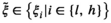







Wholesale Price Contract & Capacity Decision
In the wholesale price scenario, the buyer first observes her private information 








Table 2 summarizes the capacity levels and supplier's and buyer's profits in the respective benchmarks. If full information is available, the expected supply chain performance of the wholesale price contract (equilibrium) increases considerably, that is, by more than 116.6% (from 42.9% to 92.9%) in the low margin scenario and by more than 9.0% (from 91.6% to 99.8%) in the high margin scenario, although it is still lower compared to the supply chain optimum.
Contract Parameters and Expected Profits for the Wholesale Price Contract


Nonlinear Capacity Reservation Contract
Under the capacity reservation contract, denoted with the superscript 





















The contract parameters and expected profits of buyers and suppliers by realization 
Contract Parameters and Expected Profits for the Capacity Reservation Contract


Comparison of Wholesale Price and Capacity Reservation Contracts
According to game theory, the wholesale price contract profits more from information than the capacity reservation contract (while still performing worse). However, the game‐theoretic prediction for both contracts is that shared information is not truthful. More precisely, depending on the contract format information is either inflated or deflated, that is, forecast sharing does not reduce information asymmetries at all. Thus, according to the normative prediction, the capacity reservation contract, which reduces information asymmetries by separating buyers, performs better than the wholesale price contract.
However, behavioral studies (see section 2) demonstrate that people are rarely able to design separating contracts, thus information asymmetries are not resolved if human decision makers come into play. While the influence of information sharing on the performance of self‐designed capacity reservation contracts has not previously been explored, behavioral studies show that human decision makers share partially truthful information under the wholesale price contract (as well as under optimal separating capacity reservation contracts), and this information sharing results in contracts that perform better than predicted by game theory.
Overall, for human decision makers it remains questionable whether nonlinear contracts should be considered to resolve information asymmetries since simple contracts perform better than nonlinear contracts without information sharing, and simple contracts are further improved through forecast sharing which partially reduces information asymmetries. However, whether information can be shared (which appears to be the norm not the exception in practice) is independent of the contract format, and the answer to this question depends on whether information sharing is similarly effective for both contracts, whether humans take this shared information into account in a similar way in both contracts, and whether similar behavioral drivers influence human decisions in both contracts. We omit the presentation of behavioral hypotheses on performance because the state of the art is inconclusive, and explore whether suppliers can benefit from capacity reservation contracts. We setup controlled laboratory experiments which we explain in the next subsection before we discuss the three experimental studies that we conducted.
Design and Protocol of the Experimental Studies
We manipulate the contract types (wholesale price contract and capacity reservation) and consider two cost levels (low margin and high margin) employing a 2×2 design. The sequence of the events for the wholesale price contract and the capacity reservation contract consisted of three phases presented in Figure 1. In the first phase (
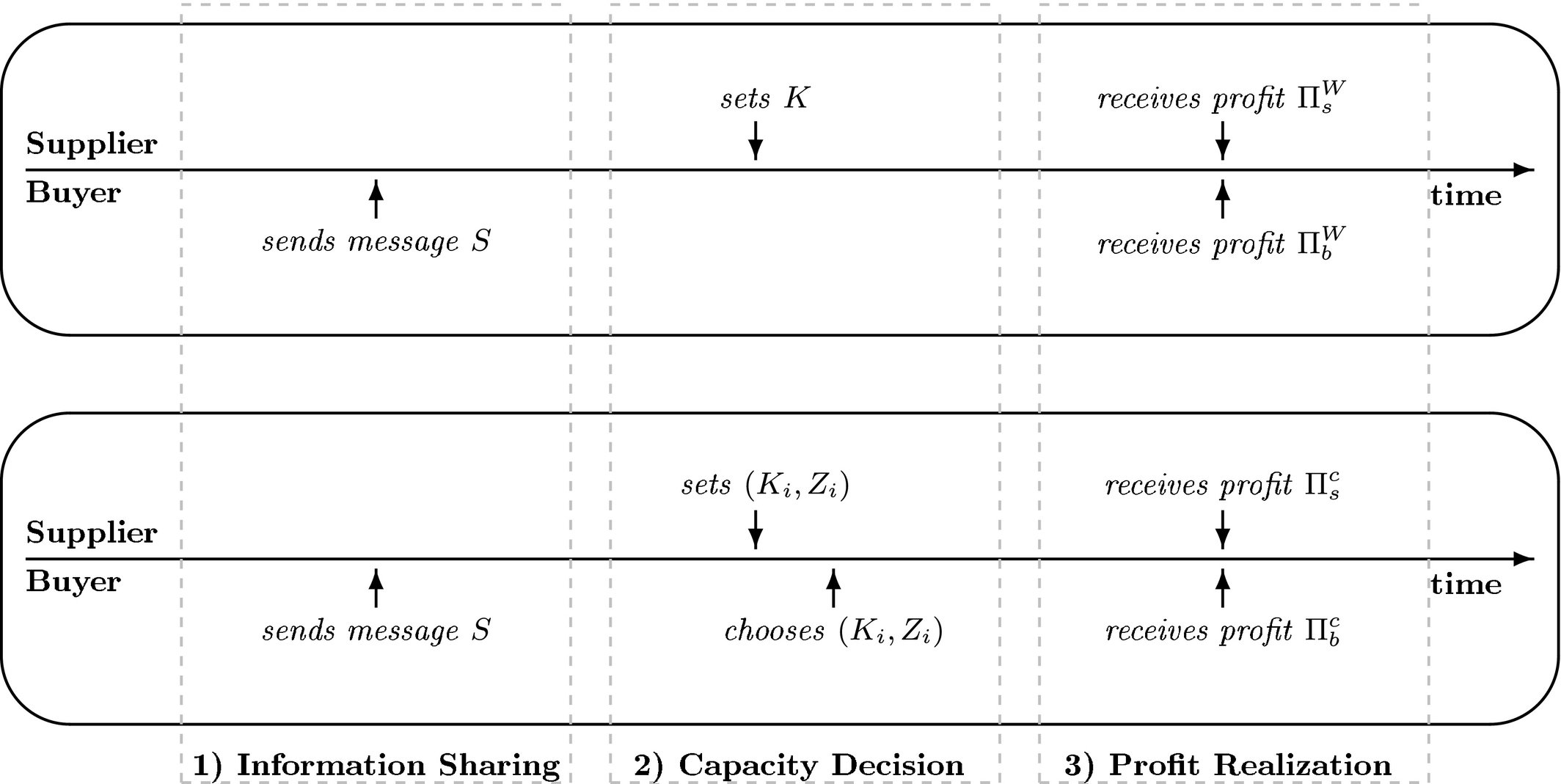
Sequence of the Events for Wholesale Price Contract (top) and Capacity Reservation Contract (bottom)
All sessions were conducted at the University of Hamburg's laboratory for experimental research in economics. Subjects were randomly placed into a cohort (matching groups) of six participants and assigned to roles (buyer or supplier) at the beginning of each treatment. Roles remained fixed for the duration of each session. Upon entering the laboratory, subjects were asked to read instructions that were identical for both margin treatments and both roles and only slightly differed for both contract treatments (see Online Appendix). Subjects could ask questions, which were answered privately. Afterward, the subject had to pass a quiz taking approximately 15 minutes to ensure that they understood the instructions correctly. The experiment was programmed and conducted with the software z‐Tree (Fischbacher 2007). During the experiment, communication between subjects other than sharing forecasts via the software was prohibited, and none was observed. There was no time pressure, and the experiment started with three training periods to ensure that subjects understood the task well. Afterward, 30 payout‐relevant periods with random matching (within the cohort) followed, thereby mimicking a one‐shot game. Upon completion of the session, each subject was privately paid his or her total earnings in cash.
Results (Study 1)
In total, 234 subjects participated in Study 1, resulting in 54 to 60 subjects and 9 to 10 cohorts per treatment. The experiment took on average approximately 75 minutes, and the average performance‐dependent compensation was approximately 16 euros. In the following, we provide and compare the results of both contracts for the three experimental phases (
Information Sharing
Table 4 shows the share of each message type (low forecast, no message, high forecast) by profit margin for both contracts and both margin treatments. In the wholesale price setting, a rational and profit‐maximizing buyer would inflate the forecast (see section 3). In both treatments, buyers report a forecast in more than 90% of all cases, whereby a high forecast was shared more often than a low forecast. There are only a few cases without forecast sharing, and almost all of them (97%) correspond to a low demand state. Almost all low forecasts were truthful, while only approximately two‐thirds of high forecasts were truthful. Overall, we do not observe major differences between the margin settings.
Share of Message Types and Share of Truthful Forecasts for a Given Type in Brackets
In the capacity reservation setting, a rational and profit‐maximizing buyer would deflate the forecast (see section 3). However, grasping the incentive to deflate requires, among others, expertise in nonlinear contracts. To this end, we observe neither consistent inflation nor consistent deflation of forecasts. Forty percent of the messages are low forecasts and 43% are high forecasts, while most but not all of the shared forecasts are truthful (approximately 88%). There is no forecast sharing in 17% of all cases, and if no forecast is shared, demand is low in 58% and high in 42% of all cases. We observe no major difference between both margin settings.
For both contracts, information sharing results in better yet not fully informed suppliers. Using the average truthfulness of the shared low and high forecasts of all buyers within each cohort as the statistical unit of analysis, we observe that forecasts are (mildly significant) more truthful for the capacity reservation contract than for the wholesale price contract for both the low margin (Mann–Whitney U,
Capacity Decision
For both contracts, the suppliers adjust the capacities based on the information provided as illustrated in Figure 2, which shows the box plots of the contract capacities (average capacity provided within each cohort). For the wholesale price contract and the capacity reservation contract (i.e.,
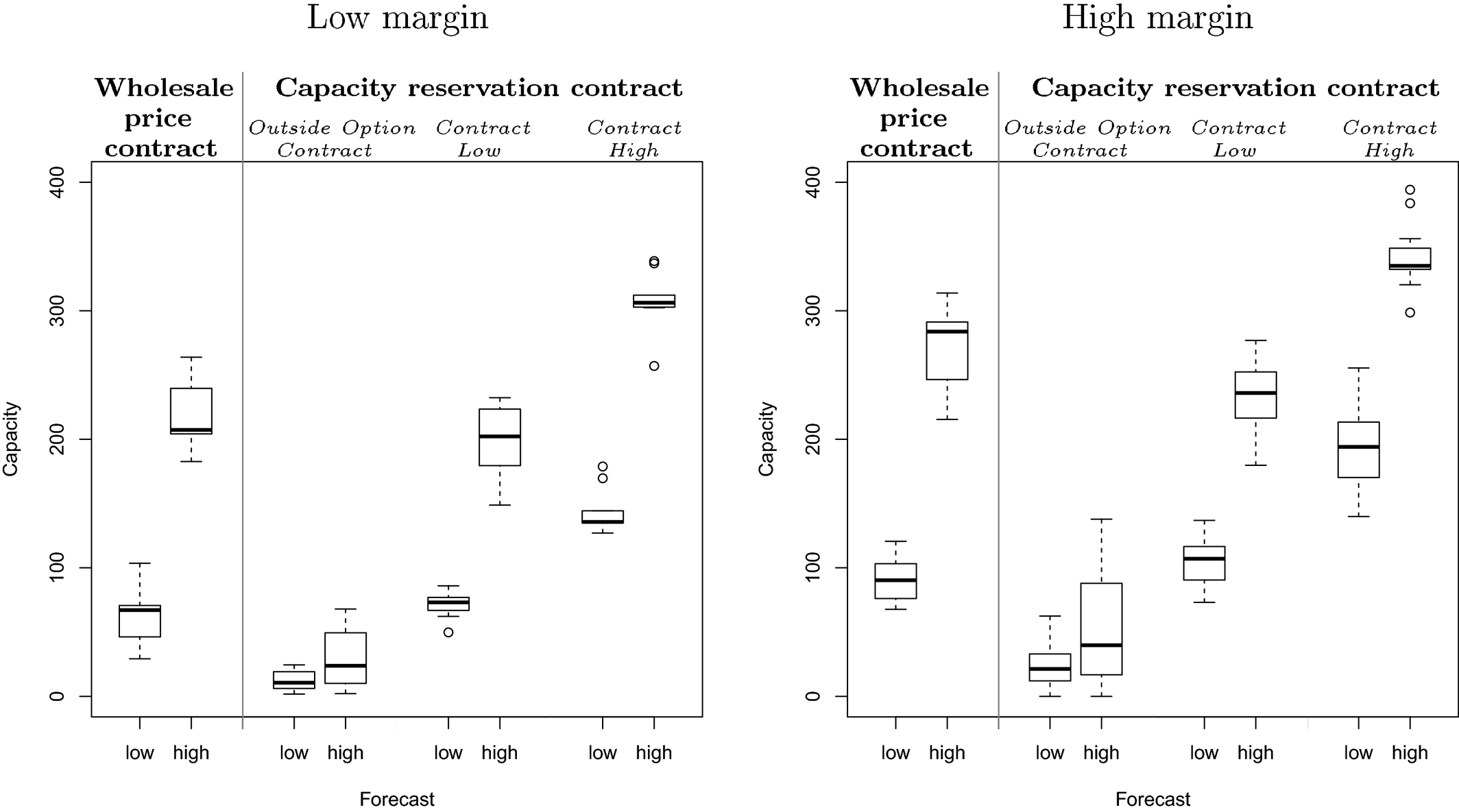
Average Capacities for Wholesale Price and Capacity Reservation Contract for High and Low Forecast
According to the game‐theoretic prediction, the capacity of
Nevertheless, the observed capacity reservation offers separate dishonest buyers from honest buyers effectively. Provided that the forecast is low while the demand is high, the
Profit Realization
Thus far, we observed that the information shared is partially truthful (even more for the capacity reservation contract), and capacity decisions strongly react to the information. As a consequence, capacity reservation contracts do not optimally separate forecast sharing buyers. However, they still separate buyers, in particular untruthful buyers. Next, we compare realized profits for both contracts.
We compare the equilibrium performance of rational and expected profit‐maximizing suppliers and buyers for capacity reservation contracts (Cr*) and wholesale price contracts (Wh*) to the corresponding observed performance levels (Wh and Cr). The performance by contract type, margin setting, and supply chain parties are displayed in Figure 3. Using the average performance of all suppliers (all buyers) within each cohort as the statistical unit of analysis validates that suppliers (buyers) earn significantly more (less) with the capacity reservation contracts for each margin case (each Mann–Whitney U,
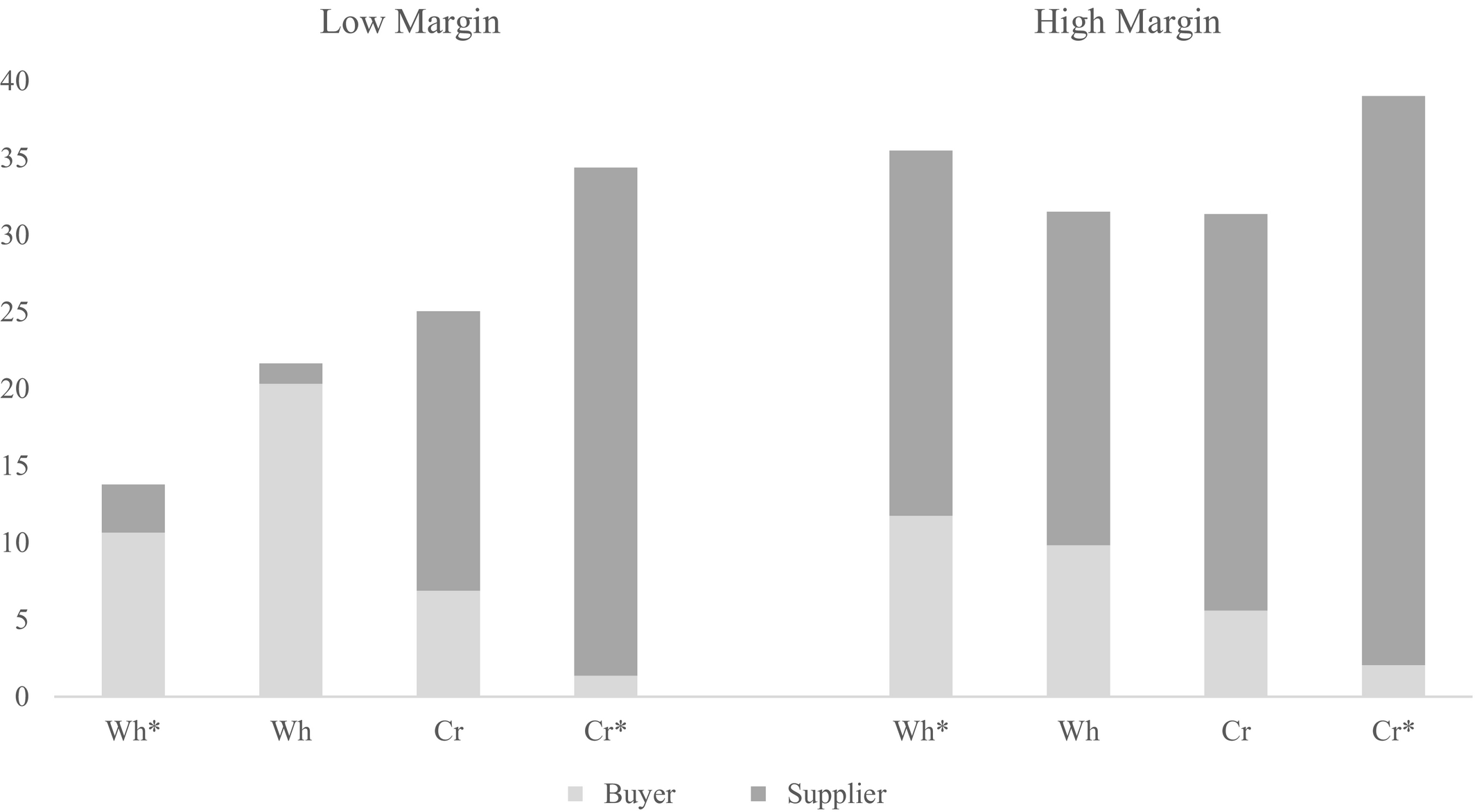
Suppliers' and Buyers' Performance Over All Periods (in euros)
Table 5 displays the supply chain performance for the two contract formats when forecasts are shared truthfully/untruthfully. For example, the average supply chain performance per period is −64 cents (2 cents) if a low demand buyer sends an untruthful forecast under the wholesale price contract (capacity reservation contract). We observe that the performances of the contract formats are almost the same, regardless of the profit margin, when information is shared truthfully. There seems to be no need to have two tailored capacity levels if the demand type is "known." Considering the untruthful forecasts, we observe that the wholesale price contract performs poorly for the low margin and well for the high margin, an asymmetry that can be explained by trust in inflated forecasts in combination with a mean anchor effect. The latter results in too high capacities for low margins and too low capacities for high margins, while trust in inflated (i.e., untruthful) forecasts results in increased capacities. In combination, both effects tend to "neutralize" each other in the high margin while they "exacerbate" in the low margin. For the capacity reservation contract, we do not observe that buyers systematically inflate (or deflate) forecasts, and furthermore it effectively, but not optimally, separates untruthful buyers (see previous subsection). As a result, it performs quite well for untruthful forecasts, and, in combination with side payments that shift profits from the buyer to the supplier, we find that from a supplier's perspective capacity reservation contracts perform better than wholesale price contracts, particularly when forecasts are deceptive.
Supply Chain Performance Per Period (in cents) if Forecast was Shared (number of observations in brackets)
Behavioral Model Describing the Capacity Decision
We identify trust and anchoring effects as potential drivers of biased wholesale price capacities, and we observe biased capacities, driven by trust, which do not allow for an optimal buyer separation for the capacity reservation contract. In the following, we elaborate on behavioral aspects influencing the capacity decision of both contracts. We claim that, besides trust, diversification based anchoring and insufficient adjustment, which we refer to as
Diversification Based Anchoring and Insufficient Adjustment
Anchoring and insufficient adjustment behavior is well‐known to be a strong driver of human behavior in general (Furnham and Boo 2011) as well as in closely related operations management settings where subjects determine supply before facing stochastic demand (Becker‐Peth and Thonemann 2018). We assume, in line with closely related studies on single contract decision, that subjects employ one anchor per contract (e.g., two anchors if two contacts are offered). Most experiments on anchoring study the role of exogenous anchors (Furnham and Boo 2011) while little is known about how subjects set anchors endogenously. In our setup, where subjects determine supply before facing demand, there are several ways to set anchors (Schweitzer and Cachon 2000), for example, based on the maximum, the minimum, or the mean demand. Assuming the number of anchors corresponds to the number of contracts, subjects might set anchors that diversify between the potential options they have. The diversification heuristic, which covers similar behavioral concepts like the diversification bias, the 1/n heuristic, or variety seeking (see Thaler 1999), provides indications of how these anchors might be set. We know from related studies that if many options are available, subjects tend to choose only a few (Huberman and Jiang 2006), 7 an observation that Benartzi and Thaler (2007) interpret as evidence consistent with naïve diversification as subjects have to simplify in situations with many options, for example, by choosing one option from each category. In this context, Hedesström et al. (2004) observe that subjects select a subset of options that all belong to different categories (yet avoiding very low or high risks), which they interpret as a tendency to select as diverse as possible while avoiding extremes.
Translating these findings to contract settings, subjects might favor diversified contracts and offer a variety of quantities. In this line, we expect that subjects set anchors by varying evenly along the range of possible quantities, that is, between the lowest demand 

The wholesale price contract is a special case with a single anchor (


In our experimental setup the demand should be in the interval [0, 200] when suppliers believe demand to be low, resulting in an anchor of 

The capacity reservation contract has several contract options and the 
In order to verify the
Figure 4 plots the demand state dependent
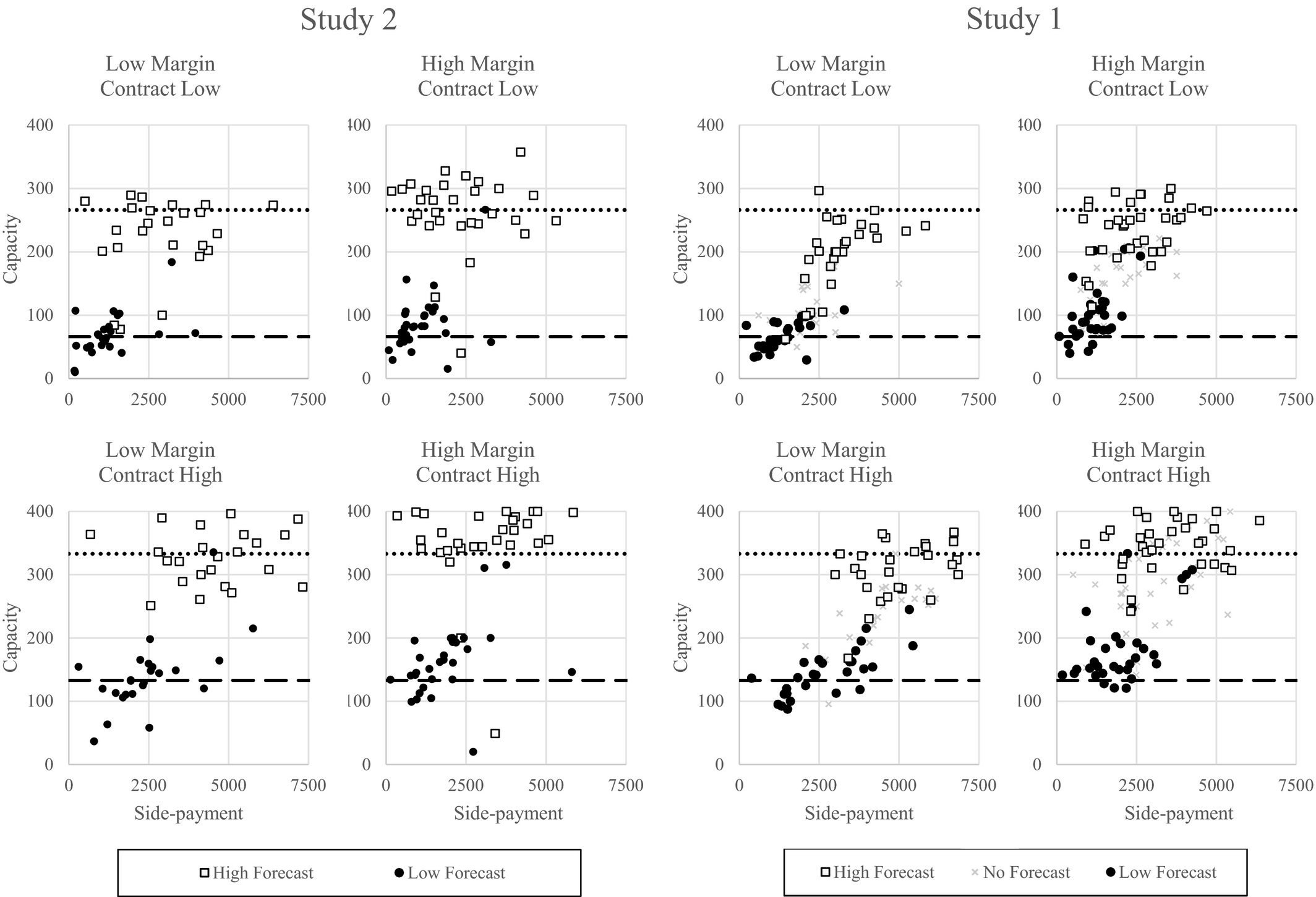
Average Contract Parameter Per Subject Depending on the Message Type
Building on the diversification heuristic, we propose a naïve anchoring and insufficient adjustment model which extends previous anchoring approaches to multiple contracts and includes mean anchoring as a special case. This approach describes well suppliers' capacity decisions for both the wholesale price contract (where
Naïve Anchoring and Insufficient Adjustment Combined with Trust
As discussed in subsection 4.2, shared forecasts are partially truthful (trustworthy) and contract capacities react to the messages demonstrating that suppliers partially trust them. In order to model the contract capacities, again focusing on the freely adjustable contract options 








Next, we present a parsimonious behavioral model where anchoring and trust are estimated from the observed data, first for the wholesale price and then for the capacity reservation contract.
Given the parametrization in our experiments, 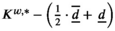



Results of Linear Mixed‐Effects Model


*
For both models, the random effects at the individual level can be confirmed, and both models yield similar results; that is, for the bounded model (unbounded model), with 

For capacity reservation contract, inserting Equation (9) in Equation (11) provides the contract block and forecast dependent capacity



Figure 5 plots the predicted capacities according to our model and the observed capacities for both contracts and both margin treatments. There is one marker per message (indicating the capacity) for the wholesale price contract while there are two markers per message for the capacity reservation contract where the lower marks
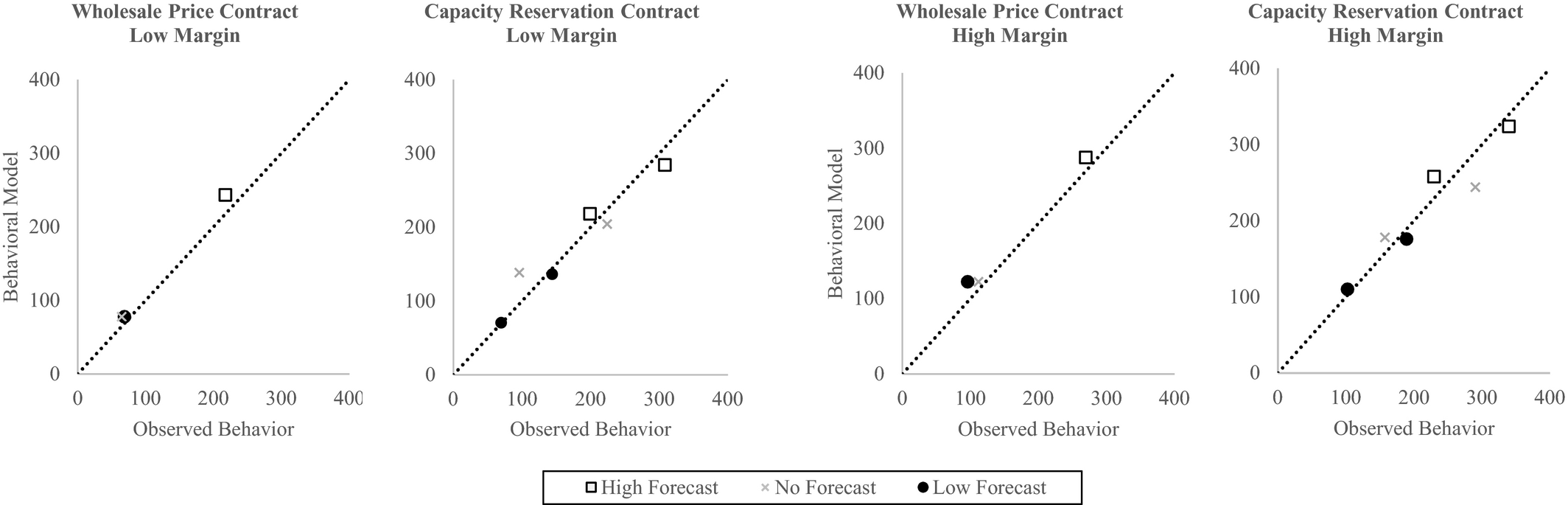
Comparison of Predicted and Actual Quantities in Dependence of the Forecast
Endogenous Contract Choice (Study 3)
Our previous results reveal that from a suppliers perspective capacity reservation contracts perform better than wholesale price contracts (driven by an effective separation of untruthful buyer and side payments that shift profits to the supplier) which leads to the follow‐up questions whether suppliers recognize that they benefit from capacity reservation contracts, that is, do they offer capacity reservation contracts if they can choose the contract type endogenously, and if so, do they offer an appropriate number of capacity levels?
In order to address this question, we setup an experimental study similar to Study 1 with the difference that the contract choice is endogenous. Suppliers offer a wholesale price contract, that is, a capacity without side payment which corresponds to the
We followed the same design and protocol as described in subsection 4.1 (the instructions are provided in the Online Appendix). We excluded subjects that participated in Study 1 or Study 2, and in total 102 subjects participated, resulting in 48 to 54 subjects and 8 to 9 cohorts per treatment. 11 The average performance‐dependent compensation was approximately 17 euros.
We observe that suppliers almost always offer additional capacity reservation contracts, that is, suppliers offer at least one additional contract in 99% of all cases for the low margin and 100% for the high margin, and they offer at least two additional contracts in 91% of all cases for the low margin and 98% for the high margin. While offering two additional contracts allows to optimally separate buyers (see section 3), we observe, that subjects tend to offer more contracts, that is, they offer three additional contracts (the maximum amount in our setup) in 46% of all cases for the low margin and 65% for the high margin.
Comparing the average performance of all suppliers (buyers) within each cohort as the statistical unit of analysis with Study 1 validates that suppliers (buyers) earn significantly more (less) with the "endogenous" capacity reservation contract than with the wholesale price contract for each margin case (each Mann–Whitney U,
Suppliers seem to understand that they benefit from capacity reservation contracts, that is, they offer such contracts when this is an endogenous decision; however, they tend to offer more contracts than normatively predicted.
Discussion
Our main contribution is showing that suppliers can benefit considerably from offering rather complex capacity reservation contracts despite and because of several behavioral phenomena. We next discuss our results in light of our model and experimental design assumptions.
We have chosen the parametrization employed by Özer et al. (2011) to allow for a comparison of both studies. We believe that our two profit margins appropriately reflect critical factors such as anchoring and adjustment, as in related newsvendor experiments (Becker‐Peth and Thonemann 2018). With this parameterization, we show theoretically and observe in the experiments that under wholesale pricing, the supplier receives a lower supply chain profit share than his buyer, while this relation is reversed under capacity reservation contracts.
In addition to the margin parameters, the choice of the demand distribution information asymmetry is an essential driver of the result, and we consider a stylized setting with two distinct information states. Intuitively, the lower the asymmetry, the lower the potential benefit of both forecast sharing and capacity reservation. To this end, it is important to note that we consider two demand types (low and high), while Özer et al. (2011) consider a continuous distribution. At an aggregated level, they observe anchoring, as we do; that is, the capacity levels lie in‐between the theoretically optimal capacity levels and the mean demand. However, a visual inspection of their figures does not indicate that buyers' low forecasts are more trustworthy than their high forecasts, while we observe that low forecasts are almost always truthful, while high forecasts are less truthful. This difference is likely driven by the discretization of types; that is, low types do not have the option to inflate by an arbitrary amount. Furthermore, in our experimental design the actual demand type is revealed ex‐post. Even though a buyer interacts with another supplier in the next period, they might not want to be identified as liars. Accordingly, our design has a somewhat optimistic view of buyers' trustworthiness. However, if this is the case, then our observed wholesale price performance is optimistic as well. Thus, with a lower trustworthiness for both contract settings, the main insight that capacity reservation increases supplier profits should hold (or be even more pronounced).
While we observe that suppliers tend to set the capacity reservation fees too low, we would expect the fees to be even lower with stronger buyers (who retaliate or are able to retaliate by ordering less), which could diminish the supplier's benefits from offering capacity reservation contracts. On the other hand, we believe it to be less likely that capacity levels react to the power structure since it seems reasonable that profit allocations are controlled via the reservation fee and thus do not impact the capacity level. Hence, the supply chain enhancing effects of capacity reservation contracts in low profit margin settings would sustain, underscoring our recommendation to consider this contract format in these scenarios.
Conclusion
We address the question whether firms should offer rather complex nonlinear contracts or stick to the common mode of wholesale price contracts when information can be shared among the supply chain parties. While normative theory suggests that nonlinear contracts outperform simple wholesale price contracts, behavioral research gives rise to the suspicion that this might not hold if human decision‐makers design contracts, share and process information, and make contract choices that are not profit maximizing. We analyze this question in laboratory experiments based on a well‐established stylized supply chain setting with asymmetric forecast information and provide evidence that, when, and why capacity reservation contracts (as a specific form of nonlinear contracts) are a beneficial contract format if information can be shared.
Contrary to previous research on information sharing under nonlinear contracts, our experimental study is the first to consider contract design complexities, that is, the contracts are self‐designed by human decision makers (without optimization based decision support that enforces separating contract offers). We observe that the supplier's and supply chain's benefits from using capacity reservation are proportional to what is predicted theoretically. In the low margin treatment, we observe a substantial and significant benefit from using capacity reservation for both the supplier and the supply chain. While the supplier's benefit remains significant, the supply chain's benefit vanishes, for the high margin treatment. These results complement and put into perspective previous behavioral research on nonlinear contract design without information sharing that finds no benefits from nonlinear contracts (Kalkanci et al. 2014). We find that capacity reservation contracts plus information sharing can be beneficial for suppliers, because (or despite) several behavioral phenomena that result in an effective separation of dishonest buyers. To this end, we present a novel behavioral model based on naïve anchoring and insufficient adjustment and show that
Suppliers that can choose between offering several capacity reservation levels or sticking to the wholesale price contract realize that capacity reservation contracts are beneficial. We observe that capacity reservation is extensively used, and while suppliers tend to offer more capacity reservation levels than game theory predicts, we find that the superior performance is robust against this bias. Overall, we find evidence that generically promoting capacity reservation contracts in the organization is sufficient to capture the positive benefits of this contract format, despite the behavioral biases human decision makers exhibit.
Although we observe capacity reservation contracts to be beneficial for suppliers, we identify biases that are subject to performance losses. Further research might shed light on the question if behavioral interventions reduce anchoring when setting capacity levels or lead to a more theory‐aligned utilization of reservation fees that effectively separates buyer types. Another interesting avenue for further research is to study different combinations of baseline contracts and nonlinear contracts with and without information sharing, which is beyond the scope of this study. Several other contract types such as revenue sharing, buyback, or option contracts (Becker‐Peth et al. 2013, Cachon and Lariviere 2005, Davis and Leider 2018) might serve as a benchmark for capacity reservation contracts, and as an alternative for the capacity reservation contract one might also consider advance purchase commitments that also allow suppliers to gather private information of the buyer before setting capacity (see Özer and Wei 2006). Finally, we assume that wholesale prices are exogenous, and one might consider whether wholesale prices perform better or worse in our scenario when negotiated endogenously (e.g., before, after, or when receiving the forecast). However, the analysis is considerably more complex because the incentives to inflate, deflate, or truthfully report forecasts change depending on the timing of forecast sharing and the actual cost parametrization (see Chu et al. 2017 for analytical benchmarks).
Footnotes
Appendix
Appendix
Acknowledgments
The authors thank Lennart Johnsen and Nils Roemer for their support during the laboratory experiments, as well as Elena Katok, the anonymous Senior Editor, and three anonymous referees for valuable suggestions that significantly improved the paper.
From an external validity perspective, the “no information sharing” option almost always exists. From a behavioral perspective, lying (i.e., sending a deceptive message) might cause disutility (lying aversion). If subjects were forced to signal either low or high demand, we take the opportunity to abstain from information sharing without suffering from lying aversion. Furthermore, sending uninformative messages in such a scenario would require to send messages that are uncorrelated with the demand state (in the extreme case; always sending the same message). By our design choice, we control for related confounding factors.
Intuitively, the contract for the high type has no consequences for the informational rents of other types. As such, there is no “informational rent—efficiency” trade‐off, and setting the supply chain efficient capacity level is optimal.
The positive quantities might be due to suppliers that aim to secure some minimal expected profits even if the buyer chooses the
For the capacity reservation contract supply chain profits are shifted between the supply chain parties by the side payments, and side payments lower than optimal (see Appendix A) explain why the supplier's share of the supply chain profit is lower than game theory predicts (as illustrated in  ). Still, side payments shift profits from the buyer to the supplier, which drives higher supplier performance compared to the wholesale price contract.
As discussed in subsection for the capacity reservation contract we observe neither a consistent inflation nor a consistent deflation if “no message” was shared. Thus, assuming that a supplier does not interpret “no message” in a distinct way, these situations correspond to a setting without information sharing. Using the average performance of all suppliers within each cohort, the suppliers' performance with shared information is better than without, that is, the difference is strongly significant for the low margin (Wilcoxon signed‐rank test,
Our approach might also explain quantity decisions in other contracts, like quantity discount contracts as studied for example, by Kalkanci et al. (2011) who observe that suppliers set a single price break quantity of 102, where our approach suggests one anchor of 100, and they set the two price break quantities of 81 and 129 where our approach suggests the two anchors 70 and 130, respectively (similar results are obtained in a related study by Kalkanci et al. ).
The revelation principle states that two contracts in the menu of contracts suffice to implement the second‐best outcome. We note that more than two contracts might also be optimal in a normative sense, if two contract offers have identical parameters (i.e., one contract is a copy of another) or if a contract option is off the equilibrium path.
We had to exclude one cohort from the following analysis since a subject left the experiment early due to physical issues.