






Abstract
Humanitarian disasters are highly dynamic and uncertain. The shifting situation, volatility of information, and the emergence of decision processes and coordination structures require humanitarian organizations to continuously adapt their operations. In this study, we aim to make headway in understanding adaptive decision‐making in a dynamic interplay between changing situation, volatile information, and emerging coordination structures. Starting from theories of sensemaking, coordination, and decision‐making, we present two case studies that represent the response to two different humanitarian disasters: Typhoon Haiyan in the Philippines, and the Syria Crisis, one of the most prominent ongoing conflicts. For both, we highlight how volatile information and the urge to respond via sensemaking lead to fragmentation and misalignment of emergent coordination structures and decisions, which, in turn, slow down adaptation. Based on the case studies, we derive propositions and the need to continuously align laterally between different regions and hierarchically between operational and strategic levels to avoid persistence of coordination‐information bubbles. We discuss the implications of our findings for the development of methods and theory to ensure that humanitarian operations management captures the critical role of information as a driver of emergent coordination and adaptive decisions.
Introduction
Humanitarians respond to an ever‐growing number of disasters. Along with progress in sensing, monitoring and communication technologies, information about disasters is continuing to increase in volume, variety, and velocity (Papadopoulos et al. 2017). There are many promises associated with the increasing access to information, such as improving efficiency and effectiveness of operations (IFRC 2013). However, the deluge of information is adding to the proverbial chaos of a disaster, and there is increasing concern about its impact (Sandvik et al. 2014, van Wynesberghe and Comes 2020).
It has been widely acknowledged that information in disasters is uncertain. Traditionally, this uncertainty has been attributed to data gaps resulting in many efforts to improve data collection. However, driven by technology innovation the very nature of uncertainty has changed. Because of the ease to create and share data, there is an increasingly fragmented and volatile information landscape: information is subjective and localized, of unknown origin and reliability (Monaghan and Lycett 2013).
If information is to have an impact on humanitarian operations, it needs help responders make sense of their situation, support decisions and coordination. Yet, organizational mandates, objectives, and norms are gradually established as the response unfolds and more information becomes available (Comes and Van de Walle 2016). Analytical models that require well‐defined objectives and constraints are abundant in the humanitarian operations management literature, but the dynamics and emergence of decisions and coordination structures have not received similar attention (Holguín‐Veras et al. 2012).
Because humanitarian decisions are far from the ideal postulated for the rational decision‐maker, it is important to investigate the mechanisms by which decision‐makers use information to make sense of a volatile environment, to decide and to coordinate. This study investigates the interplay of information and sensemaking, decision‐making, and coordination (section 2) by two case studies (research design: section 3): the response to Super‐Typhoon Haiyan in 2013 (section 4), and the response to the Syria crisis (section 5). Using qualitative research methods to identify the underlying mechanisms, we aim to make a first step toward the design of methods and approaches that take into these aspects. To do so, we identify critical factors and concepts that need to be taken into account to develop methods and models that are based on an understanding of sensemaking, decision‐making, and coordination across scales and the critical role of information therein (section 6).
Humanitarian Information, Coordination and Decisions
Efficient disaster management, so literature contends, requires well‐aligned data collection and information flows, decision processes, and coordination structures (Chen, Sharman, Rao, and Upadhyaya 2008). Disasters are highly dynamic, and with the many innovations in information technology there are new opportunities to get insights from the ground in near‐real time (Altay and Labonte 2014). This proliferation and volatility of information pressures decision‐makers to rapidly respond (Höchtl et al. 2016, Levin et al. 2012, Tsoukias et al. 2013), despite the complexity of the problem.
In literature, normative methods for complex decisions have been proposed, which are based on optimization models or simulations. Grounded in the paradigm of the rational decision‐maker, they advocate modeling uncertainty as probability distributions, and adapting to new information as it becomes available. Meanwhile, the development of prospect theory (Kahneman and Tversky 1979, Tversky and Kahneman 1974) has led to a sprawling literature on the cognitive aspects of how decision‐makers process and use uncertain information (Klein et al. 2010, Lipshitz et al. 2001, Maule et al. 2000, Weick 1993). Particularly in high‐risk and time‐compressed situations, decision‐makers are found to be far from rational in terms of information sharing and use. As such, the models and methods that conventionally support decisions in humanitarian operations need to be extended and adapted to account for the impact of information processing and sharing on decisions and coordination.
In this section, we first discuss Humanitarian Operations Management (HOM) approaches that support adaptation to dynamically changing situations. Subsequently, we provide an overview of theories relevant to humanitarian sensemaking, coordination, and decisions that reflects the role of.
Adaptation Models and Decision Behavior
Acknowledging the uncertainty and dynamics of disasters, there is a considerable body of literature that focuses on facilitating adaptive change. In HOM, flexibility, agility, and responsiveness have been advocated widely (Baharmand et al. 2017, Balcik et al. 2015, Charles et al. 2010, Oloruntoba and Gray 2006, Van Wassenhove 2006). These authors focus on changes in supply chains in terms of locations, routes, schedules, or actors along with systemic characteristics that facilitate change. They do not focus on adaptation processes and structures, or the question when and how plans should change.
In policy analysis and resilience literature, the notion of adaptive planning has been developed as a strategy to manage the timing and nature of change by identifying ideals pathways that consider a large range of future scenarios (Kwakkel et al. 2015). Adaptive planning implies that networks, structures, processes, and—indeed—plans are designed to be revised over time. As such, adaptation is planned for, rather than taking place in an ad‐hoc manner. However, adaptive planning relies on the assumption of a rational decision‐maker adapting to newly available information (Walker et al. 2013). This is in contrast to the literature on decision behavior under time pressure and stress, which clearly indicates that in these situations, decision‐makers are far from rational and have a tendency to discount important cues if they are not in line with their earlier decisions or assumptions (Klein et al. 2010).
At the organizational level, characteristics of innovating and learning were initially described by Galbraith (1982). However, the roles, processes, rewards, and practices that have been described to lead to improvisation and innovation are not in line with the reality of humanitarian organizations, whose structure is designed to be operational, bureaucratic, and highly efficient. Driven by the short time horizon of many humanitarian operations combined with a high staff turn‐over, there is no clear systematic adaptation mechanism. Consequently, revisions of plans and strategic choices are often late, costly, and vendor lock‐ins (in terms of systems, locations, commitments, or people) frequently cause inefficiencies or imbalances (Baharmand et al. 2017).
To understand the underlying mechanisms and principles that do guide the adaptation processes in highly dynamic humanitarian settings, we develop an analysis framework that is based on the theories of coordination, sensemaking, and decision‐making. To acknowledge the volatility of disasters, we investigate the theories against the backdrop of an increasingly fast changing information landscape.
From Information to Coordination through Sensemaking
Coordination entails information sharing, collaborative use of resources, joint policies, and definition of responsibilities (van der Laan et al. 2009). For humanitarian organizations, the UN cluster system provides a framework for coordination. It has been established in its current shape as a part of the humanitarian reform process to group organizations (UN agencies and NGOs) working in the same functional areas of humanitarian aid, for example, logistics, shelter, or health (IASC 2015). HOM research on disaster coordination thus far considers stable structures (Jahre and Jensen 2010, Natarajarathinam et al. 2009) aiming to analyze the implications of the system for logistics processes.
Given the lack of a strong central authority in the UN cluster system, it has been argued that coordination should be achieved through increased cooperation and consensus building (Stephenson 2005). However, the dynamics of disasters often give way to a spontaneous and unstructured setup of coordination structures driven by individual leadership rather than organizational mandates and norms (Darcy et al. 2013). What is, therefore, missing in HOM is an understanding of how coordination structures emerge given the fragmentation and dynamics of disasters.
To understand this emergence and the interplay between information and coordination, sensemaking provides useful theoretical concepts. The sensemaking process is founded on a stream of unfiltered, chaotic data that needs to be structured, processed, and turned into meaningful and actionable information (Endsley 1995, Weick et al. 2005). Sensemaking is a collaborative process (Brown et al. 2014, Endsley 1995, Hardy and Comfort 2014) in which meaning, preferences, and aims are continuously re‐assessed (Weick and Quinn 1999), depending on the information discussed.
In disaster response, social processes are intermitted by the changing composition of groups and re‐assignment of roles driven by the rapid rotation schemes of international organizations. Nosek and McNeese (1997) were among the first to discuss group sensemaking in volatile situations as “the elicitation and creation of group knowledge relevant to an emerging situation.” Sharoda and Reddy (2010) identify the most important properties for such settings as: (i) prioritization of relevant information, (ii) sensemaking trajectories (keeping track of meaning over time), and (iii) activity awareness, combining social awareness (actors and relationships) with action awareness. Closely linked to the sensemaking process is the idea of contextual rationality. In his seminal work, Weick (1993) defines contextual rationality as: “Action motivated to create and maintain institutions and traditions that express conceptions of right behavior.” As such, contextual rationality guides coordination through establishing common norms, which is vital to achieve a consistent interpretation of information and thereby alignment.
Together, sensemaking and contextual rationality support the translation of the continuous and unstructured stream of data and information into: (i) a joint understanding of the situation and context over time (trajectories and social awareness); (ii) framing and scoping of the problem in terms of priority information and ongoing or planned activities; (iii) binding normative structures. In other words, sensemaking supports and helps shape the emergent coordination structures.
Information and Humanitarian Decisions
As the stream of information shapes sensemaking and emerging coordination structures, priorities and views on how to manage the disaster are continuously adapted (Comes 2016). Nevertheless, HOM models largely assume stability of objective functions and constraints (Galindo and Batta 2013). Typically, these models optimize humanitarian operations with respect to efficiency, effectiveness, and equity or fairness (Gralla et al. 2014, Holguín‐Veras et al. 2013). While the need for capturing trade‐offs between conflicting criteria is recognized (Gutjahr and Nolz 2016), few authors explicitly elicit or measure objectives and preferences (Gralla et al. 2014, Holguín‐Veras et al. 2013). The result is a limited understanding of the processes that determine how humanitarian decisions are made, or the mechanisms that drive the volatile nature of preferences during a disaster response.
Given the sparse literature in the humanitarian domain, we rely on findings from decision analysis. In stressful conditions decision‐makers follow intuitive rules to make fast decisions (Gigerenzer et al. 2012). Such rapid heuristics are mostly applied for low impact decisions. Few authors have investigated fast strategic decision‐making in volatile contexts (Baum and Wally 2003, Eisenhardt 1989b). Dean and Sharfman (1996) also studied the underlying decision processes. Research on rapid strategic decisions concludes that, despite short time, fast decision‐makers use more information than slow decision‐makers and tend to develop more alternatives, reflecting the exploratory nature of their decision processes (Eisenhardt 1989b).
While the empirical findings on rapid decisions provide insights into individual reasoning, there is no work on the emergence and adaptation of processes for rapid decision‐making in humanitarian operations. In addition, with the focus of HOM literature on natural sudden onset disasters (Galindo and Batta 2013), it is unclear if the findings on decision‐making discussed above are valid for complex longer term operations that are typical for conflicts.
Synthesis
Figure 1 synthesizes the theoretical findings, and the interplay between the different concepts. Starting from the top, our argumentation is as follows: through emerging coordination structures, organizations acquire roles and responsibilities that, in turn, shape their decision‐making. Decisions require specific data to inform planning and implementation. Therefore, upcoming or ongoing decisions direct data collection and information flows. The stream of information, in turn, informs the sensemaking process that shapes the understanding of the situation and is instrumental in determining priorities or mandates, ergo coordination structures. What emerges is a continuous cycle of sensemaking, formation of mandates, and assignment of responsibilities (coordination) and explicit or implicit formulation of aims, preferences and constraints that lead to decisions.
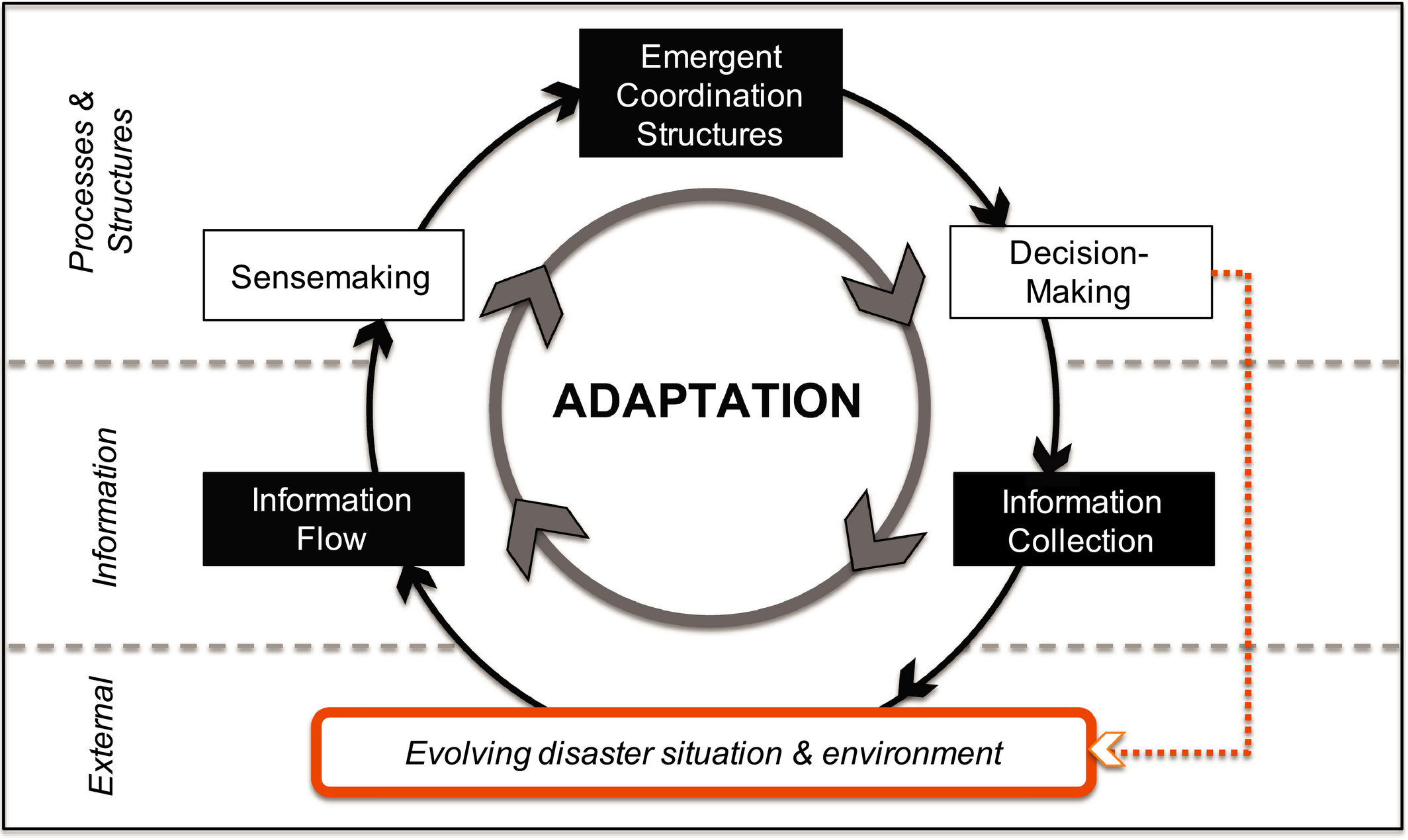
Cycle of Sensemaking, Emergent Coordination, and Decision‐Making. New elements in black [Color figure can be viewed at
The alternating cycle of sensemaking and decision‐making has been described by several authors (Gralla et al. 2016, Muhren et al. 2008). We extend this view in three ways, highlighted by the black elements in Figure 1. First, we add emergent coordination structures, roles, and mandate explicitly to the processes and mechanisms considered. This focus enables us to go beyond individual decision‐making behavior, and to consider the impact of strategic shifts at the level of organizations. Second, we specifically investigate the role of information in this process, and the co‐emergence of information flows. Third, our research evolves around the idea that operations need to be adaptive to (new) information. Although theoretically adaptation should be central given the dynamics of a disaster, the initially cue‐based process of formulating priorities and mandates is self‐reinforcing as expectations are created and retained (sensemaking trajectories) and coordination structures mature (Comes 2016, Maitlis and Christianson 2014). We argue that the volatility and fragmentation of information that have become typical in disasters are not only a product of the changing situation, but also reflect the changing coordination structures and decision processes, requiring organizations to continuously collect and search new information. As such, the changing information landscape is both a driver of adaptation and a symptom. We will use this theoretical framework as the basis for our case studies.
This section presents our design for field research and data collection, including the sample and selection of sites, as well as the research methods used to develop our framework.
Research Design
As argued in section 2, existing theories do not explain the emergence coordination structures and information flows; and the underlying adaptation mechanisms. Our goal is, therefore, to inform theory building from insights obtained in two field case studies. Qualitative case studies enable the generation of new frameworks when existing explanations are inadequate (Kaplan and Duchon 1988, Yin 2017). Case studies have been described as particularly useful to understand the dynamics within a given setting (Eisenhardt 1989a, Wacker 1998). As such, a case study approach is suitable to study the adaptation of processes and structures in the dynamic context of a disaster.
We conducted three field studies that provide the basis for our work: the response to the natural disaster of Typhoon Haiyan in the Philippines (2013) and the response to the Syria crisis (2014 and 2015). The opportunity to conduct field research in two different contexts enables a powerful multiple case study research design. As our aim is to establish foundations, investigate the underlying phenomena, and build new theory, we choose for depth of investigation in three case studies over the breadth of possible cases. The resulting insights can subsequently inform the design of methods and models that can later be tested, validated, and applied to other research designs in a broader range of settings.
The field aspect in disaster settings requires a research design that is robust to disruptions of communication, workflows and protocols, and potential biases introduced by the nature of the research environment. Auf der Heide (2006) provides an overview of data collection challenges in field conditions, including the difficulty to get representative sample sizes. Considering those constraints, we decided for both case studies to purposefully explore the response by choosing itineraries and interview partners that enabled us to obtain an overview of different settings and contexts.
For each case, we collected data until the point of theoretical saturation, where the incremental improvement in theory or methods is small because new data confirm existing propositions. Our sample includes for both cases a balanced set of UN agencies and international NGOs (iNGOs, see Appendix). In addition, we also conducted interviews with local representatives (public authorities and local NGOs) in the Philippines, as well as interviews with donors in the Syria Crisis. Since we do not have a broad enough sample for these groups to draw robust conclusions on the interplay between local representatives or donors with humanitarians, we focus purely on the humanitarian organizations.
Data Collection
For the two case studies together, a total of 71 on‐site semi‐structured interviews were conducted. By combining the interviews with focus groups and observations we increased the validity of our study. The interview protocols for both field research studies were based on key concepts developed from the theoretical foundations discussed in section 2. We focused on the setup and evolution of decision processes and coordination structures and the interplay between information, sensemaking, and decisions.
For the first case study, the authors led a research team that visited the Philippines in December 2013, 5 weeks after the Typhoon hit. The team consisted of three senior researchers and one PhD student with backgrounds in humanitarian logistics and information management. We developed our field itinerary to cover different contexts and to ensure access to decision‐makers and key coordination functions. After an exploratory phase with five initial interviews to scope the field research, we conducted 29 on‐site semi‐structured interviews (varying from 30 to 90 minutes) with representatives from UN and governmental agencies, iNGOs, charities, and affected population. In addition, we observed several coordination meetings (between 1 and 2.5 hours) and participated in a full day field trip to remote regions. A full account of our data collection in the Philippines is provided in Appendix A.
The work on the Syria crisis, our second case study, is based on two field studies conducted in May 2014 and June 2015 as part of an UN Office for the Coordination of Humanitarian Affairs (OCHA) review mission. During the first visit, the research team was based in the office of the regional humanitarian coordinator in Jordan (Amman). The second visit broadened the scope of the initial visit by studying the perspectives across three countries in the region: Jordan (Amman), Lebanon (Beirut), and Turkey (Gaziantep and Antakya). Access and security conditions as well as availability of decision‐makers in key functions determined our planning. After two initial exploratory skype interviews we conducted 42 in‐person semi‐structured interviews in total (16 in 2014 and 26 in 2015) with representatives from UN agencies, international and local NGOs and donors with a representation in Syria. In addition, we conducted semi‐structured focus groups with stakeholders and experts from different organizations that shared the same geographic location and context, and we observed coordination meetings. All details are provided in Appendix B.
Data Analysis
The goal of the data analysis was to build a theory that explains adaptation mechanisms in dynamic situations via the interplay of sensemaking, coordination, and decision‐making. The role of information is instrumental in this process. While theoretically (rational) decision‐makers are assumed to adapt to new insights, we specifically explore how information shapes sensemaking, thereby driving the emergence of coordination structures, decision processes, objectives, and preferences. Building theory is an inductive process, in which the theory emerges from data, in a process of “capturing the complexities of the real world, and then making sense of it” (Pettigrew 1990).
In a first step, in order to extract initial concepts from data, we use an inductive process, inspired by grounded theory applied to organizational settings (Martin 1986) and case study methods (Eisenhardt 1989a, Jahre et al. 2009). Data analysis started with each case separately. Per case, we use an initial qualitative conceptualization step (Kaplan and Duchon 1988) to identify key concepts related to sensemaking, coordination, and decisions, and how these processes, in turn, drive adaptation of the ongoing humanitarian operations. This analysis is enriched with observations and contextualized data through a secondary data review (including situation reports, internal documents on coordination structures and information sharing) that reflects the evolution of the respective disasters, and provides context and a timeline of events, which are essential to understand the evolution of the situation. What emerged from this step was (i) a set of codes describing the main drivers and barriers to adaptation; and (ii) an initial narrative on the emergence of coordination structures and decision processes per case.
In a second step, we further interpret and conceptualize the data to understand and explain the differences and commonalities across the case studies. First, data that were coded in a similar way were compared across cases to seek patterns or differences in the way coordination structures or decision processes evolved. The results are described more detailed per case study. Second, we revisited the timelines and narratives of the cases to describe overall patterns and mechanisms and explain differences related to the different environments and contexts. Importantly, the timeframes and geographical scopes of both responses are different. Therefore, the focus in the narrative for the Haiyan case is adaptation in overcoming an initial “void” of data; whereas the Syria case is directed to the continuous adaptation needed in a dynamic conflict. This second step led to the revision of our theoretical framework, and the identification of important mechanisms and barriers for adaptation (section 6).
Case Study 1: The Response to Typhoon Haiyan
Reaching the shores of the Philippine archipelago on November 8, 2013, Haiyan acquired the status of “super‐typhoon,” reaching sustained wind speeds of 230 km/hour (145 mph) upon landfall. Haiyan became the deadliest Philippine typhoon on record, killing at least 6200 people and damaging an estimated 1 million homes. Within days, a system‐wide level 3 (L3) response was activated, marking the highest level of humanitarian crisis. The Haiyan response became the first large‐scale response to a sudden onset disaster since the protocols for coordination under the Transformative Agenda were adopted in 2011. For an updated version of the protocols, see (IASC 2015). We present next the findings from our field work with respect to sensemaking, decisions and coordination (section 4.1), followed by a characterization of adaptation (section 4.2).
Findings on Sensemaking, Coordination, and Decision Processes
The findings of this case study are presented in the form of theoretical principles describing how decision‐ and sensemaking processes were coevolving with the setup of information management and coordination structures. This approach follows Mintzberg et al. (1976) and Turoff et al. (2004) who formulate principles to guide decision processes in dynamic crises. Table 1 provides an overview of the main concepts that emerged from our interviews, along with the number of interviews in which a concept emerged for different geographical contexts. To enrich and illustrate the main points, we provide sample quotes. Per sample quote, the category of organization is provided. Coding IDs are not added here, as some of the interviewed roles will allow the identification of the interviewees.
Decision‐Making and Coordination Structures in the Response to Haiyan
Decision‐Making and Coordination Structures in the Response to Haiyan
In the initial surge of the operations, deployment and prioritization decisions need to be made rapidly, within 48–72 hours. Instead of formulating and solving a problem as suggested by Gralla et al. (2016), interviewees consistently report that actions were cue based: “There is not much time to think, what priority is. It is priority to boom boom boom one after the other” (see Table 1). Operational simplifications and reliance on personal experience driven by a lack of reliable information and extreme time pressure dominated decision processes. Efforts dedicated to assessment were simply discarded: “Honestly, we have done many assessments and I have never looked at one of them.”
In the absence of analytic decision support, typically, choices entailed only a small number of options or criteria that decision‐makers felt comfortable with managing and “thinking through” or had experienced in other contexts. For instance, the choice for Guiuan as a major hub was made: “because it has a port, an airport and was badly hit. That is all.” (cf. Table 1). The quotes in Table 1 also highlight that the approach taken was “to settle with good enough,” that is, satisficing, not optimizing behavior, while acknowledging the need to continuously adapt (“you have to keep moving”).
he more disrupted the infrastructure, the more interviewees relied on individual perceptions. Table 1 shows that the deeper into the field (Tacloban and Guiuan), the more frequently sensemaking was identified as a key concept in interviews. With limited access and communication restricted to voice and text messages in Tacloban and Guiuan, direct perceptions or information from trusted sources were largely judged as more meaningful, relevant and reliable than official UN information products. An important factor here is time pressure, and the fact that many information products or dashboards required time for processing and were, therefore, discarded. In other words: “It is us seeing it rather than us actually taking the time to look at it.” (cf. Table 1).
Interviewees also confirmed the importance of sensemaking as a major function of (local) decision‐making: they collaboratively build a coherent understanding of the local evolution of the situation: “There is synergy, you know the guy. It is like that. There is no other way.” The long lead times of information requests gave ways to speculation, rumors and reliance on perceptions or social networks: “It is like, forget it and let me just do my seeing and believing” (Table 1). As such, the elaborate data collection, verification, and triangulation contributed to localized and cue‐based decisions at operational level. As such, the disruption between local and direct sensemaking and remote sensemaking at headquarters level gave way to a fragmentation of response efforts.
The disconnect of strategic and operational levels led to a confusion of mandates and responsibilities. Within the initial communication void and unclear decision structures, operational decision‐makers had to invent and setup local processes they deemed would best serve their needs. This is reflected in quotes such as: “Administration was taking operational decisions, and we took administrative decisions at operational level.” This led to inefficiencies: the seaport of Guiuan, for instance, quickly became congested, and the lack of explicit prioritization exacerbated the situation. From this “chaos to start operations”, priorities emerged slowly with the reinstitution of communication channels to strategic planning and coordination. However, the re‐introduction of hierarchies did cause friction operationally: “I only got four calls from Manila during the first weeks. After that, they came to introduce strategic direction,” and interviewees at operational level felt that their success in setting up coordination locally was “hardly recognized in Manila. It is definitely not recognized in a global system” (Table 1).
Adding to the vertical and lateral coordination issues within the humanitarian system were inter‐organizational coordination challenges. The rapid up‐scaling of response structures as a part of the system‐wide activation (or L3) was set against the backdrop of a lower middle‐income country with strong national capacities and a well‐developed disaster management system (Carden and Clements 2015). The declaration of an L3 as a part of the humanitarian transformative agenda entails the activation of significant resources and surge capacity. While there were processes and programs in place for data collection and coordination with the humanitarian system (Ebener et al. 2014), interoperability between the humanitarian cluster system and the Philippines response framework was a challenge, both at operational and strategic level, cf. Table 1, coordination II. The problems related to the coordination between government and international response in terms of priorities and time horizons led to criticism of the transformative agenda for “not embrac[ing] the government enough” (Table 1).
The lack of coordination among humanitarian organizations, and between international and national response is also reflected in and driven by the information layer. At headquarters and regional coordination levels (in Manila), a primarily analytical and data‐driven process targeted at advocacy and accountability was instituted, focusing on standardized products and formats to meet urgent information needs. Data from local actors that did not meet the standards were often not included in the humanitarian reporting mechanisms. This is also reflected in a duplication and multiplication of assessments: while the first humanitarian Multi‐Cluster Rapid Initial Assessment (MIRA) was completed end of November, it had to be aligned with local information later on and was republished end of December. In sum, this leads us to the following proposition regarding coordination:
Driven by limited access, humanitarian needs became known locally and gradually organizational mandates took shape. Many of the initial decisions needed to be made on the basis of incomplete or lacking information. According to one interviewee, even “the Philippine army said that until CNN got in, they didn't understand the extent of the disaster” (Table 2). At the same time, responders were trying to react to the urgent needs they saw in their immediate vicinity (cf. Table 1, Sensemaking). As such, they focused on alleviating the suffering that they saw around them, neglecting information search and an exploration of the wider scale and scope of the disaster. Therefore, the adaptation processes we observed were slow concerning the scale, scope and geographical locations. This was particularly true for Guiuan, the last response hub established, roughly 10 days into the disaster, and acknowledged by our interviewees: “10 days is a long time to realize that [the response is scattered]. It could be after 2–3 days. But I was busy. This is why it took so long.” (Table 2).
Adaptation in the Typhoon Haiyan Response
Adaptation in the Typhoon Haiyan Response
As communication was restored, the effectiveness of initial decisions became increasingly recognized at strategic level, leading to centralized interventions and adaptations to streamline planning. Throughout those adaptations and changes, roughly 4 to 8 weeks into the disaster, uncertainty persisted because of incomplete monitoring and reporting, reflected also in the double MIRA. As the appetite for information at headquarters level transitions into coordination, and international humanitarian response was pushed to align with national governmental interests. Yet, friction remained: while the government's strategic response plan was published in the beginning of December, the Humanitarian Country Team (published end of December) was “developed, approved and released […] without Government involvement” (IASC 2014).
The strategic response plan brought about a change of funding, moving from the initially “abnormally high” (Table 2) resources to consolidated planning and more constrained budgets. These new requirements changed the priorities that had emerged locally “Now you say these and these are the situation and these are the issues we want to address with these price tags and you can choose projects and that changes all the time” (Table 2). Moreover, interviewees at all levels perceived this process at least in part as driven by the prospect of funding and visibility, and as such the interests of donors or the attention of the media were understood as drivers of priorities, rather than their operational insight.
The conflict in Syria has entered its sixth year with no foreseeable end in sight. UN Emergency Relief Coordinator Valerie Amos declared a Level 3 Humanitarian System‐Wide Emergency for Syria on January 15, 2013. Since then, the humanitarian community has scaled up its efforts and many organizations have since run into their organizational limits. To date, it is estimated that 13.2 million Syrians, more than half the population, need humanitarian assistance. Over 10 million people have been displaced, of whom 6.2 million internally. The Syria crisis is a major protection crisis marked by disregard of International Humanitarian and Human Rights Law, with the emergence of new actors and parties that do not subscribe to the humanitarian principles, adding to the complexity of the response.
Generally, the response in conflicts poses specific challenges to operations management. Decision‐making and coordination structures are set up to provide aid to those in need while maintaining protection aims to ensure safety of beneficiaries and responders. In conflicts, information sharing is a risk (Van de Walle and Comes 2015), and particularly cross‐border or cross‐line operations are highly sensitive (Tomasini and Van Wassenhove 2009). Obtaining real‐time information from partners on the ground is difficult, and operations need to consider extremely volatile access and security conditions, which often go hand in hand with swift changes of needs and demand patterns.
Findings on Sensemaking, Coordination, and Decision Processes
As for the first case study, we formulate our findings as theoretical principles of sensemaking, decision‐making and coordination based on interviews that were conducted during two field visits in 2014 and 2015, enabling us to compare our findings across geographical contexts and over time.
Sensemaking and Decision Processes
Driven by a lack of access and the security situation in the country, confirmed or verifiable data about the situation in Syria remain scarce (Sida et al. 2016). Particularly the operations within Syria were described as “responding in the dark” (Table 3). Despite considerable efforts to identify the most credible sources and comparing information from different origins to avoid the perception of being inaccurate or conflicting with officially stated information, data verification remains extremely difficult. Most interviewees were frustrated by the sensitivity of information, and the lack of guidance on how to handle it: “Lots of confusion, and no protocols on information sharing, even 3 years in crisis.” (Table 3) Several interviewees stated that the relevant data were often lost in confidentiality concerns: “There are a million excuses for this, but there is no excuse any more for this secrecy.”
Decision Processes and Coordination Structures in Syria
Decision Processes and Coordination Structures in Syria
Given the political nature of the crisis, the advocacy and negotiation efforts conducted at the highest level of the UN Security Council cast a long shadow on the operations on the ground. The prerogative of strategic concerns is ubiquitous across the interviews we conducted. Information managers and responders were struggling to keep up with frequent ad‐hoc requests to support advocacy, frequently breaking into planned operational information and decision‐making cycles. The strategic decision processes were opaque from the field perspective: “Headquarters and donors want to control the game. And they want to choose their own reality” (Table 3). Some interviewees even described decisions at headquarters level as conflicting with humanitarian principles (see also Table 4). Because official information was thought to be biased or distorted (“We currently use political numbers to have a common denominator and agreement transported in the indicators,” Table 3), we observed a clear and growing divergence between operations on the ground that were following similar strategies of simplification and satisficing as we observed for Haiyan, and the global political realm, which added to the atmosphere of mistrust and enforced rather than eliminated barriers to information sharing.
Adaptation in the Syria Response
Because of the siloed and opaque decision processes and information flows, data are fragmented and subject to considerable uncertainty. In the absence of agreed processes and procedures to reason under uncertainty, processes of information sharing, and verification were perceived as too slow (“We even BCC all partners. It slows everything down. Everything is slowed down.”). Furthermore, representing information as static and factual situation reports, maps, and indices on dashboards, whereas the situation and the information about it are highly dynamic and uncertain effectively induces consensus‐finding barriers. Interviewees confirmed consistently that rather than knowing how the situation was, they missed “trend analysis, particularly for volatile situations,” As such there was a sentiment of information sharing not being at pace with the evolution of the events, such as the Battle of Aleppo in 2014. In this situation, interviewees reverted to their personal networks, and we observed the dominance of strong narratives and rumors within the respective organizations and geographical locations inducing particular views, if not biases (Comes 2016). This was particularly detrimental in terms of collective sensemaking for the Syria response in the region. Despite efforts to create a Whole of Syria approach, the narratives, standards, and norms remained fragmented across geographical locations.
Our findings show that there are considerable frictions between the realms of influence in the region. Most interviewees confirmed that particularly Security Council resolution 2165 authorizing cross‐border traffic enabled coordination between the two separate operations from Damascus (within Syria) and Turkey (cross‐border), see also Table 4 below. Before the resolution, cross‐border activities largely carried out by NGOs exceeded the UN operations from Damascus in scale and budget. Perceptions of the other were dominated by mistrust, partly fueled by competition between the operations within Syria and the cross‐border counterpart and partly by the dynamics of the conflict. Moreover, interviewees acknowledged the different way of operations as a barrier: “Coordination was difficult, because the response was started up by NGOs, most structures were informal, and the work was just going on” (Table 3). While the environment has been slowly improving since 2015, competition between the offices or hubs in the region remained fierce: “Once they created a regional office, the country offices were worried about their role and losing grasp on their leadership. Everyone wanted to become the super‐office and knows the best” (Table 3).
Besides actual security concerns, privileged access to scarce information turns this very information into a source of power (Yang and Maxwell 2011). This is also recognized by the interviewees: “More than anywhere else, information is political in Syria.” As information is seen as power, coordination, and establishing relations largely evolve around information sharing. Against the backdrop of politicized and scarce information, in which organizations competed for “access, cross border partners; relationship with armed or non‐armed actors,” and funding, competition was identified as the reason “why information is not shared.” (Table 3). Consequently, the humanitarian community continues to work in self‐created fragmented coordination structures, characterized by the strong role of personal networks. Information becomes an instrument in the political struggles fueled by intra‐organizational competition between national coordination structures in the region and inter‐organizational competition for funding. The atmosphere of mistrust hampered official exchange even of information that is common knowledge between all actors. All interviewees confirmed, for instance, that critical locations (schools, hospitals, power plants, etc.) are known by all parties, and yet the data were only available bilaterally and informally. For example, WhatsApp was used communicate with informants and local representatives of Syrian NGOs despite security concerns. This poses challenges to established principles such as verifiability of information and impartiality of the humanitarian organizations. These concerns have also been raised by official evaluations of the response (Sida et al. 2016).
The revisions of organizational strategies were shaped by two aspects: drastic and often unexpected (albeit foreseeable) changes of the situation, primarily in terms of access or needs, paired with a continuous struggle to maintain the standards of the humanitarian system and its working principles in a hostile environment driven by non‐humanitarian actors.
The revisions to changing external conditions under uncertainty are similar to the adaptations required in the natural disaster. But the volatile situation of an ongoing conflict, create continuous uncertainties and thereby the need to change and adapt strategies and coordination structures. Together with the indefinite timeframe and scope of the operations, this creates an overwhelming sense of uncertainty. The fragmented information landscape exacerbates the situation (see Table 4). First, since strategic planning could not consider information that was not in line with the official statements or reporting, there were significant gaps between planning and operations, leading to inefficiencies and misallocations. At the same time, the fragmentation and delayed or highly aggregated sharing of information between the different regional hubs even within the same organization hampered sensemaking laterally. In this sense, hierarchical and lateral fragmentation together create and contribute to the uncertainty in the Syria response, and thereby delay the necessary adaptation.
Moreover, even three to 4 years into the crisis, interviewees still referred to the misconceptions in the setup of the response operations, which started as “preparedness” and was built on the expectation that the “government was about to fall” (Table 4). The fact that interviewees still perceived this as a barrier to operations highlights how slow adaptation processes are, if they are set against organizational expectations, and require a change of mandates, processes and procedures. Similarly, while the cross‐border resolution (SCR2165) was perceived as an improvement, the existing social and organizational networks were slow to adapt, and UN agencies reported that they were “not aware of the other partners” (Table 4). Since the severity of the situation is recognized by all actors, different attempts were undertaken to adapt the formal coordination structures, yet leaving the informal structures intact resulting in continuously shifting official structures with little improvement of information sharing or actual coordination. This continuous struggle between intra‐ and inter‐organizational stability and adaption, as highlighted by the following quotes: “We struggle all the time. All the usual issues here are magnified on the situation.” “We are constantly searching for new structures, which indicates that the current structures are not working.” (both Amman 2014).
At the same time, the emergence of new actors such as local NGOs and civil activists or donors from the Gulf states questioned the relevance of humanitarian coordination and made it difficult to adhere to humanitarian principles and standards. The use of non‐standardized information systems like WhatsApp as mentioned in the previous section, or the lack of reporting structures for the donors from the Gulf are not interoperable with the UN coordination structures or decision processes. Following the emerging landscape, where coordination and decisions are made in an agile, asynchronous and distributed way, humanitarian organizations were continuously seeking compromises and structures to enable collaboration with local NGOs, diaspora, or Syrian activist groups.
The Syria crisis clearly stretches the limits of the humanitarian system. As such, it can be an indicator of an upcoming “episodic” structural change, which is disruptive in nature (Barnett and Carroll 1995, Weick and Quinn 1999). Mintzberg and Westley (1992) describe the period of struggle, which typically precedes structural change: “changes in the environment may have so upset standard procedures that many of the operating behaviors may also be in a state of flux. At worst, a period of struggle may represent a state of limbo or delay, the official leaders of the organization not knowing which way to turn.” While the period of struggle is typically followed by learning and structural change, uncertainties during this period affect all levels of the operation, including aims, preferences, constraints; decision processes, and coordination structures; and the information layer that connects and informs both realms.
The cases confirm that coordination structures and decision‐making processes during the response to a humanitarian disaster are emergent and continuously adapting through sensemaking, feeding upon and into the information available which, in turn, reflects the dynamic nature of a disaster (cf. Figure 1). Table 5 provides an overview of all propositions we developed from our cases on the response to Typhoon Haiyan and the Syria crisis. It shows that the continuous and often unpredictable changes in information, decision‐making and coordination were reported to cause instability and confusion particularly at operational level. This can be explained by disrupted sensemaking trajectories and a lack of activity awareness (see section 2.2), which, in turn, reflect on decision‐making and coordination. At the same time, we also found that the social awareness and binding norms of the sensemaking process influenced coordination across localized networks. This multiplicity of narratives, processes, and structures led to a lack of convergence and slowed‐down adaptation.
Overview of Propositions on Decision‐Making, Sensemaking, and Coordination
Overview of Propositions on Decision‐Making, Sensemaking, and Coordination
Our findings on sensemaking, decision‐making, and coordination indicate that disrupted information flows led to fragmented sensemaking, which, in turn, leads to unstable and ineffective coordination structures and biased decisions. For Haiyan, the initial uncertainty combined with extreme pressure led actors to create their own localized narratives and discard official information products as “too time‐consuming” (Proposition 1). Our findings are in line with the well‐documented tendency of decision‐makers to simplify problems under time pressure and rush to action before a situation is understood (Comes 2016). Therefore, important cues are discounted or ignored (Weick 1993) and strategic implications are neglected, with the argument of “unsuitable” information. This information filtering mechanisms led to a highly localized sensemaking process that was vulnerable to rumors and individual perceptions (Proposition 2). Yet, this process drove the emergence of coordination structures in the field, where the priorities for the initial response decisions were determined detached from planning at strategic level, even within the same organization (Proposition 3).
Commonly, uncertainty in disasters is attributed to disrupted infrastructures and a lack of access. The assumption is that as more and better data is available and access is improving, sensemaking, decision‐making, and coordination will somewhat automatically improve as well. However, our findings show that even for natural disasters, information does not necessarily improve sensemaking, decision‐making or coordination. This is in line with earlier research on sensemaking that shows that more information can sometimes degrade performance, although confidence continues to increase so that decision‐makers are increasingly (over‐)confident in the wrong decisions (Klein et al. 2006).
The Syria case introduces an additional layer of complexity as the response efforts spanned multiple countries in the region, and the many and frequent human rights violations challenged the humanitarian principles. The politicized environment that turned information into a source of power led to an atmosphere of overwhelming uncertainty. Particularly, there was a deep mistrust in official information products at the operational level (Proposition 6) confirming the hierarchical fragmentation that we also observed for Haiyan. This extended uncertainty prevented operational decision‐processes from going beyond the initial stages of simplification and satisficing based on trusted sources and networks (Proposition 5). Driven by the mistrust in institutions and trying to keep up with the pace of volatile developments on the ground, localized sensemaking in different regional hubs emerged. This led to the emergence of a fragmented contextual rationality (cf. section 2.2.) and separated standards and norms regionally. This instability and fragmentation led to friction and fragmentation laterally, even within the same organization (Proposition 6). This double fragmentation amplified the already high uncertainty and thereby contributed to a prolonged situation of competition between regional hubs (Proposition 7A) and the emergence of parallel “shadow coordination” structures (Proposition 7B).
Our findings on Syria, therefore, echo and amplify the findings for the natural disaster response in Haiyan. While for Haiyan the most dominant divide was between strategic and operational level, for Syria we also observed a more pronounced lateral divide between the different geographical regions of the conflict, even though the response efforts had already been going on for years, providing ample opportunity and time to improve alignment and coordination. A possible explanation for this continuous lack of alignment is fragmented adaptation processes.
Adaptation not at pace with volatile situations
While the literature on planning and decision‐making conventionally relies on the paradigm of a rational decision‐maker who continuously adapts to the (best available) information, we observe a plethora of barriers to adaptation in our case studies. In the Haiyan response, humanitarians prioritized responsive action locally over broad information acquisition and the creation of a shared understanding of the situation. This led to delays and gaps in the immediate response and slowed adaptation (Proposition 4A), particularly in identifying the full geographical scale and scope of the disaster.
The long lead times for strategic planning at national or international level create an organizational void in the initial response phase, which was, therefore, characterized by self‐organization and emergence locally. The resulting fragmented sensemaking (cf. Table 5) created localized narratives of how the operation unfolded, and strong expectations about the future trajectory, which made the creation of a joint strategy difficult. While such path‐dependencies are well‐documented for strategic decisions (Webster 2008), the fragmentation of the humanitarian response creates similar dependencies at operational and local level. This effect is amplified by changes of organizational mandates and positioning driven by donors and media attention, prolonging the sense of uncertainty beyond the phase of the initial response. The conflict between operational and strategic priority and the perceived unpredictability of strategic directions created the need to continuously adapt (Proposition 4B) to internal uncertainties created by the humanitarian system itself, rather than by an uncertain external environment.
Although the response to the Syria crisis is now in the seventh year, it is still characterized by shifting and volatile lines. As such, the Syria response combines a dynamic situation, similar to the immediate response phase, with strong local narratives and path‐dependencies that we observed for Haiyan later‐on. Because of the extended duration of the conflict, hierarchical and lateral fragmentation between the different regional hubs became deeply engrained in the response structures. This combination of the urgent need to react to tremendous human suffering with highly fragmented and politicized structures makes it extremely difficult for organizations to keep at pace with the situation, even though the need for continuous and rapid adaptation is broadly recognized (Proposition 8).
The framework of organizational strategic decisions by Eisenhardt and Zbaracki (1992) provides a useful framework to understand why the disconnect between the local hubs early in the response persists. The transition from a situation where local hubs take responsibility to fill a real or perceived void (e.g., by running cross‐border operations), to regional planning with the reinstitution of clear hierarchies and reporting lines can be understood as a prolonged political process (see Table 6), in which decisions are dominated by power, coalitions are formed, and information is a means to enhance these power positions. Decision processes are understood less as problem solving activities, but as conflict resolution, which fits well with the frictions and competitive environment described in section 5.2.
Overview of Propositions on Adaptation
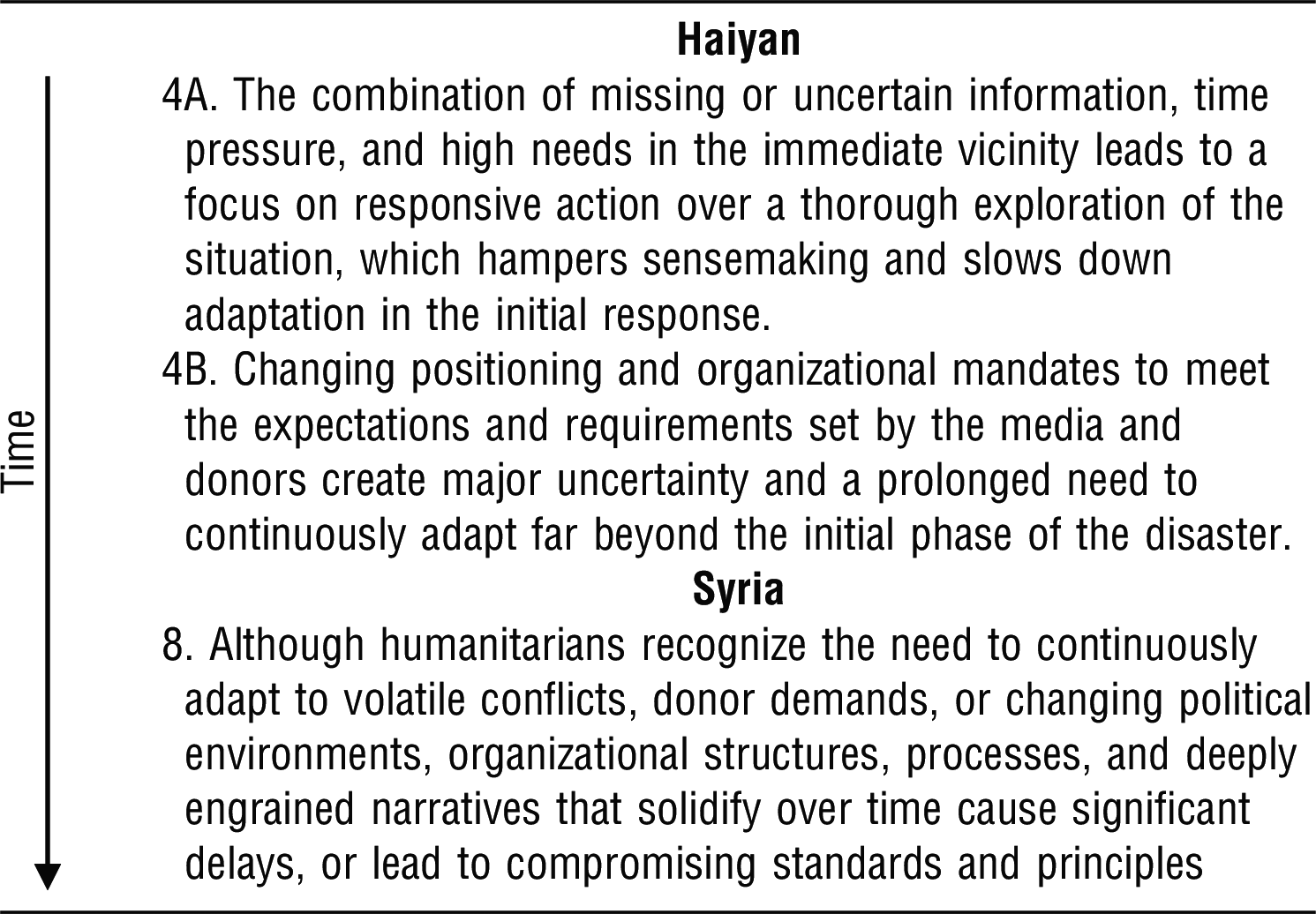
Overview of Propositions on Adaptation
To synthesize, we start with the idea that disrupted information flows in a disaster response shape sensemaking, and thereby coordination and decision‐making (cf. Figure 1). Our findings confirm a close relation between sensemaking, coordination, and decisions: we showed that disruptions of information flows in both cases lead to localized sensemaking and a lack of coordination. In turn, this creates a fragmented information landscape, where information is not shared, shared too late, or not trusted, consolidating or even amplifying the initial disruptions, despite attempts to (better) coordinate.
The dynamics of a disaster require rapid and coordinated adaptation. Yet, the findings from our case studies highlight that the fragmentation and disconnect of information flows lead to the emergence of multiple localized pockets or bubbles of sensemaking, decision‐making, and coordination. Even if the need to adapt is widely acknowledged, each of these bubbles is characterized by its own cycle. This parallelism leads to friction and uncertainty laterally (between different geographical regions) and hierarchically (between operational and strategic level). Figure 2 synthesizes these findings and extends Figure 1 by making explicit the barriers to sensemaking, coordination, decision‐making, and adaptation.
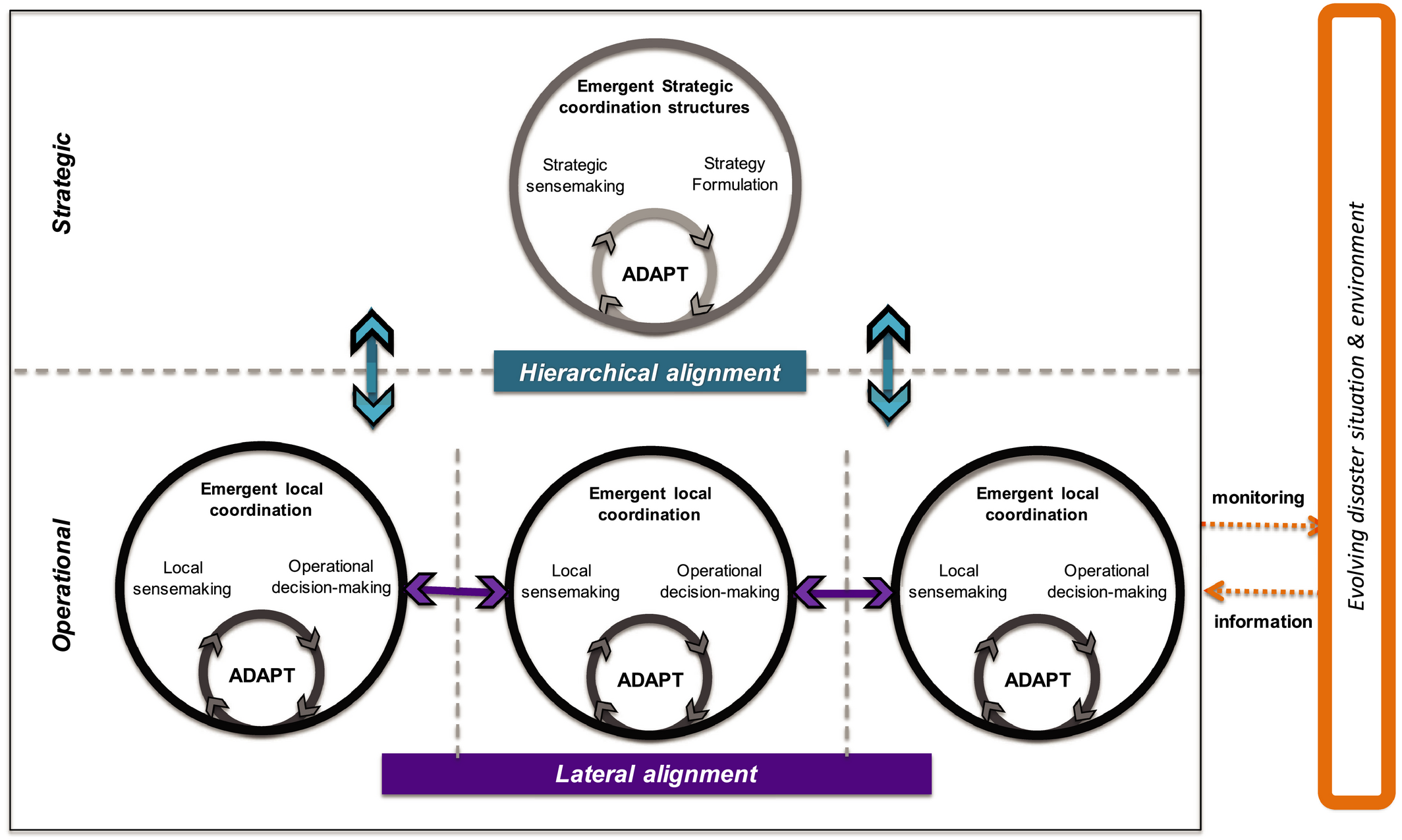
The Need to Orchestrate Information Flows and Align Strategic and Operational Processes [Color figure can be viewed at
Our findings show that the initial lack of information (sharing) is an important source of misalignment. The emergence of decision processes and coordination structures as “accidents of timing and sensemaking” (Comfort 1993) has also been observed for smaller scale sudden onset crises (ibid). While Comfort (1993) presented the introduction of information (technology) as a promising solution, our findings indicate a persistence of fragmentation for both Haiyan and Syria even after communication is reinstituted. In addition, much of the information about mandate, aims, response capacity, and access depends on decisions at strategic level. The continuous and at times unpredictable adaptation of plans, priorities, or budgets causes uncertainty at operational level. We, therefore, argue that the hierarchical alignment between strategic and operational levels and lateral alignment between different regions need to be addressed. So far, efficient information sharing mechanisms that respect the requirements and timing of decision‐making and coordination at different levels or regions are lacking. Because of the path‐dependencies and the persistence of initial decisions and contextual rationalities, we argue that these processes and mechanisms need to be established at the very onset of the response.
Our paper shows that our current understanding of emergent and dynamic disaster phenomena and their impact on the performance of humanitarian operations is limited. To ensure that mathematical HOM models can take into account these elements, further insights are needed that allow us to understand and quantify the mechanisms that shape the co‐evolution of information, sensemaking, decision‐making, and coordination. Based on our findings, we propose three research areas that together can help align the response laterally and hierarchically and improve adaptation in humanitarian operations.
Research Area #1: The co‐evolution of sensemaking, coordination, and decision‐making
Thus far, there is very little work on the evolution of humanitarian coordination structures, and the interplay between standardized structures at headquarters and the emergent structures in the field (Holguín‐Veras et al. 2012); neither is it known how coordination unfolds between organizations with different mandates and norms such as humanitarians and public authorities, the military or civil society. To test and further validate our propositions, we foremost emphasize the need for further empirical studies to capture the nature of sensemaking, decision processes, and coordination structures across a range of disasters and roles, including slow‐onset disasters or pandemics, and formalize the dynamic interdependencies between them.
While Sue and Ostrom (1995)'s Grammar of Institutions provides a useful starting point to understand the emergence of coordination structures and the interaction between strategic planning and operational ad‐hoc coordination, we advocate explicitly considering information (flows) to capture the networks, scale, and timing of information sharing. In addition, to understand the impact of fragmentation on the emergence of sensemaking, coordination, and decision‐making, traditional coordination theory that focuses on integration and coherence (Wolbers et al. 2018) needs to be extended. Fragmentation here refers to different contextual rationalities at different levels and roles, emerging through disrupted communication or different processes and retained via sensemaking trajectories.
Research Area #2: Modeling Information Sharing as a Barrier and Driver of Adaptation
Throughout this article, we stressed that information alone is not sufficient for better sensemaking, coordination and decision‐making. The focus on technology and the widespread access to data and analysis tools gives rise to an unprecedented number of forecasts, predictions and analyses, adding noise and uncertainty—and providing decision‐makers with an excuse to discard and neglect information. Therefore, it is first vital to understand the value and use of information in humanitarian operations. While the theory of value of information (Feltham 1968), provides a useful starting point, it needs to be extended to include the sensitivities and potential risks of information sharing as well as principles of humanitarian information management (Van de Walle and Comes 2015).
We identified uncertainty and time pressure as factors that lead to the initial focus on responsive action, versus searching for information broadly. There is a plethora of experimental or case‐study driven research on rapid decision‐making that analyzes how individuals process and use (uncertain) information to make a decision (Eisenhardt 1989b, Payne et al. 1996, Tversky and Kahneman 1974), showing that time pressure leads to changes in information processing, risk preference, and performance. Yet little is known about the trade‐offs between action and information acquisition, or the impact of information acquisition strategies on decision performance. Therefore, experimental and empirical research is needed to assess and quantify the perceived priority of information to understand information acquisition in different contexts. Understanding information priority can target and direct the creation of information products and streamline the overwhelming multitude of data analytics and optimization models to those who need it most.
Based on insights of informational value, use and adaptation behavior, simulation models such as agent‐based models can contribute to understand how micro‐level decisions lead to the emergence of patterns at systems level. While there are few models on information diffusion in the cluster system (Altay and Pal 2014), there is no connection to specific HOM decisions or coordination structures. Because of the importance of misinformation and rumors, particularly in conflicts, the risks of (rapid) information sharing need to be analyzed in terms of privacy violations, spreading of rumors and misinformation.
Research Area #3: Humanitarian Operations Management, Revisited
The theoretical and empirical insights about coordination, decision‐making, and information sharing open up research opportunities for optimization and normative models. Crucial is the integration of modeling techniques that go beyond traditional analytical HOM optimization models, and are able to integrate behavioral aspects, adaptation in dynamical systems, and emergence in complex systems.
System dynamics (SD) has been suggested as a possible way to describe the dynamics of humanitarian response (Besiou et al. 2011). SD has been used to analyze the impact of information delays on the performance of operations (Peng et al. 2014, Phelps et al. 2016). This work could be extended by new deprivation cost functions (Holguín‐Veras et al. 2013) that include the effect of missing or late information toward specific regions or communities. Based on insights about how information is shared, used, and affects performance, scheduling models can optimize and orchestrate information flows laterally and vertically to reduce delays and bottlenecks. Allocation and scheduling models can support the prioritization of information acquisition versus other operational response activities. Insights about changing values and preferences over time or as a function of donor decisions can be integrated as an additional element of uncertainty into strategic HOM models such as facility location problems.
Conclusions
Understanding adaptation to dynamically unfolding disasters is key to advance research and practice of humanitarian operations. While the need for adaptation is commonly ssumed to stem from lacking or uncertain data, we identify the emergence of coordination structures as an important source of prolonged uncertainty. We derive our findings from two case studies that enable us to explore different contexts: the response to Typhoon Haiyan in the Philippines, and the Syria Crisis. In both cases, the lack of a reliable structure in humanitarian operations gave way to spontaneous, unstructured, and reactive decision‐making driven by individual and local leadership rather than organizational mandates, joint standards and norms. This led to continuous revisions of processes and structures along with an adaptation of mandates and aims, driven by new insights or changes in the information, as well as rivalry between and among humanitarian organizations, and new challenges to the humanitarian response system in today's crises. From there, we derived a series of propositions on sensemaking, decision‐making, and coordination that address the fragmentation of humanitarian operations both vertically and laterally. We furthermore argue that the combination of uncertainty, time pressure, and fragmentation lead to significant delays in adaptation to new insights.
Implications for Humanitarian Organizations: Despite the importance of rapid decisions under time pressure and low levels of predictability in humanitarian operations, systematic techniques to support decision‐making are often unknown to, unavailable or not tailored for humanitarian decision‐makers in the field. Our findings point at the importance of adequate information systems particularly at the onset of a response. Indeed, as more and better information becomes available and the capacity is ramped up, more information is available. But to benefit from this information, decision‐makers need to break out of their information and coordination bubble and monitor their environment to understand emerging trends and adapt their decisions. Ideally, such adaptations are already foreseen in the initial plans. This will, in most cases, require more complex and decentralized structures and strategies that combine reactive and proactive elements, and include approaches to data preparedness that account for the (expected) information needs and partnerships with information and communication providers.
Implications for HOM Research and Modeling: our case studies highlighted that the dynamic nature of disasters and the associated information via sensemaking create volatile decision processes and fragmented coordination structures that persist even after communication is re‐instituted. In our discussion, we argue that current HOM models need to be adapted and extended beyond the paradigm of the rational decision‐maker to design models that are tailored to the context and improve decision performance. First, a deeper theoretical understanding is needed of the phenomena related to emergence, behavior, or dynamical systems across different types of contexts and disasters. To this end, empirical work, behavioral experiments and case studies are needed to contextualize and further validate the propositions formulated in this study. Additionally, modeling and simulation techniques that allow for exploration of the implications of information sharing and decision‐making behavior at micro‐level are promising to test hypotheses under different conditions and explore the emergence of patterns at systems level. These techniques should include agent‐based modeling, system dynamics, and scenario analysis. Finally, these insights and findings need to be translated back into HOM modeling and optimization through deriving and validating appropriate functional forms and representations of these phenomena.
Footnotes
Overview of Data Collection for Typhoon Haiyan
Overview of Data Collection in the Syria Response 2014 and 2015
Acknowledgments
The authors thank the interviewees who devoted their time to this research under difficult and trying conditions. This research would not have been possible without the support from the Center of Integrated Emergency Management at the University of Agder (Norway) and Tilburg University (the Netherlands), devoted UN staff, and our Haiyan team members Jennifer Chan, Marc van den Homberg, and Kenny Meesters.
