






Abstract
We analyze trade‐offs in the organization of public safety networks when network assets are distributed across districts and a district values network assets in its own and other districts. Comparing centralized, decentralized, and mixed organization forms, we capture two critical properties: interoperability among distributed technology‐based network assets and the ability of districts to opt‐in or opt‐out of the centralized form. We model the provision of public safety networks, where network assets are chosen by each district or by a federal government, where these assets have a positive cross‐district spillover that depends on interoperability, where investments in effort can be made to improve interoperability, and where districts can opt‐in or opt‐out of centralized provision. With the adoption of centralized, decentralized, or mixed provision as a result of districts' opt‐in or opt‐out choices, we identify conditions that determine when the districts deviate from the social optimum and thus regulatory intervention is beneficial to incent the socially optimal organization form. We show how the socially optimal organization form can be achieved through policy instruments such as a sharing rule for the cost of interoperability effort and direct government grants.
Introduction
Modern consumer information and communication technologies and devices provide ubiquitous access to data, reliable coverage, resilient dependability, and dynamic capabilities. The same cannot be said about most of the United States' public safety networks, where the safety of its citizens depends on first responders exchanging timely and accurate information in emergency situations (Newman et al. 2010). New York City Police Commissioner Raymond Kelly admitted that a teenager with a smartphone has more capabilities in the field than the average emergency responder does with a radio (Kelly 2011). The Yarnell Hill Fire, the deadliest wildfire in the United States in more than eight decades, killed 19 City of Prescott firefighters on June 30, 2013. In 36 hours, the wildfire turned from a small brush fire to more than 500 acres due to dry heat and a swift wind shift. The only available communication technology was traditional radio communications. Later investigation reveals that state dispatchers failed to call in some of the crews and equipment closest to the fire location due to coordination failure (Loew 2014).
Most current public safety networks provide responders with voice communication, but lack data driven services found on typical consumer networks, such as video‐capable devices to record the condition of a patient or geo‐location to guide a firefighter to a forest fire. Moreover, the absence of interoperable systems precludes synchronized exchange of information between first responders like police and firefighters, which often result in coordination failures. These failures often occur because visibility and readiness status of first‐response assets cannot be shared in real time, if at all. The addition of these types of information technology‐driven services – services that are otherwise available in integrated third‐party logistics firms such as UPS and Federal Express – would allow for many other beneficial tools and could make the difference between life and death for those in distress and first responders.
Compared to modern consumer information and communication technologies where provisions of the network are distributed evenly among users, the current provision of public safety networks is decentralized based on regional boundaries, leaving taxpayers with costly and spectrally inefficient networks (Hallahan and Peha 2008). By tradition, in the United States every police department, fire department, and emergency medical service can make its own decisions, and in most cases, this policy extends to the provision of public safety network assets. Without effective coordination mechanisms, any infrastructure designed by many thousands of independent decision‐makers is prone to producing a tangle of non‐interoperable systems.
First Responder Network: FirstNet
The greater the degree of differentiation among public safety agencies, the more difficult coordination becomes and the more likely are rescue systems, assets, and practices to diverge across agencies. Moreover, the use of multiple, potentially incompatible, technologies leads to interoperability problems (Angst et al. 2011, Newman et al. 2010). Accordingly, in March of 2010, the Federal Communications Commission (FCC) released the National Broadband Plan (NBP) that suggests significant changes to current systems and calls for responders to work on a centralized network, providing interoperability that serves both public safety and the general public (Newman et al. 2010). As a result, the First Responder Network (FirstNet) Authority was created by Congress as part of the Middle Class Tax Relief and Job Creation Act signed in February 2012. Congress created FirstNet with the aim of delivering the first high‐speed, nationwide wireless broadband network dedicated to public safety. The Act established the FirstNet project, but many details of the nationwide network remain unknown or undecided. According to the Act, states are encouraged to participate in the network, however there is an opt‐out option that allows states to construct the network themselves rather than leave the task to the federal government. Much of the construction and operation likely will fall to the federal government if FirstNet is to be constructed with a centralized approach. In such an approach the federal government allocates public safety network assets throughout the United States and the centralized design and implementation promotes interoperability. The obvious benefit is an interoperable network with a uniform quality of service.
However, public safety is an intimately local affair, and some say the provision of FirstNet needs to be played out in the state, district, or city legislative bodies. The concern is that centralized provision does not reflect specific local needs for different technological capabilities. Moreover, a fully interoperable network will be more expensive to build because the technical implementation and the different interests of parties involved make the task complicated. Centralized provision is in contrast to the traditional approach where the choice of public goods, such as public safety networks, is determined by local governance. The decentralized approach meets local public safety needs, but the drawback is that it neglects the effects of interoperability on public good spillovers to neighboring districts (e.g., Katrina and 9/11), leaving fragmented networks.
Our Focus
We investigate the provision of public safety networks where we incorporate two novel features. The first is that we model interoperability and its effect on network asset spillovers as the result of integration effort choices by districts or the federal government depending on organization form. The second is that each district chooses either to opt‐in and delegate its choice of network assets as well as its choice and implementation of interoperability effort to the federal government or opt‐out and choose its own levels of network assets as well as choose and implement its own interoperability effort. Our research goal is to develop policy guidelines to aid FirstNet and similar public safety networks to obtain the socially optimal organization form.
We consider two districts with heterogeneous preferences – one with a larger value for network assets – and explicitly model their investment in effort to improve interoperability. Under decentralized provision (where both districts opt‐out), each district chooses network assets and interoperability effort to maximize its own surplus. Consequently, individual districts' effort choices jointly determine the interoperability of public safety networks in the two districts. Specifically, individual districts could make their networks interoperable through system integration activities using policies and protocols. For example, the degree to which individual districts comply with Emergency Data Exchange Language (EDXL) Data Standards directly determines the interoperability of the sharing systems for critical data such as requests for equipment and personnel during an emergency. Under centralized provision (when both districts opt‐in), the federal government chooses network assets for each district and a single level of interoperability effort that it implements to maximize social surplus. Under mixed provision (where one district opts‐in, the other district opts‐out), the federal government chooses network assets and interoperability effort (that it implements) for the opt‐in district to maximize social surplus, while the opt‐out district chooses its network assets and interoperability effort to maximize its own surplus. Thus, the distinction between centralized, decentralized, and mixed provision is one of organization form.
Furthermore, we introduce the interoperability efficiency of centralized and mixed provision to capture the fact that interoperability is more challenging under decentralized than mixed provision, and under mixed than centralized provision. Comparing centralized, decentralized, and mixed provisions, we find that centralized provision is socially optimal when the interoperability efficiency is high. However, due to the non‐contractibility of interoperability effort tasks and the convexity of effort costs, centralized provision has a disadvantage in the costs of interoperability effort and may over‐provide on both network assets and interoperability effort when the interoperability efficiency is low. As a result, in maximizing social surplus the federal government may prefer mixed provision where the district with the smaller value for network assets opting in. In addition, we find that when facing opt‐in or opt‐out choices, districts' incentives may be misaligned with that of the federal government. We identify the conditions when districts' choices deviate from the socially optimal organization form and thus policy instruments such as sharing the cost of interoperability effort and direct government grants become beneficial. We show that cost sharing for interoperability effort alone is not always sufficient to induce socially optimal opt‐in/opt‐out choices, and when direct government grants are needed. Finally, we propose the cost‐sharing rule and minimum grant necessary to attain the socially optimal organization form.
The rest of the article is organized as follows. The following section discusses the related literature and our major contributions. For formal analysis, we start by explaining our notation, assumptions, and model setup. Next we derive the properties of network assets and interoperability under different organizational forms (e.g., decentralized, centralized, and mixed provisions) and determine the socially optimal organization form. We then consider whether the equilibrium opt‐in/opt‐out choices by districts lead to the socially optimal organization form. When they do not, we consider cost sharing and direct government grants as policy instruments, and show how they can be utilized by the federal government to induce the social optimum. In our conclusion we provide policy implications, discuss limitations, and generalize to other settings in which our model of public safety network provision can apply.
Related Literature
Coordination of Public Safety Networks
Public safety agencies operate in complex environments that are urgent, uncertain, and volatile, and this presents organizational and operational challenges (Kleindorfer and Saad 2005, Majchrzak et al. 2007, Pedraza‐Martinez and Van Wassenhove 2013).
From the perspective of operation and knowledge collaboration, public safety has been studied in contexts such as natural disasters (Majchrzak et al. 2007, Salmeron and Apte 2010), hospitals (Faraj and Xiao 2006, Helm et al. 2011), and homeland security (Majchrzak and Jarvenpaa 2010). Coordinating mechanisms are needed to assure that the efforts of various agencies are synchronized, that rescue missions and operations remain aligned for knowledge integration of cross‐functional teams (Faraj and Xiao 2006, Majchrzak et al. 2012, Okhuysen and Eisenhardt 2002) and for interorganizational collaboration (Majchrzak and Jarvenpaa 2010).
From the perspective of provisioning and managing information technology (IT) assets, public safety agencies have produced a highly fragmented infrastructure consisting of many thousands of independent systems using a variety of technologies (Peha 2007). The public safety community has recognized that simply distributing emergency management responsibilities across agencies is not sufficient to guarantee successful use of public safety network assets (DeSanctis and Jackson 1994). The IT infrastructure governance choice should integrate local information processing with control and coordination (Xue et al. 2011, 2012). New technologies such as Web 2.0 social networking tools (Majchrzak and More 2011), radio‐frequency identification, and global positioning systems (Gaukler et al. 2008) have shown promise to help responders and volunteers in problem solving and coordination during relief operations.
Information Systems for Crisis Response and Management (ISCRAM)
The ISCRAM literature has an applied focus, and describes many of the organizational and interoperability issues that our analyses is designed to resolve. Manoj and Baker (2007) advocate dual‐use technologies that have normal and emergency modes, as well as architectural and protocol redundancy in order to achieve interoperability between organizations in emergencies, thereby recognizing the key role of interoperability. Braunstein et al. (2006) suggest that traditional wireless ad hoc networks do not scale well for large emergency operations, supporting diseconomies of scale and scope in interoperability, and they propose a distributed but hierarchical network architecture for communications. Jaeger et al. (2007) provide a compelling case for the use of common platform technologies in emergency situations by government, community, and emergency response units. Bharosa et al. (2010) examine multi‐agency disaster management exercises and find that the extent to which information is shared is often limited, and Bharosa et al. (2009) find that information quality requirements are attracting much attention from agencies involved in disaster management. Both are evidence of network asset spillovers and the need for interoperability.
Fiscal Federalism
Centralization or decentralization of public good provision is a question in public finance. The traditional theory of fiscal federalism, first formulated in Oates (1972), lays out a normative framework whereby government maximizes the aggregate surplus of its citizens. Under decentralized decision‐making, this maximization is done separately for each district in its choice of public good levels, while under centralized decision‐making this maximization is done with a uniform public good level for each district by a federal government. Decentralized provision allows public goods to be tailored to the preferences of a heterogeneous population (Brueckner 2006, Cerniglia and Longaretti 2013), but fails to properly account for public good spillovers across districts (Alesina and Spolaore 1997, Besley and Coate 2003, Oates 1972). Centralized provision internalizes the cross‐district spillovers. However, the uniform public good level does not take into account the differences between districts properly. When there are no spillovers, Oates' Decentralization Theorem states that decentralization is desirable from a social welfare perspective. When there are spillovers, however, centralization can be desirable depending on the differences between the districts and the strength of the spillovers.
Technology Compatibility and Interoperability
Unlike common public goods, multiple incompatible technologies are available for public safety networks, which lead to potential interoperability issues. Consequently, interoperability has an important moderating effect on the spillover one district has on others. The standard framework for modeling compatibility was explored by Katz and Shapiro (1985) and Farrell and Saloner (1985). A system of compatible components is treated as a single good characterized by positive network externalities: the utility a consumer obtains from a system increases with the number of others using compatible products. With network externalities, the firms' incentives to produce compatible systems have been shown to depend on the firms' relative size and on how compatibility can be enforced. Cremer et al. (2000) model positive network externalities as a function of the degree of compatibility (interoperability) and find that competing firms may have incentives to degrade compatibility under a market sharing equilibrium. Mason (2000) models Internet Service Provider competition with both horizontal and vertical differentiated customers, and finds that interoperability results in reduced competitive pressure. Compatibility (interoperability) analysis in existing literature is driven by network externalities, and a general finding is that when networks have asymmetric installed bases, large networks might have an incentive to restrict compatibility because compatibility equalizes large and small networks.
Although districts do not compete in public safety networks, interoperability does moderate the spillovers from network assets. Unlike decentralized provision, where various districts, technologies, and systems work independently, centralized provision such as FirstNet rely on a single entity (e.g., the First Responder Network Authority) to create the nationwide network. State and local agencies only have a consulting role in the development, deployment, and operation of the network. On one hand, centralized provision more likely results in a network environment where the information generated by each district, technology, or system is interoperable, creating a higher level of interoperability efficiency in operation. On the other hand, when the centralized network becomes larger, the organization tends to start preserving the status quo, spending more time, money, and energy on coordinating between its various parts, duplicating efforts, political in‐fighting, and other wasted efforts. Although centralized provision enjoys an advantage in interoperability efficiency, the trade‐off is that for a given level of interoperability, the costs of effort face greater diseconomies of scale and scope under centralized provision.
Choice of Organization Form
The choice of centralization or decentralization is an allocation of decision rights, or put another way, a choice of organization form. Jensen and Meckling (1992) argued for the colocation of decision rights and information, and Brynjolfsson and Mendelson (1993) suggested this could be accomplished either by moving the decision rights closer to the information (the organization redesign solution) or move information closer to where the decisions were located (the management information systems solution). Nault (1998) showed that colocation may not be optimal when facing horizontal externalities and agency problems – typically the problems encountered in public safety networks from spillovers and local information and preferences. Indeed, in an IT context, decentralization makes system integration challenging and presents a barrier to standardization (DeSanctis and Jackson 1994, Gopal et al. 2003, Harter et al. 2000, King 1983, Krishnan et al. 2000, Schuff and Louis 2001, Zmud 1980).
Our Contribution Relative to the Literature
Our work makes two novel contributions to the literature: (i) We model the critical unique feature – interoperability, and its effect on network asset spillovers, which has not been considered in the existing literature addressing the provision of public goods and free‐riding. Specifically, interoperability in our work is the result of efforts made by the federal government, local districts, or both. Existing literature (Katz and Shapiro 1985, Farrell and Saloner 1985, Choi and Whinston 2000, Cremer et al. 2000) models technology compatibility (interoperability) as a binary decision variable (e.g., compatible or incompatible) and considers the spillover effect in forms such as the size of the user base or market share. We contribute to that literature by modeling the cross‐district interoperability of network assets such that effort can be made to improve the interoperability among different networks with a cost, hence, the resulting interoperability is a continuous variable. Consequently, interoperability moderates the spillover benefits, which eventually affect the network assets provided to local districts. (ii) In the original Oates model (Oates 1972), under a decentralized system, the level of public good output in each district is chosen by the local district to maximize the aggregate surplus of its constituents. In a centralized system, the federal government chooses a uniform level of public spending for each district. The Oates model assumes that technology is standard and thus there is no interoperability issue in the provision of general public goods, e.g., roads, parks, etc. In addition, the Oates model assumes the organization form (either centralized or decentralized) is mandated rather than chosen by individual districts. In contrast to the Oates model and other fiscal federalism literature, we model the provision of a public safety network as a two‐player simultaneous‐move game where districts can opt‐in or opt‐out of centralized provision such as FirstNet. The decision to opt‐in or opt‐out by each district results in three organization forms. Within the model, we compare centralized, decentralized, and mixed provisions, in terms of network assets, interoperability, and social welfare. Given the choice to opt‐in or opt‐out, we examine when districts have incentives to deviate from the socially optimal organization form. When the socially optimal organization form does not obtain in equilibrium, we study two commonly used federal government instruments – a cost sharing rule for interoperability effort under centralized provision, and direct government grants to incent districts to opt‐in under decentralized provision.
Notation, Assumptions and Model Setup
Preferences
Our economy is divided into two distinct districts, indexed by i = 1, 2. Each district represents the preferences of its citizens and maximizes its own surplus. Technology‐based public safety network assets associated with the two districts are


District 1 values network assets more than District 2, i.e.,

The level and quality of emergency communications vary dramatically across regions. For example, rural communities face various geographical and topographical issues that impact their level of service. Conversely, large urban areas are confronted with the challenge of ensuring communications can occur in larger buildings containing materials that interfere with transmission. As a result, districts have heterogeneous valuations for network assets. We refer to the district with the larger value for network assets (District 1) as the larger district, and the other (District 2) as the smaller district.
Network assets are distributed across districts. A given district values network assets in the other district as well as valuing network assets in its own district. In valuating network assets, a given district weighs the value of network assets in the other district as well as network assets in its own, and we use κ ∈ [0, 0.5] to denote the weight of network assets in the other district and use 1 − κ to normalize the weight of network assets in its own district. Defining κ this way ensures local network assets always have a higher weight: when κ = 0, districts only value network assets in their own district; when κ = 0.5, they value the network assets in both districts equally. We interpret κ as a degree of spillover of network assets between districts. That is, a higher κ represents a higher cross‐district value of public safety network assets. To this point, our model formulation mathematically matches that of the classic Oates model of fiscal federalism (Oates 1972). Our notation is summarized in Table 1 at the end of our references.
Summary of Notation
Organization Form
We model the districts' choices of participating in the nationwide network as a two‐player simultaneous‐move game. This is one of our novel features. The decision to opt‐in or opt‐out by each district results in three organization forms: centralized, decentralized, and mixed provision. We use subscript cc, dd, cd, and dc to denote these different organization forms, where c and d represent opt‐in and opt‐out choices by individual districts, respectively, and cd represents District 1 opt‐in and District 2 opt‐out with dc being the opposite. Under decentralized provision (both districts opt‐out), each district decides on its network assets and interoperability effort that it implements, and bears the corresponding costs. Under centralized provision (both districts opt in), the federal government decides on the network assets for each district and the overall interoperability effort – each district bears the costs of its own network assets and bears a share of the interoperability effort cost, but the federal government implements the interoperability effort. Under mixed provision, the opt‐out district decides on its network assets and interoperability effort that it implements, and bears its own cost. The federal government decides on the network assets and interoperability effort that it implements for the opt‐in district while maximizing overall social welfare (e.g., setting standards for the participants of the nationwide public safety network to maximize the social welfare).
Interoperability Efficiency
The other novel feature of our model is the inclusion of interoperability. Although in public safety networks a given district values network assets in the other districts as well as network assets in its own district, there is an issue of whether the network assets are interoperable. Under decentralized provision, both districts, and under mixed provision one district, makes its own network asset decisions including technology choices as well as implementation choices, both of which are geared to local conditions and history. In such cases there are always issues of interoperability. Interoperability may well be an issue under centralized provision as local micro‐level implementation choices may be hard for a centralized government to control, but interoperability is a more critical issue under decentralized and mixed provision. To the extent that network interoperability does occur, it comes by linking together otherwise stand‐alone networks, so that the output of one component serves as input to another. The coordination of different information technologies presents a challenge to districts with decentralized public safety networks. In other words, local network asset decisions may bring flexibility and fast response to changing local needs, as well as other benefits, but also makes systems integration difficult and presents a barrier to standardization (see DeSanctis and Jackson 1994, Gopal et al. 2003, Harter et al. 2000, King 1983, Krishnan et al. 2000, Schuff and Louis 2001, Xue et al. 2011, Zmud 1980). Indeed, Angst et al. (2011) found that in healthcare networks, information systems is the basis for interoperability and should be developed before any other technologies that are to be integrated. Integration among unintegrated systems is usually coordinated through policies and protocols. The compatibility of network equipment is not ensured unless highly centralized control of procurement is maintained. As interoperability is more challenging under decentralized provision, we use α > 1 to represent the interoperability efficiency of centralized provision and γ > 1 to represent the interoperability efficiency of mixed provision, where α > γ, and normalize interoperability efficiency of decentralized provision to 1. An interoperability efficiency of mixed provision moderately greater than decentralized provision is sufficient for our main results to apply. This leads to our next assumption.
(a) Among the three organizational forms, the interoperability efficiency is the highest under centralized provision, followed by mixed provision, and is the lowest under decentralized provision, α > γ > 1; (b) interoperability efficiency of mixed provision is moderate, 
Interoperability efficiency is highest in centralized provision when there is a sole decision maker. Under mixed and decentralized provision there are two decision makers resulting in potentially disparate choices, and under mixed provision one of the decision makers is the federal government that accounts for social welfare and consequently interoperability efficiency is higher in mixed provision. Although reasonable in our two‐district model, the interoperability efficiency advantage of centralized provision becomes more obvious in the case of a larger network such as fifty states in FirstNet. When a number of districts opt‐in and other districts opt‐out (mixed provision), the interoperability efficiency is lower than under centralized provision and higher than that under decentralized provision. Under mixed provision decisions and implementations are made by the federal government for the multiple opt‐in districts resulting in fewer decision makers than under decentralized provision. Under decentralized provision, different districts within the network could be interoperable within a region due to substantial local efforts, yet not be very interoperable beyond the region because each district converged on their own preferred, local standards based on local needs.
Interoperability Effort
We model the cross‐district interoperability of network assets such that effort can be made to improve the interoperability among different networks with a cost. Interoperability effort is chosen and implemented by the federal government under centralized provision and by districts under decentralized provision. Under centralized provision, the federal government chooses its overall interoperability effort over a closed and bounded interval 


Interoperability takes the forms of 


Using second subscript in 


In Assumption 3, centralized provision and mixed provisions' interoperability include interoperability efficiency parameters α and γ, which is normalized to 1 for decentralized provision. Interoperability moderates the spillover benefit one district receives from the other district. Under decentralized provision, the total benefits for District 1 consist of two parts: benefit from its own network assets, i.e., 




Costs
We use a quadratic cost function with parameter 


Interoperability Effort Costs Across Provisions
From our formulation of the different provisions in the next section, interoperability effort costs differ when the federal government chooses and implements interoperability effort. That is, we believe that in practice as well as in our formulation, interoperability costs follow a different structure when the federal government is incurring them, such as is the case in the centralized model. The federal government is both choosing the interoperability effort level and executing/implementing the interoperability effort. As this effort is not contractible, it cannot be allocated to individual districts as though the districts were executing different elements of the effort so in this way the federal government is not incurring district‐specific costs as though it were the districts.
Indeed, because the federal government does not possess local information, and because the interoperability effort is more focused on coordination between their choices of network assets in the two districts than on effort within individual districts, interoperability effort is not separable between the two districts. Thus, we do not model the federal government's interoperability effort as being expended in three buckets such as effort‐in‐district‐1 plus effort‐in‐district‐2 plus centralization effort.
Rather, the federal government interoperability effort is in researching, creating and implementing some universal standard that can handle generic district needs and district‐specific needs so that the federal government's choices of network assets (

Our interoperability effort cost function is designed to be internally consistent. When an individual district chooses and implements its own interoperability effort, then its cost of effort is in a quadratic form. When the federal government chooses and implements interoperability effort across one or more districts, its cost of effort is in a quadratic form. In the mixed provision this is harder to see because in our model with only two districts, the federal government chooses and implements interoperability effort for only one district. Although a many district formulation is beyond the scope of our research here, consider a three district model when Districts 1 and 2 both opt‐in. Then the interoperability effort costs for the federal government would be 

We make the following technical assumption to ensure the concavity of the objective functions of the districts and the federal government under different organization forms.
The costs for network assets and interoperability efforts are sufficiently high such that 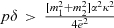

Assumption 4 is true so long as the numeraire, 


Because network assets can be defined separately between districts in either organization form, under centralized or decentralized provision each district bears the costs of its own network assets. In contrast, under centralized provision the tasks underlying interoperability effort are not separable between districts and only a cost share can be assigned to a given district. Prior research (Mithas et al. 2008) helps identify six dimensions of non‐contractibility of interoperability tasks. Essentially because of the complexity of interoperability tasks, such as exchange of proprietary information between districts and involvement in planning and goal setting activities, these tasks are not contractible and hence not assignable to districts. This observation leads to our final assumption.
Interoperability effort tasks are not contractible.
It is worth noting that we take the value of network assets to be the same regardless of organization form, that the spillover proportions are the same for each district, and that our model setup is one of complete information concerning the spillovers and interoperability, both so that we can concentrate on the effects of interoperability effort and the sharing of the resulting costs.
Government Policy Instruments
We consider two economic policy instruments. First, under centralized provision the federal government may use laws and regulations to mandate a percentage of the cost shared by each participating district for the overall effort cost invested to improve interoperability. This type of sharing rules have long been used to allocate the cost of various public goods. Classical examples include multi‐purpose reservoirs by the Tennessee Valley Authority and water supplies by municipalities in southern Sweden (Young 1994). In this work, we use ϕ to represent the share allocated to District 1, hence 1 − ϕ is allocated to District 2.
Second, the federal government may provide direct monetary grants to the districts that opt in. This grant instrument is consistent with the Middle Class Tax Relief and Job Creation Act of 2012, which provides $7 billon in funding toward the deployment of the First Responder Network as discussed in the Introduction. Let F denote the total grant available, with 


Based on these polices, each district then compares their surplus under different organization forms anticipating the other district's choices and make participation decisions. As a result, we model the game of districts and federal government in three stages. In stage 1, the federal government chooses the interoperability effort cost sharing percentage and offers grants to the opt‐in districts in order to coordinate districts' incentives and achieve the organization form that optimizes social welfare. In stage 2, districts make participation (opt‐in, opt‐out) decisions simultaneously, leading to the Nash equilibrium organization form. In stage 3, the opt‐out district(s) decide(s) on their optimal network asset level and interoperability effort investment to maximize their surplus, whereas the federal government decides on the optimal network asset level and interoperability effort investment (i.e., standards) for the opt‐in district(s) to maximize social welfare. Figure 1 illustrates the timing of this game.
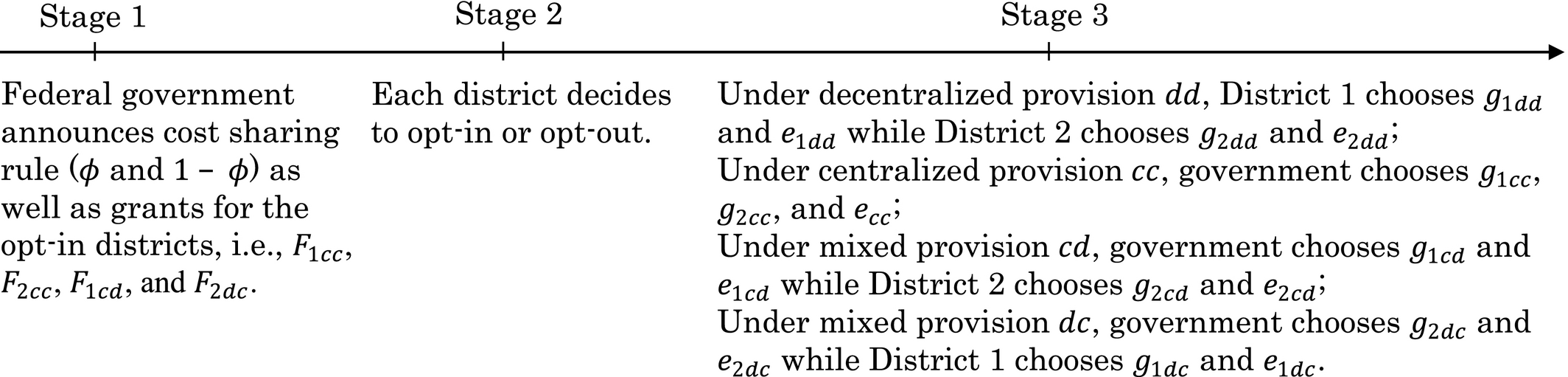
Timing of the Game
The game is solved using backward induction. In section 3, we first analyze the equilibrium network assets and interoperability efforts under different organization forms. We then compare the social welfare levels and derive the socially optimal organization form. In section 4, we derive the equilibrium organization form determined by the districts' opt‐in or opt‐out choices under different policy instruments selected by the federal government, and we characterize the cost sharing rule and grants that lead to the social optimum.
Organizational Forms
Decentralized Provision
Under decentralized provision, both districts opt out of joining the nationwide network (e.g., FirstNet) and choose to build their own network. As a result, both districts make their network asset and interoperability effort decisions simultaneously to maximize the total surplus within their districts, and each bears their own implementation costs. The objective of each district is to maximize the benefits minus the cost of producing/acquiring network assets (e.g., the cost of building cell towers) and the interoperability effort cost, where subscript idd corresponds to District i under decentralized provision (i.e., dd). The formulation in Equation 1 presents District 1's decision problem:
Given the network asset and interoperability effort choices of District 2, 




Similarly, District 2's decision problem is represented by Equation 2:
Solving the above maximization problems yields Nash equilibrium pairs of network assets (


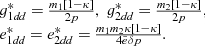
Under Assumption 1 whereby 


Under decentralized provision, the equilibrium network assets
The network assets chosen by a district are independent of the network asset preference of the other district.
The interoperability efforts chosen by the two districts are the same, i.e.,
The combined interoperability effort 


The proofs of all propositions are relegated to Appendix S1.
Proposition 1 shows that when deciding on its network assets, each district accounts only for the benefits it receives, and not the benefits going to the other district. In contrast, District 1's incentive to invest in interoperability effort, 


We also find that the overall interoperability level increases in the degree of spillover. In other words, the more a district derives benefits from the network assets in the other district, the higher the interoperability effort is. This type of spillover for public safety networks is similar to other public goods. However, unlike other public goods, the interoperability between the two networks moderate the overall benefit from network assets that spillover to the neighboring district. A greater degree of spillover (i.e., higher κ) provides a greater incentive for both districts to invest effort in interoperability. As a result, it is not surprising to observe the positive impact of the degree of spillover on districts' interoperability efforts.
Centralized Provision
Under centralized provision, both districts choose to opt‐in the nationwide network. Following recent literature in fiscal federalism and public goods (Besley and Coate 2003; Stansel 2005), we model centralized provision as where the federal government chooses network assets, 


Under centralized provision, the federal government simultaneously chooses 



The optimal network assets (




Under centralized provision, the network assets
The network assets for one district increase in the network asset preference of the other district.
The interoperability effort 


In contrast to decentralized provision, the federal government selects the network assets by simultaneously considering the network asset preferences of both districts. As a result, the optimal network assets now depend on the network asset preferences of both districts. Under centralized provision, a single interoperability effort is chosen to maximize the interoperability while accommodating districts' heterogeneous preferences for network assets. Thus, the federal government internalizes the externalities the two districts impose on each other through the choices of network assets and interoperability effort.
Mixed Provision
Different opt‐in or opt‐out strategies by individual districts leads to two possibilities: District 1 opts‐in while District 2 opts‐out or vice versa. Because different districts have different network asset preferences (Assumption 1), the two possibilities are not symmetric. Hence we use subscript cd to indicate mixed provision where District 1 chooses to opt‐in while District 2 chooses to opt‐out. Similarly subscript dc denotes the mixed provision where District 1 opts‐out but District 2 opts‐in.
District 1 opts‐in, District 2 opts‐out: cd
Under mixed provision cd, District 1 chooses to opt‐in the nationwide network and thus it must comply with the standards as specified by the federal government. Essentially the federal government makes decisions for District 1 while maximizing social welfare over all districts. The federal government faces the optimization problem in Equation 4.
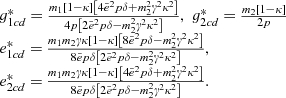
Given the federal government's choices of network assets and interoperability effort (as well as its implementation of the latter) for District 1, District 2 selects 


The Nash equilibrium network assets 

District 1 opts‐out, District 2 opts‐in: dc
Similarly, the optimization problems for the federal government and District 1 under mixed provision dc are in Equations 6 and 7, respectively. The federal government chooses 


Given the federal government's choices of network assets and interoperability effort (as well as its implementation of the latter) for District 2, District 1 selects 


Solving the above optimization problems yield the Nash equilibrium network assets 

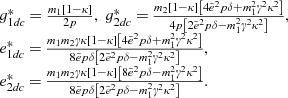
Proposition 3 summarizes the properties of the above network assets and interoperability effort results under mixed provision.
Under mixed provision, the equilibrium network assets and interoperability efforts for the two districts have the following properties:
The network assets for the opt‐in district increase in the network asset preference of the opt‐out district.
The interoperability efforts increase in the degree of spillover κ for both districts. The interoperability efforts and hence total interoperability effort is greater when District 2 opts‐in (dc) than when District 1 opts‐in (cd).
Under mixed provision, the federal government chooses the network assets as well as the interoperability effort level and implementation thereof for the opt‐in district. Doing so essentially determines standards and minimum levels of interoperability for the public safety network. When the opt‐out district has a higher preference for network assets, the federal government increases the opt‐in district's network asset level to subsidize the opt‐out district through the spillover effect. Consequently, the federal government internalizes the spillover effect of the network assets in the opt‐in district on the opt‐out district when choosing the network assets and interoperability effort levels for the opt‐in district. Such benefit through internalizing the spillover effect is stronger under mixed provision dc than cd because the opt‐out district (District 1 under dc) enjoys more spillover from the network assets in the opt‐in district (District 2 under dc) as compared to the cd case. Thus, to avoid the opt‐out district free riding on the opt‐in district's investment, the federal government prefers the smaller district to opt‐in. This is because the larger district has higher incentive to invest in network assets and interoperability effort when choosing to build its own network. Higher interoperability is achieved and hence greater benefits spillover to both districts, leading to higher total social surplus (welfare) for the mixed provision dc. Therefore, mixed provision dc is welfare superior to cd.
Social Welfare Analysis
In this section, we compare the social welfare levels between organization forms to determine the socially optimal organization form. Under decentralized provision, 


Social welfare under mixed provision is greater than that under decentralized provision; under mixed provision, the federal government prefers the smaller district (i.e., District 2) to opt in, i.e.,

Lemma 1 indicates both forms of the mixed provisions provide higher social welfare than decentralized provision. The involvement of the federal government in decision‐making contributes to this result. The federal government aims to maximize the overall social welfare when deciding the network assets as well as the interoperability effort and implementation thereof for the opt‐in district. Although the benefits come at the expenses of the opt‐in district subsidizing the opt‐out district, the overall social welfare increases under mixed provision due to increased interoperability and network assets when compared to decentralized provision. Between the two forms of mixed provisions, Lemma 1 also indicates the total social welfare under dc is always greater than that under cd (i.e., 

Given Lemma 1, the federal government may prefer either centralized or mixed provision dc when such organization form provides greater total surplus. We show in Proposition 4 that there exists a threshold for the efficiency advantage in interoperability, 
Centralized provision is socially optimal when the interoperability efficiency α is higher than a threshold 
The definition of threshold 
Comparing centralized and mixed provisions, we find that centralized provision is socially optimal when the interoperability efficiency is high. However, due to the non‐contractibility of interoperability effort tasks, from the convexity of costs centralized provision has a cost disadvantage in interoperability effort and thus may over‐provide on both network assets and interoperability effort when the interoperability efficiency is low. As a result, federal government may prefer the mixed provision with the smaller district opt‐in for higher social welfare.
Proposition 4 suggests that centralized provision is not always best. Counter to intuition, allowing a district to opt‐out and create its own network may be more beneficial. From the perspective of policy, mixed provision should be encouraged rather than discouraged when the interoperability efficiency under centralized provision is low. If mixed provision is desirable, then the federal government should target the smaller of the two districts to join the nationwide public safety network.
Equilibrium Analysis under Different Policy Instruments
We now consider the equilibrium organization form among centralized, decentralized, and mixed provisions as the outcome of the opt‐in or opt‐out choices made by individual districts. Districts compare their surpluses under each organization form and select the one with highest surplus. If both districts choose to opt in (out), then centralized (decentralized) provision is adopted, otherwise mixed provision is adopted.
Cost Sharing as a Policy Instrument to Induce the Socially Optimal Organizational Form
It is well known that the provision of public goods modeled as non‐cooperative games often leads to inefficient under/over‐provision (see, e.g., Bergstrom et al. 1986) as individual districts have incentives to free‐ride. To overcome the free‐riding problem, economists have proposed different compensation mechanisms that would set proper incentives for individual districts to make contributions toward efficient provisions of public goods (see, among others, Groves and Ledyard 1977, Varian 1994, Walker 1981). Following prior literature, we explore the scenario where under centralized provision the federal government may allocate different proportions of the interoperability effort cost to districts. Recall ϕ ∈ [0, 1] and 1 − ϕ are the proportions for District 1 and District 2, respectively. This flexible sharing rule for the interoperability effort cost grants the federal government an extra instrument to coordinate districts' choices by providing necessary incentives for the districts to collectively select the socially optimal organization form. The resulting surpluses for each district under centralized provision are: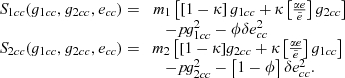
As we discussed in section 3, under centralized provision, network assets (


Lemma 2 compares individual district's surplus under mixed provision with that under decentralized provision:
Mixed provision, cd, is dominated by decentralized provision, dd, for District 1, i.e.,


Under mixed provision, given the other district opts out, Lemma 2 suggests the opt‐in district always has the incentive to opt‐out. Although mixed provision outperforms decentralized provision in terms of social welfare (as discussed in section 4), the opt‐in district is not willing to subsidize the opt‐out district under mixed provision. As a result, neither mixed provision is an equilibrium. It is worth noting that our Assumption 2(b) is sufficient but not necessary for Lemma 2 and the results that follow.
Individual districts choose between centralized and mixed provision depending on the cost sharing rule ϕ announced by the federal government. Lemma 3 compares an individual district's surplus under mixed provision with that under centralized provision. For this comparison we define the threshold 


If 


Lemma 3 suggests that centralized provision is an equilibrium organization form if a feasible cost sharing rule ϕ can be found. Recall that the cost sharing rule ϕ corresponds to the portion of the interoperability effort cost 
Figure 2 illustrates districts' incentives to deviate from centralized provision. Specifically, for the range of ϕ to the left of 


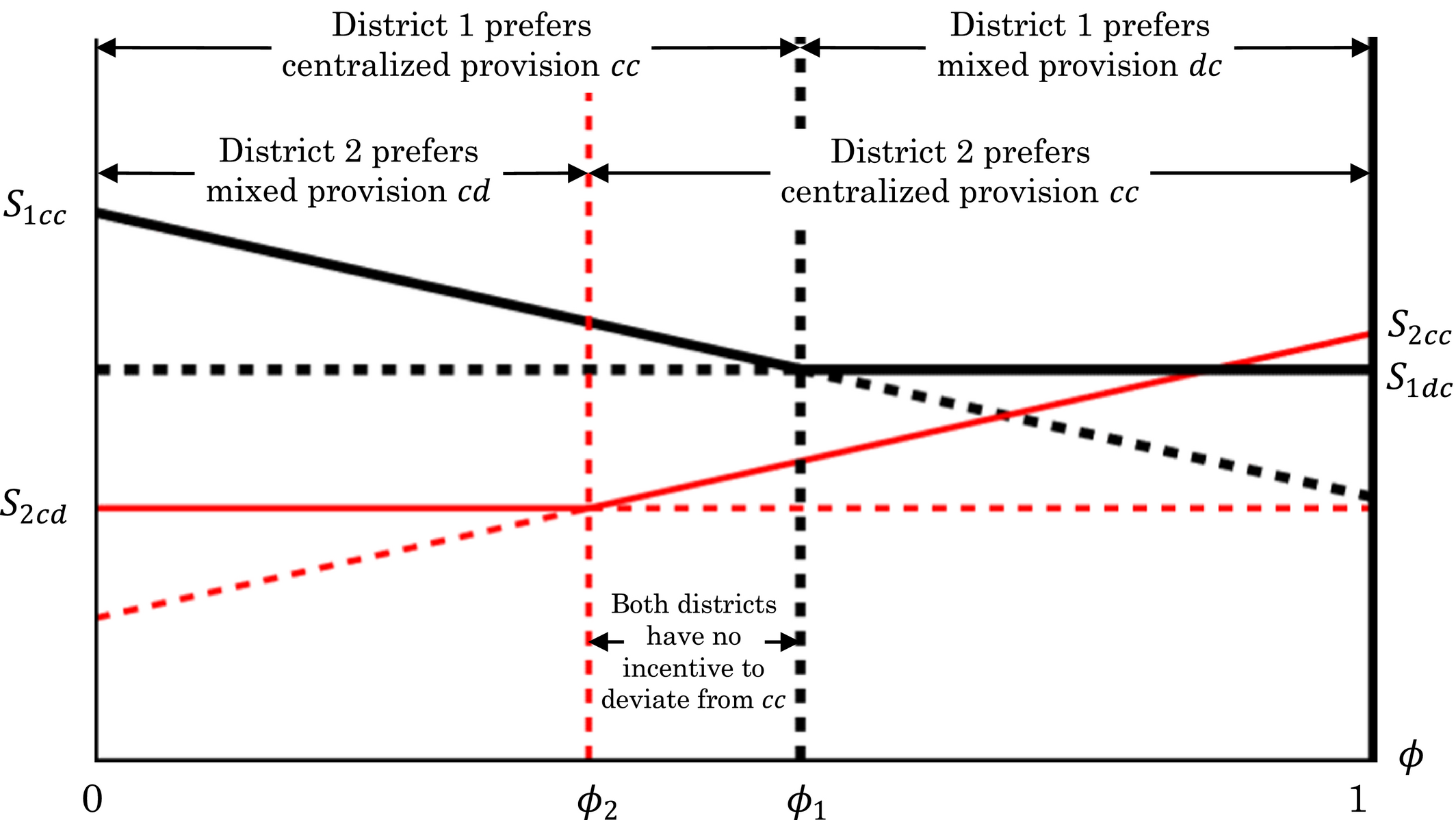
Districts' Incentives to Deviate from Centralized Provision cc
There exists a threshold 


Lemma 4 suggests that the existence of the feasible range of ϕ (i.e., 


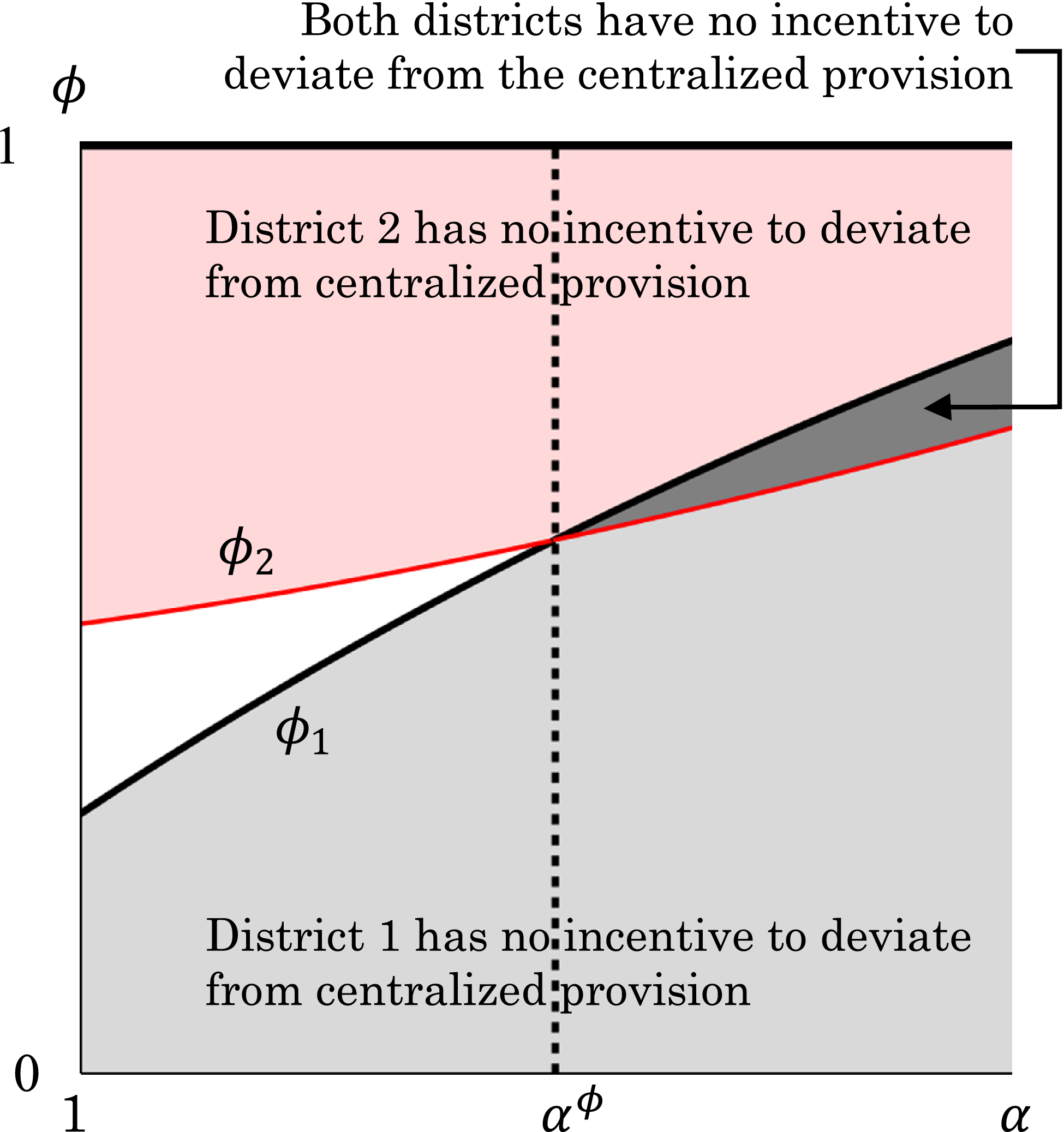
Impact of α on the Feasible Range of ϕ to Induce Centralized Provision
Recall from Proposition 4 in section 3, depending on the value of α, federal government may prefer either centralized or mixed provision dc to increase social welfare. However, depending on the relative values of 

If
If
If


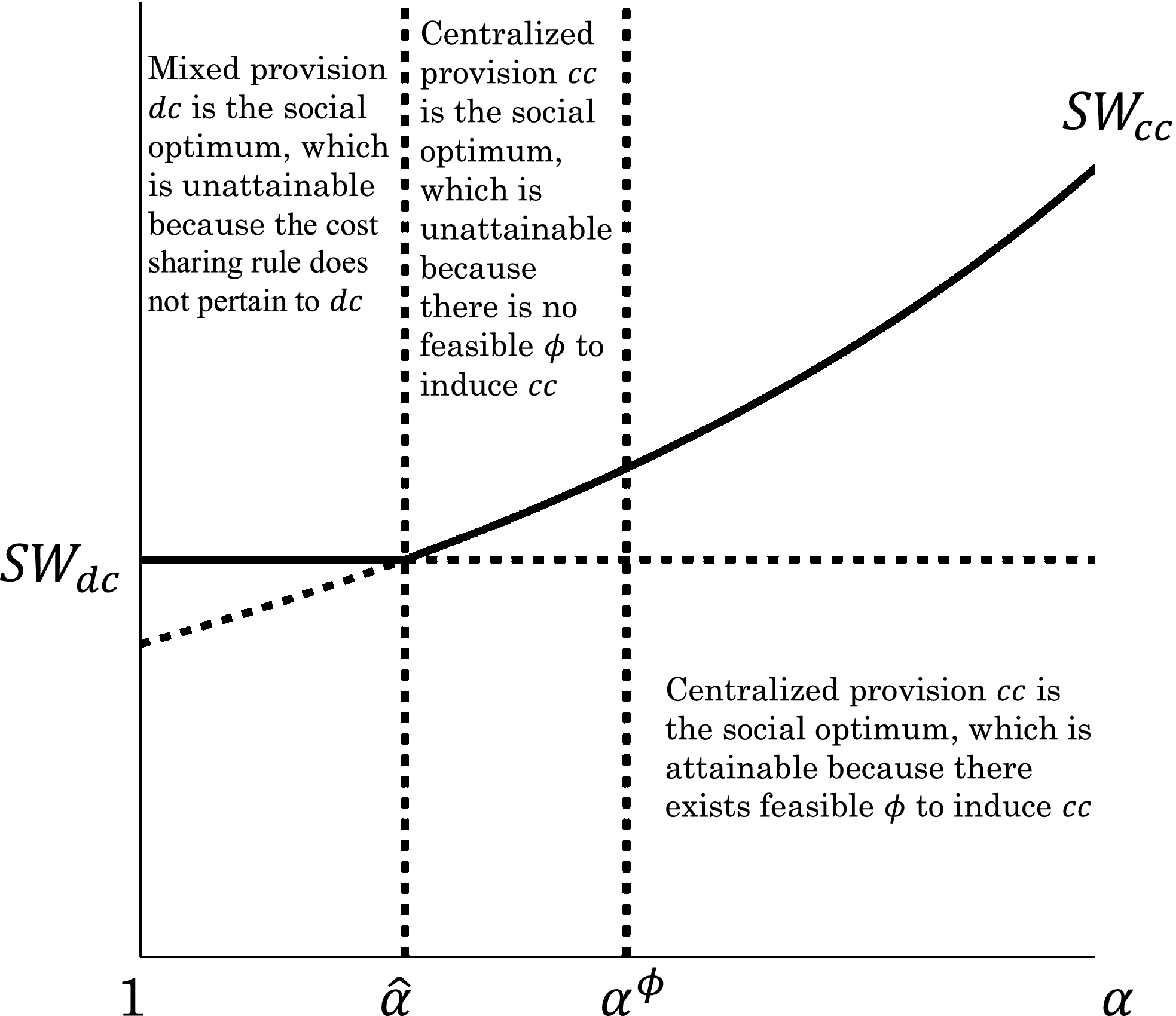
The equilibrium organization form for the provision of the public safety network is the outcome of the opt‐in or opt‐out choices made by individual districts (e.g., in the case of FirstNet). Figure 4 illustrates how the federal government may utilize cost sharing to induce social optimum. The federal government prefers centralized provision when 


Utilizing Cost Sharing to Induce Social Optimum
When the interoperability efficiency of centralized provision is moderate or low, i.e., 
Cost Sharing and Grants as Policy Instruments to Induce the Socially Optimal Organization Form
According to Proposition 5, the federal government may induce centralized provision as the socially desirable organization form when 

Recall that 







Both districts' incentives to deviate from the centralized provision decrease in the total grant 


The detailed definition of threshold 
When centralized provision is the socially optimal organization form, Lemma 5 reveals that there exists a lower bound for the grant in order to induce centralized provision as the equilibrium organization form. The federal government may provide extra grants to the opt‐in districts, but these grants should be sufficient to align the districts' incentives with the social optimum.
Figure 5 illustrates the impact of the grant 


Impact of
Similarly, the federal government can induce mixed provision‐dc as the equilibrium organization form by subsidizing District 2 with grant 
If
If
If





The definition of grants 

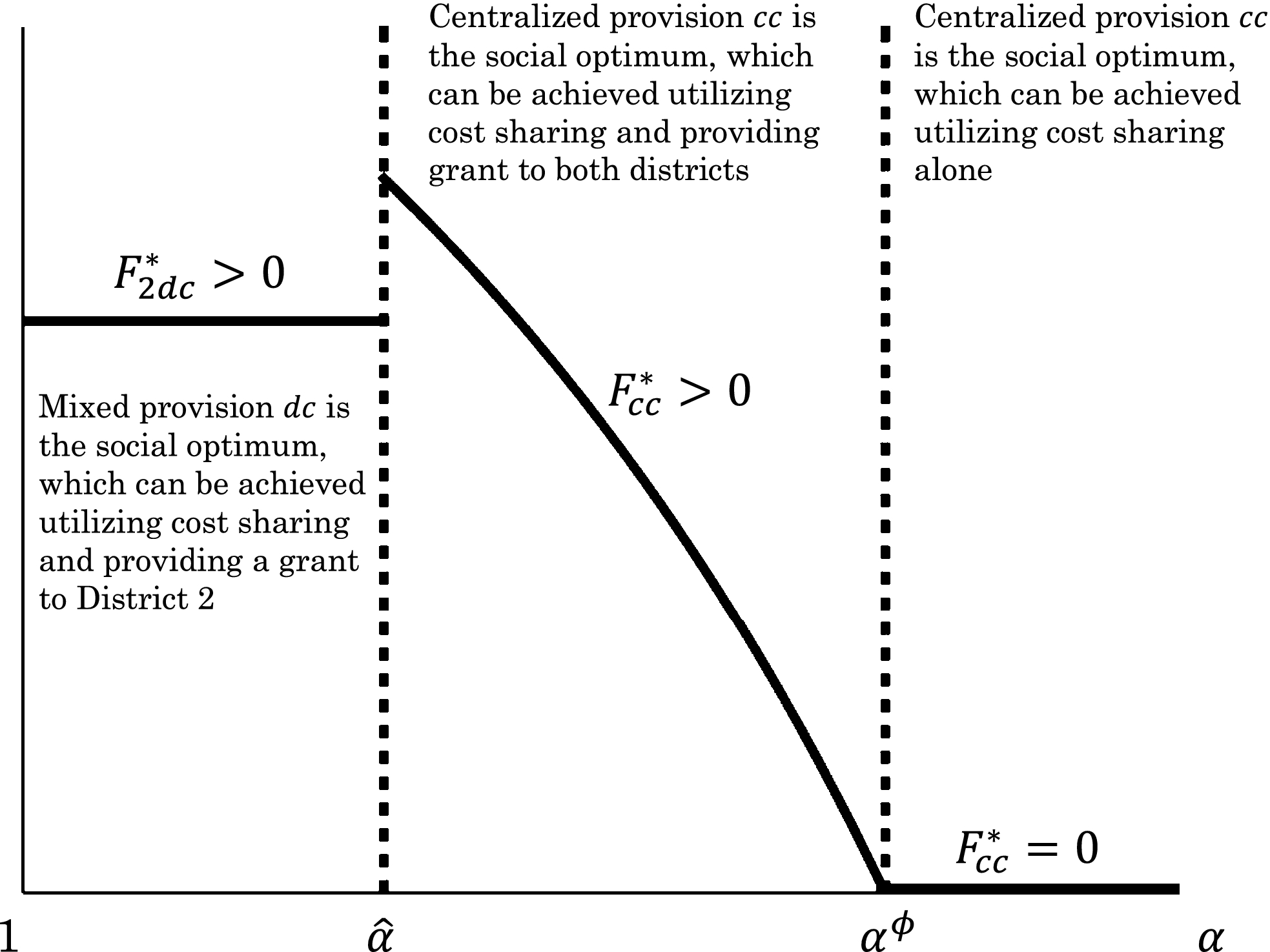
It is worth recognizing that the grant varies as the interoperability efficiency of centralized provision parameter α increases. Figure 6 summarizes our main policy results.
Minimum Necessary Grants to Induce Social Optimum
Proposition 6 and Figure 6 reveal a non‐monotonic relationship between the grants and the interoperability efficiency of centralized provision, α. When α is low (i.e., 


With the help of the grant and cost sharing, the federal government can induce the social optimum as the equilibrium organization form given that there is sufficient amount of grant available. Proposition 6 has several important policy implications. First, the federal government prefers either centralized or mixed provision for higher total social surplus over decentralized provision, but may not achieve the social optimum in equilibrium without the help of the grant. Our results provide support for the $7 billion budget already allocated to the project of the First Responder Network. We further provide guidelines for allocating part of the grant to align district's participation incentives. The socially optimal grants allocation critically depends on the interoperability efficiency of centralized provision. Second, our results provide support for the district that chooses to opt‐out and build the network on its own. Contrary to the common wisdom that suggests all districts should opt‐in, our results indicate mixed provision may outperform centralized provision and achieve higher total social surplus. Last but not least, our results reveal how a federal government can use policy instruments such as cost sharing and grants to induce the socially optimal organization form.
Conclusion
This work introduces two important features – interoperability and opt‐in/opt‐out – to the problem of public safety network provision. Although in public safety networks a given district values network assets in the other district as well as network assets in its own district, this value depends on the degree to which the network assets are interoperable. We model cross‐district interoperability of network assets as a continuous feature such that efforts can be made to improve the interoperability among different networks with a cost. Interoperability effort to integrate different technologies to provide greater cross‐district interoperability is chosen and implemented by the federal government under centralized provision and mixed provision for the opt‐in districts, and by districts under decentralized provision. As such we capture the key trade‐off between interoperability efficiency and interoperability effort cost under different organization forms.
We find that the equilibrium interoperability level increases in the degree of spillover from the value of public safety network for centralized, decentralized, and mixed provisions. Interestingly, we find that centralized provision with both districts opting in may not always be socially optimal. When the interoperability efficiency of centralized provision is lower than a threshold, the mixed provision with the smaller district opting in and the larger district opting out is more socially desirable.
The equilibrium organization form critically depends on cost sharing for the interoperability effort determined by the federal government under centralized provision. The equilibrium organization form may deviate from the socially optimal organization form based on the opt‐in or opt‐out choices of districts. That is, the districts choice to opt‐in or opt‐out may be at odds with the socially optimal organization form: the socially optimal organization form is either centralized provision or mixed provision with the smaller district opting‐in depending on the interoperability efficiency of centralized provision, but the equilibrium organization form is decentralized provision.
We characterize a cost‐sharing rule that the federal government can implement under centralized provision so that districts are motivated to make opt‐in/opt‐out choices that result in the socially optimal organization form when the interoperability efficiency of centralized provision is greater than a certain threshold. However, cost sharing under centralized provision is not sufficient to induce this social optimum when interoperability efficiency is lower than the threshold. Consequently, we show how cost sharing together with grants can align districts' incentives with federal government and induce the socially optimal organization form.
Our findings shed light upon provision policies in public safety networks such as the First Responder Network. Although centralized provision has the advantage of higher interoperability efficiency, it also has a cost disadvantage due to non‐contractibility of interoperability effort and cost diseconomies of scale and scope. These conflicting advantages of centralized vs. other organizational forms suggest a role for a federal government that uses cost sharing and grants to induce socially desirable organizational form choices by districts. For example, in FirstNet, each state has the option to opt‐in or opt‐out. Our analyses show that the FirstNet Authority should encourage the smaller states to opt in as these smaller states are more likely to free ride on the interoperability effort of the larger states. When the interoperability efficiency of centralized provision is low, a grant is necessary to provide additional incentives to smaller districts to encourage their participation. When this interoperability efficiency is moderate, a higher or lower grant (depending on the interoperability efficiency) is necessary for all districts to opt in (i.e., centralized provision). Finally, when this interoperability efficiency is high, grants are no longer needed, and cost sharing alone is sufficient to induce centralized provision. Our results also raise caution against common public opinion, which suggests centralized provision through maximizing districts' participation (Peha 2007). The benefits of the improved interoperability under centralized provision must be weighed against its effort cost disadvantage in determining provision policies.
Generalizations and Limitations
Although our model is based on the provision of public safety networks our results can be generalized to other settings. The essential element of our model is one where subunits (districts) of a larger organization (federal government) make investments (network assets) that spill over to other subunits; where that spillover depends on how much the value of the investments can carry across subunits (interoperability); where additional investments (effort) can be made to improve the spillover value; where the subunits can choose to delegate their asset and effort choices to a larger organization (opt‐in) or not (opt‐out); and the larger organization can use policy instruments to induce subunits to make delegation choices that result in the socially optimal organization form.
Consequently, our results can be generalized to any setting that is made up of elements that match the essential elements of our model. For example, many health information systems such as those that support electronic medical records are developed based on local standards, are proprietary, and are designed to be insular for privacy reasons. Indeed, many such systems were not designed to communicate with others whether inside or outside individual health provider organizations. However, interoperability and open standards to support information and data exchange has become a significant issue for healthcare providers, health information network developers, and all levels of governments promoting the implementation of national health information networks and infrastructures. The provision of interoperable electric power systems serves as another example where our results can be generalized. The interoperability of the electricity grid consisting of a complex network of systems improves the stability, energy efficiency, cost, choice, and flexibility. Linking thousands of networks, systems, devices, and applications in order to provide connections between independent power producers and the power grid shares many features with the provision of public safety networks.
In addition, the opt‐in/out option is commonly observed in many other policy projects initiated by the federal government such as the Affordable Care Act, Social Security, Common Core Education, etc. As a result, many features of our model and findings can be generalized to these and related contexts.
There are two sets of limitations to the generalizability of our model. First, our model makes choices in the functional form of some of our essential elements in order to be tractable. So, rather than a model that shows when a set of results always happen, our model and its results show what can happen in a set of reasonable circumstances. The main functional form choices in our formulation that could have been selected differently are the additive form of the district efforts in contributing to interoperability, and the quadratic form for costs. The latter is common in many studies – indeed there would have to be good reason to choose differently – and the former is the simplest mathematical form with which interoperability effort can be combined while still having a positive effect should one district choose not to invest in effort at all.
The second set of limitations is features we did not include in our model set‐up. One feature is that the value of network assets is the same regardless of organization form, and another feature is that the proportion of the value that is the spillover is the same for each district. These are unlikely to affect the qualitative characteristics of our results. It is possible that degrees of spillover could differ between districts, together with or instead of our assumed differences in the value of network assets, and this might affect which district should opt‐in for the mixed provision when the mixed provision is the socially optimal organization form. As such, there is a trade‐off between assuming differences in the value of network assets or having differing degrees of spillover in evaluating the different opt‐in/opt‐out combinations in mixed provision. We leave exploring this trade‐off to future work.
Deeper features relate to the full information we take to be the case in our model. The value of network assets, spillovers, interoperability efficiency, and interoperability effort could all be private information belonging to individual districts. Future research might consider how mechanisms such as screening, signaling, and revelation might be used within the context of our model set‐up.
Footnotes
Acknowledgments
We thank the participants at INFORMS 2013, ICIS 2013, and TEIS 2014 for helpful comments. Generous support was provided by the Syndeo Network OM&IS Faculty Research Fellowship, the Natural Science and Engineering Research Council of Canada, and the Social Science and Humanities Research Council of Canada. We benefitted from excellent editing assistance from Jeanette Burman, and outstanding guidance from the Department Editor, the Senior Editor and Reviewers at POM.