






Abstract
In this article, we look at research published over a five‐year time span in the economics of information systems (IS) area in four premier journals, including
Keywords
Introduction
Revolutions in fundamental technologies last a very long time – much longer than most people believe – when applied to production and operations. Two common examples are the printing press and the steam engine. The first fifty years after 1455 when Gutenberg perfected the printing press resulted in an explosion in communication and information from automation of the printed word. In the early 1500s, Luther's German Bible and Machiavelli's
Comparatively, the information revolution beginning with the industrial use of chip‐based information technology (IT) started in the late 1950s, and for the first forty years followed a performance/price evolution – characterized by Moore's Law doubling approximately every two years – that far outmatched that of the printing press or steam engine. The widespread availability of the Internet in the mid‐1990s has had similarly significant social and economic impacts as broadly distributed influential books and railroads in the prior revolutions. Productivity increases from IT (when measured properly) to around 2010 are unprecedented. In recent years, IT's potential has increased further with cloud computing, nano technology, multi‐processor arrays, quantum computing, telecommunications and mobile computing, and other new developments. These information and communication technologies provide the basis for new IT applied to production and operations, and new research challenges in how to manage these technologies.
Our objective in this article is to identify emergent themes for future research in the interface of management of technology (MOT) applied to operations management (OM), and the economics of information systems (econ of IS). The three emergent themes that result from our analysis are
The Role of the Economics of Information Systems in MOT
As a sub‐discipline of the broader management information systems discipline, the econ of IS studies the impact of IT on individuals, organizations, industries, and society from an economics perspective. Although not comprehensive, the econ of IS entails studying individuals maximizing utility through choice decisions; organizations choosing prices, quantities, incentive systems, channel structures, and production technologies to maximize profits; industries that aggregate supply and demand, and have supply chain and input–output relationships with other industries; and society where planners or governments impose policy‐based regulations and incentive systems.
In the context of the MOT in OM, the role of the econ of IS is to examine how IT in its various forms is used to enhance and integrate the product development process (e.g., improving time‐to‐market), aid in production and operations as well as manage their impacts (e.g., expanding the mix of products), change the structure and efficiency of vertical supply chains from raw materials to different channels offered to consumers (e.g., cost reductions in inventory from real‐time information), and more effectively use internal and external resources to generate productivity (e.g., smaller workforce with improved capabilities). Many of these are also reflected in Gaimon et al. (2017) in this issue.
Approach to Searching the Literature
We took a two‐pass approach to searching the literature in order to identify and elaborate on our three emergent themes:
The three emergent themes are not meant to be mutually exclusive or collectively exhaustive – there is existing and potential future work that is consistent with multiple themes. Our emergent themes and subthemes are shown in Figure 1. Conceptually, we believe platforms form a technical basis for firms to vertically integrate. Platforms also provide the necessary technical capability for firms to coordinate their activities and increase their productivity. Vertical relations, similarly, can impact productivity – higher level of IT adoption and integration allows firms to take advantage of IT, which increases their productivity. Within each theme we considered broad categories of research. In productivity we considered different types of spillovers, substitution of IT for other inputs, coordination, and sustainability. In vertical relations we examined the partially opposing options of integration and intermediation, and how IT adoption occurs in vertical structures. In platforms we identified capabilities, and the effects of these capabilities on new product development, on knowledge markets, and on manufacturing and customization.
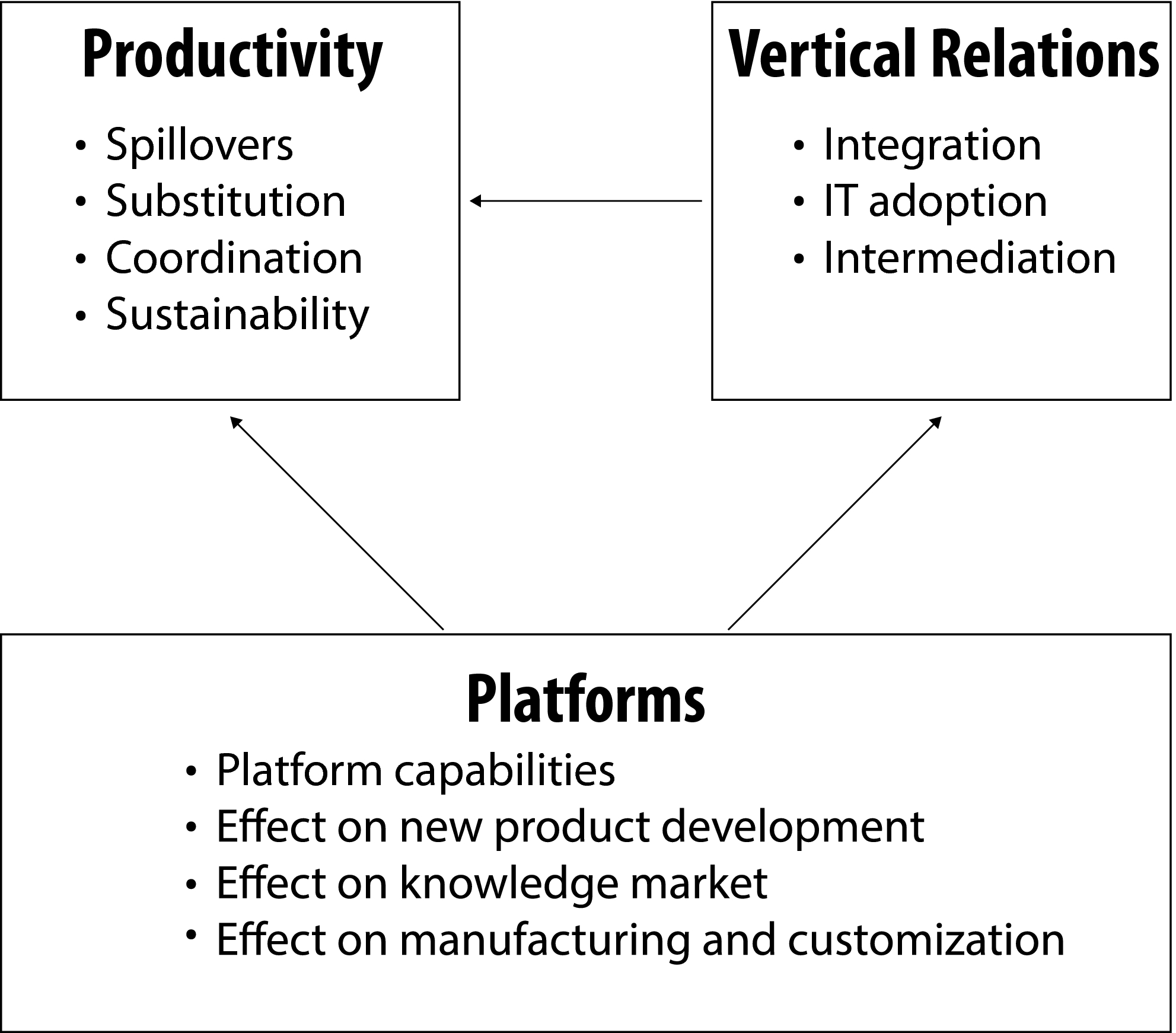
Emergent Themes and Subthemes
Productivity: Emergent Theme 1
To understand how IT can affect MOT in OM, it is helpful to introduce a production function. A production function describes output as a function of inputs and assumes a technological relationship within and between inputs to product output. A commonly‐used function form for a production function is a Cobb‐Douglas:

From the perspective of MOT, IT has a set of different effects on Equation 2. There is a direct effect through the IT input that is reflected in
Spillovers
In past research, spillovers have been defined in two separate ways. The first comes from a stream of research in R&D that identifies spillovers as coming from knowledge that moves between firms within an industry, between IT service firms and their clients, or even among trading partners. Such knowledge spillovers from IT have been shown to affect productivity. Tambe and Hitt (2014) examine the effect of IT labor moving between firms. They use a slightly modified version of Equation 1 that in log form is

The second stream of research in spillovers identifies IT spillovers between industries along the supply chain that come from increased information‐sharing through various interorganizational systems or from IT that is reflected in the traded good. Cheng and Nault (2012) examine the effect of IT investments upstream on the productivity of supplying industries. As this reverses the flow of traded goods, this effect is posited to come from information sharing and coordination. In addition, they account for the relative concentration of the trading industries, and estimate a form that includes intermediate inputs on the right‐hand side:
Future Opportunities
The research above partitions the spillovers into three categories: IT knowledge, information sharing, and unmeasured increases in quality. The former two have significant potential for future research. IT knowledge spillovers may be generic IT knowledge, or they may be knowledge about particular implementations that are industry best practice. This means delving deeper into 

Next, the IT spillovers upstream from information sharing and coordination – which may also happen downstream – reduce transaction costs. The finding that relative concentration affects which partner receives the productivity benefit from these reduced transaction costs opens two separate questions with implications for MOT. First, which transaction costs are being reduced: uncertainty, specificity, opportunism, etc? Second, how does competition affect the allocation of productivity benefits from IT spillovers: using the terminology of Clemons and Kimbrough (1986), is it a case of competitive advantage or strategic necessity? This means expanding the specification of
Substitution
Determining whether a new technology is a substitute or complement to existing capital and labor is a key aspect of managing technology. The classic economic approach is to assess the elasticity of substitution between inputs. Following an earlier study by Dewan and Min (1997), Chwelos et al. (2010) extend the 1987–1994 firm level dataset described above to 1999 and find that increasing use of IT in production comes at the expense of labor. In contrast, IT can be a complement to non‐IT capital – possibly reflecting positive effects of TFP. Decentralized IT (e.g., personal computers) are more price elastic than other IT capital. From the perspective of MOT, decentralized IT in operations may become a cheaper input that can be used in a broader set of applications.
The studies immediately above use the Allen elasticity of substitution (AES), and as Zhang et al. (2015) point out, with more than two inputs as would be the case with a third input such as IT capital the AES is a relatively uninformative measure. The less well‐known Morishima elasticity of substitution (MES) is a more informative measure as the scale of the measure is meaningful and the measure differs depending on which input price is changing. In particular, IT has had a consistent decline in price for a given level of performance. Across industries Zhang et al. (2015) find that reductions in the price of IT increase the quantity of IT in use without changing input share, and that in this way IT is a complementary input to both labor and non‐IT capital. The implication for MOT is that the complementarity of IT with other inputs in operations makes them more productive.
Substitution in the broader sense is not only about one input substituting for another, but also about firms’ make or buy decisions. Thus, firms can choose to buy technology services such as using fee‐for‐service cloud computing and IT outsourcing, or they can choose to produce them internally using labor and capital. In a study closely related to their work cited in an earlier subsection, Chang and Gurbaxani (2012b) examine productivity gains from IT outsourcing, and start by identifying firm characteristics that are more likely to lead to IT outsourcing such as larger firms and firms that face more variability in demand and in their input mix. For these firms, they find that productivity gains from IT outsourcing are substantial when modeling these gains through the transfer of knowledge from IT service firms, in contrast to the common view that firms lose IT knowledge when outsourcing. In this setting, the implication for MOT is that there are advantages in buying IT services rather than providing them in house, and these advantages are at least in part due to knowledge spillovers. Han et al. (2011) examine the relative productivity of IT outsourcing using industry level data. Using a slightly modified version of Equation 1 that in log form is


Future Opportunities
The increased awareness of the MES provides an important tool for assessing tradeoffs in the mix of inputs when input price changes over time differ so widely – the price of IT capital falling in contrast to prices of labor and other capital increasing. Studies providing MES within industries at the firm level may provide a better understanding of the tradeoffs between inputs in particular sectors, partially unlocking the critical MOT question of
Furthermore, understanding the substitution or complementarity of IT with externally purchased IT services through MES estimates would enhance our understanding of how IT outsourcing increases productivity (as evidenced through
In addition, with the ubiquitous presence of the Internet there is an open question regarding the productivity increases that have come as a consequence of such shared infrastructure. Shared infrastructure like the Internet can be either a substitute or complement to all inputs, and likely has fundamental effects on the input mix between labor and different capitals. How shared infrastructure can be defined (e.g., the Internet, the so‐called cloud) and its impact is a relatively unexplored area of MOT.
Coordination
Two articles in
Future Opportunities
The effects of coordination are most likely found in TFP, our
Sustainability
In a seminal article in
Drake and Spinler (2013) outline a series of firm risks associated with sustainability. There is a risk of regulation when not operating in a sustainable way, and there are also regulation threats from change in policies and tariffs when investing in sustainable goods and services. In addition, firms face increased risk where profits or cash flows are affected by changes in climate such as changes in growing seasons and natural disasters. Connecting to Kleindorfer et al. (2005), sustainability implemented as life‐cycle management, CLSC, or extended producer responsibility (EPR) regulations, directly affects production technology choice. Furthermore, supply chain coordination is important because logistics creates a disproportionate share of pollution and emissions. Consequently, there are tradeoffs among trading partners in deciding where pollution and emissions are created, and greater logistics efficiency can mitigate net negative effects.
In the IS literature, two articles in
Future Opportunities
MOT not only involves production, but the ability to change production in response to changes in demand. A potentially important consideration is that of IT capital on capacity – does IT make production more efficient so that firms operate closer to their capacity limit, or does IT make changing production scale more flexible thereby increasing capacity so that firms operate at lower level of capacity utilization? In the latter case, IT can also facilitate the integration of contract capacity, adding to flexibility. Both connect IT to sustainability in production: increased efficiency in use of inputs or increased efficiency in growing capacity.
In its most abstract form, sustainability in production is about producing output with less input or a different mix of inputs. In addition to relating IT with capacity, there are tradeoffs in make vs. buy, and possible efficiency gains from the latter. One area of consideration is logistics – if there are efficiency gains from logistics outsourcing that come from wider and more interconnected transportation networks and from greater efficiency in less‐than‐truckload shipping, then these efficiency gains are supported by IT both within the transportation system and between customers and logistics suppliers. Understanding these relationships is also part of MOT.
As an applied technology for industries, IT can also be used to monitor pollution, which can enable regulation or support incentive schemes like cap and trade systems. For end customers, monitoring energy use and therefore the resources consumed, either through the smart grid or comparable systems, has potential efficiency effects that roll back through the supply chain. In the case of electricity, greater efficiency from customers affects distribution, which affects transmission and then generation. How to best implement these technologies is an important MOT‐for‐sustainability topic, with the additional complication of data privacy being a critical issue for firms and individuals. Indeed, this privacy/security issue is one of the greatest difficulties in applying CLSC: tracking the entire life cycle of products requires information about ownership and use, information typically considered private.
Healthcare as a Special Example
As summarized in the previous subsections, researchers have looked at IT productivity from multiple aspects and across multiple industries. As a sector that makes up a large proportion of the economy and has special production characteristics, healthcare IT productivity has been particularly vexing. Bhargava and Mishra (2014) find that electronic medical records (EMR) have negligible effects on productivity possibly because EMR requirements pull the physician away from the patient, and the small effects found were for more general specialties such as pediatrics and family practice. The implication for MOT is that IT productivity in healthcare differs depending on the underlying task. Mukhopadhyay et al. (2011) find that the learning rate of newly implemented physician referral systems lags that of similar systems in other manufacturing and services industries. The referral system is essentially a routing problem for emergency, non‐emergency, and out‐of‐network cases where the sequence goes from high domain/low systems (e.g., emergency cases require immediate domain knowledge and little systems involvement) to low domain/high systems (e.g., out‐of‐network cases require high systems involvement to identify and notify other healthcare providers). From the perspective of MOT, the learning rate is highest for low domain knowledge/high systems involvement settings.
Angst et al. (2011) examines integration between technologies in health care: medical technologies to specific health IT to more general IS. For example, a computed tomography (CT) scanner may be linked to a hospital Picture Archiving and Communication System (PACS) that is in turn integrated with other hospital systems. Thus, the CT scanner is a medical technology, PACS is a specific health IT application, and patient records, physician scheduling, accounting, etc. are general IS modules. They find that interoperability – the ability of different technologies to work together – in the sequence of technology integration yields higher productivity. In addition, they find that given more general IS is the basis for interoperability, then IS should be developed first in the order of integration. The lesson for MOT is that developing and implementing the technology that is the basis for interoperability – IS – is the key to integrating multiple technologies.
Future Opportunities
Although health care has specific characteristics such as different domains of expertise that coexist within an organization or network of organizations, the knowledge economy we face has similar characteristics. Moreover, health care is increasingly information‐rich as new tests and devices all provide data, and these data are being increasingly used to dynamically treat patients. Important research in MOT is to understand sources of resistance and success of health IT implementations and integration including remote access to medical care, with likely similar patterns in knowledge‐based industries.
There is also important potential MOT research in bringing IT that embeds OM techniques to health care. An example is operating room scheduling where the most prevalent model is to schedule operating room blocks (part of a day) to surgeons 6–12 months ahead, and then assign patients to an operating room slate 1–2 weeks ahead. Adaptive control of the operating room slate is usually done manually, where methods like bin packing implemented in an IT‐based scheduler could substantially improve patient throughput. Another example is the use of analytics with large datasets, optimizers, and genome sequences that evaluate huge numbers of permutations of gene‐based solutions to identify the most promising avenues for future medical research.
Vertical Relations: Emergent Theme 2
The issues of IT and vertical integration/disintegration, the optimal number of suppliers, organization design, and coordination through interorganizational systems (IOS) began a substantial area of research in the first decade of the econ of IS. For example, Gurbaxani and Whang (1991) describe the potential effects of IT on organizations and markets; Riggins et al. (1994), and Wang and Seidmann (1995) show the role of network externalities in IOS and how this impacts the number of suppliers; Anand and Mendelson (1997), and Nault (1998) show how IT impacts the design of two‐tier organizations. These and many other subsequent studies began a literature on how IT changes vertical relations.
Integration
Integrating different operations often involves contracts, and the choice between contract types can have a large effect. Bhattacharya et al. (2014) examine contracts between clients and support centers when product improvements reduce the need for support center services. The issue for the client is that they still require investment and effort on the part of support centers, and these investments are often non‐contractible as they are unobservable. The model shows that the gain‐share contracts where the client shares the gains from product improvements can motivate support centers and attain second‐best, whereas cost‐plus contracts are not optimal. The implication for MOT is that properly designed contracts allow clients to manage product improvements when also using outside suppliers that are affected by those improvements.
Sankaranarayanan and Sundararajan (2010) study the impact of different types of IOSs used for search in procurement to determine the vertical scope of enterprises – should the procurement function stay in house or be outsourced. IOS are either information‐intensive (i.e., collecting published information and prior records such as posted and historical prices) or communication‐intensive (e.g., collective‐specific buyer information requiring active communication with those associated with the buyer such as feedback and references), and there is moral hazard with outsourcing. They find that constant (block) reductions in search costs from IT improvements result in greater outsourcing when search is information‐intensive, and less outsourcing when search is communication‐intensive. From the perspective of MOT, common technology platforms that integrate procurement can reduce in‐house search costs and favor insourcing.
Yao and Zhu (2012) address how to manage the bullwhip effect in supply chains. Using industry data, they find that for buyers electronic linkages upstream in the supply chain reduce the bullwhip effect, while for suppliers electronic linkages with buyers increase the bullwhip effect. They also find that this latter effect can be moderated with IT in the form of better information sharing and coordination. The MOT conclusion is that IT can be used to manage the bullwhip effect coming from downstream partners.
Future Opportunities
Issues about IT‐based integration revolve around two connected aspects. First is vertical integration and the avoidance of double marginalization (Spengler 1950). The pricing efficiency of vertical integration depends on the absence of competition whereas with competition the most efficient result can be vertical separation. The MOT question in this aspect of integration is to address how IT can create differentiation leading to a different balance of vertical integration and separation.
The second IT‐based integration issue is transaction costs with the threat of opportunism, bounded rationality leading to incomplete contracts, and hold‐up from asset specificity. The research opportunity in MOT here is recognizing that IT supports virtual vertical integration based on information sharing, where virtual implies a range of temporal vertical integrated relationships from individual transactions (e.g., purchases from a retailer online through Amazon) to long‐term investments in IOS. Understanding how different levels of information sharing investments and the incentives they create impact virtual vertical integration is an interesting area of future work.
Finally, there is a longer‐term question of whether IT has changed the structure of industry – that is, have investments in IT changed which industries transact and the volume of transactions between industries. Examining this trend would help us understand the long‐term effects of the IT revolution described in the Introduction.
IT Adoption
New IT arises constantly. Understanding the factors that affect the adoption of these new technologies, such as cost and acceptance, is critical to successful implementation. In addition to IOS that affect multiple tiers in an organization or supply chain, there are also new tracking technologies such as RFID. Whang (2010) examines the adoption of RFID in a two‐firm supply chain: when does the upstream firm adopt, and does the downstream firm free ride? As a typical IT, RFID adoption costs fall over time, and a supply chain typically adopts later than a vertically integrated firm as costs are borne by the first adopting tier. In this case, cost sharing can lead to earlier adoption, and the implication for MOT is that coordination in adoption through revenue or cost sharing is needed to adopt IT that has effects along the supply chain.
Continuing with RFID, Camdereli and Swaminathan (2010) study the impact of RFID on misplaced inventory in a two‐tier supply chain where the variable cost of RFID is assigned to one of the tiers. They consider a supply chain that is vertically integrated, decentralized or coordinated with contracts. Using numerical analysis they find that both decentralized and coordinated supply chains result in higher wholesale prices. From the perspective of MOT, how IT is implemented and charged across the supply chain can result in higher wholesale prices, and this is likely to result in higher retail prices and double marginalization.
Future Opportunities
RFID is not only a typical IT in terms of costs, but also in terms of privacy issues and the role of standards. Many IT innovations in the coming years are related to mobile computing and tracking of consumers by firms, and between firms along the supply chain. Studies that examine privacy and the role of standards in the adoption of IT, including firms’ strategies, the ability to opt‐in or opt‐out, and possible regulation constitutes a wide range of possible MOT research.
Intermediation
Intermediation by automated agents or IOS‐based exchanges, or disintermediation by changing channels of distribution to go directly to customers such as direct sales through the Internet continues to be a fruitful area of research that spans multiple disciplines. In a recent article, Hsiao and Chen (2014) examine when a manufacturer should use its own Internet channel vs. a retailer when customers differ to the degree they are physical channel shoppers (retail stores) vs. Internet (online) shoppers. In their model either the manufacturer or the retailer can use an Internet channel. They find that with multiple retailers the manufacturer can leverage retail competition and not use its Internet channel, while maintaining the threat of using its Internet channel. The implication for MOT is how IT, typically through the Internet, can affect channel choice and configuration
Future Opportunities
There are two particularly promising and related directions for MOT research on IT and intermediation. The first is horizontal integration over one tier in the supply chain. An example is one used above – Amazon as an Internet retail intermediary between retailers and customers. The question is whether this type of horizontal integration is feasible at other tiers in the supply chain.
The second is how IT‐based platforms may facilitate the sharing economy. Firms such as Airbnb and Uber have done this in the travel retail space. The industrial opportunity is for firms to use the sharing economy for assets such as plant capacity or specialized equipment in a two‐sided platform‐mediated network, where investments are required for both the sharing platform and the side that owns the assets.
In the next section, we focus on platforms and point to some areas where platform‐related research can be fruitful.
Platforms: Emergent Theme 3
IT‐based platforms are becoming increasingly prevalent. Platforms are systems made up of multiple components (Katz and Shapiro 1994, Marshak 1964) which are often in common or reused across implementations. According to Boudreau (2010), “a platform may include physical components, tools and rules to facilitate development, a collection of technical standards to support interoperability, or any combination of these things. Serving as a stable nexus or foundation, a platform can organize the technical development of interchangeable, complementary components and permit them to interact with one another.” Search and database technology, personalization technology, online communities and social networks, etc., have enabled platforms in different industries such as retail (e.g., Amazon), insurance (healthcare.gov), dating (match.com), education (Coursera), and freelancing (elance.com). Platforms are dynamic; as technology improves, they can be upgraded and extended, which has implications on firms’ IT investment decisions. Platforms may also be vulnerable to replacement by rivals (Eisenmann et al. 2006). For example, Blu‐ray defeated rival HD DVD, and Facebook replaced MySpace as the dominant force in social media.
IT‐based platforms have had increasing impact on OM, from new product development to supply chain management and customer service: they may reduce time‐to‐market, improve design for manufacturability, improve product features, and reduce manufacturing costs (Gaimon et al. 2017). We organize platform‐related research into four subthemes presented in sequence below.
Managing a Platform's Capabilities
A platform is a system of components and rules used in common across users’ transactions. Depending on the context, a platform might be used for product design, for computer software (e.g., Windows or Mac) or mobile app development (Android vs. iOS), or for networked markets (e.g., Amazon, eBay). Naturally, the rules and components might be different from platform to platform. Within the same context, the components of competing platforms might be different, yielding different application outcomes.
The IS literature has looked at platforms themselves as a technology whose capability can be designed/manipulated. Anderson et al. (2014) investigates a key decision in platform design: the level of a platform's processing and graphical capabilities to invest in at each product development cycle, using the video game industry as a context. The video game industry is a typical two‐sided market: on one side, there are video game players who own a game console; on the other side, there are game developers who develop for a particular platform (e.g., Nintendo or PlayStation). There is a strong cross‐side network effect in this kind of two‐sided market: the more players that own a particular platform (console), the more developers are willing to develop games for that platform. Similarly, the more games there are available for a particular platform, the more players are willing to buy that platform. Therefore, platform creators need to carefully balance the needs on both sides of the market to attract the maximum number of players and developers. Interestingly, the authors find that a platform with lower capabilities but a wider product mix (e.g., games) might be a winning strategy in a network with cross‐side effects that is content driven and highly competitive. From a MOT perspective, managing a platform's capabilities has a direct impact on a firm's product strategy and market competitiveness.
Looking at a different platform capability, Ba et al. (2010) analyzes what level of e‐service is optimal for a firm. Firms increasingly rely on IT platforms to deliver a variety of services: for example, tracking courier packages, booking tickets, scheduling car maintenance, applying for mortgage loans, after‐sales support, as opposed to the human intervention needed a decade ago. Given that a firm has the option of offering services through a digital platform and/or with human assistance, what is the appropriate level of e‐service capabilities the firm should provide, taking into account consumer preference, as well as the cost of providing each service? How does a firm's action affect its competitiveness in a marketplace where competitors also act strategically? The authors conclude that if the firms are not very differentiated in human service, but differ greatly in e‐service, then it is not worthwhile to attempt to increase the differentiation in human service. From the perspective of MOT, their analysis suggests that, although e‐service is necessary in today's business environment, firms should still try to maximally differentiate the service provided by their platforms. Managing their e‐service capabilities in this way allows firms to capture different types of customers and avoid direct price competition.
Future Opportunities
Past research has mainly focused on the scenario where firms provide their own platforms and compete against each other with platforms that have different capabilities: video game consoles with different processing and graphical capabilities, as in the study of Anderson et al. (2014), or online service capabilities, as in Ba et al. (2010). Shared platforms have not been studied and could be a significant area for future MOT research. We use e‐service as an example to illustrate this point.
Empirical research has shown e‐service to be a differentiator among competitors (Ba et al. 2012, Rust and Oliver 2000, Zeithaml et al. 2002). Platform‐based e‐service is emerging. As an example, ShopRunner is a platform that connects retailers with shoppers. Members enjoy free 2‐day shipping and free return shipping. Three forms of customer services are available on the ShopRunner platform: searching for products, order tracking, and printing of return labels – the actual purchase process is accomplished on the individual retailer's own website. More sophisticated and involved customer service still needs to be handled by individual retailers. If a platform like ShopRunner handles all e‐service for member retailers, then there is no differentiation over e‐service, and this might not be desirable. On the other hand, platforms like ShopRunner exhibit strong cross‐side network effects, similar to the video game consoles studied by Anderson et al. (2014), and these cross‐side effects benefit participating retailers. Important research in MOT is to understand how these different forces affect retail competition. In addition, from the platform providers’ perspective, can they benefit by providing compatible platforms, under what conditions do they benefit, and what is the social welfare gain (or loss) on the consumer side?
Effects of Platforms on Innovation and New Product Development
The prevalence of platforms has enabled a wide variety of applications that touch upon key OM areas. For example, many companies (Google, Best Buy, HP, to name a few) use prediction markets for price forecasting, sales forecasting, or project completion estimation. Some use platforms to coordinate their supply chain activities. And yet many others use platform‐based innovation markets for idea generation and evaluation.
Innovation and new product development are critical to a company's competitive edge, and sometimes its survival. Traditionally, R&D and new product development activities are mostly done in‐house and are often expensive. Many ideas might go through a development funnel, with most ideas winnowed out and few surviving. Sometimes a firm may not be able to find a solution within its own base of expertise. IT‐based platforms have enabled a new way of generating innovative ideas and creative solutions.
The OM literature shows that higher product variety may lead to higher firm performance. However, greater product variety also means lower production efficiency and greater cost in terms of production, inventory, supply chain management, etc. IT apparently lends a counter effect by lowering the cost of concept development, product design, project management, and supply chain coordination. Gao and Hitt (2012) investigate the relationship between IT and product variety, using trademarks as a measure of product variety. They find that not only does IT contribute to higher trademark holdings, but also that firms with more IT capital tend to apply for more new trademarks and retire existing trademarks more quickly, suggesting an increased rate of product introduction. In the same vein, Kleis et al. (2012) show that a 10% increase in IT input is associated with a 1.7% increase in innovation output for a given level of innovation‐related spending. That is, IT is also important for improved innovation productivity.
More recent development in IT platforms has enabled new ways of innovation and product ideation. Crowdsourcing is one of these new ways, and refers to taking a task once performed by an employee and outsourcing it to a large undefined group external to the company in the form of an open call (Howe 2008). Crowdsourcing has become a popular way of gathering ideas for new products and services from a large, dispersed crowd of non‐experts (e.g., consumers). Dell's IdeaStorm is a crowdsourcing website that launched in February 2007. The goal of this initiative was to hear what new products or services Dell's customers would like to see Dell develop: “IdeaStorm was created to . . . allow you the customer to share ideas and collaborate with one another and Dell. Our goal through IdeaStorm is to hear what new products or services you'd like to see Dell develop." (see ideastorm.com) Since launching, the site has received over 16,000 ideas, nearly 500 of which Dell has implemented.
Bayus (2013) and Huang et al. (2014) both try to uncover the economic mechanisms shaping the individual behavior and ideation efforts on crowdsourcing platforms. Huang et al. (2014) finds that individuals learn rather quickly about their abilities to come up with high‐potential ideas, but the learning regarding the firm's cost structure, which affects the feasibility of their ideas, is slow. Bayus (2013) concludes that serial ideators are found to be more likely than consumers with only one idea to generate an idea the organization finds valuable enough to implement, but are unlikely to repeat their early success once their ideas are implemented. An interesting research question from the MOT perspective is how to design these ideation platforms to nurture individuals’ ideation process.
InnoCentive is a successful platform that uses crowdsourcing to generate innovative ideas. Through this platform, firms can post a problem and solicit solutions, with the winning entry receiving a cash prize. A spin‐off from Eli Lilly, the creator of the platform recognized a problem that many firms had long faced: firms tended to address science problems using a limited number of scientists in a single knowledge domain, often from an in‐house group, forming a local‐search phenomenon. When a local search was unsuccessful, problems simply were not solved or lay dormant. Eli Lilly created the platform to connect diverse “outside" experts to “inside" problems. After the spin‐off, the platform was opened up to anybody looking to have a problem solved in the areas of engineering, computer science, math, chemistry, life sciences, physical sciences, and business. Cash awards are given for the best solutions to solvers that meet the challenge criteria. Today, InnoCentive's solver community consists of over 355,000 people from nearly 200 countries.
An important concern for MOT researchers is how to manage the “crowd" in order for innovation to continue to flourish, as the user base on this type of platform continues to grow. Economists have long noted the negative incentive effects in innovation contests ‐ increasing the number of competitors admitted to a contest reduces the likelihood of any one competitor winning, thereby reducing incentives to exert effort and lowering overall innovation outcomes (Che and Gale 2003, Fullerton and McAfee 1999, Taylor 1995). On the other hand, adding a greater number of competitors (thus more parallel paths) will lead to a greater chance of finding at least one good solution (Abernathy and Rosenbloom 1969, Dahan and Mendelson 2001). Using data from a popular crowdsourcing platform, Boudreau et al. (2011) empirically examine evidence of these two opposing forces and find that adding competitors indeed worsens outcomes in expectation but increases the “upside" in that at least one competitor would deliver a good outcome. Their findings call for greater research into integrating and examining the interplay between the parallel path and incentive effects in innovation contests.
Recognizing that although a firm can now have immediate access to an unlimited supply of labor and a wide pool of talent and skills, Acemoglu et al. (2014) state that “extracting the good from the bad and managing this pool of workers is fraught with difficulties." They propose a model of crowd innovation in which a firm seeks to assign a range of innovation tasks of unknown difficulty to a set of heterogeneous workers using a virtual marketplace (i.e., a platform). Using a dynamic programming formulation, they propose a matching method when worker skills are unknown and workers choose when to participate and which tasks to work on. The implementation relies on a simple pricing scheme in which rewards for completing tasks increase the longer these tasks remain uncompleted (i.e., the more times they are unsuccessfully attempted). A noteworthy feature of this optimal matching method is its ability to economize on the scarcity in this marketplace – the time of skilled workers.
A question that has not been frequently asked is the interaction and dynamics between the firm seeking new ideas and the individuals providing the solutions. Lee et al. (2015) analyze an economic model of the buyer‐provider knowledge outsourcing problem. Recognizing that the firm seeking knowledge may not know with certainty the amount of knowledge necessary to arrive at a good solution, they identify conditions under which both the buyer and provider benefit from uncertainty in the project deliverable. In addition, they articulate that the buyer's level of absorptive capacity, which normally is not known by the provider, may affect the provider's economic outcome.
Future Opportunities
Brynjolfsson et al. (2010) explores the long tail effect of IT and asks the question: how does IT affect product variety and sales concentration patterns? As platform‐based crowdsourcing becomes more widespread, the same question should be asked by MOT researchers: crowdsourcing works partly because of the divergent expertise, ideas, and the out‐of‐the‐box thinking it brings. Will crowdsourcing enable an even longer tail for product variety, and in what kind of product markets will this likely happen? Does the design of these technology‐based crowdsourcing platforms have an impact on the potential long tail outcome, and what are the social welfare implications as more niche products are developed and delivered to consumers? Most existing research has focused on currently available crowdsourcing platforms. We believe these platforms should also be examined from a mechanism design perspective, as Acemoglu et al. (2014) have done. For example, what reputation mechanisms should be built into these crowdsourcing platforms to enable firms to efficiently sift through hundreds of thousands of potential ideators who may or may not have the ability to provide feasible solutions? Although reputation mechanisms exist on other platforms in different contexts, and have worked well in those contexts (Ba and Pavlou 2002, Dellarocas 2003), innovation and product development are inherently different from carrying out a sales transaction. One can conjecture a different type of reputation mechanism than the ones we are familiar with would be necessary.
In addition to mechanism design, another future research topic for MOT is to examine how participants make decisions about what types of tasks to work on, and how different design incentives for crowdsourcing lead to different innovation outcomes. There is potential for more research in this area to help us understand what characteristics of a problem lend themselves to productive use of external solvers. Of course, technological change will affect these innovation platforms, which will necessarily shape the ways that people connect to generate and evaluate ideas (Kornish and Hutchison‐Krupat 2017). We believe this will be a fruitful research area for years to come.
Effects of Platforms on Knowledge Management
Firms do not always need to go outside to find the necessary expertise and knowledge for new product development ideas or problem solving. Often times, the expertise and knowledge exist within the firm, but codifying them, storing them, and efficiently distributing them poses a significant challenge. The field of knowledge management in the IS discipline has existed for many years for exactly this reason. Technical systems are needed to support the knowledge workers in their effort to advance science and technology (Gaimon et al. 2017). In recent years, because of the development and availability of a variety of IT platforms and the ease of access to these platforms, internal knowledge markets have appeared that facilitate information sharing within large organizations. An internal knowledge market is typically an IT‐supported platform that helps connect users to experts and expertise within the organization so that users can trade their knowledge via price mechanisms (Benbya and Van Alstyne 2011).
Different from many physical goods, knowledge goods have two distinct characteristics. First, knowledge within an organization can be considered a public good – once knowledge is created, it can be freely disseminated to or shared by various organizational units at close to zero marginal cost. Therefore, it is subject to free‐riding. Individual organizational units may refuse to pay for the creation of knowledge even though they privately have a high value for the knowledge. Second, knowledge is interrelated and interdependent; that is, there is complementarity among knowledge components. The value of knowledge often derives from a bundle of knowledge components, rather than from individual components. These two characteristics present a serious challenge to allocating organizational resources for knowledge creation and knowledge dissemination. Existing internal knowledge markets such as those used by Infosys, Siemens, Bank of America, etc. treat knowledge as discrete objects that can be individually priced and traded.
Earlier research partially addresses this problem. Ba et al. (2001) presents a Groves–Clarke‐type double auction mechanism that allows bundled knowledge goods to be traded so as to recognize complementarities between knowledge projects. Their model enables a firm to optimally select what knowledge should be chosen for investment. They argue that a centralized approach may lack the oversight and local information needed to obtain an optimal selection – an opinion echoed by Benbya and van Alstyne (2011). Moreover, without proper economic incentives, corporate entities may not have the motivation to provide the true valuation for their use of knowledge. The market mechanism designed by Ba et al. (2001) which allows the knowledge creators (sharers) to be compensated is incentive compatible and takes into account the complementary nature of the knowledge components. The implication for MOT is that although knowledge markets can facilitate knowledge sharing and creation, different knowledge market designs might lead to over‐ or under‐investment in knowledge creation.
Future Opportunities
The platforms of today are becoming increasingly powerful. Implementing a platform‐based internal knowledge market, even those that require significant computational power such as the one presented by Ba et al. (2001), is entirely feasible. MOT should not only be concerned with product development and production, but also the underlying knowledge needed for these activities. Future research, particularly experimental studies, could provide insight into how this kind of market performs compared to traditional knowledge management approaches and knowledge markets that do not allow complementarity among knowledge projects. In addition, how this market impacts the behavior of individual agents and their valuation of knowledge is an interesting question.
As platforms become more prevalent, knowledge acquisition from external sources has become easily achievable. For example, within software development and system administration functions of an organization, employees can turn to external knowledge platforms such as Stack Overflow or Experts Exchange to seek technical help and solutions. A research question that is well worth exploring is the interaction between internal knowledge management mechanisms and external ones. Which ones would be more economical for an organization? How is an organization's overall knowledge management strategy affected when employees frequently seek external knowledge solutions? How does this phenomenon affect an organization's own research and development capabilities? Erat and Krishnan (2011) articulate the importance of carefully specifying the nature of the knowledge to be acquired by the knowledge seeker, beyond considering the price charged by the provider. Opportunities exist for future research to explore the process by which the buyer identifies the attributes and scope of the knowledge needed (Kornish and Hutchison‐Krupat 2017). As Gaimon et al. (2017) point out, a firm's employees and knowledge management systems do not operate in isolation. We must consider how the external marketplace and the firm's internal incentives drive the success of a product development project.
Effects of Platforms on Manufacturing and Customization
The concept of product customization has been around for a long time. It generally refers to the manufacturing practice of interacting with a client, understanding the client's preferences, and producing a product that suits the client's needs. Although appealing in theory, product customization is considered a costly process. Mass‐customization, as an improvement, combines the flexibility and personalization of “custom‐made" with the low unit costs associated with mass production by delivering wide‐market goods and services that are modified to satisfy a specific customer need (Pine 1993). However, managers have realized that mass customization, too, can lead to unnecessary cost and manufacturing complexity. Customization could also make the purchase decision difficult by making the choice task complex (Arora et al. 2008).
Fortunately, IT‐enabled platforms have significantly reduced the communication costs between customers and manufacturers. Gu and Tayi (2015) investigate a new type of customization that relies on digitizing the customization process: consumer customization. Consumer customization differs from other forms of product customization in that product customization is carried out by firms for consumers, whereas consumer customization is done by consumers for themselves. For example, Shoes of Prey, an online retailer, let shoppers design their own shoes online using its 3D design platform. The shoes are then made to order and shipped to the customer at prices comparable with those available from mass‐market stores. In the IT industry, offering consumer‐customizable products have become common: a customer can order a computer from a manufacturer to custom‐fit their preferences. Gu and Tayi (2015) explore the benefits for a firm offering a consumer‐customizable product and the strategic implications on consumer surplus. They find that it is more profitable for a monopolist to offer a consumer‐customizable product than to offer a standardized product if the overall customizing capability of the consumer market is sufficiently high. Otherwise, offering a standardized product is more profitable. From an MOT perspective, their findings have important implications for when a firm should incorporate consumer customization into their production process and what factors lead to that decision.
Future Opportunities
Although consumer customization is not yet widespread, it is catching on. Project Ara from Google, still in the development stage, enables users to create a modular smartphone that is precisely tailored to their functional and esthetic preferences. A consumer‐customized smartphone would give users the ability to choose hardware components to fit their needs – a camera, battery, or an oximeter that measures pulse rates and blood oxygen levels – just as they choose apps. IT‐based platforms have made this kind of consumer customization possible and accessible, even if not immediately. Some forward‐thinking MOT research questions to ask are as follows: what are the implications of consumer customization on manufacturing? How would traditional inventory management and supply chain management practice be impacted? Moreover, how should firms price their customized products? How is social welfare and consumer surplus affected when a firm adopts the consumer customization practice? When do firms benefit from adopting customization technologies, and what are the long‐term impacts and profitability of consumer customization?
Conclusions
In developing our emergent themes and subthemes, we explicitly recognize that research is best constructed as a cumulative tradition where future opportunities build on previous research. Even great historical paradigm shifts such as Einstein's special relativity in theoretical physics was driven from the negative results of the Michelson–Morely experiments on the aether theory and subsequent work by Lorentz and Poincaré.
Although slightly less ambitious, our outlining of future opportunities for each of our emergent subthemes point to potentially important research on MOT from the econ of IS viewpoint. Of course, our themes and subthemes are subsets of a wide range of possible future directions for econ of IS‐based research in MOT. We stayed away from recommendations about any particular new IT as the underlying technology changes so rapidly. However, as seen by the studies on RFID, it is sometimes possible to get more broadly applicable results from studying a specific technology. Our themes and subthemes are designed to be concepts that not only apply to existing IT, but also to future unforeseen technologies.
There are some common threads that run through the future opportunities in some of our subthemes. Coordination plays a role in the impact of IT spillovers, and is also a subtheme in directly generating effects of IT on TFP. Furthermore, coordination plays a subtle role in the effects of platforms on knowledge management complementarities, and in both horizontal integration and IT‐based platforms supporting a sharing economy. Integration and intermediation from vertical relations both play an explicit role in productivity spillovers and in sustainability, and all subthemes from vertical relations play an implicit role in substitution and coordination.
The most obvious common thread is that between platforms and our other themes. Platform capabilities and their effects on knowledge, new product development and on manufacturing have the potential to impact all of the subthemes described under productivity and vertical relations. Indeed, even as we consider the MOT implications of platforms and the associated research questions, platforms continue to evolve. Mobile platforms are playing an ever‐greater role in how consumers interact with firms, with products, and with each other. More traditional IT‐based platforms might even be replaced by newer technologies such as virtual reality before too long. As Mark Zuckerberg recently stated: “We believe virtual reality will be the next major platform. VR is such an immersive experience, and one day it will enable everyone to create, share and experience anything.” (FB posting, September 24, 2015). Although most VR experiences today are from gaming content, other content will surely emerge as the platform matures, even though the forms of which we cannot yet anticipate (Chan 2015). These newer platforms will continue to challenge our existing business practice, and most certainly will affect how we think about innovation, product development and customization, as well as how these can be used to enhance vertical relations and increase productivity.
Footnotes
Acknowledgments
We thank the National Natural Science Foundation of China (project number 71229101), the Natural Science and Engineering Research Council of Canada, and the Social Science and Humanities Research Council of Canada for support. We also thank Cheryl Gaimon and an anonymous reviewer for feedback, and Jeanette Burman for editing assistance.