






Abstract
Case history
A 14-year-old girl presented with a 6-year history of severe stabbing pain on the right side of her neck, lasting for a couple of seconds, followed by tingling and numbness on the right side of the tongue. These episodes were always precipitated by neck movements, although the same neck movements would not always result in the symptoms. Examination was normal.
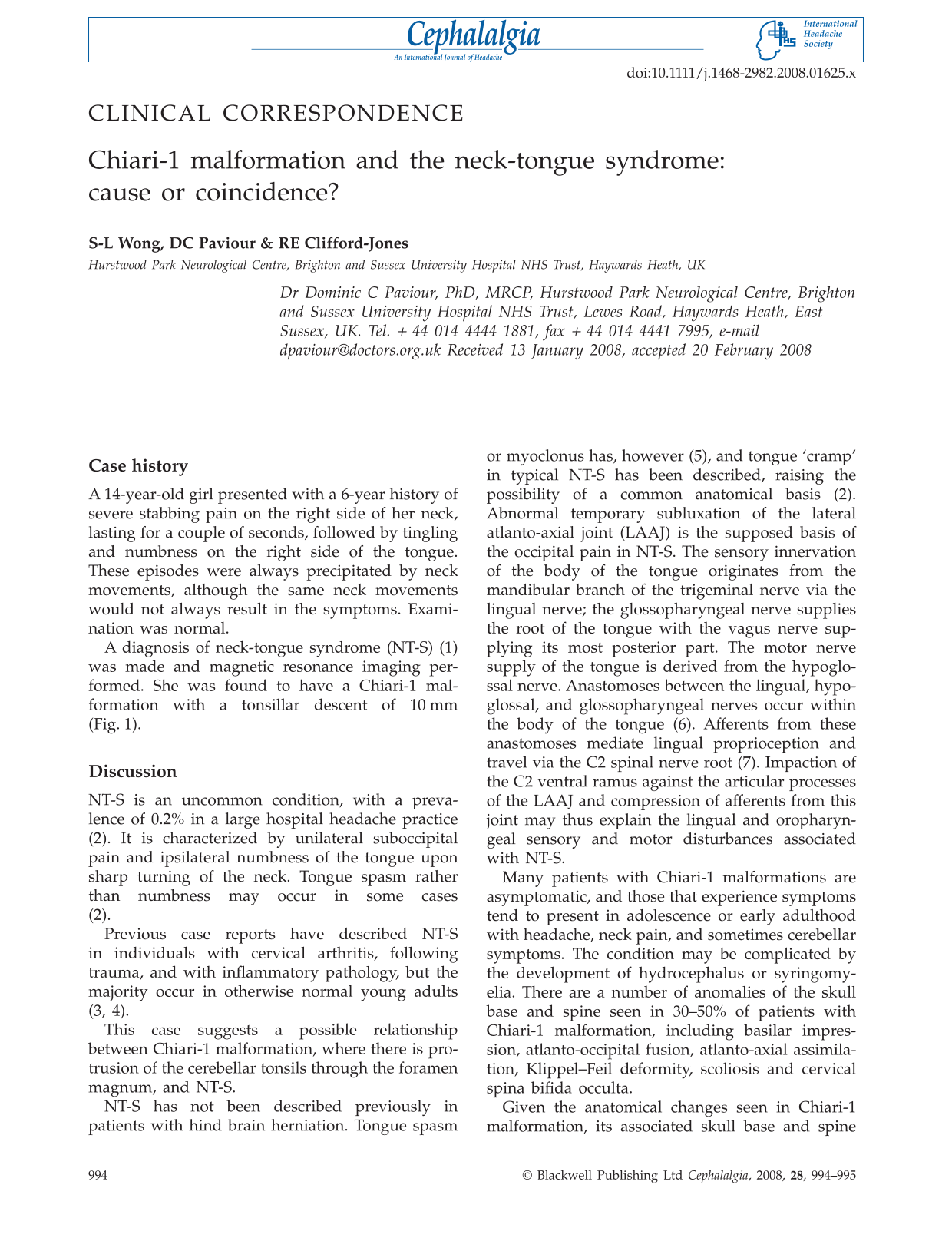
A diagnosis of neck-tongue syndrome (NT-S) (1) was made and magnetic resonance imaging performed. She was found to have a Chiari-1 malformation with a tonsillar descent of 10 mm (Fig. 1).

Sagittal T1-weighted magnetic resonance imaging demonstrating typical appearances of a type-I Arnold Chiari malformation.
Discussion
NT-S is an uncommon condition, with a prevalence of 0.2% in a large hospital headache practice (2). It is characterized by unilateral suboccipital pain and ipsilateral numbness of the tongue upon sharp turning of the neck. Tongue spasm rather than numbness may occur in some cases (2).
Previous case reports have described NT-S in individuals with cervical arthritis, following trauma, and with inflammatory pathology, but the majority occur in otherwise normal young adults (3, 4).
This case suggests a possible relationship between Chiari-1 malformation, where there is protrusion of the cerebellar tonsils through the foramen magnum, and NT-S.
NT-S has not been described previously in patients with hind brain herniation. Tongue spasm or myoclonus has, however (5), and tongue ‘cramp’ in typical NT-S has been described, raising the possibility of a common anatomical basis (2). Abnormal temporary subluxation of the lateral atlanto-axial joint (LAAJ) is the supposed basis of the occipital pain in NT-S. The sensory innervation of the body of the tongue originates from the mandibular branch of the trigeminal nerve via the lingual nerve; the glossopharyngeal nerve supplies the root of the tongue with the vagus nerve supplying its most posterior part. The motor nerve supply of the tongue is derived from the hypoglossal nerve. Anastomoses between the lingual, hypoglossal, and glossopharyngeal nerves occur within the body of the tongue (6). Afferents from these anastomoses mediate lingual proprioception and travel via the C2 spinal nerve root (7). Impaction of the C2 ventral ramus against the articular processes of the LAAJ and compression of afferents from this joint may thus explain the lingual and oropharyngeal sensory and motor disturbances associated with NT-S.
Many patients with Chiari-1 malformations are asymptomatic, and those that experience symptoms tend to present in adolescence or early adulthood with headache, neck pain, and sometimes cerebellar symptoms. The condition may be complicated by the development of hydrocephalus or syringomyelia. There are a number of anomalies of the skull base and spine seen in 30–50% of patients with Chiari-1 malformation, including basilar impression, atlanto-occipital fusion, atlanto-axial assimilation, Klippel–Feil deformity, scoliosis and cervical spina bifida occulta.
Given the anatomical changes seen in Chiari-1 malformation, its associated skull base and spine anomalies and the hypothesized aetiology of NT-S, a causal association between Chiari-1 malformation and NT-S seems probable, and increased frequency of NT-S in hind brain hernia conditions might be expected.
Footnotes
Competing interests
None to declare.