





Abstract
We have read with interest the report of Obermann et al. regarding symptomatic migraine in a patient with a pontine vascular malformation (1). Recently, we had the opportunity to treat a patient with a similar disorder, who may further support the speculations of the authors.
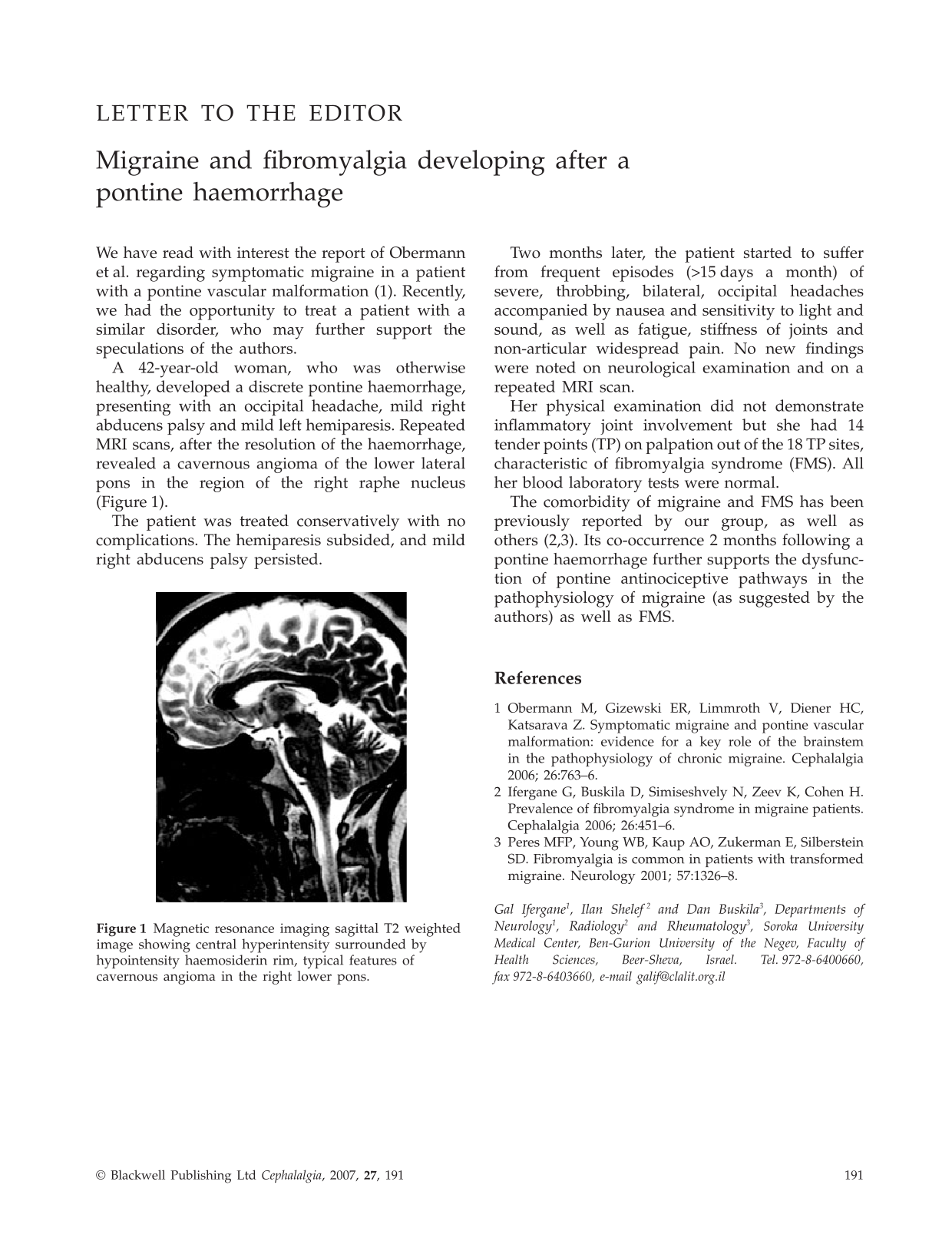
A 42-year-old woman, who was otherwise healthy, developed a discrete pontine haemorrhage, presenting with an occipital headache, mild right abducens palsy and mild left hemiparesis. Repeated MRI scans, after the resolution of the haemorrhage, revealed a cavernous angioma of the lower lateral pons in the region of the right raphe nucleus (Figure 1).

Magnetic resonance imaging sagittal T2 weighted image showing central hyperintensity surrounded by hypointensity haemosiderin rim, typical features of cavernous angioma in the right lower pons.
The patient was treated conservatively with no complications. The hemiparesis subsided, and mild right abducens palsy persisted.
Two months later, the patient started to suffer from frequent episodes (>15 days a month) of severe, throbbing, bilateral, occipital headaches accompanied by nausea and sensitivity to light and sound, as well as fatigue, stiffness of joints and non-articular widespread pain. No new findings were noted on neurological examination and on a repeated MRI scan.
Her physical examination did not demonstrate inflammatory joint involvement but she had 14 tender points (TP) on palpation out of the 18 TP sites, characteristic of fibromyalgia syndrome (FMS). All her blood laboratory tests were normal.
The comorbidity of migraine and FMS has been previously reported by our group, as well as others (2,3). Its co-occurrence 2 months following a pontine haemorrhage further supports the dysfunction of pontine antinociceptive pathways in the pathophysiology of migraine (as suggested by the authors) as well as FMS.