




Abstract
Pool is a cue game played over a green baize table. In order to achieve stability for accurate shooting, pool players adopt a characteristic stance. This entails flexion at the waist with legs spread wide, flexion of the cue arm with extension of the shoulder, extension of the other arm close to the ball and extension at the neck in a ‘sniffing the air’ position to allow the player to fix his eye on the ball and the target pocket (Fig. 1). Although a game of pool does not usually last more than half an hour, pool players often spend hours practising to hone their craft.
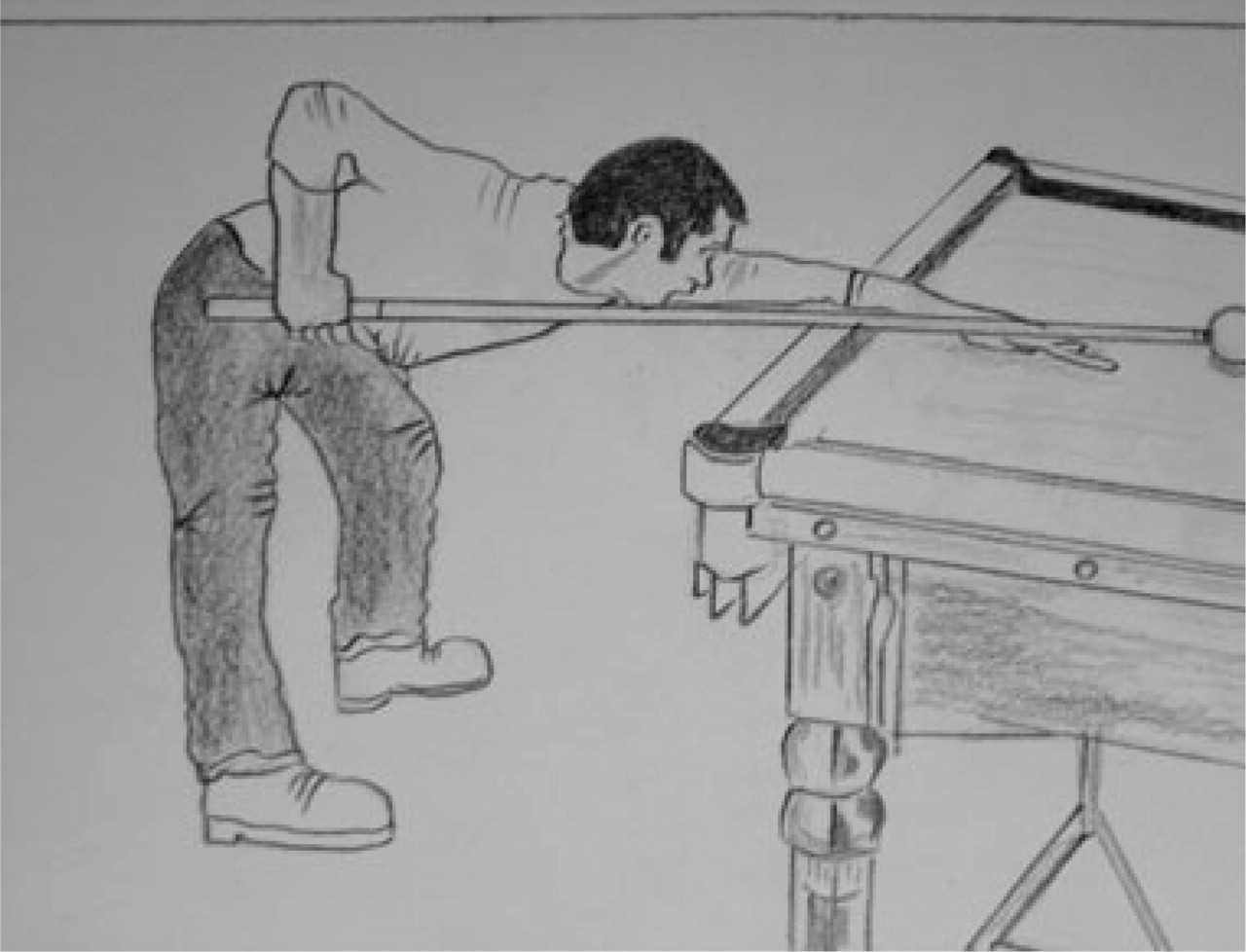
The ‘Sniffing the air’ position adopted when shooting pool (drawn by the author, ECHL).
Case report
Over the past 3 years, we have seen 2 patients, both young men under the age of 35, who complained of bilateral occipital headaches lasting from three to six hours, always preceded by bilateral neck ache and ‘stiffness’, usually occurring either at the end of a prolonged (at least three to four hours long) session shooting pool, or a few hours after. The neck pain was likened to stiffness, but the patients did not describe limitation in range of motion. The headaches were rated at between 6 and 7 on a pain scale of 1–10, and did not interrupt sleep, but usually curtailed their pool playing. They each complained of between 10 and 20 attacks per year. The first patient noted the headaches 3 years previously, a few months after he started playing the game. The second patient started having headaches 1 years prior to consultation. He had been shooting pool for 2 years, but had begun practising in earnest six months before headache onset. They did not have headaches otherwise, and retrospectively noted that they did not have headaches if they played games lasting less than an hour. Periods of abstinence from playing pool corresponded with absence of headaches. These headaches were not associated with nausea, vomiting, scintillations or fortification spectra. Neither patient noted photo- or phonophobia, and there were no complaints of brachialgia, paraesthesia or weakness. Clinical examination, carried out in both patients at each of 3–4 consultations, was unremarkable in both, and neither patient had cervical myofascial tender spots. Neither patient was examined during a headache episode. They were provisionally diagnosed to have cervicogenic headaches. They were prescribed topical and oral analgesics as needed, prior to the association made with their pool playing activities. Both patients reported that the medications ameliorated the pain. Computed tomographic and magnetic resonance scans of the brain did not reveal any abnormalities. Cervical radiographs did not reveal any bony abnormalities.
The patients, told of the possible association, modified their stances when shooting pool, and took care to limit the duration spent at the table. This resulted in abolition of their headaches.
Discussion
Cervicogenic headaches (CEH) were previously called cervical headaches, and refer to headaches arising from the neck (1). They characteristically occur in female patients, are of moderate intensity and are associated with symptoms and signs linking it to the neck (2). Headaches due to cervical pathology have long been described in the literature (3), but have only recently been recognized as a distinct entity (4). Our patients had headaches which best fit CEH (5), satisfying the major criterion of ‘precipitation of head pain … by neck movement and/or sustained awkward head positioning’, but was atypical for the absence of precipitation of pain by external pressure over the cervical or occipital region, brachialgia and limitations in range of motion of the neck. These are not obligatory for the diagnosis, however (6). CEH is typically unilateral, but can be bilateral, although bilateral headaches can be confused with tension-type headaches (6). The association with long hours spent shooting pool made us think of prolonged pool playing as a possible aetiological factor. We did not perform diagnostic anaesthetic blockades (6) to confirm the diagnosis, as a definite trigger was identified, and alterations in their posture when shooting pool brought about freedom from attacks.
The young age of our patients and the absence of radiographic abnormalities did not exclude a diagnosis of CEH. Ormos reported CEH in children and adolescents (7), and in Antonaci's evaluation of the diagnostic criteria of CEH, 49.1% of their 132 patients had normal cervical radiographs (2).
A search of existing literature failed to identify similar patients, except for a sailor with headaches when he bent over to play pool, who subsequently died from a ruptured basilar artery aneurysm (8).
It is likely that our pool players developed headaches due to the vertebral and soft tissue strain from prolonged neck hyperextension as a result of adopting the ‘right posture’. Sjaastad & Bakketeig (9) reported similar headaches in tractor drivers, who developed neck- and head-aches as a result of rotation of the neck during tractor work. As in pool players’ headache, the tractor drivers did not have headache without neck-ache. Also, there was prolonged neck strain with abnormal posture which precipitated the headaches.
We suggest that a history of pool playing or other activities that entail neck strain for prolonged periods be looked for when evaluating patients with cervicogenic headaches.