






Abstract
Recent research suggests that women can use living apart together (LAT) for a reflexive and strategic undoing of the gendered norms of cohabitation. In this article we examine this assertion empirically, using a representative survey from Britain in 2011 and follow-up interviews. First, we find little gender differentiation in practices, expectations, or attitudes about LAT, or reasons for LAT. This does not fit in with ideas of undoing gender. Secondly, in examining how women talk about LAT in relation to gender, we distinguish three groups of ‘constrained’, ‘strategic’ and ‘vulnerable’ female interviewees. All valued the extra space and time that LAT could bring, many welcomed some release from traditional divisions of labour, and some were glad to escape unpleasant situations created by partnership with men. However, for the constrained and vulnerable groups LAT was second best, and any relaxation of gendered norms was seen as incidental and inconsequential to their major aim, or ideal, of the ‘proper family’ with cohabitation and marriage. Rather, their agency in achieving this was limited by more powerful agents, or was a reaction to perceived vulnerability. While the strategic group showed more purposeful behaviour in avoiding male authority, agency remained relational and bonded. Overall we find that women, at least in Britain, seldom use LAT to purposefully or reflexively undo gender. Equally, LAT sometimes involves a reaffirmation of gendered norms. LAT is a multi-faceted adaption to circumstances where new autonomies can at the same time incorporate old subordinations, and new arrangements can herald conventional family forms.
Introduction: LAT, gender and agency
In a 2011 survey 9 per cent of British adults were living apart together (LAT) – that is, the relationship form where intimate partners live at different addresses. 1 This equates to 22 per cent of all those not married or cohabiting. That people living apart together constitute a sizeable minority is not so surprising (although this is largely unrecognized in official statistics or administration) – for similar figures are found in other recent surveys in Britain, Western Europe and North America. 2 But what is surprising is that there was little gender differentiation in either the national survey or in interview accounts of why people lived apart (Duncan et al., 2013, 2014). While there were significant differences according to age, and some difference (but not much) by class, men and women who lived apart together seemed to share characteristics, attitudes, understandings and behaviour.
This is surprising not just on a priori grounds, where we would expect gendering of social behaviour, but also on conceptual and theoretical grounds. For it is women, according to theorists like Anthony Giddens and Ulrich Beck, who are at the forefront of individualizing and democratizing practices within families. Women have most to gain from the decline in traditional structures, not least the weakening of the ‘traditional’ family, while modern economic, social and legislative changes allow them to realize these benefits more easily. Women are also seen as more capable in the newly required skills of reflexive interaction and emotional negotiation. Given all this, we might expect that daily living arrangements would also change – and LAT would be a perfect vehicle for completing this new autonomy. What is more, given all the gendered transformations in modern societies, LAT is now available for most women. As Jamieson and Simpson put it:
Rather than seeing women as displaying the same selfishness as men, women, as the more skilled practitioners of self-disclosing intimacy, play the leading role in this process … Living-apart-together, an arrangement in which couples maintain long-term relationships without pooling resources or jointly conducting domestic affairs in co-residence, is perfectly consistent with Giddens' vision of ‘pure relationship’ and conducting democratic personal lives. (2013: 19)
While Jamieson and Simpson find little evidence of such behaviour in practice, this idealized view of LAT remains influential. Indeed, some recent articles have started from exactly this premise: women often live apart together rather than cohabit with a male partner because they are ‘more modern’ in ‘emphasizing individualism, personal autonomy, gender equality, and detachment from traditional family roles’ (Geirveld and Merz, 2013: 1100, 1099). While keeping intimacy, women may use LAT to escape unequal gender divisions of labour, to avoid male controlling behaviour and more generally to resist powerful patriarchal structures (Upton-Davis, 2012). Thus, LAT, for those women who have chosen it, ‘is a political act that subverts and transforms the gendered norms of cohabitation’ (Upton-Davis, 2013: 1 online). Or as Evertsson and Nyman speculate: ‘Perhaps LAT relationships provide the opportunity for a reflexive and strategic undoing of gender in which taken-for-granted patterns regarding couplehood are undermined and destabilised’ (2013: 75).
In this article we question how far women actually show such ‘reflexive and strategic agency’ in living apart together, and how far they may ‘subvert’ gendered norms, or undo gender, in so doing. We frame this empirical question about ‘what is’, rather than speculating about ‘what ought to be’, on linked methodological and conceptual grounds. Methodologically, commentators have often based general conclusions on small, selective samples. Evertsson and Nyman (2013) draw inferences from interviews with one older woman who lived apart, and 11 single women who were asked to reflect on the idea of living apart. Upton-Davis (2013) uses a somewhat larger sample of 20 women, but purposively restricts her sample to those over 45 who had chosen to live apart from their partners – a group thought particularly likely to ‘subvert’ gendered norms. Both samples were mostly self-selected through media advertisement, and hence interviewees presumably wanted and were able to communicate about their experiences. Not surprisingly, most were well educated and resourced, and positive about LAT. Such particular groups may be interesting and important in themselves, but cannot represent either the diversity or the generality of women living apart together. 3
This methodological selectivity is compounded by conceptual selectivity, for individualization theorists generally adopt a one-sided view of agency as dominantly individual, purposive and conscious where action reflects ‘choice’. Reflexivity is assumed as inherent to agency. This emphasis neglects habitual action, which is often unexamined and non-discursive, while also forgetting that agency is often relational with other individuals and collective agents. It is also usually deeply emotional (Holmes, 2004, 2010; Burkitt, 2012; Pham, 2013). Action may well be constrained, unsuccessful and sometimes ‘unchosen’, even coerced (Madhok et al., 2013). Rather than expressing agency, individuals may end up with ‘patiency’ ‘– having actions done to them (Reader, 2007). Reflexivity is only one possible facet of agency, and often this may be only weakly developed, if at all. All this has implications for how we think about LAT. Thus we might expect that actions about LAT will be relational, in that commitment and connection to a partner is a central element (Holmes, 2004; Carter et al., 2014). Similarly, such actions are likely to be emotionally charged, as they concern intimacy with another as part of daily life. At the same time these intimacies will often become habitual, and may well remain unexamined and unreflective. In addition, agency in LAT will be constrained, not just because of possible imbalances of power with ‘external’ institutions like employers or housing finance providers, but also because of these intimate and emotional ties with partners.
Furthermore, theorists often neglect how agency is practically achieved. The notion of ‘agency’ remains abstract, and the actual ‘doing’ remains less explored. For agents rarely set out with some completely new, logical, and reflexive plan of action or, if they do, such a plan has to be rapidly adapted to circumstances, resources and available ideas of what is possible. Hence, agents act through a pragmatic process of bricolage which is only partially discursive and reflective, and often draws on pre-existing practices and ideas. In so doing they often refer to, adapt, and re-serve ‘tradition’ even as they create something new. Nor is successful adaption guaranteed, for this requires social acceptance and legitimation when other, more powerful, agents may hold different intentions. Tradition then becomes valuable in legitimizing any new departure (Cleaver, 2012; Duncan, 2011). This is likely to be especially acute for understandings of LAT, for ideas around the romantic, exclusive couple and the ideal of marriage seem hegemonic (Carter, 2013). Similarly, empirical studies, both in Britain and in other countries, show that most people who live apart together see cohabitation as a goal or longer-term ideal (eg Holmes, 2004; Haskey and Lewis, 2006; Régnier-Loilier et al., 2009; Liefbroer et al., 2012; Jamieson and Simpson, 2013). For all these reasons we might expect that many women end up in LAT, rather than positively choose it. At the same time many women who live apart from a male partner might well hold an unreflective, taken-for-granted commitment to traditional coupledom, with cohabitation and even marriage, as aims, desires or ideals. Indeed this is what we found in earlier work on why people live apart (Duncan et al., 2013) and on their understandings of commitment to partners (Carter et al., 2014).
Many women had ended up in LAT rather than choosing it because of various barriers to desired cohabitation, and many of those who did ‘choose’ or ‘prefer’ LAT in fact expressed more of a negative preference – they would ideally desire cohabitation and, often, marriage, sometimes with (more) children. However, they felt vulnerable and/or threatened because of past experiences of cohabitation, or the perceived unsuitability of their partner, or the perceived needs of children, and so ended up living apart. This is a different side of agency, reminiscent of the recent study of ‘street children’ in Ghana by Phillip Mizen and Yaw Ofusi-Kudi (2013). For it was the vulnerability of children, rather than their strategic plans or choices, that provided an agentic force capable of moving them to chance life on the streets of Accra. As Andrew Sayer put it ‘concepts of human agency emphasise our capacity to do things, but our vulnerability is as important as our capacities; indeed the sides are clearly related, for vulnerability can prompt us to act or fail to act … (2011: 5, quoted in Mizen and Ofusi-Kudi, 2013: 369). For this reason we pay some particular attention to feelings of vulnerability as expressed by women who live apart together in what follows. Note, however, that reacting to feelings of vulnerability does not mean lack of agency, still less passive ‘vulnerable women’ (the resourcefulness of Accra street children provides a telling corrective). Women who live apart from their partner because they feel vulnerable in cohabitation clearly show practical agency. But this negative preference for LAT does imply a different sort of agency – less strategic and individualistic, more reactive and relational.
In the next section I discuss sources and methods. The third section then describes the apparent lack of gender differentiation in practices, expectations and attitudes about LAT, and in the reasons respondents gave for living apart. The following section goes on to examine in detail how women respondents expressed agency in living apart together in relation to feelings of constraint, autonomy, and vulnerability. I then briefly conclude in a final section.
Methodology
Sources and sampling
I use two linked sources, a statistically representative survey of people in LAT relationships in Britain in 2011, and follow-up interviews with 50 respondents, of whom 29 were women. 4 The interview sample took the national survey as a sampling frame from which respondents were purposively selected according to the reasons for living apart given in their survey responses. This design has the advantage of creating an interview sample that, while not statistically representative, is not limited to a particular type of LAT but instead reflects the range and diversity of LAT in Britain.
The national survey combined data from three statistically representative socio-demographic population surveys. 5 Together these three surveys yielded a total of 572 people in a self-defined LAT relationship. 6 These LAT respondents were asked questions about practices, experiences, motivations and attitudes in relation to living apart. The 50 interviews were semi-structured and conversational, lasting about an hour, and were designed to give insights into the social processes and contexts underlying the patterns found in the survey. The interview sample roughly corresponds with the national survey in terms of reason for LAT, age, gender, ethnicity, sexuality, household type and occupational group (although some categories are over- or under-represented). 7
Analysis
The national survey information was coded for the statistical software package SPSS and analysis proceeded through standard frequency distribution and cross-tabulation. Chi-square testing was used to assess statistical significance of variable associations. The 50 semi-structured interviews were recorded, transcribed and coded using the qualitative software package NVivo. Further analysis of the semi-structured interviews was grounded on a close reading of each interview transcript, identifying respondents' discursive rationalizations of their agency and decisions in living apart from their partner.
We used this interview material in two ways. First, we constructed a graphical representation of the analysis, with qualitative plotting of interviewees' positions on a summary diagram as defined by (1) preference for LAT (the respondent talked about the advantages of, and/or their preference for, living apart) or (2) constraint in LAT (the respondent talked about circumstances preventing desired cohabitation). At the same time we recorded (3) stage statements (plans and ideas about cohabiting, sometimes with marriage and children) and (4) state statements (about how current LAT was seen as a continuing and satisfactory arrangement). In so doing we made overall judgments about each interviewee's responses as relatively ‘strong’ or ‘weak’. Thus, more statements of one category would make that category stronger (and fewer would make it weaker). Similarly, the way interviewees made the statement, or the context in which the statement was made, would affect this ‘strength’ assessment – if, for example, it was hypothetical or prompted (hence weaker). We then used this grid to visually discover and present social clusters and associations in displaying the whole range and variety of the interview sample. 8 We also plotted other social variables on this basic grid, including the gender, class and age of interviewees, the length of their relationship and the presence of dependent children. Secondly, we took individual interviews to illustrate and develop our account of particular situations as revealed by the graph. As discussed in Duncan et al. (2013), this was a basic method for our analysis of why people live apart together.
In this paper we go on to use this basic grid as a starting point for an analysis of vulnerability, autonomy and constraint as related in participants' accounts of living apart together. In particular, we developed a measure of relative vulnerability as expressed by participants if they were to live with a partner – covering physical vulnerability (fears of direct physical harm), financial vulnerability, and emotional vulnerability (often a fear of repeating past unhappiness). We also included those participants expressing what we call ‘obligated preference’ as a reason for LAT; these interviewees felt obliged not to cohabit (even though they would personally like to do so) because of their perception that others in their care – usually children – were emotionally vulnerable.
The strange case of missing gender differentiation
The national survey: practices, expectations and attitudes
Remarkably, very few of the 50 odd survey variables on the practices, experiences and attitudes about LAT show any statistically significant variation by gender. 9 This is in some contrast to the significant variations we found by age, and, much less widely, by class (see Duncan et al., 2014). Nor was there any correlation between age and gender, or reason for LAT and gender. In particular we identified a number of key variables for which, if women were using LAT to undo or subvert gendered norms, we might expect significant differences between men and women. But in fact women are not more likely than men to choose or prefer LAT – even for ‘obligated preference’ reasons connected to care of others. They are just as likely as men to end up in LAT because of financial constraints, because of job or educational location, or because they think the relationship is at an early stage. 10 Similarly, they are just as likely as men to see themselves as part of a couple, and to think they might move in together within 2 years.
Men and women also have similar attitudes about LAT. They are just as likely, or not, to hold positive attitudes about LAT as making them feel ‘more emotionally safe and secure’, as giving ‘more freedom to develop my career’, ‘more freedom to be with my friends and family’, 11 or ‘giving me greater financial independence’. If women were ‘undoing gender’ through LAT, we would expect them to hold these positive attitudes significantly more than men, but this is not the case. Similarly, there is no significant gender difference in negative attitudes about LAT (which we might expect men to hold more). Men and women are just as likely to see LAT as putting ‘our relationship at greater risk of breaking down’, as limiting ‘the extent to which we can have a close relationship’, or ‘making me feel less secure when I think about the future’. This lack of gender differentiation remained even when controlling for age and education; there was no statistically significant difference in attitudes about LAT between men and women over 45 or with higher educational levels. 12
In short, based on this statistically representative evidence, women appear to have no particular gendered relationship to LAT. This does not fit at all well with the idea that women use LAT to subvert gendered norms or heteronormative expectations, or to ‘undo’ gender. The one major difference we found in the survey between men and women if anything reinforces traditional roles – more than twice as many women LATs live with children (33 per cent, compared to just 15 per cent for men).
The semi-structured interviews – understandings of LAT
Surely the interviews would reveal gender differentiation once individual LATs accounted for their situation in more depth and detail. Rather surprisingly, at least at first sight, this was not the case. For our qualitative summary of how interviewees understood why they lived apart also showed little differentiation by gender. Rather, perhaps reassuringly, the qualitative summary matched the survey analysis – see Figure 1. Women and men were more or less just as likely to combine ‘preference’ for LAT with designation of this as a permanent ‘state’ (the ‘won't’ live together section on Figure 1), as they were to see LAT as a response to ‘constraint’ preventing cohabitation with designation of LAT as a temporary ‘stage’ (the ‘can't’ section), or indeed to see LAT as preference with stage (‘not now’). Only for the ‘oughtn't’ section – where people lived apart because of prior obligations to others – did women pre-dominate. As the survey suggests, these were women who lived with children. 13 This perhaps gives us a clue – for these women were LAT because they felt that their children would in some way be vulnerable if they did what they personally wanted, that is lived with their partner. Hence they ‘preferred’ to live apart together for the time being – but planned to cohabit once their child(ren) were older, or had left home.
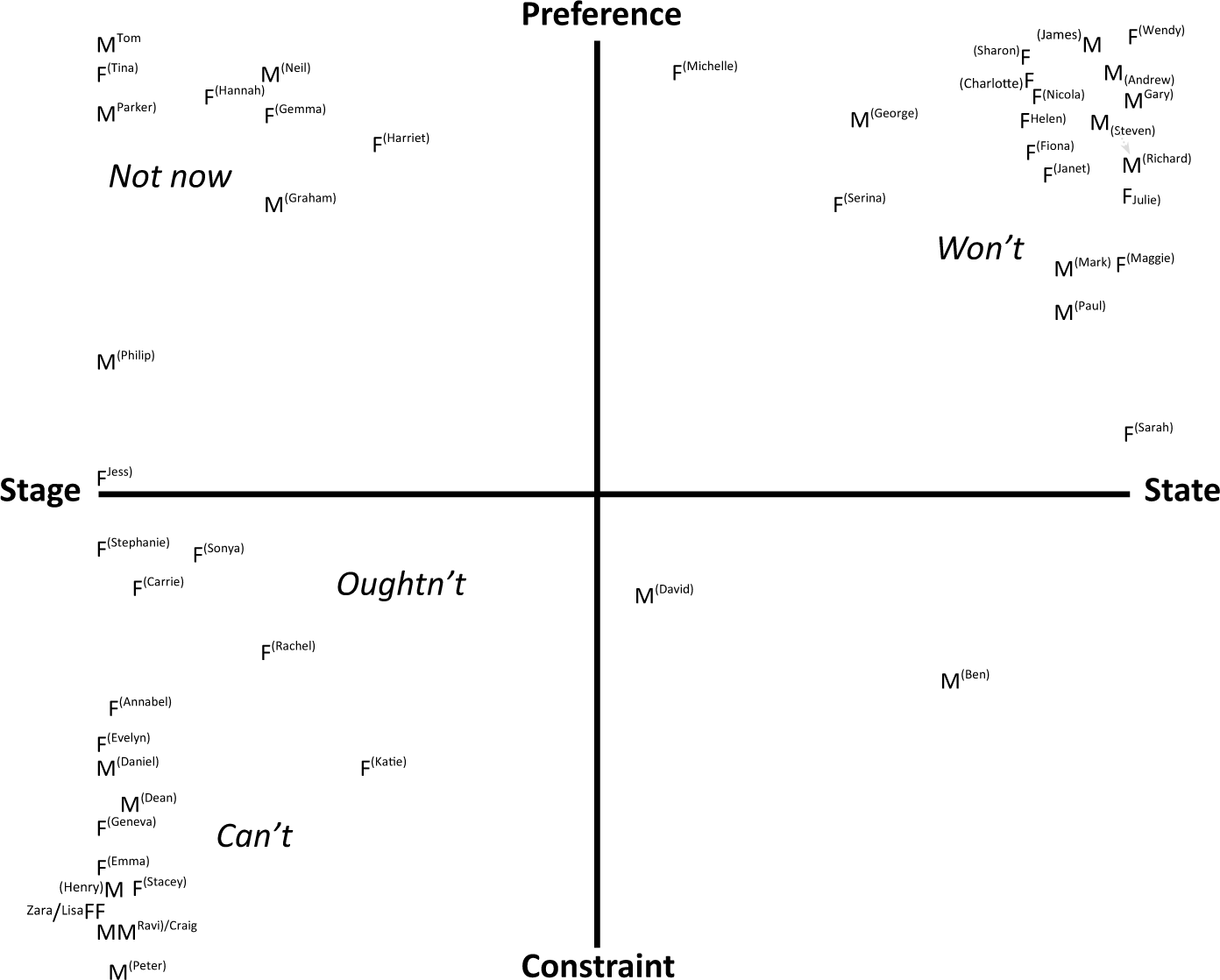
Understanding LAT by sex F = female, M = male
Constraint, strategy, and vulnerability
Figure 2 presents our analysis of women interviewee's agency in living apart together. The horizontal axis shows how far they said they preferred LAT over cohabitation with their partner, or alternatively how far they saw LAT as just a response to constraints of various sorts which prevented cohabitation. (This information is taken from the existing analysis presented in Figure 1.) The vertical axis, however, shows the extent to which interviewees expressed various feelings of vulnerability were they to cohabit. As discussed above, these feelings of vulnerability could refer to anticipated emotional distress with cohabitation, and this was the most common expression of vulnerability, but a few interviewees also expressed fears of financial loss and two feared physical abuse. These could be held in combination and indeed one interviewee, Michelle, strongly conveyed feelings of emotional, financial and physical vulnerability. Usually interviewees pointed to previous distressing experiences as the rationale for their fears around cohabitation, but sometimes (or as well) it was the current partner who provided the problem.
As can be seen from Figure 2, there are three broad groups of interviewee according to this analysis. The most tightly distributed group, with 8 out of the 29 interviewees, we have labelled ‘constrained’; these interviewees expressed few or no feelings of vulnerability concerning cohabitation – indeed they wanted to live together as soon as they could but were currently unable to do so. Conversely, but also with a relative lack of feelings of vulnerability, is a group who preferred to live apart and did not want to cohabit – we have labelled these interviewees ‘strategic’. Another 8 of the 29 interviewees were located in this group, although 3 also showed a degree of constraint. Finally, the third group of 13 interviewees expressed high feelings of vulnerability were they to cohabit (although note that three cases were transitional between this group and the ‘strategic’ group – they expressed both perspectives). These are split into two subgroups in Figure 2 – those who preferred to live apart because they personally felt vulnerable (9 interviewees), and those who expressed ‘obligated preference’ (4 interviewees) – they felt their children would be vulnerable, a feeling which also acted as a constraint on their own preferred behaviour. We will discuss each of these three groups in turn.
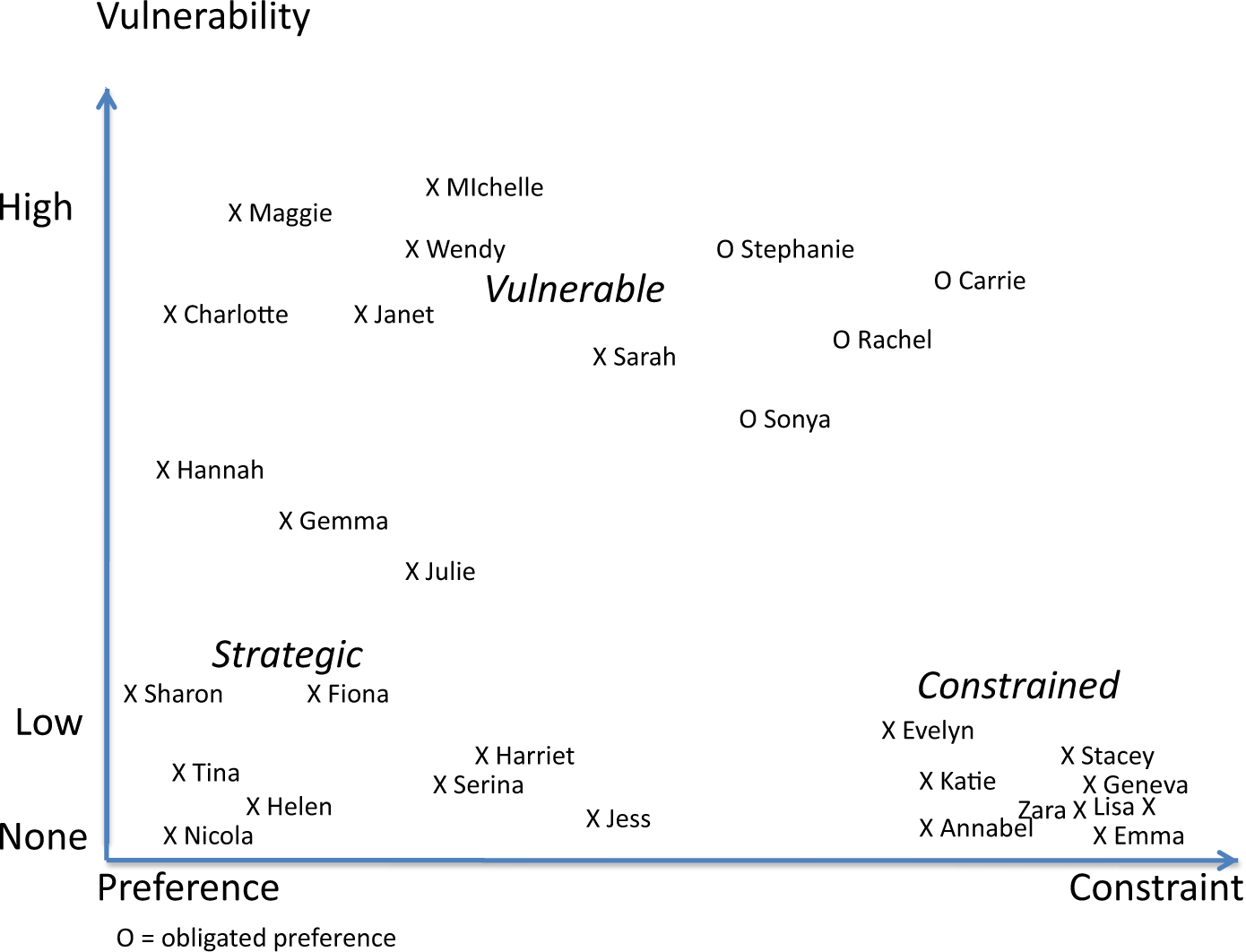
LAT and agency
Constrained
We would not expect much expression of vulnerability in this group, as these interviewees were planning to cohabit as soon as possible – it was just that external constraints stopped them doing so. These constraints were, variously, housing affordability (Annabel), partner's debt agreements (Geneva), job location (Emma and Evelyn, both with partners working abroad, and Stacey whose partner lived in army barracks), family opposition (Katie's partner's family would not allow any formal relationship with a non-Muslim), visa issues (Zara, whose husband remained in Zimbabwe), and incarceration (Lisa's partner was in a bail hostel, subsequent to a prison term).
In other words the agency of these interviewees was constrained by more powerful outsiders and institutions. Their response, the level or degree of agency available in achieving desired cohabitation, was swayed by the imbalance of power each experienced. For example, Geneva and her partner had ‘a mission’ to pay off the debt over the next few years and then live together, while Annabel and her partner planned emigration to New Zealand where housing was cheaper. Other interviewees, with less room for manoeuvre, expressed ‘patiency’ rather than agency. Lisa and Zara had to wait for action by state authorities, while Katie could only carry on resignedly living apart as family opposition to cohabitation – indeed to her recognition at all – remained implacable.
This is not to say these interviewees did not see advantages in LAT. All appreciated the extra space and time that LAT afforded (this was a refrain for virtually all interviewees, including men). For example, Geneva liked ‘the bed to herself’, and Emma (and her partner) ‘really like our own space [and] a bit of time on our own’. This feeling sometimes extended further to an appreciation of gender autonomy from male authority in general and traditional divisions of labour in particular. Thus Geneva could:
leave for work in the morning, usually my house is in a reasonable, clean, tidy state. And I know it's that way when I come back. But with men around, it's not that way. Is it? You know, you'll come back to a pile of washing up and the bed unmade, and that irritates the life out of me.
Similarly for Katie:
the way he's been brought up the women – the woman does everything … it's like having two children. So I do like the days that I know he's not coming.
Evelyn, whose husband couldn't find work at home and was employed abroad, went further. LAT allowed her to reclaim her identity as an individual – ‘now I do things … and you can think about yourself’. Similarly Zara contrasted her freedom living apart with her subordinated married life:
us as Africans, we're supposed to be under men. For right now, I can just phone and say I've done this or sometimes I just don't tell him. He doesn't see … I make my decisions … if I go to Africa I'll be told I have to dress this, this, this, this, this is what I want.
Lisa pulled all these strands together:
if there is a benefit [from living apart] it's still that you've still got your own space, you know I still can get up in the morning and walk around with my make-up half-way down my face.
Furthermore she was able to ‘see my friends or my family or do whatever I want’.
But this appreciation of the autonomy offered by LAT was seen as just an incidental, temporary, benefit. For example, Lisa's partner was to move in on his release from bail hostel and then they would find a house together, following which she would ‘love to be married to him and obviously have another baby’. Zara's ideal situation would be to have her husband at home, despite all her current freedoms – she would just ‘have to be strong and wait until we stay together’. Nor was LAT seen as some alternative family form. For example, after ‘a year or two’ Emma looked to ‘the normal path’ – ‘setting up base somewhere and having kids … a home where we both lived’. Similarly Geneva didn't just want cohabitation and marriage, more than that she longed for ‘just being considered a family … the official family unit’. LAT was simply abnormal:
I don't think it [LAT] would work long term. I don't understand it. Don't get it. I d- I don't. But because human beings are supposed to be together, aren't they? Natural – it's a natural kind of biological thing isn't it?
Far from using LAT for subverting or undoing gender, these ‘constrained’ interviewees wanted to move into traditional coupledom as soon as circumstances allowed. Indeed, joint living in a family home was idealized as the proper vehicle for complete connectedness to both partners and children. Their agency in achieving this desired goal was limited and sometimes became patiency. It remains a moot point, however, whether their autonomous experiences in living apart would colour the reality of future gendered coupledom.
Strategic
Like nearly all other interviewees, the ‘strategic’ group valued ‘peace and quiet’ (Sharon) and ‘space and freedom’ (Julie). They also appreciated release from gendered divisions of labour – not ‘running around tidying up after him’ (Julie), ‘his stuff everywhere’ … ‘he can just sort of slob about [at his house]’ (Fiona), ‘he will be a bit old school “I'm tired, can you make me dinner”’ (Serina). Helen envisaged always recycling ‘his newspapers’ and having to endure constant football on the TV.
But more than this, these interviewees particularly valued individual autonomy and freedom from male authority. So Nicola could ‘do what you want, when you want, you don't have to ask’ while Fiona didn't ‘have to tell him anything, I can just decide’. Helen got ‘annoyed after about ten days [when her long distance partner visited] and thought ‘right, I've had enough now … I can't do this anymore … I'm used to having things done my way’. Some articulated this individual freedom directly, Serina could ‘feel more like you're your own person’ in living apart while Harriet could ‘feel more of an individual’ where she was ‘not tied to this unit thing’.
Like the constrained group, levels of felt vulnerability if they were to cohabit were low (however, note in Figure 2 a transitional group, of three interviewees, who did express feelings of vulnerability). But unlike the constrained group, most of these interviewees could have quite easily moved together had they wished to do so – although a few would experience some difficulties such as housing affordability (Harriet) or family opposition (Serina). Rather, they were able to exercise relatively unconstrained and purposeful agency in living apart together so as to both retain individual autonomy and maintain connectedness. As both Helen and Fiona pithily stated, they were able to ‘get their cake and eat it’. In this way these interviewees strategically used LAT to subvert conventional gendered norms, or as Gemma put it ‘I kind of hold the reins of power … It's kind of him singing to my tune’.
Nonetheless, this relatively strategic agency was not untrammelled. First, agency was bounded through relational bonds with partners. Helen assessed herself as ‘really selfish’ in valuing her autonomy, while Gemma (who also expressed strong fears of financial vulnerability) thought she sounded ‘awful’ and ‘horrible’. This apparent guilt was perhaps why some interviewees seemed to compensate by carrying out traditionally gendered domestic work for their partners. Thus despite holding ‘the reins of power’, Gemma did her partner's clothes washing and cooking, while Nicola even went to her partner's house to do cleaning, washing, ironing and cooking – in this way appearing like the traditional unpaid housewife. Secondly, agency was bounded by the availability of ideas about family and relationships, so in making their new arrangements interviewees usually referred to the model of the conventional couple, and in this way tradition also smuggled back. Thus Harriet was ‘obviously working up to living together again … we dream about being able to get a bigger house’ in which it would be ‘quite cool to be married’. Serina would get married and have a child ‘for cultural reasons, that's what my parents would accept and it's quite nice anyway’, while Fiona admitted to liking the ‘idea of traditional marriage … when you get older’, for she was worried by the question ‘who will look after me if I'm ill’. Circumstances could also change; Jess was newly pregnant, so (if she kept the baby) she would have to give up her job, move in together and get married – although they would probably do this anyway in a year or two. Gemma, also pregnant, was beginning to consider cohabitation ‘for the help and emotional support’. This is not any simple subversion or undoing of gender, but a more complex development where new autonomies can at the same time incorporate old subordinations, and new arrangements can herald conventional family forms. This is ‘bonded agency’, as Pham (2013) calls it – interviewees negotiated the conditions of bondedness from within, not beyond, their relational ties with their partners and hegemonic ideas about family.
Vulnerable
As always, this group of interviewees valued the extra space and autonomy LAT provided them. For Stephanie, LAT meant ‘you can have your own space and do what you want’, and Rachel didn't ‘need to rely on [partner] for anything’. Several mentioned the benefit of not living with ‘messy’ men. Wendy put summed this up well:
I have the best of both worlds, I do have a relationship but … I can do my own thing.
Nonetheless, as with the ‘constrained’ group, these benefits appeared more as pleasant by-products where LAT remained second best after cohabitation and, often, marriage. Michelle, for example ‘would love to live with him and have a perfect family’. Cohabitation was ‘the next step’, she thought ‘the whole moving in and being a proper family … is the future really … maybe we will get married and have more kids’. For Hannah living together was the way to ‘become a couple’, or as Sonya put it she would move together in the next year or so, maybe marry, have more children and thus ‘have this family feel’. For others, cohabitation and the proper family this brought remained an ideal; marriage was ‘a lovely thought but impractical’ for Wendy, while for Maggie ‘in an ideal world I would live with my partner and be married to him … but “I've reconciled to the fact that it's not going to happen” … so the next best thing is what we've got’.
In fact these interviewees could move together fairly easily in the relative absence of external constraints like housing costs. So why didn't they do what they wanted and establish their ideal of a ‘proper family’ with cohabitation and marriage? As Figure 2 suggests, this was because they felt high levels of vulnerability were they to do this. These feelings of vulnerability, as mentioned above, were often discussed in terms of emotional distress but could also reflect financial worries or physical fear. There were three major origins to these feelings; most common was previous bad experiences of cohabitation, but problems with the current partner, or the perceived vulnerability of dependent children (‘obligated preference’) were also important to some. Some interviewees expressed a combination of types and origins of vulnerability. In these ways vulnerability is not some inherent, individual, characteristic, but is itself relational (Roseneil, 2014).
The four ‘obligated preference’ interviewees in Figure 2 were able to limit the time frame of their children's vulnerability – for children could grow older and leave home, or come to accept or even appreciate the partner. In some senses this was like an external constraint which could lessen, and indeed these interviewees anticipated cohabitation in one or two years (Rachel had a less certain time frame for this ‘ideal world’ due to her son's disability). Agency in cohabiting was relationally constrained, and living apart together was partly reactive and patient. However, this future move could still be jeopardized by their own vulnerability, Stephanie was ‘just scared of rushing into something and then it all going wrong again’ while Rachel and her partner had ‘both been divorced and you know we don't want the drama, it's just we just have a nice quiet easy life now’.
This fear of repeating a past unhappy experience of cohabitation was a common response for the other ‘vulnerable’ interviewees. Maggie's ex-husband had ‘cheated, lied, all that sort of thing’, while Janet had
been married and divorced three times before. That's the main reason I don't want to get married again.
Financial worries could also play a part, neither Maggie nor Sarah would countenance cohabitation without marriage when this might leave them homeless, and Charlotte had ended a previous relationship ‘with literally nothing … I lost everything’. Fear of physical abuse was an added component for Michelle, she had:
kind of learnt from my lessons and … I don't want to lose everything in my house, I don't want to be possessed, I don't, and I don't want to be beaten up [small laugh], by someone who's meant to love me.
Not surprisingly, she had ‘built a very solid brick wall, and it takes a long time to knock that down’.
Often these fears were reinforced by worries concerning the current partner. Maggie was repelled by her partner's ‘hardcore’ green lifestyle – his lack of washing, no central heating (which she needed for medical reasons) and sporadic toilet flushing. She also thought her partner looked down on her as ill-educated and intellectually inferior, when ‘from his point of view he might get tired of me’. Wendy had lived with her LAT partner for a year but:
when he drinks he's not a nice person … He was both abusive to me and my son so that's when we decided – well I decided that was it.
Janet's partner also had an alcohol problem, but she:
gave him an ultimatum, not to stop drinking, but not to turn up to see me with drink on him and he stopped it … And he only drinks now on a Thursday Friday night.
Given these fears, worries and aversions, then why stay with their partners at all, especially as LAT was seen as second best? The answer is interviewees' desire for connectedness, often expressed in terms of love. As Wendy said:
I mean I do love him, yeah, but um he is awkward to live with but I don't know what I'd do without him … I would love to be with him, if he was the person that he is when he's not drinking because he is the most kindest, he treats me brilliant in every way.
Despite her aversions to her partner and his lifestyle, Maggie did ‘really love [partner]. I love him and I like him. Not everything about him but I do like him enough’, consequently they had ‘set up an agreement’ whereby:
if I do your cooking and your washing and ironing can you take me out once a month and pay for me.
Too much love might even be dangerous, Charlotte didn't ‘want to lose him, so he's not moving in basically’, and Hannah used LAT in
keeping him at arm's length, you know, I'm trying not to get too close ‘cause my heart's trying to be sensible, and you know, not, you know, fall in love too deeply.
Michelle had ‘a good relationship’ with her LAT partner, also father of her son, but as we have seen maintained a protective ‘brick wall’ against cohabitation. However, while she might be better protected, she still worried that her son's connectedness with his father was at stake:
I think it would be nice to get Daddy a bit more in his life. ‘Cause I don't really want to get to the point where he asks me, ‘Why doesn't Daddy live with us?’
Nonetheless:
I fight myself back, I try not to let myself. I think it's, as soon as you start giving your feelings and, you're able to get hurt.
Janet had worked out one creative answer to this conundrum, she was:
getting engaged next year … But it's quite a modern way of doing it because we're getting engaged not to be married, it's more of a commitment.
For these ‘vulnerable’ interviewees, then, LAT was not just a means of avoiding fears of distress and harm, but also a means of maintaining connectedness and intimacy in unfavourable circumstances. This was usually second best to the ideal way – cohabitation and marriage – but nonetheless remained the best available. In her path-breaking study Irene Levin (2004) interpreted LAT as a ‘both/ and’ settlement – it delivered both intimacy and autonomy. For these ‘vulnerable’ interviewees we can reformulate this ‘both/and’ as both intimacy and protection. While LAT allows the avoidance of some unpleasant sides to gendered norms of cohabitation, it does not replace cohabitation as a goal and an ideal. Agency in choosing LAT for these interviewees was both relationally bonded to their partners and, at the same time, reactive to perceived vulnerability to their partners or to partnership more generally.
Conclusions
We began this article by questioning the suggestion in recent research that women reflexively and strategically used LAT to subvert and undo gender. Initially we found that, using a representative national survey for Britain in 2011, there was no significant gender differentiation in the practices, experiences and expectations about LAT, or in the reasons for LAT. Furthermore, pre-existing interview analysis of understandings of LAT also showed no gender differences, except for the traditional situation where women are more likely to live with dependent children. None of this evidence chimes well with the idea that women use LAT to subvert or undo gender norms.
We went on to carry out a more in-depth analysis of 29 women interviewees with a range of social backgrounds and reasons for LAT. Nearly all the interviewees appreciated the extra personal space and time that LAT provided, although this was the same for men. More significantly, many of the interviewees enjoyed a relative autonomy from traditional divisions of labour and male authority. However, for the ‘constrained’ and ‘vulnerable’ groups this relaxation in gendered norms was more in the nature of an incidental, if pleasant, by-product. For LAT remained second best in comparison to the ‘proper family’ of cohabitation and marriage and, for some, children. The constrained group saw LAT as a hopefully temporary interruption to this more complete intimacy.(Although it remains a moot point how far their experiences of the relative autonomy of LAT might then conflict with the future reality of the traditional family.) The vulnerable group feared this ideal in practice, but found that LAT could offer a good-enough combination of protection and intimacy. For despite these fears, it was most important to retain and further connectedness with their partner, often expressed as love. The ‘strategic’ group appeared more purposeful in undoing gendered norms through LAT, in that they were particularly concerned with autonomy from male authority and partners' demands. However, this ‘undoing’ was compromised by their relational ties with partners. Some expressed guilt over their ‘selfish’ actions, and some elected to carry out traditional labour services for their partners, almost as a sort of compensation or symbol (as did some women in the other two groups). ‘Undoing gender’ was also limited in practice through the availability of ideas about family and relationships. Like both the ‘constrained’ and ‘vulnerable’ groups, these interviewees interpreted LAT, and what might develop in the future, in terms of the conventional cohabiting couple and marriage. Interviewees did not express ideas around alternative family or relationship forms, but referred to and adapted from pre-existing tradition.
In undertaking this analysis we distinguished three emphases in interviewees' agency in living apart together. For the constrained group agency in achieving a desired cohabitation was limited by more powerful outsiders or institutions, and their effective agency – or for some their patiency – depended on the nature and level of the resulting imbalance of power. Interviewees in the strategic group exercised more purposeful agency in living apart from their partner so as to maintain relative independence. However, this agency was not simply individual choice, but was bonded through relational ties with partners and evaluated through the lens of the conventional family. Finally was the ‘vulnerable’ group. For these interviewees agency in choosing LAT was both relationally bonded to their partners and, at the same time, reactive to perceived vulnerability to their partners or to partnership more generally. LAT was more a reaction to their vulnerability rather than an outcome of their capacity.
On the whole we find that women, at least in Britain, seldom use LAT to purposefully or reflexively subvert or undo gender. Overall, women and men have a similar range of expectations and attitudes around LAT, and practise living apart in similar ways. Sometimes gendered norms of cohabitation are avoided or relaxed – women enjoy sidestepping traditional divisions of labour, and some are glad to escape possible unpleasant situations created by partnership with men. In this sense many women who LAT are undoing gendered norms in their current daily life, although usually in an incidental, non-strategic and non-reflexive manner. The ‘strategic group’ did place emphasis on LAT as a means of avoiding male authority, but this more purposeful behaviour remained compromised and bounded both ideologically and relationally. At the same time, however, many women – especially those in the ‘constrained’ and ‘vulnerable’ groups – see any gendered benefits of LAT as inconsequential and/or temporary, where the more complete intimacy of the ‘proper family’ should be reaffirmed through cohabitation and marriage. Furthermore, some women who LAT ‘redo’ gendered norms through their everyday practice. LAT is a multi-faceted adaption to circumstances where new autonomies can at the same time incorporate old subordinations, and new arrangements can herald conventional family forms. Similarly, the example of LAT shows well how agency is in practice variable and differentiated in various social contexts and with diverse types of agent. Women's agency in living apart together was variably constrained and relational, bonded and emotional, and habitually traditional, as well as purposeful and reflexive.
Footnotes
Acknowledgements
Thanks to my co-researchers Julia Carter, Miranda Phillips, Sasha Roseneil and Mariya Stoilova for their help, encouragement and advice. Julia Carter and Mariya Stoilova carried out the interviews, and Miranda Phillips organized the national survey. Thanks to Mansour Pourmehdi for help with SPSS. Thanks also to the Economic and Social Research Council (ESRC) for financial support, grant number RES-062-23-2213.

2
3
The category ‘women over45 who mentioned any preference for LAT’ accounted for just 8 per cent of LATs in Britain in our 2011 survey (or 16 per cent of female LATs). Restricting this category to those who gave preference as a major reason for LAT, and who possessed a high educational level, would diminish these figures even further.
4
We also took a ‘psychosocial’ sample from the survey, of 16 different respondents, with whom we carried out in-depth biographical narrative interviews (not used in this article). Both the survey data and interview transcripts are available from the UK Data Archive.
5
The National Centre for Social Research (NatCen) Omnibus, the British Social Attitudes (BSA) Survey and the Office for National Statistics (ONS) Omnibus. Britain includes England, Scotland and Wales.
6
Living apart together was self-defined in response to the interviewer question (addressed to all who were not married, in a civil partnership or cohabiting):‘Are you currently in a relationship with someone you are not living with here?’ In two of the surveys (the BSA Survey and NatCen's Omnibus), married, civil partnership and cohabiting respondents were subsequently asked ‘Can I just check … does your partner live here or somewhere else (please include your spouse or partner if you are not currently living with them)’.
7
8
9
Using standard chi-squared tests.
10
One possible gender difference – although numbers are very small and hence not statistically significant – is that more women are LAT because partners are in a care home, or in prison. Neither involves much choice or preference for LAT.
11
Men are somewhat more likely to disagree with this proposition.
12
Higher educational level defined as degree level and above.
13
The two men transitional to this group, David and Ben, did not live with children. David felt he could not live with his partner because that would disturb her children. Ben lived with his infirm and dependent mother, and felt he could not cohabit until after her death.