






Abstract
Gap years are often put forward as an opportunity to engage in individualized, reflexive, identity work. In contrast to this position, I draw upon a qualitative analysis of young people's travel blogs to highlight the tendency for gap year narratives to stick to standard scripts. Four key narratives frame gap years, which centre on making the most of time to do something worthwhile. I explore issues of intersubjectivity in the representation of gap year experiences, in terms of tacit consensus, moral boundary-drawing and reflexivity prompted by dialogue. Considering intersubjectivity in such accounts can add to our understanding of critical reflection in self-development strategies without resorting to the voluntarism of a reflexive model of identity. It also provides a critique of the individualized responsibility placed on young people to make the right choices.
Introduction
Overseas gap years 1 between school and university are framed as worthwhile experiences. They are put forward as a way for young people to grow, mature and learn, with an emphasis on the development of useful personal qualities at a transitional moment (Ansell, 2008; Bagnoli, 2009; Johan, 2009; King, 2011). The discourses that surround gap years emphasize this ‘identity work’, as seen in The Guardian's advice for prospective gappers: ‘[the gap year is] a period when a young adult will be actively constructing an identity and taking responsibility for their own lives in a way unlikely to be matched by friends going straight to university or college’ (Price, 2008: n.p.). Young people wishing to undertake gap years are urged to ‘make the most’ of the time (Connexions, 2009) and to use it ‘wisely’ (Ford, 2005). Individual responsibility is placed on young gappers to make their time out worthwhile and to stand out from the crowd.
This is an open access article under the terms of the Creative Commons Attribution License, which permits use, distribution and reproduction in any medium, provided the original work is properly cited.
This paper offers a critique of understandings of the gap year as an individualized project of self-development, a position that can be aligned with the body of work termed the ‘reflexive modernisation thesis’. According to Giddens (1991), identity in late modernity is less constrained by tradition and structural determination. In contrast, I argue that young people's narratives of gap year travel tend to be framed with reference to standard ‘scripts’ and are influenced by structural forces. The paper explores gap year narratives in online travel journals or ‘blogs’ written by young people and reflects upon the implications for wider debates. I highlight four narratives that constitute ‘worthwhile’ activity during a gap year: undertaking ‘proper’ travel; accruing benefits; making a contribution; and enjoying oneself, and I note the classed distinctions drawn and exotic differences highlighted in such accounts. I draw upon Bourdieu (1990) to suggest gap year identity work is the outcome of embodied dispositions shaped by social circumstances. Although the young people reflect upon their experience, there is limited evidence of critical self-awareness. However, I also note limitations to Bourdieu's position and highlight instances of reflection prompted by implicit and explicit dialogue. I suggest the significance of intersubjectivity in undertaking self-development, as a shared sense of what is worthwhile is agreed and negotiated between subjects; and also morality, as lines are drawn between experiences that do and do not have worth. The following section introduces accounts of gap year identity work, and critically considers how this might be theorized.
Gap year identity work
The benefits of undertaking gap year travel are often understood with reference to Bourdieu's concept of cultural capital [Bourdieu, 1997 (1986)] to describe the skills, personality traits and embodied knowledge that are gained through the experience. A review of gap year volunteering by Ansell (2008) suggests young people are under pressure to engage in the right form of identity work that often requires taking part in commodified ‘constructive’ activities (Ansell, 2008: 221). There are two distinct approaches to such self-development in existing gap year research. The first views the experience as a way for young people to reflexively construct their identity. Reflexivity can be defined as ‘the ability [of agents] to reflect upon the social conditions of their existence and to change them accordingly’ (Beck, 1994: 174). From this perspective, collective identities are less significant in contemporary contexts. We have to consider the risks and possibilities of the various choices available and actively pursue a coherent biographical narrative (Giddens, 1991). O'Reilly suggests that the ‘transformative experience of travel’ contributes to the building of a ‘reflexive self-identity’ (2006: 1010–1011). The potential offered by the gap year to engage in identity work is also considered by Bagnoli (2009), who argues that travel enables young people to reflexively narrate their identity at transitional points in their lives. The development of the ‘year out’ in the Anglo-American context is described as an institutionalized opportunity that ‘increases cultural capital for the definition of today's young middle class identities’ (Bagnoli, 2009: 342).
Viewing gap years as both individualized identity work and a way of accumulating cultural capital is problematic, given that Bourdieu's concept of cultural capital was developed as part of his wider theory of practice. For Bourdieu, identity is not a matter of conscious self-creation using the resources at our disposal, but the expression of pre-reflexive dispositions that are the result of being embedded in a particular social context. This is encapsulated in his concept of the habitus, a ‘system of durable, transposable dispositions’ (Bourdieu, 1990: 52). We are already pre-adapted to appropriate ways of being and doing through the internalization of structured social circumstances (Bourdieu, 1990: 560). The second approach to gap year self-development stresses that accumulating cultural capital is pursued from a position of relative privilege and maintains social advantage (Heath, 2007; Simpson, 2004, 2005a, 2005b). Jones (2004) identifies the common characteristics of young people who are more likely to undertake gap years: white; women outnumbering men; relatively affluent; an over-representation of grammar school and private school backgrounds; and an under-representation of people with disabilities. The factors which limit gap year access are similar to those associated with inequalities in access to university (Jones, 2004). Heath (2007) suggests gap years are a middle-class response to widening participation in higher education in order to establish new forms of distinction. Gap years are seen to engender the development of embodied cultural capital in the form of ‘soft skills, greater maturity, enhanced self-awareness and increased independence’ (Heath, 2007: 100). This is advantageous when looking for a graduate job, as charismatic personal qualities are the key to success in flexible forms of work and organization (Brown et al., 2003).
King (2011: 353) engages with these contrasting approaches to self-development and suggests that ‘it is possible to view accounts of the Gap Year as forms of biographical reflexion and experimentation, indicative of the individualising tendencies of tendencies of late modernity’, as well as indicative of emerging social class (and adult) identities in specific contexts. Linking the development of personal attributes to their benefits in education and employment is, according to King, a way of ‘working through’ the effect of structural factors within a ‘narrative of individuality’ (King, 2011: 354). However, I would argue that simply because young people present individualized accounts does not mean that that they are engaging in reflexive identity work. While prevailing gap year discourses stress individual choice and responsibility to pursue the ‘correct strategies’ for advancement, the nature of this choice is predetermined and limited by economic and social conditions (Cremin, 2007). These ideas are also dominant in other national contexts. Haverig and Roberts (2011) argue that the analogous New Zealand ‘OE’ (Overseas Experience) is surrounded by discourses of independence, freedom and choice, but that such activities are limited by institutionalized boundaries and regulatory frameworks, which set out what this ‘freedom’ should look like. Consequently, ‘even though some young people imagine themselves as freely choosing individuals, they act within clearly defined fields of opportunities’ (Haverig and Roberts, 2011: 601). Such structural limits are not recognized in the concept of a reflexive self, so that a lack of reflexivity in identity construction is seen as a moral problem (Skeggs, 2004: 81). Moreover, Atkinson finds little evidence of reflexivity in biographical narratives, and argues against the ‘constant “refashioning of self” and annulment of the past implied by the notion of reflexivity’ (2010: 190).
Thus far, I have put forward the case for a Bourdieusian model of identity work during gap years, in which young people, imbued with the orientations of others in their particular social milieu, approaching the experience with a pre-established sense of what is valuable. The undertaking validates their dispositions to action as they make distinctions with regard to what is appropriate (and what is inappropriate). As this is institutionally legitimated they will gain advantages in the form of embodied cultural capital. However, I argue that the online gap year narratives explored in this paper demonstrate moments of critical reflection that are difficult to incorporate into a model of identity work that is only pre-reflexive. While Bourdieu accounts for reflexivity through dissonance between habitus and field (Bourdieu and Wacquant, 1992), critics suggest that this is still too restrictive. Understanding gap year identity work needs to incorporate insights that raise ‘concerns about whether the concept of habitus deals adequately with the extent and nature of reflexivity in social life’ (Bottero, 2010: 5). First, identifying what makes a gap year ‘worthwhile’ needs to consider issues of moral value, and the moral dimensions of class (Sayer, 2005a, 2005b; Skeggs, 2004). Sayer (2005a: 142) argues moral judgements and emotional dispositions need to be brought into the concept of habitus, alongside our inner reflections on the right course of action which constitute ‘mundane reflexivity’. Secondly, young people's stories of their gap year are not produced in isolation, but in specific contexts; in this case, in blogs that are produced for a real or imagined audience. Crossley (2001) suggests that our capacity for reflexivity is rooted in the habitus, as we habitually incorporate the ‘other’ as a mirror to reflect upon our own action. This intersubjective context, or ‘mutual influence and accountability’ (Bottero, 2010: 20), is evident in both the shared understandings and more explicit evaluations of worth present in the accounts presented in young people's gap year blogs.
Researching the gap year
A qualitative thematic analysis was conducted of travel blogs written by young people to record their gap year experience and share it with others.
Blog sample
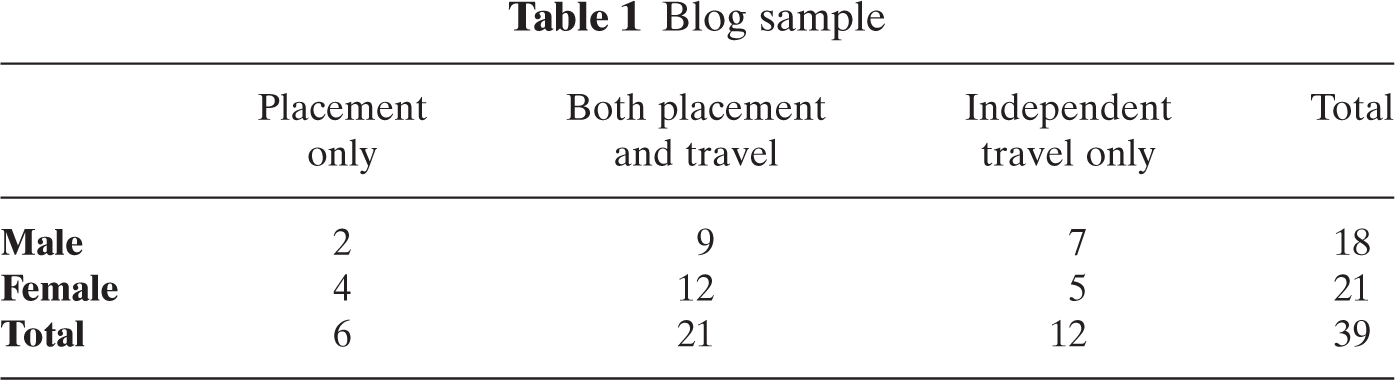
A purposive sample was constructed to include blogs that were written by young people from the UK who took their time out between school and university, and who spent some time overseas. All were between the ages of 17 and 19 when they commenced their travel. The sample was collected through a search for the phrase ‘gap year’ on specialist blog search engines and blog host platforms. Some gappers went on volunteering / work placements only and some only travelled, but the majority engaged in a mixture of both. Initially a sample of 40 was constructed that provided a sufficiently broad range of cases. However, one case was later excluded from the sample as it transpired they were taking their gap year at a later point in their life course. This left a final sample of 39 blogs, outlined in Table 1. The sampled blogs were converted into text files, imported into a qualitative data analysis package and then coded. They were also read online to gain a sense of their overarching narrative. The coding process was guided by Kelle's (1997) description of ‘qualitative induction’, in which specific phenomenon are described with reference to existing categories; and ‘abductive inference’, in which data presents new and atypical events. This meant that the analysis aimed to be faithful to the participants' explanations and understandings, whilst remaining aware of the influence of previous studies on the codes generated. This analysis was also supplemented with nine qualitative interviews with a subset of the bloggers, although I focus on the blog data in this article. Pseudonyms are used throughout. Quotations from the blogs are presented verbatim, with spelling and grammar unedited.
Investigating how young people frame their gap years enables an examination of both their subjective understandings of these experiences and how they draw upon resources to describe them. By accessing these accounts though unsolicited blogs, I am able to capture spontaneous narratives in a way that would not be possible if a researcher was directly involved in their generation (Hookway, 2008). Blog analysis allows me to examine what the participants themselves consider to be important to communicate. A limitation, however, is that it is not possible to confirm the gappers' backgrounds. Some blogs explicitly state the gapper's age and gender (or it is possible to uncover these through reading) but there is no guarantee that this information is accurate, or if they are telling the ‘truth’. Early ethnographic work on Internet use explored liberation from their offline embodied selves and experimental online identities (Turkle, 1995). Even if individuals are not deliberately misleading or playful, the ‘anonymity in text-based environments gives one more choice and control in the presentation of self, whether or not the presentation is perceived as intended’ (Markham, 2005: 809). Re-evaluations suggest that the relative anonymity online means that people may in fact be more ‘truthful’, and that perhaps this notion of play is outdated (Hewson et al., 2003: 44).
Hookway (2008) argues that the importance of whether a blog is ‘authentic’ or not depends on ‘whether a researcher is looking at how blogs work to produce particular effects or whether they are looking at how blogs correspond with an “offline” reality’ (Hookway, 2008: 97). As Germann Molz (2007: 79) notes with regard to online travel journals, these stories are not taken as ‘transparent representations of … actual travel experiences’. Nor are the blogs seen as straightforward reflections of the young people's ‘identity’, but an insight into the online version of self-development presented by the gappers, and the resources that they draw upon – existing narratives / discourses, their own capitals – to do this. 2 Furthermore, using interviews alongside the blog analysis enabled the participants' online representations to be placed in the context of how they articulated their experiences ‘offline’. They offered similar accounts, but there were some subtle differences. For example, the participants suggested in the interviews that certain things were held back a little in the blogs themselves. One young woman commented that she was aware that the vicar was reading it (Christina). Another example was an interviewee who interacted with his closest friends via Facebook, and kept his blog a little more formal (Owen). Thus, the accounts in the blogs, and the story of self-development told, are for public consumption, and are approached as such.
A lack of certainty in objective position also has consequences for determining whether self-development is limited by or freed from structural constraints. Yet some homogeneity can be detected amongst the group, as the participants were all able to take a gap year abroad between school and university, a position of relative ‘distance from necessity’ (Bourdieu, 1984: 55). 3 Only one gapper in the sample can be identified as coming from a non-white background. The young people who wrote these blogs are of a similar age, all (except one) white, living at a particular historical moment in the UK, and in an economic position that allows them to take a year off to travel before commencing higher education. 4 More fundamentally, the young people in this study share a ‘consensus on [the] meaning of practices’ (Bourdieu, 1990: 59) While the gappers may use the space of a blog to reflect on their experiences, this is not necessarily reflexive. One of the key arguments of the reflexive modernization thesis is that class (and other structural forces) ‘has ceased to constrain or enable life decisions … and no longer produces taken-for-granted ways of living that shape behaviour, values, views and identities’ (Atkinson, 2010: 2). While discourses surrounding the gap year may suggest it is a matter of choice for individuals to make the most of their time, I argue that the experience tends to confirm existing understandings of value.
What are worthwhile experiences?
A key concern for the participants is to ensure that their gap year is ‘worthwhile’. Many of the bloggers talk about how gap years are a significant life event, using phrases such as ‘once in a lifetime’; ‘trip of a lifetime’; ‘first day of the rest of our lives’; and ‘defining point’. Jason wants to make sure he doesn't waste his time in Australia:
I'm on a bloody gap year! There'll be plenty of time to eat shit, waste days sleeping in, etc when I get back to my real life in Not-So-Great Britain. But whilst I'm here, I'm going to make every day count! (Jason)
Contrasting this period of time out with normal life back home stresses the temporary nature of the experience. It is a finite period that should be utilized fully, when the correct choices need to be made. However, the ‘choice’ that young people have in these circumstances is limited, exactly because such experiences need to be worthwhile. This results in the reproduction of four key narratives that centre on ‘making the most of time’ to:
Become an experienced traveller through undertaking ‘proper travel’;
Gain skills and knowledge that will be beneficial in the future;
Help others through volunteering / working;
Have fun away from home.
First, discourses of anti-tourism and authenticity are prominent in the narratives, in common with the classificatory systems of independent travel practices. Munt (1994), for example, discusses how middle-class travellers place themselves in opposition to tourists by travelling in the ‘right way’. This is exemplified by the phrases used in independent travel brochures: ‘adventurous, broad-minded, discerning, energetic, experience, keen, imaginative, independent, intrepid, “modern”, real and true’ (Munt, 1994: 116). During his time in Thailand, Ewan decides to stay in SE Asia after his first period of teaching, and continue to volunteer:
The realisation that there are so many amazing things you can do has really hit me today. There is absolutely no need at all to be a sightseer. Whether it is teaching, working at a rescue centre or building furniture for Tsunami victims [as (Friend), one of the other GAPpers is], working in a place gives you so much more than just passing through and seeing the sights. Getting to know a place, networking with the Thais – learning the lingo and having fun, is infinitely more rewarding. (Ewan)
Gap year placements are one way that proper travel can be conducted, due to their ability to make claims for authenticity through access to the ‘inside’ (MacCannell, 1999). However, similar discourses are at work in the accounts of the gappers who ‘only’ backpack during their time out. For example, the ‘Travel Buddies’ (a group blog) comment on the differences between ‘Asian’ and ‘Western’ tourists at Angkor Wat in Cambodia: ‘We watched the sunrise over Angkor Wat with the other early birds – japenese [sic] only, proving all other westerners were hungover in bed’ (Travel Buddies). These gappers align themselves with Eastern encounters with place, in contrast to the inauthenticity of the Western experience.
Secondly, the gap year is seen to provide participants with specific attributes that may be useful in education and employment. Upon her return to the UK, Jenny notes that her father recognizes that she has more ‘knowledge about the world’. She explicitly regards this knowledge as ‘one for the CV’ (Jenny). This echoes Heath's (2007) suggestion that gap years develop a young person's ‘personality package’. In many cases, there is also evidence of something less tangible being learned. The belief that gap years should be life changing in some way is evident in Zoe's thoughts regarding returning home: ‘I want to think that I've changed as a person in some way. For me not to have done, after all that I've seen/done this year, would be rather saddening, I feel’ (Zoe). The standard narrative of gap year travel is also one that incorporates ‘changing as a person’. These expectations can be seen to structure the way the participants understand their experience.
Thirdly, as well as personal benefits, the gappers who undertake volunteering and teaching placements discuss doing something worthwhile in an altruistic sense. By ‘making a difference’ to the people and communities they encounter, the gappers can take pleasure in feeling like their activities are important. Anna comments she can tell that the teachers at her school in South Africa appreciate the fact that she and her fellow volunteers are ‘there’, ‘which is what counts’. Simpson (2004) critically reflects on such discourses with particular reference to programmes in developing countries. They are predominant in the gap year industry itself, which rarely talks about ‘development’, except with reference to ‘personal’ development (Simpson, 2004: 683).
This feeling of making a difference has a profound effect on some participants, even in countries that are not defined as ‘needy’. Ingrid looks back on the part of her gap year as a camp counsellor in the United States, and feels that her work has some significance:
On the back of our staff shirts it said: “Be the change you want to see in the world” and this summer i've realised how true that is I mean, i haven't done much yet but i know that i've affected some kids lives for the better and that's an amazing feeling. (Ingrid)
This discourse is present even for participants who felt that they are not necessarily making an impact. Daniel acknowledges that the volunteer work he can do in Botswana is somewhat limited, but looks to the future when he may be able to offer more help: ‘I'd like to imagine that I'll be able to come back once I've got some medical training under my belt, so I can be a bit more useful’ (Daniel).
Finally, despite these discussions of worthwhile travel and doing something different, the participants are teenagers away from home. As may be expected, having a good time is also at the forefront of their objectives for the year. Quite a few of the blogs devote a significant amount of time to funny stories about nightclubs, pubs, alcohol and going to parties. One common highlight in Thailand is the infamous ‘Full Moon Party’ on the island of Koh Phangnan. Dave neatly summarizes the main attractions:
On the night of the full moon we went to a party down on the beach, saw another fire show, and damn those buckets, 5 we got hammered!: D Was a brilliant night! (Dave)
The Full Moon Party has been identified as: ‘a mecca for footloose gap-year tourists … the epitome, the pinnacle, of the modern gap-year experience’: a symbol of young people wasting their gap year (Kingsley, 2010: n.p.). How can this be reconciled with ‘worthwhile’ activity? The gappers who spend all or the majority of their time backpacking have more opportunities for this hedonistic lifestyle, such as Hugo and his friends who have ‘5 nites [sic]of pure mayhem’ in Byron Bay, Australia. However, the most successful gappers are able to incorporate hedonism into an overall narrative of doing something worthwhile and they are able to balance such stories with more worthy activities. This includes backpackers as well as those on placements. The idea of having a good time is not antithetical to official understandings of what gap years should be about. In an analysis of promotional material from gap year providers, Cremin (2007) argues that injunctions to enjoy oneself support orientations to enterprise in late capitalism:
It is really living: it is fun, expressive, happy and spontaneous. It is the choice of reflexive agents making the most of their opportunities and having fun, so that once the chrysalis has ruptured the butterfly can leave its gap year cocoon and work for people friendly, interpersonal, flexible, team-based organizations. (Cremin, 2007: 532)
A key part of the successful gap year is the recognition that enjoyment is an intrinsic part of the experience, as long as orientations to doing something worthwhile are also evident. Thus, the gappers who only focus on having fun tell a less successful story than those who strike a balance, aligning with the imperative to be a well rounded, socially conscious employable person. There are some variations here, but the blogs display standard narratives representing collective ideas of what gap years should be about. As noted by Haverig and Roberts (2011) in relation to the New Zealand ‘OE’, there is a discourse of individualized self-improvement at work, but one that puts forward a normalized idea of worth and value. Moreover, they draw on moralized and classed distinctions of taste and representations of the Other that tend to emphasize difference.
Distinction and difference
Moral boundaries are established in the gap year narratives between the participants and those who do not undertake proper travel:
Some say that the point of travel is to open the mind to other cultures and we have found this to be mostly true. However, we've also developed a certain amount of scorn for the english [sic] based on the average backpacker we meet. Three girls arrived and, somewhere in between their complaints about ants and bemoaning the loss of their hair straighteners, we came to love Nacula. 6 (Jessica and Celia)
In this blog post, Jessica and Celia distance themselves from other travellers by drawing symbolic boundaries. On one side is the ‘average backpacker’, part of an unsophisticated mass that relies on home comforts and that lacks the appropriate taste for authenticity. On the other side are Jessica and Celia, open to other cultures and appreciative of local settings. Implicit in Jessica and Celia's comments are class-based distinctions (the uncultured ‘masses’) and, to some extent, the feminized (concerns with appearance and not being able to ‘rough it’). 7
Exotic people and places are also encountered during the gap year, such as tropical paradises:
One day we hiked 2 hours through the coastal rainforest to get to the remotest beach on the Island – the whitest, untouched sand you could possibly imagine, beaten by the clear, empty seas of Brazil. We took a small packed lunch for the day and just chilled on this virgin beach in what reminded me of a scene from my book ‘The Beach’. (Adam)
Such references draw upon the legacy of colonial exploration narratives, echoing the tropes of adventurous travel into ‘undiscovered lands’ (Tickell, 2001). The escape from the everyday offered by the gap year delineates such experiences through highlighting difference; the ‘out of the ordinary’ (Urry, 2002: 12). The line between home and Other runs through Paul's discussion of leaving the ‘Western’ world behind when he lands in Uganda. He also reflects upon his pre-conceptions of ‘Africa’ wondering if there would'… be mud-huts everywhere or would all the towns and cities feel just [like] western ones? Seeing orange roads criss-crossing hinted at the former but really I knew it would be somewhere in-between’ (Paul). Paul's comments both challenge but also reinforce images of ‘Africa’ in the popular imagination; referring to mud huts and dusty roads creates a clear sense that this is not home. Another common narrative is encountering the traditional authentic Other, in opposition to the civilized West: ‘A few miles away from the town all civilisation seems to disperse and all you have are a few rather traditional people living an extremely simplistic life’ (Owen).
The status afforded to being away in a place that is exotic, non-Western and thus more authentic is a significant theme running through many of the blogs. As Simpson (2005a) notes, gap year representations reproduce discourses of less developed countries as places of Otherness and experimentation (Simpson, 2005a: 111). However, difference is also highlighted in ‘developed’ places, such as the USA and Japan, often on racialized and/or classed lines. For example, Hugo shows how white skin can be an identifier of not fitting in, even in the West, when he discusses his arrival in New York. Otherness is defined by ethnicity, not nationality:
We were slightly nervour [nervous] about travelling on teh [the] subway esp[ecially] later in the evening. However it wasnt too bad despite getting a few looks and [and] for a whi;e [while] travelling in a carriage where we were the only white people out of 20 or so people. (Hugo)
The extent of critical reflection in the gappers' accounts is limited by these references to collective boundaries. However, this does not fully encapsulate the range of self-development narratives in the blogs. I now consider how we might account for instances of reflection and self-awareness.
Reflexivity in gap year narratives
In Archer's critique of Bourdieu, she claims that contemporary subjectivities are decreasingly reliant on tacit routines and embodied knowledge (Archer, 2007: 5). The gap year stories presented by the bloggers bring this into question, as they narrate their experiences drawing upon well-established discourses – the exotic Other or the uncultured tourist – which are rooted in structural hierarchies of worth. If these inequalities are pervasive in discourses that frame gap year experiences, then this suggests the workings of the habitus, the outcome of ‘structured dispositions’ (Bourdieu, 1977: 3). In defining the self against the other, be it the exotic Other or the uncultured masses, the gappers utilize established frameworks of understanding.
This is not to say that reflexivity is completely absent from the accounts. At times that there was something approaching a consideration of one's place in the world, what Savage et al. (2005) term ‘global reflexivity’. Christina compares the standard of living in Uganda with that back home, and tries to challenge the idea that the children she teaches at a local school need pity or charity:
If you live by subsistence farming you will have a very stress free life (providing you can grow enough!) Compare this to England; how many people pay to go to yoga classes or therapists, or just permanently feel tiered [tired]? (Christina)
Simpson (2005a) is highly critical of gap year programmes for perpetuating a paternalistic view of less developed countries and a lack of engagement with development issues, but here Christina challenges the idea of ‘poor people who need the help of the West’. Jones (2005) suggests that gap year programmes may not lead participants to a sophisticated understanding of development needs but can encourage young people to reflect upon different cultures, improving their ‘global perspective’. Despite this, Christina's interpretation of the life of the Ugandan people is based on an existence that is less stressful, simpler and more traditional, with strong family ties. This is still drawing upon a rather romanticized view.
What might prompt such reflections? Sweetman (2003) highlights how reflexivity is incorporated into Bourdieu's theory of practice when there are disjunctures between habitus and field. McNay (1999), for example, draws on this position to theorize the possibility of transformations in gender relations as prompted by dissonance between gendered habitus and field, while emphasizing the limits imposed by embedded systems of constraint. While the metaphor of field is intended to be an account of practice within different arenas of the social space rather than different geographical locations, 8 the significance of this when considering the gappers' accounts is twofold. First, feelings of being out of place can be conceptualized as differences between dispositions to action and the most appropriate action in a given situation. Secondly, if deliberation and even reflexivity may be a result of such disjunctures, this might go some way to explaining how overseas gap years may prompt reflections upon one's place in the world. For example, Paul's initial thoughts when he arrives in Uganda are that he might do ‘the wrong thing’:
I could not help but feel out of place. I was still heavily culture shocked and I think the root of it was a great uncertainty of how the people around me would react. I knew that the Ugandan people I was surrounded by had a life very different to mine, what could I say to them? How would they react to my prescence [sic]? What if I do something to offend them? (Paul).
The habitus provides individuals with a ‘feel for the game’ to guide appropriate action. However, when one's feel for the game does not fit with the game one is positioned within, a feeling of bodily discomfort and unease can be generated (Savage et al., 2005: 9), such as Paul's culture shock.
It should also be noted that the dispositions of the habitus are not necessarily deterministic, despite some critical accounts (see Jenkins, 1992). Bourdieu argues that improvisation and adaptation can be accounted for within structural constraints. Practices generated by the habitus are both ‘relatively unpredictable’ yet ‘limited in their diversity’ (Bourdieu, 1990: 55). However, there are some cases in which the bloggers critically reflect on their self-development in a way that is difficult to incorporate within Bourdieu's model of identity, as they indicate a degree of more explicit deliberation. Instances of critical dialogue in the bloggers' accounts suggest reflexivity may emerge from moral evaluation and intersubjective dialogue.
Intersubjectivity, dialogue and moral boundary-drawing
The time out offered by the gap year provides the space and context to make reflection possible. However, it is entering into a dialogue with an audience that prompts the gappers' more critical reflections. A notable example is Alicia, who attempts to get to grips with why she considers herself to be ‘different’ following her gap year, trying to understand what she was like ‘before’, what needed ‘improvement’, and how this was achieved:
But nevertheless, I'm different, I maybe couldn't express why or how but I know that I am, you spend enough time with only yourself for moral compass and you give up worrying about how things were, or how they should be, and just do what works for you. I don't think I'd ever realised how much sway my friends had over me before now … I don't think I'd ever really listened before, I was always waiting for a flaw in the argument, but I've realised that I know what I think but the real opportunity is to find out what everyone else believes. (Alicia)
Her considerations go beyond the standard narratives of worthwhile activity and the accumulation of benefits to a more introspective reflection on personal development. Alicia's blog also stands out as it was set up some time before her year out as a way of sharing and discussing her poetry. It thus already fulfilled the function as a space for dialogue with an audience of potential critics.
A similar process can be found in the discussion of the self-improvement ‘journey’ of Libby, who spends her year abroad at a Christian ‘discipleship training school’. Her blog provides the only consistent and in-depth critique of the self in the sample, and is a space to discuss how she is learning to be a ‘better Christian’. In one post she considers herself to be a sinner:
I was so humbled this week. I realised what a baby Christian I am, living my life focussed on my sin, not living free but just sinning, feeling guilty about it and then repenting rather trying to live like a saved person. Time for change! (Libby)
These blog posts provide Libby with the space for a form of self-reflexive confession, somewhere to examine what is wrong. However, this is achieved through an intensive programme of study and reflection, rather than the gap year experience itself.
Prompts to reflexivity are most apparent in an incident from Katy's blog that documents her time teaching in Nepal. Katy receives a hostile comment from a reader that attacks some of the statements she has made in her blog and Katy herself:
[Katy] you do sound naive. its no wonder that you have learnt so much because you knew so little to begin with. I quote “I don't think that there is a class barrier in Britain” … Maybe you should see your own country before jetting off around the world and working in private HVP schools where you aren't really needed because the kids are already fluent … Personally I think GAP years are all about the participating individual and are geared to “developing character” and giving the “Gapper” a “life-changing experience” instead of really helping people, but at least if that's the case we went to a deserving cause. [Katy (Blog comment)]
This echoes the academic debate concerning personal development, but also makes some assertions that the comment author's volunteering is more worthwhile. Katy does not delete this message, but defends herself and validates her work at the placement. She describes how her experiences have extended her knowledge of the world, and recognizes the limits on how much of a contribution she has been able to make:
the school isnt just a private school. its a charity school, and can only continue to work as it has been doing with the support of volunteers, donation, and [voluntary organisation] UK … i wish i could have done more here, i dont feel like ive ‘made a difference’ (a naive thing to say i know). (Katy)
It is not until she receives these critical remarks that Katy begins an examination of what her gap year means beyond doing a good thing. She enters into a dialogue with an outside source to negotiate what a worthwhile gap year might mean.
In order to understand the gappers' representations of self-development, we need a consideration of intersubjective dialogue that is both implicit and explict. This moves beyond Bourdieu's narrow definition of reflexivity as a critical disjuncture but is not an individualized and voluntary orientation to future action. It does not involve a radical departure from Bourdieu's theory of practice, as the dispositions of the habitus are not ‘conscious, constant rules’ (Bourdieu, 1990: 12) but an ‘intersubjective sense of the game’ (King, 2000: 420). In this sense, actions are guided by:
A sense of honour, a disposition inculcated in the earliest years of life and constantly reinforced by calls to order from the group, that is to say, from the aggregate of the individuals endowed with the same dispositions, to whom each is linked by his dispositions and interests. (Bourdieu, 1977: 14–15)
By presenting their gap year to an audience, the bloggers engage in a dialogue that, for the most part, results in a tacit consensus regarding worthwhile action. Rather than thinking about the gap year as an exercise in individualized narration of the self, it tends to engender habitual identity work that incorporates the view of the other, as described by Crossley (2001).
According to Sweetman (2003), the idea that the self requires constant reworking is indicative of a contemporary habitus in which reflexivity is deeply embedded. The uncertainty of late modernity means that ‘individuals or groups may easily and largely unquestioningly engage in reflexive projects of self (re)construction as a matter of course’ (Sweetman 2003: 542–543). Using the example of gender relations once again, Adkins (2004) considers how Bourdieu can account for increased reflexivity in gender identity. This does not necessarily result in social transformation or the freedom to question but a reworking of gender identity that maintains distinctions (Adkins, 2004: 202). Critical reflection on self-development, such as Katy's, is prompted by more explicit dialogue, or ‘calls to order from the group’. Bottero (2010) suggests that greater emphasis on the intersubjective nature of practice, such as the generation of accounts and accountability through interaction, can overcome the ‘problem of reflexivity’ in Bourdieu's work.
The data also highlight the workings of moral judgements in these ways of thinking, which can result from both mutual evaluation and self-monitoring of conduct. This can be an automatic feel for the game or conscious deliberation (Sayer, 2005a: 45). Gap year narratives are a collective enterprise in such moral boundary-drawing. When the gappers talk about doing something worthwhile, this means that others are doing something that is not worthwhile, as evidenced by their poor taste. This misrecognition of cultural capital as personal attributes can be seen in Sayer's (2005b) discussion of the drawing of boundaries in lay morality:
the way in which social groups often distinguish themselves from others in terms of moral differences, claiming for themselves certain virtues which others are held to lack: we are down-to-earth, they are pretentious; we are cosmopolitan, they are parochial; we are hard-working, they are lazy, and so on (Sayer, 2005b: 953)
As noted by Skeggs (2004), there is a link between economic and moral value, and the employment of cultural resources is a class process, which tends to normalize middle-class experience. Whilst thinking of the self as a reflexive project gives individuals a sense of freedom in their identity, it also pathologizes those other forms of self-making that lack reflexivity (Skeggs, 2004). The notion of doing something worthwhile and enterprising, and therefore being active in self-development, implies that individuals have ‘no choice but to choose’ (Giddens, 1991: 81) and are free to do so. However, as noted in the work of Furlong and Cartmel (1997) on youth transitions, the discourse of choice obscures the effects of structure on young people's life chances.
Conclusion
Doing something worthwhile provides the justification for taking a gap year. There is a discourse of individual self-improvement at work: one takes a gap year to travel (in the ‘correct way’); gain skills and knowledge; help others; and also have fun. However, there is little evidence of critical self-awareness, and not all of these activities are equal – having fun on its own is not enough. Instead, the gappers are able to utilize the correct discourses to varying degrees of success, and tell the right story in orientation to future goals. Such stories drew upon classed and racialized distinctions of taste, so that the benefits of capital are misrecognized as differences in moral worth. Do such distinctions necessarily question trends of detraditionalization and individualization and threaten the validity of a reflexive model of identity? As Adkins (2004) notes, this model does not presuppose these trends, but it is associated with the freeing-up of structure and the centrality of choice. In contrast, the gap year narratives mobilized structural identities. Moreover, the degree of choice available is questionable, as the imperative to do something worthwhile is pervasive. What is considered to be worthwhile aligns with the requirements of capital, in terms of being enterprising, or acquiring culturally sanctioned benefits. A discourse of choice does not mean that individuals are free to choose.
Blogs offer an innovative way to access spontaneous, naturalistic narratives, but they are limited in their ability to confirm the authors' structural position. Being able to combine blog data more extensively with data on social locations and trajectories would allow a more detailed exploration of the workings of habitual dispositions in gap year identity work. This would also mean that additional consideration of intra-sample differences could be considered, for example in the adoption of more reflexive stances. Another area worthy of further exploration is the effects of gender on self-development. It would be wise to heed Lovell's (2000) cautionary note on how Bourdieusian analysis tends to place ‘sex/gender, sexuality, and even “race” as secondary to that of social class’ (Lovell, 2000: 12). There were some indications in the data of a type of femininity that does not have value (for example, Jessica and Celia's distaste for girls who can't ‘rough it’). Interestingly, the three blog accounts that demonstrated reflexivity prompted by intersubjective dialogue were produced by young women. Despite suggestions that young women outnumber young men (Jones, 2004), there is a distinct lack of work on gender in existing gap year literature, and there is a clear need to engage with gendered self-development in future studies.
The workings of morality in such distinctions – we do what is worthwhile, they do not – point to the salience of such facets of inequality. The gap year blogs address an audience, and thus these representations of experience are directed towards others for interpretation. By representing experience using dominant understandings, they are situated within a shared (ie intersubjective) consensus. Incidences of reflexivity occur in the same intersubjective context: when there is conflict, or calls to order from the group; ongoing dialogue; or a lack of fit between habitual ways of framing and the experiences encountered. The bloggers reflect on the gap year experience, but the way that the gappers are doing their ‘identity work’ online is not individualized and reflexively chosen, and is shaped by underlying cultural scripts that repeat across the narratives. This paper provides a critique of the ‘official’ framings of the gap year, one in which young people make rational decisions to undertake worthwhile activities. These discourses lose sight of the collective meanings that define gap year experiences, and place the responsibility for self-development on the shoulders of individuals, rather than acknowledging structural factors and alignments with moral hierarchies of worth.
Footnotes
Acknowledgements
This work was supported by the Economic and Social Research Council (grant number PTA-031-2004-00276). I would like to thank Wendy Bottero and Nick Crossley for their feedback and advice, and the anonymous referees for their comments.
1
Jones (2004: 8) defines a gap year as: ‘any period of time between 3 and 24 months which an individual “takes out” of formal education, training or the workplace, and where the time out sits in the context of a longer career trajectory’. Gap year travel can include ‘backpacking’, or independently organized travel, but can also be arranged through ‘structured’ placements, when provider organizations coordinate accommodation, volunteering, employment, etc.
2
This raises interesting methodological issues concerning ‘real’ identity. See Hookway (2008) and  for an extended discussion of the methodological issues associated with blog analysis.
3
Similar locations in the social space were apparent among the interviewees, whose parents could all be described as professionals (with an over-representation of professions in the public sector and education).
4
Habitus is not only produced by ‘social class’, but similar conditions of existence (Bourdieu, 1990: 72).
5
‘Buckets’ are literally buckets filled with Thai whiskey, cola and ice.
6
Nacula is an island in Fiji.
7
See the conclusion for a discussion of gender in gap year self-development.
8
Although senses of belonging are engendered by feelings of comfort within one's locality (Savage et al., 2005).