






Abstract
It has been argued, based upon national polling and mid-term election results, that Britain's Liberal Democrats will lose a substantial number of seats at the next general election. However, such argument is in danger of underestimating the unique importance of strong local party organisation and incumbency to the Liberal Democrats as a platform for subsequent general electoral success. This article examines the changing income, expenditure and membership of the party's strongest local constituency associations since 2010, and concludes with a short assessment of the possible implications for the Liberal Democrats at the next election and beyond.
It would appear a common assumption, both within the mainstream media (Grice, 2012; Ross, 2012) and within the academic community (Bale, 2012; Dommett, 2013), that the Liberal Democrats in Britain will perform badly at the next general election. While government provides the benefits of public office, most governmental parties lose votes and seats between one election and the next, and this is usually more so the case for minor coalition parties (Paun and Munro, 2013). Additionally, the Liberal Democrats remain a relatively new party, and some suggest that they are more prone to fragmentation, especially if they have previously developed a reputation as an anti-establishment party (Dunphy and Bale, 2011). Reports of significant falls in membership have supported such claims (Watts, 2012). Finally, the Liberal Democrats' national polling figures, averaging between 7 and 10 per cent since the end of 2010, represent a large fall from the 23 per cent that the party polled at the last general election (Ford et al., 2013).
However, such analysis does not take into account the ability of the Liberal Democrats to win and maintain parliamentary seats in their strongest geographical areas. Previously, the party has struggled under the first past the post electoral system to convert a widely spread vote into a substantial share of seats. Since 1997, the party has become much more adept at effectively targeting seats in their strongest areas. This was demonstrated no better than when the party held the Eastleigh constituency in a by-election in February 2013, despite the scandal surrounding the former MP Chris Huhne. 1 For the Liberal Democrats, a strong organisational base with active campaigners has been argued to be essential to the party's national electoral fortunes (Pattie and Johnston, 2009). Building up a local activist base brought about local electoral success and local government incumbency, and provided a platform for capturing and maintaining parliamentary seats (Fieldhouse et al., 2006). Cutts (2013) argues that, for the Liberal Democrats, local activism and organisational structure are a necessary platform for maintaining and strengthening national representation.
This article contends that the Liberal Democrats' electoral success in 2015 will, in part, depend upon its ability to maintain financial and organisational strength in its strongest local associations. To this end, local constituency party accounting and membership data will demonstrate how the Liberal Democrats' strongest local associations have been affected since their national party's entry into coalition government in 2010. While a fall in membership is common in most Liberal Democrat associations, it has not been met by a general fall in income and expenditure. So far in the electoral cycle, it would appear that the Liberal Democrats' strongest local constituency parties will fight the next general election with relatively good financial resources. This would appear especially the case for local constituency parties with incumbent Liberal Democrat MPs, to the extent that they might be able to withstand falls in the national vote elsewhere. In short, this article asserts that targeting incumbent seats in areas of the country where they are organisationally strongest is likely to be the best means the Liberal Democrats have of maintaining their share of seats at the next general election.
The importance of local parties to the Liberal Democrats
Local parties form the bedrock of the Liberal Democrats' party organisation. While the party has often benefitted in elections following disillusionment with government policies, most notably in the 2005 general election following the decisions on Iraq and tuition fees, they have struggled to transform votes into subsequent seats. Electors have appeared reluctant to ‘waste’ their vote on a party that will not form a government (Fieldhouse et al., 2006). Until 2010, the Liberal Democrats' highest public office was in sub-national coalition with Labour in the Scottish Executive (1993–2003 and 2003–2007) and the Welsh Assembly (2000–2003).
The most effective way for the party to establish long-term credibility has been to develop success at local government level, hoping to be judged on their performance in that specific context before building further (Cutts et al., 2010). This should not be considered a surprising method. Local parties serve many functions in representative democracies, not least providing the benefits of campaigning and membership to national parties (Denver and Hands, 1997; Scarrow, 1996). National parties also value their local associations as they provide them with legitimacy in the eyes of the public (Clark, 2004, p. 37). For ‘ordinary citizens’, local parties provide easy means of entering the political process through activism. Such voluntary labour is vital as local parties become able to translate the abstract national agenda into the relevant local, and encourage further participation throughout the party's organisational structure (Geser, 1999, pp. 5–13).
Although the party has professionalised since 1997 as its share of MPs increased (Evans and Sanderson-Nash, 2011), the Liberal Democrats, like their Liberal/SDP predecessors before them, have typified a local approach to electoral strategy. Copus (2007, p. 127) argued that there is a greater intensity of support for local activism among Liberal Democrat councillors than there is for councillors from the Labour and Conservative parties. He also noted a possible tension for the party in viewing community politics as an end in itself, and viewing it as a means to an electoral end. However, the two need not be mutually exclusive. The Liberal Democrats' approach to community politics developed throughout the 1990s, and the emphasis on campaigning (and subsequent electoral gain) became essential in order to organise the activism and support that had developed (Cutts, 2013, p. 3).
Electorally, the Liberal Democrats have found it much easier to win local authority seats, and subsequently take control of local authorities, than they have parliamentary seats. As local authority wards are smaller than parliamentary constituencies, limited resources can be targeted more directly. Instead of general campaigns about Liberal Democrat policy, particular strategies can be employed in local areas, reinforced by concentrated campaigning by activists. Such a strategy has worked. By 1996, the party had amassed control of over 50 local authorities and was the second largest party of local government in Britain (Meadowcroft, 2001). This further developed into the twenty-first century as metropolitan city areas became successful hunting grounds for the Liberal Democrats. As recently as 2009, Nick Clegg declared that these gains were ‘part of a complete transformation of city politics in this country from Labour to the Liberal Democrats … in Bristol as in Sheffield, Newcastle, Hull and Liverpool, people have been voting (Liberal Democrat) in droves’ (Clegg, 2009). 2
In the past, success for the Liberal Democrats at local authority level has been followed by success at the parliamentary level. Parliamentary victories in the 1997 general election mostly occurred where the party had developed strong local government representation, and this continued in 2001 (Russell and Fieldhouse, 2005). Wherever possible, links would be made between local election success and the possibility of this transforming into something more substantial. Most Liberal Democrat leaflets will contain a chart to indicate the success of the party in recent elections, aiming to show that a vote for the party is not a wasted one. By running more local authorities, the Liberal Democrats were in a position to counter the suggestion of inexperience touted by voters and opposition, and establish credibility in the process (Russell et al., 2007). Local election success also builds up a greater body of activism for the Liberal Democrats, and institutes a wider ethos of continued campaigning that strengthens the party year on year (Cutts, 2006).
Between previous elections (when the party has been in opposition), media attention on the Liberal Democrats has often diminished, and their poll ratings have subsequently dipped. In such circumstances, their emphasis on local campaigning and party structure is a tremendous asset (Russell, 2010). However, it has been suggested that this has now been stretched as far as resources permit, and the struggle to fund campaigns is now ‘akin to the impact of an unseasonably warm winter on the snowball effect’ (Harrison, 2007, p. 145). 3 Fieldhouse, Cutts and Russell (2006) offered evidence to suggest that local electoral support mattered less in the 2005 general election than previously, with increased support in metropolitan areas arising from protest at Labour government policy.
So far, however, the evidence to suggest a decreasing link between local election success and parliamentary gain is largely circumstantial. Cutts (2013) addresses this shortcoming with multivariate analysis of the relationship between the two in the 2010 general election. He finds that when the Liberal Democrats won council seats in local elections, their electoral credibility was significantly enhanced at the parliamentary level through effort in the local campaign.
The benefits of local election success on the ground – larger numbers of party workers and local activists who have experience of winning elections – enhances the local party infrastructure and enables the party to be more efficient and effective in targeting local resources through grassroots campaigning. (Cutts, 2013, p. 14)
Most importantly, Cutts' research finds that the effect of local success and subsequent increased campaigning was larger for the Liberal Democrats at the 2010 general election than it was for Labour or the Conservatives. While local campaigning and community approaches to politics continue to be important for all three main parties, it appears to be especially important for the Liberal Democrats.
The extent to which successful transformation from the local to the national will continue ahead of and beyond the next general election is questionable. In 2010, the declining Conservative and Labour parties' vote provided the first hung parliament at a general election since 1974, and the decision to enter coalition as a junior partner represents the highest public office obtained by the Liberal Democrats since their formation. However, this has come at heavy electoral expense. Table 1 shows some of the losses experienced by the Liberal Democrats post-2010.
Liberal Democrat electoral performance since 2010
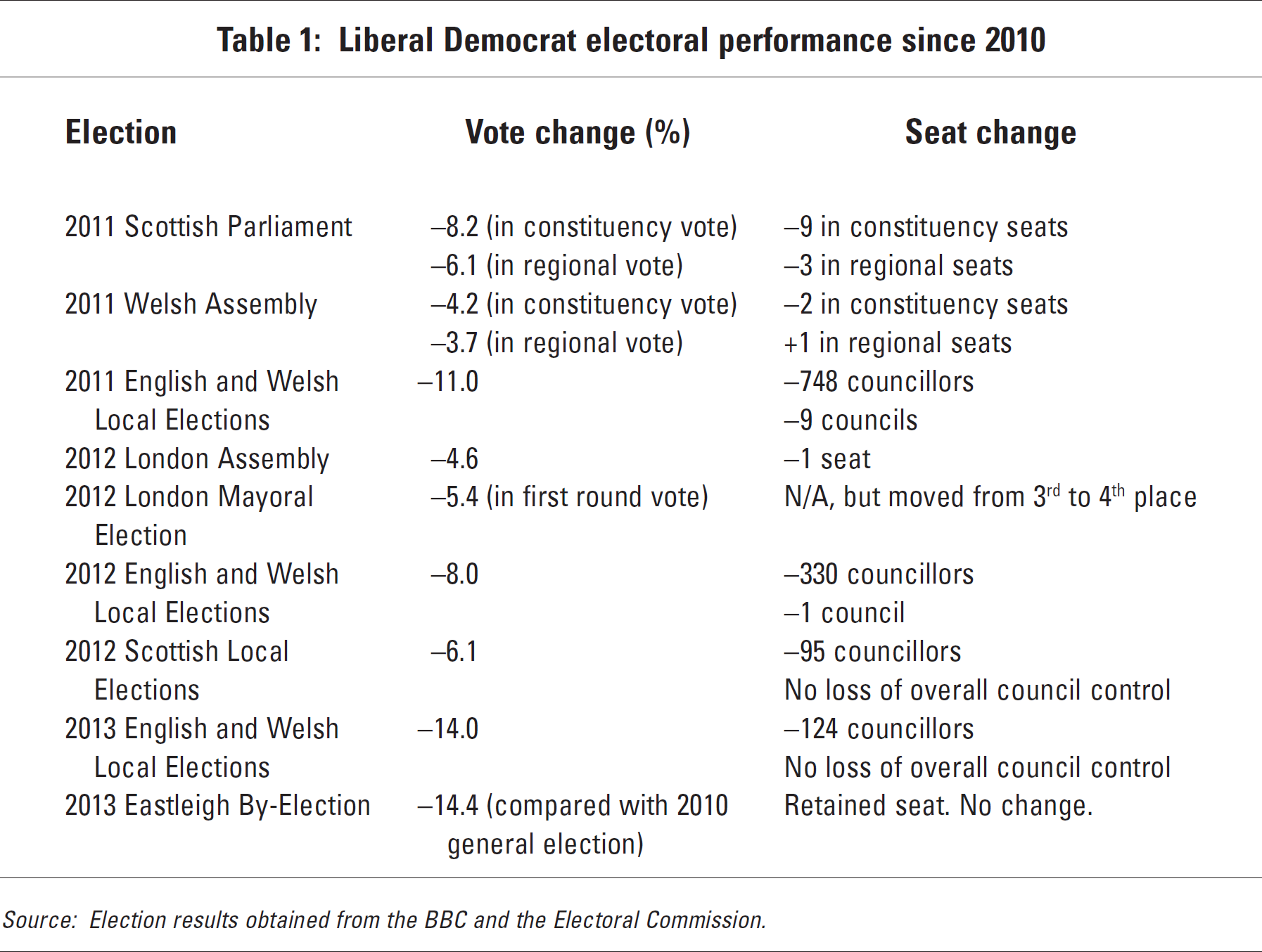
Heavy losses in local elections are not uncommon for incumbent parties. Labour's local electoral base declined throughout its 13 years in government, yet they still maintained national success. However, such precedent is not available for junior coalition parties within British politics. The Liberal Democrats have focused on building a local electoral base that forms a significant aspect of their organisational structure. Losing over 1,000 councillors post-2010 across Britain has not only damaged the electoral reputation of the Liberal Democrats, but also represents a major setback for the party and its organisational structure.
It is such bad results, along with lower national polling figures, that have led some to suggest that the Liberal Democrats will lose a substantial number of seats at the next general election. Dommett (2013, p. 218) goes as far as to suggest that the party could win as few as nine seats in Westminster next time around. However, if the Liberal Democrats' seat share is to collapse so badly, then two more expectations should be realised. First, the Liberal Democrats should be losing support in their strongest regions and in those constituencies where they have an incumbent MP. Data collected by Lord Ashcroft (2013) suggests that the Liberal Democrats are polling relatively well in marginal seats, and the Eastleigh by-election also showed that the Liberal Democrats are capable of successfully defending seats in spite of dwindling national support. Second, since local parties are a necessary platform for national success for the Liberal Democrats, the party's strongest local associations should be crumbling. Examining financial and membership reports to the Electoral Commission can demonstrate the extent to which this is the case.
Liberal Democrats' local income and membership
In 2013, the Liberal Democrats' national membership stood at 42,501 (Electoral Commission, 2013). This represents a fall of nearly 35 per cent from the 65,038 members the party had in 2010. This is based on reports to the Electoral Commission. Given the minimum £12 membership fee that the party imposes for non-concessionary members, it follows that large falls in membership will also have a large impact on party finances. What is less clear is the extent to which individual Liberal Democrat local party associations have seen their membership and income fall. This can be examined with data submitted from 2002 onwards under the requirements of the Political Parties, Elections and Referendums Act 2000, which requires political party local associations (or ‘accounting units’) with an income or expenditure of £25,000 or higher to report their accounts to the Electoral Commission (2013). From 2008 onwards, many (but not all) of those obligated Liberal Democrat associations have also chosen to submit their membership figures for that accounting year as well.
As Randall (2009, pp. 189–190) notes in his analysis of Conservative Party accounting unit submissions, the data is not perfect. Associations that do not earn or spend more than £25,000 in an accounting year largely choose not to report their accounting data. This represents a particular problem when studying the Liberal Democrats – fewer than 10 per cent of the party's local associations submitted accounts in 2012. However, this data strengthens the argument that the Liberal Democrats have always had to target their resources effectively for electoral success (Clark, 2007). For instance, of the 57 Liberal Democrat associations to submit accounts in 2012, 34 of them returned a Liberal Democrat incumbent MP.
Therefore, while the data cannot provide a broad picture of the behaviour of Liberal Democrat associations, it can provide a more specific account of how the strongest associations are faring since 2010. Since they are the associations that are most likely to return Liberal Democrat MPs in 2015, they are the associations most worth examining. In the first instance, we can examine the continuing strength of the Liberal Democrats' strongest associations by distinguishing those that report accounts from those that do not. From this, we can make the simple hypothesis that the higher the number of associations to submit accounts, the broader the strength of the local organisational base of the Liberal Democrats. Table 2 shows the trend from 2002 to 2012, along with average income and expenditure, and the average difference between the two, during that time.
Average income and expenditure of Liberal Democrat accounting units, 2002–2012
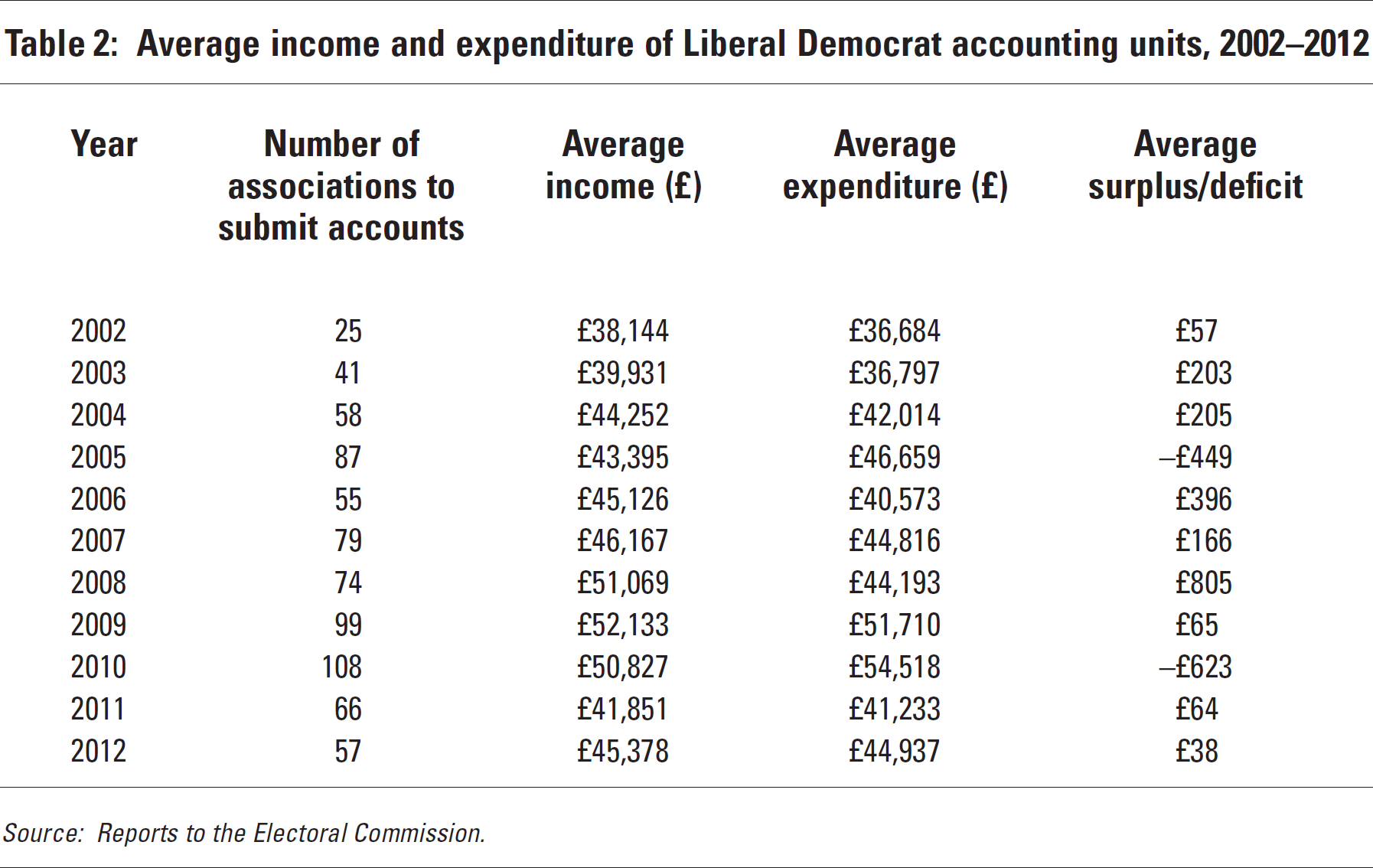
As might be expected, the number of associations to submit accounts rises in 2005 and 2010 compared with the previous accounting year, and falls again following that. During a general election year, local parties will aim to recruit more members, take in more donations, and make and spend more money (Fisher and Denver, 2009). That they spend more money than they earn in general election years is also unsurprising. However, there are some noteworthy results emerging from Table 2. In the run-up to 2005, the number of associations to submit accounts increases significantly. Barring a slight decrease between 2007 and 2008, the large increases continue until 2010, indicating that during this time more local Liberal Democrat associations became financially stronger. Post-2010, however, a different picture emerges. While a fall in 2011 is perhaps inevitable, the fall continues in 2012. At 57, the number of associations to submit in 2012 is 22 short of the 79 associations to submit in 2007, the equivalent period in the previous electoral cycle. It is also noteworthy that while post-2005, associations were able to earn hundreds of pounds on average more than they spent, this is reduced to tens of pounds post-2010.
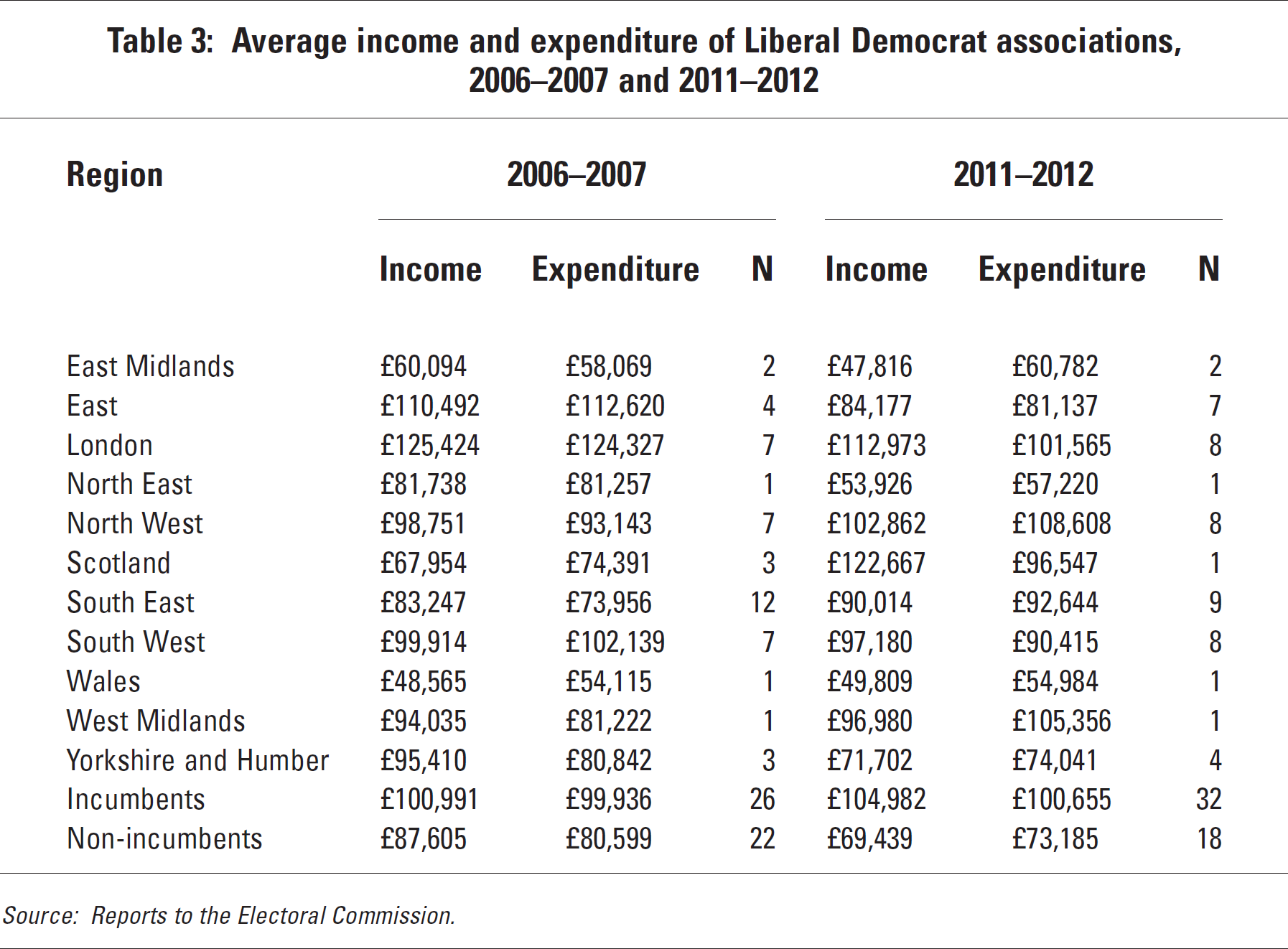
However, this is not yet enough to assert that the Liberal Democrats' strongest local organisations are crumbling post-2010. To do this, Table 3 shows Liberal Democrat local organisation financial data post-2010 compared with post-2005 broken down into two specific categories: geographic region and incumbency. While the Liberal Democrats' electoral support remains geographically evenly spread, Cutts (2012) showed that they were strongest in the South West of England region in the 2010 general election, winning 35 per cent of the vote, compared with just 19 per cent of the vote in Scotland. Examining regional breakdown of the Liberal Democrats' local association reports allows more specific analysis of their situation.
Average income and expenditure of Liberal Democrat associations, 2006–2007 and 2011–2012
Since the 1970s, it has been widely accepted that, in single member districts, incumbent legislative candidates have enjoyed an advantage in their bid for re-election (Heitshusen et al., 2005; Smith, 2013, p. 167). Smith notes that in several of the elections in the 1990s, it would have been easier to defeat a member of the United States Congress than an incumbent Liberal Democrat MP. As the Liberal Democrats have grown larger, and the novelty factor of having an incumbent Liberal Democrat MP hits a ceiling effect, research suggests that this trend might not be as strong as it once was (Harrison, 2007; Smith, 2013). However, incumbency is still important. The relative weakness of the party's appeal nationally has often meant that Liberal Democrat MPs' re-election has been more dependent on personal popularity and local activity than it has for Labour and the Conservatives (Curtice et al., 2010, p. 16). In 2010, Liberal Democrat incumbents saw their vote increase by 0.6 per cent, compared to a fall of 4.7 per cent for non-incumbents. Most strikingly, first time incumbent MPs for the party saw their vote rise on average by 3.1 per cent (Curtice et al., 2010, p. 16). Such strength of incumbency for the party represents a continued trend since 1992. Therefore, it is important for the party to maintain membership and income in incumbent seats.
Since income and expenditure can change annually depending on factors individual to constituencies (e.g. repayment of loans, different regional electoral cycles), the accounting years 2011 and 2012 are cumulated to give a more medium-term sum, with averages then taken of these sums across each region. This is to give as extensive a picture as possible of the Liberal Democrats' financial and organisational strength post-2010. This is then compared with the equivalent years in the previous electoral cycle, 2006 and 2007. If the Liberal Democrats are going to collapse electorally in 2015, then it should be expected that income and expenditure will be lower post-2010 in the Liberal Democrats' strongest areas compared with post-2005.
First, some caveats. In many constituencies, averages are skewed by high income and expenditure in the party's strongest associations, such as Tim Farron MP's constituency party in Westmoreland and Lonsdale in the North West (cumulative income for 2011–2012: £242,303, compared with a North West average of £102,862). Additionally, for each region, only a small number of associations submit their accounts, with only one association submitting in some regions. In the North East, Scotland, Wales and the West Midlands, it is difficult to discern any meaningful trends. However, the lack of constituencies submitting accounts year-on-year in these regions should be a concern for the party; particularly, the fall in Scottish associations submitting accounts adds to concerns raised elsewhere about the strength of the Liberal Democrats in Scotland (Clark, 2007). In the East Midlands, East of England, London and Yorkshire and Humber regions, there are large falls in average cumulative income post-2010 compared with post-2005. Of these, the fall in London, where the party currently have seven MPs, is perhaps most concerning.
However, in the South West, North West and South East regions, more positive conclusions can be drawn. The Liberal Democrats currently have 14 MPs in the South West, and associations within that region report similar financial figures post-2010 compared with post-2005. Average expenditure has fallen, but not heavily, and we might expect increased activity as the general election draws nearer. Of the North West associations to report, where the Liberal Democrats currently have seven MPs, both average cumulative income and expenditure were higher post-2010 than they were post-2005. A similar picture emerges in the South East, where the Liberal Democrats won five seats in 2010, although a fall in the number of associations to submit accounts is a concern.
The South West, North West, South East and London are regarded as important regions for the Liberal Democrats because of the number of incumbent MPs they have in those regions. For those associations without incumbent Liberal Democrat MPs, Table 3 demonstrates a significant fall both in income and in the number of associations to report. A drop of over £18,000 in average income represents a fall of over 20 per cent post-2010 compared with post-2005. Based on the data in Table 3, those strongest associations without incumbent Liberal Democrat MPs are financially weaker post-2010 than post-2005.
However, a different pattern emerges for local associations with incumbent Liberal Democrat MPs. Although their average income and expenditure has not risen by a great deal, Table 3 shows that these associations earned and spent similar amounts post-2010 compared with post-2005. Add this to consideration of the large fall in the number of Liberal Democrat councillors since 2010, party associations with incumbent Liberal Democrat MPs appear to be coping well. Most significantly, Table 3 also shows that the number of associations with incumbent MPs submitting successive accounts in 2011–2012 has risen by more than 20 per cent since 2006–2007. Based on the data in Table 3, those strongest associations with incumbent Liberal Democrat MPs are financially stronger post-2010 than post-2005.
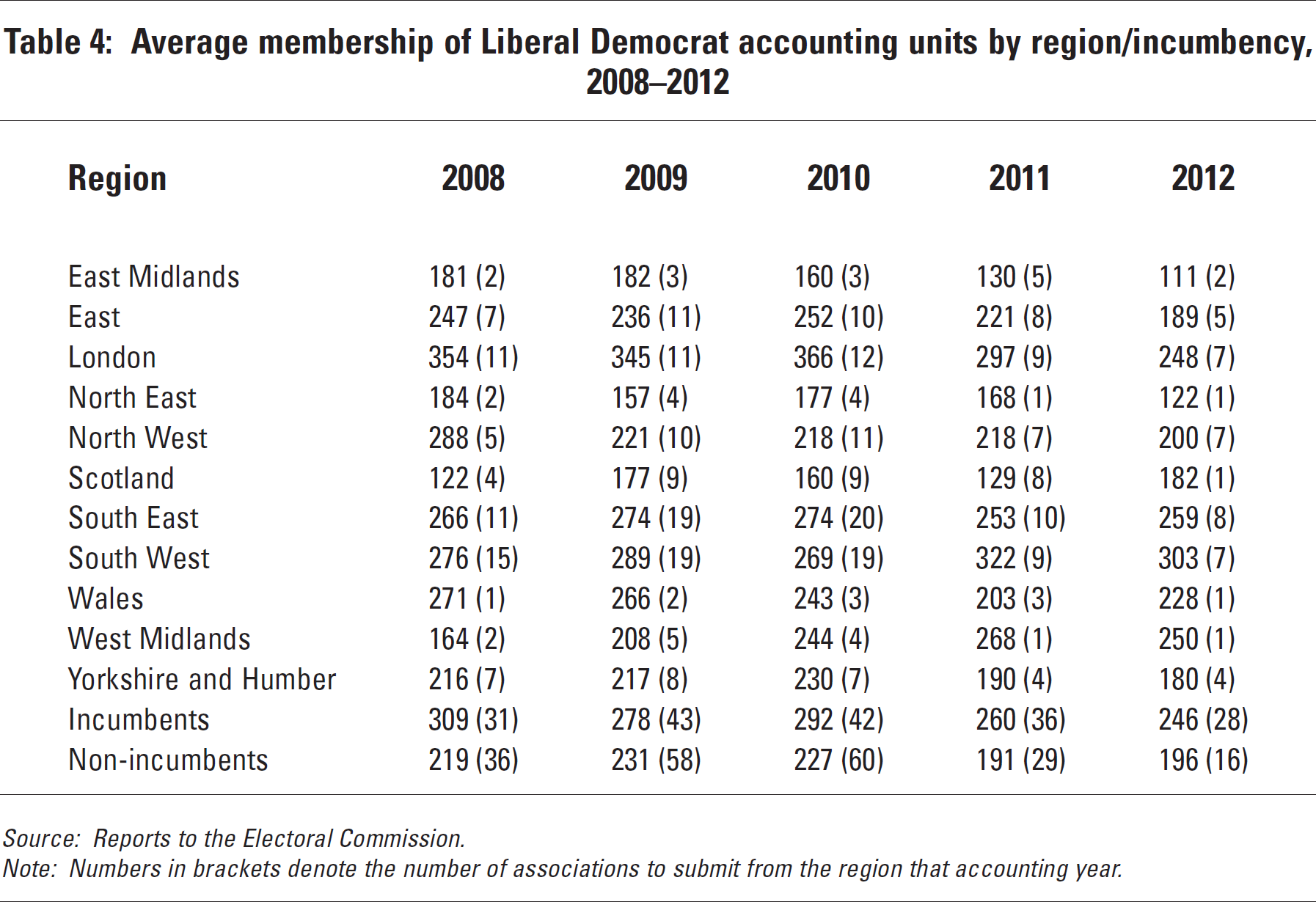
Meaningful association membership data for the Liberal Democrats is only available via the Electoral Commission website from 2008 onwards, so comparisons between 2006–2007 and 2011–2012 cannot be drawn. However, we can examine year-on-year trends from 2008 to 2012. Table 4 shows average association membership data compared by region and incumbency. As with the financial data, there are some caveats. Charting political party membership over time is a difficult task (Mair and Van Biezen, 2001). Since associations are not legally obliged to submit their membership figures, and there are no arbitrary minimum benchmarks, the data is more liable to fluctuate year-on-year. As with the regional financial data, the number of constituencies (or lack thereof) that submit in some regions makes any meaningful trends difficult to discern, and exaggerates the actual averages across Britain. Nevertheless, membership estimates from parties are often the only source available to researchers (Mair and Van Biezen, 2001), and examining membership trends in the strongest Liberal Democrat associations will provide a key indicator of how well prepared they are for the next general election in these seats.
Average membership of Liberal Democrat accounting units by region/incumbency, 2008–2012
Note: Numbers in brackets denote the number of associations to submit from the region that accounting year.
As with the average cumulative income and expenditure data, London should represent an area of concern for the party. The average association membership in London has fallen by nearly 30 per cent, from 354 in 2008 to 248 in 2012. Given too that the party has lost seats in the Greater London Assembly since 2010, and fell behind the Green Party to fourth place in the 2012 London Mayoral Election, the data suggests that the strongest Liberal Democrat associations in London have struggled to maintain or strengthen their organisational base since 2010.
More positive trends emerge in the South East and South West. Average association membership in the South East was largely the same in 2012 as it was in 2008, and in the South West, average membership has increased by nearly 20 per cent between 2008 and 2012. However, further evidence should be gathered before these claims are substantiated, as for both regions, there is a decline in the number of submissions in 2012 compared with pre-2010.
In associations with incumbent Liberal Democrat MPs, the average association membership in 2008 was 349, falling to 246 in 2012. This represents a fall of just over 20 per cent. Although party membership is declining throughout Europe, on the face of it, this is concerning news. Successful party policy and strategy depends upon those who develop it, but also depends upon the foot soldiers who can communicate it on the doorstep by means of leaflets or door-knocking. However, a significant decline in membership need not represent a significant decline in activism. Studies of the health of political parties have largely focused on membership levels as an indicator of activism (Mair and Van Biezen, 2001; Van Biezen et al., 2012; Whiteley, 2011). Fisher, Fieldhouse and Cutts (2013) challenge this, echoing Scarrow's (2000, pp. 95–99) analysis that the size of a party's membership need not reflect the level of individual activism. They find that, of the three main parties, the Liberal Democrats were most likely to recruit non-members to campaign, with 86 per cent of responding associations doing so. This complements Whiteley, Seyd and Billinghurst's findings (2006, pp. 98–100), who show that many Liberal Democrat members are embedded in many local community organisations, and subsequently can recruit local activists to campaign without the need for them to join. Nonetheless, the Liberal Democrats have previously relied on a strong membership in target seats to employ traditionalist campaigning techniques (Fisher and Denver, 2009). The ability of the strongest Liberal Democrat local associations to raise funds and conduct campaigns alongside a declined membership will be a determinant of how they fare at the next general election.
Conclusion
The Liberal Democrats have struggled since their first entry into national government. They have suffered disproportionately in the polls since 2010, and have also lost over 1,000 councillors across Britain in that time. However, those predicting collapse for the party at the next general election appear to be underestimating the importance of strong local party organisation to the Liberal Democrats. For a party that has historically focused on its target electoral areas, the Liberal Democrats' difficulties nationally are not sufficient on their own to indicate the substantial fall in seats at the next general election that some predict. By also examining how their strongest local associations are performing, a more rounded analysis can be articulated that recognises the unique position of the Liberal Democrats.
Maintaining and strengthening their position in associations with incumbent MPs is perhaps the best chance the party has to return an electorally relevant share of seats at the next general election. Overall, the strongest Liberal Democrat associations appear to be operating from a relatively robust organisational position. Financially, the experience of Liberal Democrat associations with incumbent MPs and in the party's strongest regions post-2010 suggests that they may do better than previously predicted. This is not to say that the Liberal Democrats will retain all 57 seats from their 2010 intake. Indeed, they are clearly under considerable pressure. However, ahead of the next general election, if they are able to maintain their local party organisation in their strongest constituencies, then the predicted Liberal Democrat collapse may be somewhat mitigated.
Footnotes
Acknowledgements
The work on this article was made possible by support from the Economic and Social Research Council, Grant Reference ES/J500082/1. Thank you to the Electoral Commission for publicly providing the reported local party association data that this paper utilised. I am also particularly grateful to the three anonymous referees and to Alistair Clark, Nick Randall, Emily Robinson and Joe Dodd for their comments and suggestions.
1
The party would arguably have won the by-election more comfortably were it not for the electoral support for UKIP. It is expected that UKIP would not be able to mount such a strong campaign in Eastleigh at the next general election when their resources would be more geographically diluted.
2
The Liberal Democrats have since lost seats in all of these cities, and are second place in terms of local representation on each council behind Labour.
3
The ‘snowball effect’ theory suggests that the party has the potential to gain seats by building an expanding local organisational base in certain areas of strength.