






Abstract
In all animal species, oxygen consumption is a key process that is partially impaired in a large number of pathological situations and thus provides informative details on the physiopathology of the disease. In this study, we describe a simple and affordable method to precisely measure oxygen consumption in living zebrafish larvae using a spectrofluorometer and the MitoXpress Xtra Oxygen Consumption Assay. In addition, we used zebrafish larvae treated with mitochondrial respiratory chain inhibitors, antimycin A or rotenone, to verify that our method enables precise and reliable measurements of oxygen consumption.
Introduction
Respiration is a key cellular function, which is altered in a great number of disorders and animal disease models, thus providing a meaningful window to interrogate the physiology of living cells and organisms. 1 Automated devices allowing precise measurement of both mitochondrial respiration (oxidative phosphorylation) and glycolysis have been developed in recent years, but their price and cost of usage restrain their use on a daily basis. To overcome this limitation, we describe here a simple and affordable method that allows precise measurement of oxygen consumption in living zebrafish larvae, using a simple spectrofluorometer and the MitoXpress Xtra Oxygen Consumption Assay (Agilent), a quantitative test relying on a fluorescent probe, which is quenched in a dose-dependent manner by O2 molecules (Fig. 1A).
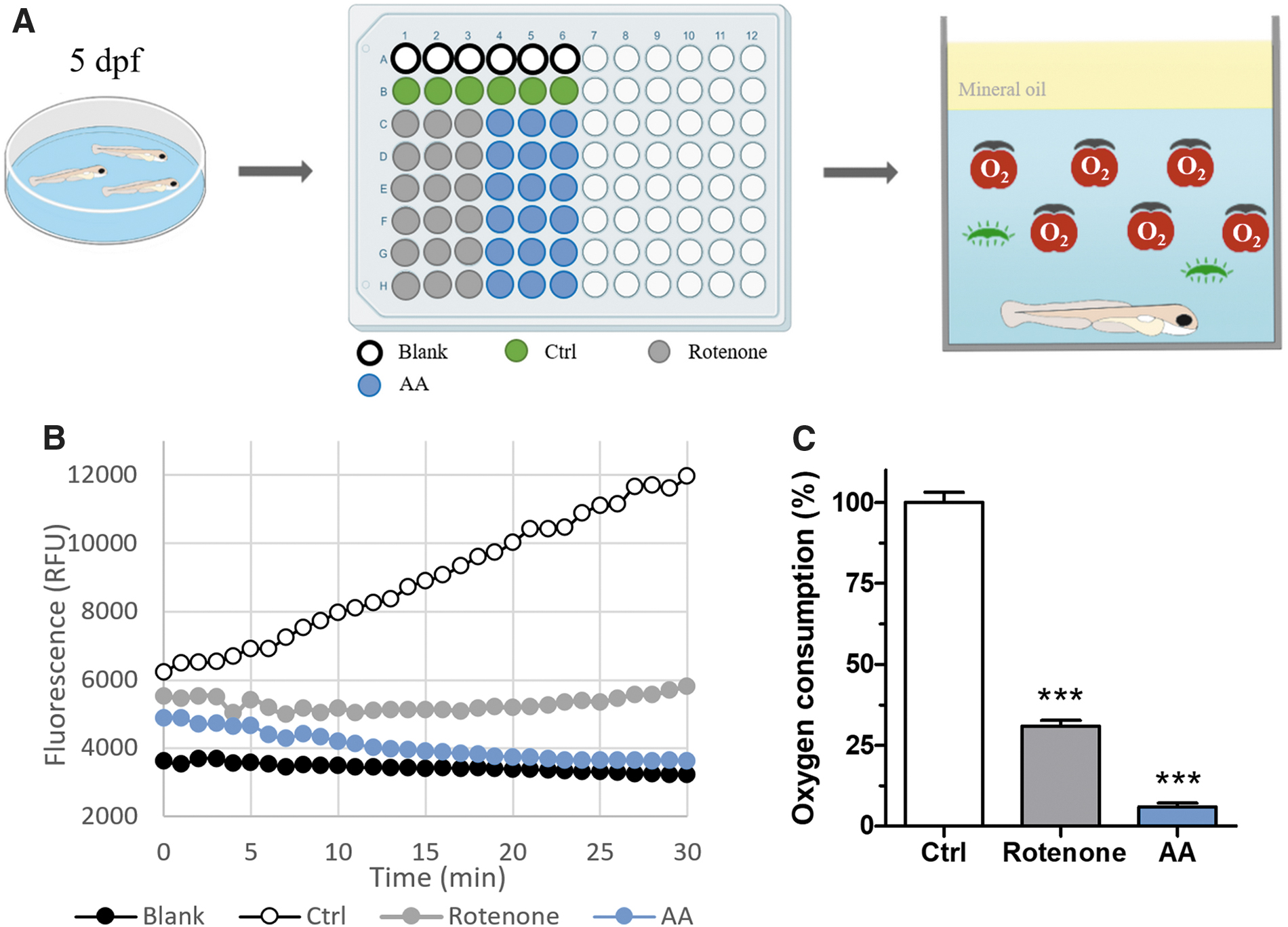
Real-time measurement of oxygen consumption in 5 dpf zebrafish larvae.
Results
To assess the ability of this method to detect fine changes in O2 consumption in living zebrafish larvae, we measured O2 consumption of pools of seven 5 days post-fertilization wild-type individuals treated with either vehicle (1% dimethyl sulfoxide [DMSO]), 2 μM rotenone, a specific inhibitor of the mitochondrial respiratory chain (MRC) complex I, 2 or 10 μM antimycin A (AA), a specific inhibitor of the MRC complex III (Fig. 1A).3,4 As previously reported, we found that 1% DMSO concentration had no effect on larval development. 5
Results showed that oxygen consumption of larvae exposed to 2 μM rotenone and 10 μM AA was 31% and 6%, respectively, of that observed in non-treated controls (Fig. 1B, C, Supplementary Data), indicating that the method described allows reliable measurements of oxygen consumption. Thus, this simple and direct method can be used to measure respiration in vivo in zebrafish intoxication and disease models.
Footnotes

References
Supplementary Material
Please find the following supplemental material available below.
For Open Access articles published under a Creative Commons License, all supplemental material carries the same license as the article it is associated with.
For non-Open Access articles published, all supplemental material carries a non-exclusive license, and permission requests for re-use of supplemental material or any part of supplemental material shall be sent directly to the copyright owner as specified in the copyright notice associated with the article.
