






Abstract
Abstract
The first Nordic Countries Meeting on the Zebrafish as a Model for Development and Disease took place at Karolinska Institutet in Stockholm, November 21–23, 2012. The meeting gathered 130 scientists, students, and company representatives from Iceland, Finland, Norway, Denmark, and Sweden, as well as invited guests and keynote speakers from England, Scotland, Germany, Poland, The Netherlands, Singapore, Japan, and the United States. Presentations covered a wide range of topics, including developmental biology, genetics, evolutionary biology, toxicology, behavioral studies, and disease mechanisms. The need for formal guidance and training in zebrafish housing, husbandry, and health monitoring was recognized, and the meeting expressed its support for the joint working group of the FELASA/COST action BM0804 EuFishBioMed. The decision was made to turn the Nordic meeting into an annual event and create a Nordic network of zebrafish researchers.
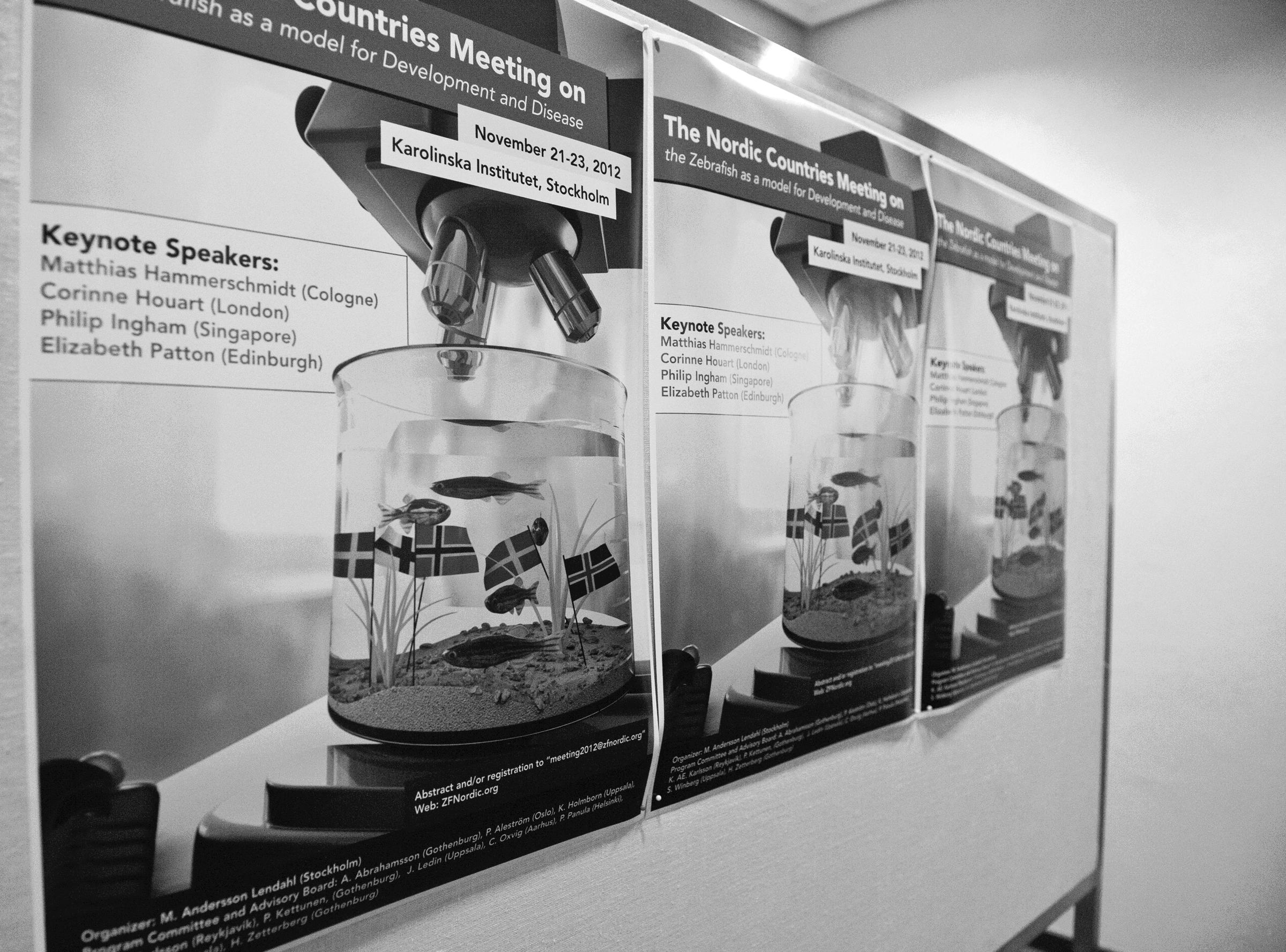
The conference poster announces the first Nordic Countries meeting on the Zebrafish as a model for Development and Disease. The meeting was held at the Nobel Forum, Karolinska Institutet, Stockholm, Sweden, on November 21–23, 2012.
A strong field in Nordic zebrafish research, well represented at the meeting with presentations from both Swedish and Finish research groups, is the study of muscle development and modulation of spinal networks in locomotion.1–3 Other prominent fields discussed in several presentations were cardiovascular, cartilage, kidney and brain development, and the use of zebrafish in toxicological studies. New disease models for diabetes, Alzheimer's disease, and arthritis were presented, and two talks covered the regulation of the sleep–wake cycle. One presentation dealt with changes in transcript isoform dynamics during zebrafish differentiation and provided an update on the essential role of polyadenylation in the regulation of the expression of maternally deposited mRNAs. 4 Another presentation reported on studies of the evolution of visual opsin genes in relation to early vertebrate tetraploidizations in a manner similar to what has been done for other gene families in the phototransduction cascade. 5 Two new techniques were presented: (i) live tracing of cell lineages using a Cre-reporter line with improved optical properties (contact person: Bettina Ryll at bettina.ryll@ebc.uu.se) and (ii) a rapid whole mount in situ and immuno-hybridization technique to be used in automated screens (contact person: Nina Kaukua at nina.kaukua@ki.se).
Keynote speaches were given on (i) melanocyte development and melanoma models by Elizabeth Patton, (ii) bone and skin formation and wound healing by Matthias Hammerschmidt, (iii) forebrain development by Corinne Houart, and (iv) hedgehog signaling and skeletal muscle development by Philip Ingham. One important topic was the lack of formal guidelines and standard operating procedures for zebrafish housing, husbandry, and health monitoring. Several research groups reported that they sometimes face unrealistic demands and challenges from national regulatory expert authorities on, for example, fish density and facility requirements. In this context, the presentation by Ann-Christine Eklöf on the BM0804 EuFishBioMed project was particularly welcome (www.cost.eu/domains_actions/bmbs/Actions/BM0804). The project is a joint venture between the European Cooperation in Science and Technology (COST) and the Federation for Laboratory Animal Science Associations (FELASA), with the overarching goal to promote research on and use of small fish as models in biomedical research. At present, the working group is reviewing available information on basic housing and husbandry practices with the aim to publish guidelines during 2013 and is still open for input and interaction (contact person: Ann-Christine Eklöf at Ann-Christine.Eklof@ki.se).
Summary
The first Nordic Countries Meeting on the Zebrafish as a Model for Development and Disease marks the start of a new meeting series that will provide excellent opportunities to disseminate knowledge on zebrafish as a laboratory animal in the Nordic countries. The meetings are intended to be complementary to larger international congresses and have a focus on resource-sharing, education, and networking. As a supportive action, a Nordic zebrafish research network was created (zfnordic.org).
Footnotes
Acknowledgments
The Meeting was supported by the Swedish Research Council and with sponsorship from BergmanLabora AB, Cryogenetics, Leica Microsystems, Loligo Systems, Union Biometrica Inc, Aquatic Habitats, BioNordika, Noldus, Sigma, ViewPoint, Visualsonics, Abcam, and Gene Tools LLC. The poster artwork and the photograph was kindly provided by Mattias Karlén and Linda Lindell, respectively.
Disclosure Statement
No competing financial interests exist.