






Abstract
Abstract
Many assays are used in animal model systems to measure specific human disease-related behaviors. The use of both adult and larval zebrafish as a behavioral model is gaining popularity. As this work progresses and potentially translates into new treatments, we must do our best to improve the sensitivity of these assays by reducing confounding factors. Scientists who use the mouse model system have demonstrated that sex and age can influence a number of behaviors. As a community, they have moved to report the age and sex of all animals used in their studies. Zebrafish work does not yet carry the same mandate. In this study, we evaluated sex and age differences in locomotion behavior. We found that age was a significant factor in locomotion, as was sex within a given age group. In short, as zebrafish age, they appear to show less base level locomotion. With regard to sex, younger (10 months) zebrafish showed more locomotion in males, while older zebrafish (22 months) showed more movement in females. These findings have led us to suggest that those using the zebrafish for behavioral studies control for age and sex within their experimental design and report these descriptors in their methods.
Introduction
Some studies have noted variability among zebrafish relating to a variety of behavioral tests that can be attributed to genetics or phenotypic characteristics.6–9 Magguran et al. demonstrated that the mating tank itself used in behavioral studies can lead to sex-specific behaviors. 10 In experiments which include the interactions of multiple zebrafish, sex and color11,12 and age13,14 have been shown to be determinants of behaviors, including interactions between fish and locomotion. However, more is necessary to understand the behavior of individual zebrafish.
The initial hypothesis of this work is that differences in sex and age of adult zebrafish may elicit significant differences in locomotion-based behavior of individual zebrafish measured using traditional assays. Understanding and defining any such contribution would be helpful in experimental protocol designs for zebrafish.
Materials and Methods
Zebrafish
All fish for the experiments were maintained by the Mayo Clinic Zebrafish Core Facility at 28.5°C and a 14:10 light:dark cycle.
Sex
15 male and 15 female zebrafish were individually placed into a mating tank with four equal size quadrants. Each fish was allowed to acclimate for 5 min before the test was started. One-minute intervals were used to monitor zebrafish locomotion. All measurements were done in real-time. Each time a zebrafish crossed a quadrant indicated one movement. Each fish was tested independently five times. Methodology was verified for accuracy by mentor partner.
Age
Age groups of zebrafish included 10 months, 22 months, and 32 months. The sex of fish used in the “Age Only” experiments was allowed to vary. Each age group was tested individually using 10 fish per group. Each individual fish was allowed to acclimate for 5 minutes before the test was started. One-minute intervals were used to monitor zebrafish locomotion. Each time a zebrafish crossed a quadrant indicated one movement. Each fish was tested independently five times.
Sex and age
Age groups from the previous experiments were used for an additional experiment in which sex was also controlled as a variable. Five male and five female zebrafish were used for each age group. Testing proceeded as described above.
Statistics
Averages, standard error, and graphing were performed using Microsoft Excel 2008. Student's t-tests for statistical significance were performed using the free online t-test calculator at http://studentsttest.com. P values in this work were calculated using the 2-tailed t-test. Analysis of variance for the overall effect was performed using St. John's University/College of St. Benedict Physics department's free online tool (http://www.physics.csbsju.edu/stats/anova.html) for ANOVA. Additionally, a Bonferroni correction was used to determine the threshold for statistical significance.
Results
Sex
The trial to compare male and female locomotion included 15 male and 15 female zebrafish ranging in age from 10 to 32 months. The data include five 1-minute trials for each of the fish. When age was not controlled within the experiment, male fish and female fish did not differ significantly in their baseline movement between quadrants (p=0.82, n=75 trials) (Fig. 1A).
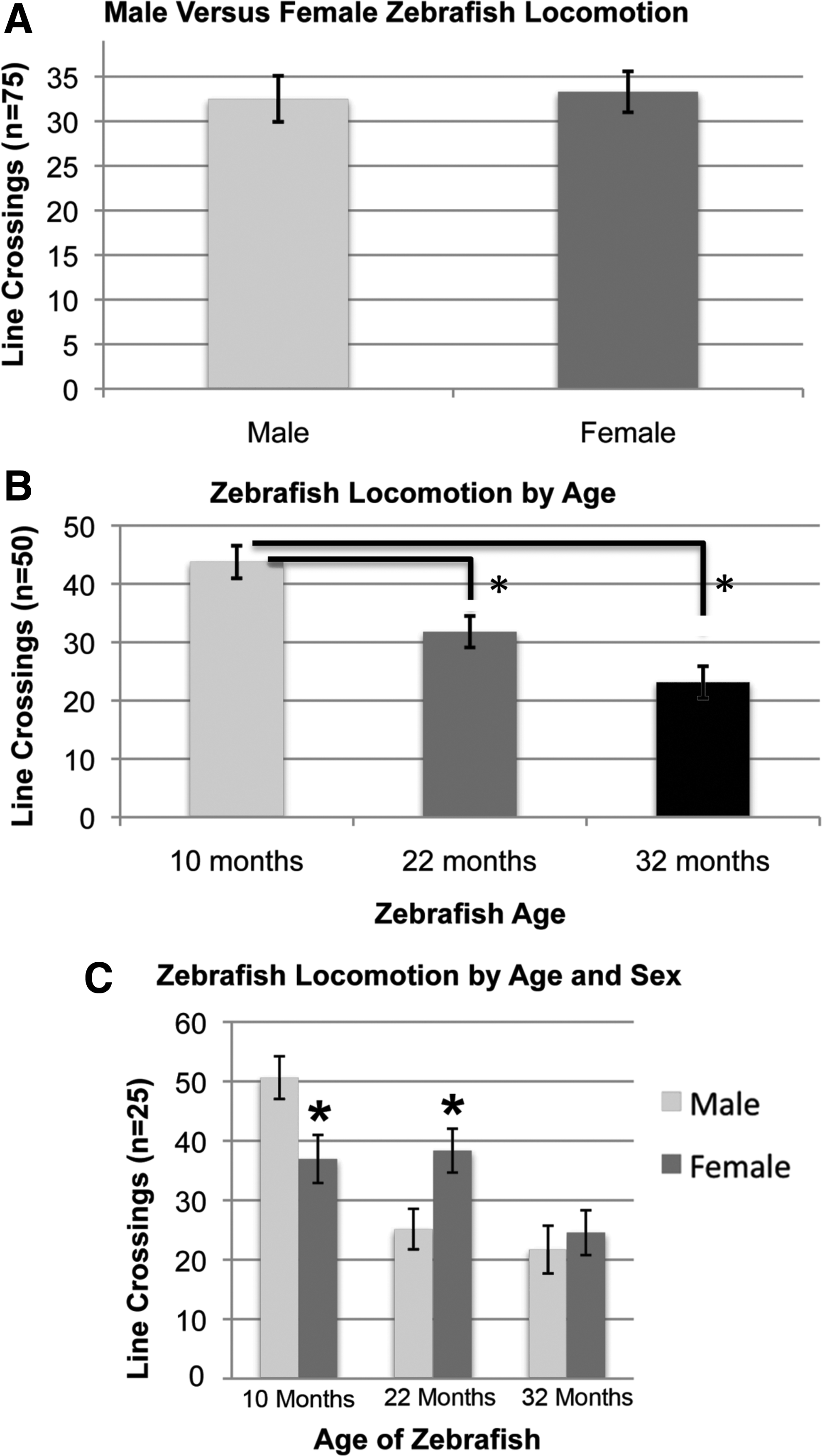
Activity of adult zebrafish independently and coordinately assessed by sex and age. Locomotion of adult zebrafish was described by the number of times a fish crosses a predetermined boundary in 1 minute.
Age
The trial to compare locomotion by age included 10 zebrafish at each of 3 ages (10, 22, and 32 months) (Fig. 1B). The data include five 1-minute trials for each of the fish. A decrease in motion was shown with increasing age of the zebrafish. In 10-month-old fish, an average of 43 line crossings (between quadrants) was documented. The 32-month-old fish showed nearly a 50% reduction to 23 line crossings on average. With sex of the fish not controlled, the fish of differing ages did show statistically significant differences in their total movement (average number of line crossings) using a Student's t-test, n=50 trials for each group. Differences between 10 and 22 months, p=0.003; between 10 and 32 months, p=9.6×e−7, 22 and 32 months p=0.035. Bonferroni correction based on 3 groups within the comparison and a 95% confidence interval, therefore show the first two comparisons to achieve significance (p<0.017). The latter comparison (22 vs. 32 months) does not. Analysis of variance for the overall effect revealed that as an overall effect, locomotion varies significantly by age of zebrafish (p<0.0001). The analysis of variance results are shared in Table 1.
The probability of this result, assuming the null hypothesis, is less than 0.0001.
Sex and age
Finally, we compared the locomotion of each sex within each age group (Fig. 1C). The data include five 1-minute trials for each of 5 fish, n=25 trials for each combination. Within the 10- and 22-month ages, differences in locomotion between males and females reached statistical significance (p for both=0.01). The differences in locomotion between males and females at 32 months was not statistically significant (p=0.6). The reduction in overall locomotion brought on by age (as described in Fig. 1B) appears to reduce total locomotion to a level that would require many more fish to reveal any potential differences in locomotion by sex.
Discussion
In this study, a simple locomotion assay was used to determine baseline differences in behavior potentially affected by the sex or age of our zebrafish. Age of adult zebrafish was shown to be a significant factor in differences between baseline locomotion. Sex of the zebrafish was initially shown to be insignificant. However, within a single age cohort of adult zebrafish, sex was a significant factor in fish of 10 months and 22 months of age.
Recent behavioral work with zebrafish show that size and color may be important determinants of locomotion and behavior. 15 Within this experiment, size was not measured, but there were not visually significant differences within a given age group. Wild-type coloration was also used for all experiments.
The switch in Figure 1C from higher movement in males at 10 months to higher movement in females at 22 months also drives further questions with regard to the priority of behaviors at any given age (i.e., food, safety, mate selection, etc.). 10 It will be interesting to follow up with fish prior to sexual maturity.
Studies in mice have similarly shown a significant influence by sex in behavioral assays. Duvoisin et al. demonstrated age-related differences within anxiety behavior assays on mice. 16 An et al. further demonstrated differences in anxiety and baseline activity of mice when compared by sex. 17 Others have indicated differences in mouse behaviors by sex as it relates to depression and food reward response.16,18–21 Following these findings, it has been recommended that scientists working with mice should specify the sex and age of the animals used in their studies. Many of the assays for mouse behavior tend to be more complex than plotted locomotion, but the data contained in this manuscript strongly suggest that those vested in behavioral assays using zebrafish should carefully analyze differences that may be present within their test groups. It also seems reasonable to suggest that publications on behavior using zebrafish should follow the advice of mouse behaviorists and report the age and sex of their animals.
Footnotes
Acknowledgments
The authors gratefully acknowledge: 1. Funding for the InSciEd Out partnership through the Center for Translational Science Activities Program Grant (NIH) at Mayo Clinic (UL1RR024150); 2. Stephen C. Ekker for the use of laboratory space and supplies; 3. Funding for student laboratory facilities through Lowe's grant (James Kulzer, Lincoln K–8 Choice School), and 4. Linnea Archer and her Language Arts class for active revision and proofing of manuscript drafts and revisions.
Author Biographies
Catie Philpott is now an 8th grade student at Lincoln K–8 Choice School in Rochester, MN. Corey Dornack is her science teacher. Margot Cousin is a graduate student with the Center for Translational Science at Mayo Clinic, Rochester, MN.
Disclosure Statement
No competing financial interests exist.