






Abstract
The purpose of this article is to describe the method of developing an internet-based reproductive options intervention to increase informed reproductive decision-making among individuals with sickle cell disease (SCD) or sickle cell trait (SCT). An interprofessional team of graphics and media specialist, nurses, physicians, and researchers collaborated to develop the intervention. Individuals from the community served as advisory board members who reviewed and advised on webpage design, content, delivery, and media. The intervention was theory based, delivered online, and experientially oriented for young adults of reproductive age with SCD or SCT. The intervention was culturally specific, supporting individuals with SCD or SCT in making informed reproductive decisions about transmission of SCD or SCT to their offspring. The intervention could be strengthened to include content on implementing behaviors concordant with informed reproductive decisions. Health care providers can use the result of this study to enhance their knowledge about the complexity of parenting options.
Introduction
In the United States, 1 of every 500 African Americans has sickle cell disease (SCD) and 1 of every 12 African Americans has sickle cell trait (SCT). 1 Between 2000 and 2006, 15,277 American infants were diagnosed with SCD in 44 states. 1 To treat approximately 100,000 individuals with SCD in the United States, the annual cost is 2.4 billion dollars. 2 Due to global migration, contributions to the U.S. SCD population include genetic sickle cell pools from Africa, the Middle East, Mediterranean, Central and South America, and India and Hispanic populations. 1 Individuals with SCD or SCT are at risk for having children with SCD if their reproductive partners have SCT or SCD. Current genetic counseling offered to parents after their child has been born with SCD is reactive. Reactive counseling can be distressing for parents who could have been proactive if armed with current evidence-based reproductive choices when aware of their own sickle cell status. Reproductive health decision interventions are necessary for young adults with SCD or SCT. Unfortunately, there are not many opportunities for young adults with SCD or SCT to receive comprehensive information about sickle cell inheritance and their options for reproduction.
An internet-based reproductive options intervention was designed to facilitate informed reproductive health decisions and behavior among young adults at risk for their children inheriting SCD or SCT. 3 A randomized controlled trial of the intervention showed statistically significant sustained intervention effects on the knowledge outcome. 3 However, the intervention effects were not significant for the intention and behavior outcomes, 3 which suggests the need for a critical appraisal of the intervention. The purpose of this article is to describe the method of developing this reproductive options intervention, including the need for the intervention and its theoretical basis, development process, content, and delivery process. We conclude with several recommendations for future directions.
Background
Among studies conducted on SCD, very few have focused on reproductive behaviors of young adults living with SCD or SCT. 4 We identified one study that investigated the efficacy of a clinically delivered, genetic education program for adolescents with SCD. 5 Porter et al. used a genetic counseling framework with a candy model strategy to convey genetic risks and found that adolescents were able to grasp the basic genetic inheritance concepts of SCD. Other quantitative studies explored the attitudes and beliefs and desire for reproductive health knowledge on SCD or SCT.5–8 Each of these studies was conducted in the United States, except for Melaibari et al.'s study, which investigated views of young adults in Saudi Arabia on the national premarital screening program of the country. 9 Findings were similar across the board, with studies indicating a general lack of knowledge about reproductive options and sickle cell inheritance, and confusion about adequacy of resources for this information. The qualitative studies we identified follow a similar trend—exploring attitudes, beliefs, and reproductive decision-making of individuals with SCD or SCT.4,10,11 This body of literature indicates a dearth of interventions focused on the reproductive health information needs of SCD or SCT populations. A gap remains among studies providing reproductive options. An internet-based intervention3,12,13 is an exception. Gallo et al. 3 developed an intervention to educate reproductive-age adults with SCD or SCT on reproductive knowledge (genetic inheritance) of sickle cell. The preconception education intervention included options, such as adoption, preimplantation genetic testing, or not to parent, which could enable individuals to specify a parenting plan in advance of pregnancy. The internet-based reproductive options intervention was based on two guiding theories, the theory of reasoned action (TRA) and Kolb's experiential learning theory (ELT).
Theoretical basis
The TRA is a behavioral change theory shown to aid individuals in changing unhealthy or adopting healthy behaviors. 14 TRA served as a conceptual basis for the content of the CHOICES intervention. The constructs within TRA (e.g., behavioral beliefs, evaluation of behavioral outcomes, normative beliefs, and motivation to comply) steered the content for the intervention and measures of its effects (Fig. 1). Since the delivery of an intervention is just as important as its content, Kolb's ELT guided the delivery of the intervention as an engaging, interactive, and user-friendly electronic format. Table 1 provides an overview of knowledge and behavior content and is summarized within the four components of the ELT. The TRA and ELT provided a strong conceptual basis for the intervention development process.
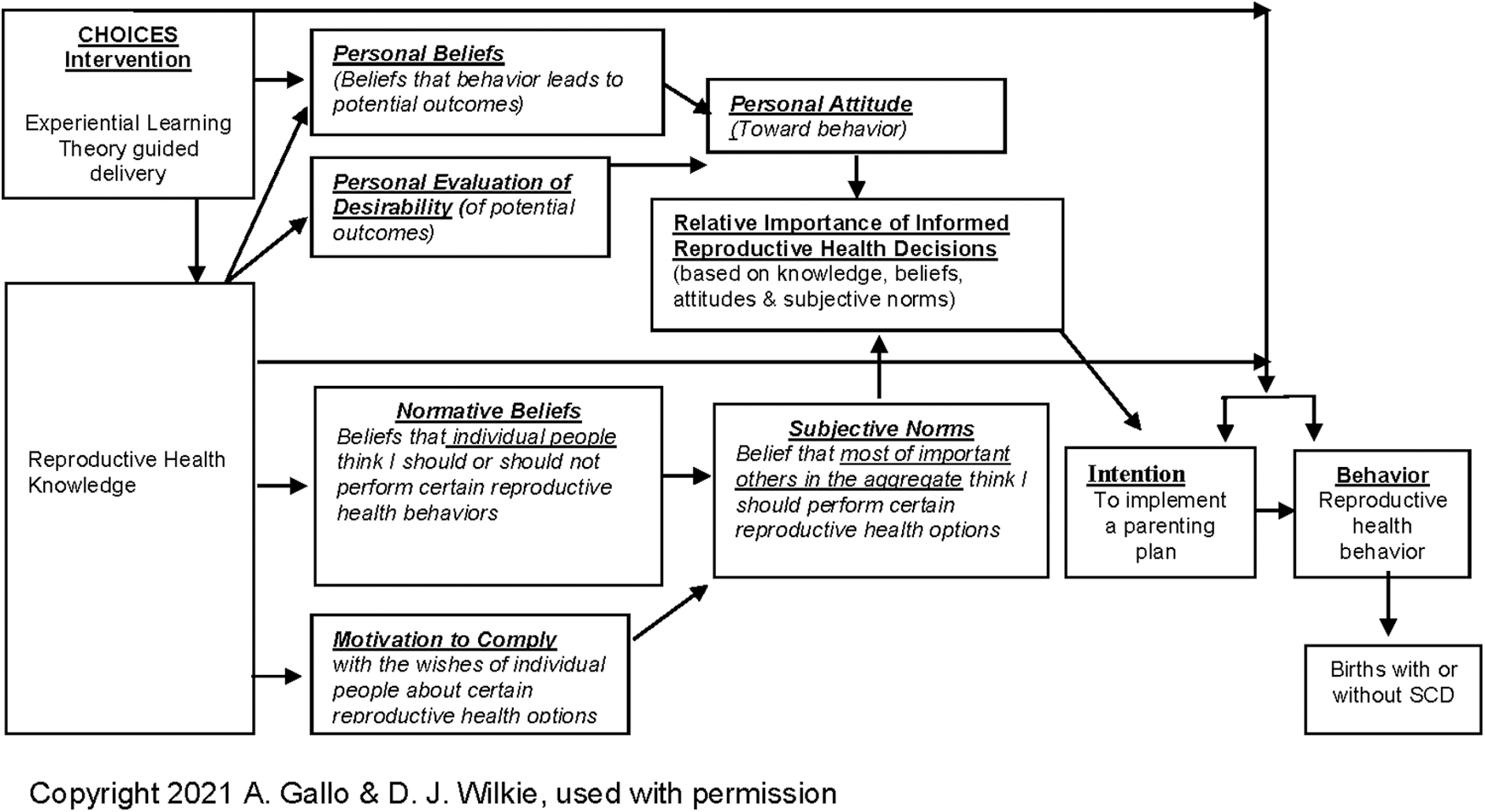
Theory of reasoned action: content bridging. SCD, sickle cell disease.
Overview of Knowledge and Behavior Elements of the Intervention: Organized by Kolb's Experiential Learning Theory
SCD, sickle cell disease; SCKnowIQ, Sickle Cell Knowledge Intention Questionnaire; SCT, sickle cell trait.
Intervention Development Process
A team of nurses, researchers, physicians, community members with SCD or SCT, a graphics and media specialist, and a software engineer collaborated in an iterative process to develop the reproductive options intervention. In collaboration with the community members, nurse scientists led the team, developed the content outline, and drafted intervention content and media scripts. Using expertise in genetics of SCD and human reproductive behavior, the research team used the TRA to focus the intervention's content around information an individual with SCD or SCT would need to make informed decisions about a preferred parenting plan. For example, individuals were provided information on the genetic inheritance of sickle cell, birth control options, and general information on adoption or fostering. Extreme care was taken to present all options equally and avoid presenting any option as more desirable. Permanent contraception, adoption, in vitro testing, and advanced reproductive techniques were all presented in a nonbiased informative manner. The content emphasized the notion that the individuals and their reproductive partners made the decision about their preferred parenting plan.
After content experts drafted the intervention content, other professionals and individuals with SCD or SCT expertise reviewed the intervention for accuracy and understandability. This review included a general review with mapping of the content to the TRA domains. Intervention content revisions were made based on an iterative series of reviews. Then, the nurse experts guided the graphic and media specialist to illustrate the content and develop the interactive components. The nurse experts also worked with the software engineer to develop the database and create webpages. The media specialist recruited the actors for interactive audio and video components and produced and edited the media, all of which required a considerable amount of strategic planning to ready the materials for the software engineer.
An advisory board of four (4) young adults with SCD or SCT reviewed the media/videos and webpage design. The advisory board reviewed the reproductive options intervention and their suggested changes were integrated and reviewed again to ensure that the revision sufficiently captured all suggestions. The research team tested the prototype intervention with a group of 10 young adults with SCD or SCT using a cognitive interview process, with findings supporting the validity of the intervention. 15
Description of the content
The knowledge and behavior content of the internet-based reproductive intervention is theory based, experientially oriented at the primary prevention level, and developed to improve public health, inform reproductive options, and assist with future pregnancy planning. The content is designed specifically for young adults of reproductive age with SCD or SCT to consider their reproductive health behaviors and options. Personal options are presented with preventive possibilities to avoid having a child with SCD. The content is fundamentally designed to improve public understanding of complex processes of genetics and inherited disease. The content involves translating TRA concepts (italics) within the constructs of Kolb's ELT
Content was developed to increase the understanding of reproductive risks for genetic transmission of SCD and SCT. The intervention informs of reproductive options, risks, and benefits for the woman with SCD. Individuals are provided up-to-date evidence and a list of possible steps designed to help them make reproductive health decisions (Table 2). The content also informs those who may or may not know their partner's SCT status about the importance of testing as part of understanding the genetic transmission of the disease. The intervention's evidence-based content is intended to change knowledge so that intentions and behaviors are congruent with their parenting plan. The
Examples of Behavioral Topics and Content Focused Within the Abstract Conceptualization and Active Experimentation Sections
ART, advanced reproductive techniques.
Examples of Videos Within the Experiential Learning Activities
Delivery process
The delivery of the intervention begins once the individual signs in and launches the Pretest, which needs to be completed before proceeding through the rest of the program (Fig. 2). The pretest is an online, 71-item, Sickle Cell Knowledge Intention Questionnaire (SCKnowIQ) developed to assess reproductive knowledge behaviors and intentions of those with SCD or SCT. 15 Once the pretest is completed, the participant moves to the introductory video screen that depicts two male actors having a conversation about one man's newborn daughter born with SCD and the problem of neither parent being aware of their SCT status. The inclusion of this video is in line with the concept of concrete experience in ELT, which is intended to give the learners a tangible experience as they begin to engage with education materials (Table 1).
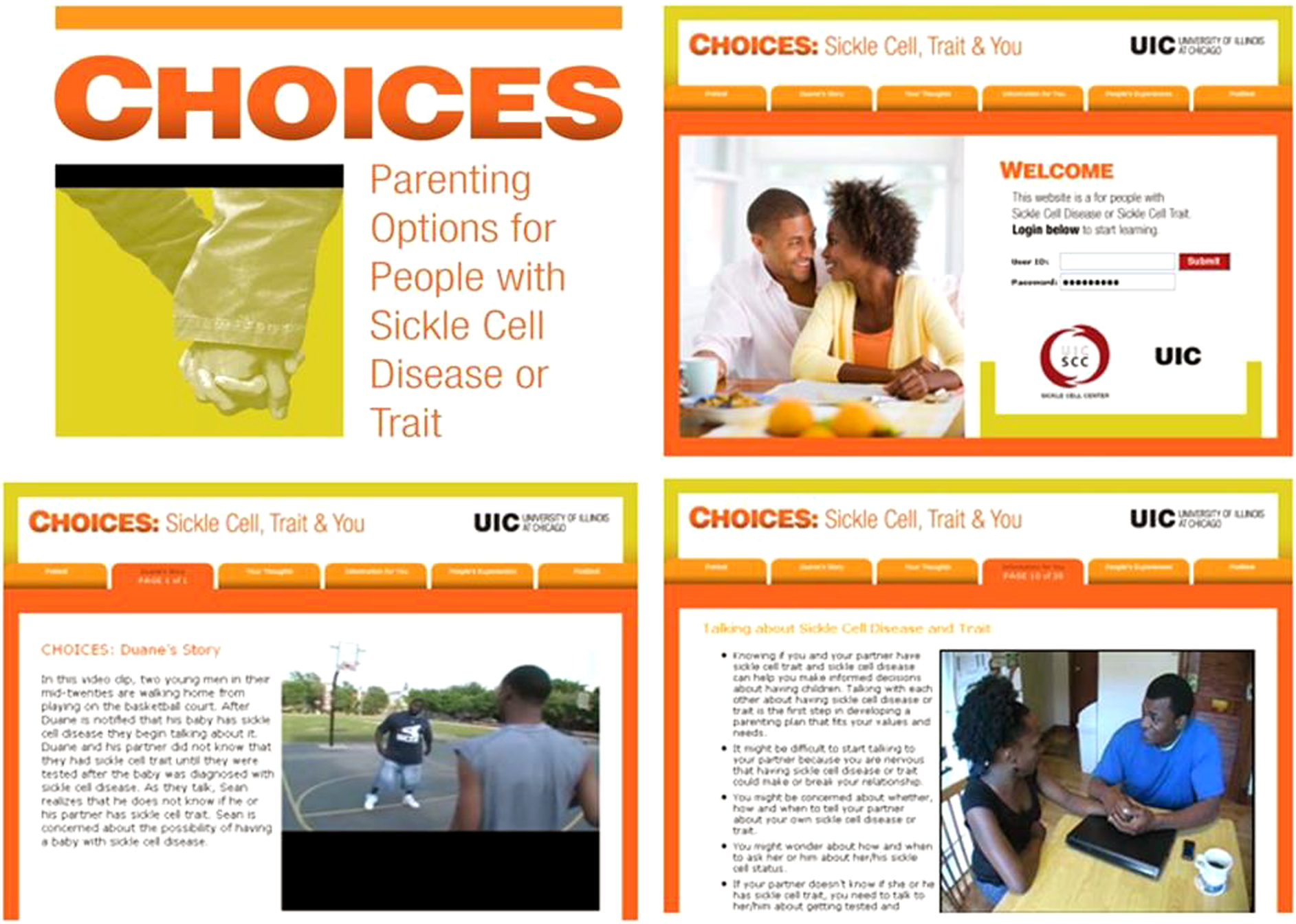
Examples of intervention screens.
The third tab (Fig. 2) on the user's intervention screen is Your Thoughts, which leads directly to the reflective observation. Your Thoughts asks the participants pointed questions related to their ideas and beliefs about SCD to personalize the concrete experience within the learner's normative beliefs and behavioral beliefs, concepts within TRA (Fig. 1). This personal reflection allows individuals to contemplate where they are with parental planning and what they may hope to achieve.
The fourth tab, Information for You, contains evidence-based information related to becoming a parent, genetic inheritance of SCT and SCD, and possible reproductive options such as having a baby naturally, adopting or fostering, or having prenatal testing. The information is presented in a myriad of ways such as text, audio/video clips, animations, photos, and testing one's knowledge to reinforce information learned (Table 2). This section provides interactive information about SCD and SCT while aiding participants in thinking about a parenting plan. Information for You content is modeled after ELT's abstract conceptualization component and bridges any gaps in knowledge, which is an important component of behavior congruent with the parenting plan (Fig. 2).
In the fifth tab, People's Experiences, participants are presented with five scenarios, which may mirror the situation they find themselves in. The active experimentation component of ELT appears in the People's Experiences section and users can choose a scenario that best characterizes their situation and decision. This section provides role models of behaviors to implement various parenting plans and encourages individuals to make a list of steps required to reach their desired goals, an important factor of behaviors congruent with their parenting plan (Table 3).
The last section is the post-test, which like the pretest includes items from the SCKnowIQ. Once these items have been completed, the program generates a parenting plan that reflects the user's responses to the program and SCKnowIQ items. The user indicates if the parenting plan is an adequate representation of their goals. The parenting plan is tailored to each user's situation, listing behaviors in which they should engage to achieve their desired goals.
The experience of the intervention can be tailored to the participant's desired technology settings. For example, settings include a read-aloud function, which presents the information on the screen to the users in either a male or female voice, or the option for on-screen text without audio. These settings can be tailored at any point during the program.
Recommendations for Future Directions
Strategic use of the internet and mobile devices is ideal for dissemination of health information. 16 In this article, we describe development and content of a reproductive options intervention focused on improving knowledge, intention, and behaviors to implement a parenting plan in advance of pregnancy. This intervention was designed for delivery to young adults with SCD or SCT through the internet and mobile technology. The preferred method of communication among young adults appears to be the internet and mobile devices, 16 which positions this intervention to have an impact on a public health concern. Prior studies of the intervention showed that dissemination of tailored age- and population-appropriate information is possible with mobile technologies.3,13,15 Furthermore, interventions supported by digital technology also allow for global dissemination.
Critical analysis of the publications on intervention effects provides important insights for refining the intervention. Analysis of the theoretical basis, development process, content, and delivery process suggests that the intervention is an exceptional tailored intervention designed to educate young adults living with SCD/SCT about their reproductive options. The format and content of this educational intervention are optimal for future social media and SMS text formatting. The published evaluative comments from study participants17,18 indicate that the content needs to be strengthened in the area of reproductive health concerns of same-sex couples. The nonsignificant improvement in behavior change to implement the individual's parenting plan indicates that the reproductive options intervention could be strengthened to include educational content on implementing behaviors concordant with informed reproductive decisions.
Critical analysis of the publications also provides important insights for designing another randomized controlled trial. The study design to test intervention efficacy requires careful consideration of eligibility criteria. Clearly, there is a need to recruit study participants whose reproductive partners' status puts them at risk for having a child with SCD and who express the intention of soon having a child free of SCD. Inclusion of individuals not at risk or not intending to have a child free of SCD, who do not need to change their behavior to be concordant with their reproductive decisions, decreases the power to detect an intervention effect among individuals who do need behavior change to achieve their own goals.
The reproductive options intervention holds promise to support individuals with SCD and SCT in making reproductive decisions and, with enhancements, could assist individuals or couples in implementing behaviors concordant with their informed reproductive decisions. A future application of the intervention could enhance health care provider knowledge about the complexity of information needed for parenting plan options and translate evidence-based information to the stakeholders.
Footnotes
Author Disclosure Statement
No competing financial interests exist.
Funding Information
This research was made possible by Grant Numbers U54HL090513 and 1R01HL114404 from the National Institutes of Health and National Heart, Lung and Blood Institute. Its contents are solely the responsibility of the authors and do not necessarily represent the official views of the National Heart, Lung and Blood Institute. The final peer reviewed manuscript is subject to the National Institutes of Health Public Access Policy.