






Abstract
Background:
Over the past three decades, there has been a 900% increase in the number of women experiencing incarceration in Minnesota. We wished to test whether handwriting, as creative visual art expression for women in jail, would be a positive experience for them as well as for individuals viewing the artwork during expositions.
Methods:
Over a 2-year period, the principal artist invited women residents from four separate county jails in Minnesota, to handwrite their thoughts on a sheet of paper. Two hundred twenty-three women residents participated in the artist-led handwriting/visual art sessions and gave permission to use their authentic script, anonymously, for presentation in a 3-D visual art form. At the conclusion of the sessions, a survey was offered at each venue, which asked three questions relative to the participation in the handwriting art project: (1) Did it have a positive impact on me? (2) Would you recommend it to other women who are incarcerated? (3) Do you want to participate in more projects such as this during your incarceration? The resulting artwork of more than 1,000 sculptures, each exhibiting a portion of the women's original script, was displayed at several public showings and a survey was offered at each venue, which asked: (1) Did the exhibition increase awareness of mass incarceration of women? (2) Did it help the viewer see women who are incarcerated? (3) Did it make the viewer realize that action is needed to reduce incarceration of women? Survey questions were graded from 1 to 5, with a sliding scale from strongly disagree to strongly agree.
Results:
The impact of this project of art activism has been very positive on both participants and the larger audience. The vast majority of women residents responding to the survey either agreed or strongly agreed that their participation in the project (1) had a positive effect on them (94%), (2) would recommend it to other incarcerated women (94%), and (3) would want to participate in more projects such as this (93%). A total of 425 surveys were collected among the audience at several sites: the law school (N = 87), open studios (N = 268), and a public library (N = 62). The vast majority of individuals responding to the survey either agreed or strongly agreed that the exhibited work (1) increased awareness of the problem (93%), (2) showed the humanity behind the script (88%), and (3) suggested that interventions were needed to address the problem (86%).
Conclusions:
Women under incarceration in county jails, who participated in a visual art handwriting program, as part of a collaborative visual art project led by principal artist, found great value in the sessions and agreed that such programs should be available to other women in detention. The overwhelming majority of the audience of the resulting exhibitions in public venues strongly agreed that interventions are needed to address the mass incarceration of women in Minnesota, suggesting the importance of art as a vehicle for increasing awareness about social problems and perhaps social change.
Introduction
Art exhibits have been shown to be an important format to highlight shared values among patients and providers in the health care system 1 and, when used in public venues, can serve as a valuable tool to address inequities of diverse members of our community.2,3 Empathy, expressed through the arts, may be one of the most important ways that our society can reduce polarization between individuals with different backgrounds. This is particularly true in the present times, where the novel COVID-19 virus coupled with excessive police force against BIPOC (Black, Indigenous, People of Color) has marginalized many unfortunate members of our communities. The combination of COVID-19 among individuals incarcerated in jail led to grave implications about the welfare of citizens in urban America. 4
Women create strong foundational forces in communities and we need to ensure that all women have a chance to leverage their unique sensibilities to create harmony and sustainability in their neighborhoods and places of employment, so that we all can survive and flourish. This project was stimulated by the rate of incarceration among women in Minnesota, which has increased nearly ninefold over the past 30 years. The effects on their lives as primary caregivers to their children need to be recognized. 5 Although the reasons for this escalation of mass incarceration of women are multifactorial, it is clear that the inequities within the judicial system related to mass incarceration, particularly among BIPOC and poor women, need better scrutiny. 6 We need action on all fronts to eradicate the control of the criminal justice system affecting more than 1,000,000 women nationwide.
Art evokes empathy, and this format may be one of the most important tools to address the need for social change.7,8 Using art forms of authentic handwritings from women under incarceration, the goal of this project was twofold. First, we wished to determine whether the implementation of scheduled art projects with women in jail could bring value to their lives. Second, we sought to determine whether demonstrating their art forms, highlighting their individual handwritings, could bring value to the viewing public. To determine whether the art project provided benefits, we offered questionnaires to both the women creating the art and the public viewing the authentic handwritings in art installations.
Methods
Art sessions with women experiencing incarceration
Between July 2017 and December 2019, the principal artist was granted the right to work with women experiencing incarceration in four separate county jails in Minnesota, lasting 1–2 hours/session. Of note, requests to offer art sessions by the principal artist to the Minnesota State as well as Federal Women's prisons had been formally denied. The goal was to engage the women by handwriting their thoughts and explore art techniques that expanded on the concept of handwriting as visual art, utilizing printmaking, painting, sculpting with clay, and embroidery techniques. At the conclusion of each workshop, a voluntary, anonymous survey was offered to every participant at each of the venues, and >90% of them responded to the questionnaires. The survey asked three questions about the session, including (1) Did it have a positive impact on me? (2) Would you recommend it to other women who are incarcerated? (3) Do you want to participate in more projects such as this during your incarceration? Each survey question was given a numerical response from 1 to 5, enumerating Strongly Disagree to Strongly Agree and a space for comments was available. At the conclusion of all sessions, the forms were collected and the data were entered into an Excel File for further analysis.
Art exhibits of handwritings of women experiencing incarceration
The principal artist applied the handwritings and incorporated them in art installations at six public venues serving different communities. At each of the public showings, a survey was offered to viewers, which asked three questions relative to the art exposition, including (1) Did it increase my awareness of mass incarceration of women? (2) Did it help me see women who are incarcerated? (3) Did it make me realize that action is needed to reduce incarceration of women? Each survey question was given a numerical response from 1 to 5, enumerating Strongly Disagree to Strongly Agree and a space for comments was available. At the conclusion of all sessions, the forms were collected and the data were entered into an Excel File for further analysis.
Results
Art workshops with women experiencing incarceration
Among the 4 county jails, 223 women residents participated in the voluntary artist-led handwriting/visual art classes and used their own handwritings to express their ideas (Fig. 1). At the conclusion of the sessions, they were offered a questionnaire and on a voluntary basis, provided feedback by completing the surveys. Based on the number of women in the workshops and the return of the surveys, completion was available for >90% of the women who participated in the classes. The vast majority of individuals responding to the survey either agreed or strongly agreed that their participation in the project (1) had a positive impact on them (94%), (2) would recommend it to other women who are incarcerated (94%), and (3) would want to participate in more projects such as this (93%). The data from each of the jails are summarized in Table 1 and Figure 2. A list of all comments from the women is provided in Table 2.

Handwriting during workshop. A woman participant in one of the jails is creating expressive handwriting as part of the visual art class.

Summary data from the questionnaires obtained from the 223 women at the four jails are shown for each of the questions. The overwhelming response was viewed as favorable for each of the questions.
Summary of Survey Responses from the Women in Minnesota Jails
Verbatim (unedited) Transcribed Handwritten Comments from Participants of Art Workshops in Four Minnesota Jails
The principal artist kept a diary for short notes written immediately after each session. It shows that an art form introduced by the principal artist of crumpled paper, bound tight together and suspended with a long string, hovering above the gallery floor, led to a participant's exclamation, “that is exactly how I feel.” Through their own handwritten visual art, participants expressed feelings of frustration, angst, anger, isolation, and more. Mothers frequently wrote about their children, how they deserved better than their parent in jail. There are chronological stories of “why” and poems about “here.” People imagined a safe home, free from abuse, reciprocated love, and work opportunities with childcare options, instead of drug dependency and mental health challenges. Most wrote about the importance of family that they have been barred from. Less than a handful out of all stories addressed how they finally had reached safety, including food and shelter; however, the majority stated that life was on hold in an unpleasant place with uncertainty for survival on release. Unedited submissions contained erasures and spelling bamboozles, with expressions such as “I am a rose without pedals,” “I lost my self-esteam to myself,” or “I am greatful to finally be leaving.” Others described physical and mental agony, in addition to loss of freedom: “hundreds of others have worn the clothing,” “changed my meds to suite the jail to make money,” and “I am wasting sitting here doing Nothing! Making no money!.” Many expressed faith and “everything happens for a reason.” Altogether, the writings offer deep insight and possible solutions that support lives rather than control them, including access to free counseling for mental health and substance addiction, living wage jobs, affordable childcare, housing, nutrition, and education. The project empowered the women by validating their feelings and self-actualizing their voice. The cries for self-realization need the attention of all community members for policy changes from within the affected group to explore ways that achieve self-fulfillment without state control.
Art exhibits of handwritings of women experiencing incarceration
Portions of the authentic handwritten reflections were traced by the principal artist through hand-stitching onto transparent polymer and embedded into artist-made individual 3-D sculptures for viewing. More than 1,000 sculptures, each exhibiting a portion of the women's original script, were created and exhibited in different configurations at each of the venues. An example of one of the art installations, at a local law school, is shown in Figure 3. A total of 425 surveys were collected, including those from exhibitions at law school (N = 87), open studios (N = 268), and a public library (N = 62). An informal counting of individuals viewing the art shows during open studios estimated that 10%–20% of viewers provided feedback by completing the surveys. The vast majority of individuals responding to the survey either agreed or strongly agreed that the exhibited work (1) increased awareness of the problem (93%), (2) showed the humanity behind the script (88%), and (3) suggested that action is needed to address the problem (86%). The data from all public showings are summarized in Table 3 and Figure 4, and a complete list of additional comments in the survey is provided in Table 4.
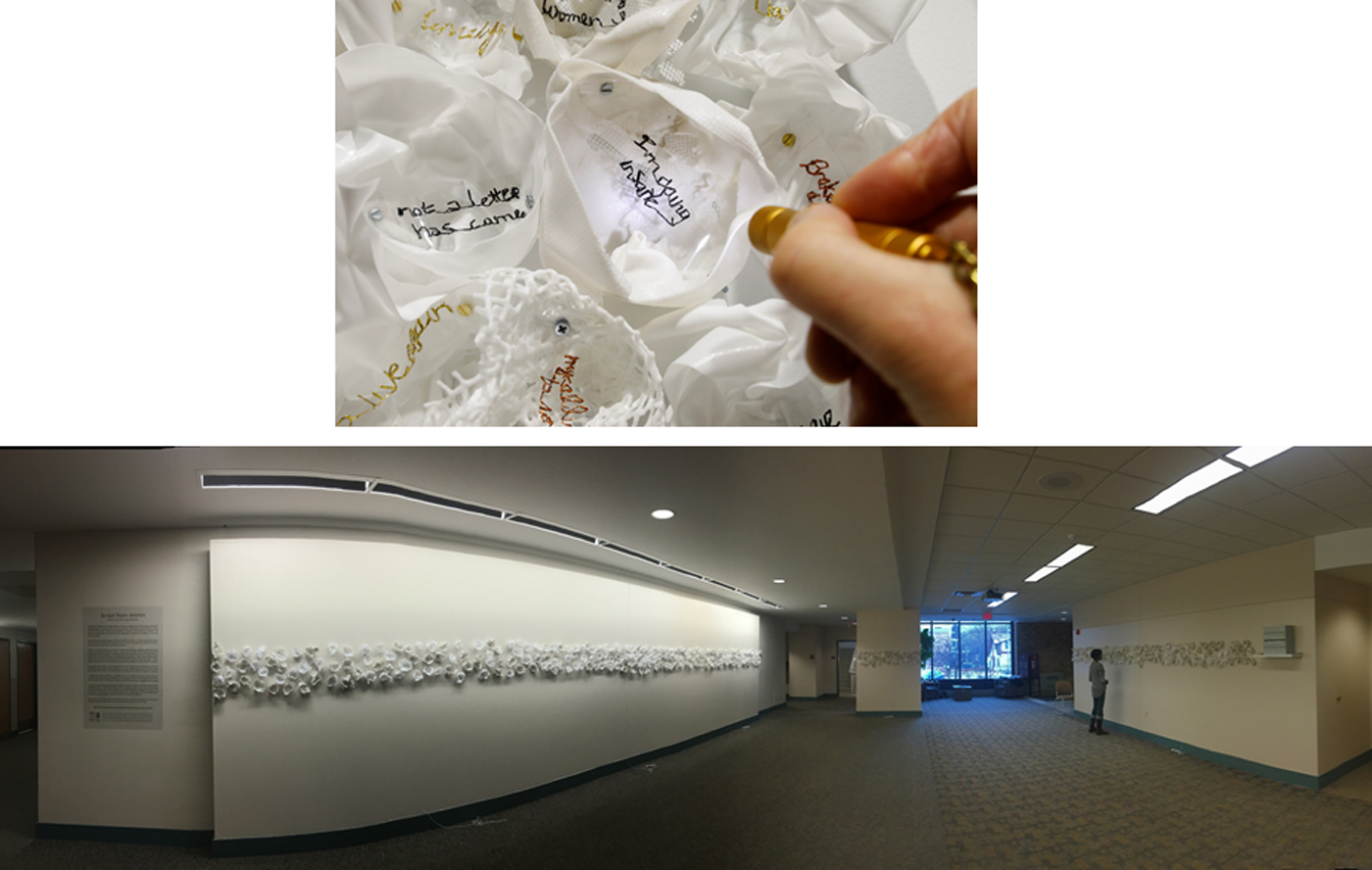
Installation art of handwritings. An example of an art installation is shown in detail and overview at a local law school. The original artwork of the handwritings has been embedded into the sculptures, for site-specific installations.

Summary data from the questionnaires obtained from the 425 respondents at the 6 public exhibition venues are shown for each of the questions. The overwhelming response was viewed as favorable for each of the questions.
Summary of Surveys from the Public Viewers at Six Art Venues
Verbatim (unedited) Transcribed Handwritten Comments from Viewing Audience at Six Public Exhibitions
Voluntary comments of the public show a deeper understanding on viewing the artwork. There is a universal pathos expressed in the sentiments that inspires not only empathy for the women's sad plight but also a sense of the shared, personal feelings of regret, longing, separation, alienation, helplessness, and even entrapment that we all experience to some degree as human beings in this unjust world.
Discussion
The principal finding of this analysis was that visual art involving original handwritings provides benefits both to women in the jails participating in the project and to individuals in society who were able to view the resulting art installations. The artist who was granted access to work with women residents at the jails invited women residents to explore their own handwritings and optionally share with a greater audience what is important to them. It may have provided a form of validation of their situation, and as demonstrated by the return of the surveys, was viewed favorably. There is ample evidence that creative forms of art among individuals in care facilities serve an important purpose for facilitating shared social connectedness among residents with an improved sense of well-being. 1 Among individuals with criminal justice involvement, use of participation in drama projects has shown favorable effects in altering the emotional state related to traumatic experiences and improves capacities to regulate interpersonal relations. 9 Similar favorable effects among individuals experiencing incarceration have been shown with meditation, as a means of fostering mindfulness-based stress reduction. 10 The women who participated in the creation of handwritings as visual art often commented in their work on their roles in motherhood, and the stresses that were created by their situation for dependents. Considering that 80% of women in jail are mothers and most are primary caretakers of the children, it is a critical problem to address how incarcerated mothers' parenting is intertwined with their health and sense of well-being. 5
The notion that art can be a catalyst for positive change, among both women locked up in jails and the public, is timely. Incarceration rates among women in Minnesota have increased logarithmically over the past three decades, and considering the recent events involving COVID-19, marginalized members of our community in jails represent the most vulnerable individuals. 4 The original handwritings of the women experiencing incarceration were traced through hand-stitching by the artist and embedded into individual sculptures. Site-specific installations were created at various public venues, and the response by viewers participating in the surveys was favorable. Many of the handwritings evoke emotion, inciting awe and wonder, which is an important tool to elicit empathy. 8 This highlights the importance of shifting the paradigm of incarceration from “tough on crime” rhetoric, to more inclusive messages, particularly related to the inherent humanity of alleged offenders. 11 It is very likely that the production of art validates many emotions of marginalized individuals who have suffered from the injustices of our legal system as well as the inequities created by poverty within communities. 6 Arts-informed approaches may be one of the most valuable means of engaging the public in disparities of marginalized members of the community. 12
Creating change to address mass incarceration requires many elements. Incarceration of women in Minnesota has increased ninefold over the past three decades, with a negative ripple effect through affected communities. The divide between women experiencing incarceration and society has led to a polarization, which can be addressed through the arts and its related expression of human empathy. These systems of punishment, control, and isolation should be abolished and replaced with human investments that allow all to thrive while being held accountable. It is through the arts that empathy can be the instrument of change.
In summary, we have shown that art, both in its creation of handwritings by women experiencing incarceration and in its amplified showings at public installations, offers great benefits. The funding sources through philanthropy are limited and unfortunately, many artists are unable to sustain their role in continuing their craft within marginalized communities. We hope that public policies will support marginalized individuals who suffer from inequities in the legal system with tools of creative self-empowerment that actively and holistically embrace their human spirit so that in time, in tandem with other efforts in the areas of social welfare, jobs, health, food, education, housing, and environment, inequities become obsolete with a just future for all. Art can be a great tool toward one's self-fulfillment and purpose under adverse circumstances.
Footnotes
Acknowledgment
The author/artist acknowledges the strength and resilience of the amazing women she had the privilege to engage with at art workshops in jails and thanks all people who contributed via surveys.
Author Disclosure Statement
No competing financial interests exist.
Funding Information
Funding for the project was provided, in part, through a Minnesota State Arts Board Grant.