






Abstract

Introduction:
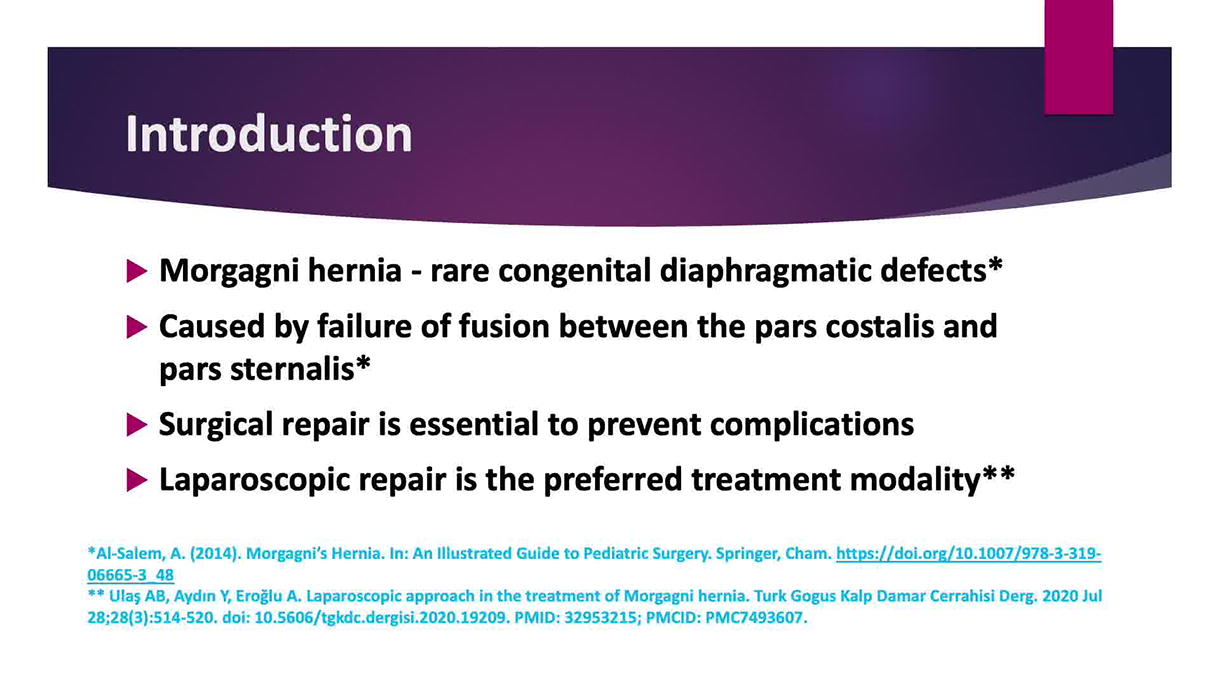
Morgagni hernias are a rare type of congenital diaphragmatic hernia first described in 1769 as an anterior retrosternal defect, 1 resulting from failure of fusion between the pars costalis and pars sternalis part of diaphragm 2,3 . It is more common in children and often goes undiagnosed in adults until chest imaging is performed for unrelated reasons. Most cases (91%) occur on the right side, with 5% on the left and 4% bilateral. 4 Surgical repair is crucial to prevent complications such as strangulation or incarceration of the bowel and omentum. These hernias have been traditionally repaired by the open abdominal or thoracic approaches. Several authors have described hybrid repair of Morgagni hernia, where the hernia defect is closed initially by open technique followed by laparoscopic implantation of composite mesh. 5 This video illustrates a case of a Morgagni hernia repaired successfully via a laparoscopic approach using both transfascial and intracorporeal suturing with mesh reinforcement.
Methods:
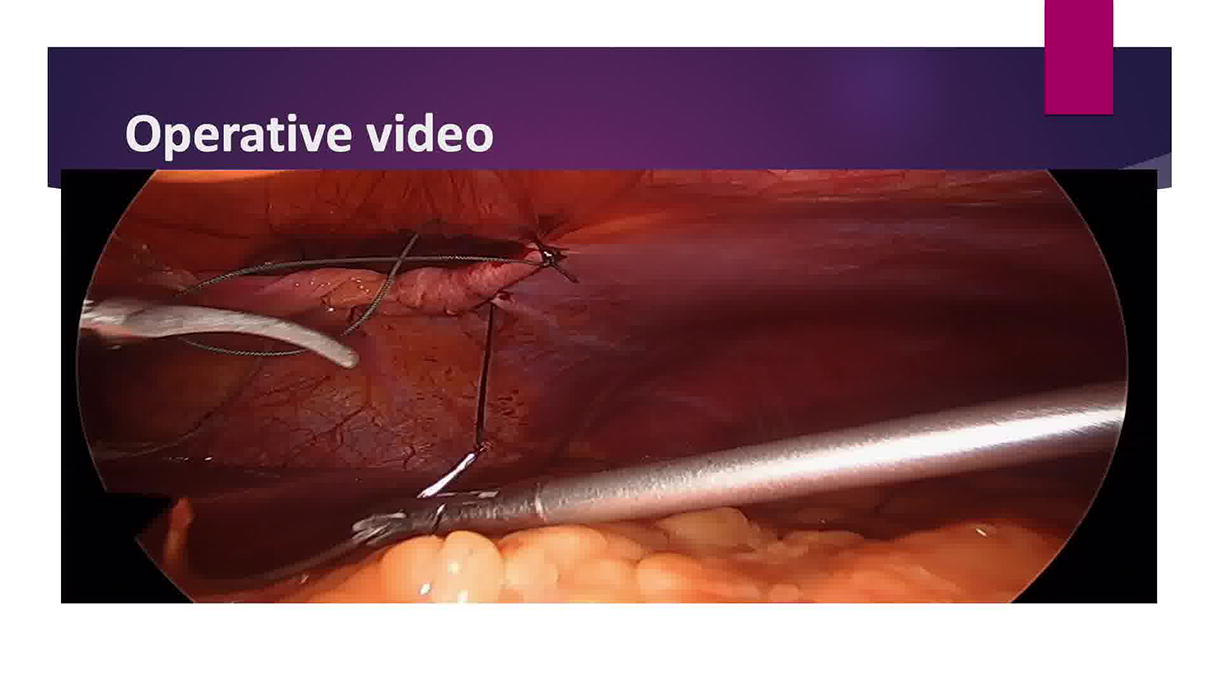
A 25-year-old male presented with a dry cough for 8 months. The imaging confirmed a large Morgagni hernia. He underwent laparoscopic repair of the defect with mesh reinforcement. On diagnostic laparoscopy, a large part of the omentum and transverse colon was noted in the hernia defect. Gradual reduction of the abdominal viscera was performed using atraumatic graspers, which yielded a defect of 5 × 4 cm. To reduce tension, trans-fascial sutures were used in a U configuration. The defect was then closed with Ethibond intracorporeally. A 15 × 15 cm composite titanium-coated mesh was used with sufficient overlap. The mesh was fixed using fibrin glue and prolene 2-0 intracorporeal suture toward the pericardial and diaphragmatic side to avoid injury to vital structures. Postoperative chest X-ray at 10 months revealed a normal study with no features of recurrence.
Conclusions:
Laparoscopic repair of Morgagni hernias with combined intracorporeal and transfascial suture closure of the defect along with composite mesh reinforcement using glue and suture fixation is safe and feasible and leads to reduced morbidity when compared to traditional open repair.
Patient Consent Statement:
The corresponding author have received and archived patient consent for video recording/publication of the video without exhibiting patient demographic details in advance.
Source of work or study:
This is an original work carried out in a tertiary care public hospital, and there are no conflicts of interest or obligations resulting from it to any of the authors.
Author Disclosure statement:
There are no commercial associations during the last 3 years that might create a conflict of interest in connection with the video.
Authors have already received and archived patient consent for video recording/publication of the surgical procedure video without exhibiting patient identity in advance.
Runtime of video:
7 mins 46 secs.
Get full access to this article
View all access options for this article.