






Abstract

Introduction:
The Hartmann’s reversal procedure may be associated with high morbidity and mortality rates, 1 –4 leading to non-reversal rates of up to 40%. 3,5 Minimally invasive approaches are preferred due to their benefits, including improved cosmetic outcomes, 6 faster recovery times, 6 –8 and comparable efficacy to open techniques. 4 –6 This video shows the feasibility, safety, and efficacy of a handmade single-port laparoscopic Hartmann’s stoma reversal procedure. 9 –12
Methods:
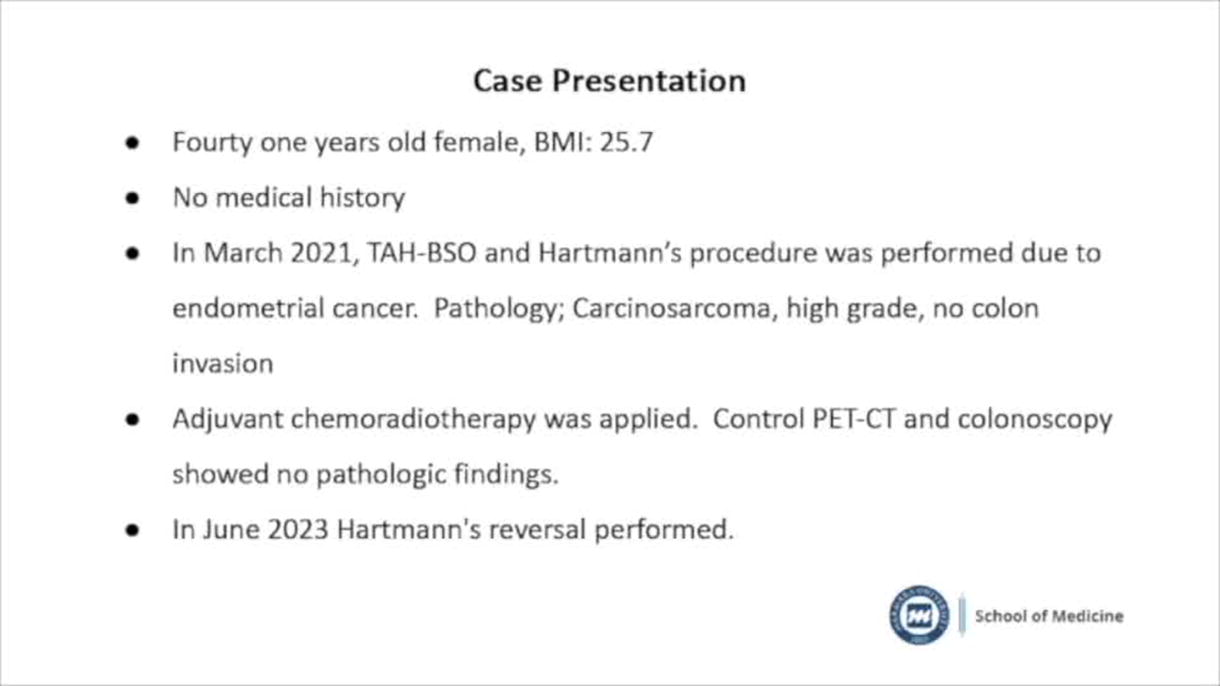
A 41-year-old female patient with a history of endometrial carcinoma invading the colon underwent total abdominal hysterectomy, bilateral salpingo-oophorectomy, and Hartmann’s procedure in March 2021. Following adjuvant chemo-radiotherapy, the patient underwent a handmade single-port laparoscopic Hartmann’s reversal procedure in June 2023. The patient was positioned in lithotomy position, with the left hand adducted, and Trendelenburg. The surgeon stood on the left side, the camera assistant behind the surgeon, and the second assistant between the patient’s legs. The instruments used included an Alexis retractor, sterile gloves, and 3–4 trocars. A circular incision was made around the colostomy, followed by complete liberation of the colon. The skin on the distal part was cut, and the anvil was inserted into the colon with purse suturing around it. The colon was placed into the abdominal cavity, and the Alexis retractor was set up. Insufflation of the abdominal cavity was performed, followed by insertion of the stapler performing the anastomosis. A gas leak test was conducted. Instruments were removed, and the facia was closed, followed by closure of the incision with subcuticular absorbable monofilament suture.
Results:
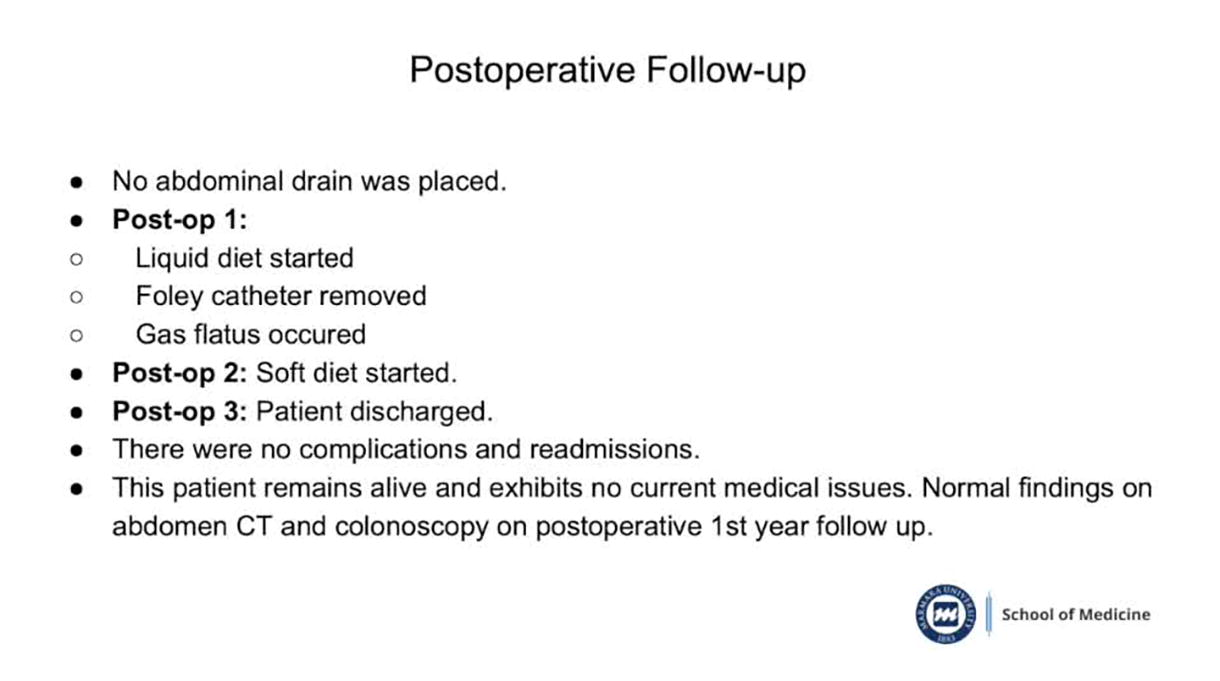
The patient initiated a liquid diet on postoperative day 1, followed by removal of the Foley catheter. On postoperative day 2, a soft diet was started, and the patient was discharged on postoperative day 3. Overall, the study included 27 patients who underwent handmade single-port laparoscopic Hartmann’s stoma reversal procedure. The median age of patients was 62 years, with a female-to-male ratio (n = 14, 60.9%). Successful completion of the procedure was achieved in 23 cases (85.2%), with a median operation time of 92 minutes and median blood loss of 100 mL. Conversion to open was needed in four cases (14.8%). In two cases (8.6%) splenic flexure mobilization was required. In two cases, small bowel injury occurred; in one case, stump injury occurred, and in one case, ovarian injury occurred during pelvic dissection. Postoperative complications occurred in five cases (21.7%), with two (8.6%) grade IIIa Calvin–Dindo complications requiring minor interventions. No anastomotic leaks or mortalities occurred. The median time to first gas flatus was 2 days, and a soft diet was initiated on postoperative day 2.
Conclusion:
This study highlights the potential benefits of handmade-single port laparoscopic Hartmann’s stoma reversal procedure. The feasibility, safety, and efficacy of this approach demonstrate its potential as a viable alternative to traditional open techniques. However, further research and experience are necessary to refine this technique and improve patient outcomes.
The patient was informed about the procedure in details, and an informed consent form was obtained. And before the procedure was performed, the patient was informed that the procedure would be recorded and potentially published as well.
The author has obtained an informed consent form from all 27 patients who underwent Handmade single-port stoma reversal procedure as well.
All authors declare no conflict of interest.
00:00–00:32 Background
00:32–01:10 Case presentation, positioning and instruments
01:10–02:14 Incision, liberating the colon and Anvil fixation
02:15–03:40 Set up of the Handmade Single-Port
03:40–04:00 Insufflation and exploration of the abdomen
04:00–05:05 Inserting of ILS and performing the Colorectal anastomosis
05:05–05:10 Gaz leak test
05:10–05:26 Taking instruments out and closure of facia and skin
05:27–05:50 Postoperative follow-up
05:50–05:55 Conclusion
Keywords
Get full access to this article
View all access options for this article.