






Abstract

Introduction:
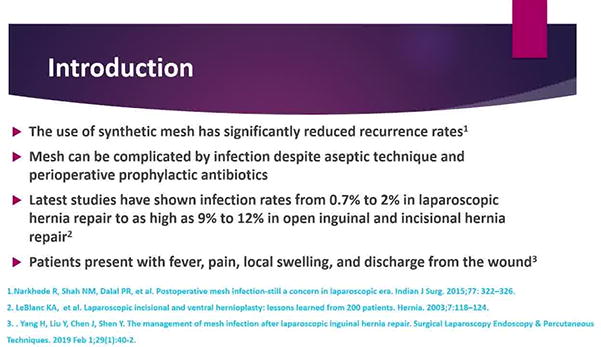
The use of synthetic mesh was a revolutionary development in hernia repairs, and its introduction dramatically reduced the incidence of recurrence. 1 However, new issues emerged, the most significant of which is a “mesh infection.” Initial nonoperative treatment includes intravenous antibiotics, percutaneous drainage, or negative pressure wound therapy. 2 However, mesh removal is still necessary and may be the most important step in the treatment of mesh infection. 3 Traditionally the infected mesh was removed by an open approach, which carries higher morbidity. 4 This video highlights a case of infected mesh, which was managed by a laparoscopic approach.
Method:
A 25-year-old male presented postoperatively with port site drainage after a laparoscopic TEP repair for a right inguinal hernia. The patient was initially managed nonoperatively but with no response. The patient underwent laparoscopic removal of the infected mesh. A drain was left in the right lower quadrant. The patient responded well to surgical treatment.
Result:
The abdominal drain was removed on postoperative day (POD) 2, and the patient was discharged on POD 3. For the initial 2 days, he was kept on intravenous antibiotics (Cefuroxime) and discharged on oral antibiotics (Cefuroxime) for the next 5 days. At a follow-up of 10 months, the patient is completely asymptomatic with no features of hernia recurrence on clinical or radiological examination (ultrasonography).
Conclusion:
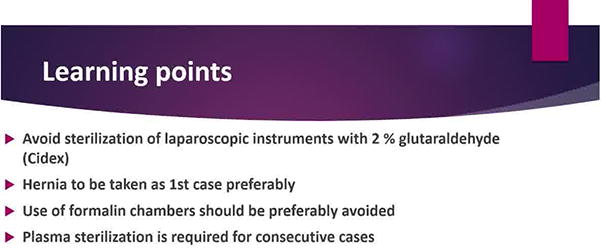
Laparoscopic management of infected mesh is a feasible option. Even the smallest breach in sterility might result in this complication that leads to increased treatment cost and morbidity. Even though systemic antibiotics and limited debridement may be utilized initially, mesh removal may be required to treat infected mesh.
Patient Consent Statement:
The corresponding author have received and archived patient consent for video recording/publication of the video without exhibiting patient demographic details in advance.
Runtime of video: 9’30”.
Exact runtime of video: 9 mins 30 secs.
The authors have already received and archived patient consent for video recording/publication of the surgical procedure video without exhibiting patient identity in advance.
Source of Work or Study:
This is an original work carried out in a tertiary-care-public-hospital, and there was no conflict of interest or obligations resulting from it to any of the authors.
Author Disclosure Statement:
There are no commercial associations during the last 3 years that might create a conflict of interest in connection with the video. The author has already received and archived patient consent for video recording/publication of the video without patient demographic details in advance.
Get full access to this article
View all access options for this article.