






Abstract
Introduction:
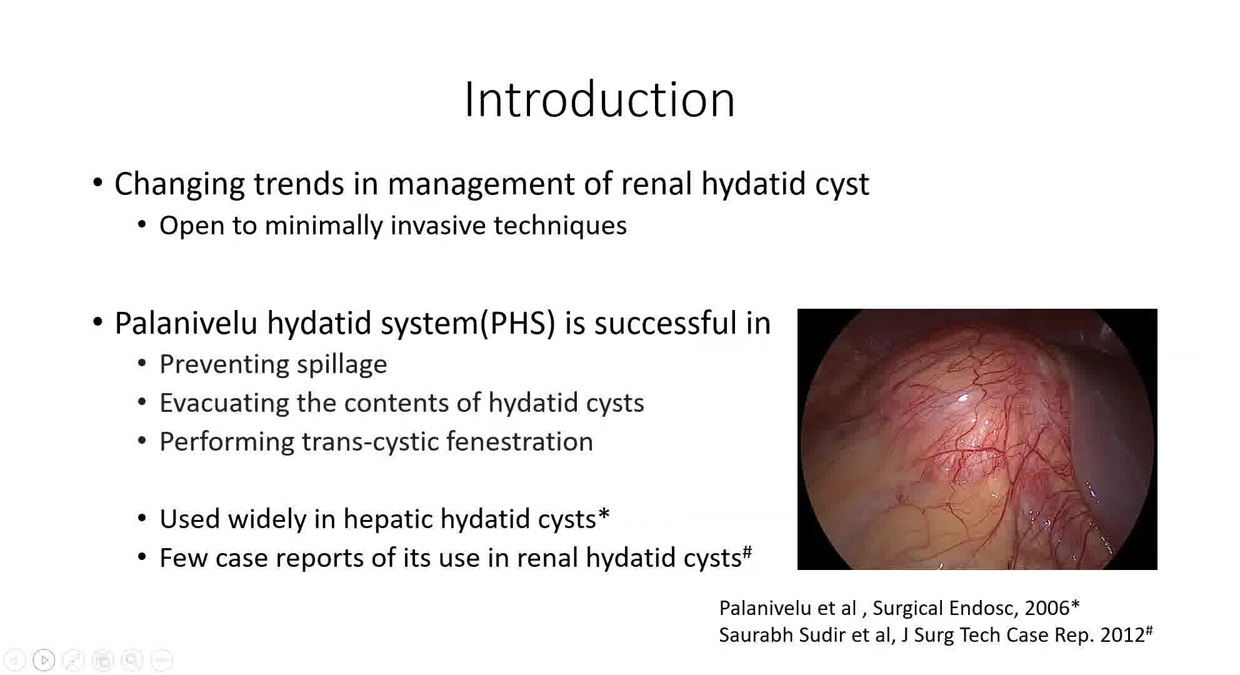
Hydatid disease is endemic in India. Kidney involvement is seen in only 2–5% of patients affected by the disease 1,2 There has been a change in the operative trend from an era of cysts excision and open nephrectomies to minimally invasive and hybrid procedures. Earlier attempts at laparoscopic treatment resulted in spillage of contents with risk of anaphylaxis and recurrence. 3 However, with the development of newer instruments like the Palanivelu Hydatid System (PHS), 4 hydatid spillage has dramatically reduced. This method, though initially popular and introduced for management of liver hydatids, is now used in the management of renal hydatid. This video describes the laparoscopic management using the PHS.
Materials and Methods:
The surgical technique of a laparoscopic deroofing with PHS and pericystectomy is discussed. The PHS is a 12 mm assembly of laparoscopic trocar and cannula. The trocar is introduced overlying the cyst, and the cannula connected to suction is placed in contact with the cyst. The trocar is introduced into the cyst, and spillage is prevented by suction into the trocar and cannula. The cavity is evacuated and visualized with a telescope. Hypertonic saline or 10% betadine is instilled for 10 minutes, and the cyst is marsupialized or excised. The advantage of the PHS is controlled puncture and prevention of spillage of hydatid contents while ensuring complete evacuation.
Results:
Twenty-one patients were treated in this period (12 male and 9 female). The median age was 41 years. Majority of the patients were from the north and the northeast part of India. The diagnosis of renal hydatid disease was achieved using ultrasonography in 6 patients and computed tomography in 15. Three patients underwent laparoscopic deroofing with PHS followed by pericystectomy. There was no spillage or other complications. At a median follow-up of 2 years, the patients are asymptomatic with no recurrence.
Discussion:
The utility of minimally invasive techniques for hydatid disease is gaining popularity. 4,5 With the introduction of the PHS for liver hydatid more than a decade ago it has been shown to aid in cyst fenestration and reduction in spillage of contents. 4 There is also reduced recurrence rates with use of this technology. 4,5 The incidence of renal hydatids is rare, and only a few case reports are published with little data on use of minimally invasive techniques. 2 In our early experience, we report its effective use (no spillage) and no recurrences at 2 years. The PHS is a useful tool in managing renal hydatid cysts laparoscopically. It reduces spillage and is effective in controlled puncture and complete aspiration. The size and location of cyst is important while advocating this approach.
Acknowledgment:
I would like to thank Mr. Jerome David for the help in acquiring images and video editing.
Consent was obtained from the participant with permission to use the intraoperative video for research and presentation.
No competing financial interests exist.
No funding was received for this article.
Runtime of video: 7 mins 34 secs

Get full access to this article
View all access options for this article.