






Abstract
Introduction:
Superior mesenteric artery (SMA) syndrome, also known as Wilkie's syndrome, is a rare vascular condition characterized by the abnormal course of the superior mesenteric artery, which arises from the abdominal aorta at a narrow angle (<22°). 1 This reduced angle compresses structures passing between the aorta and the superior mesenteric artery, such as the duodenum and the left renal vein. This abnormality potentially causes pain, intestinal obstruction, and left-sided varicoceles. 2 The SMA syndrome may be congenital or acquired. The acquired form, which is more common, is typically due to reduced perivascular adipose tissue surrounding the abdominal aorta and superior mesenteric artery. This form is often seen in anorexic patients who have experienced rapid weight loss. 3 Due to its rarity and the intermittent presence of symptoms, it is not uncommon that the diagnosis is delayed.
Methods:
A 24-year-old male patient presented to the emergency department with persistent postprandial epigastric pain, discomfort, and vomiting. The patient revealed that these symptoms lasted for 7 years and drastically worsened during the last few months and was associated with a 10 kg weight loss. Upon admission, a nasogastric tube was placed to relieve symptoms, and parenteral nutrition was started. First, the patient underwent an esophago-gastro-duodenoscopy, which showed a suspected compression of the third duodenal segment. A barium swallow test confirmed the finding. An abdominal ultrasound and a CT scan clearly showed a dilated duodenum up to the third segment and its compression between the aorta and the superior mesenteric artery. The aorto-mesenteric angle was 12°, highly suggestive of an aorto-mesenteric syndrome.
The patient underwent surgical treatment with a robotic-assisted duodeno-jejunostomy using the DaVinci Xi system with a 4-trocar technique. Four 8 mm robotic trocars were placed in a horizontal line 2 cm inferior to the umbilicus. A duodenal enterotomy was performed in the third portion of the duodenum, proximal to the stenosis. The jejunum was measured 50 cm from the Treitz's ligament. An enterotomy was performed, and a side-to-side hand-sewn duodeno-jejunostomy using two continuous V-loc 3-0 absorbable sutures was completed.
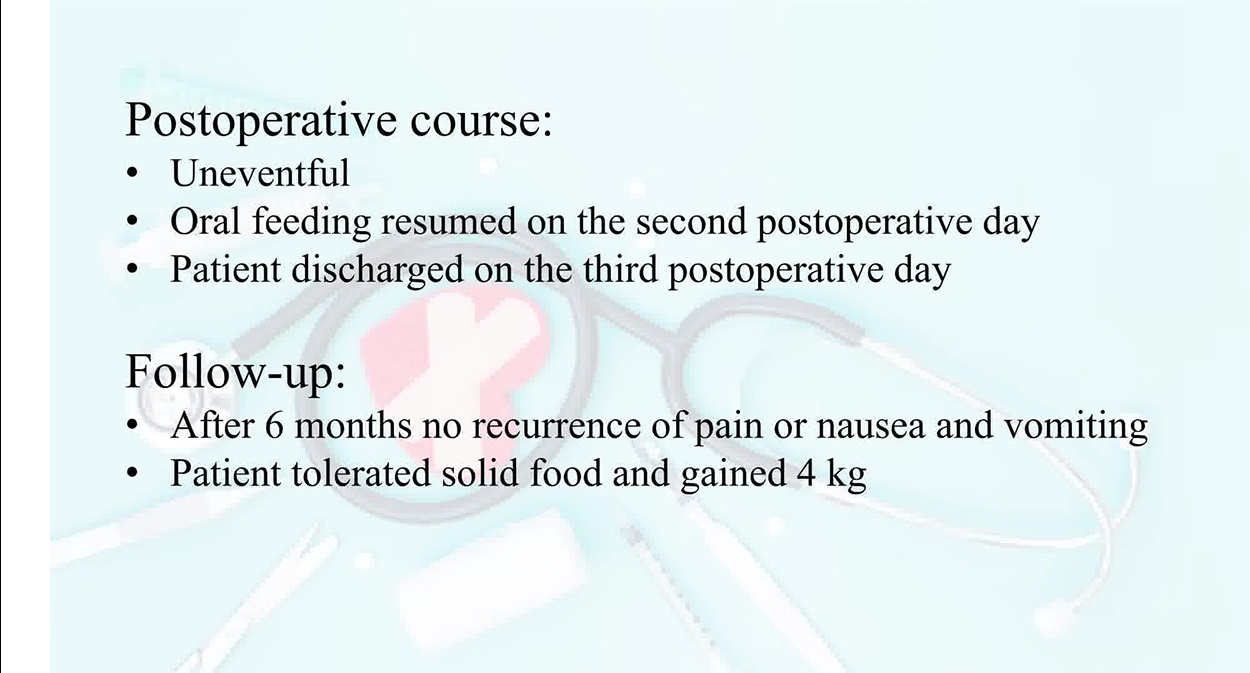
The postoperative course was uneventful, with oral feeding well tolerated from the second postoperative day. The patient was discharged on the third day after surgery. The patient was then followed up 6 months after surgery without recurrence of pain, nausea, or vomiting. Solid food was well tolerated, and there was a weight gain of 4 kg. No radiological study was conducted because the patient was symptom-free.
Conclusion:
Robotic-assisted duodeno-jejunostomy appears to be a viable surgical option for the management of superior mesenteric artery syndrome. This minimally invasive technique offers potential benefits in terms of reduced postoperative recovery time and improved patient outcomes.
Discussion:
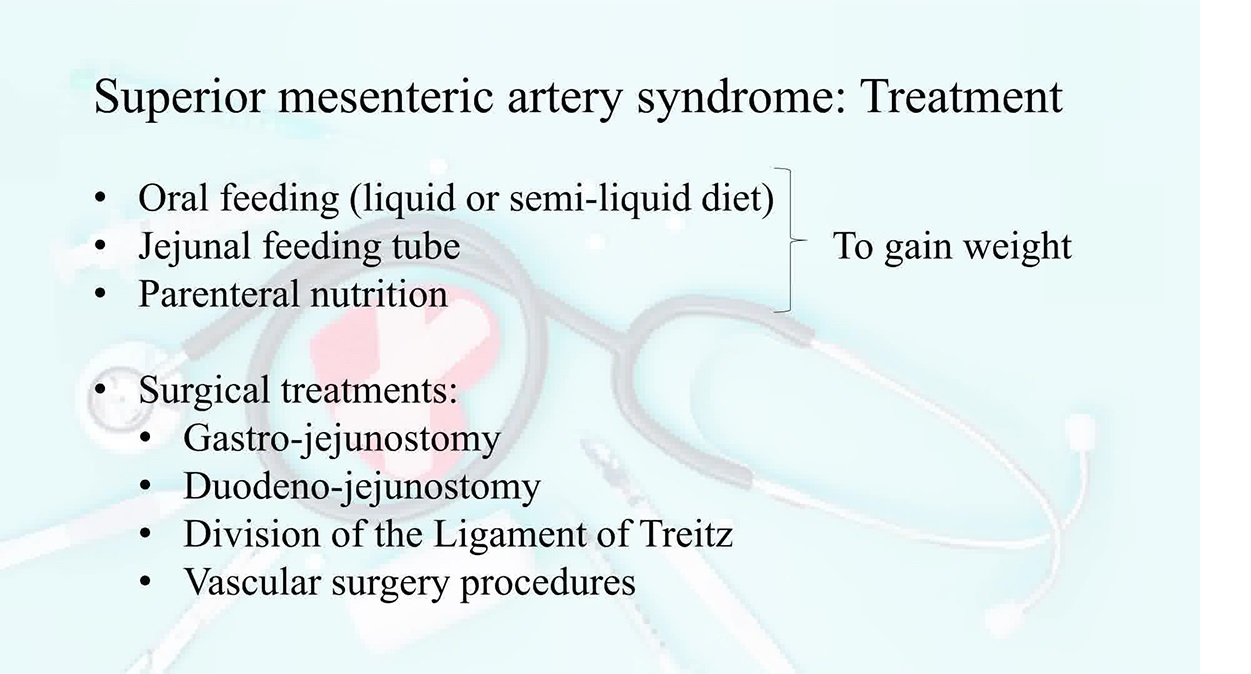
SMA syndrome is a challenging condition that often requires a multidisciplinary approach for diagnosis and treatment. 2 Often, a correct diagnosis requires several investigations, and the time between the appearance of symptoms and treatment is rather long. Historically, these patients were operated on using an open approach, as the operation itself might be challenging. Thanks to technological development, robotic-assisted surgery has emerged in the last decade. It allows for the carrying out of complex surgeries, especially in confined operatory fields and when challenging tasks (e.g., suturing and knot tying) are deemed necessary.
In our experience, the indication for surgery was given according to the clinical and radiological suspects. 1 A conservative approach (i.e., liquid diet, parenteral nutrition) was ruled out due to the severity of symptoms. We chose a minimally invasive approach to reduce postoperative pain and to allow a shorter postoperative recovery. The robotic-assisted approach was preferred over standard laparoscopy as it might be advantageous when complex tasks are required. 4 The duodeno-jejunostomy was successfully carried out, and no intraoperative complications occurred. The effectiveness of the operation was also confirmed during the follow-up as the patient started eating normally and gained weight.
No competing financial interests exist.
Authors have received and archived patient consent for video recording and publication in advance of video recording of procedure.
Runtime of video: 05 mins 17 secs

Get full access to this article
View all access options for this article.