






Abstract
Background:
Laparoscopic ventral hernia repair is known to provide less pain, fewer hospital days, and a lower complication rate than open hernia repair. Recently, extended totally extraperitoneal (eTEP) repair has been widely conducted for ventral hernia patients. Compared with laparoscopic intraperitoneal onlay mesh, it has been reported to reduce pain and hospital stay. 1,2 Most of the eTEP repair reported so far are accessed from the upper abdomen in costal curvature through multiple ports with blunt midline crossover procedure. 1 –5 However, there was no report of upward approach with reduced ports from the lower abdomen. This video presents the efficacy and feasibility of the upward approach of eTEP with selective nerve block for ventral hernia.
Materials and Methods:
Forty-six-year-old female patient with four parities visited our hospital for umbilical hernia. The size of the hernia defect in the CT scan was 3.2 × 2.5 cm with diastasis recti, and the patient complained of pain and cosmetic dissatisfaction when omentum incarcerated. Informed consent was obtained. The operation started in the lithotomy position with flexion, and a 2.5 cm Pfannenstiel incision was made. Using only a single-port device (Glove Port A®; Meditech Inframed, South Korea), we created an extraperitoneal space using LigaSure™ (Marlyand Jaw Laparoscopic Sealer/Divider; Covidien, USA). LigaSure ligation and cutting were used instead of blunt midline crossover, and by identifying the arcuate line, bilateral retrorectus space was consecutively created. Additional 12 mm trocar was inserted into the right lower quadrant for hernia sac dissection. After approaching the retrorectus space, barbed suture (Monofix® 0.23 cm; Samyang, South Korea) was used in closing the fascial defect and plication of linea alba. Before applying a sublay mesh, abdominal wall nerve block was selectively performed with <5 mL of 0.75% ropivacaine on each side. We have used medical glue for fixating the positioned mesh instead of using staplers to reduce postoperative pain. For cosmetic purposes, umbilicus was fixated onto the fascia also using barbed sutures. An analysis was performed with the safety and effectiveness of this method and the clinical course after surgery.
Result:
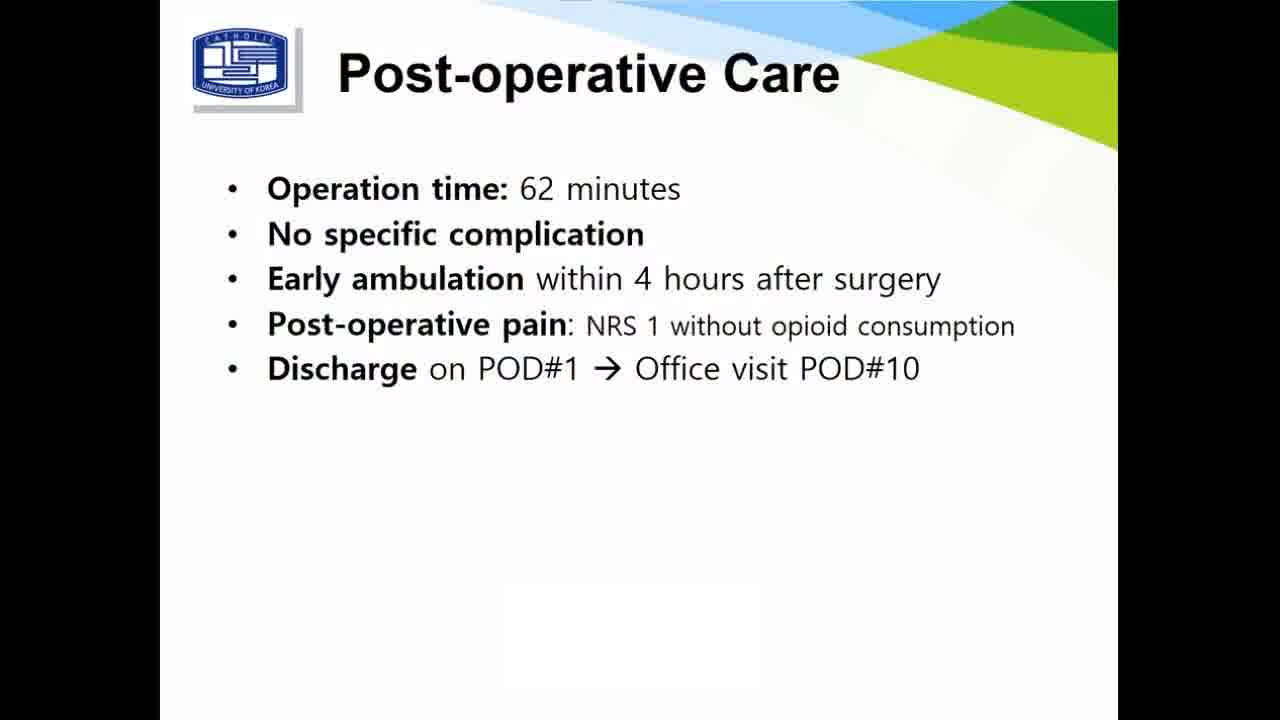
The operation was conducted for 62 minutes without any specific complications. Ambulation was possible within 4 hours after surgery. Postoperative pain score was checked numerical rating scale 1 without opioid consumption. On postoperative day 1, the patient was discharged and revisited our outpatient clinic without any complications at 10 days after surgery.
Conclusion:
Upward approach eTEP with selective nerve block for ventral hernia has a cosmetic effect as well as reducing the number of ports compared with conventional eTEP. In addition, it is a feasible and safe method with tolerable operation time, pain relief, and low complication rate.
Authors have received and archived patient consent for video recording/publication in advance of video recording of procedure.
Runtime of video: 9 mins 1 sec


Get full access to this article
View all access options for this article.