






Abstract
Introduction:
Identification of the uterine artery during laparoscopic surgery allows the surgeon to secure the uterine blood supply by permanent or temporary ligation if significant blood loss is anticipated. These scenarios include a myomectomy, cornual ectopic pregnancy, an enlarged uterus, or significant adhesions. The approach utilized for identification of the uterine artery should be tailored to the presenting pathology report and procedure. Several different techniques are demonstrated in this video. 1
Materials and Methods:
Three main categories of techniques are illustrated to identify the uterine artery at time of laparoscopic surgery using surgical footage obtained during laparoscopic pelvic surgery. This project was reviewed by the Institutional Review Board at the Mayo Clinic in Rochester, Minnesota, and was deemed exempt.
Results:
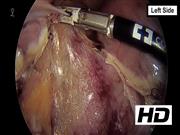
Methods of identification include lateral, medial, and cervical approaches. For the lateral approach, the pararectal space is entered lateral to the ovary and the internal iliac artery or ureter is traced in an antegrade manner to the origin of the uterine artery. Similarly, within the paravesical space the obliterated umbilical artery can be traced in a retrograde manner to the origin of the uterine artery. In the medial approach, the pararectal space is entered medial to the ovary and the ureter is followed beneath the uterine artery. At the level of the cervix, the uterine artery is identified by anterior or posterior division of the peritoneum. For each approach, identification of surrounding anatomy allows safe ligation without damage to the ureter, bladder, or other associated structures.
Conclusions:
Knowledge of each of these approaches allows the surgeon to safely identify and ligate the uterine artery regardless of patient anatomy or pathology report.
No competing financial interests exist
.
Funding:
Academic Medical Center.
Runtime of video: 7 mins 5 secs
Prior presentation: This study was previously presented as a video poster at the 44th Annual Scientific Meeting of the Society of Gynecologic Surgeons in March 2018 and as an oral video presentation at the American College of Obstetrics and Gynecology Annual Scientific Meeting in April 2018.


Get full access to this article
View all access options for this article.