





Abstract
Introduction:
Appropriate management of germ cell neoplasm of the testis depends on adequate staging and consists of a multimodal approach including inguinal orchidectomy, cisplatin-based chemotherapy, and retroperitoneal lymph node dissection (RPLND). 1 Given its vicinity to vital neurovascular structures and limited operative space, RPLND can be a challenging procedure. Robot assistance can facilitate operative management since robotics provides a magnified three-dimensional vision and ergonomic advantages for the surgeon. 2 Robot-assisted RPLND (RA-RPLND) has been reported as an established alternative for low stage testicular neoplasms. 3 But, its feasibility for postchemotherapy residual retroperitoneal disease is scarcely reported. 4 –7 This video presents an RA-RPLND in a setting of postchemotherapy residual masses in a patient with testicular neoplasm. The video discusses salient steps involved in managing such cases.
Methods:
A 23-year-old male with a history of right inguinal orchiectomy for a testicular neoplasm presented for further evaluation. His tumor markers were classified as S1 and computed tomography of the abdomen, pelvis, and chest revealed a 2.2 cm left para-aortic mass and solitary pulmonary metastasis. His disease was staged as IIIA and four cycles of BEP chemotherapy were administered. Postchemotherapy tumor markers normalized, the pulmonary lesions disappeared, but his PET CT revealed a residual mass of 2.3 cm at the same location. Consequently, the patient underwent RA-RPLND.
Results:
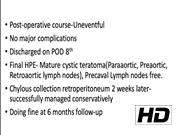
The postoperative course of the patient was uneventful. Abdominal drains were removed on postoperative day (POD)-7 and the patient was discharged on POD-8. Final histopathology showed a mature cystic teratoma and the patient was doing well without recurrent disease at 6 months follow-up. Ten patients have undergone an RA-RPLND at our center. Four patients were postchemotherapy and six had a primary RPLND. Three cases were bilateral and seven cases were unilateral template RPLND. Mean operative time was 222 ± 30 minutes, mean estimated blood loss was 220 ± 99 mL, mean lymph node yield was 16, and the mean hospital stay was 6.9 days. No patient was converted to open exploration. On final histopathology, four patients had reactive lymph nodes, four patients had mixed nonseminomatous germ cell tumors, one patient had a teratoma, and one patient had a yolk sac tumor. No patient had more than a grade 2 Clavien–Dindo complication or recurrence at a median follow-up of 375 days. One patient had retrograde ejaculation during the postoperative period.
Conclusion:
For testicular germ cell neoplasms, >50% of patients have residual malignant retroperitoneal nodal disease even after chemotherapy. RPLND is a vital component for management of germ cell neoplasms. Robotic assistance with an RA-RPLND provides magnified vision, better maneuverability, and ergonomic comfort. Based on our experience, RA-RPLND is a promising alternative as reported in this video. Future studies with large sample sizes and long-term outcomes are needed.
No competing financial interests exist
.
Runtime of video: 9 mins 31 secs


Get full access to this article
View all access options for this article.
References
Supplementary Material
Please find the following supplemental material available below.
For Open Access articles published under a Creative Commons License, all supplemental material carries the same license as the article it is associated with.
For non-Open Access articles published, all supplemental material carries a non-exclusive license, and permission requests for re-use of supplemental material or any part of supplemental material shall be sent directly to the copyright owner as specified in the copyright notice associated with the article.
