





Abstract
Introduction:
The Malone antegrade continence enema (MACE) procedure can help patients with chronic constipation and/or fecal incontinence attain fecal continence. The operation typically involves the creation of an appendicostomy at the umbilicus, which allows for cannulation to washout the colon. A variation is required when a patient has had a previous appendectomy. Chatoorgoon et al. 1 have described the creation of a neoappendicostomy for this purpose. Although this has been performed through laparotomy, to our knowledge, the laparoscopic method has not been published previously.
Case Presentation:
A 5-year-old boy was born with an imperforate anus and rectourethral fistula. He initially underwent colostomy with mucous fistula. Later, he underwent laparoscopic ligation of the rectourethral fistula and was found to have intestinal malrotation, so a Ladd's procedure was performed. Concomitantly, he underwent colostomy closure and anorectoplasty. Owing to refractory constipation and encopresis, a MACE procedure was desired. Since he no longer had an appendix, a neoappendicostomy was performed, and a laparoscopic approach was undertaken.
Operative Technique:
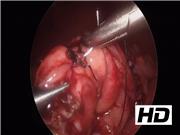
Three 5 mm laparoscopic trocars are placed in the umbilicus, left mid abdomen, and right mid abdomen. A full thickness cecal flap is created starting on the antimesenteric taenia and extending toward the mesentery. The flap is temporarily suspended using a Prolene suture brought through the abdominal wall. An entire 8F foley catheter is passed through the umbilical defect and advanced into the ascending colon. The cecum is then closed in a transverse manner. The flap is then sutured around the catheter to create the neoappendix. A valve is created by plicating the cecum over the neoappendix. Careful attention is made not to appose the suture lines. The hub of the 8F foley catheter is brought out through the umbilical fascial defect, and the balloon is inflated in the ascending colon under direct vision. Finally, the end of the neoappendix is sutured to the umbilical skin as a V-V plasty.
Results:
We present the first known publication and video demonstration of a laparoscopic neoappendicostomy. The operative time was 4 hours (including a 1.5-hour lysis of adhesions). The patient was discharged home on postoperative day 2. After 2 years of postoperative follow-up, he remains free from abdominal pain and no longer has stool incontinence.
Conclusion:
Laparoscopic neoappendicostomy is an effective and novel method for performing an MACE procedure in patients with history of appendectomy.
No competing financial interests exist.
Runtime of video: 4 mins


Get full access to this article
View all access options for this article.