





Abstract
Introduction:
Inguinal hernia repair is a common operation in pediatric surgery. As many as 1%–5% of all children undergo inguinal hernia repair. Of these, 25%–33% occur in girls, and 4%–20% of female hernias are sliding hernias that contain ovary. 1,2 Of all sliding hernias, ∼5% are irreducible, and of these irreducible hernias, 25%–40% become torsed. 1 –3 The traditional treatment for incarcerated hernias with torsion is inguinal hernia repair and oophorectomy. 1 –4 Furthermore, most ovaries and fallopian tubes are described as being too swollen to reduce laparoscopically, and, therefore, some sort of open repair is needed to close the hernia. This is the first case report of complete laparoscopic reduction and repair of an incarcerated inguinal hernia involving a torsed ovary. Furthermore, this is the first report of ovarian salvage of a torsed ovary that was contained in an incarcerated hernia of a young infant.
Materials and Methods:
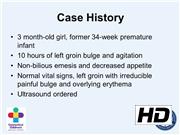
The patient is a 3-month-old, 5 kg girl who was a former 34-week premature infant. She had presented to the emergency department after 10 hours of agitation associated with a left groin bulge. The patient's physical examination was notable for irreducible swelling of the left groin with overlying erythema. Ultrasonography revealed an enlarged left ovary herniated through the canal of Nuck. There was absence of spectral Doppler flow in the left ovary. The volume of the left ovary was more than twice that of the right ovary. The patient was then taken to the operating room emergently for laparoscopic hernia reduction and repair. A 5 mm 30° laparoscope identified hemorrhagic fluid in the pelvis. The hernia contained the left fallopian tube and ovary. A combination of laparoscopic manipulation with a 3 mm grasper and external pressure was effective at reducing the hernia. The left ovary and fallopian tube were large, ischemic, and purple. The ovary was detorsed counter clockwise and left in place. The laparoscopic approach of choice to repair the hernia was the transcutaneous laparoscopic repair. 5
Results and Conclusions:
The patient did well postoperatively, and was discharged home the next day. Doppler ultrasonography was not obtained before discharge because it was assumed that the vascular supply to the ovary would still be in spasm. However, the patient returned to the hospital at 3 months postoperatively with a Doppler ultrasonography. On examination, the patient's hernia repair was intact. The ultrasonogram showed a viable, although slightly smaller, left ovary with normal flow and follicles. At 1 year follow-up, the hernia repair still remains intact. Laparoscopic repair of an incarcerated inguinal hernia containing a torsed ovary in a young infant is possible. Furthermore, detorsion with ovarian salvage may result in viable and potentially functional ovarian tissue postoperation, 6 –8 and this approach is an appealing option to be considered for treatment of future similar cases.
No competing financial interests exist.
Runtime of video: 4 mins 48 secs


Keywords
Get full access to this article
View all access options for this article.