





Abstract
Introduction:
The use of minimal invasive surgery (MIS) simulation models has been included into our residency program curricula and hands-on courses since 2013. We have previously presented our low-cost tracheoesophageal fistula esophageal atresia simulation model for training in IPEG 2013. The Society of American Gastrointestinal and Endoscopic Surgeons describes telementoring as a relationship, facilitated by telecommunication technology, in which an expert provides guidance to a less experienced learner from a remote location. MIS procedures are an ideal platform for real-time transmission and thus apply telementoring for surgery. We started a project to look at the efficacy of telementoring starting with simulation.
Aim:
The aim of this 5 minute video is to present a low-cost simulation model for training MIS repair of duodenal atresia (DA) and our first steps with combining telementoring technology.
Material and Methods:
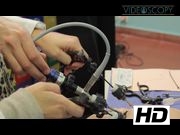
The base model was introduced into the abdominal cavity of a rubber doll that resembles a 3 kg newborn. We use silicone finger covers and tubular latex balloons (as proximal and distal duodenum and bowel). The cost of materials was less than $50US. Video endoscopic equipment and 3 mm instruments were used. We reproduced all steps of the procedure: dissection of the proximal pouch, finding the distal duodenum below the transverse mesocolon, opening of both blind duodenal ends and performance of a duodenoduodenal anastomosis. We use a validation sheet to evaluate the performance: number of errors and type of injuries, quality of the anastomosis, and time of practice. A video camera was connected with a videoconference equipment through Internet under 1 MB for telementoring. Two pediatric surgery fellows were mentored by three faculties with focus in both the use of the lens and performance of the correct steps to repair a DA. Both of them had previously attended a basic and advanced MIS hands-on programs in our institution and developed skills for advanced suturing and working in small spaces. Mentors and mentees had a human and academic previous relationship. The development checklist sheet was filled after consensus.
Results:
The procedure was completed without injuries in 75 minutes. Interaction was effective without need to assist them in person.
Discussion:
Telementoring MIS simulation could assist in the provision of teaching advanced skills worldwide.
No competing financial interests exist.
Runtime of video: 5 mins
This video was presented at 25th IPEG annual meeting, May 24–28 2016, Fukuoka Japan.


Get full access to this article
View all access options for this article.
Supplementary Material
Please find the following supplemental material available below.
For Open Access articles published under a Creative Commons License, all supplemental material carries the same license as the article it is associated with.
For non-Open Access articles published, all supplemental material carries a non-exclusive license, and permission requests for re-use of supplemental material or any part of supplemental material shall be sent directly to the copyright owner as specified in the copyright notice associated with the article.
