





Abstract
Introduction:
Enteral nutrition is preferred over parenteral route as it avoids septic complications associated with central venous catheter, is cost effective, and provides immunologic benefits. Percutaneous endoscopic gastrostomy is the preferred method of enteral access in most circumstances. 1 However, jejunal feeds may be required for patients with gastroparesis and those at risk for aspiration. Standard techniques of laparoscopic feeding jejunostomy (FJ) require special instruments and expensive kits. 2 –12 A modified technique of laparoscopic FJ using an inexpensive T-tube and standard laparoscopic instruments is described.
Methods:
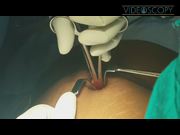
Four ports (two 10 mm and two 5 mm) are used for the procedure. A Kehr's 16F T-tube is modified by shortening the limbs. In addition, half, the diameter of the T-tube limb is excised. An enterotomy is made in the jejunum ∼20 cm from the duodenojejunal flexure with a monopolar diathermy hook. The left anterior axillary port is removed and an artery forceps grasping the T-tube is inserted through the abdominal wall. Once the jejunal lumen is entered, the artery forceps is gently rotated to guide the T-tube into the jejunum. The T-tube is then held with a laparoscopic grasper, and the artery forceps is removed. Two full thickness sutures are placed at the exit site of the jejunum using nonabsorbable sutures to secure the T-tube into the jejunal lumen and then two seromuscular sutures are used to secure the jejunum to the abdominal wall. A leak test is performed by infusing saline through the T-tube. The T-tube is then fixed to the skin and port sites are closed. Jejunostomy feeds are started on the first postoperative day.
Results:
From July 2014 to December 2014, 14 patients including 10 females (72%) with a median (range) age of 49.5 (20–68) years underwent laparoscopic FJ using the T-tube. The most common indication for laparoscopic FJ was dysphagia secondary to hypopharyngeal and esophageal tumors (11/14, 78.6%). In the remaining three patients, laparoscopic FJ was combined with a laparoscopic retrosternal gastric pull up for corrosive esophageal stricture (n = 2) and laparoscopic pancreatoduodenectomy for a periampullary cancer (n = 1). In six patients with esophageal cancer undergoing neoadjuvant chemoradiotherapy, a staging laparoscopy was performed in addition to the laparoscopic FJ. The median (range) duration of surgery was 66 (40–95) minutes. There were no intraoperative complications. In all patients, enteral feeding was started on the first postoperative day. Postoperative complications included a minor enteric leak from the tube entry site and a wound infection. In the patient with the minor enteric leak, the contrast study did not show any evidence of intraperitoneal contrast extravasation and the enteral feeds were restarted on postoperative day 7. There was no dislodgement of the feeding tube during the postoperative period. None of the patients had an enteric leak after removal of the feeding tube.
Conclusions:
This study demonstrates the feasibility of a laparoscopic FJ using a T-tube. The present technique of laparoscopic FJ is simple to perform, does not require specialized laparoscopic instruments, and is a cost-effective alternative to conventional laparoscopic feeding tube placement.
No competing financial interests exist.
Runtime of video: 5 mins 15 secs


Get full access to this article
View all access options for this article.
References
Supplementary Material
Please find the following supplemental material available below.
For Open Access articles published under a Creative Commons License, all supplemental material carries the same license as the article it is associated with.
For non-Open Access articles published, all supplemental material carries a non-exclusive license, and permission requests for re-use of supplemental material or any part of supplemental material shall be sent directly to the copyright owner as specified in the copyright notice associated with the article.
